
Chapter 7 Making Sense of Statistical Significance Decision
- Slides: 10
Chapter 7 Making Sense of Statistical Significance Decision Errors, Effect Size, and Statistical Power Aron, & Coups, Statistics for the Behavioral and Social Sciences: A Brief Course (3 e), © 2005 Prentice Hall
Decision Errors • When the right procedure leads to the wrong conclusion • Type I Error – Reject the null hypothesis when it is true – Conclude that a manipulation had an effect when in fact it did not • Type II Error – Fail to reject the null when it is false – Conclude that a manipulation did not have an effect when in fact it did Aron, & Coups, Statistics for the Behavioral and Social Sciences: A Brief Course (3 e), © 2005 Prentice Hall
Decision Errors • Setting a strict significance level (e. g. , p <. 001) – Decreases the possibility of committing a Type I error – Increases the possibility of committing a Type II error • Setting a lenient significance level (e. g. , p <. 10) – Increases the possibility of committing a Type I error – Decreases the possibility of committing a Type II error Aron, & Coups, Statistics for the Behavioral and Social Sciences: A Brief Course (3 e), © 2005 Prentice Hall
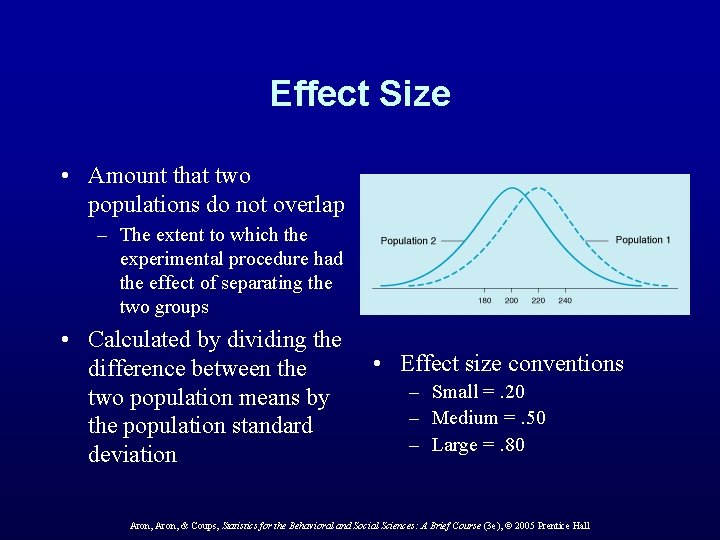
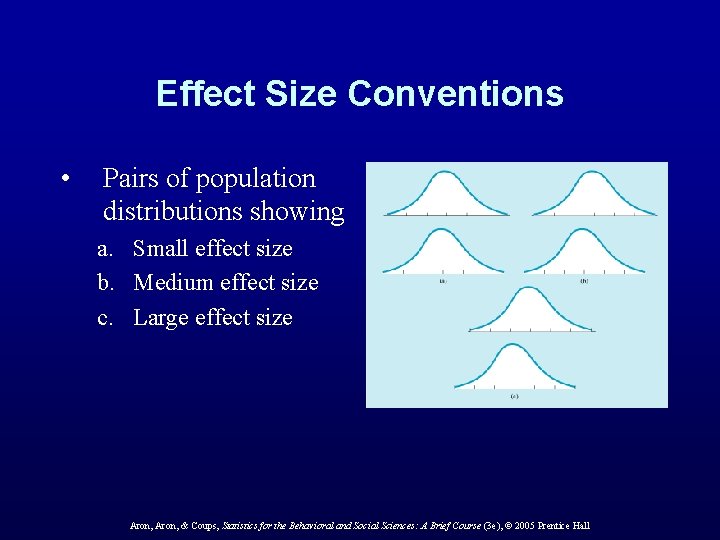
Effect Size • Amount that two populations do not overlap – The extent to which the experimental procedure had the effect of separating the two groups • Calculated by dividing the difference between the two population means by the population standard deviation • Effect size conventions – Small =. 20 – Medium =. 50 – Large =. 80 Aron, & Coups, Statistics for the Behavioral and Social Sciences: A Brief Course (3 e), © 2005 Prentice Hall
Effect Size Conventions • Pairs of population distributions showing a. Small effect size b. Medium effect size c. Large effect size Aron, & Coups, Statistics for the Behavioral and Social Sciences: A Brief Course (3 e), © 2005 Prentice Hall
Effect Size • Dividing by the standard deviation standardizes the difference between the means – Allows effects to be compared across studies – Important tool for meta-analysis • Different from statistical significance, which refers to whether an effect is “real” and not due to chance Aron, & Coups, Statistics for the Behavioral and Social Sciences: A Brief Course (3 e), © 2005 Prentice Hall
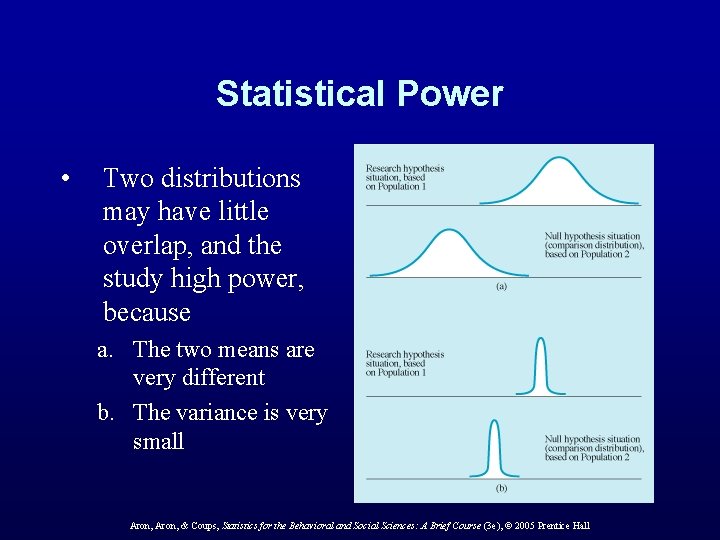
Statistical Power • Probability that a study will produce a statistically significant result if the research hypothesis is true • Can be determined from power tables • Depends primarily on effect size and sample size – More power if… • Bigger difference between means • Smaller population standard deviation • More people in the study • Also affected by significance level, one- vs. twotailed tests, and type of hypothesis-testing procedure used Aron, & Coups, Statistics for the Behavioral and Social Sciences: A Brief Course (3 e), © 2005 Prentice Hall
Statistical Power • Two distributions may have little overlap, and the study high power, because a. The two means are very different b. The variance is very small Aron, & Coups, Statistics for the Behavioral and Social Sciences: A Brief Course (3 e), © 2005 Prentice Hall
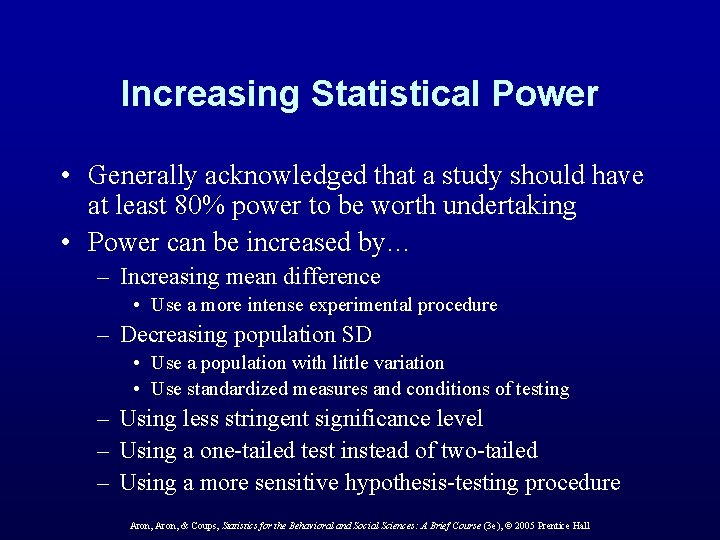
Increasing Statistical Power • Generally acknowledged that a study should have at least 80% power to be worth undertaking • Power can be increased by… – Increasing mean difference • Use a more intense experimental procedure – Decreasing population SD • Use a population with little variation • Use standardized measures and conditions of testing – Using less stringent significance level – Using a one-tailed test instead of two-tailed – Using a more sensitive hypothesis-testing procedure Aron, & Coups, Statistics for the Behavioral and Social Sciences: A Brief Course (3 e), © 2005 Prentice Hall
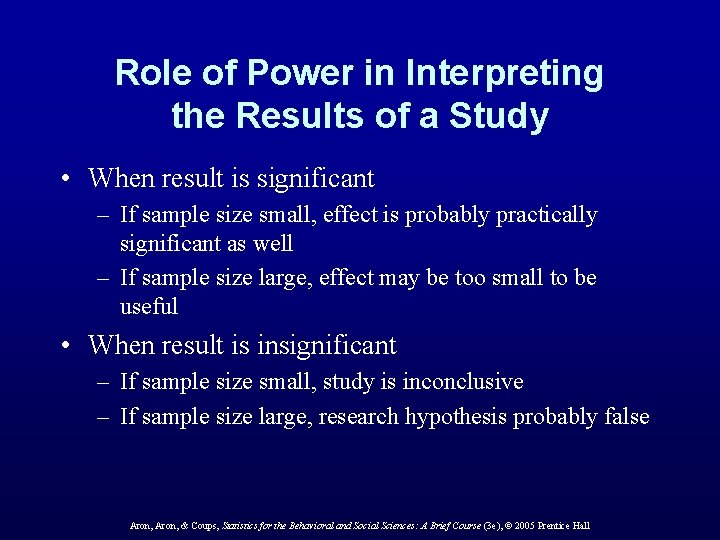
Role of Power in Interpreting the Results of a Study • When result is significant – If sample size small, effect is probably practically significant as well – If sample size large, effect may be too small to be useful • When result is insignificant – If sample size small, study is inconclusive – If sample size large, research hypothesis probably false Aron, & Coups, Statistics for the Behavioral and Social Sciences: A Brief Course (3 e), © 2005 Prentice Hall