
Chapter 7 Making Math Meaningful By The Math
Chapter 7: Making Math Meaningful By: The Math Department
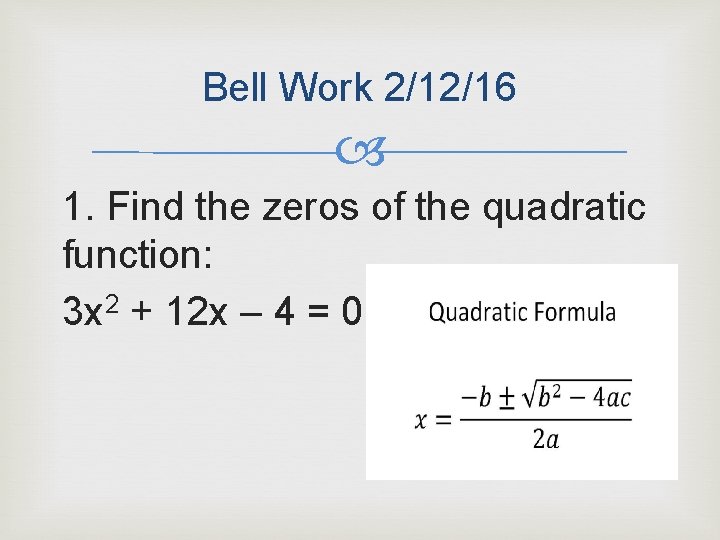
Bell Work 2/12/16 1. Find the zeros of the quadratic function: 3 x 2 + 12 x – 4 = 0
Who Needs Math? “Working world seldom requires Algebra” -Arnold Packer found that only 4 % of population—pure mathematicians, astronomers, physicists, and tiny subset of engineers—uses advanced algebraic concepts in their work. 80% of highest-paying, most prestigious careers will never use anything beyond addition, subtraction, multiplication, and division. “ p. 199. Less than 5% of workforce will make extensive use of Algebra II or other advanced courses. P 199 Math more of a rite of passage than a career preparation. He asks if we need higher level Mathematics courses in schools or do we need to shift to practical applied Mathematics?
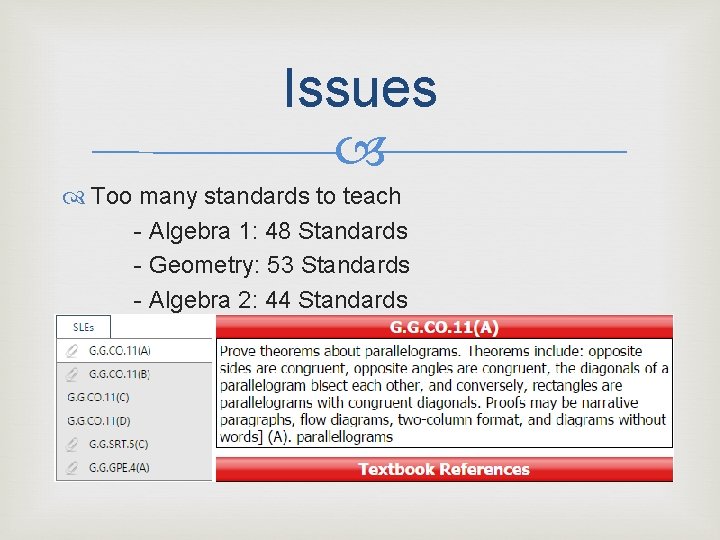
Issues Too many standards to teach - Algebra 1: 48 Standards - Geometry: 53 Standards - Algebra 2: 44 Standards
Abstraction is the Enemy Math has the lowest pass rates in proficiency tests for all ethnic groups Too much of a focus on abstract problems -“As the level of abstraction increases…. links to meaning fade. ” pg. 197 Working world seldom requires algebra. “In the real-world, students actually need less abstract, advanced math: they need more elementary and middle school math” pg. 199 - The real-world requires sophisticated thinking with elementary skills (arithmetic, percentages, ratios, discounts or markup prices)
What to do now? Cross curricular: Infuse math curriculum with literacy and writing Teach students how to interpret numbers in a text in both math textbooks and real-world documents Model and teach students how to read documents Technical reading Use effective teaching strategies K-12 Make sure every lesson is an effective lesson. P. 215
Reading in Math “The meaning in math text often pivots on the use of a single word” pg. 209 Create and integrate opportunities for students to understand apply essential math concepts Need to understand quantitative data in current articles Need to have slow, carful, reiterative reading in all content areas, including math. Need reading, and writing in math, as well as, well developed open-response critical math thinking questions.

Example
Writing in Math “Writing in math class requires students to organize, clarify, and reflect on their ideas” pg. 212 Students need “to be able to write to explain the meaning of data, tables, graphs, and formulas. ” pg. 212 Simple writing strategy: 1. I think that the answer is…. . 2. I think that because…. . 3. I figured this out by…. . We need to logically look at what we teach and why we teach it?
Lynn Steen (2007, p. 12) in Schmoker p. 197 “It is not yet clear whether the best option for all is the historic algebra-based mainstream that is animated primarily by the power of ‘abstraction… “Teachers need to focus on the interplay of numbers and words, especially on expressing quantitative relationships in meaningful sentences … “ “To make mathematics meaningful, the three R’s must be well blended in each student's mind. ’”
KEY TAKE-A-WAYS FROM THE CHAPTER -Math content needs to be coherent, taught with good instructional strategy, and infused with literacy. P. 194 -Need to reduce number of standards, emphasize mathematical thinking, teach fewer topics, teach topics that have visible connections to meaning and applications, p. 196 -Schools should abandon a “a failed curriculum that insists on advanced coursework but ‘relegates applications to an afterthought” (1997, pp. 138 -139) p. 198 Make sure every lesson is an effective lesson. P. 215 Need reading, and writing in math, as well as, well developed open-response critical math thinking questions.
- Slides: 11