
Chapter 7 LONG TERM ASSETS PART A ACQUISITION






- Slides: 35
Chapter 7 LONG TERM ASSETS
PART A ACQUISITION & IMPROVEMENTS
PROPERTY, PLANT, EQUIPMENT (PPE) �Land Improvement �Building �Equipment
LAND �Use in Business – not for investment �Purchase Price (Historical Cost) �+ Closing Costs and any fees �+ Commissions
LAND IMPROVEMENTS �Parking Lots �Paving, �Flowers (permanent), �Fences, �Lighting �Will be depreciated
BUILDINGS Administrative offices Retail stores Storage Warehouses Manufacturing Facilities Cost includes the purchase price, commissions, legal fees, anything that is required to get the building ready for use If new construction: include interest on loan while building. Once revenue is produced—interest will be an expense
EQUIPMENT �Machinery �Computers & office equipment �Vehicles �Furniture and fixtures �Cost is the purchase price, transportation, tax, testing, installation, legal fees—any costs to prepare the asset to use
NATURAL RESOURCES �Can be physically used up or depleted �Oil �Natural �Timber �Coal Gas
INTANGIBLE ASSETS �Intangible –can’t be felt �Patents, �Copyrights, �Trademarks, �Franchise �Goodwill Rights
Definitions �Patent – exclusive rights to manufacture a product or process 20 yrs add legal fees �Copyrights-- protection of published work 70 yrs �Trademark – word, slogan or symbol 10 yrs �Franchises – pay to use name and sell its products. Cost is initial fee—rest is expensed �Goodwill – Value of a company over the value of its assets
CLICKERS �A. PPE �B. Intangible �C. Natural Resource � 1. Water � 2. Mac’s Golden Arches � 3. Sprinkler System � 4. Store � 5. Testing Machine � 6. Timber � 7. Rights to a story � 8. Use of Process � 9. Word or Slogan � 10. Rights to sell a product
Purchase vs creating Intangibles �Purchase – can tell the value of the asset �Create – can’t tell the value �Purchase – like PPE – cost of getting ready to use �Create – R&D – must expense—can’t determine future benefit
CAPITALIZE vs EXPENSE �CAPITALIZE – record as an asset - depreciate �EXPENSES – record on income statement �We capitalize an expenditure as an asset if it increases future benefits, whereas we expense an expenditure if it benefits only the current period.
Costing an Asset Examples �Land BE 7 -1 pg 332 �Equipment BE 7 -2 pg 332 �Goodwill BE 7 -3 pg 332
Expenditures after Acquisition �Repairs and Maintenance (Minor) – expense �Repairs and Maintenance (Major) capitalize �Addition – major addition –capitalize �Improvements -- Capitalize �Legal Defense of Intangible Asset
Examples of After Acquisiting �BE 7 -5 pg 332
PART B COST ALLOCATION
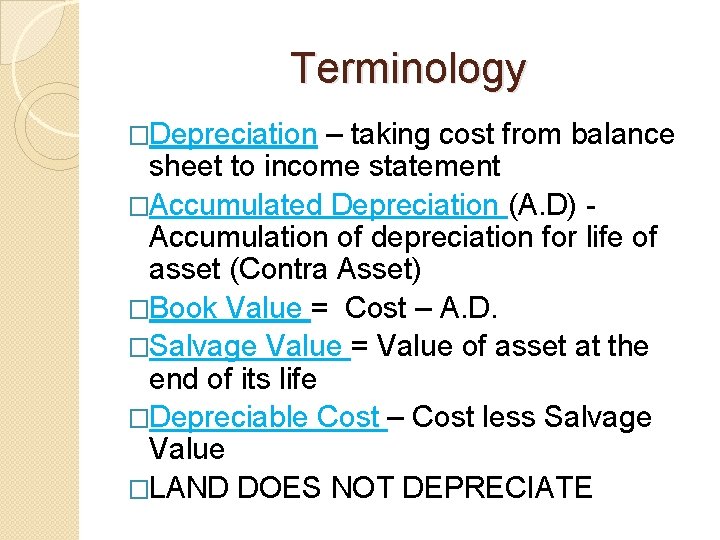
Terminology �Depreciation – taking cost from balance sheet to income statement �Accumulated Depreciation (A. D) Accumulation of depreciation for life of asset (Contra Asset) �Book Value = Cost – A. D. �Salvage Value = Value of asset at the end of its life �Depreciable Cost – Cost less Salvage Value �LAND DOES NOT DEPRECIATE
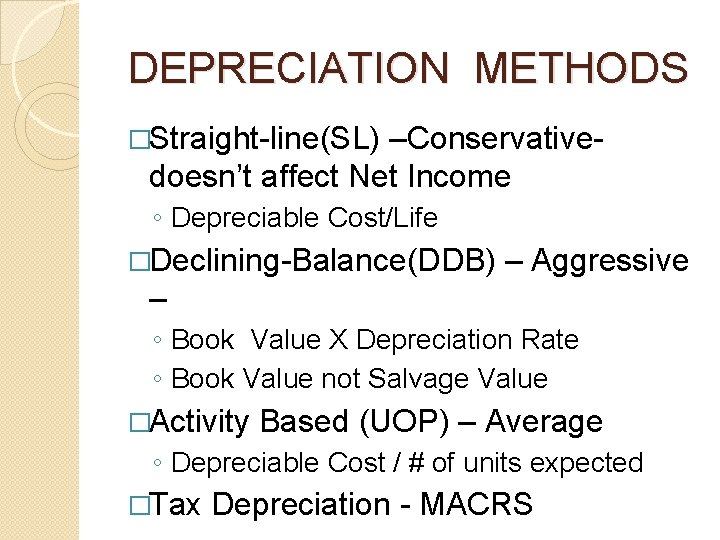
DEPRECIATION METHODS �Straight-line(SL) –Conservativedoesn’t affect Net Income ◦ Depreciable Cost/Life �Declining-Balance(DDB) – Aggressive – ◦ Book Value X Depreciation Rate ◦ Book Value not Salvage Value �Activity Based (UOP) – Average ◦ Depreciable Cost / # of units expected �Tax Depreciation - MACRS
Examples: BE 7 -8 pg 332
Journal Entry �Depreciation Expense � Accumulated Depreciation
DEPRECIATION SCHEDULE �Straight Line pg 313 �Declining Balance pg 314 �Activity Based pg 316 �Comparison pf 316
AMORTIZATION �Intangible Assets with a definite life �Depreciable Cost/ Life Like SL �Unlimited life do not amortize –like LAND �Amortization Expense � Patent or Franchise
Amortization Expense Example �BE 7 -9 pg 333
PART C ASSET DISPOSITION
Asset Deposition �Sale �Retirement �Exchange
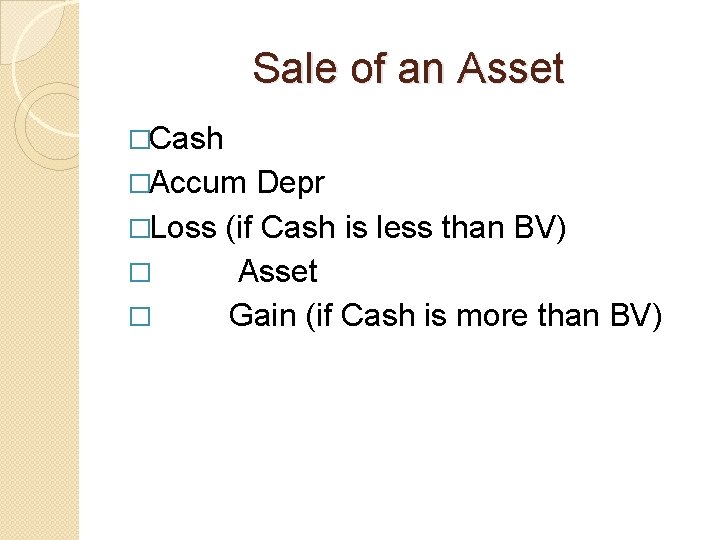
Sale of an Asset �Cash �Accum Depr �Loss (if Cash is less than BV) � Asset � Gain (if Cash is more than BV)
Example of Sale of Asset �BE 7 -10 pg 333
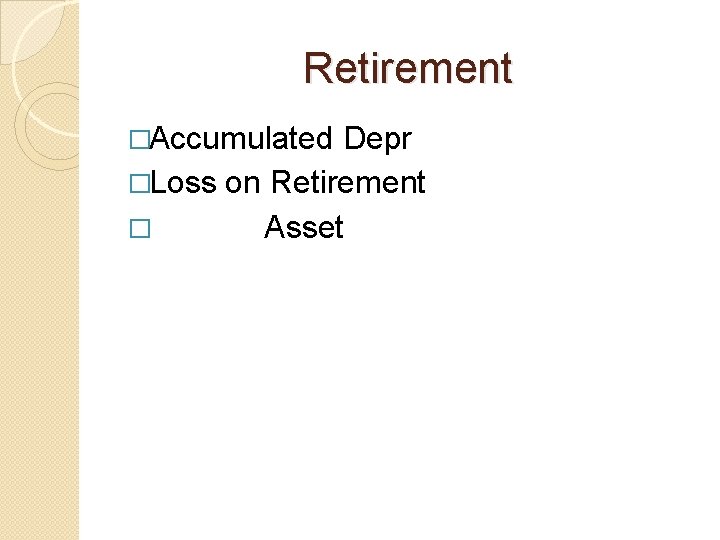
Retirement �Accumulated Depr �Loss on Retirement � Asset
Exchange(Trade-In) �New Asset �Accum Depr (old) � Cash or A/P � Old Asset � Gain (if more than BV)
Both Sides of Exchange �Buyer BE 7 -11 pg 333 �Seller BE 7 -12 pg 333
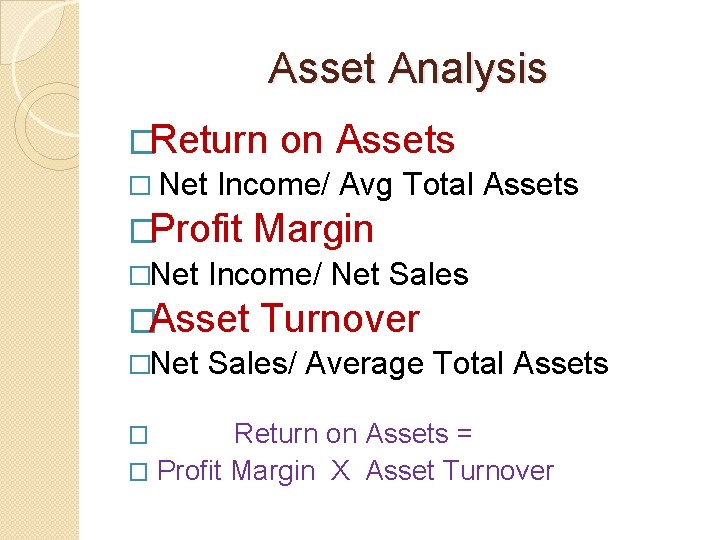
Asset Analysis �Return on Assets � Net Income/ Avg Total Assets �Profit Margin �Net Income/ Net Sales �Asset Turnover �Net Sales/ Average Total Assets Return on Assets = � Profit Margin X Asset Turnover �
Asset Analysis �BE 7 -13 pg 333
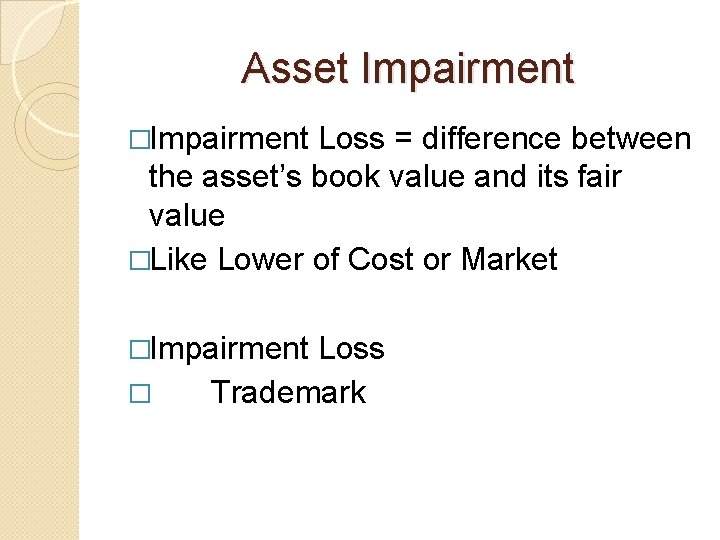
Asset Impairment �Impairment Loss = difference between the asset’s book value and its fair value �Like Lower of Cost or Market �Impairment � Loss Trademark
Asset Impairment �BE 7 -14 and 7 -15 pg 333