
Chapter 7 Leverage and Capital Structure INTRODUCTION Leverage

- Slides: 36
Chapter 7 Leverage and Capital Structure
INTRODUCTION • Leverage, as a business term, refers to debt or to the borrowing of funds to finance the purchase of a company's assets. Business owners can use either debt or equity to finance or buy the company's assets. • Using debt, or leverage, increases the company's risk of bankruptcy. • It also increases the company's returns. Copyright © 2006 Pearson Addison-Wesley. All rights reserved. 11 -2
Leverage • Leverage results from the use of fixed-cost assets or funds to magnify returns to the firm’s owners. • Generally, increases in leverage result in increases in risk and return, whereas decreases in leverage result in decreases in risk and return. • The amount of leverage in the firm’s capital structure— the mix of debt and equity—can significantly affect its value by affecting risk and return. Copyright © 2006 Pearson Addison-Wesley. All rights reserved. 11 -3
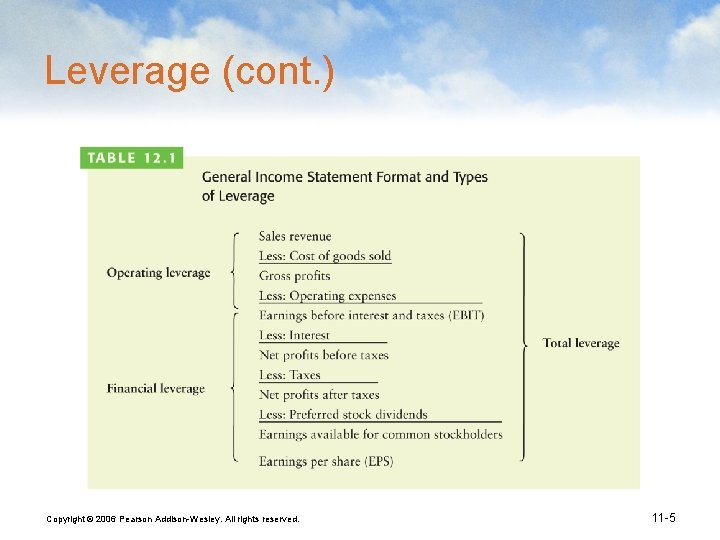
Leverage • Operating Leverage is concerned with the relationship between firm’s sales revenue and its Earnings before interest and taxes (EBIT) • Financial Leverage is concerned with the relationship between the firm’s EBIT and its common stock Earnings per share (EPS) • Total Leverage is concerned with the relationship between the firm’s sales revenues and EPS Copyright © 2006 Pearson Addison-Wesley. All rights reserved. 11 -4
Leverage (cont. ) Copyright © 2006 Pearson Addison-Wesley. All rights reserved. 11 -5
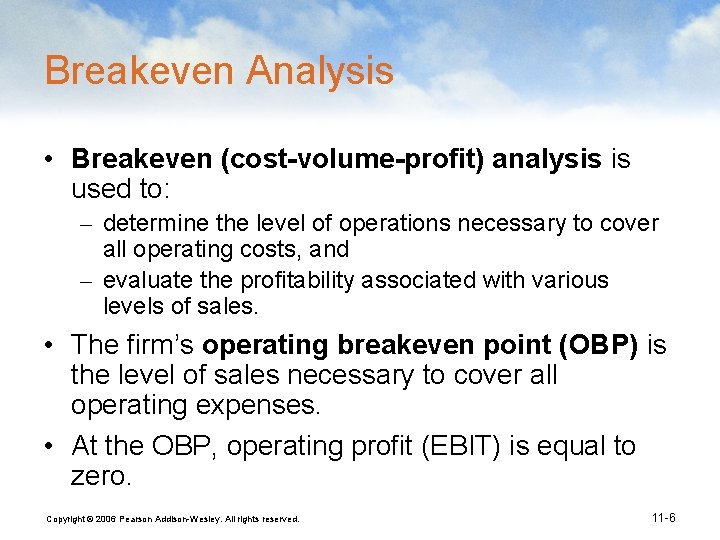
Breakeven Analysis • Breakeven (cost-volume-profit) analysis is used to: – determine the level of operations necessary to cover all operating costs, and – evaluate the profitability associated with various levels of sales. • The firm’s operating breakeven point (OBP) is the level of sales necessary to cover all operating expenses. • At the OBP, operating profit (EBIT) is equal to zero. Copyright © 2006 Pearson Addison-Wesley. All rights reserved. 11 -6
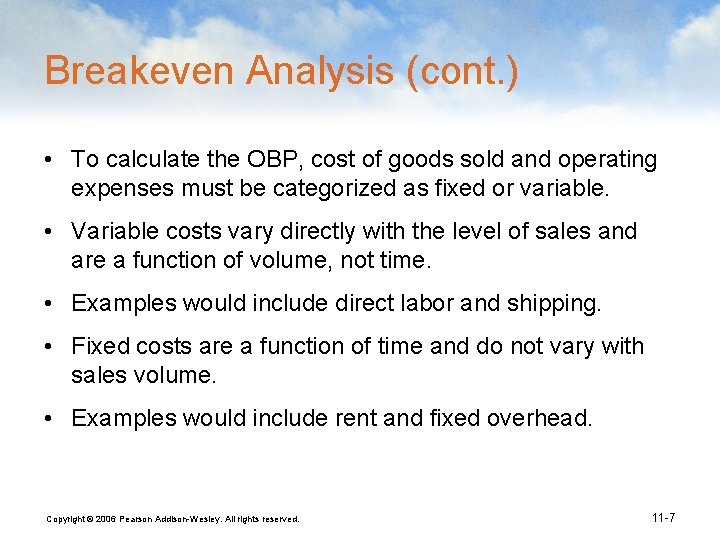
Breakeven Analysis (cont. ) • To calculate the OBP, cost of goods sold and operating expenses must be categorized as fixed or variable. • Variable costs vary directly with the level of sales and are a function of volume, not time. • Examples would include direct labor and shipping. • Fixed costs are a function of time and do not vary with sales volume. • Examples would include rent and fixed overhead. Copyright © 2006 Pearson Addison-Wesley. All rights reserved. 11 -7
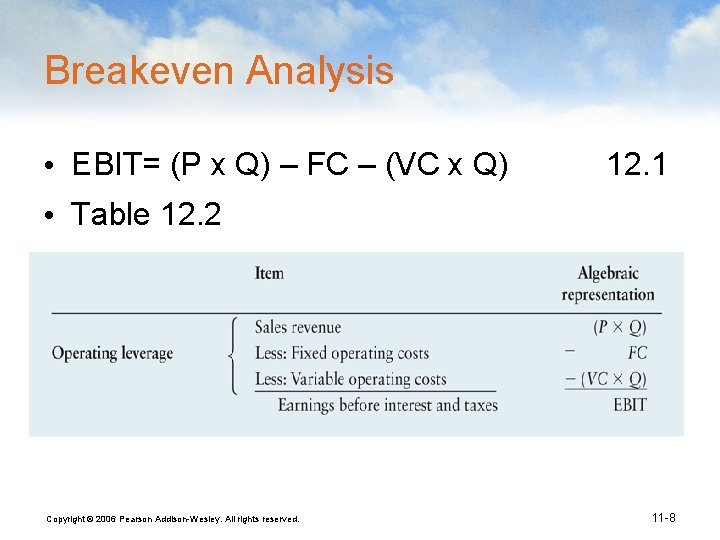
Breakeven Analysis • EBIT= (P x Q) – FC – (VC x Q) 12. 1 • Table 12. 2 Copyright © 2006 Pearson Addison-Wesley. All rights reserved. 11 -8
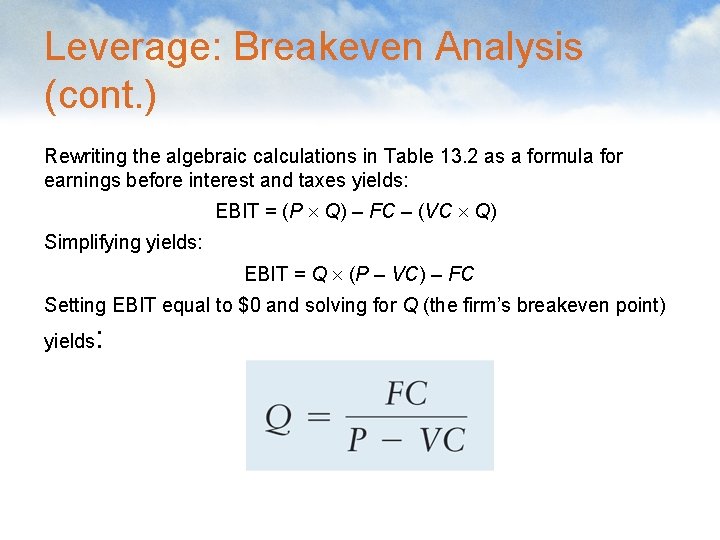
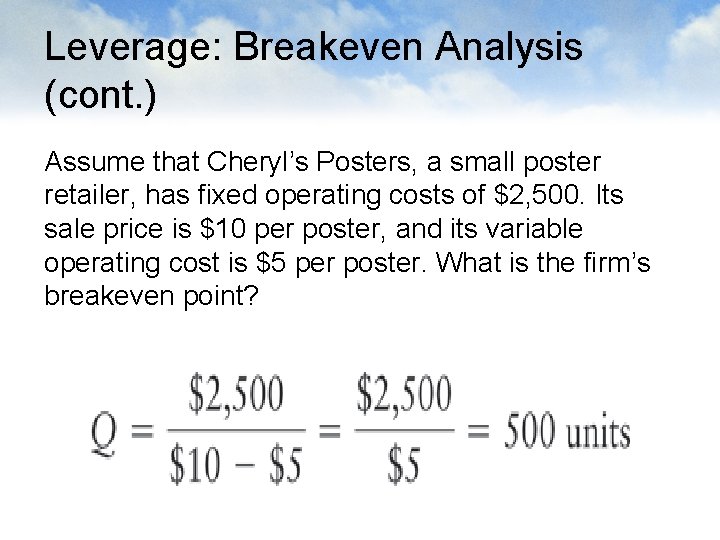
Leverage: Breakeven Analysis (cont. ) Rewriting the algebraic calculations in Table 13. 2 as a formula for earnings before interest and taxes yields: EBIT = (P Q) – FC – (VC Q) Simplifying yields: EBIT = Q (P – VC) – FC Setting EBIT equal to $0 and solving for Q (the firm’s breakeven point) yields :
Leverage: Breakeven Analysis (cont. ) Assume that Cheryl’s Posters, a small poster retailer, has fixed operating costs of $2, 500. Its sale price is $10 per poster, and its variable operating cost is $5 per poster. What is the firm’s breakeven point?
OPERATING LEVERAGE Operating leverage can be defined as the potential use of fixed operating costs to magnify the effects of changes in sales on the firm’s earnings before interest and taxes. Copyright © 2006 Pearson Addison-Wesley. All rights reserved. 11 -11
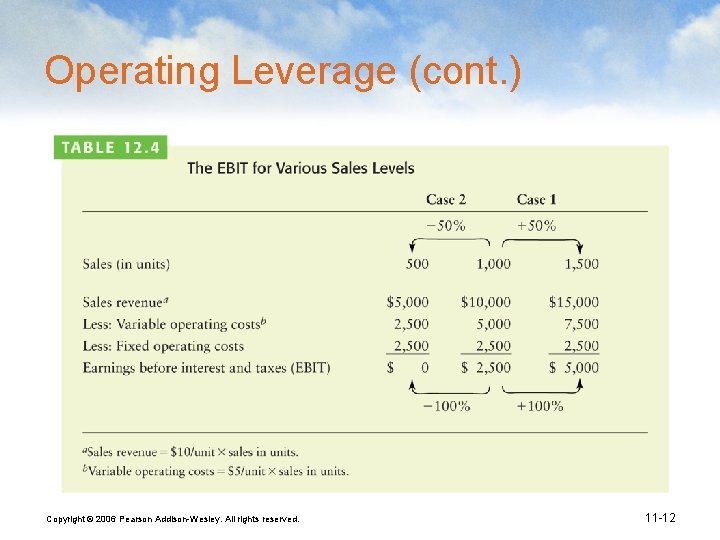
Operating Leverage (cont. ) Copyright © 2006 Pearson Addison-Wesley. All rights reserved. 11 -12
Operating Leverage: Measuring the Degree of Operating Leverage • Degree of Operating Leverage (DOL) is the numerical measure of the firm’s operating leverage • The degree of operating leverage (DOL) measures the sensitivity of changes in EBIT to changes in Sales. • Only companies that use fixed costs in the production process will experience operating leverage. Copyright © 2006 Pearson Addison-Wesley. All rights reserved. 11 -13
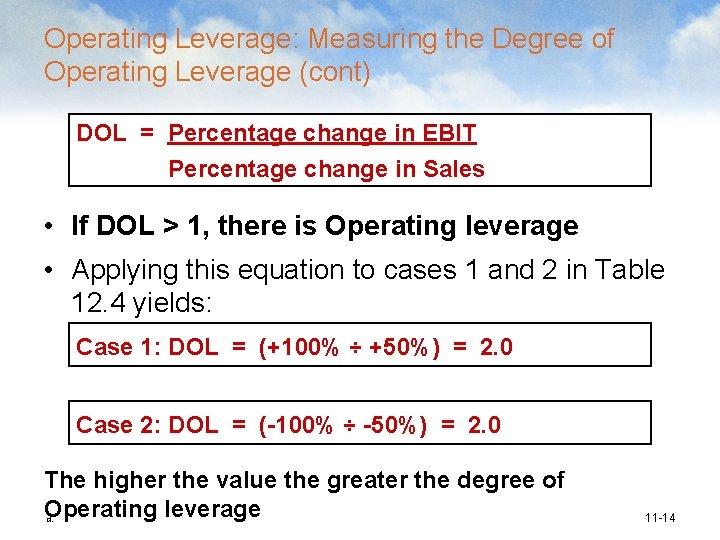
Operating Leverage: Measuring the Degree of Operating Leverage (cont) DOL = Percentage change in EBIT Percentage change in Sales • If DOL > 1, there is Operating leverage • Applying this equation to cases 1 and 2 in Table 12. 4 yields: Case 1: DOL = (+100% ÷ +50%) = 2. 0 Case 2: DOL = (-100% ÷ -50%) = 2. 0 The higher the value the greater the degree of Operating leverage d. 11 -14
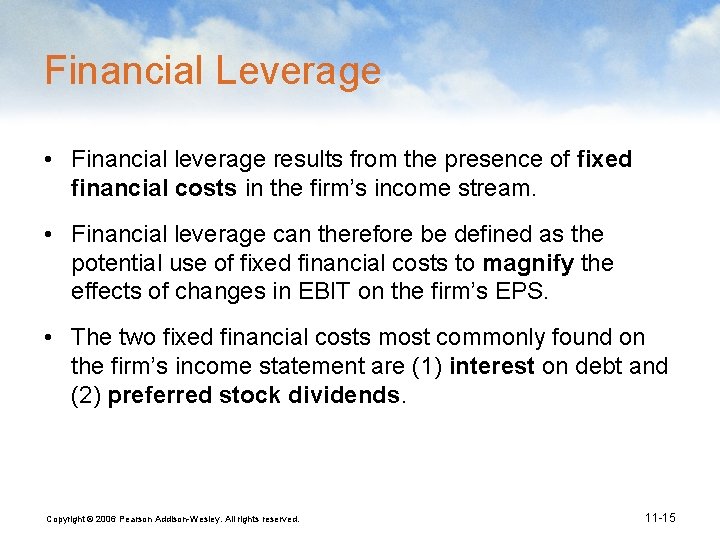
Financial Leverage • Financial leverage results from the presence of fixed financial costs in the firm’s income stream. • Financial leverage can therefore be defined as the potential use of fixed financial costs to magnify the effects of changes in EBIT on the firm’s EPS. • The two fixed financial costs most commonly found on the firm’s income statement are (1) interest on debt and (2) preferred stock dividends. Copyright © 2006 Pearson Addison-Wesley. All rights reserved. 11 -15
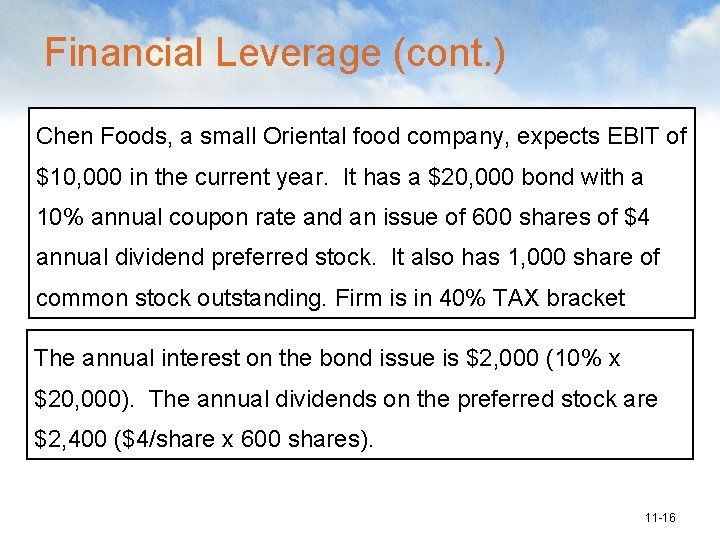
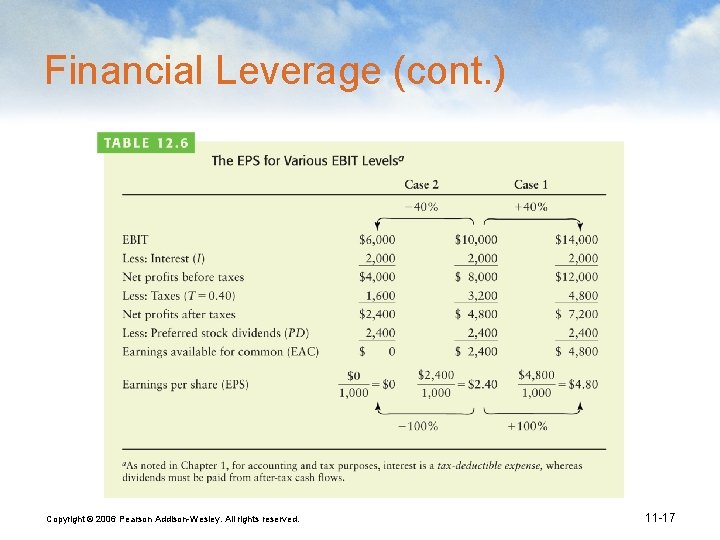
Financial Leverage (cont. ) Chen Foods, a small Oriental food company, expects EBIT of $10, 000 in the current year. It has a $20, 000 bond with a 10% annual coupon rate and an issue of 600 shares of $4 annual dividend preferred stock. It also has 1, 000 share of common stock outstanding. Firm is in 40% TAX bracket The annual interest on the bond issue is $2, 000 (10% x $20, 000). The annual dividends on the preferred stock are $2, 400 ($4/share x 600 shares). 11 -16
Financial Leverage (cont. ) Copyright © 2006 Pearson Addison-Wesley. All rights reserved. 11 -17
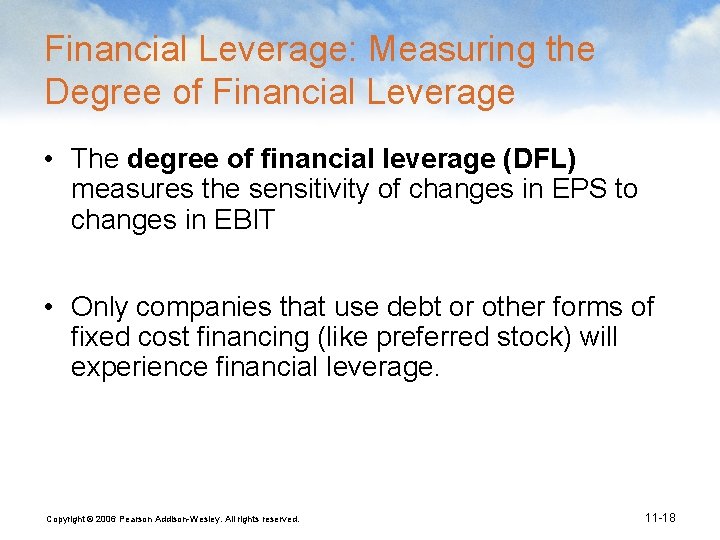
Financial Leverage: Measuring the Degree of Financial Leverage • The degree of financial leverage (DFL) measures the sensitivity of changes in EPS to changes in EBIT • Only companies that use debt or other forms of fixed cost financing (like preferred stock) will experience financial leverage. Copyright © 2006 Pearson Addison-Wesley. All rights reserved. 11 -18
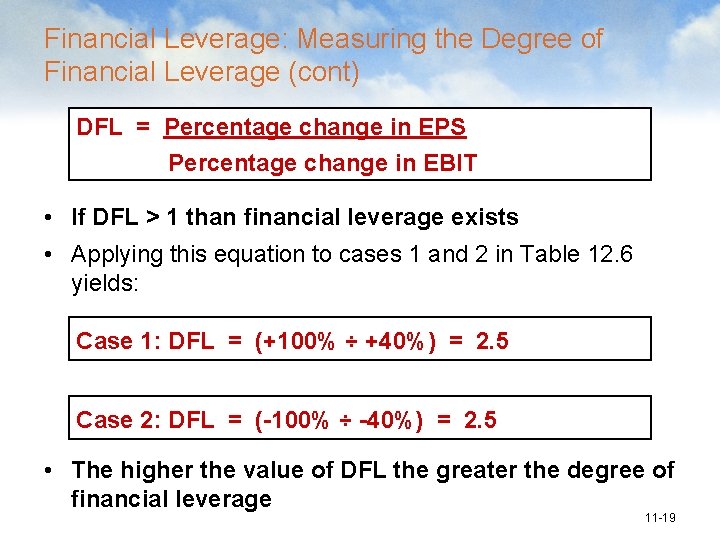
Financial Leverage: Measuring the Degree of Financial Leverage (cont) DFL = Percentage change in EPS Percentage change in EBIT • If DFL > 1 than financial leverage exists • Applying this equation to cases 1 and 2 in Table 12. 6 yields: Case 1: DFL = (+100% ÷ +40%) = 2. 5 Case 2: DFL = (-100% ÷ -40%) = 2. 5 • The higher the value of DFL the greater the degree of financial leverage 11 -19
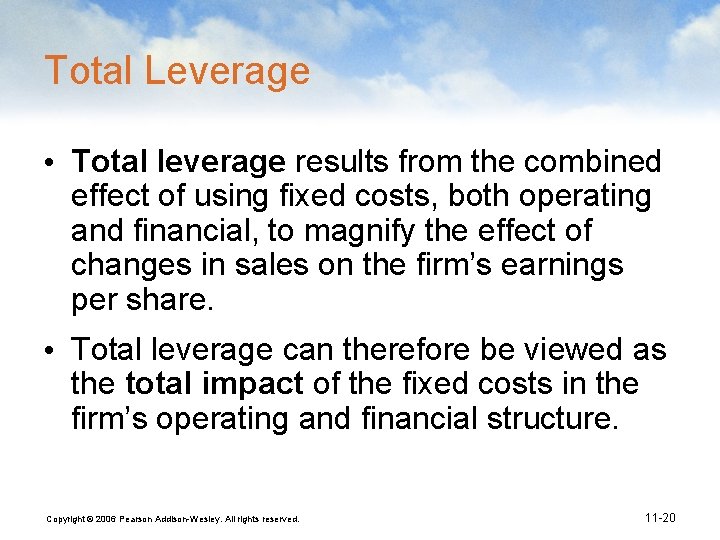
Total Leverage • Total leverage results from the combined effect of using fixed costs, both operating and financial, to magnify the effect of changes in sales on the firm’s earnings per share. • Total leverage can therefore be viewed as the total impact of the fixed costs in the firm’s operating and financial structure. Copyright © 2006 Pearson Addison-Wesley. All rights reserved. 11 -20
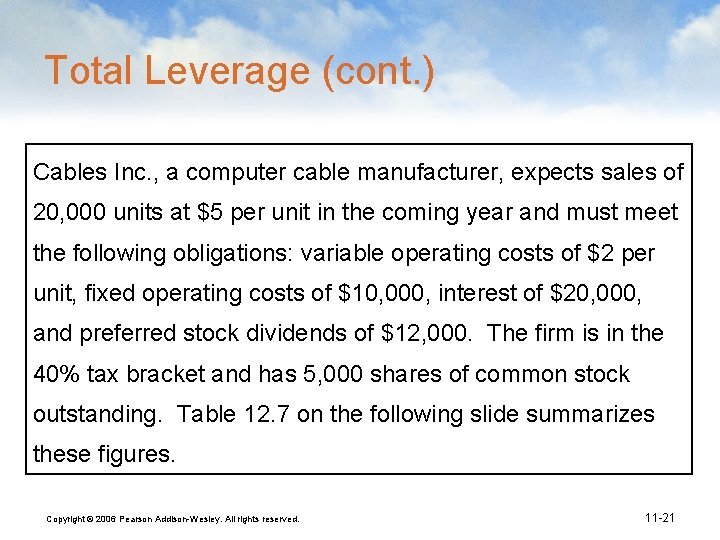
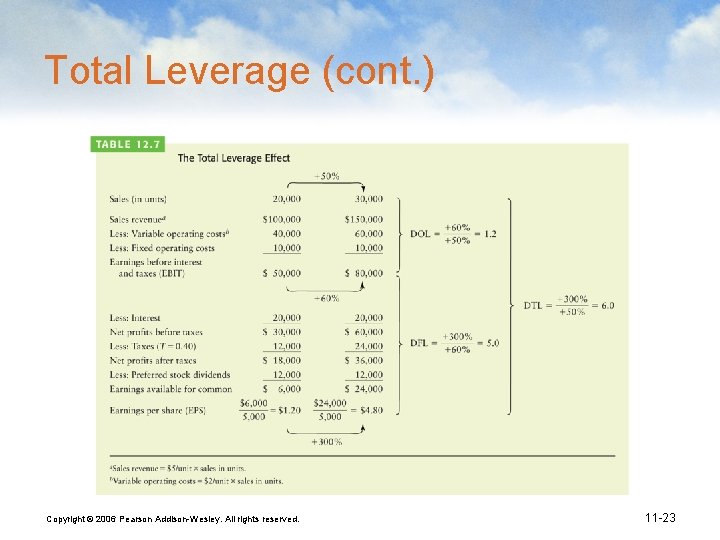
Total Leverage (cont. ) Cables Inc. , a computer cable manufacturer, expects sales of 20, 000 units at $5 per unit in the coming year and must meet the following obligations: variable operating costs of $2 per unit, fixed operating costs of $10, 000, interest of $20, 000, and preferred stock dividends of $12, 000. The firm is in the 40% tax bracket and has 5, 000 shares of common stock outstanding. Table 12. 7 on the following slide summarizes these figures. Copyright © 2006 Pearson Addison-Wesley. All rights reserved. 11 -21
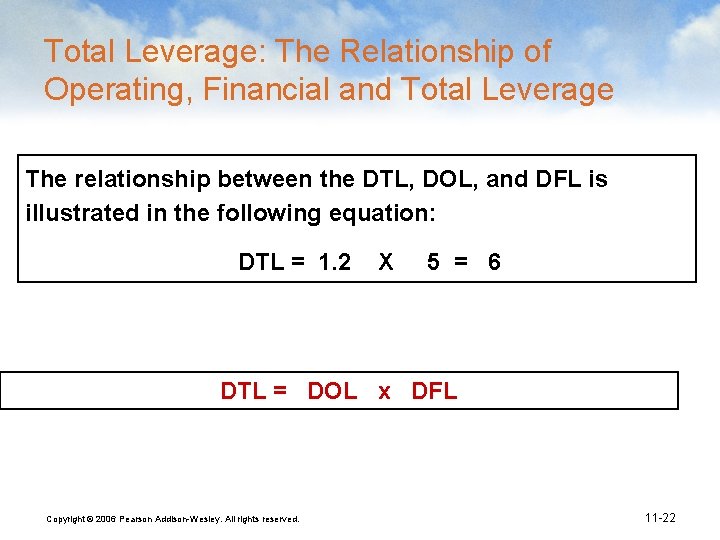
Total Leverage: The Relationship of Operating, Financial and Total Leverage The relationship between the DTL, DOL, and DFL is illustrated in the following equation: DTL = 1. 2 X 5 = 6 DTL = DOL x DFL Copyright © 2006 Pearson Addison-Wesley. All rights reserved. 11 -22
Total Leverage (cont. ) Copyright © 2006 Pearson Addison-Wesley. All rights reserved. 11 -23
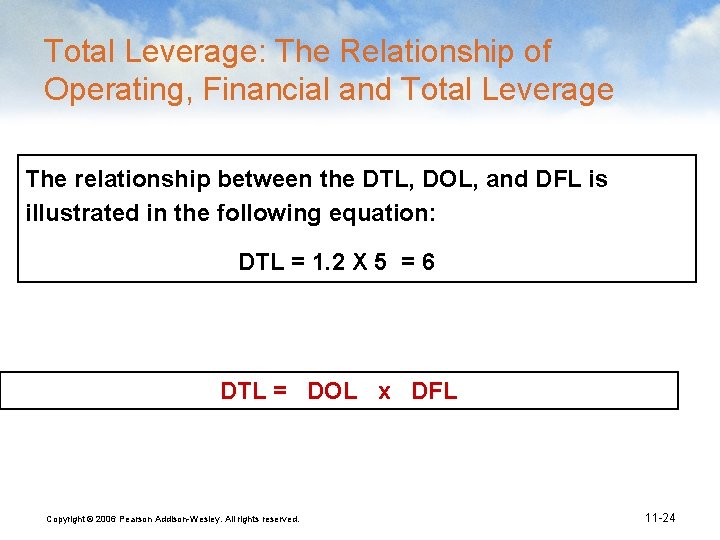
Total Leverage: The Relationship of Operating, Financial and Total Leverage The relationship between the DTL, DOL, and DFL is illustrated in the following equation: DTL = 1. 2 X 5 = 6 DTL = DOL x DFL Copyright © 2006 Pearson Addison-Wesley. All rights reserved. 11 -24
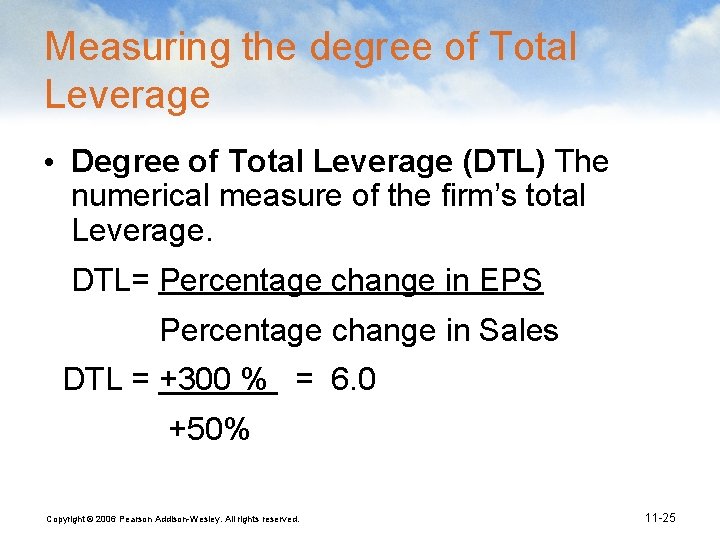
Measuring the degree of Total Leverage • Degree of Total Leverage (DTL) The numerical measure of the firm’s total Leverage. DTL= Percentage change in EPS Percentage change in Sales DTL = +300 % = 6. 0 +50% Copyright © 2006 Pearson Addison-Wesley. All rights reserved. 11 -25
The Firm’s Capital Structure • Capital structure is one of the most complex areas of financial decision making due to its interrelationship with other financial decisions. • Poor capital structure decisions can result in a high cost of capital, thereby lowering project NPVs and making them more unacceptable. • Effective decisions can lower the cost of capital, resulting in higher NPVs and more acceptable projects, thereby increasing the value of the firm. Copyright © 2006 Pearson Addison-Wesley. All rights reserved. 11 -26
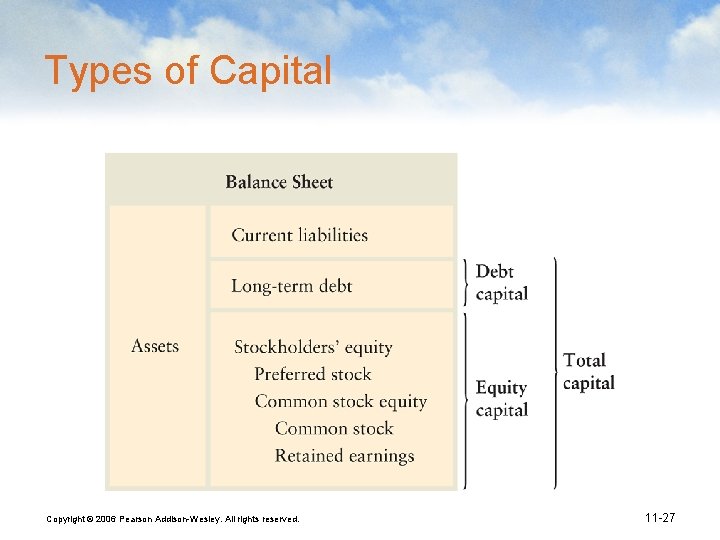
Types of Capital Copyright © 2006 Pearson Addison-Wesley. All rights reserved. 11 -27
Capital Structure Theory • According to finance theory, firms possess a target capital structure that will minimize its cost of capital. • Unfortunately, theory can not yet provide financial mangers with a specific methodology to help them determine what their firm’s optimal capital structure might be. • Theoretically, however, a firm’s optimal capital structure will just balance the benefits of debt financing against its costs. Copyright © 2006 Pearson Addison-Wesley. All rights reserved. 11 -28
Capital Structure Theory (cont. ) • The major benefit of debt financing is the tax shield provided by the federal government regarding interest payments. • The costs of debt financing result from: – the increased probability of bankruptcy caused by debt obligations, – the agency costs resulting from lenders monitoring the firm’s actions, and – the costs associated with the firm’s managers having more information about the firm’s prospects than do investors (asymmetric information). Copyright © 2006 Pearson Addison-Wesley. All rights reserved. 11 -29
Capital Structure Theory: Tax Benefits • Allowing companies to deduct interest payments when computing taxable income lowers the amount of corporate taxes. • This in turn increases firm cash flows and makes more cash available to investors. • In essence, the government is subsidizing the cost of debt financing relative to equity financing. Copyright © 2006 Pearson Addison-Wesley. All rights reserved. 11 -30
Capital Structure Theory: Probability of Bankruptcy • The probability that debt obligations will lead to bankruptcy depends on the level of a company’s business risk and financial risk. • Business risk is the risk to the firm of being unable to cover operating costs. • In general, the higher the firm’s fixed costs relative to variable costs, the greater the firm’s operating leverage and business risk. • Business risk is also affected by revenue and cost stability. Copyright © 2006 Pearson Addison-Wesley. All rights reserved. 11 -31
Capital Structure Theory: Probability of Bankruptcy (cont. ) • The firm’s capital structure—the mix between debt versus equity—directly impacts financial leverage. • Financial leverage measures the extent to which a firm employs fixed cost financing sources such as debt and preferred stock. • The greater a firm’s financial leverage, the greater will be its financial risk—the risk of being unable to meet its fixed interest and preferred stock dividends. Copyright © 2006 Pearson Addison-Wesley. All rights reserved. 11 -32
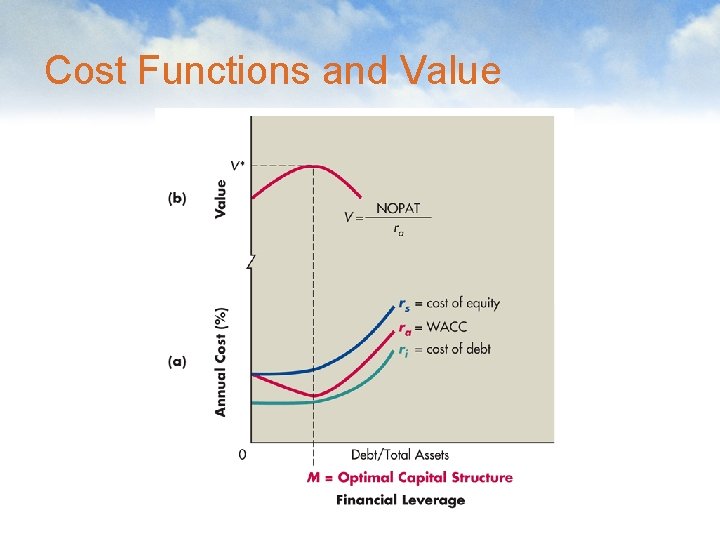
OPTIMAL CAPITAL STRUCTURE The capital structure at which the weighted average cost of capital is minimized, thereby maximizing the firms value. Generally, the lower the firm’s weighted average cost of capital, the greater the difference between the return on a project and the WACC and therefore the greater the owners return. Copyright © 2006 Pearson Addison-Wesley. All rights reserved. 11 -33
OPTIMAL CAPITAL STRUCTURE • The capital structure at which the weighted average cost of capital is minimized, thereby maximizing the firms value. Copyright © 2006 Pearson Addison-Wesley. All rights reserved. 11 -34
Cost Functions and Value
In simple terms it can be stated that, minimising the weighted average cost of capital allows management to undertake a large number of profitable projects, thereby further increasing the value of the firm. Copyright © 2006 Pearson Addison-Wesley. All rights reserved. 11 -36