
Chapter 7 Landforms rocks and minerals The Earths
- Slides: 26
Chapter 7 Landforms, rocks, and minerals
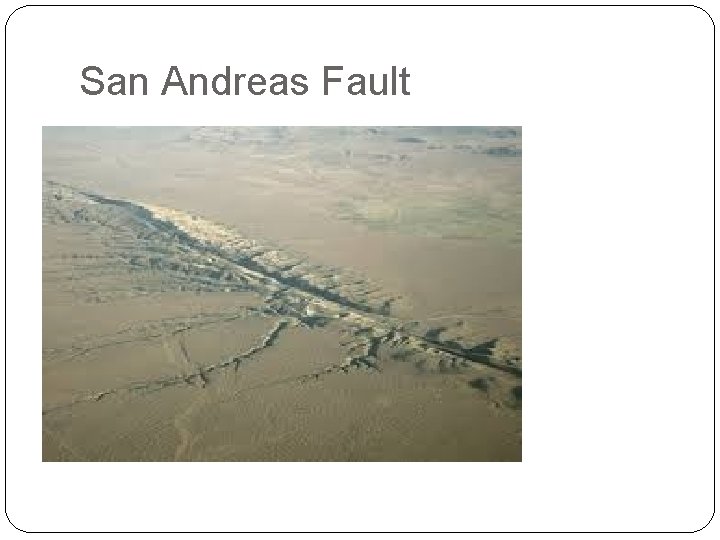
The Earth’s Changing Crust What makes the Earth’s Crust move? �The Earth’s crust is constantly moving. Sometimes it moves quickly enough to be felt which is an earthquake. �Faults are cracks in the earth’s crust and are where earthquakes happen. �Surveyors measure crust movement by studying the elevation (or how high a place is above sea level). �Geologists are scientists who study the Earth and place sensitive devices all along faults. Ex. San Andreas
San Andreas Fault
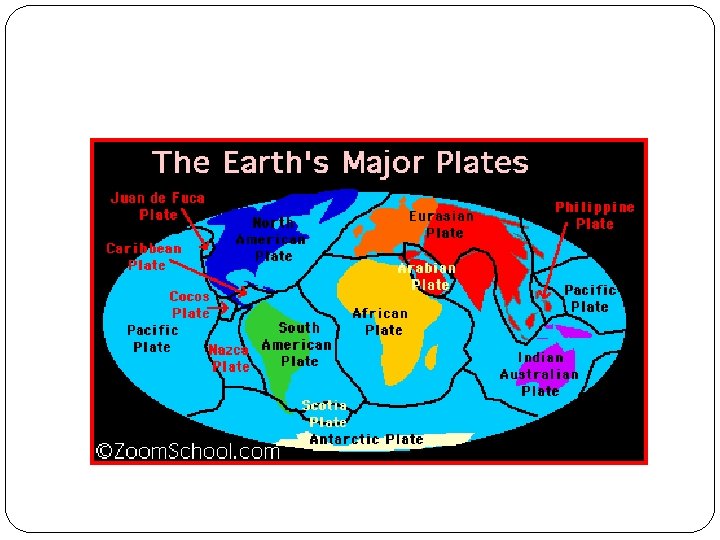
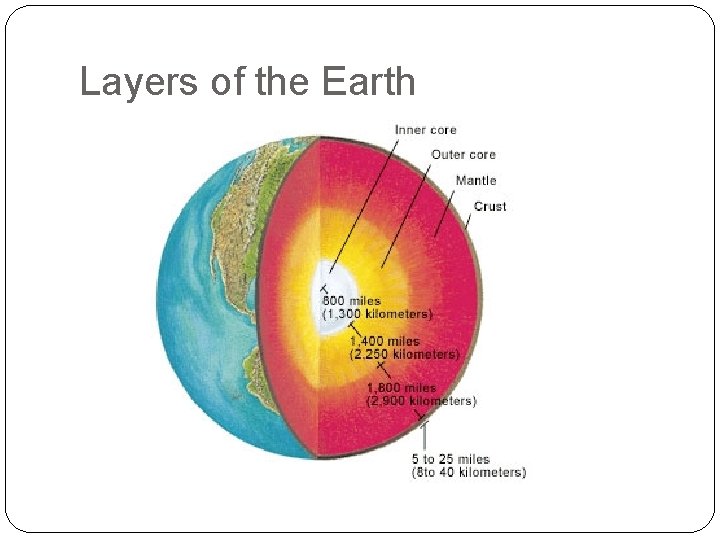
Plate Tectonics � The crust is the Earth’s hard surface. It is the thinnest layer. � The mantle (below the crust) is the thickest layer. It is solid, but also flows. Kind of like if you had puddy and were squeezing it through your fingers. � Below the mantle is the core. The outer core is liquid and the inner core is solid. � The mantle heats up and causes the crust to become so hard it breaks into plates. These plates move along the earth’s surface. Earthquakes and the movement of crust all come about because of these plates.
Layers of the Earth
What forces act on the crust? �There are 3 ways plates can move: 1. Tension – stretches or pulls apart the crust 2. Compression – squeezes or pushes together the crust 3. Shear – twists, tears, or pushes one part of the crust past one another. �These can cause faults which produce mountains.
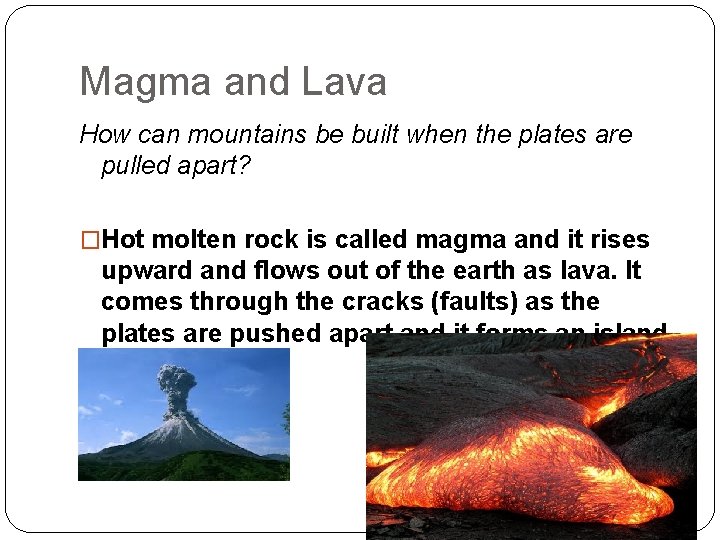
Magma and Lava How can mountains be built when the plates are pulled apart? �Hot molten rock is called magma and it rises upward and flows out of the earth as lava. It comes through the cracks (faults) as the plates are pushed apart and it forms an island or a volcano.
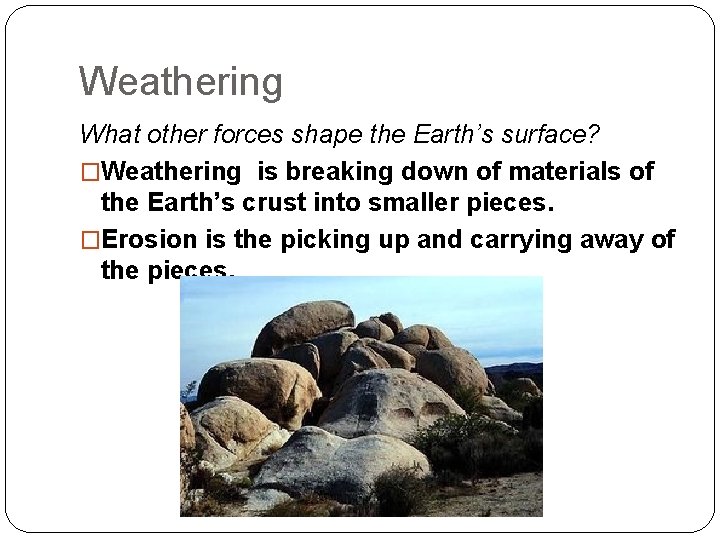
Weathering What other forces shape the Earth’s surface? �Weathering is breaking down of materials of the Earth’s crust into smaller pieces. �Erosion is the picking up and carrying away of the pieces.
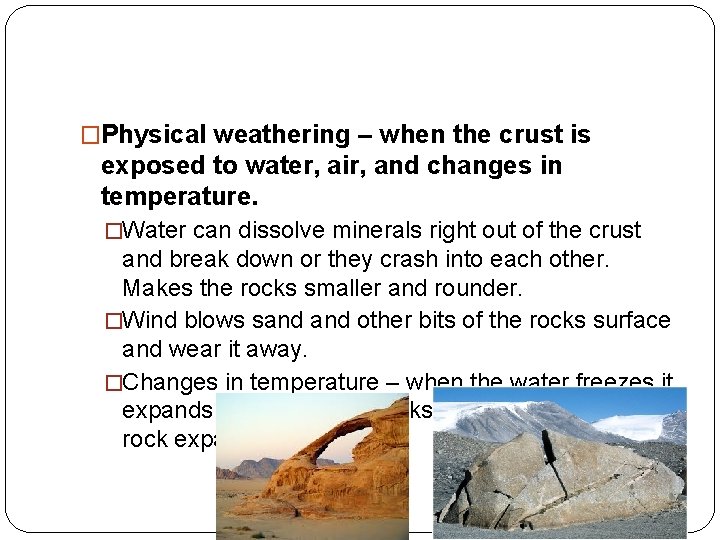
�Physical weathering – when the crust is exposed to water, air, and changes in temperature. �Water can dissolve minerals right out of the crust and break down or they crash into each other. Makes the rocks smaller and rounder. �Wind blows sand other bits of the rocks surface and wear it away. �Changes in temperature – when the water freezes it expands and can crack rocks. It can also make the rock expand or contract.
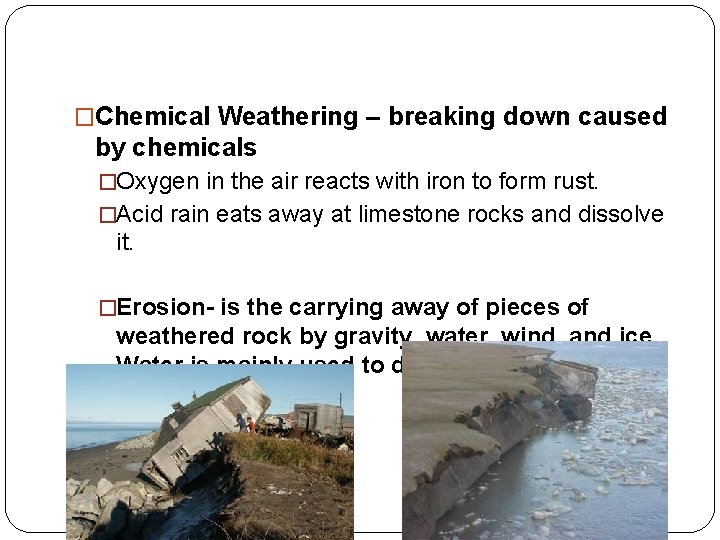
�Chemical Weathering – breaking down caused by chemicals �Oxygen in the air reacts with iron to form rust. �Acid rain eats away at limestone rocks and dissolve it. �Erosion- is the carrying away of pieces of weathered rock by gravity, water, wind, and ice. Water is mainly used to do this.
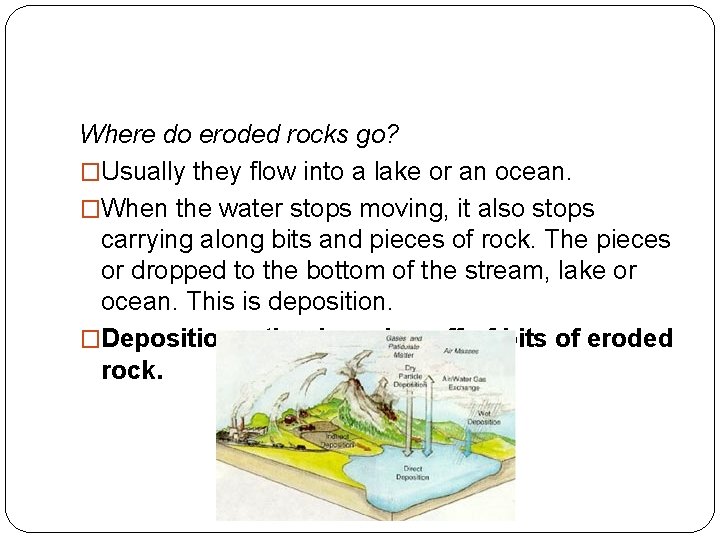
Where do eroded rocks go? �Usually they flow into a lake or an ocean. �When the water stops moving, it also stops carrying along bits and pieces of rock. The pieces or dropped to the bottom of the stream, lake or ocean. This is deposition. �Deposition – the dropping off of bits of eroded rock.
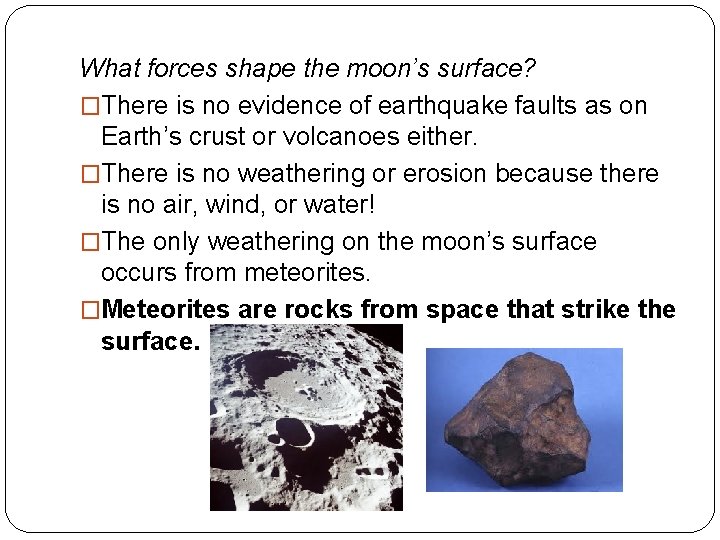
What forces shape the moon’s surface? �There is no evidence of earthquake faults as on Earth’s crust or volcanoes either. �There is no weathering or erosion because there is no air, wind, or water! �The only weathering on the moon’s surface occurs from meteorites. �Meteorites are rocks from space that strike the surface.
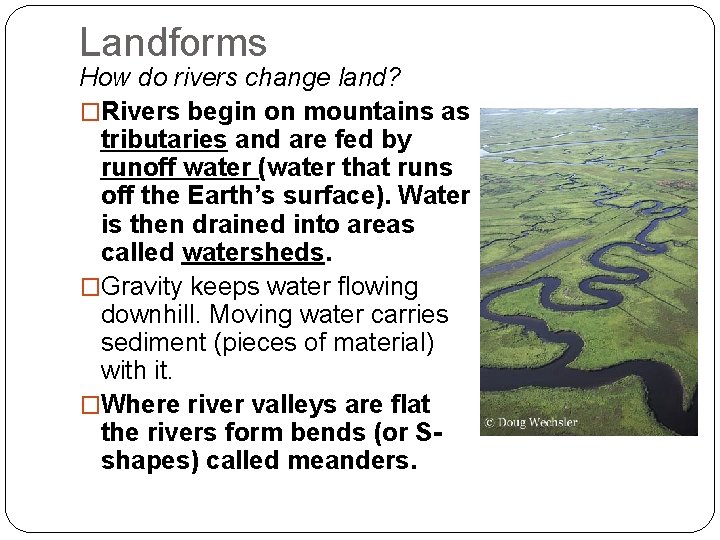
Landforms How do rivers change land? �Rivers begin on mountains as tributaries and are fed by runoff water (water that runs off the Earth’s surface). Water is then drained into areas called watersheds. �Gravity keeps water flowing downhill. Moving water carries sediment (pieces of material) with it. �Where river valleys are flat the rivers form bends (or Sshapes) called meanders.
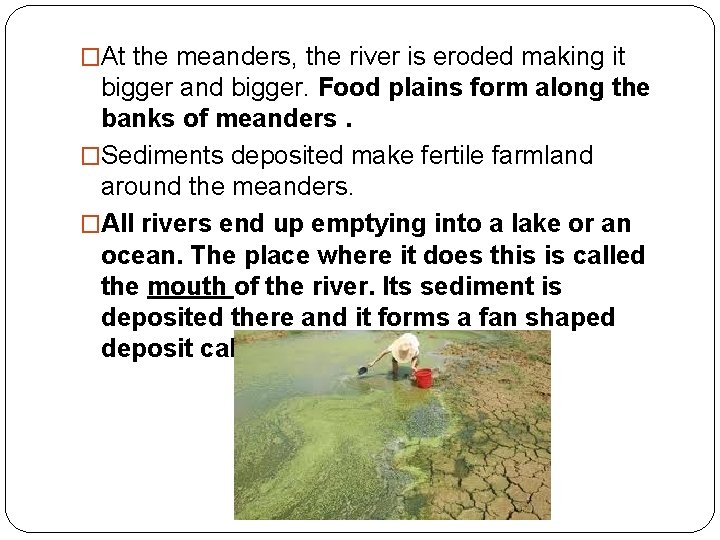
�At the meanders, the river is eroded making it bigger and bigger. Food plains form along the banks of meanders. �Sediments deposited make fertile farmland around the meanders. �All rivers end up emptying into a lake or an ocean. The place where it does this is called the mouth of the river. Its sediment is deposited there and it forms a fan shaped deposit called a delta.
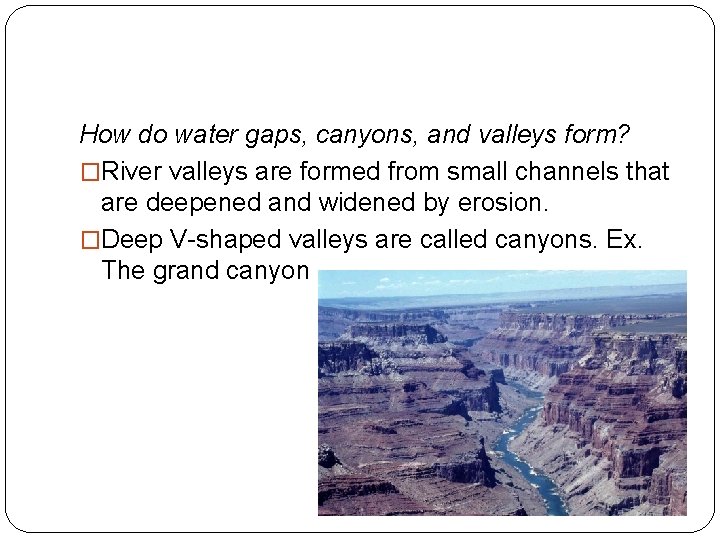
How do water gaps, canyons, and valleys form? �River valleys are formed from small channels that are deepened and widened by erosion. �Deep V-shaped valleys are called canyons. Ex. The grand canyon
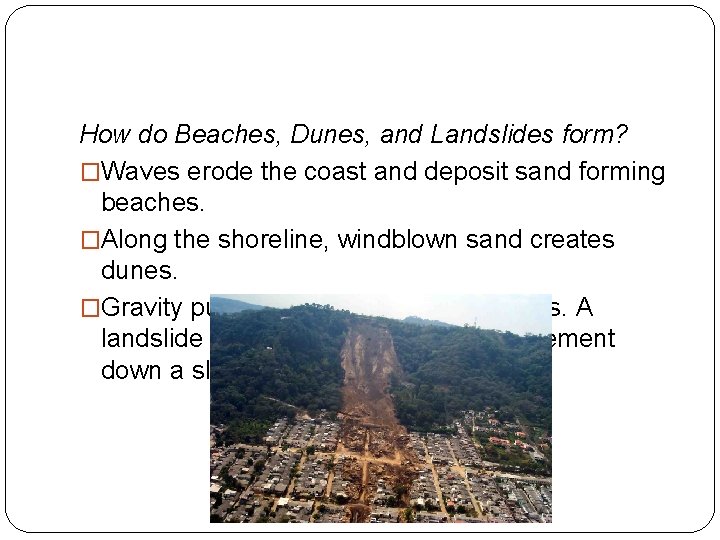
How do Beaches, Dunes, and Landslides form? �Waves erode the coast and deposit sand forming beaches. �Along the shoreline, windblown sand creates dunes. �Gravity pulls rocks and soil down slopes. A landslide is an example of a rapid movement down a slope.
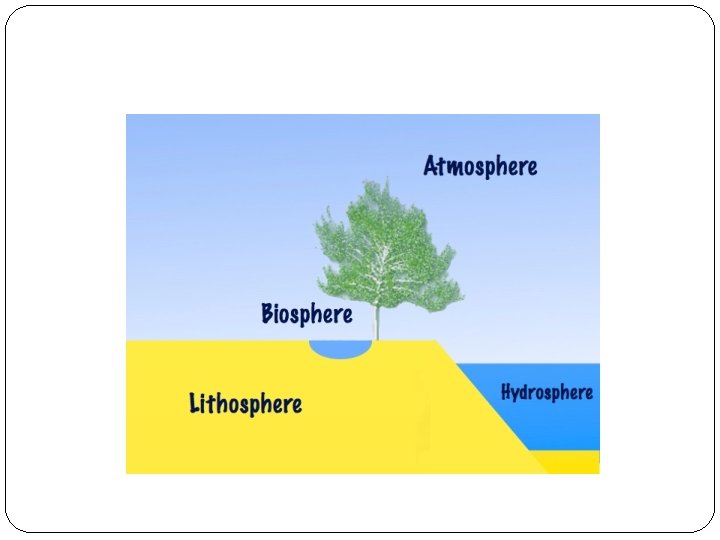
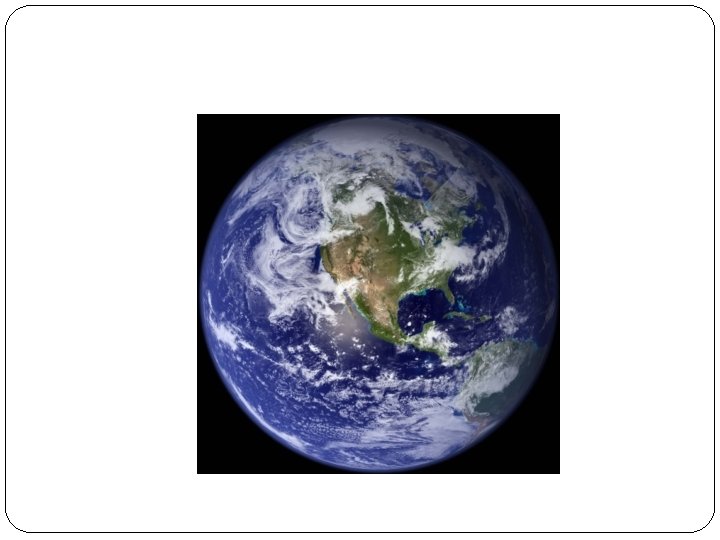
Major Earth layers �Lithosphere – hard, outer layer (62. 14 miles thick). The top makes up the crust and includes the earth’s resources. �Hydrosphere – is the Earth’s water – trillions of liters. It covers most of the lithosphere. This includes all the oceans, freshwater, and even the water found in the air! The water changes temperature slowly. �Atmosphere – layers of gases that surround the earth. The one nearest to the surface of Earth is the troposphere that contains oxygen. Most of Earth’s weather occurs here. It protects against harmful energy from the sun.
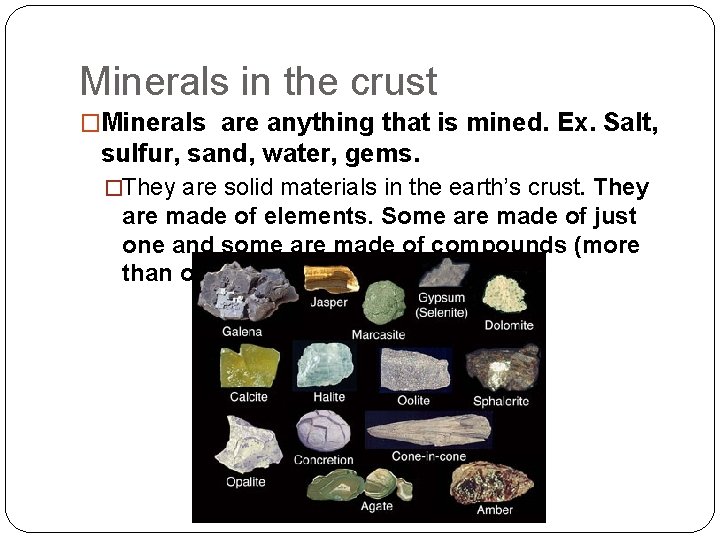
Minerals in the crust �Minerals are anything that is mined. Ex. Salt, sulfur, sand, water, gems. �They are solid materials in the earth’s crust. They are made of elements. Some are made of just one and some are made of compounds (more than one) of elements.
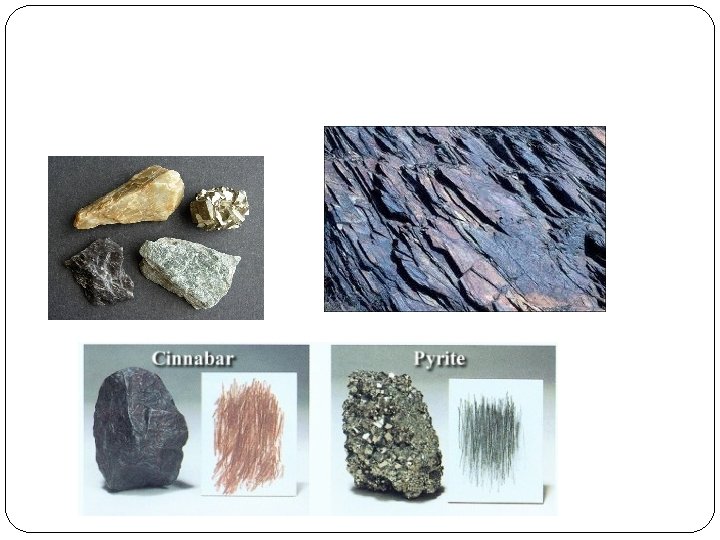
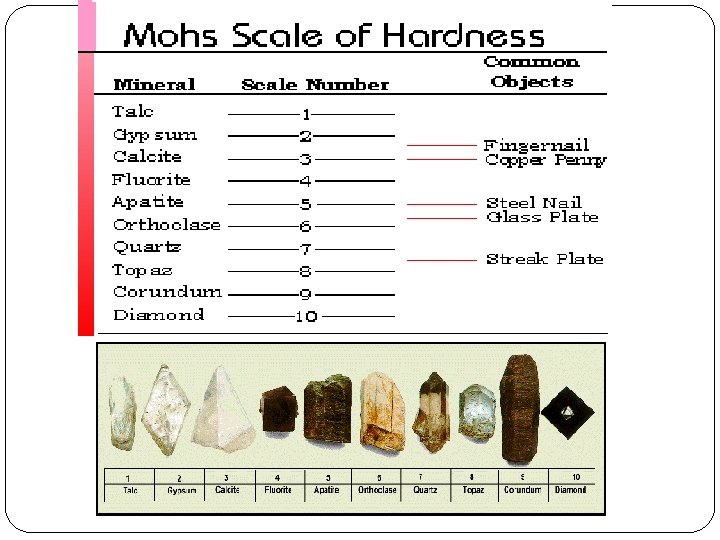
How can you tell what is in it? � The color – helps but not always right � Luster – way light bounces off a mineral. Is it shiny or dull or glassy? � Streak – color of the powder left when a mineral is rubbed against a hard surface. � Hardness – how the mineral resists scratching. � Cleavage – the way the mineral breaks (jagged or smooth? ) � Some minerals are special –like magnetite– you can tell what it is by using a magnet to attract it.
Moh’s scale
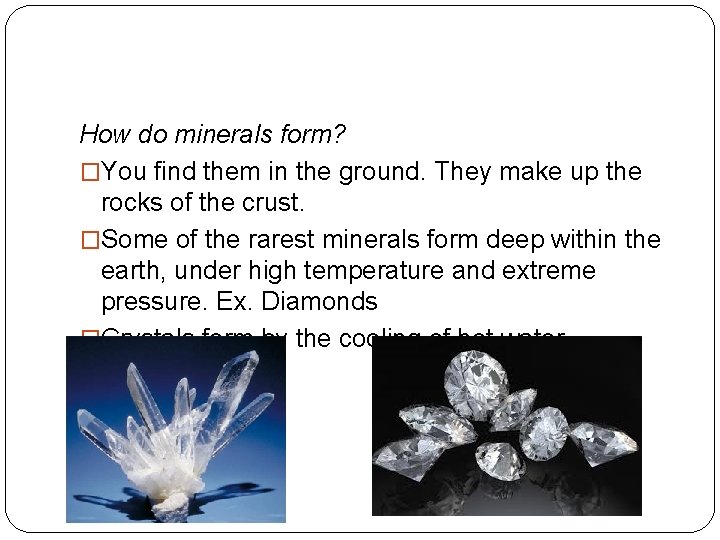
How do minerals form? �You find them in the ground. They make up the rocks of the crust. �Some of the rarest minerals form deep within the earth, under high temperature and extreme pressure. Ex. Diamonds �Crystals form by the cooling of hot water.
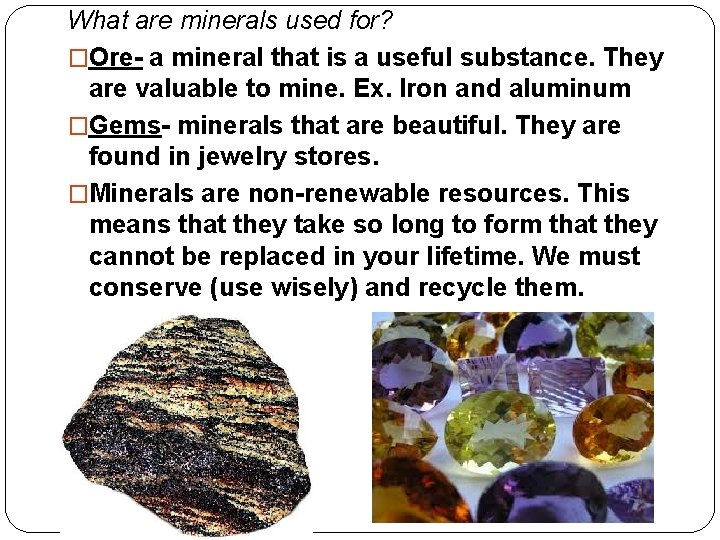
What are minerals used for? �Ore- a mineral that is a useful substance. They are valuable to mine. Ex. Iron and aluminum �Gems- minerals that are beautiful. They are found in jewelry stores. �Minerals are non-renewable resources. This means that they take so long to form that they cannot be replaced in your lifetime. We must conserve (use wisely) and recycle them.