
Chapter 7 Kinetic Energy and Work Work and

















- Slides: 38
Chapter 7 Kinetic Energy and Work
Work and Energy: scalar quantity associated with a state (or condition) of one or more objects. Work and energy are scalars, measured in N·m or Joules, J, 1 J=kg∙m 2/s 2 Energy can exist in many forms - mechanical, electrical, nuclear, thermal, chemical….
Work and Energy is a conserved quantity - the total amount of energy in the universe is constant. Energy can be converted from one type to another but never destroyed. Work and energy concepts can simplify solutions of mechanical problems - they can be used in an alternative analysis
Work done by a constant force Work done on an object by a constant force is defined to be the product of the magnitude of the displacement and the component of the force parallel to the displacement W = FII · d Where FII is the component of the force F parallel to the displacement d
Work In other words W = F d cosq Where q is the angle between F and d F q d If q is > 90 o, work is negative. A decelerating car has negative work done on it by its engine. The unit of work is called Joule (J), 1 J = 1 N·m 1 J=kg∙m 2/s 2
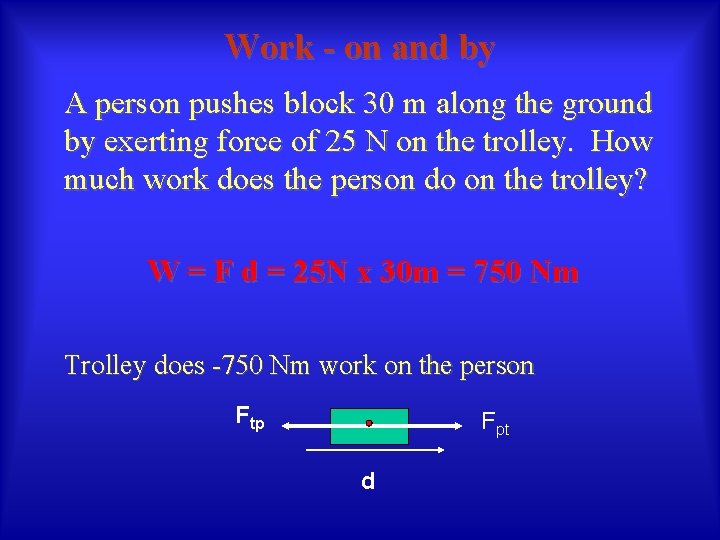
Work - on and by A person pushes block 30 m along the ground by exerting force of 25 N on the trolley. How much work does the person do on the trolley? W = F d = 25 N x 30 m = 750 Nm Trolley does -750 Nm work on the person Ftp Fpt d
Mechanical Energy Mechanical energy (energy associated with masses) can be thought of as having two components: kinetic and potential – Kinetic energy is energy of motion – Potential energy is energy of position
Kinetic Energy In many situations, energy can be considered as “the ability to do work” Energy can exist in different forms Kinetic energy is the energy associated with the motion of an object A moving object can do work on another object – E. g hammer does work on nail.
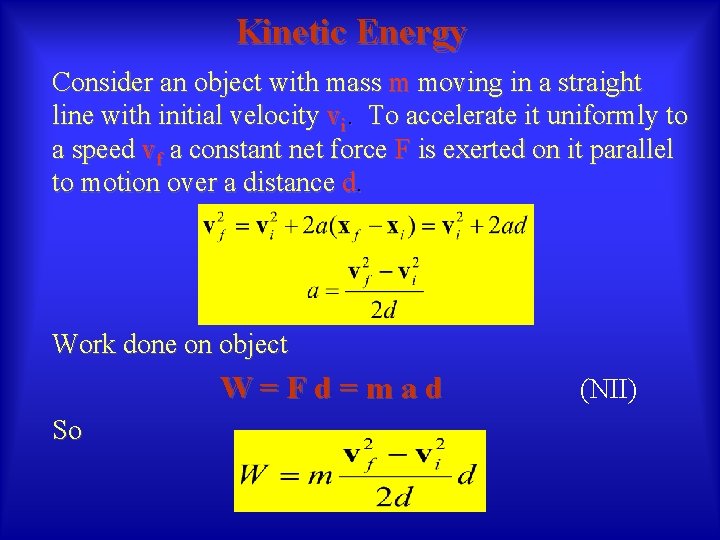
Kinetic Energy Consider an object with mass m moving in a straight line with initial velocity vi. To accelerate it uniformly to a speed vf a constant net force F is exerted on it parallel to motion over a distance d. Work done on object W=Fd=mad So (NII)
Kinetic Energy If we rearrange this we obtain We define the quantity ½mv 2 to be the translational kinetic energy (KE) of the object W = DKE This is the ‘Work-Energy Theorem’: “The net work done on an object is equal to its change in kinetic energy”
The Work-Energy Theorem W = DKE • Note – The net work done on an object is the work done by the net force. – Units of energy and work must be the same (J)
Energy: scalar quantity associated with a state (or condition) of one or more objects. I. Kinetic energy. II. Work. III. Work - Kinetic energy theorem. IV. Work done by a constant force V. - Gravitational force VI. V. Work done by a variable force. VII. - Spring force. VIII. 1 D-Analysis 3 D-Analysis VI. Power
I. Kinetic energy Energy associated with the state of motion of an object. Units: 1 Joule = 1 J = 1 kgm 2/s 2 II. Work Energy transferred “to” or “from” an object by means of a force acting on the object. To +W From -W
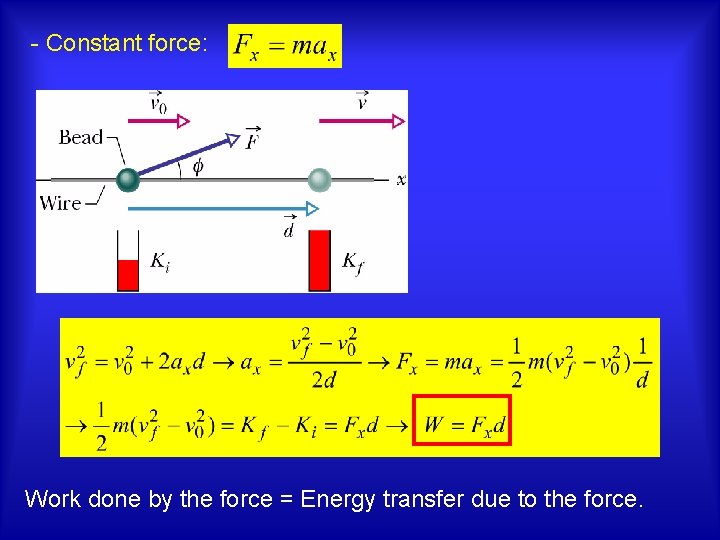
- Constant force: Work done by the force = Energy transfer due to the force.
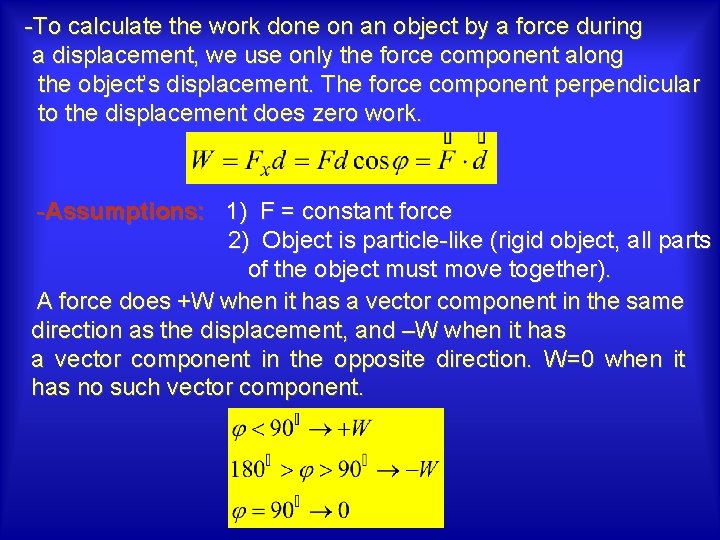
-To calculate the work done on an object by a force during a displacement, we use only the force component along the object’s displacement. The force component perpendicular to the displacement does zero work. -Assumptions: 1) F = constant force 2) Object is particle-like (rigid object, all parts of the object must move together). A force does +W when it has a vector component in the same direction as the displacement, and –W when it has a vector component in the opposite direction. W=0 when it has no such vector component.
Net work done by several forces = Sum of works done by individual forces. Calculation: 1) Wnet= W 1+W 2+W 3+… 2) Fnet Wnet=Fnet d
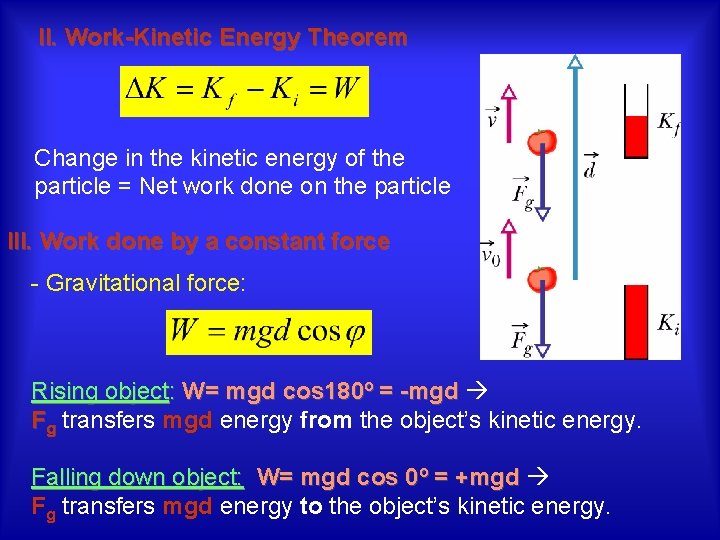
II. Work-Kinetic Energy Theorem Change in the kinetic energy of the particle = Net work done on the particle III. Work done by a constant force - Gravitational force: Rising object: W= mgd cos 180º = -mgd Fg transfers mgd energy from the object’s kinetic energy. Falling down object: W= mgd cos 0º = +mgd Fg transfers mgd energy to the object’s kinetic energy.
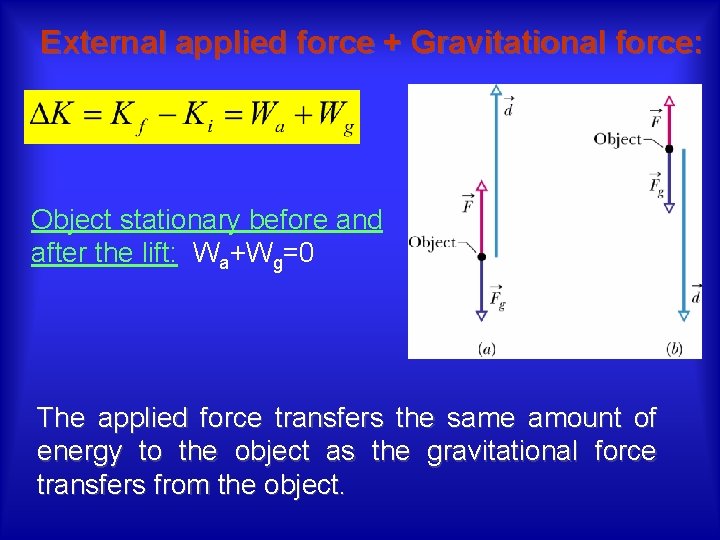
External applied force + Gravitational force: Object stationary before and after the lift: Wa+Wg=0 The applied force transfers the same amount of energy to the object as the gravitational force transfers from the object.
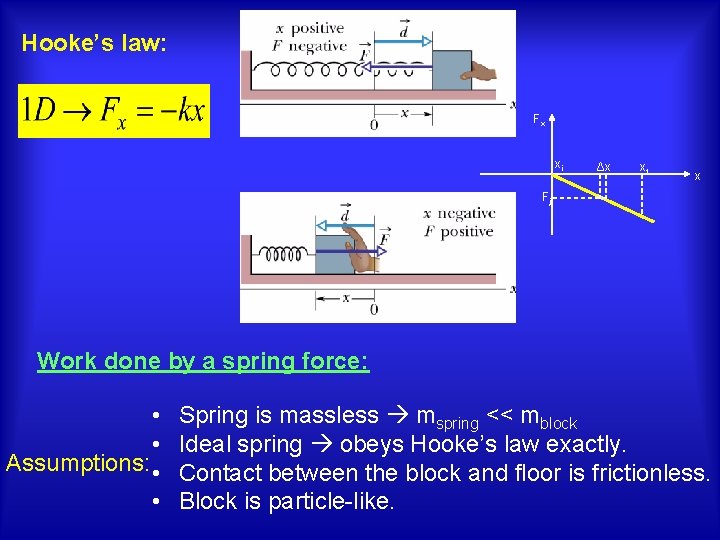
IV. Work done by a variable force - Spring force: Hooke’s law k = spring constant measures spring’s stiffness. Units: N/m
Hooke’s law: Fx xi Δx xf x Fj Work done by a spring force: • • Assumptions: • • Spring is massless mspring << mblock Ideal spring obeys Hooke’s law exactly. Contact between the block and floor is frictionless. Block is particle-like.
- Calculation: 1) The block displacement must be divided into many segments of infinitesimal width, Δx. 2) F(x) ≈ cte within each short Δx segment. Fx xi Δx xf x Fj Ws>0 Block ends up closer to the relaxed position (x=0) than it was initially. Ws<0 Block ends up further away from x=0. Ws=0 Block ends up at x=0.
Work done by an applied force + spring force: Block stationary before and after the displacement: Wa= -Ws The work done by the applied force displacing the block is the negative of the work done by the spring force.
Work done by a general variable force: 1 D-Analysis Geometrically: Work is the area between the curve F(x) and the x-axis.
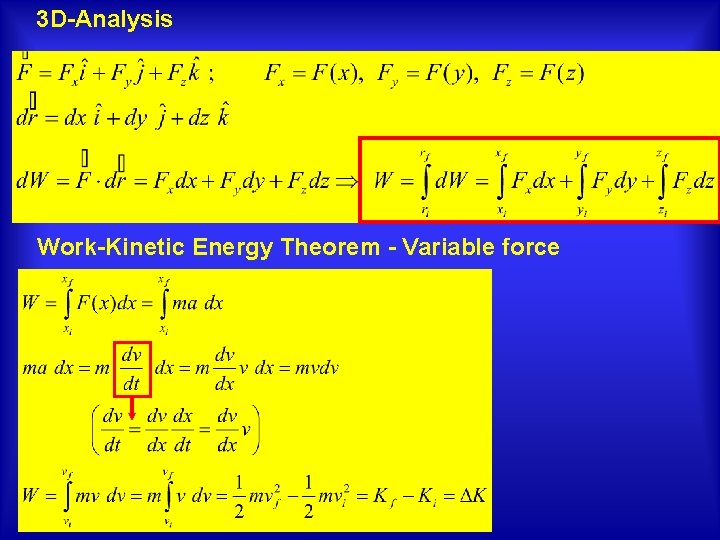
3 D-Analysis Work-Kinetic Energy Theorem - Variable force
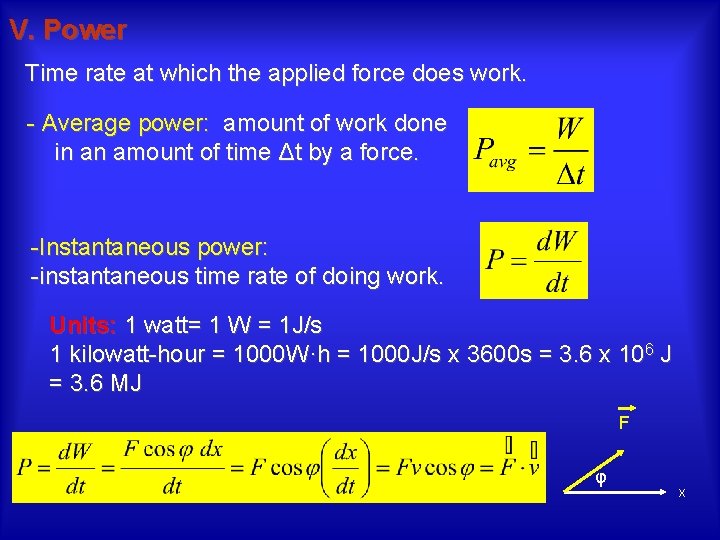
V. Power Time rate at which the applied force does work. - Average power: amount of work done in an amount of time Δt by a force. -Instantaneous power: -instantaneous time rate of doing work. Units: 1 watt= 1 W = 1 J/s 1 kilowatt-hour = 1000 W·h = 1000 J/s x 3600 s = 3. 6 x 10⁶ J = 3. 6 MJ F φ x
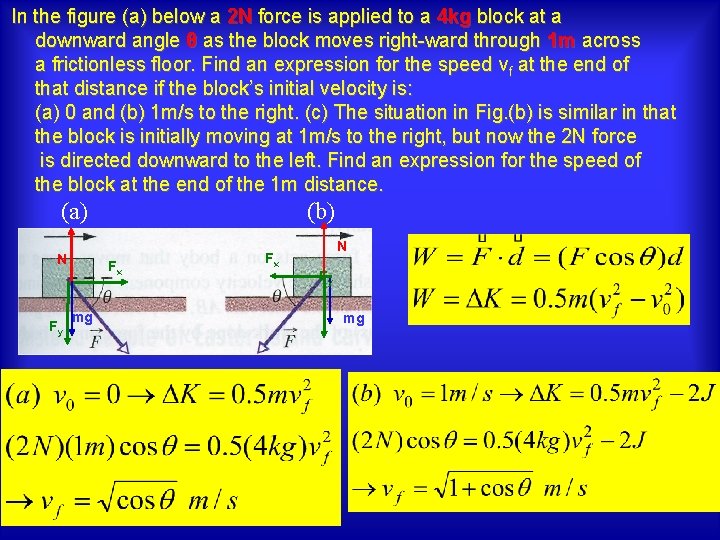
In the figure (a) below a 2 N force is applied to a 4 kg block at a downward angle θ as the block moves right-ward through 1 m across a frictionless floor. Find an expression for the speed vf at the end of that distance if the block’s initial velocity is: (a) 0 and (b) 1 m/s to the right. (c) The situation in Fig. (b) is similar in that the block is initially moving at 1 m/s to the right, but now the 2 N force is directed downward to the left. Find an expression for the speed of the block at the end of the 1 m distance. (a) N Fy Fx mg Fx N Fy mg
In the figure (a) below a 2 N force is applied to a 4 kg block at a downward angle θ as the block moves right-ward through 1 m across a frictionless floor. Find an expression for the speed vf at the end of that distance if the block’s initial velocity is: (a) 0 and (b) 1 m/s to the right. (c) The situation in Fig. (b) is similar in that the block is initially moving at 1 m/s to the right, but now the 2 N force is directed downward to the left. Find an expression for the speed of the block at the end of the 1 m distance. (a) N Fy (b) Fx mg Fx N Fy mg
In the figure (a) below a 2 N force is applied to a 4 kg block at a downward angle θ as the block moves right-ward through 1 m across a frictionless floor. Find an expression for the speed vf at the end of that distance if the block’s initial velocity is: (a) 0 and (b) 1 m/s to the right. (c) The situation in (b) is similar in that the block is initially moving at 1 m/s to the right, but now the 2 N force is directed downward to the left. Find an expression for the speed of the block at the end of the 1 m distance. N Fy Fx mg Fx N Fy mg
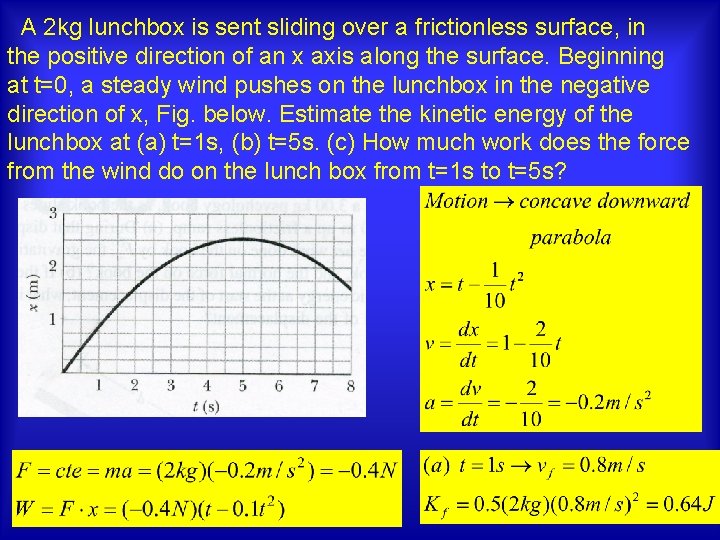
A 2 kg lunchbox is sent sliding over a frictionless surface, in the positive direction of an x axis along the surface. Beginning at t=0, a steady wind pushes on the lunchbox in the negative direction of x, Fig. below. Estimate the kinetic energy of the lunchbox at (a) t=1 s, (b) t=5 s. (c) How much work does the force from the wind do on the lunch box from t=1 s to t=5 s?
A 2 kg lunchbox is sent sliding over a frictionless surface, in the positive direction of an x axis along the surface. Beginning at t=0, a steady wind pushes on the lunchbox in the negative direction of x, Fig. below. Estimate the kinetic energy of the lunchbox at (a) t=1 s, (b) t=5 s. (c) How much work does the force from the wind do on the lunch box from t=1 s to t=5 s?
In the figure below a horizontal force Fa of magnitude 20 N is applied to a 3 kg book, as the book slides a distance of d=0. 5 m y up a frictionless ramp. (a) During the x displacement, what is the net force done N on the book by Fa, the gravitational force F on the book and the normal force on the F mg book? (b) If the book has zero kinetic energy at the start of the displacement, what is the speed at the end of the displacement? gx gy
N 12. In the figure below a horizontal force Fa of magnitude 20 N is applied to a 3 kg book, as the book slides a distance of d=0. 5 m y up a frictionless ramp. (a) During the x displacement, what is the net force done N on the book by Fa, the gravitational force F on the book and the normal force on the F mg book? (b) If the book has zero kinetic energy at the start of the displacement, what is the speed at the end of the displacement? gx gy
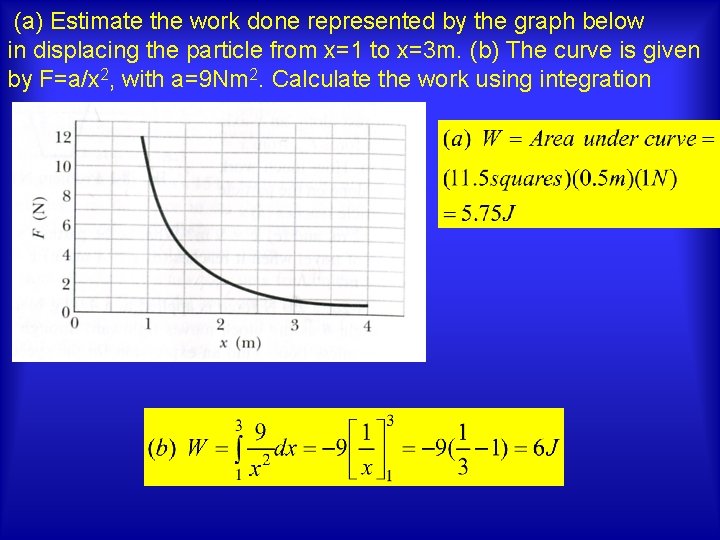
(a) Estimate the work done represented by the graph below in displacing the particle from x=1 to x=3 m. (b) The curve is given by F=a/x 2, with a=9 Nm 2. Calculate the work using integration
An elevator has a mass of 4500 kg and can carry a maximum load of 1800 kg. If the cab is moving upward at full load at 3. 8 m/s, what power is required of the force moving the cab to maintain that speed? Fa mg
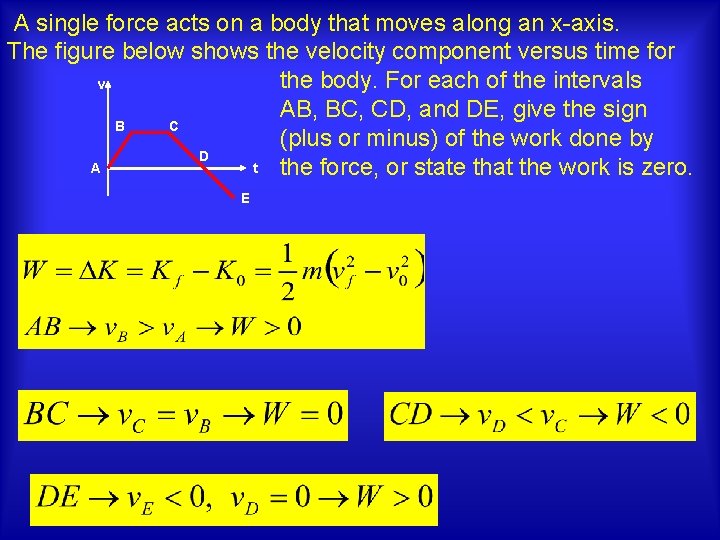
A single force acts on a body that moves along an x-axis. The figure below shows the velocity component versus time for the body. For each of the intervals v AB, BC, CD, and DE, give the sign B C (plus or minus) of the work done by D A t the force, or state that the work is zero. E
15 E. In the figure below, a cord runs around two massless, frictionless pulleys; a canister with mass m=20 kg hangs from one pulley; and you exert a force F on the free end of the cord. (a) What must be the magnitude of F if you are to lift the canister at a constant P 2 speed? (b) To lift the canister by 2 cm, how far must you pull the free end of the cord? During that lift, what is the T T T work done on the canister by (c) your P 1 force (via the cord) and (d) the mg gravitational force on the canister?
In the figure below, a cord runs around two massless, frictionless pulleys; a canister with mass m=20 kg hangs from one pulley; and you exert a force F on the free end of the cord. (a) What must be the magnitude of F if you are to lift the canister at a constant P 2 speed? (b) To lift the canister by 2 cm, how far must you pull the free end of the cord? During that lift, what is the T T T work done on the canister by (c) your P 1 force (via the cord) and (d) the mg gravitational force on the canister? (b) To rise “m” 0. 02 m, two segments of the cord must be shorten by that amount. Thus, the amount of the string pulled down at the left end is: 0. 04 m
15 E. In the figure below, a cord runs around two massless, frictionless pulleys; a canister with mass m=20 kg hangs from one pulley; and you exert a force F on the free end of the cord. (a) What must be the magnitude of F if you are to lift the canister at a constant P 2 speed? (b) To lift the canister by 2 cm, how far must you pull the free end of the cord? During that lift, what is the T T T work done on the canister by (c) your P 1 force (via the cord) and (d) the mg gravitational force on the canister? WF+WFg=0 There is no change in kinetic energy.