
Chapter 7 Issues in Policing Learning Objectives Recognize
Chapter 7 Issues in Policing
Learning Objectives Recognize the benefits likely to accrue from higher education for police ➤ Describe how the role of women and minorities in local police agencies has evolved over time ➤ Explain the concept of a police culture ➤ Recall the reasons why experts believe police have a unique personality ➤ Recognize the different types of police officer styles ➤
Learning Objectives Identify the factors that influence police discretion ➤ Recognize the consequences of stress and fatigue ➤ Distinguish between brutality and corruption ➤ Explain the difference between deadly and nondeadly force ➤ Recall the leading types of less-lethal weapons ➤
Who Are the Police? ➤ Police and Education ➤ ➤ ➤ About 16% of departments have some type of college requirement About 9% require a two-year degree Only 1% of local police departments required a four-year degree ➤ Most police departments recognize that college education is an important element in promotion decisions
Who Are the Police? ➤ Benefits of higher education for police Better communication with the public ➤ Better writers ➤ More likely to be promoted ➤ Fewer citizen complaints ➤ More initiative ➤ More professional ➤ Less inclined to use force ➤
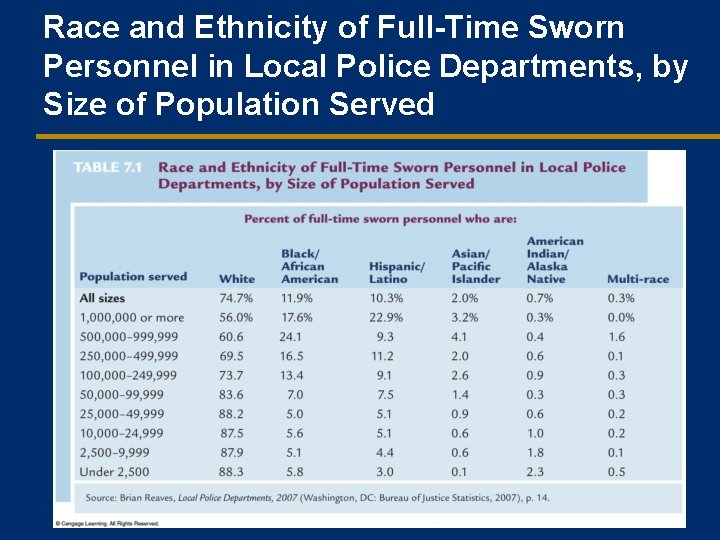
Race and Ethnicity of Full-Time Sworn Personnel in Local Police Departments, by Size of Population Served
Who Are the Police? ➤ Minorities in Policing ➤ ➤ ➤ Over the past several decades, police departments have made a concerted effort to attract minority police officers Minority officers help to gain the confidence of the minority community Qualities that can improve police performance Spanish speakers ➤ Undercover officers ➤
Who Are the Police? ➤ Minorities in Policing ➤ The African American experience ➤ ➤ Double marginality Minority representation today Almost 25% of local police officers today are minorities ➤ More aggressive & self-assured ➤ Job-related stress ➤
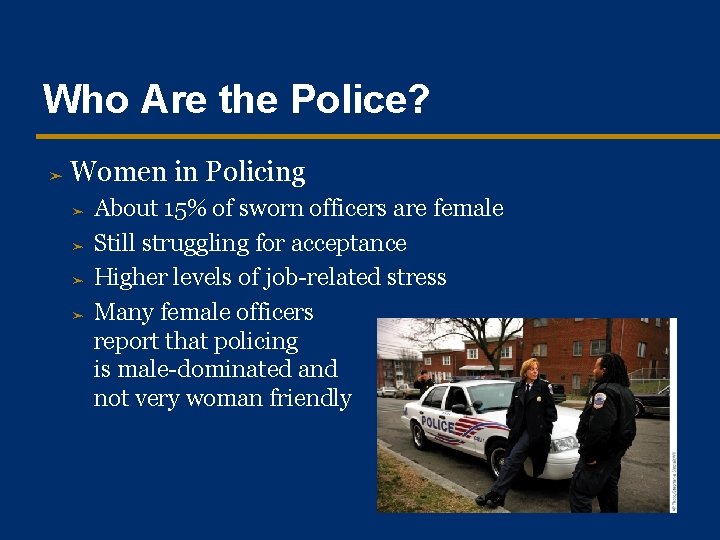
Who Are the Police? ➤ Women in Policing ➤ ➤ About 15% of sworn officers are female Still struggling for acceptance Higher levels of job-related stress Many female officers report that policing is male-dominated and not very woman friendly
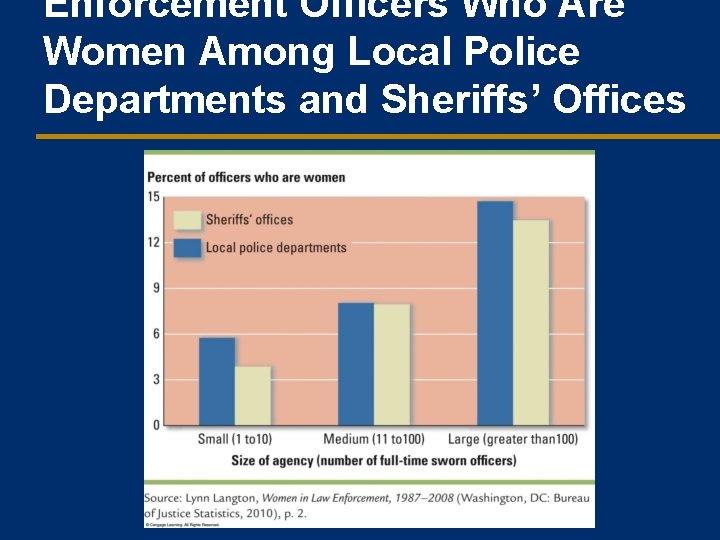
Enforcement Officers Who Are Women Among Local Police Departments and Sheriffs’ Offices
Police Culture ➤ Six core beliefs are viewed as being at the heart of the police culture: 1. 2. 3. 4. 5. 6. Police are the only real crime fighters No one else understands Loyalty to colleagues above everything else The war against crime cannot be won without bending the rules Members of the public are basically unsupportive and unreasonably demanding Patrol work is the pits
Police Personality ➤ Some experts believe that police officers develop a unique set of personality traits that distinguish them from the average citizen ➤ This working personality is shaped by constant exposure to danger and the need to use force and authority to reduce and control threatening situations
Thinking Point ➤ Think about the issue of the “police personality. ” ➤ ➤ Based on what you have read, seen, and generally been exposed to about the police in the media, do you believe a distinct “police personality” exists? Why or why not? Do you know someone in law enforcement? Do they have this “police personality”?
The Police Profession ➤ Police styles ➤ ➤ Working personalities adopted by police officers that can range from being a social worker in blue to being a hard-charging crime fighter Police styles: ➤ ➤ The crime fighter The social agent The law enforcer The watchman
Thinking Point ➤ Police Style ➤ ➤ ➤ What police style do you believe is represented most frequently as associated with policing in the media? Based on your personal experience with the police, what is the style of policing you have encountered? Do you believe there is a style of policing that “most” police officers exhibit?
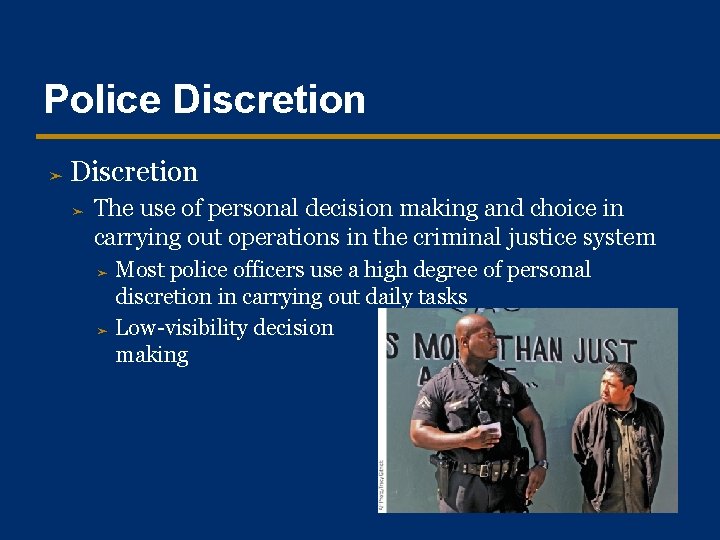
Police Discretion ➤ The use of personal decision making and choice in carrying out operations in the criminal justice system Most police officers use a high degree of personal discretion in carrying out daily tasks ➤ Low-visibility decision making ➤
Police Discretion ➤ Factors Influencing Discretion ➤ ➤ ➤ ➤ Crime factors Victim factors Environmental factors Departmental factors Peer factors Suspect behavior and characteristics Officer characteristics
Thinking Point ➤ There are 7 factors believed to influence police discretion (crime factors, victim factors, environmental factors, departmental factors, peer factors, suspect and behavior and characteristics, and officer characteristics). ➤ Which factor(s) do you believe should influence officer discretion the most? The least? Why?
Problems of Policing ➤ The role ambiguity, social isolation, and threat of danger present in working the streets are the police officer’s constant companions ➤ The most significant negative effects are job stress, fatigue, violence and brutality, and corruption
Job Stress Difficulties maintaining social and family relationships, considering their schedule and workload ➤ Stressors are typically: ➤ ➤ ➤ External Organizational Duty Individual
Job Stress ➤ Controlling police fatigue ➤ ➤ Review policies, procedures, and practices Assess how much of a voice officers are given in workhour and shift-scheduling decisions Assess the level of fatigue officers experience Review recruit and in-service training programs
Violence and Brutality ➤ ➤ Refers to actions such as using abusive language, making threats, using force or coercion unnecessarily, prodding with nightsticks, and stopping and searching people to harass them Evidence shows that only a small proportion of officers are continually involved in problem behavior
Corruption ➤ ➤ Consists of exercising legitimate discretion for improper reasons or using illegal means to achieve approved goals Two types of corrupt officers: 1. Meat eaters ➤ 2. Aggressively misuse police power for personal gain by demanding bribes, threatening legal action, or cooperating with criminals Grass eaters ➤ Accept payoffs when their everyday duties place them in a position to be solicited by the public
Corruption ➤ Types of corruption include: ➤ ➤ ➤ Internal corruption Selective enforcement or nonenforcement Active criminality Bribery and extortion Causes of corruption include: ➤ ➤ ➤ Police personality Institutions and practices Moral ambivalence Environmental conditions Corrupt departments Officer characteristics
Thinking Point ➤ Do you believe violence and/or corruption in policing are a problem in your neighborhood? ➤ ➤ How frequently are incidents of violence and/or corruption in policing represented in the media? What types of ways of controlling corruption are discussed?
Controlling Corruption ➤ Strengthen the internal administrative review process within police departments ➤ Accountability system ➤ ➤ A system that makes police supervisors responsible for the behavior of the officers in their command Outside reviews boards Change the social context of policing Special prosecutor
Use of Force ➤ Police use of force may not be as common as previously believed, but it still remains a central part of the police role ➤ ➤ Remains debate over whether police are more likely to get rough with minority suspects Suspect behavior may be a more important determinant of force than race or ethnicity
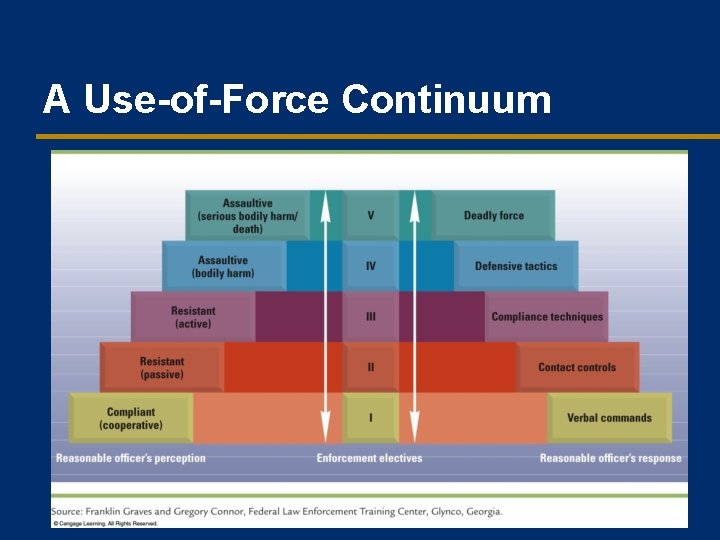
A Use-of-Force Continuum
Deadly Force ➤ Deadly force ➤ ➤ Force that is likely to cause death or significant bodily harm Non-deadly force ➤ Force that is unlikely to cause death or significant bodily harm
Deadly Force ➤ Factors related to police shootings ➤ ➤ ➤ ➤ Local and national violence levels Exposure to violence Workload Firearms availability Social conflict Administrative policies Race
Controlling Deadly Force ➤ One of the most difficult problems that undermined the control of deadly force was the continued use of the fleeing-felon rule in a number of states ➤ Tennessee v. Garner (1985) ➤ ➤ ➤ Outlawed the indiscriminate use of deadline force Individual state jurisdictions still control police shooting policy and some states have adopted statutory policies that restrict the police use of violence Internal review and policy making by police administrative review boards are used
Nondeadly Force ➤ Can range from the use of handcuffs and suspect compliance techniques to rubber bullets and stun guns ➤ ➤ Researchers have found that the crime in question is strongly linked to the type of nondeadly force used Officers are also influenced by past experience, the presence of other officers, and the presence and behavior of bystanders
Nondeadly Force ➤ Graham v. Connor ➤ ➤ Created reasonableness standard Less lethal weapons ➤ ➤ Designed to subdue suspects Among the most widely used nonlethal weapons are impact munitions ➤ Used to stun or otherwise incapacitate uncooperative suspects so they can be subdued
Thinking Point ➤ Research has shown that Tasers are more effective at incapacitating suspects that pepper spray. ➤ ➤ What are the advantages and disadvantages of using a less-lethal type of force like a taser? Would you advocate the use of a taser or pepper spray by police? In what circumstances? Why or why not?
Police as Victims ➤ Fewer people are being killed by police, and fewer officers are being killed in the line of duty than ever before
- Slides: 35