
Chapter 7 Interrogations and Confessions Objectives Define interrogation
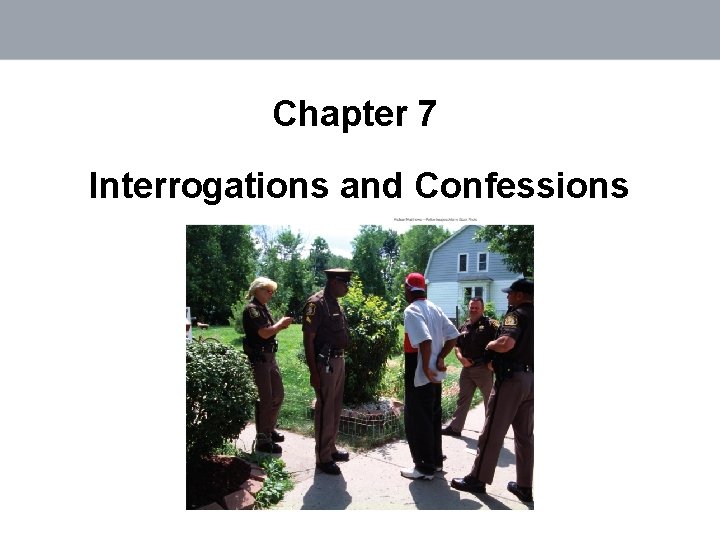
Chapter 7 Interrogations and Confessions
Objectives • Define interrogation and explain how it differs from an interview • Discuss the controversy of interrogation methods • Identify the prerequires of a productive interrogation • Compare and contrast the Reid Technique of interrogations with the PEACE Model • Discuss the methods of conduction a polygraph examination and the value of the results Brandl, Criminal Investigation 4 e SAGE Publishing, 2018 3
Objectives • Discuss how the use of deception by investigators in interrogations can be problematic and how it can be useful • Explain why suspects confess • Explain why suspects falsely confess what can be done to prevent false confessions • Discuss the general theory underlying the detection of deception and identify the non-verbal and verbal behaviors that tend to indicate deception • Discuss the methods of conduction a polygraph examination and the value of the results Brandl, Criminal Investigation 4 e SAGE Publishing, 2018 4
From the Case File: The “Secret” Interrogation of O. J. Simpson • The interrogation of O. J. Simpson was poorly conducted and as a result, O. J. Simpson was able to provide vague answers and conflicting statements – The three questions of the most importance were not well answered. These questions were: o When did O. J. Simpson last drive the Ford Bronco? Where did he park it? o When did O. J. Simpson injure his hand? o What were his activities on the night of the murders? Brandl, Criminal Investigation 4 e SAGE Publishing, 2018 5

Interrogation Defined • Interrogation is questioning and other actions conducted by an investigator done to elicit information from a suspect • The goal is to obtain a confession but not a false confession – Noncustodial interrogation does not require the investigator to inform the suspect of his/her Miranda rights Brandl, Criminal Investigation 4 e SAGE Publishing, 2018 6
The Controversy of Interrogation Methods • There is controversy about how interrogations should be done to avoid false confessions, and in the end, false convictions – As of 2017, 242 of 2, 026 false convictions occurred based on a false confession o This is especially prevalent in homicide cases (20%) Brandl, Criminal Investigation 4 e SAGE Publishing, 2018 7

The Controversy of Interrogation Methods – The Reid Technique relies on confrontation and stress to obtain confession o It is still trained and legally supported although it is under a lot of ethical scrutiny – The goal of an interrogation is not necessarily a confession Brandl, Criminal Investigation 4 e SAGE Publishing, 2018 8

Prerequisites for a Productive Interrogation • • A plan Adequate time Control of the conversation A good understanding of the facts of the case A familiarity with the suspect’s background Ability to build rapport A familiarity with persuasive themes, approaches, and tactics Brandl, Criminal Investigation 4 e SAGE Publishing, 2018 9

Approaches to Investigative Interrogations • The traditionally used Reid Technique is facing a lot of criticism • The PEACE Model is mostly used in England Canada but is also starting to be used in the U. S. Brandl, Criminal Investigation 4 e SAGE Publishing, 2018 10
The Reid Technique • Three stages: – Factual analysis – Information-gathering – Nine steps of interrogation Brandl, Criminal Investigation 4 e SAGE Publishing, 2018 11
Nine Steps of Interrogation 1. Confront the suspect directly with a statement that he or she committed the crime and then wait for a reaction 2. Classify the suspect as emotional or non-emotional – Emotional offenders experience guilt and respond to emotional themes – Non-emotional offenders respond to rational themes 3. Denials beyond the initial one should be cut off Brandl, Criminal Investigation 4 e SAGE Publishing, 2018 12
Nine Steps of Interrogation 4. Objections take place 5. Make clear the intent of just getting the truth 6. Continue theme by showing that a confession is the best course of action 7. Force the suspect to answer a yes or no question regarding the incident that indicate some involvement 8. Have the suspect orally relate their involvement 9. Turn the oral confession into a written one Brandl, Criminal Investigation 4 e SAGE Publishing, 2018 13
The PEACE Model • Less coercive and manipulative than the Reid Technique • Five stages: – Planning and preparation – Engage and explain – Account, clarify, and challenge – Closure – Evaluation Brandl, Criminal Investigation 4 e SAGE Publishing, 2018 14
The Potential Problems with Police Deception in Interrogations • Interrogators may use persuasion and deceit to get a person to confess – Deceive suspect into believing there is evidence against him or her – Technology may be used to detect deception and its capabilities may be legally overstated (e. g. voice stress analyzer) – Misrepresentation of the seriousness of the crime Brandl, Criminal Investigation 4 e SAGE Publishing, 2018 15
Why Do Suspects Confess? There are many reasons for suspects to confess • Feelings of guilt and the need forgiveness • The suspect believes his/her involvement in the crime can be proven • To justify their actions • To enhance their reputation as a criminal Brandl, Criminal Investigation 4 e SAGE Publishing, 2018 16
Why Do Suspects Confess? • To get help for their problematic behaviors • The suspect is convinced by investigators to confess • The suspect confesses to one crime to avoid questions about another • As a payback for respectful treatment by investigators Brandl, Criminal Investigation 4 e SAGE Publishing, 2018 17
The Issue of False Confessions • A false confession is when an innocent individual confesses to a crime or overstates his/her involvement in the crime • Why do people confess to crimes that they did not commit? – Stress Compliant false confessions – Persuaded false confessions – Voluntary false confessions • False confessions are significant because a confession is the most persuasive form of evidence for establishing guilt Brandl, Criminal Investigation 4 e SAGE Publishing, 2018 18
What Can be Done about False Confessions? • The police must be mindful that false confessions occur • A confession should not be seen as the ultimate goal of an interrogation • The police should recognize that deceptive behavior does not prove guilt in the crime in question • The police should video-record all investigations • The police should systematically evaluate the credibility of the confessions obtained Brandl, Criminal Investigation 4 e SAGE Publishing, 2018 19
Investigative Tools in Recognizing Deception • It is important to detect deception when obtaining information from people • The basic theory is that under stressful situations, like an interrogation, suspects will try to repress fight or flight responses through physiological changes Brandl, Criminal Investigation 4 e SAGE Publishing, 2018 20
Non-Mechanical Methods of Detecting Deception • Non-mechanical methods of detecting deception include verbal and nonverbal practices – No single behavior is always indicative of deception – Gender and ethnic/cultural differences need to be considered – The situation and environment need to be factored in Brandl, Criminal Investigation 4 e SAGE Publishing, 2018 21
Non-Mechanical Methods of Detecting Deception • Behavioral clusters may be meaningful even though single behaviors may not be • The timing of verbal and nonverbal cues needs to be considered • Nonverbal behaviors like facial expressions, body positioning, and gestures • Verbal behaviors are easier to control, yet can still be indicators of deception Brandl, Criminal Investigation 4 e SAGE Publishing, 2018 22
Verbal Cues Related to Deception • • Use of vague and confusing answers Providing conflicting statements Offering explanations that do not make sense Using the present tense to describe a past occurrence Presence of modifiers Eliminating or reducing self-references Using unusually short, long, or complicated sentences Brandl, Criminal Investigation 4 e SAGE Publishing, 2018 23
Verbal Cues Related to Deception • • Complaining frequently Delaying answering questions Being overly helpful, polite, or respectful Claiming to experience memory problems, or to have too good of a memory • Denying their involvement with strong denials • Using “buy-out” statements Brandl, Criminal Investigation 4 e SAGE Publishing, 2018 24
Mechanical Methods of Detecting Deception • Polygraph – A machine that records physiological responses (perspiration, blood pressure, and galvanic skin response) to psychological phenomena like the stress of deception – Not always accurate (60– 75% accuracy rates) but can be useful in eliciting a confession – Infrequently admitted into court Brandl, Criminal Investigation 4 e SAGE Publishing, 2018 25
Mechanical Methods of Detecting Deception • Computer Stress Analyzer – A machine to detect in one’s voice – Not a valid scientific assessment but can be useful in eliciting confessions Brandl, Criminal Investigation 4 e SAGE Publishing, 2018 26
Types of Polygraph Techniques • Relevant-Irrelevant Test – A series of relevant and irrelevant questions to determine deception • Concealed-Information Test – Multiple-choice questions concerning “guilty knowledge” of the suspect • Control Question Technique – Asks both control and crime-relevant questions o The control questions affect the innocent o The crime-relevant questions affect the guilty Brandl, Criminal Investigation 4 e SAGE Publishing, 2018 27
Challenges with Measuring the Accuracy of the Polygraph • Difficult to test it in actual investigative settings where it is unknown whether the subject is actually stating the truth or being deceptive • There might be characteristics of the subject which influence the accuracy (e. g. mental illness) • It depends on the skill of the operator to use the machine correctly and interpret the results Brandl, Criminal Investigation 4 e SAGE Publishing, 2018 28
- Slides: 28