
Chapter 7 Integers Part 2 Part 1 Graphing








- Slides: 26
Chapter 7 Integers Part 2
Part…. . 1. Graphing Rational Numbers 2. Absolute Value 3. Ordering Rational Numbers 4. Comparing Value v/s Absolute Value
Part 1
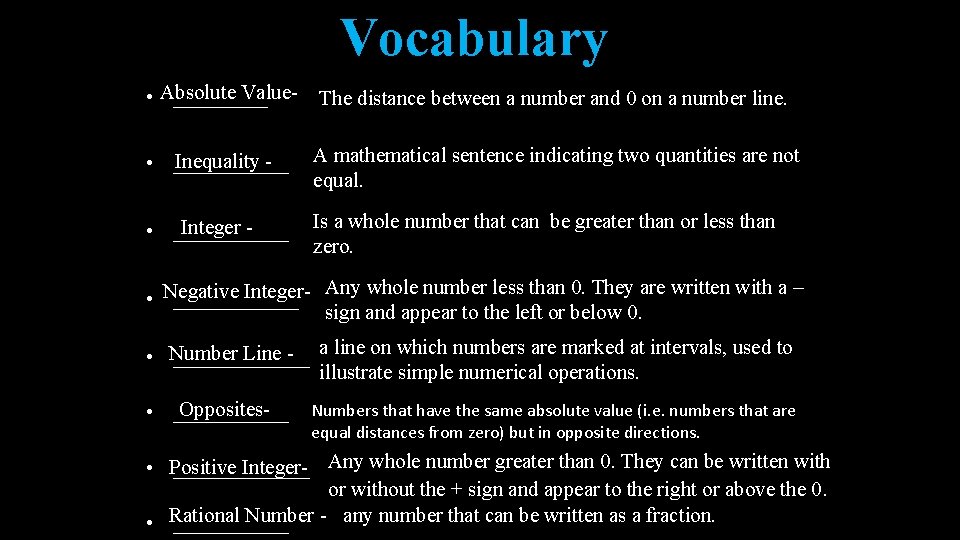
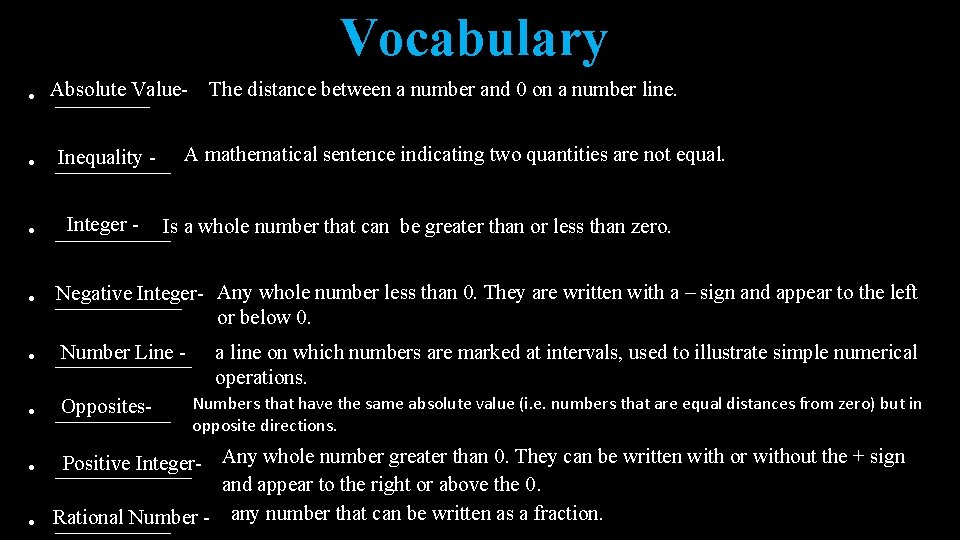
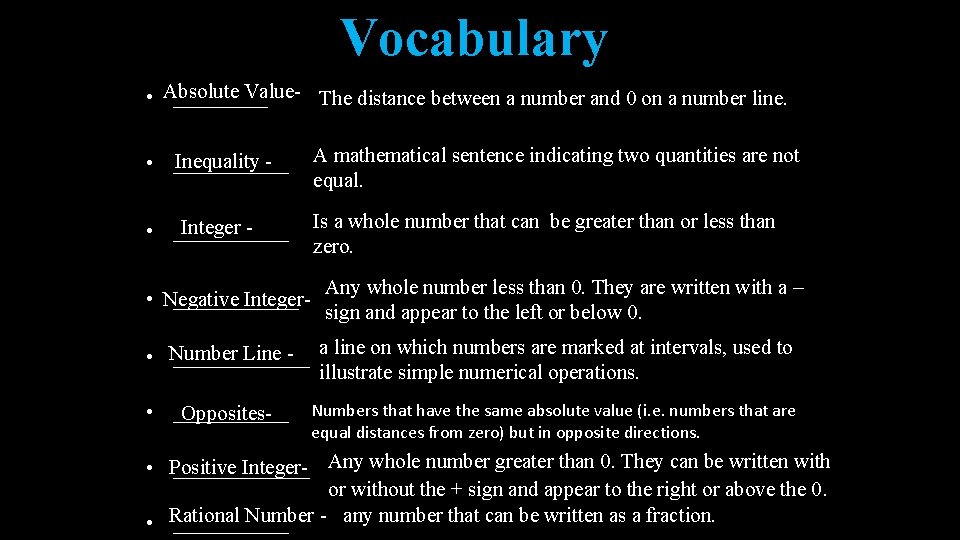
Vocabulary Value- The distance between a number and 0 on a number line. • Absolute _____ Inequality • ______ A mathematical sentence indicating two quantities are not equal. Integer • ______ Is a whole number that can be greater than or less than zero. Integer- Any whole number less than 0. They are written with a – • Negative ______ sign and appear to the left or below 0. Line - a line on which numbers are marked at intervals, used to • Number _______ illustrate simple numerical operations. Opposites • ______ Numbers that have the same absolute value (i. e. numbers that are equal distances from zero) but in opposite directions. Integer- Any whole number greater than 0. They can be written with • Positive _______ or without the + sign and appear to the right or above the 0. Number - any number that can be written as a fraction. • Rational ______
Today’s Standard 6. NS. C. 6. c Find and position integers and other rational numbers on a horizontal or vertical number line diagram; find and position pairs of integers and other rational numbers on a coordinate plane.
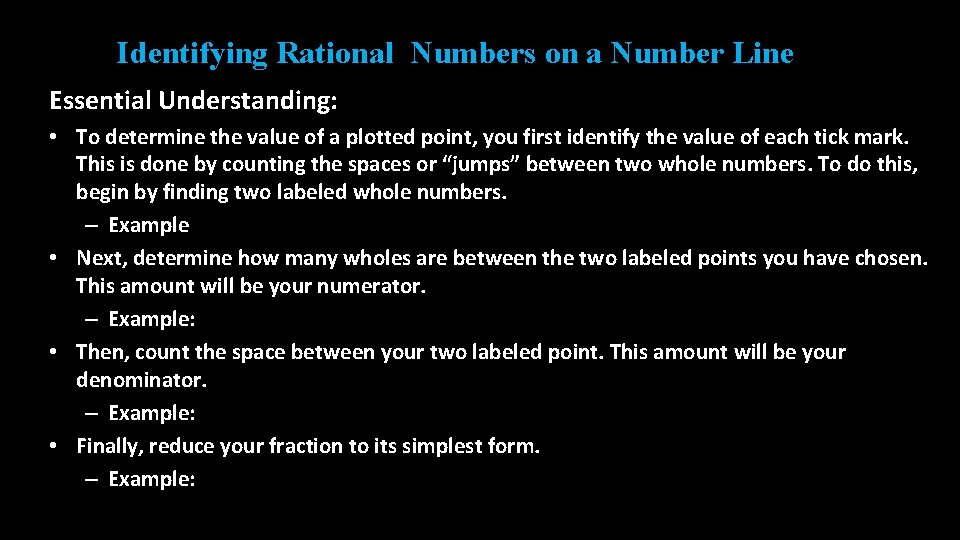
Identifying Rational Numbers on a Number Line Essential Understanding: • To determine the value of a plotted point, you first identify the value of each tick mark. This is done by counting the spaces or “jumps” between two whole numbers. To do this, begin by finding two labeled whole numbers. – Example • Next, determine how many wholes are between the two labeled points you have chosen. This amount will be your numerator. – Example: • Then, count the space between your two labeled point. This amount will be your denominator. – Example: • Finally, reduce your fraction to its simplest form. – Example:
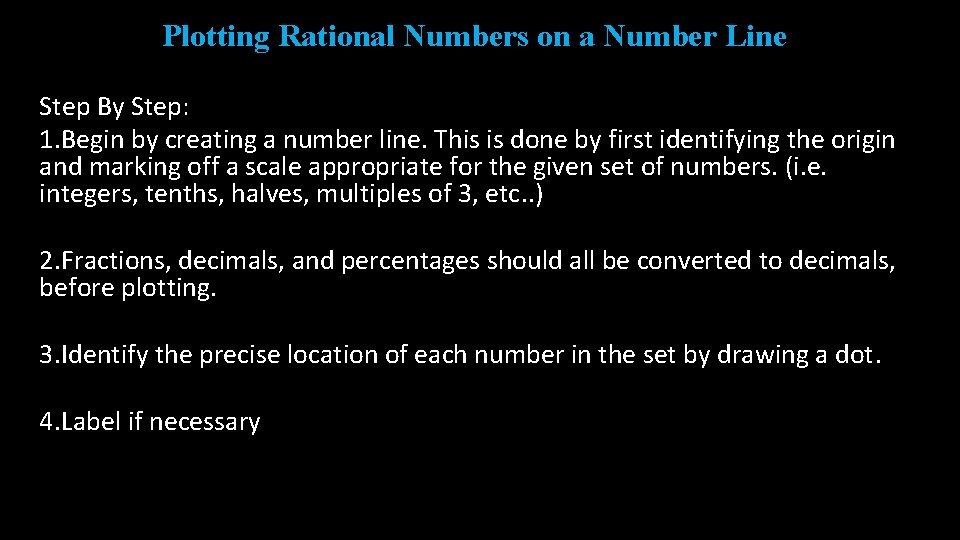
Plotting Rational Numbers on a Number Line Step By Step: 1. Begin by creating a number line. This is done by first identifying the origin and marking off a scale appropriate for the given set of numbers. (i. e. integers, tenths, halves, multiples of 3, etc. . ) 2. Fractions, decimals, and percentages should all be converted to decimals, before plotting. 3. Identify the precise location of each number in the set by drawing a dot. 4. Label if necessary
Wrap it Up • Review • Questions • Exit Tickets
Part 2
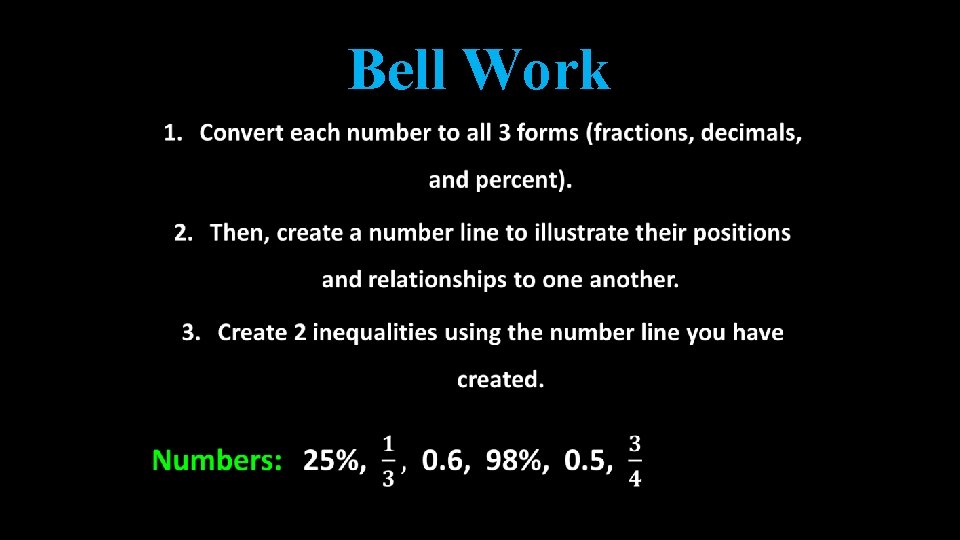
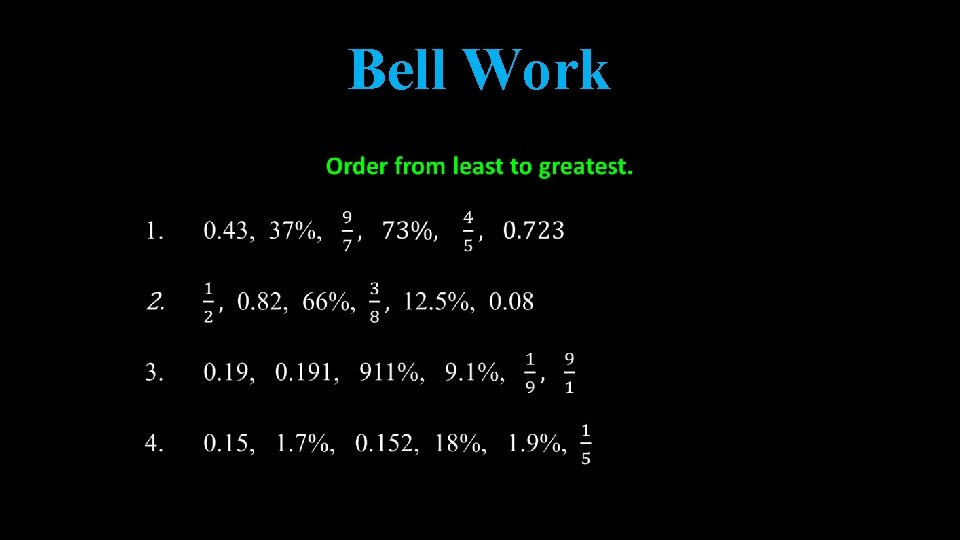
Bell Work •
Vocabulary Value- The distance between a number and 0 on a number line. • Absolute _____ Inequality - A mathematical sentence indicating two quantities are not equal. • ______ Integer - Is a whole number that can be greater than or less than zero. • ______ Negative Integer- Any whole number less than 0. They are written with a – sign and appear to the left • ______ or below 0. Number Line • _______ Opposites • ______ a line on which numbers are marked at intervals, used to illustrate simple numerical operations. Numbers that have the same absolute value (i. e. numbers that are equal distances from zero) but in opposite directions. Positive Integer- Any whole number greater than 0. They can be written with or without the + sign • _______ and appear to the right or above the 0. Number - any number that can be written as a fraction. • Rational ______
Today’s Standard 6. NS. C. 7 c . Understand the absolute value of a rational number as its distance from 0 on the number line; interpret absolute value as magnitude for a positive or negative quantity in a real-world situation.
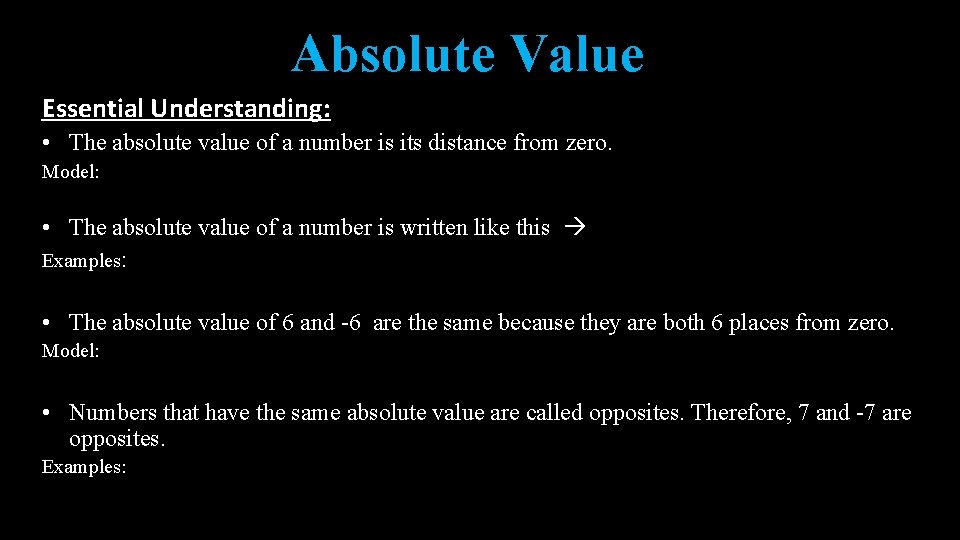
Absolute Value Essential Understanding: • The absolute value of a number is its distance from zero. Model: • The absolute value of a number is written like this Examples: • The absolute value of 6 and -6 are the same because they are both 6 places from zero. Model: • Numbers that have the same absolute value are called opposites. Therefore, 7 and -7 are opposites. Examples:
Wrap it Up • Review • Questions • Exit Tickets
Part 3
Bell Work
Vocabulary Value- The distance between a number and 0 on a number line. • Absolute _____ Inequality • ______ A mathematical sentence indicating two quantities are not equal. Integer • ______ Is a whole number that can be greater than or less than zero. • Negative ______ Integer- Any whole number less than 0. They are written with a – sign and appear to the left or below 0. Line - a line on which numbers are marked at intervals, used to • Number _______ illustrate simple numerical operations. • ______ Opposites- Numbers that have the same absolute value (i. e. numbers that are equal distances from zero) but in opposite directions. Integer- Any whole number greater than 0. They can be written with • Positive _______ or without the + sign and appear to the right or above the 0. Number - any number that can be written as a fraction. • Rational ______
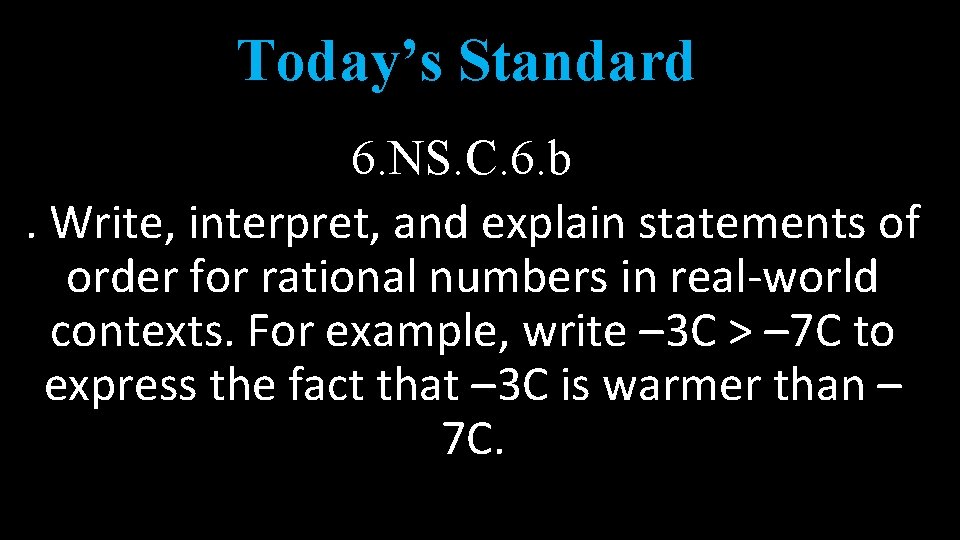
Today’s Standard 6. NS. C. 6. b. Write, interpret, and explain statements of order for rational numbers in real-world contexts. For example, write – 3 C > – 7 C to express the fact that – 3 C is warmer than – 7 C.
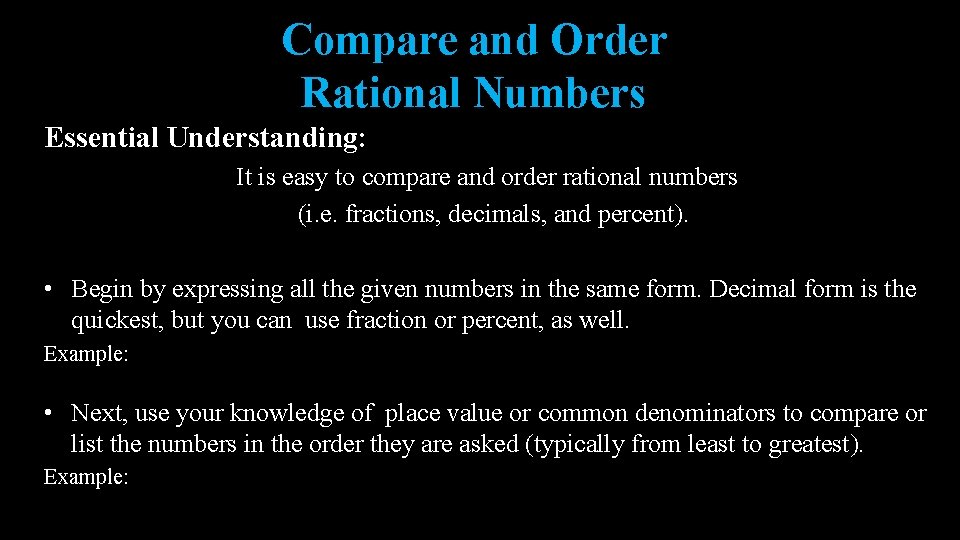
Compare and Order Rational Numbers Essential Understanding: It is easy to compare and order rational numbers (i. e. fractions, decimals, and percent). • Begin by expressing all the given numbers in the same form. Decimal form is the quickest, but you can use fraction or percent, as well. Example: • Next, use your knowledge of place value or common denominators to compare or list the numbers in the order they are asked (typically from least to greatest). Example:
Wrap it Up • Review • Questions • Exit Tickets
Part 4
Bell Work •
Vocabulary Value- The distance between a number and 0 on a number line. • Absolute _____ Inequality • ______ A mathematical sentence indicating two quantities are not equal. Integer • ______ Is a whole number that can be greater than or less than zero. • Negative ______ Integer- Any whole number less than 0. They are written with a – sign and appear to the left or below 0. Line - a line on which numbers are marked at intervals, used to • Number _______ illustrate simple numerical operations. • ______ Opposites- Numbers that have the same absolute value (i. e. numbers that are equal distances from zero) but in opposite directions. Integer- Any whole number greater than 0. They can be written with • Positive _______ or without the + sign and appear to the right or above the 0. Number - any number that can be written as a fraction. • Rational ______
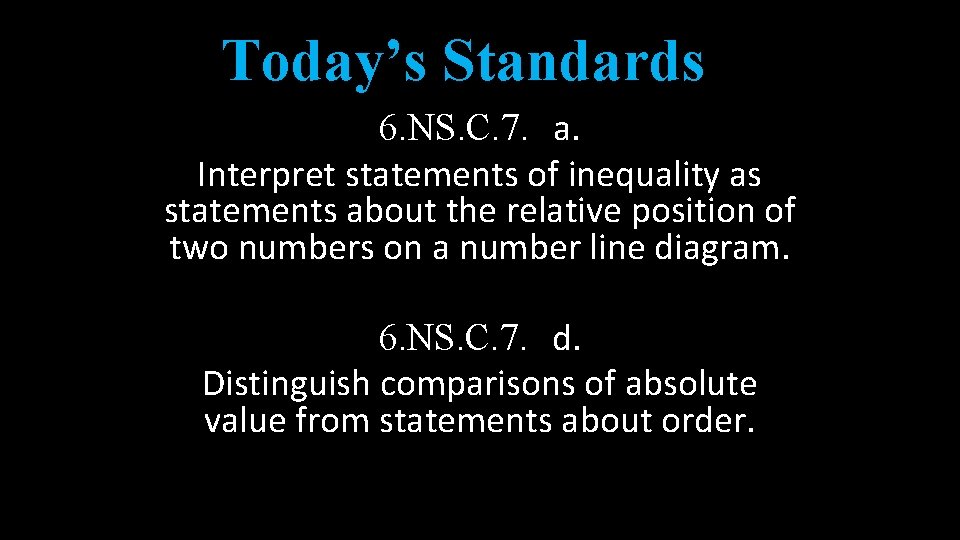
Today’s Standards 6. NS. C. 7. a. Interpret statements of inequality as statements about the relative position of two numbers on a number line diagram. 6. NS. C. 7. d. Distinguish comparisons of absolute value from statements about order.
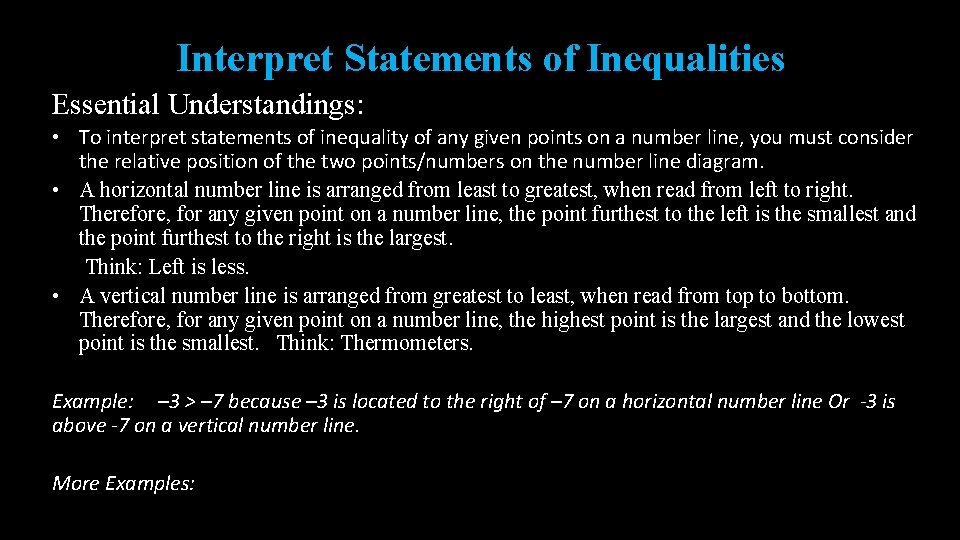
Interpret Statements of Inequalities Essential Understandings: • To interpret statements of inequality of any given points on a number line, you must consider the relative position of the two points/numbers on the number line diagram. • A horizontal number line is arranged from least to greatest, when read from left to right. Therefore, for any given point on a number line, the point furthest to the left is the smallest and the point furthest to the right is the largest. Think: Left is less. • A vertical number line is arranged from greatest to least, when read from top to bottom. Therefore, for any given point on a number line, the highest point is the largest and the lowest point is the smallest. Think: Thermometers. Example: – 3 > – 7 because – 3 is located to the right of – 7 on a horizontal number line Or -3 is above -7 on a vertical number line. More Examples:
Wrap it Up • Review • Questions • Exit Tickets