
chapter 7 Instructional Strategies for Adapted Physical Education







- Slides: 31
chapter 7 Instructional Strategies for Adapted Physical Education Douglas H. Collier
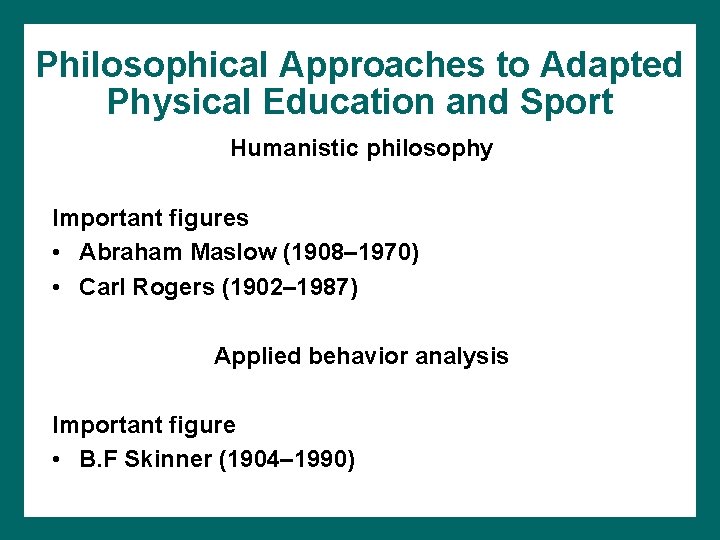
Philosophical Approaches to Adapted Physical Education and Sport Humanistic philosophy Important figures • Abraham Maslow (1908– 1970) • Carl Rogers (1902– 1987) Applied behavior analysis Important figure • B. F Skinner (1904– 1990)
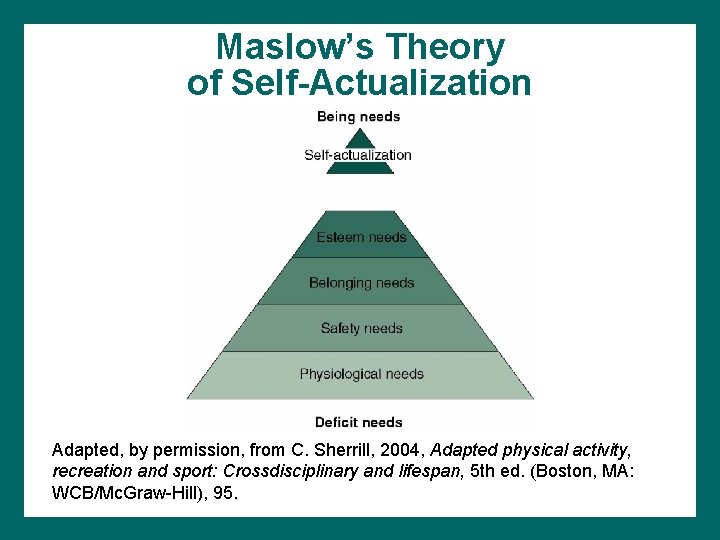
Maslow’s Theory of Self-Actualization Adapted, by permission, from C. Sherrill, 2004, Adapted physical activity, recreation and sport: Crossdisciplinary and lifespan, 5 th ed. (Boston, MA: WCB/Mc. Graw-Hill), 95.
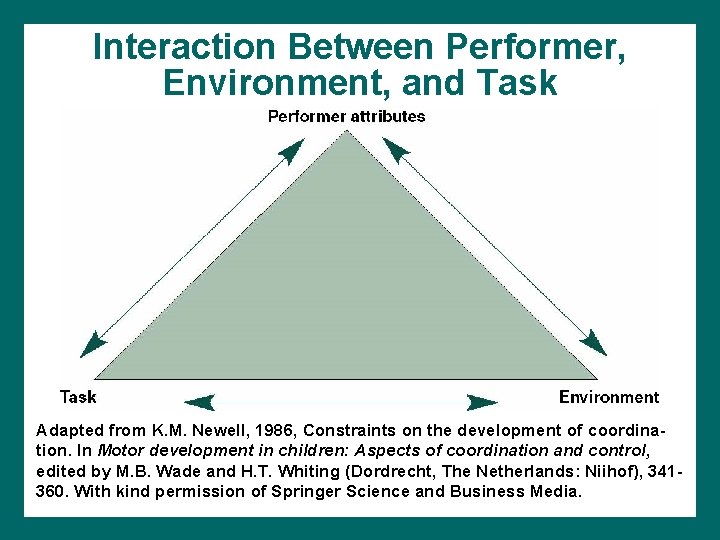
Interaction Between Performer, Environment, and Task Adapted from K. M. Newell, 1986, Constraints on the development of coordination. In Motor development in children: Aspects of coordination and control, edited by M. B. Wade and H. T. Whiting (Dordrecht, The Netherlands: Niihof), 341360. With kind permission of Springer Science and Business Media.
Motor Skill Tenets 1. Growth and maturation influence the ability to learn a movement skill. 2. Mechanical and physiological principles of movement dictate the best way to perform a given skill. 3. Reinforcement and repetition are needed when learning a new skill. (continued)
Motor Skill Tenets (continued) 4. Emotion affects the process of learning motor skills. 5. Success at a given task leads to improved learning. 6. Learning takes place more quickly when practice sessions are separated by adequate rest periods. 7. Motor skills that are overlearned are retained longer.
Curricular Modifications Leading to Meaningful Integration • The “same” curriculum • Multilevel curriculum • Modified curriculum • Different curriculum
Curricular Approaches Top-Down An emphasis on the teaching of specific, functional, age-appropriate leisure skills (continued)
Curricular Approaches (continued) Bottom-Up A developmentally focused curriculum with an emphasis on abilities expected at a particular chronological age
Categories of Activity Modifications • Equipment • Rules • Environment • Instruction
Effective Teachers Adapt Their Instruction To. . . • The nature of the content being taught • Their personal skills and preferences • The characteristics of the learners • The teaching context
Teaching Styles Reproductive styles • Command • Practice/task • Reciprocal • Self-check • Inclusion/invitation (continued)
Teaching Styles (continued) Productive styles • Guided discovery • Convergent discovery • Divergent discovery (after Mosston and Ashworth, 1994)
Teaching Formats • One-to-one instruction • Small-group instruction • Large-group instruction • Mixed-group instruction • Peer teaching or tutoring (continued)
Teaching Formats (continued) • Self-paced independent work • Cooperative learning • Reverse mainstreaming • Teaching stations
Components of an Instructional Episode • Instruction • Optional prompt • Student’s response • Consequences • Intertrial interval
The Response Prompting Continuum Physical prompts Complete physical manipulation Manipulative prompting Minimal guidance Visual prompts Complete skill demonstration Partial skill demonstration Gestural prompting (continued)
The Response Prompting Continuum (continued) Verbal prompts Skill cue Action command Action cue No prompts Initiation with environmental goal Imitative initiation Initiation in free play (after Watkinson and Wall, 1982)
Guidelines for Effective Prompting • Use prompts that are meaningful to the student. • Consider the learner’s characteristics. • Be careful not to underprompt. • Be careful not to overprompt. • Focus the learner’s attention on the task. (continued)
Guidelines for Effective Prompting (continued) • Make sure that the prompt is effective. • Pretest and assess carefully, as students might need less assistance than you assume. • Fade physical proximity. • Couple the appropriate verbal prompt with other prompts used. • Fade verbal prompts.
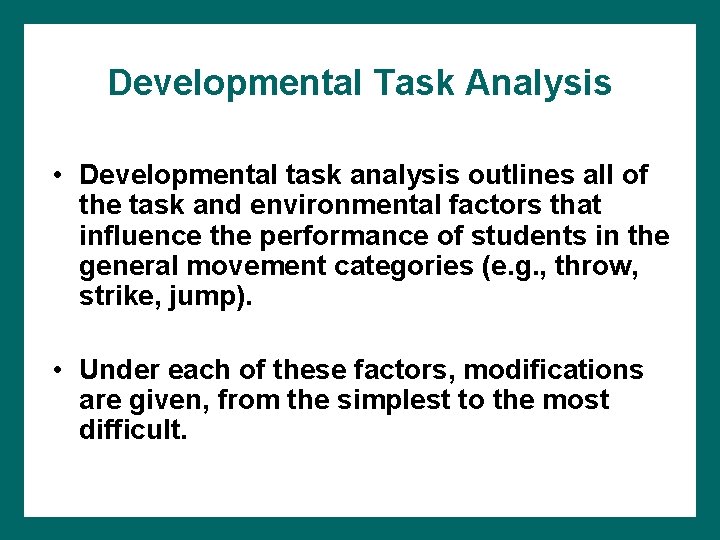
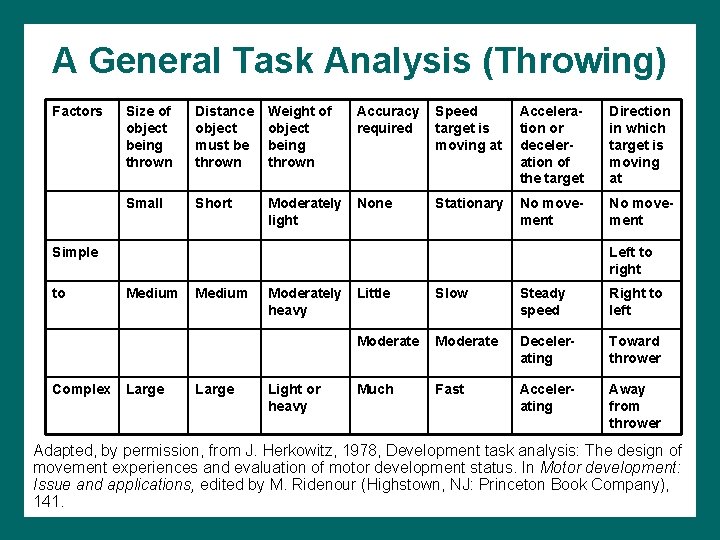
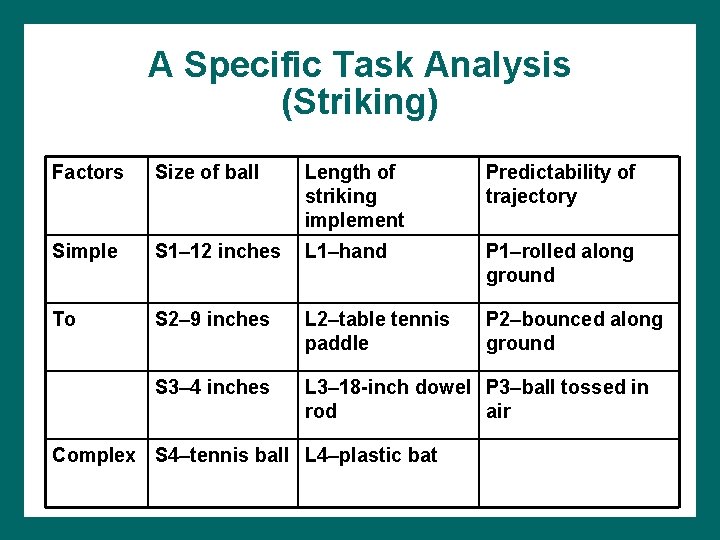
Developmental Task Analysis • Developmental task analysis outlines all of the task and environmental factors that influence the performance of students in the general movement categories (e. g. , throw, strike, jump). • Under each of these factors, modifications are given, from the simplest to the most difficult.
A General Task Analysis (Throwing) Factors Size of object being thrown Distance object must be thrown Weight of object being thrown Accuracy Speed required target is moving at Small Short Moderately None light Stationary Acceleration or deceleration of the target Direction in which target is moving at No movement Simple to Complex Left to right Medium Large Moderately Little heavy Light or heavy Slow Steady speed Right to left Moderate Decelerating Toward thrower Much Fast Accelerating Away from thrower Adapted, by permission, from J. Herkowitz, 1978, Development task analysis: The design of movement experiences and evaluation of motor development status. In Motor development: Issue and applications, edited by M. Ridenour (Highstown, NJ: Princeton Book Company), 141.
A Specific Task Analysis (Striking) Factors Size of ball Length of striking implement Simple S 1– 12 inches L 1–hand P 1–rolled along ground To S 2– 9 inches L 2–table tennis paddle P 2–bounced along ground S 3– 4 inches L 3– 18 -inch dowel P 3–ball tossed in rod air Complex S 4–tennis ball L 4–plastic bat Predictability of trajectory
Prescriptive Planning and Instructional Models Project ACTIVE • Incorporates a test-assess-prescribeevaluate planning process • Includes normative as well as criterionreferenced tests in the areas of motor ability, nutrition, physical fitness, and posture (continued)
Prescriptive Planning and Instructional Models (continued) The Data-Based Gymnasium • A prescriptive instructional model that provides information on effectively managing the learning environment of individuals with severe disabilities • Unique in its specific delineation of applied behavior analysis techniques as a means of accomplishing meaningful learning objectives (continued)
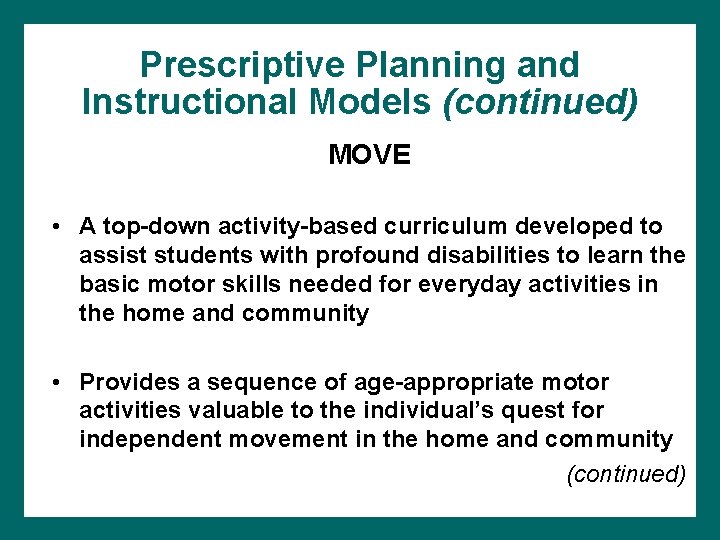
Prescriptive Planning and Instructional Models (continued) MOVE • A top-down activity-based curriculum developed to assist students with profound disabilities to learn the basic motor skills needed for everyday activities in the home and community • Provides a sequence of age-appropriate motor activities valuable to the individual’s quest for independent movement in the home and community (continued)
Prescriptive Planning and Instructional Models (continued) Moving to Inclusion • Consists of nine books, available in English and French, that address a variety of disability groups. • Each book provides ideas for individualizing and modifying activities. • These resources are particularly valuable when planning to include students with disabilities in regular physical education classes. (continued)
Prescriptive Planning and Instructional Models (continued) Special Olympics A series of sport-specific instructional manuals, each including long-term goals, short-term objectives, skill assessment, task analysis, teaching suggestions, progression charts, and related information (continued)
Prescriptive Planning and Instructional Models (continued) I CAN • Individualized instruction, create social leisure competence, associate all learning, narrow the gap between theory and practice • A comprehensive physical education and leisure skills program appropriate for children with unique needs • Developmental in nature, I CAN provides a continuum of skills from preprimary motor and play skills to sport, leisure, and recreation skills (continued)
Prescriptive Planning and Instructional Models (continued) I CAN Primary Skills K – 3 A performance-based instructional model with feedback methods to improve and modify instruction based on student performance (continued)
Prescriptive Planning and Instructional Models (continued) SMART START Provides teachers and caregivers a developmentally appropriate movement curriculum for preschoolaged children of all abilities