
Chapter 7 Information Collection and Use For use














- Slides: 46
Chapter 7: Information Collection and Use For use with Strategic Electronic Marketing: Managing E-Business Copyright 2000 South-Western College Publishing 1
LEARNING OBJECTIVES(1): • Describe how businesses are using data to gain competitive advantages. • Explain the flow related to marketing information systems. • List the sources of information for a business. For use with Strategic Electronic Marketing: Managing E-Business Copyright 2000 South-Western College Publishing 2
LEARNING OBJECTIVES(2): • Explain how a business uses information to discover new knowledge. • Describe the role that databases play in organizational knowledge. • Explain how a business can incorporate organizational knowledge into its decision making process. For use with Strategic Electronic Marketing: Managing E-Business Copyright 2000 South-Western College Publishing 3
Vignette: What's Old Is New Again (1) • Thinking Strategically – Determine the importance that the knowledge of customer data plays in increasing the profitability of banks. – Justify why a bank should charge its own customers to use “live” tellers. – Consider if a bank should provide free customer service as a community service. For use with Strategic Electronic Marketing: Managing E-Business Copyright 2000 South-Western College Publishing 4
Vignette: What's Old Is New Again (2) • Thinking Strategically – Speculate on how customers would feel if they knew that their bank tracked individual behaviors. – Determine how the customer could benefit by the bank’s knowledge of their behavior. Capital One (www. capitalone. com), The Bank of America’s (www. bankofamerica. com), The Bank of Montreal (www. bmo. com) , First Union Corp. (www. firstunion. com). For use with Strategic Electronic Marketing: Managing E-Business Copyright 2000 South-Western College Publishing 5
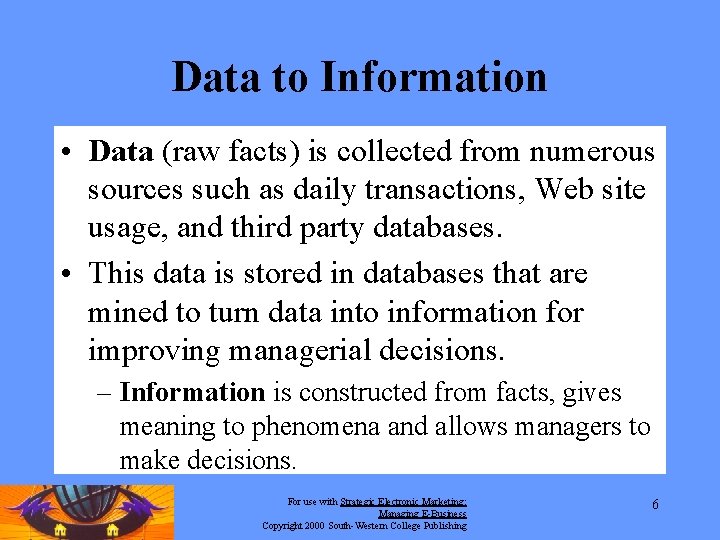
Data to Information • Data (raw facts) is collected from numerous sources such as daily transactions, Web site usage, and third party databases. • This data is stored in databases that are mined to turn data into information for improving managerial decisions. – Information is constructed from facts, gives meaning to phenomena and allows managers to make decisions. For use with Strategic Electronic Marketing: Managing E-Business Copyright 2000 South-Western College Publishing 6
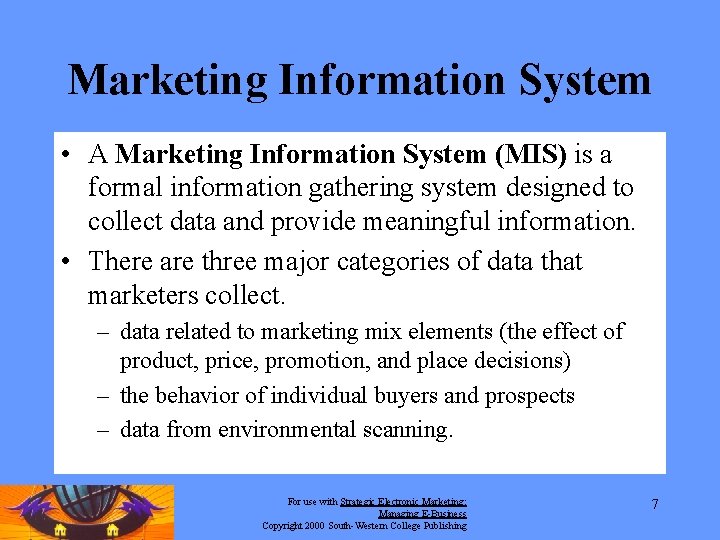
Marketing Information System • A Marketing Information System (MIS) is a formal information gathering system designed to collect data and provide meaningful information. • There are three major categories of data that marketers collect. – data related to marketing mix elements (the effect of product, price, promotion, and place decisions) – the behavior of individual buyers and prospects – data from environmental scanning. For use with Strategic Electronic Marketing: Managing E-Business Copyright 2000 South-Western College Publishing 7
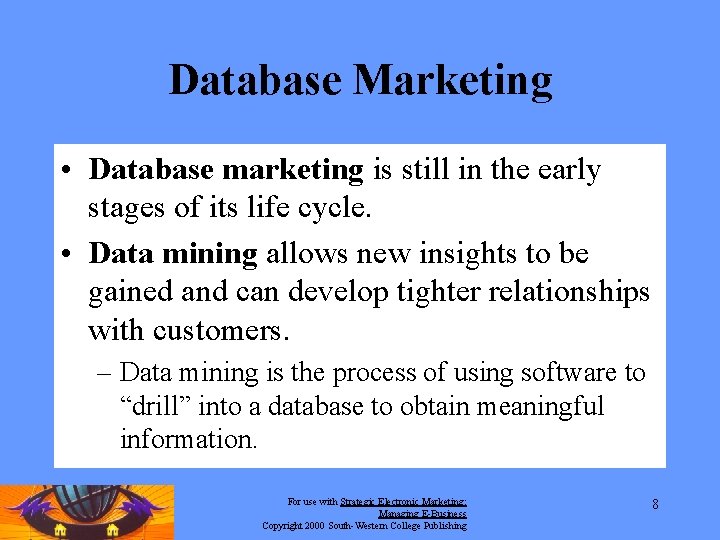
Database Marketing • Database marketing is still in the early stages of its life cycle. • Data mining allows new insights to be gained and can develop tighter relationships with customers. – Data mining is the process of using software to “drill” into a database to obtain meaningful information. For use with Strategic Electronic Marketing: Managing E-Business Copyright 2000 South-Western College Publishing 8
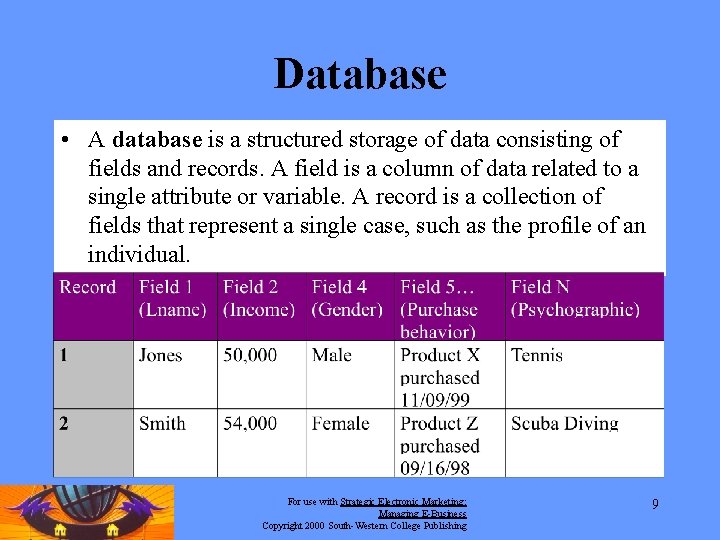
Database • A database is a structured storage of data consisting of fields and records. A field is a column of data related to a single attribute or variable. A record is a collection of fields that represent a single case, such as the profile of an individual. For use with Strategic Electronic Marketing: Managing E-Business Copyright 2000 South-Western College Publishing 9
Marketing Information System Flows SOURCES OF DATA THE MARKET Marketing Research & Data Capture COMPETITIVE INTELLIGENCE USE OF INFORMATION THE DATA BASE Data Warehouse Environmental Scanning and Data Collection THIRD PARTY DATA Secondary Data Marketing Decision Support System For use with Strategic Electronic Marketing: Managing E-Business Copyright 2000 South-Western College Publishing KNOWLEDGE DISCOVERY Information for Managerial Decisions BUSINESS SYSTEM CONTROL KNOWLEDGE MANAGEMENT 10
Data From the Market • Behavior tracking records transaction data taken from employees, data captured from point of sales scanners, and/or electronic recording devices such as Web tracking software. – The data captured can be transaction based, customer profile data, or more complex behavioral data can be recorded. • Customer's complaints or questions can be used to spot product defects or improve communication. – This type of information can be recorded from Web communications or logged in from telephone service operators. • Marketing research collects primary data directly from the market. For use with Strategic Electronic Marketing: Managing E-Business Copyright 2000 South-Western College Publishing 11
Behavior Tracking • Scanner data helps determine shopper's profiles allowing for a market-of-one strategy. • Service employees can help develop databases of customer's desires. • Web tracking monitors site use such as referral location (where the individuals linked from), surfing paths, and duration within a site. – This data can be made even more valuable when behavior is matched to visitor registration data. For use with Strategic Electronic Marketing: Managing E-Business Copyright 2000 South-Western College Publishing 12
Case 7. 1: Playing for Keeps • Thinking Strategically – Describe how the casinos track customers. – Determine what type of data the casinos would want to capture to identify high value customers. – Speculate on the use of that data, should the casinos use gaming information to entice customers to return. – Evaluate the advantages that a casino would gain by having access to this behavioral data. – Determine how this data could be used to gain competitive advantages. For use with Strategic Electronic Marketing: Managing E-Business Copyright 2000 South-Western College Publishing 13
Infomediary • An infomediary is a firm that specialized in the capture, collection, or analysis of data. – This service can be marketed to other businesses and can protect individual privacy. Cyber. Gold (www. cybergold. com) Engage Technologies (www. engage. com) For use with Strategic Electronic Marketing: Managing E-Business Copyright 2000 South-Western College Publishing 14
Customer Inquiries • Many businesses use software to track consumer's complaints. • Telephone service personnel can type consumer's concerns into computers where software then looks for patterns in the text. For use with Strategic Electronic Marketing: Managing E-Business Copyright 2000 South-Western College Publishing 15
Marketing Research • Marketing research is the systematic and objective process of generating data for aiding in making marketing decisions. • Online Research Advantages: – Data can be collected in a much shorter time and at a lower cost. – Errors from data collection can also be minimized. • Online Research Problems: – users do not represent a random sample of the overall population. For use with Strategic Electronic Marketing: Managing E-Business Copyright 2000 South-Western College Publishing 16
Table 7. 1: Marketing Research Steps (1) For use with Strategic Electronic Marketing: Managing E-Business Copyright 2000 South-Western College Publishing 17
Table 7. 1: Marketing Research Steps (2) For use with Strategic Electronic Marketing: Managing E-Business Copyright 2000 South-Western College Publishing 18
Online Research Design (1) • Software Based Surveys: – Data returned to the server can have statistical analysis is automatically performed, reports generated, and charts are developed. • Panels: A panel allows researchers to pull respondents from a known pool. Intelli. Quest (www. intelliquest. com) For use with Strategic Electronic Marketing: Managing E-Business Copyright 2000 South-Western College Publishing 19
Online Research Design (2) • Online Focus Groups: Traditional focus groups are a means of collecting a rich set of responses from a target audience. – Ongoing groups use forums or message boards to discuss the research topic. – Real-time chat groups allow several focus group members to interact online at the same time and have real-time discussions. For use with Strategic Electronic Marketing: Managing E-Business Copyright 2000 South-Western College Publishing 20
Competitive intelligence (CI) • Competitive intelligence (CI) is a continuous process involving the legal and ethical collection of information and monitoring of the competitive environment giving managers the ability to make strategic decisions. – Competitive intelligence allows managers to make informed decisions about marketing, R&D, and longterm business strategies. The Society for Competitive Intelligence Professionals (www. scip. org) Fuld’s Internet intelligence index (http: //www. fuld. com/i 3/index. html) For use with Strategic Electronic Marketing: Managing E-Business Copyright 2000 South-Western College Publishing 21
Guide To Ethical Snooping • • Observe legal restrictions Avoid misrepresentations Do not release misinformation Never ask for or exchange price information with competitors Don't steal trade secrets Do not offer bribes Do not hack other sites Protect information sources For use with Strategic Electronic Marketing: Managing E-Business Copyright 2000 South-Western College Publishing 22
Third Party Data Sources • Companies specializing in compiling data for mailing or email lists. – Credit rating, geodemographic information, etc. • Original source of the data collection. – Retailers, hospitals, and other businesses sell data on their customers to interested parties. • Infomediaries use their expertise in data collection, data warehousing, and database mining to provide services to their clients. – Catalina Marketing Corporation (www. catmktg. com) – Source Informatics (www. simatics. com ) For use with Strategic Electronic Marketing: Managing E-Business Copyright 2000 South-Western College Publishing 23
KNOWLEDGE DISCOVERY • Data Base Techniques – OLAP (On-Line Analytical Processing) allows queries, or searches, of known variables such as asking how much of product A is sold in district 1. – Data Mining Techniques allows for queries that will surface unknown relationships such as: determine the indicators that are likely to lead our customers to purchase product A. For use with Strategic Electronic Marketing: Managing E-Business Copyright 2000 South-Western College Publishing 24
Database Knowledge Discovery • OLAP (On-Line Analytical Processing) allows queries, or searches, of known variables. – How much of product A is sold in district 1. • Data mining allows for queries that will surface unknown relationships. – What are indicators that are likely to lead our customers to purchase product A? • Used in combination these tow techniques can surface patterns, suggest models, and then help to confirm relationships For use with Strategic Electronic Marketing: Managing E-Business Copyright 2000 South-Western College Publishing 25
Strategic Value of Customers • Determining the strategic value of each customer can: – increase the overall profits for a company by indicating which customers should receive specialized services and which customers should be dropped or prodded to increase their purchasing. – limit non-productive reach by limiting efforts to those individuals who are not likely to react to a marketing strategy. For use with Strategic Electronic Marketing: Managing E-Business Copyright 2000 South-Western College Publishing 26
Table 7. 3: Determining Customer Strategic Value For use with Strategic Electronic Marketing: Managing E-Business Copyright 2000 South-Western College Publishing 27
Table 7. 3: Determining Customer Strategic Value For use with Strategic Electronic Marketing: Managing E-Business Copyright 2000 South-Western College Publishing 28
Figure 7. 2: Database Behavioral Model Past Behavior Inquiries, purchases, etc. Future purchases Profile Characteristics Demographics, psychographics, geographic data, etc. For use with Strategic Electronic Marketing: Managing E-Business Copyright 2000 South-Western College Publishing 29
Table 7. 5: Data Mining Applications Undertaken by Fortune 1000 Companies For use with Strategic Electronic Marketing: Managing E-Business Copyright 2000 South-Western College Publishing 30
Case 7. 2: Giving Databases the Credit • Thinking Strategically – Determine how Capital One has gained a competitive advantage over other credit cards. – List the factors that should be included in determining the value of a credit card customer. – Speculate on the source of the data that Capital One uses to choose its credit card customers. – Determine why it would be important that Capital One’s employees would be able to use and share information. – Speculate on the importance of the collective organizational knowledge held by Capital One employees. For use with Strategic Electronic Marketing: Managing E-Business Copyright 2000 South-Western College Publishing 31
Figure 7. 3: The Database Marketing Process 1. Customer interaction 5. A profile of an ideal customer 2. Transactions Information 6. Information is used to determine specific marketing strategies 3. Data is merged, scrubbed, and stored in the data warehouse. 7. Data is shared with local marketers 4. Data mining 8. Customer interaction For use with Strategic Electronic Marketing: Managing E-Business Copyright 2000 South-Western College Publishing 32
Data Mining • Data mining software can be used to turn the raw data into information for managerial decisions. • Data mining reaches into data warehouses and extracts relationships using sophisticated statistical techniques. • Neural-network software builds models by finding patters of customer behavior. For use with Strategic Electronic Marketing: Managing E-Business Copyright 2000 South-Western College Publishing 33
Data Mining • Should not be used as a substitute for managerial decisions – Managerial expertise should be used to assess the information gleaned from databases. • Just because patterns emerge from data does not mean that those generalizations hold for a larger population. For use with Strategic Electronic Marketing: Managing E-Business Copyright 2000 South-Western College Publishing 34
Data Mining Pitfalls • Using ad hoc theories: Developing a theory to fit the data • Not taking no for an answer: Allowing the computer search until it confirms preconceptions • Story-telling: Developing a story to fit the data • Using too many variables: The more variables, the more likely the computer is to find relationships regardless of what "true" relationships exist. For use with Strategic Electronic Marketing: Managing E-Business Copyright 2000 South-Western College Publishing 35
Database Business System Control Extranet Links to suppliers Customer Relationship Management Customer Service call Customer profile displayed Sales Force Automation Database Sales force automation software Salesperson Business Process Factory Warehouse Accounting For use with Strategic Electronic Marketing: Managing E-Business Copyright 2000 South-Western College Publishing Management 36
Table 7. 6: Web Based Customer Support Systems For use with Strategic Electronic Marketing: Managing E-Business Copyright 2000 South-Western College Publishing 37
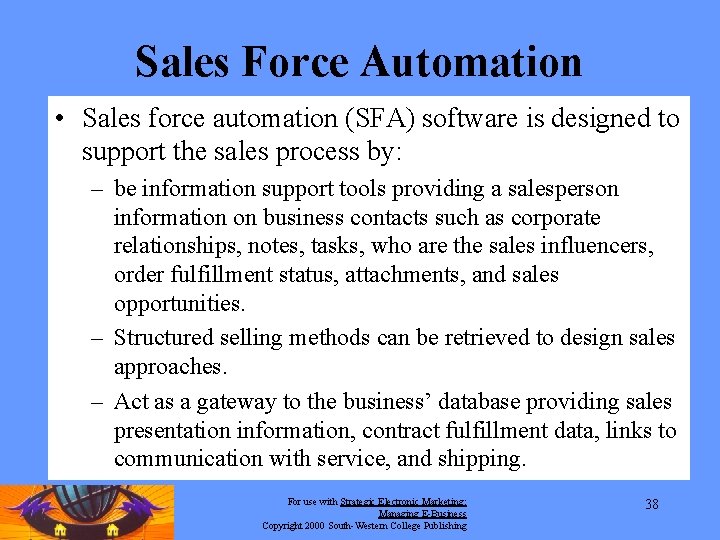
Sales Force Automation • Sales force automation (SFA) software is designed to support the sales process by: – be information support tools providing a salesperson information on business contacts such as corporate relationships, notes, tasks, who are the sales influencers, order fulfillment status, attachments, and sales opportunities. – Structured selling methods can be retrieved to design sales approaches. – Act as a gateway to the business’ database providing sales presentation information, contract fulfillment data, links to communication with service, and shipping. For use with Strategic Electronic Marketing: Managing E-Business Copyright 2000 South-Western College Publishing 38
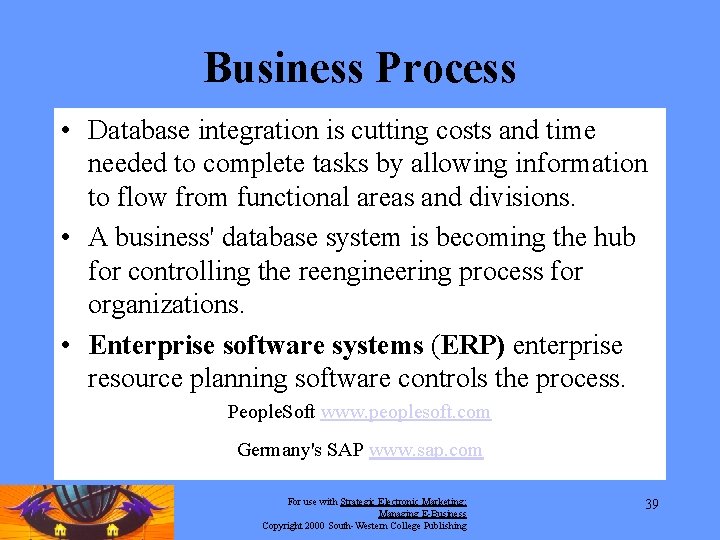
Business Process • Database integration is cutting costs and time needed to complete tasks by allowing information to flow from functional areas and divisions. • A business' database system is becoming the hub for controlling the reengineering process for organizations. • Enterprise software systems (ERP) enterprise resource planning software controls the process. People. Soft www. peoplesoft. com Germany's SAP www. sap. com For use with Strategic Electronic Marketing: Managing E-Business Copyright 2000 South-Western College Publishing 39
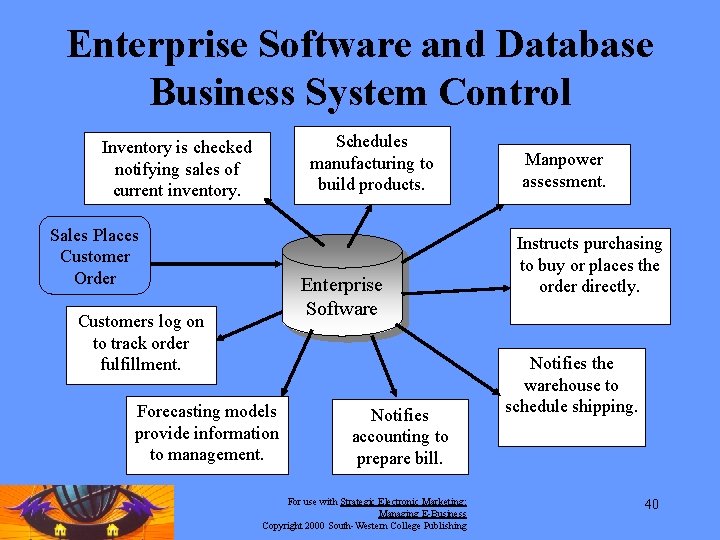
Enterprise Software and Database Business System Control Schedules manufacturing to build products. Inventory is checked notifying sales of current inventory. Sales Places Customer Order Enterprise Software Customers log on to track order fulfillment. Forecasting models provide information to management. Notifies accounting to prepare bill. For use with Strategic Electronic Marketing: Managing E-Business Copyright 2000 South-Western College Publishing Manpower assessment. Instructs purchasing to buy or places the order directly. Notifies the warehouse to schedule shipping. 40
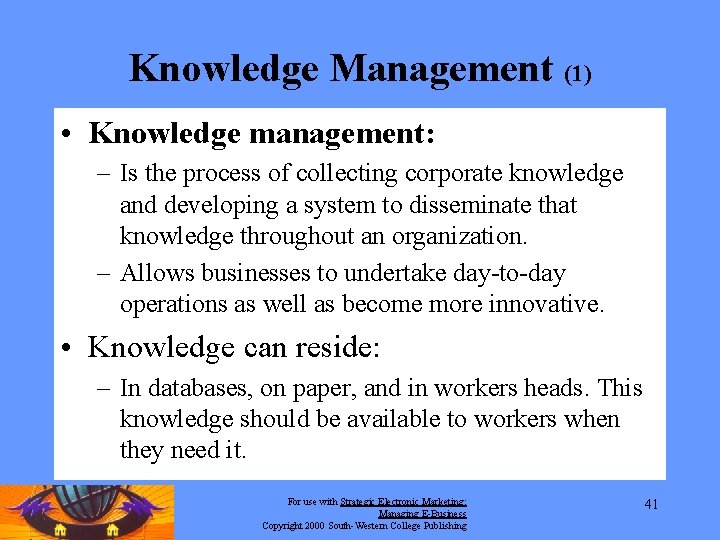
Knowledge Management (1) • Knowledge management: – Is the process of collecting corporate knowledge and developing a system to disseminate that knowledge throughout an organization. – Allows businesses to undertake day-to-day operations as well as become more innovative. • Knowledge can reside: – In databases, on paper, and in workers heads. This knowledge should be available to workers when they need it. For use with Strategic Electronic Marketing: Managing E-Business Copyright 2000 South-Western College Publishing 41
Knowledge Management (2) • Developing a knowledge management system can: – Reducing the cost of information gathering, – Improve customer support – Identifying new market opportunities – Reducing cycle times – Retain knowledge of workers who leave the organization. For use with Strategic Electronic Marketing: Managing E-Business Copyright 2000 South-Western College Publishing 42
PRIVACY CONCERNS • Privacy concerns have risen because of the use of personal data collected in databases. While in the United States data collected on customers belongs to the agency that collects it, in Europe laws have been passed that govern the use of an individual's personal data. These issues will be further explored in Chapter 10. For use with Strategic Electronic Marketing: Managing E-Business Copyright 2000 South-Western College Publishing 43
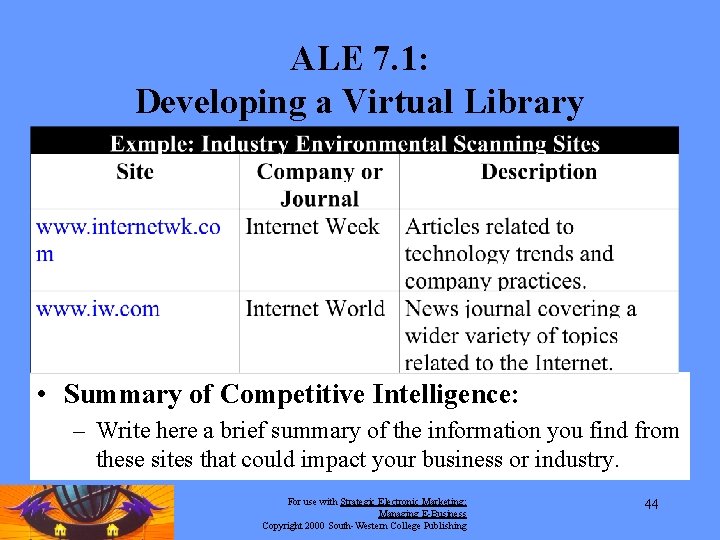
ALE 7. 1: Developing a Virtual Library • Summary of Competitive Intelligence: – Write here a brief summary of the information you find from these sites that could impact your business or industry. For use with Strategic Electronic Marketing: Managing E-Business Copyright 2000 South-Western College Publishing 44
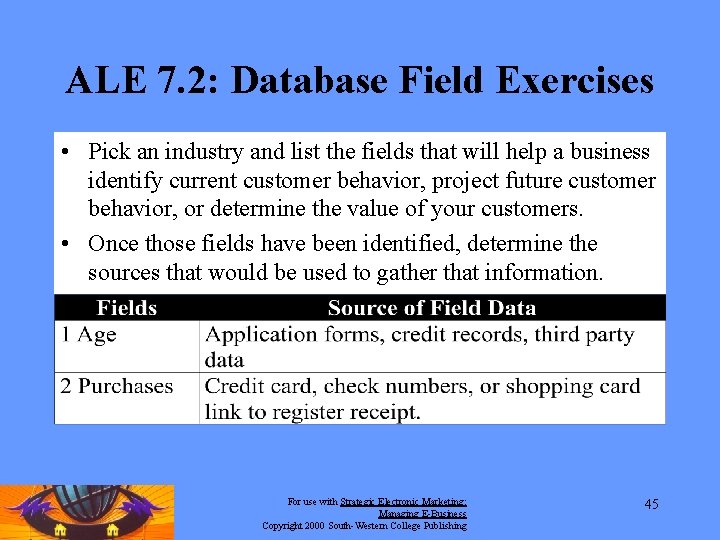
ALE 7. 2: Database Field Exercises • Pick an industry and list the fields that will help a business identify current customer behavior, project future customer behavior, or determine the value of your customers. • Once those fields have been identified, determine the sources that would be used to gather that information. For use with Strategic Electronic Marketing: Managing E-Business Copyright 2000 South-Western College Publishing 45
ALE 7. 3: Determining Your Strategic Value • Rating yourself on recency, frequency, and monetary value. Use the five point scale and compare yourself to other customers of the store. • Determine what types of incentives would be necessary to give you to turn you into high value customers. • Indicate the business strategy that should be undertaken, for example should you be dropped as a customer or given those incentives identified. For use with Strategic Electronic Marketing: Managing E-Business Copyright 2000 South-Western College Publishing 46