
Chapter 7 HIM Roles and Functions in the
- Slides: 30
Chapter 7 HIM Roles and Functions in the EHR Environment
Chapter Topics Technological innovations in the management of health information Evolution of job opportunities for HIM professionals EHR influence on traditional HIM job functions New roles and duties assumed by HIM professionals in the EHR environment ü Incorporation of paper records in EHR systems ü ü
Objectives • Depict how health information management (HIM) roles and functions are evolving as a result of implementation of electronic health records (EHRs). • Demonstrate use of a master patient index. • Explain the tracking of paper medical records. • Discuss the advantages and disadvantages of coding from an EHR. • Explain how transcribed reports interface and become part of the EHR. • Discuss the benefits and challenges of using speech recognition technology. • Demonstrate release of information (ROI) functions carried out by HIM staff in the EHR environment. • Demonstrate how to produce an accounting of disclosures log. • Demonstrate the monitoring and completion of EHRs. • Describe the process of scanning paper records, including document identification and preparation, indexing, and quality control.
The Master Patient Index • The master patient index (MPI) is a permanent record of all episodes of care a patient has at a facility • The MPI houses demographic details about the patient as well as dates of service • Each patient seen for the first time is assigned a medical record number • This medical record number is retained for the patient for all subsequent encounters • The MPI is important to medical record number assignment and prevention of assigning multiple medical record numbers for patients • Historically MPIs were maintained via card files; today they are robust databases
The Master Patient Index • In EHR environments the MPI is the first data entry point • Subsequent data entries for a patient create the EHR by facilitating longitudinal collection of health information linked to the medical record number • Larger facilities may utilize an enterprise master patient index (EMPI), which is used for multiple facilities under one organizational umbrella • Duplicating MPI records is a threat to patient safety and often occurs due to oversights by admissions staff • Duplicate medical record number assignment occurs when a second MPI record is created for a patient already in the database • HIM staff are responsible for MPI oversight and auditing, to include merging duplicate records • Few staff members within an organization are granted access to modify or merge MPI records
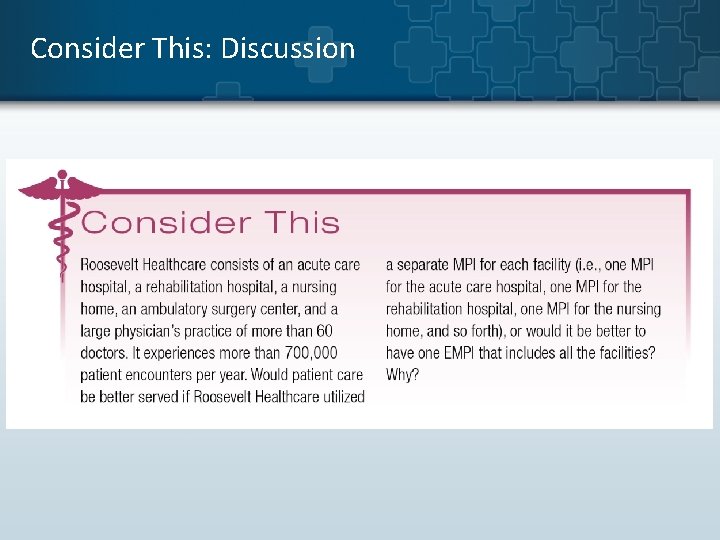
Consider This: Discussion
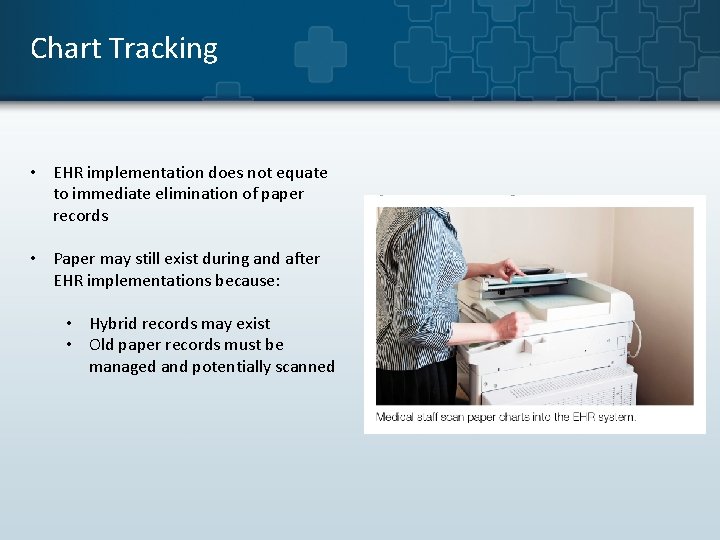
Chart Tracking • EHR implementation does not equate to immediate elimination of paper records • Paper may still exist during and after EHR implementations because: • Hybrid records may exist • Old paper records must be managed and potentially scanned
Chart Tracking • Organizations often use chart tracking software and bar coding technology as tools in paper record management • Paper records are barcoded and accounted for in chart tracking software • Any time the record moves throughout the organization it must be scanned and its location logged in the software system • Chart tracking software ensures records can be located at all times • In smaller organizations managing 500 or fewer records, it is less likely to see barcoding in place
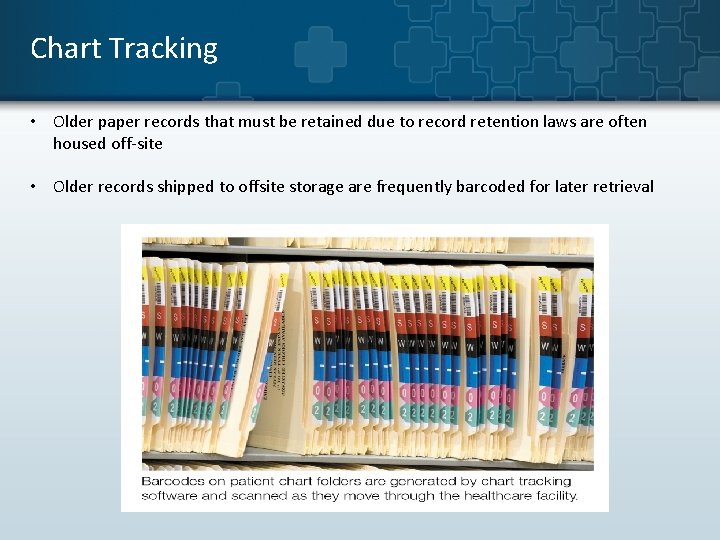
Chart Tracking • Older paper records that must be retained due to record retention laws are often housed off-site • Older records shipped to offsite storage are frequently barcoded for later retrieval
Checkpoint: Your Turn True or false: Duplicate MPI records resulting in assignment of multiple medical record numbers for a patient is a safety concern. • True • False True or false: Barcoding is more beneficial to small organizations. • True • False
Coding • Coding is the practice of assigning codes to written descriptions of diagnoses and procedures • Coded data captures morbidity and resource utilization details • A variety of coding classification systems are used in the U. S. • Coding occurs in all health care settings and appropriate coding relies on accurate and complete documentation in the health record • Various official guidelines and principles apply to coding performed in all settings • A period of transition is under way as the industry learns the benefits and challenges of coding from EHRs
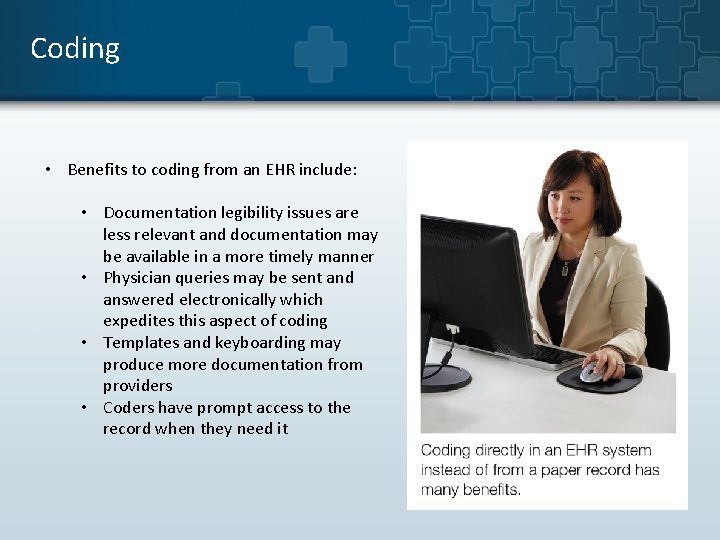
Coding • Benefits to coding from an EHR include: • Documentation legibility issues are less relevant and documentation may be available in a more timely manner • Physician queries may be sent and answered electronically which expedites this aspect of coding • Templates and keyboarding may produce more documentation from providers • Coders have prompt access to the record when they need it
Coding • Potential disadvantages to coding from an EHR such as cloned notes, “normal” functions, and threats to data integrity are of interest to HIM professionals • Cloned notes are populated when providers copy and paste documentation from previous encounters into a new encounter with the intent to edit it appropriately for the patient on whom they are documenting • EHR templates often auto populate clinical details as normal unless the provider edits the details to reflect negative or abnormal clinical findings • Cloning notes and normal auto population may save time, but the reliability of documentation for coding is a concern • Both features assume the provider has paid adequate attention to documentation they enter • Medicare and other third party payers have expressed concerns related to these practices and how they may or may not accurately inform reimbursement
Coding • Data integrity refers to accuracy, completeness, and reliability of clinical documentation in EHRs • Organizations must use checks and balances that ensure data integrity • Data lacking integrity inaccurately reflects care provided to patients and is an unfounded basis for reimbursement – both are legal and ethical concerns • Increasingly, data integrity analysts are among roles assumed by HIM professionals to audit and assess documentation
Medical Transcription • Medical transcription entails typing medical reports based off audio files dictated by a provider • Prior to EHRs, transcription software was used to produce transcribed documents which were printed and/or faxed from the system for charting • In a setting using an EHR system, transcription software may be interfaced with the EHR • The above noted interface may be an HL 7 interface that automatically loads the transcribed report into the EHR from the transcription software • Another option is file important or file monitor utility in which transcribed reports are sent to a network server and the report will be imported into the EHR
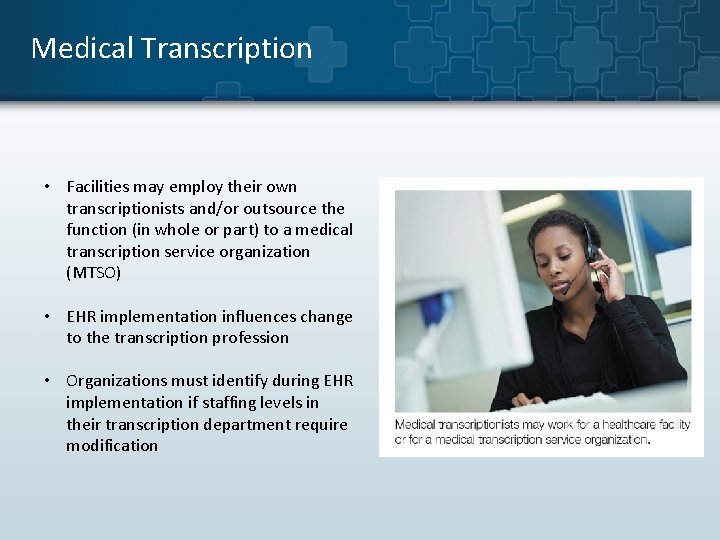
Medical Transcription • Facilities may employ their own transcriptionists and/or outsource the function (in whole or part) to a medical transcription service organization (MTSO) • EHR implementation influences change to the transcription profession • Organizations must identify during EHR implementation if staffing levels in their transcription department require modification
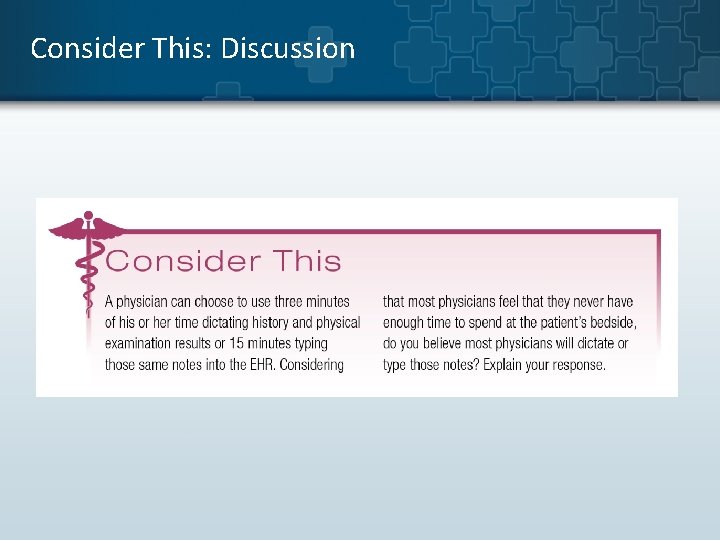
Consider This: Discussion
Medical Transcription • Speech recognition technology is another aspect changing medical transcription processes • Speech recognition systems allow providers to dictate reports and based on the software’s comprehension of their words produces draft clinical documentation • Front-end speech recognition allows the dictator to dictate their report and it automatically populates in real-time on the screen in front of the provider; the provider is responsible for all editing and the report is immediately available • Back-end speech recognition is the most commonly used option in health care because it does not change dictation processes for physicians • In back-end environments, the provider dictates into the system and a draft document is produced; the draft document and copy of the voice file is sent to an editor who addresses quality issues and returns the draft to the provider for authentication and signature
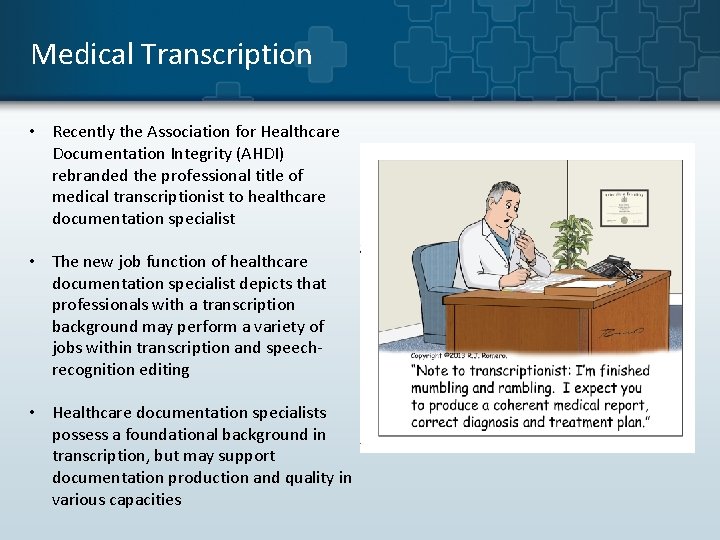
Medical Transcription • Recently the Association for Healthcare Documentation Integrity (AHDI) rebranded the professional title of medical transcriptionist to healthcare documentation specialist • The new job function of healthcare documentation specialist depicts that professionals with a transcription background may perform a variety of jobs within transcription and speechrecognition editing • Healthcare documentation specialists possess a foundational background in transcription, but may support documentation production and quality in various capacities
Medical Transcription • Implementation of speech-recognition should be thoughtful to ensure success in its use within an organization • Successful use of speech-recognition technology may produce the following benefits: • • Reduced turn around times Cost savings Enhanced documentation accuracy Increased provider and staff satisfaction
Checkpoint: Your Turn True or false: Medical coders rely on health record documentation to accurately and appropriately assign codes. • True • False Which of the following is true about medical transcription? • EHRs have modified the workflow and volume of work for some transcriptionists • It is increasingly influenced by technology, to include speech recognition • AHDI now refers to professionals in this specialization as healthcare documentation specialists • All of the above are true about medical transcription
Protected Health Information • HIM professionals handle the majority of release of information (ROI) activities • Rules and regulations address ROI and the same rules and regulations apply to paper or electronic records • ROI processes are generally more streamlined within organizations using EHRs because: • Locating physical records is no longer an issue • Records are easily produced via a variety of mediums such as printing, CD, or secure email • Technology reduces labor intensive processes related to copying paper records and results in quicker release of records
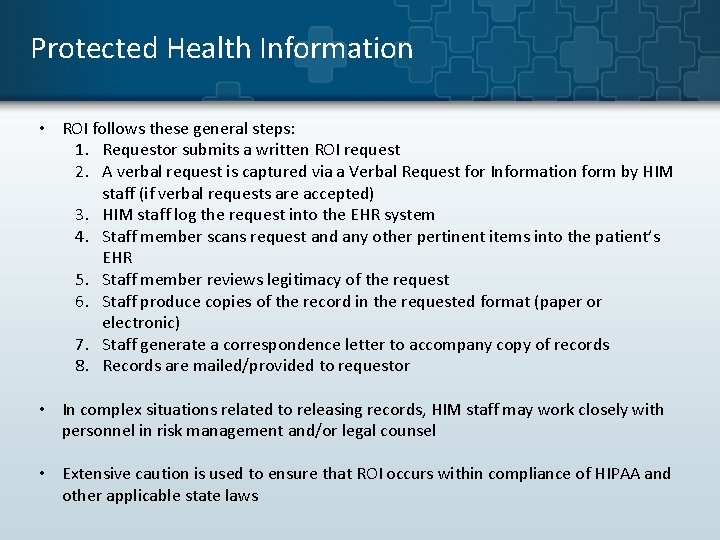
Protected Health Information • ROI follows these general steps: 1. Requestor submits a written ROI request 2. A verbal request is captured via a Verbal Request for Information form by HIM staff (if verbal requests are accepted) 3. HIM staff log the request into the EHR system 4. Staff member scans request and any other pertinent items into the patient’s EHR 5. Staff member reviews legitimacy of the request 6. Staff produce copies of the record in the requested format (paper or electronic) 7. Staff generate a correspondence letter to accompany copy of records 8. Records are mailed/provided to requestor • In complex situations related to releasing records, HIM staff may work closely with personnel in risk management and/or legal counsel • Extensive caution is used to ensure that ROI occurs within compliance of HIPAA and other applicable state laws
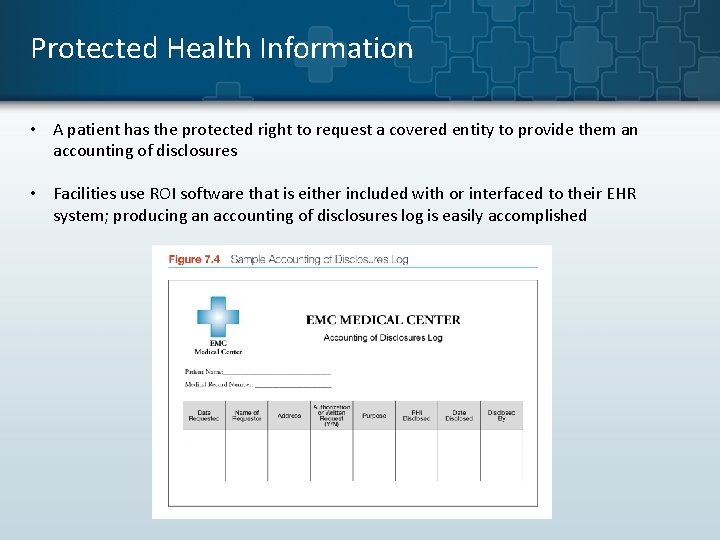
Protected Health Information • A patient has the protected right to request a covered entity to provide them an accounting of disclosures • Facilities use ROI software that is either included with or interfaced to their EHR system; producing an accounting of disclosures log is easily accomplished
Analyzing the EHR for Completeness • Organizations must define what constitutes a complete record in policy and procedure • Record content identified as needed for completeness incorporates requirements from federal and state statutes and regulations, as well as accreditation standards • HIM staff monitor records for completeness and will work with medical staff to ensure compliance • Members of the medical staff may be subject to suspended privileges if they refuse to comply with rules, regulations, and other requirements related to complete records
Analyzing the EHR for Completeness • Parameters defining a complete EHR typically include the following: • All entries are signed • H&P exams are complete 30 days prior to admission or within 24 hours of admission; if surgery is scheduled, the H&P is dictated and on the chart prior to surgery • Consultation and operative/procedure reports are complete • Entries requiring co-signature are signed • Discharge summaries are completed within 30 days of discharge • Benefits of EHRs related to record completion include the following: • Expeditious and convenient authentication and signing of previously provided telephone orders • Dating and timing of documentation is automated by the EHR at the point of e-signature
Incorporating Paper-based Medical Records into the EHR System • When implementing an EHR, organizations must decide how to address paper records • Some organizations scan all paper records into the system, while others do not scan paper records until the patient has their next patient care encounter • Proper document preparation, indexing, and scanning are important to transitioning to an EHR • Preparation involves putting documents in order, straightening pages, and removing staples or paper clips for scanning • Indexing entails codifying each type of document and associating the code with the location in the EHR where the document will reside • Scanning may be performed by staff or outsourced vendors • Quality control is an important aspect to proper incorporation of paper records into EHR systems
Checkpoint: Your Turn True or false: ROI processes are generally streamlined by EHR use. • True • False True or false: When a patient undergoes surgery, the H&P is dictated and made available in the record when surgery ends. • True • False
Chapter Summary • HIM professionals play important roles in health care • HIM professionals audit MPIs to ensure no duplications exist in medical record number assignment • Traditional functions such as coding and transcription exist in organizations that implement EHRs; some aspects of job functions and workflow change upon EHR implementation • ROI remains a guarded process after EHR implementation to ensure patient confidentiality is protected and compliance with HIPAA and state laws occur • As EHRs are implemented, organizations make decisions related to paper records and how they are incorporated into the EHR system • HIM professionals encounter a multitude of new and exciting opportunities related to data and information management in a technologically-driven environment