
Chapter 7 Heterologous Protein Production in Eukaryotic Cells
- Slides: 18
Chapter 7 Heterologous Protein Production in Eukaryotic Cells
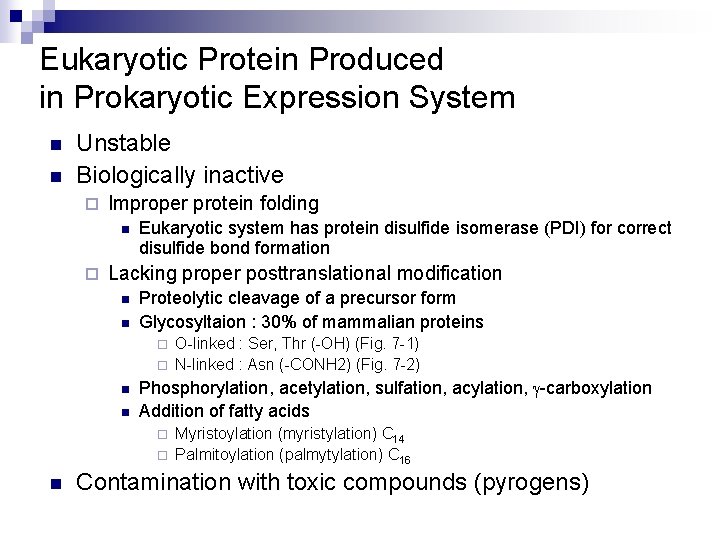
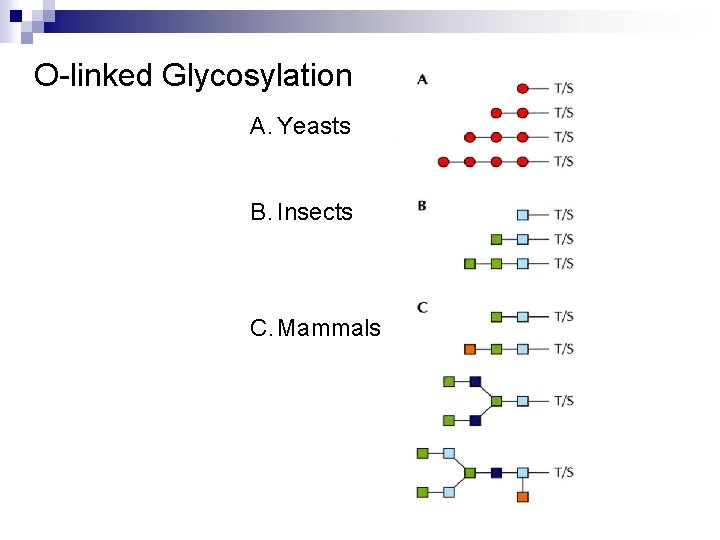
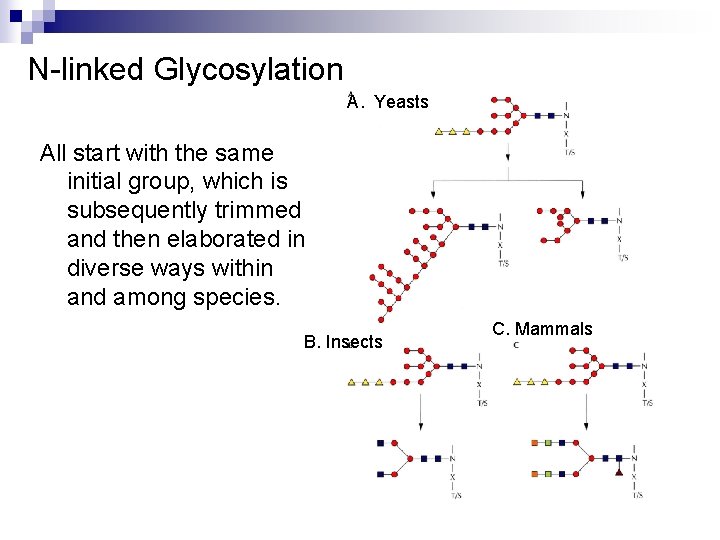
Eukaryotic Protein Produced in Prokaryotic Expression System n n Unstable Biologically inactive ¨ Improper protein folding n ¨ Eukaryotic system has protein disulfide isomerase (PDI) for correct disulfide bond formation Lacking proper posttranslational modification n n Proteolytic cleavage of a precursor form Glycosyltaion : 30% of mammalian proteins ¨ ¨ n n Phosphorylation, acetylation, sulfation, acylation, g-carboxylation Addition of fatty acids ¨ ¨ n O-linked : Ser, Thr (-OH) (Fig. 7 -1) N-linked : Asn (-CONH 2) (Fig. 7 -2) Myristoylation (myristylation) C 14 Palmitoylation (palmytylation) C 16 Contamination with toxic compounds (pyrogens)
O-linked Glycosylation A. Yeasts B. Insects C. Mammals
N-linked Glycosylation A. Yeasts All start with the same initial group, which is subsequently trimmed and then elaborated in diverse ways within and among species. B. Insects C. Mammals
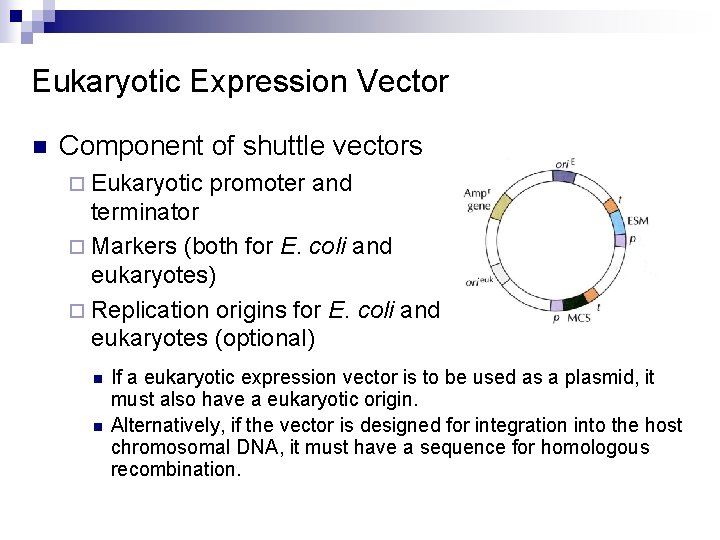
Eukaryotic Expression Vector n Component of shuttle vectors ¨ Eukaryotic promoter and terminator ¨ Markers (both for E. coli and eukaryotes) ¨ Replication origins for E. coli and eukaryotes (optional) n n If a eukaryotic expression vector is to be used as a plasmid, it must also have a eukaryotic origin. Alternatively, if the vector is designed for integration into the host chromosomal DNA, it must have a sequence for homologous recombination.
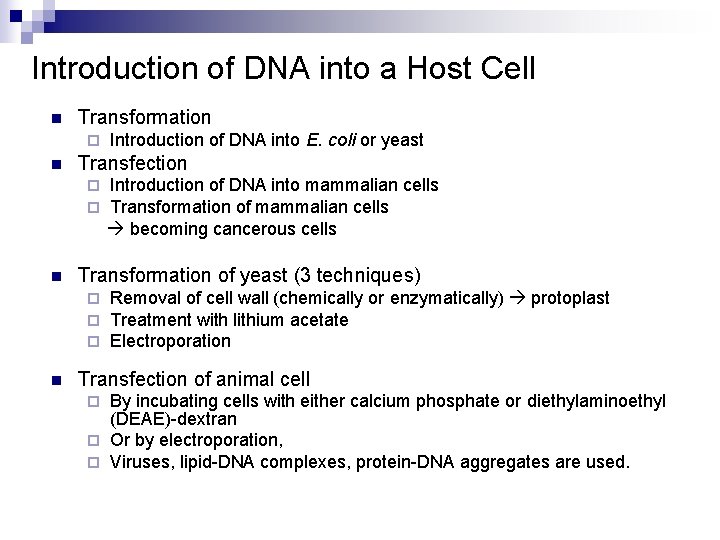
Introduction of DNA into a Host Cell n Transformation ¨ n Transfection ¨ ¨ n Introduction of DNA into mammalian cells Transformation of mammalian cells becoming cancerous cells Transformation of yeast (3 techniques) ¨ ¨ ¨ n Introduction of DNA into E. coli or yeast Removal of cell wall (chemically or enzymatically) protoplast Treatment with lithium acetate Electroporation Transfection of animal cell By incubating cells with either calcium phosphate or diethylaminoethyl (DEAE)-dextran ¨ Or by electroporation, ¨ Viruses, lipid-DNA complexes, protein-DNA aggregates are used. ¨
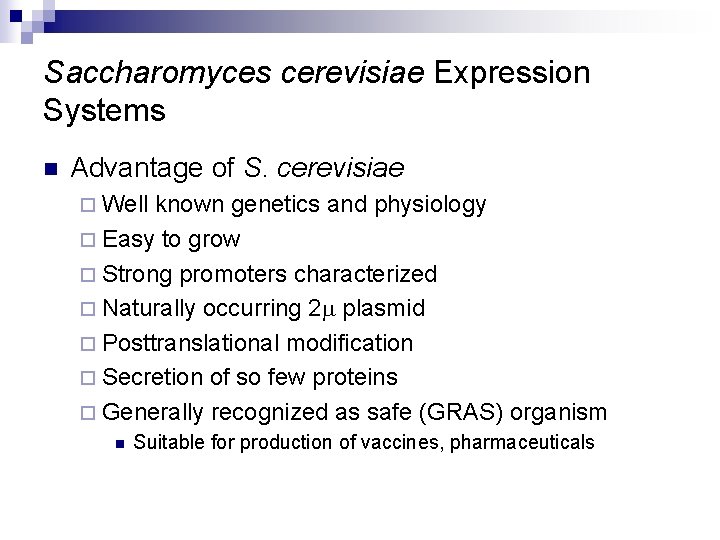
Saccharomyces cerevisiae Expression Systems n Advantage of S. cerevisiae ¨ Well known genetics and physiology ¨ Easy to grow ¨ Strong promoters characterized ¨ Naturally occurring 2 m plasmid ¨ Posttranslational modification ¨ Secretion of so few proteins ¨ Generally recognized as safe (GRAS) organism n Suitable for production of vaccines, pharmaceuticals
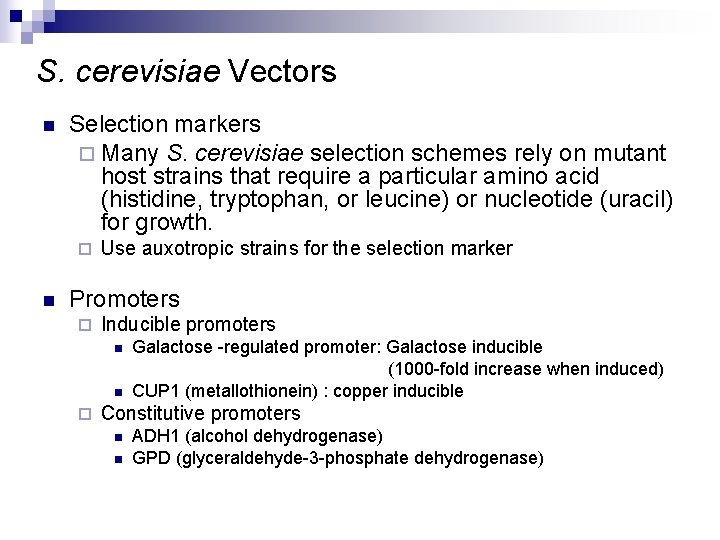
S. cerevisiae Vectors n Selection markers ¨ Many S. cerevisiae selection schemes rely on mutant host strains that require a particular amino acid (histidine, tryptophan, or leucine) or nucleotide (uracil) for growth. ¨ n Use auxotropic strains for the selection marker Promoters ¨ Inducible promoters n n ¨ Galactose -regulated promoter: Galactose inducible (1000 -fold increase when induced) CUP 1 (metallothionein) : copper inducible Constitutive promoters n n ADH 1 (alcohol dehydrogenase) GPD (glyceraldehyde-3 -phosphate dehydrogenase)
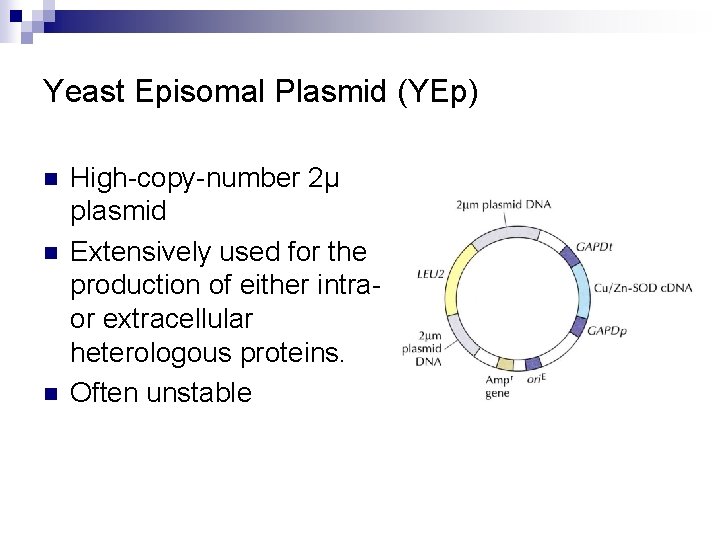
Yeast Episomal Plasmid (YEp) n n n High-copy-number 2μ plasmid Extensively used for the production of either intraor extracellular heterologous proteins. Often unstable
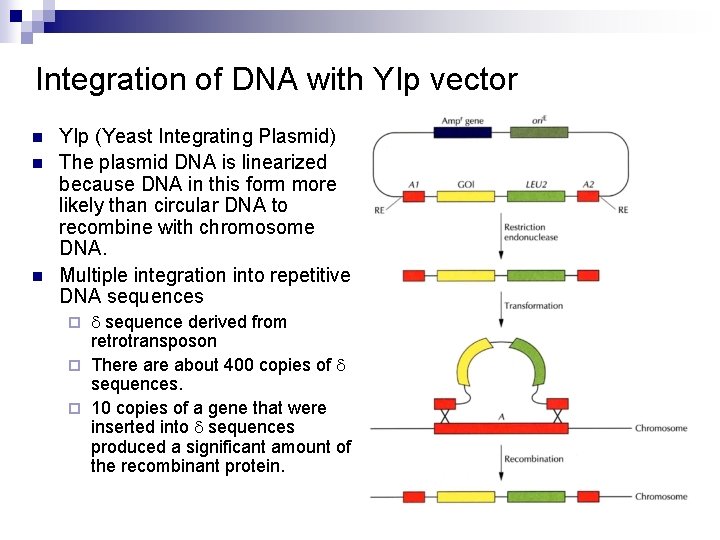
Integration of DNA with YIp vector n n n YIp (Yeast Integrating Plasmid) The plasmid DNA is linearized because DNA in this form more likely than circular DNA to recombine with chromosome DNA. Multiple integration into repetitive DNA sequences d sequence derived from retrotransposon ¨ There about 400 copies of d sequences. ¨ 10 copies of a gene that were inserted into d sequences produced a significant amount of the recombinant protein. ¨
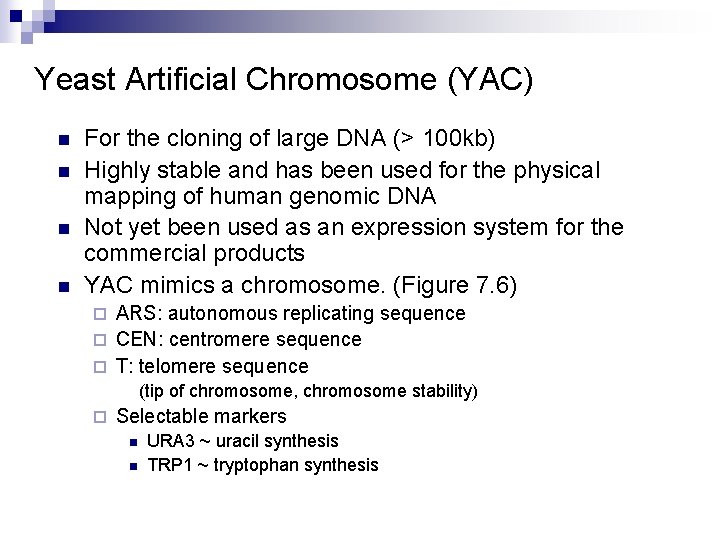
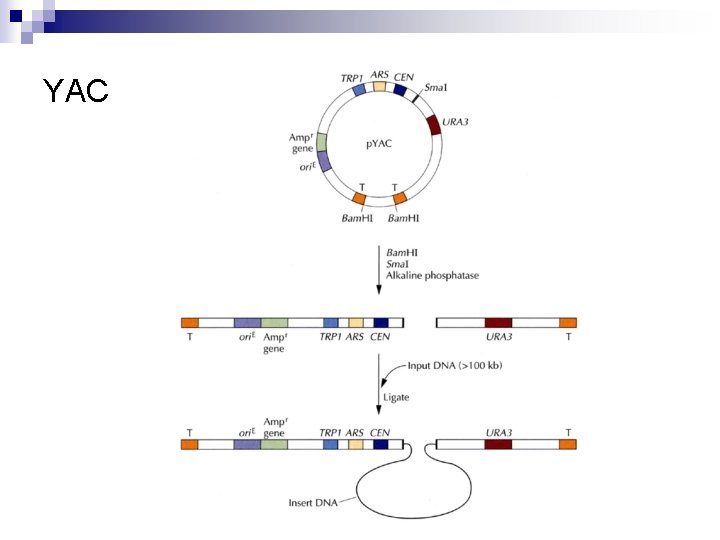
Yeast Artificial Chromosome (YAC) n n For the cloning of large DNA (> 100 kb) Highly stable and has been used for the physical mapping of human genomic DNA Not yet been used as an expression system for the commercial products YAC mimics a chromosome. (Figure 7. 6) ARS: autonomous replicating sequence ¨ CEN: centromere sequence ¨ T: telomere sequence ¨ (tip of chromosome, chromosome stability) ¨ Selectable markers n n URA 3 ~ uracil synthesis TRP 1 ~ tryptophan synthesis
YAC
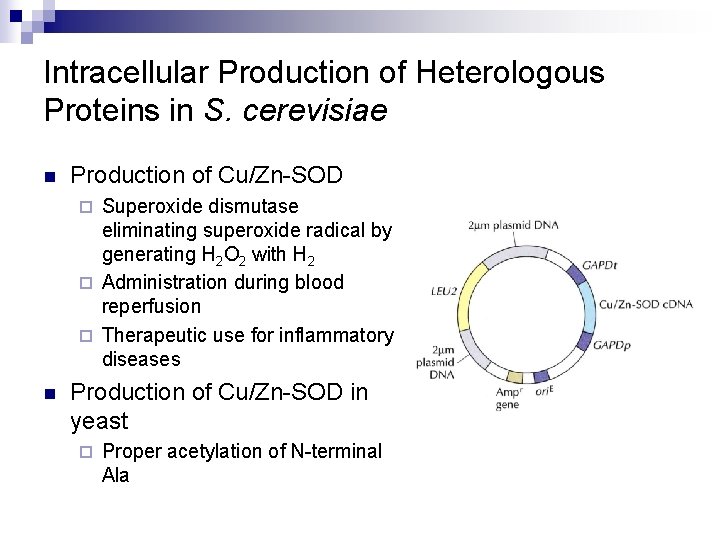
Intracellular Production of Heterologous Proteins in S. cerevisiae n Production of Cu/Zn-SOD Superoxide dismutase eliminating superoxide radical by generating H 2 O 2 with H 2 ¨ Administration during blood reperfusion ¨ Therapeutic use for inflammatory diseases ¨ n Production of Cu/Zn-SOD in yeast ¨ Proper acetylation of N-terminal Ala
Secretion of Heterologous Proteins by S. cerevisiae n Secretory proteins in yeast All the glycosylated proteins ¨ Containing leader sequence ¨ n Addition of leader sequence for secretion Leader sequence of mating type factor a ¨ Lys-Arg (endoprotease recognition site) adjacent to starting amino acid for proteolytic removal of the leader sequence ¨ n Strategies to enhance the secretion of recombinant proteins ¨ Overexpression of PDI (protein disulfide isomerase) n Increase secretion of proteins with disulfide bond
Pichia pastoris and Other Yeast Expression Systems n Problems in S. cerevisiae Plasmid instability ¨ Hyperglycosylation ¨ Retained within the periplasmic space n ¨ (not into the medium) Ethanol is produced at high cell density, n n (more than 100 mannose residues) which is toxic to the cells Advantages of P. pastoris (Methylotrophic yeast) ¨ Highly efficient and tightly regulated promoter n AOX 1 gene promoter, methanol-inducible No ethanol production, high cell density with the secretion of large quantities of proteins ¨ Simple purification of secreted recombinant proteins ¨ n It normally secretes very few proteins.
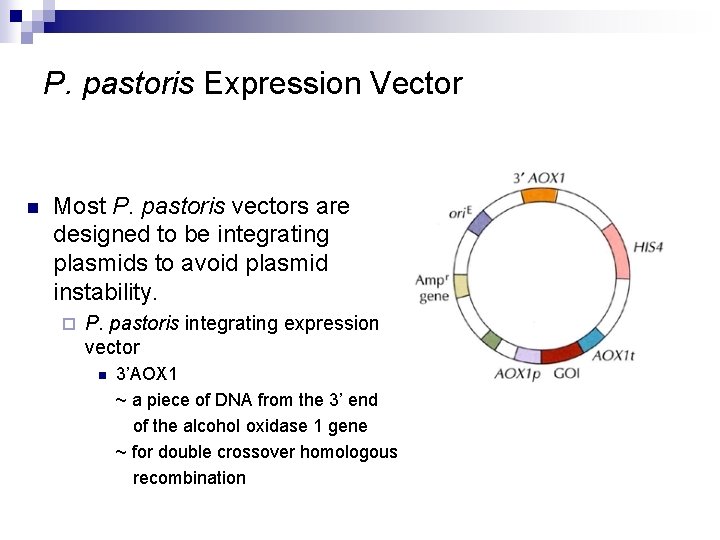
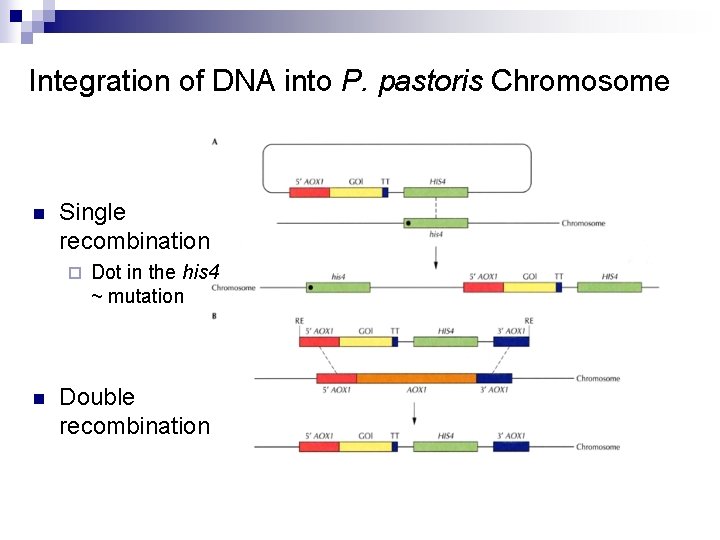
P. pastoris Expression Vector n Most P. pastoris vectors are designed to be integrating plasmids to avoid plasmid instability. ¨ P. pastoris integrating expression vector n 3’AOX 1 ~ a piece of DNA from the 3’ end of the alcohol oxidase 1 gene ~ for double crossover homologous recombination
Integration of DNA into P. pastoris Chromosome n Single recombination ¨ n Dot in the his 4 ~ mutation Double recombination
Other Expression Systems n Other yeasts ¨ Hansenula polymorpha (Methylotrophic n methanol oxidase promoter (MOXp) ¨ Schizosaccharomyces n pombe, Candida utili Aspergillus (filamentous fungus) ¨ commercial n yeast) production of various enzymes However, no one system is able to produce an authentic version of every heterologous protein. For this and other reasons, gene expression systems that use insect or mammalian cells have been developed.