
CHAPTER 7 GROUPS AND TEAMS Edited by Christine
CHAPTER 7 GROUPS AND TEAMS Edited by Christine Cross and Ronan Carbery
Learning Outcomes • Discuss the role of groups in organisational life, and identify the different types of groups • Recognise and evaluate key aspects of group composition and formation, including stages of group development, norms, and roles • Consider some key group decision-making dynamics such as cohesiveness, conformity, groupthink, and social loafing • Outline the key differences between groups and teams in the workplace • Identify the characteristics of an effective workplace team • Demonstrate an understanding of different types of teams in an organisational setting Organisational Behaviour, edited by Christine Cross and Ronan Carbery ©Palgrave, Macmillan 2016
What are Groups? • Groups are two or more people who interact together to achieve a common objective and are interdependent • Groups are a pervasive feature of organisations and working life • A group is perhaps best understood by what it is not, for instance, a group is not just a collection of people occupying the same space or sharing a demographic factor • For example, people waiting on a platform for a train would not be classified as a group as they are not working towards achieving a common objective Organisational Behaviour, edited by Christine Cross and Ronan Carbery ©Palgrave, Macmillan 2016
What are Groups? • Groups support collective action • The potential for synergy within groups is what makes them so important for organisations • If a group does not have a sense of interdependence it will have to work much harder to stay together as it has little real incentive to collaborate beyond a superficial level • Task interdependence is the degree of mutual reliance and reciprocity within the group – This can arise from how work is organised or space is shared (pooled interdependence), from connected processes or work flows (sequential interdependence), or from shared needs for information, skills, and relating (reciprocal interdependence), known as relational interdependence Organisational Behaviour, edited by Christine Cross and Ronan Carbery ©Palgrave, Macmillan 2016
What are Groups? • Social identity theory (Tajfel, 1979) tells us that we divide the world into “us” (known as our in-groups) and “them” (known as out-groups) in a process of social categorisation • In-group bias – the process where members of a group favour members of their own group over members of other groups – the in-group will discriminate against the out-group to enhance their perception of themselves Organisational Behaviour, edited by Christine Cross and Ronan Carbery ©Palgrave, Macmillan 2016
Types of Groups • Formal groups are officially established, usually as a result of the organisation’s structure, with a specific purpose and are to be found in every organisation – They are deliberately formed in order to allow the organisation to achieve its objectives – Membership is usually determined by those in authority in the organisation and they also set out the rules of operation. Formal groups can also be classified as command or task groups • Command groups are permanent formal groups that are formed as a result of organisational structures • Task groups are temporary groups designed to deal with specific issues and are dismantled once the task is complete Organisational Behaviour, edited by Christine Cross and Ronan Carbery ©Palgrave, Macmillan 2016
Types of Groups • Informal groups are those which develop naturally in the workplace in response to our need for belonging • Their membership and rules of engagement are internally rather than externally defined • These groups can often be a source of concern for management, as they have no control over group membership • As the Hawthorne Studies (Roethlisberger and Dickson, 1939) famously revealed, informal groups can be powerful and have a significant effect on what gets done in the workplace Organisational Behaviour, edited by Christine Cross and Ronan Carbery ©Palgrave, Macmillan 2016

Stages of Group Development Organisational Behaviour, edited by Christine Cross and Ronan Carbery ©Palgrave, Macmillan 2016
Group Properties • There are many variables which affect overall group performance such as – Group roles – Group size – Group cohesiveness – Group conformity Organisational Behaviour, edited by Christine Cross and Ronan Carbery ©Palgrave, Macmillan 2016
Group Roles • Group roles - a role is a pattern of behaviour expected of a group member • Benne and Sheats (1948) have identified three broad types of roles people play in small groups: – Task roles focus on completing the group objective, for example, taking minutes of a meeting – Building or maintenance roles focus on building interpersonal relationships, for example, someone who offers encouragement by providing positive feedback – Self-centered roles focus on preventing the group from achieving its goal, for example the person who does not pull their weight. This issue is known as social loafing, where a group member exerts less effort in the group than if they were working alone Organisational Behaviour, edited by Christine Cross and Ronan Carbery ©Palgrave, Macmillan 2016
Group Roles • The roles people take on have an important impact on the group’s development and its effectiveness • Role conflict happens when two or more role expectations (the way other people believe you should act in a given context) are contradictory – For example, if your work as a waitress/waiter interferes with your work as a student, but you need to earn money to pay for tuition fees, you are experiencing role conflict Organisational Behaviour, edited by Christine Cross and Ronan Carbery ©Palgrave, Macmillan 2016
Group Size • Group Size has a direct impact on group performance and productivity • The larger the group the more difficult it is to have clear lines of communication and to coordinate tasks • Where a group is small and the task is complex, there may not be enough resources to complete the task • For example, research from Seijts and Latham (2001) highlights that individual performance in seven person groups was significantly lower than individual performance in three person groups • Appropriate group size is dependent on both the task and the context Organisational Behaviour, edited by Christine Cross and Ronan Carbery ©Palgrave, Macmillan 2016
Group Cohesiveness • Group cohesiveness is the force that binds a group together • In a cohesive group, members place a value on being part of the group and interpersonal relationships are strong • The main factors that influence group cohesiveness are: – – – Group size Members’ similarity Entry difficulty Group success External competition and threats Organisational Behaviour, edited by Christine Cross and Ronan Carbery ©Palgrave, Macmillan 2016
Group Cohesiveness • Smaller groups are often more cohesive than larger groups • The more group members are similar to each other in various characteristics, the easier it is to reach cohesiveness • The more elite the group is perceived to be, the more prestigious it is to be a member in that group • Strongly cohesive groups can also cause problems: – They can become defensive of their group membership and output and make it difficult for new members to join the group – They can resist change and become overly protective of their decisions Organisational Behaviour, edited by Christine Cross and Ronan Carbery ©Palgrave, Macmillan 2016
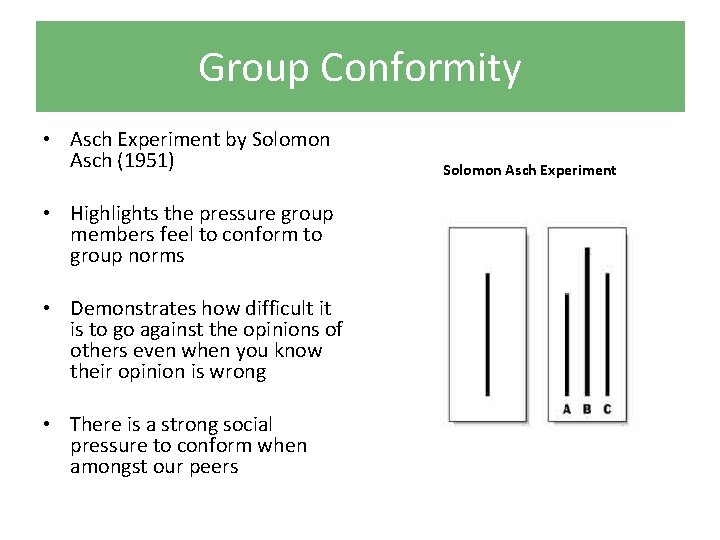
Group Conformity • Asch Experiment by Solomon Asch (1951) • Highlights the pressure group members feel to conform to group norms • Demonstrates how difficult it is to go against the opinions of others even when you know their opinion is wrong • There is a strong social pressure to conform when amongst our peers Solomon Asch Experiment
Groupthink • Groupthink: where maintaining group conformity is more important than critically evaluating alternative viewpoints, even if it means actively discouraging dissenting • Janis (1972) noted that high levels of group cohesiveness can lead to groupthink and identifies eight symptoms of this phenomenon: – – – – Illusion of invulnerability Belief in inherent morality Collective rationalisation Stereotyped views of out-groups Direct pressure on dissenters Self-censorship Illusion of unanimity Self-appointed ‘mindguards’ Organisational Behaviour, edited by Christine Cross and Ronan Carbery ©Palgrave, Macmillan 2016
Groups and Teams - How do they Differ? • In an organizational behaviour context, a team is defined as a group of people working together with a defined purpose in order to achieve a common goal • While individuals who have some relationship with one another or who share similar traits may be part of a group, a team essentially means that all members are involved in the same activity • One of the fundamental differences between workplace groups and teams is that, while individuals who are part of a group will often share knowledge and expertise with each other, this is primarily to help others in the group achieve their own individual aims rather than to complete an overarching task together which is the aim of a team Organisational Behaviour, edited by Christine Cross and Ronan Carbery ©Palgrave, Macmillan 2016
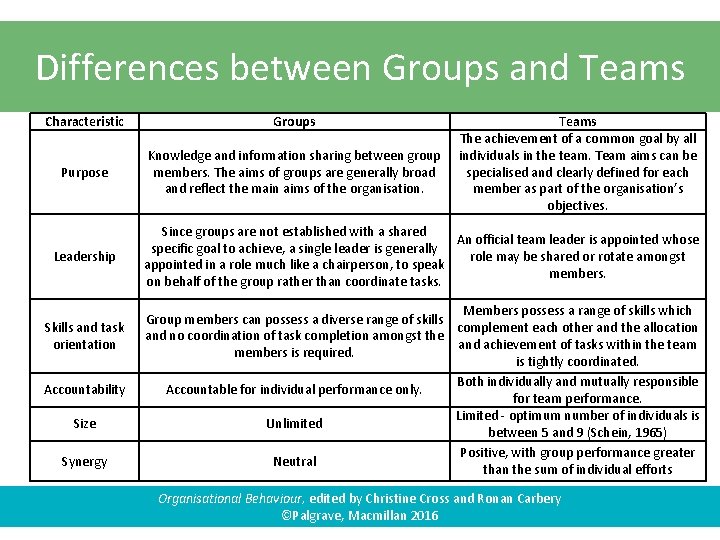
Differences between Groups and Teams Characteristic Groups Purpose Knowledge and information sharing between group members. The aims of groups are generally broad and reflect the main aims of the organisation. Leadership Skills and task orientation Accountability Size Synergy Teams The achievement of a common goal by all individuals in the team. Team aims can be specialised and clearly defined for each member as part of the organisation’s objectives. Since groups are not established with a shared An official team leader is appointed whose specific goal to achieve, a single leader is generally role may be shared or rotate amongst appointed in a role much like a chairperson, to speak members. on behalf of the group rather than coordinate tasks. Members possess a range of skills which Group members can possess a diverse range of skills complement each other and the allocation and no coordination of task completion amongst the and achievement of tasks within the team members is required. is tightly coordinated. Both individually and mutually responsible Accountable for individual performance only. for team performance. Limited - optimum number of individuals is Unlimited between 5 and 9 (Schein, 1965) Positive, with group performance greater Neutral than the sum of individual efforts Organisational Behaviour, edited by Christine Cross and Ronan Carbery ©Palgrave, Macmillan 2016

Types of Teams in Organisations • Teams can serve a variety of functions in organisations • Depending on the task to be achieved, or the working environment in which it is to be completed, different types of teams with varying structures can be developed • Five types of teams commonly found in organisations are: – – – Cross-functional Self-managed Problem solving Virtual Management Organisational Behaviour, edited by Christine Cross and Ronan Carbery ©Palgrave, Macmillan 2016

Cross-functional teams • A Cross-functional team is one which has members from a range of functional departments within the organisation working towards a common goal • The bringing together of a cross-functional mix of members ensures that a range of diverse skills and talents are present in the team • Taking part in one of these cross-functional teams is often referred to as boundary spanning • Cross-functional teams have some drawbacks: – Development of a cross-functional team can take some time – Achieving agreement and consensus decision-making can be difficult – Individuals may spend too much time away from their core roles Organisational Behaviour, edited by Christine Cross and Ronan Carbery ©Palgrave, Macmillan 2016
Self-Managed Work Teams (SMWT) • A self-managed work team (SMWT) consists of a small number of employees who have been given autonomy to plan and manage their team’s day-to-day activities with relatively little supervision – They can also be referred to as self-directed teams – SMWTs often perform tasks traditionally completed by managers • SMWTs were commonly found to exist in product environments where TQM (Total Quality Management) and JIT (Just in time) manufacturing processes were also present • The role of the SMWT is to enhance the quality of goods produced and reduce costs while simultaneously leading to improvements in the levels of job satisfaction and motivation among employees Organisational Behaviour, edited by Christine Cross and Ronan Carbery ©Palgrave, Macmillan 2016
Problem Solving Teams • Problem Solving Teams may be formed to find solutions to problems regarding quality, costs and efficiency that are identified as needing to be addressed in the organisation • Created to solve a strategic level issue and are likely to draw individuals from different sectors of the organisation so as to facilitate a wider array of perspectives on the problem and identify an appropriate solution • At an operational level, a problem solving team will generally consist of a small number of employees (less than twelve) • Problem solving teams do not always have the autonomy or resources to implement the recommendations they decide upon Organisational Behaviour, edited by Christine Cross and Ronan Carbery ©Palgrave, Macmillan 2016
Virtual Teams • A virtual team is one where the team members are dispersed geographically and where the team communicates and collaborates together through the use of a variety of electronic systems • Advantages of Virtual Teams: – Savings in time and expenses as travel time is reduced – Allow organisations to draw on a wider pool of talent when selecting team members as they are no longer restricted by geographical location • Disadvantages of Virtual Teams: – Communication difficulties as many of the non-verbal signals and cues between members are neglected – Challenging for managers to develop and foster a sense of trust between team members in a virtual setting Organisational Behaviour, edited by Christine Cross and Ronan Carbery ©Palgrave, Macmillan 2016
Management Teams • A Management Team is one which consists of individuals with managerial roles in different areas of the organisation, who coordinate the work of their respective teams • A management team is therefore usually one which is ongoing and does not end or disband with the completion of a specific task or project • One of the fundamental roles of a top management team is to effectively coordinate the efforts of interdependent work teams at lower levels in the organisation • Top management teams often experience problems in working effectively as a team, due to the characteristics of high-powered individuals within the team who may find it difficult to share resources or adapt to being part of a team rather than a leader Organisational Behaviour, edited by Christine Cross and Ronan Carbery ©Palgrave, Macmillan 2016
Team Roles • A team role refers to a pattern of behaviour or set of characteristics that is displayed in the way one team member interacts with another when serving to progress the performance of the team towards its aims • According to Belbin (1993), for a team to cooperate successfully members need to perform a variety of functions and roles which complement each other rather than overlap, in which case conflict is likely to occur or possible aspects of the task could be overlooked • Belbin identified nine commonly found team roles Organisational Behaviour, edited by Christine Cross and Ronan Carbery ©Palgrave, Macmillan 2016
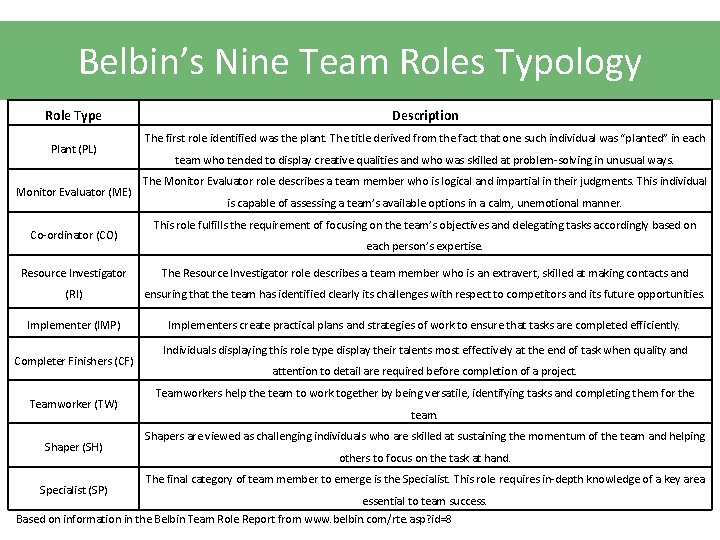
Belbin’s Nine Team Roles Typology Role Type Plant (PL) Monitor Evaluator (ME) Co-ordinator (CO) Description The first role identified was the plant. The title derived from the fact that one such individual was “planted” in each team who tended to display creative qualities and who was skilled at problem-solving in unusual ways. The Monitor Evaluator role describes a team member who is logical and impartial in their judgments. This individual is capable of assessing a team’s available options in a calm, unemotional manner. This role fulfills the requirement of focusing on the team’s objectives and delegating tasks accordingly based on each person’s expertise. Resource Investigator The Resource Investigator role describes a team member who is an extravert, skilled at making contacts and (RI) ensuring that the team has identified clearly its challenges with respect to competitors and its future opportunities. Implementer (IMP) Implementers create practical plans and strategies of work to ensure that tasks are completed efficiently. Completer Finishers (CF) Teamworker (TW) Shaper (SH) Specialist (SP) Individuals displaying this role type display their talents most effectively at the end of task when quality and attention to detail are required before completion of a project. Teamworkers help the team to work together by being versatile, identifying tasks and completing them for the team. Shapers are viewed as challenging individuals who are skilled at sustaining the momentum of the team and helping others to focus on the task at hand. The final category of team member to emerge is the Specialist. This role requires in-depth knowledge of a key area essential to team success. Based on information in the Belbin Team Role Report from www. belbin. com/rte. asp? id=8
Characteristics of High-Performing Work Teams • Synergy only occurs where they function successfully and achieve results which reflect those efforts • There are many attributes of high-performing work teams and Nelson (2010) has identified the following seven key characteristics which capture most of these elements – – – – Purpose Empowerment Relationships and communication Flexibility Optimal productivity Recognition and appreciation Morale Organisational Behaviour, edited by Christine Cross and Ronan Carbery ©Palgrave, Macmillan 2016
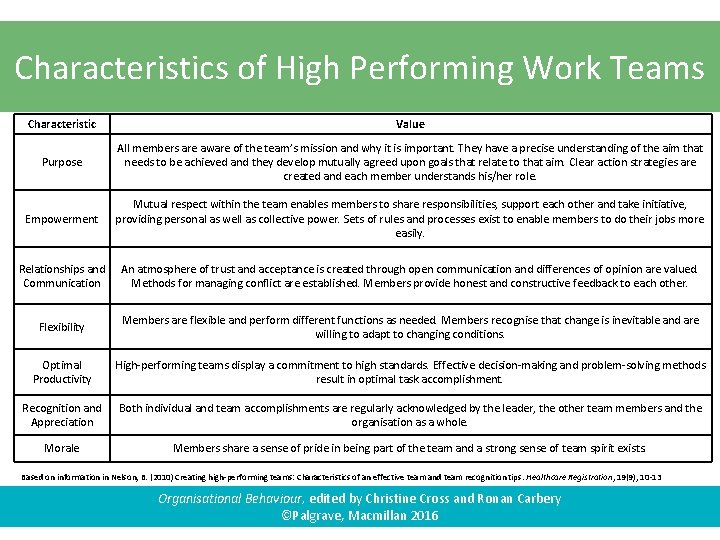
Characteristics of High Performing Work Teams Characteristic Value Purpose All members are aware of the team’s mission and why it is important. They have a precise understanding of the aim that needs to be achieved and they develop mutually agreed upon goals that relate to that aim. Clear action strategies are created and each member understands his/her role. Empowerment Mutual respect within the team enables members to share responsibilities, support each other and take initiative, providing personal as well as collective power. Sets of rules and processes exist to enable members to do their jobs more easily. Relationships and Communication An atmosphere of trust and acceptance is created through open communication and differences of opinion are valued. Methods for managing conflict are established. Members provide honest and constructive feedback to each other. Flexibility Members are flexible and perform different functions as needed. Members recognise that change is inevitable and are willing to adapt to changing conditions. Optimal Productivity High-performing teams display a commitment to high standards. Effective decision-making and problem-solving methods result in optimal task accomplishment. Recognition and Appreciation Both individual and team accomplishments are regularly acknowledged by the leader, the other team members and the organisation as a whole. Morale Members share a sense of pride in being part of the team and a strong sense of team spirit exists. Based on information in Nelson, B. (2010) Creating high-performing teams: Characteristics of an effective team and team recognition tips. Healthcare Registration, 19(9), 10 -13 Organisational Behaviour, edited by Christine Cross and Ronan Carbery ©Palgrave, Macmillan 2016
Summary • What is the difference between a group and a team? • What are the stages of group development? Discuss and reflect on the characteristics of each stage • What are the challenges and advantages of working in a group, from your own experience? • What is group conformity? Discuss and assess the dynamics of conformity using the Asch studies as a reference point Organisational Behaviour, edited by Christine Cross and Ronan Carbery ©Palgrave, Macmillan 2016
Summary • Each of Belbin’s team roles can be placed in the category of either people-oriented, action-oriented or problem-solving oriented. Place each of these team roles within one of those categories • List three features of high-performing work teams and outline how these features might differ in an underperforming team • Critically evaluate the advantages for organisations in using virtual teams over traditional teams based in a central location • Identify two drawbacks of a) self-managed teams and b) crossfunctional teams Organisational Behaviour, edited by Christine Cross and Ronan Carbery ©Palgrave, Macmillan 2016
- Slides: 30