
Chapter 7 Genetics Punnett Squares Dominant genes The
- Slides: 17
Chapter 7 Genetics
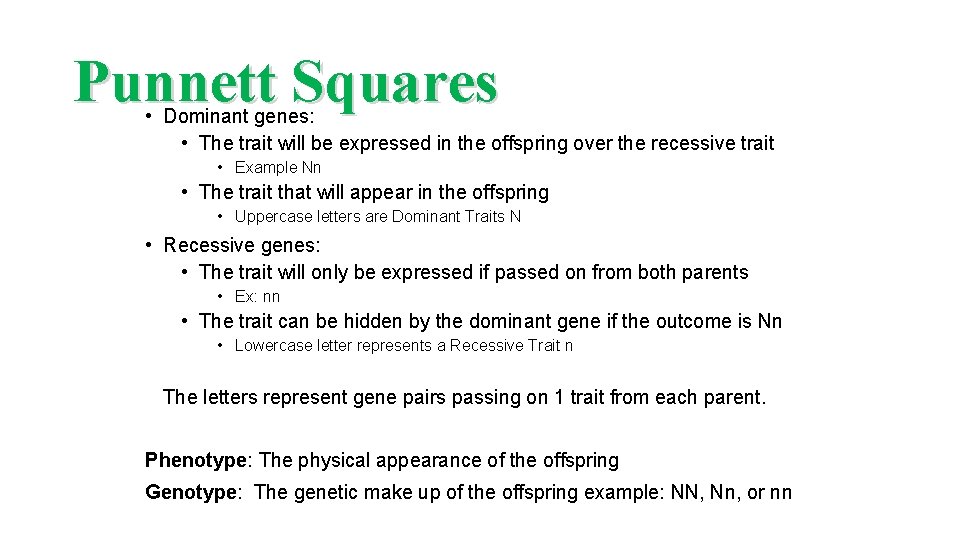
Punnett Squares • Dominant genes: • The trait will be expressed in the offspring over the recessive trait • Example Nn • The trait that will appear in the offspring • Uppercase letters are Dominant Traits N • Recessive genes: • The trait will only be expressed if passed on from both parents • Ex: nn • The trait can be hidden by the dominant gene if the outcome is Nn • Lowercase letter represents a Recessive Trait n The letters represent gene pairs passing on 1 trait from each parent. Phenotype: The physical appearance of the offspring Genotype: The genetic make up of the offspring example: NN, Nn, or nn
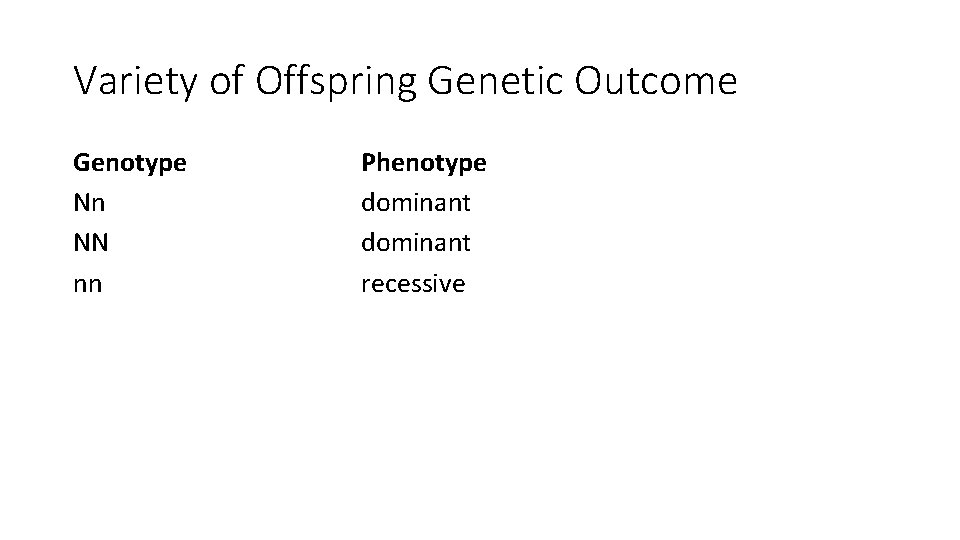
Variety of Offspring Genetic Outcome Genotype Nn NN nn Phenotype dominant recessive
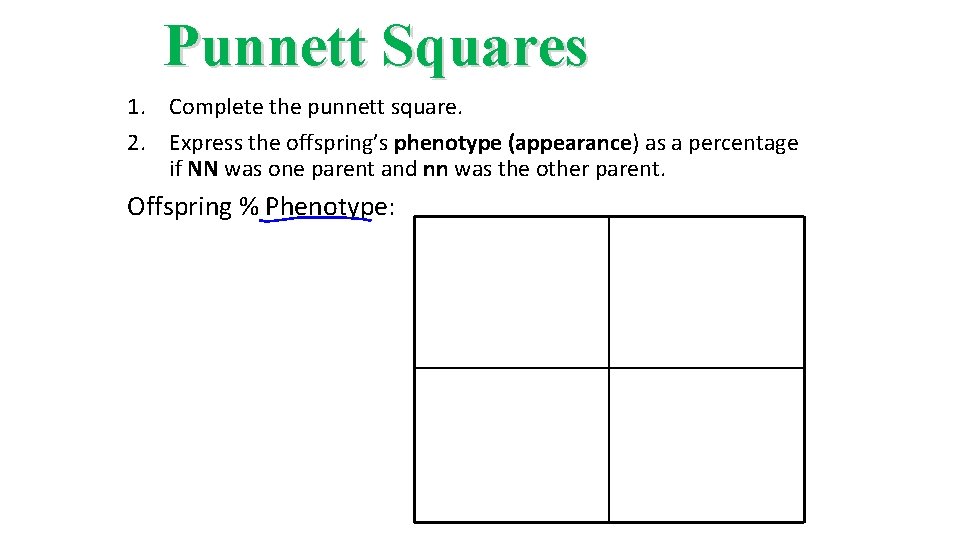
Punnett Squares 1. Complete the punnett square. 2. Express the offspring’s phenotype (appearance) as a percentage if NN was one parent and nn was the other parent. Offspring % Phenotype:
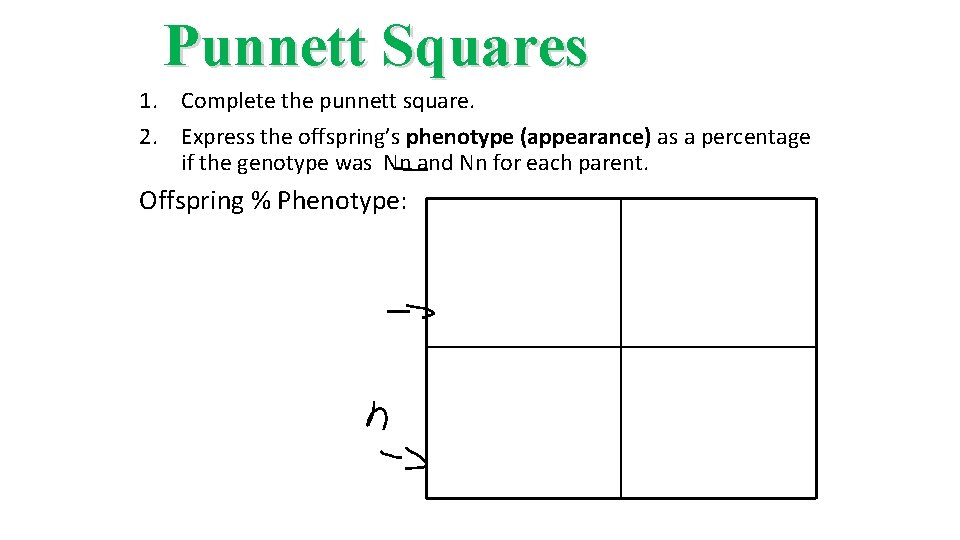
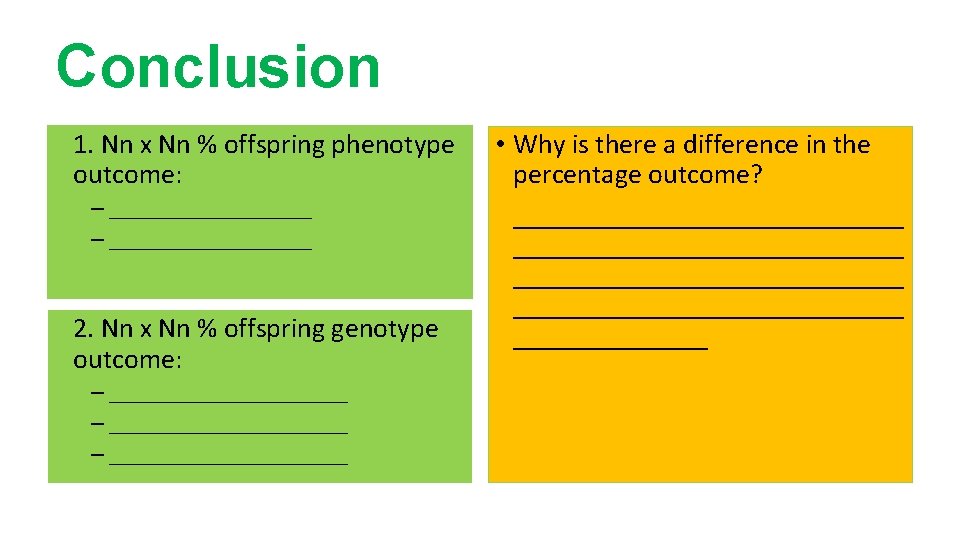
Punnett Squares 1. Complete the punnett square. 2. Express the offspring’s phenotype (appearance) as a percentage if the genotype was Nn and Nn for each parent. Offspring % Phenotype:
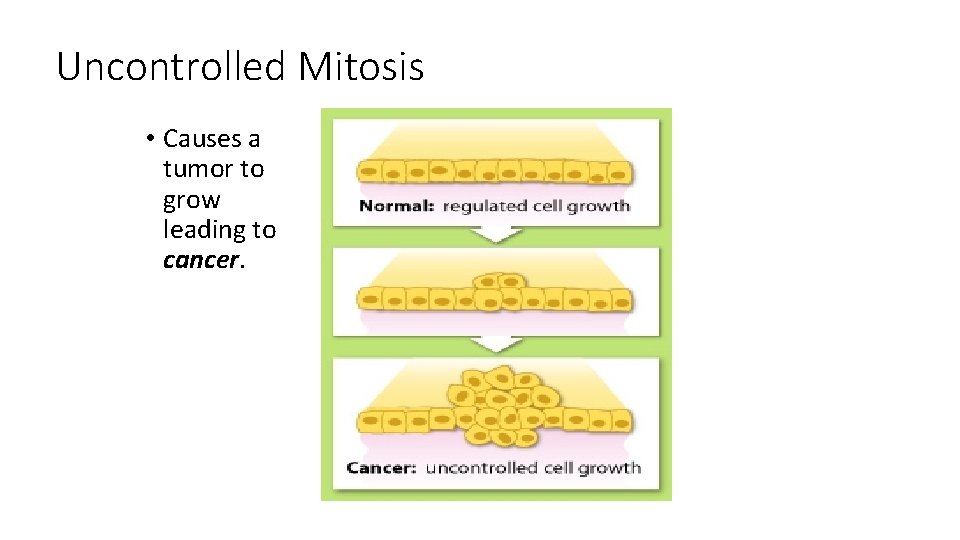
Uncontrolled Mitosis • Causes a tumor to grow leading to cancer.
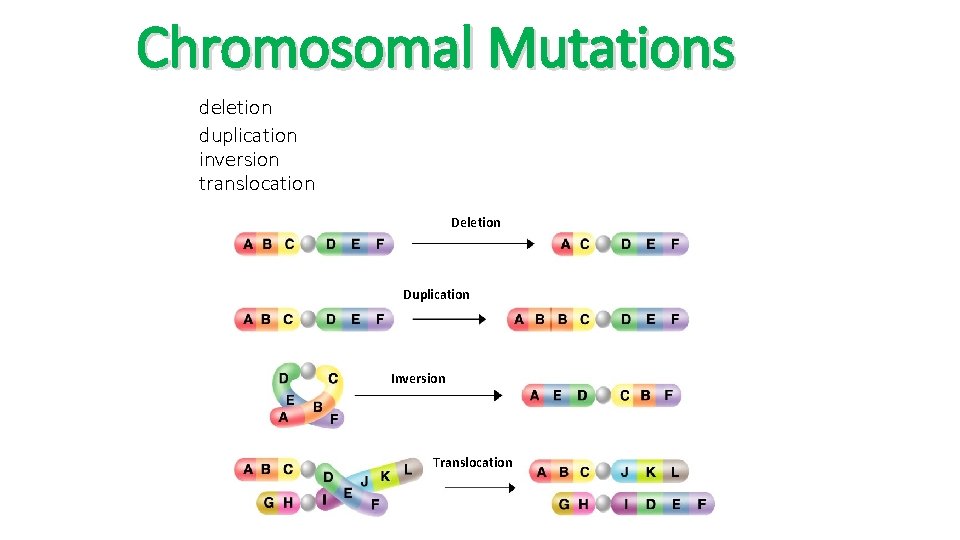
Chromosomal Mutations deletion duplication inversion translocation Deletion Duplication Inversion Translocation Go to Section:
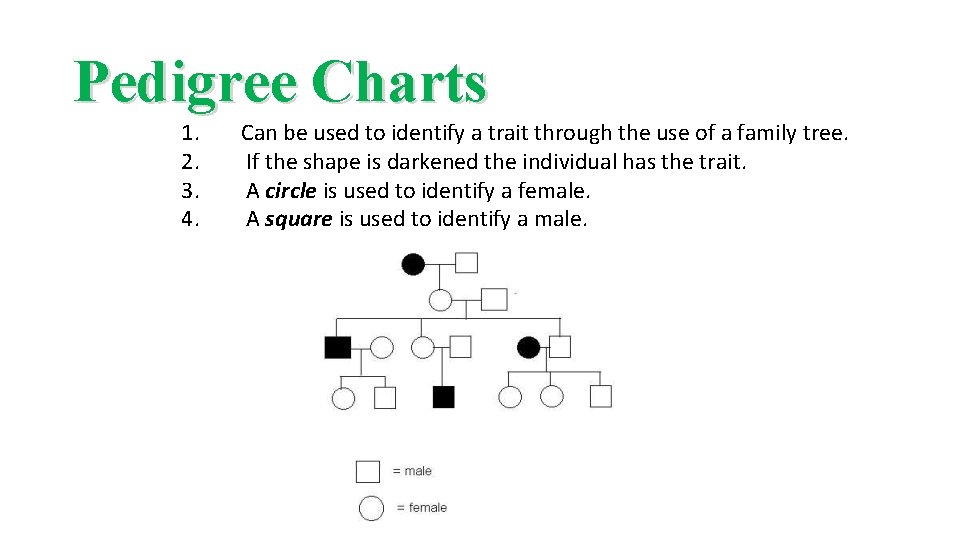
Pedigree Charts 1. 2. 3. 4. Can be used to identify a trait through the use of a family tree. If the shape is darkened the individual has the trait. A circle is used to identify a female. A square is used to identify a male.
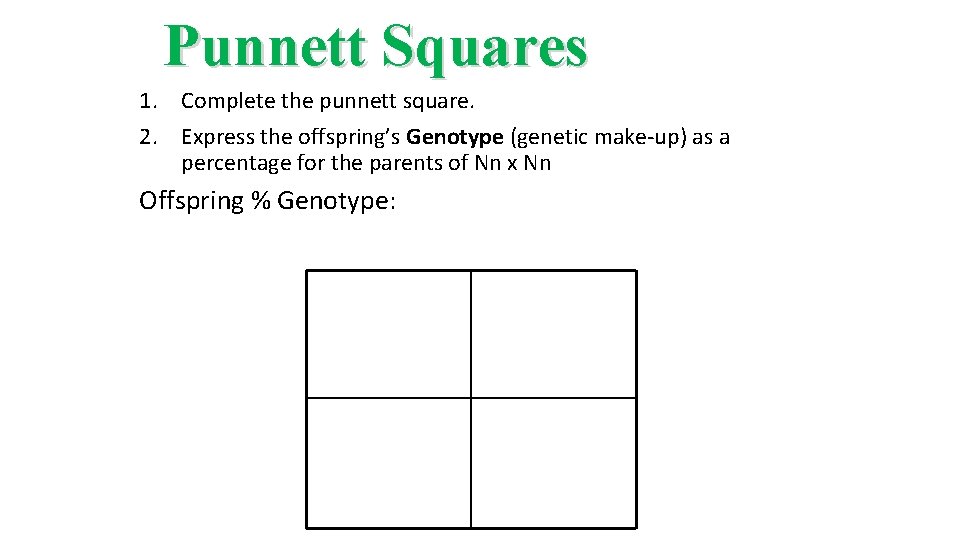
Punnett Squares 1. Complete the punnett square. 2. Express the offspring’s Genotype (genetic make-up) as a percentage for the parents of Nn x Nn Offspring % Genotype:
Check your understanding! 1. 2. 3. 4. 5. 6. NN is an example of dominant or recessive genes? Nn will show the dominant or recessive trait? Complete a Punnett Square crossing a NN and nn. What percentage of the offspring will show the dominant trait? What percent of the offspring will show the recessive trait? Make a Punnett Square expressing a cross of the offspring from the punnett square you created.
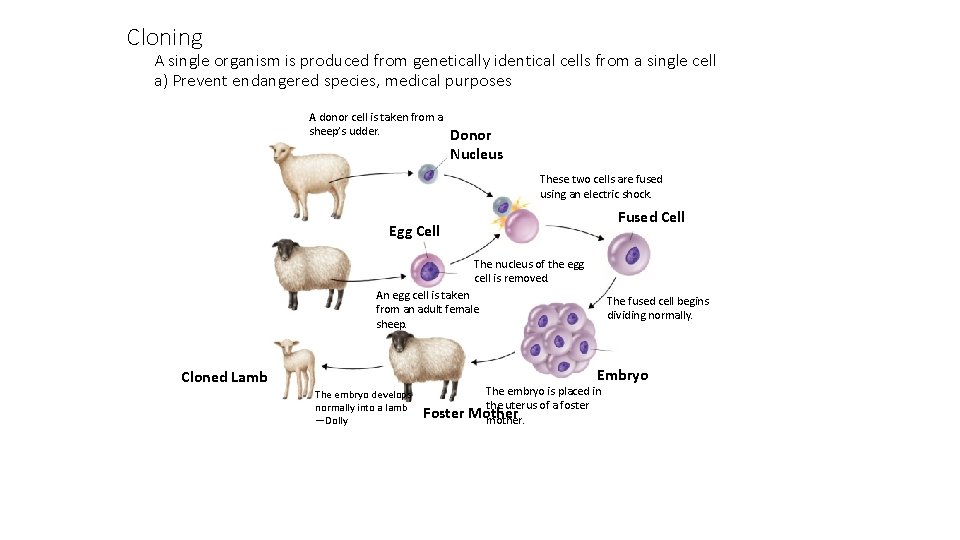
What can lead to variation? • Sexual reproduction • Mutations • Variety is important for survival • Natural Selection What will limit variation? • All types of asexual reproduction • Selective breeding/Artificial Selection • Cloning
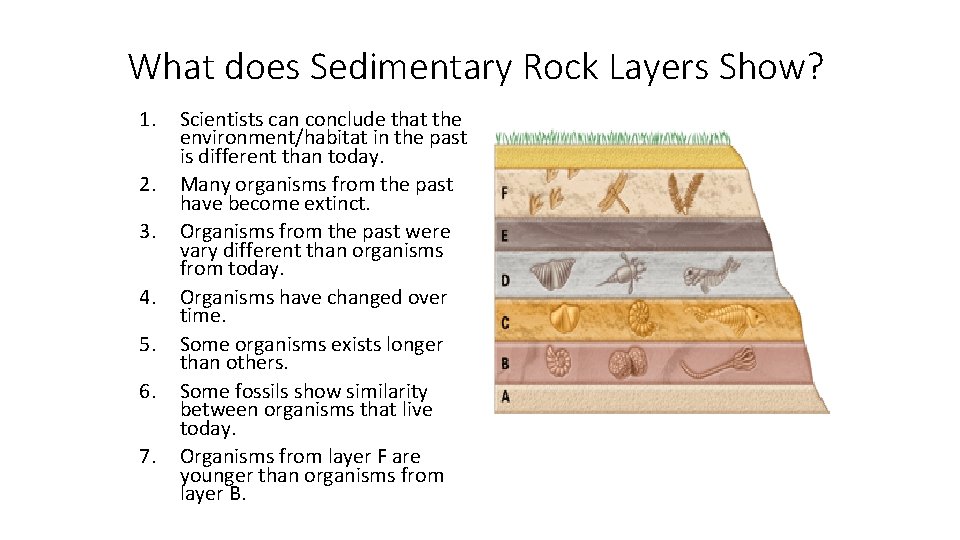
What does Sedimentary Rock Layers Show? 1. 2. 3. 4. 5. 6. 7. Scientists can conclude that the environment/habitat in the past is different than today. Many organisms from the past have become extinct. Organisms from the past were vary different than organisms from today. Organisms have changed over time. Some organisms exists longer than others. Some fossils show similarity between organisms that live today. Organisms from layer F are younger than organisms from layer B.
Cloning Figure 13 -13 Cloning of the First Mammal A single organism is produced from genetically identical cells from a single cell Section 13 -4 a) Prevent endangered species, medical purposes A donor cell is taken from a sheep’s udder. Donor Nucleus These two cells are fused using an electric shock. Fused Cell Egg Cell The nucleus of the egg cell is removed. An egg cell is taken from an adult female sheep. Embryo Cloned Lamb The embryo develops normally into a lamb —Dolly Go to Section: The fused cell begins dividing normally. Foster The embryo is placed in the uterus of a foster Mother mother.
Conclusion 1. Nn x Nn % offspring phenotype outcome: – _________________ 2. Nn x Nn % offspring genotype outcome: – ____________________ – __________ • Why is there a difference in the percentage outcome? ____________________________ _______
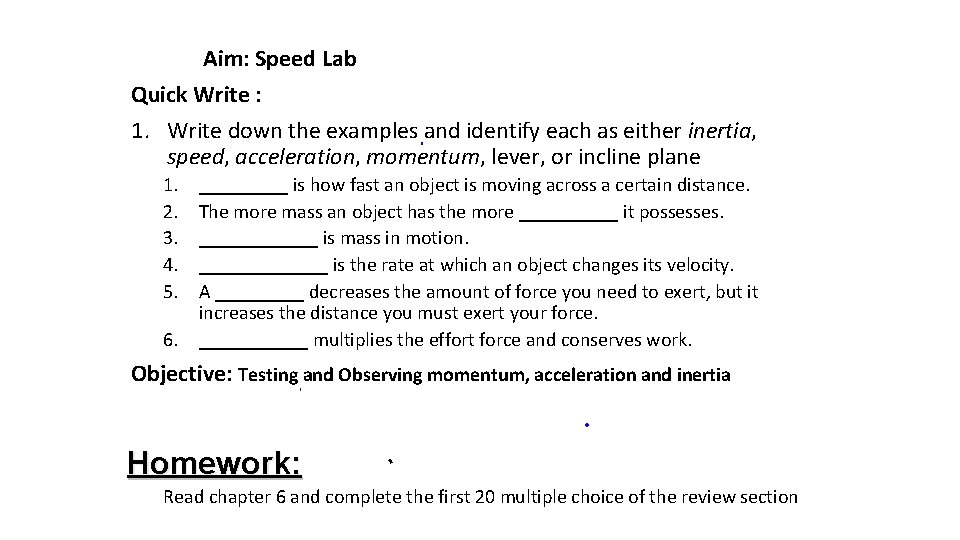
Aim: Speed Lab Quick Write : 1. Write down the examples and identify each as either inertia, speed, acceleration, momentum, lever, or incline plane 1. 2. 3. 4. 5. 6. _____ is how fast an object is moving across a certain distance. The more mass an object has the more _____ it possesses. ______ is mass in motion. _______ is the rate at which an object changes its velocity. A _____ decreases the amount of force you need to exert, but it increases the distance you must exert your force. ______ multiplies the effort force and conserves work. Objective: Testing and Observing momentum, acceleration and inertia Homework: Read chapter 6 and complete the first 20 multiple choice of the review section
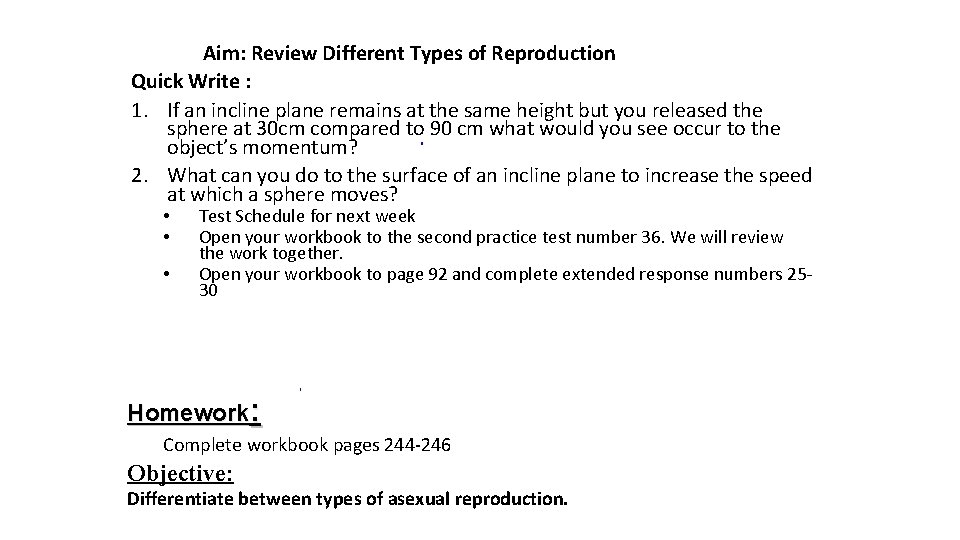
Aim: Review Different Types of Reproduction Quick Write : 1. If an incline plane remains at the same height but you released the sphere at 30 cm compared to 90 cm what would you see occur to the object’s momentum? 2. What can you do to the surface of an incline plane to increase the speed at which a sphere moves? • • • Test Schedule for next week Open your workbook to the second practice test number 36. We will review the work together. Open your workbook to page 92 and complete extended response numbers 2530 Homework: Complete workbook pages 244 -246 Objective: Differentiate between types of asexual reproduction.
Closure • New York State Review Worksheet on Reproduction and Genetics • Identify any new vocabulary you have come across since we began our State review and place on a colored sheet of paper to post on the outside wall!