
Chapter 7 Gathering Materials Using Your Own Knowledge
- Slides: 9
Chapter 7 Gathering Materials
Using Your Own Knowledge and Experience • Outside information is always necessary in speeches, however adding personal connections, knowledge, and experiences, brings it to life • Drawing on own experiences allows the point to be conveyed more meaningfully • Use your own knowledge to connect to the audience
Doing Library Research • Though thought to be outdated, libraries are an excellent source of information through use of: – The Catalogue – Reference Works – Newspaper and Periodical Databases – Academic Databases
Doing Library Research • The Catalogue: – Lists all books, periodicals, and other resources owned by the library – Call Number: – A number used in libraries to classify books and periodicals and to indicate where they can be found on the shelves • Reference Works: – A work that synthesizes a large amount of related information easy of related information for easy access by researchers – Encyclopedias – Yearbooks – Quotation Books – Biographical Aids
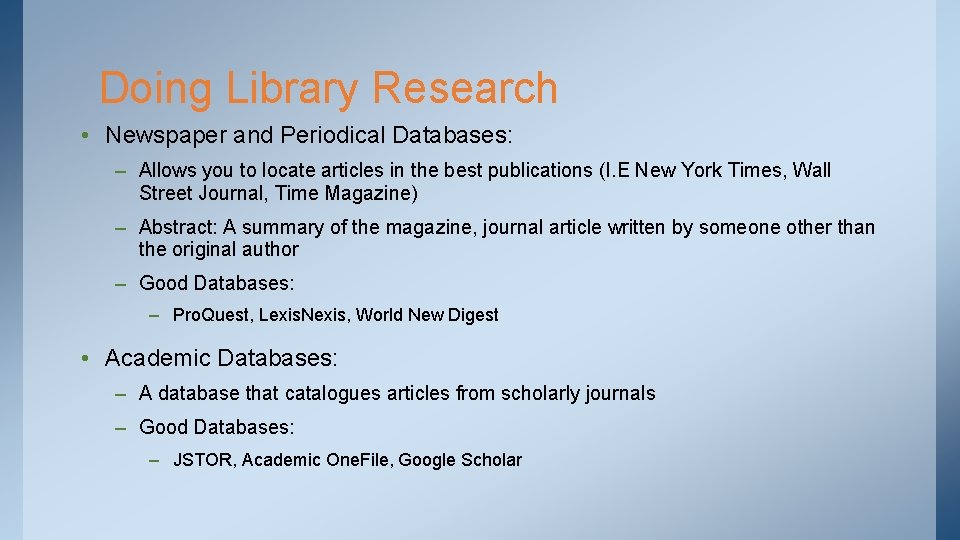
Doing Library Research • Newspaper and Periodical Databases: – Allows you to locate articles in the best publications (I. E New York Times, Wall Street Journal, Time Magazine) – Abstract: A summary of the magazine, journal article written by someone other than the original author – Good Databases: – Pro. Quest, Lexis. Nexis, World New Digest • Academic Databases: – A database that catalogues articles from scholarly journals – Good Databases: – JSTOR, Academic One. File, Google Scholar
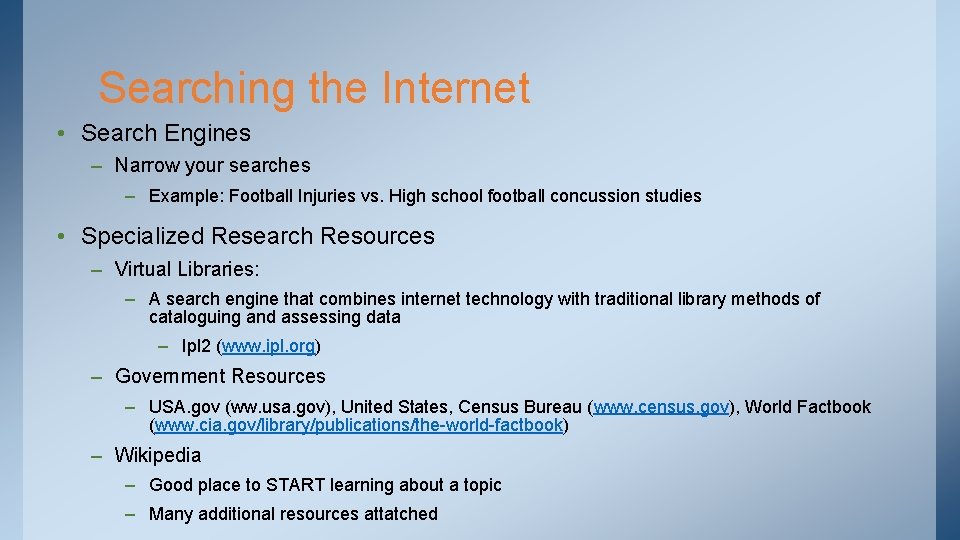
Searching the Internet • Search Engines – Narrow your searches – Example: Football Injuries vs. High school football concussion studies • Specialized Research Resources – Virtual Libraries: – A search engine that combines internet technology with traditional library methods of cataloguing and assessing data – Ipl 2 (www. ipl. org) – Government Resources – USA. gov (ww. usa. gov), United States, Census Bureau (www. census. gov), World Factbook (www. cia. gov/library/publications/the-world-factbook) – Wikipedia – Good place to START learning about a topic – Many additional resources attatched
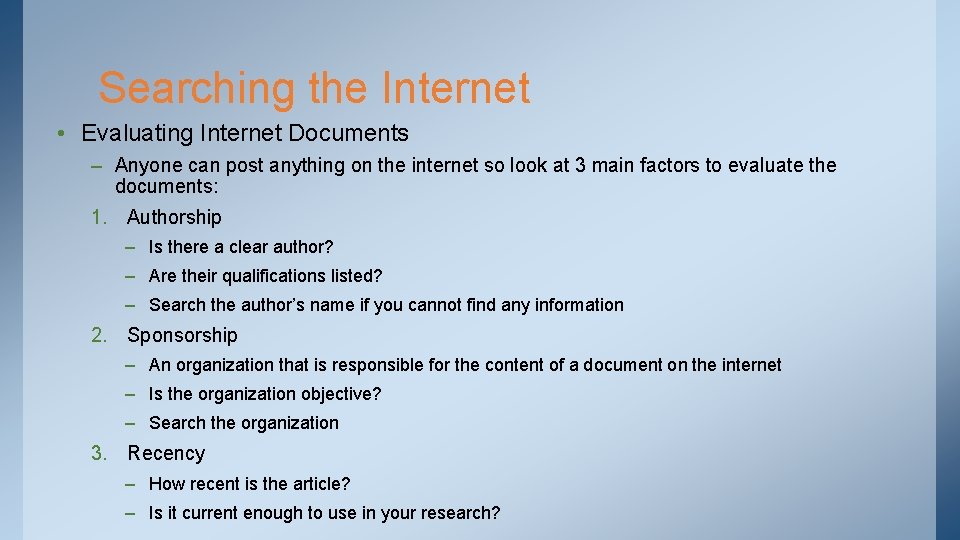
Searching the Internet • Evaluating Internet Documents – Anyone can post anything on the internet so look at 3 main factors to evaluate the documents: 1. Authorship – Is there a clear author? – Are their qualifications listed? – Search the author’s name if you cannot find any information 2. Sponsorship – An organization that is responsible for the content of a document on the internet – Is the organization objective? – Search the organization 3. Recency – How recent is the article? – Is it current enough to use in your research?
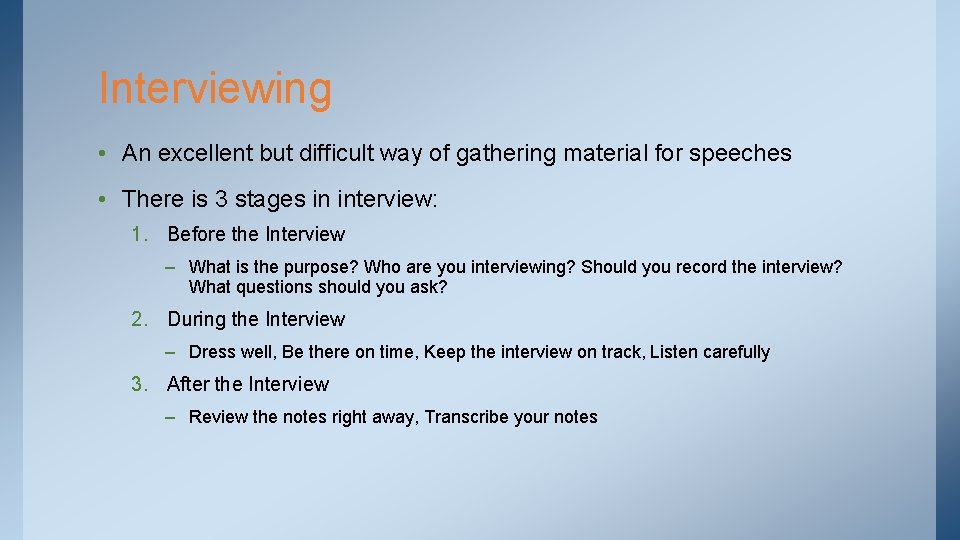
Interviewing • An excellent but difficult way of gathering material for speeches • There is 3 stages in interview: 1. Before the Interview – What is the purpose? Who are you interviewing? Should you record the interview? What questions should you ask? 2. During the Interview – Dress well, Be there on time, Keep the interview on track, Listen carefully 3. After the Interview – Review the notes right away, Transcribe your notes
Tips for Doing Research 1. Start Early – Give yourself enough time to properly research 2. Make a Preliminary Bibliography – List any sources you may use as you are doing your original research 3. Take Notes Efficiently – Take plenty of notes – Record notes in a consistent format – Make a Separate Entry for Each Note – Distinguish Among Direct Quotes, Paraphrasing, and Your Own Ideas