
Chapter 7 Forms of Energy The First Law




- Slides: 11
Chapter 7 Forms of Energy: The First Law of Thermodynamics
Section 7. 1—Forms of Energy • The total energy of a system is defined as the sum of: • Kinetic energy • Energy due to translational motion • Typically negligible because the operation itself would have to be in motion • Potential energy • Energy due to height or position • Internal energy • Energy contained within the system • e. g. kinetic energy of molecules, vibrational and rotational energy of molecules, etc.
Closed Systems • A closed system is one in which no mass is transferred across its boundaries • Energy can therefore be transferred between system and surroundings in two distinct ways: • Heat • Result of a temperature gradient • Defined as positive when transferred to system from the surroundings • Work • Energy transferred in any other manner other than a temperature difference • e. g. a moving piston, torque, voltage, etc. • Defined as positive when it is done by the system on the surroundings
Section 7. 2—Kinetic and Potential Energy • Kinetic energy is defined as: Ek = ½ mu 2 OR Ek = ½ mu 2 • Example: Water is pumped from a storage tank through a tube of 3. 00 cm inner diameter at the rate of 0. 001 m 3/s. What is the energy flow rate for this stream in J/s?
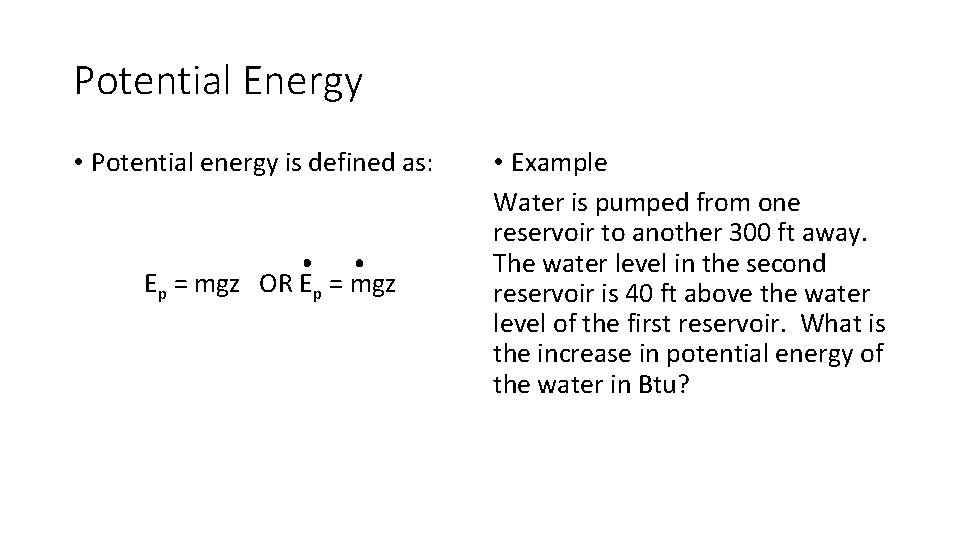
Potential Energy • Potential energy is defined as: Ep = mgz OR Ep = mgz • Example Water is pumped from one reservoir to another 300 ft away. The water level in the second reservoir is 40 ft above the water level of the first reservoir. What is the increase in potential energy of the water in Btu?
Energy Balances on Closed Process • In a closed system • A gas is contained in a cylinder fitted with a movable process, 60 Btu of piston. The initial gas temperature is 25 C. The heat is added to cylinder is placed in boiling water with the piston the system, and held in a fixed position. Heat in the amount of 2. 00 the internal kcal is transferred to the gas, which equilibrates at energy of the 100 C (and a higher pressure). system increases • The piston is then released, and the gas does 100 J of by 220 Btu. work in moving the piston to its new equilibrium Calculate the work position. The final gas temperature is 100 C. Write of the process. the energy balance equation for each of the two stages of the process and neglect the change in potential energy of the gas as the piston moves vertically.
Section 7. 4—Energy Balances on Open Systems at Steady State • For these systems mass is crossing system boundaries at a certain flow rate; therefore, work must be done to accomplish this • Two types of work to be discussed: • Shaft work (work done on a moving part within the system) • Ws • Flow work (the net rate of work done at the system outlet and inlet) • Wfl • The work described here is PV (pressure/volume) work
Section 7. 4 c—The Steady-State Open-System Energy Balance • Ultimately relies on the first law of thermodynamics Input = Output • H + Ek + Ep = Q – Ws • Terms cancel under the same conditions as closed system
Section 7. 4 b—Specific Properties and Enthalpy • Technically a specific property is obtained by dividing an extensive property by the total amount of that property • Ex: heat capacity vs. specific heat capacity • Symbolized by using a above whatever property is being discussed • Ex: Ĥ or Û • H=mĤ
Specific Enthalpy and the Open System Energy Balance • One term that occurs in the open system energy balance is change in enthalpy, H • In terms of specific properties: Ĥ = Û + PV • Example: The specific internal energy of helium at 300 K and 1 atm is 3800 J/mol, and the specific molar volume at the same temperature and pressure is 24. 63 L/mol. Calculate the specific enthalpy of helium at this temperature and pressure, and the rate at which enthalpy is transported by a stream of helium at 300 K and 1 atm with a molar flow rate of 250 kmol/hr.
Section 7. 5—Tables of Thermodynamic Data • In the previous example the Û and V were given; however, this is a very unlikely scenario. Most of the times these values will need to be determined using a table of values • Much like using a table to determine G, H, or S • The tables take advantage of the fact that Ĥ and Û are state properties • The tables can be found in Tables B. 5 through B. 8 in the back of the textbook • All of these values rely on a reference state for their determination • What is the reference state for H values from AP Chem?