
Chapter 7 Federal Income Tax Objectives n n
Chapter 7 Federal Income Tax
Objectives n n Understand the purpose of taxes, different types of taxes, and the history of taxes in the United States. Describe components of the tax system, including the IRS, the power to tax, and paying your fair share Define and show a working knowledge of exemptions, dependents, and taxable and nontaxable income when preparing tax returns Prepare forms 1040 EZ and 1040 A (Individual Federal Income Tax Returns).
Our Tax System n n n Money is collected by the government from citizens and businesses in the form of taxes This money, which is called revenue, is redistributed according to needs and priorities determined by Congress Ability-to-pay principle: individuals with different amounts of wealth or income should pay different amounts of taxes
Our Tax System cont’d n Types of taxes n Progressive n n n Regressive n n Increase in proportion to income People/Businesses with higher income pay not only higher taxes, but at a higher rate Decrease in proportion to income People/Businesses with higher income pay taxes at a decreased percentage Ex. Sales Tax Proportional n n Rate remains constant even if though the amount being taxed increases Ex. Property Tax
Our Tax System cont’d n Local Taxes n n National Taxes n n n Pay for education, parks and recreation, streets and roads, police, fire, and health departments Pay salaries for Congress Pay for national defense, highways, parks, welfare, foreign aid, etc. Most services (local and national) are provided for the general welfare of all citizens, although as an individual, you may not benefit directly
History of Taxes n Constitution (1787) included the option to tax, but not to tax individuals directly n n Revolutionary War financed by other countries War of 1812 was first temporary income tax n n When war debts were paid, income tax was dropped Civil War n n n Excise taxes and customs duties produced enough revenue at the time No income taxes against citizens, but also no services for them either 1862 -President Lincoln signed a law providing for progressive income tax on wages When the war ended the tax expired 16 th Amendment (introduced 1909, ratified 1913) n 1 st permanent income tax
History of Taxes cont’d n n n WWI (1917) was paid for by income taxes After WWI government was not providing many services for citizens Great Depression (1929) n n Social Security Act (1935) n n n President Roosevelt’s “New Deal” provided for government services for citizens through tax revenue Internal Revenue Service (IRS) created Money withheld from wages deposited with the Dept. of Treasury During WWII taxes were increased to finance the war n n This increase set precedent for changing tax rates of today Rates are increased to pay for growing services and needs of the government

Components of the Tax System n IRS Administrative agency of the Dept. of Treasury n Headquarters in DC, 7 regional offices n Main functions are to collect income taxes and enforce tax laws n Other functions include: n n Assist taxpayers in finding information and forms n Assist taxpayers in preparing tax returns
Components of the Tax System (cont’d) n Power to Tax Rests with Congress n Bills originate in the House per the Constitution n House Ways and Means Committee makes recommendations to the full House n After being passed by the House, bills must be passed by Senate, then signed by the President to become law n
Components of the Tax System (cont’d) n Paying Your Fair Share n US income tax is set at a graduated rate n n n More income received = more income tax Rates increased as Congress seeks ways to balance budget and reduce national debt US system based on voluntary compliance n n n All citizens are expected to file income tax returns by April 15, no tax collectors Late filing can result in penalty, interest charges, fine, and/or imprisonment Willful failure to pay taxes is called tax evasion, a felony punishable by fine and/or imprisonment
Components of the Tax System (cont’d) n IRS Audit n n When the IRS reviews tax returns of an individual or business Three choices if called for an audit n n Self-representation Give power of attorney to a lawyer, CPA, immediate family member, enrolled agent (someone formerly employed by the IRS at the audit level for >= 5 years) Take anyone at all with them for support (tax preparer, therapist, etc) during the audit session Most audits involve nothing more than confirming supporting documentation (receipts, bank statements, etc) so it can be done by the taxpayer w/out outside help
Tax Form Terms n Filing Status Single (not married) n Married filing jointly n Married filing separately n Head of Household (must meet certain conditions) n Qualifying widow(er) w/ dependent child n
Tax Form Terms cont’d n Exemption(s) n n n An allowance(s) a taxpayer claims for each person dependent on taxpayer’s income Automatically allowed 1 for yourself Dependent n n A person who lives w/ you and receives > ½ of living expenses from you (including baby born at any time during the tax year) Each exemption claimed excludes a certain amount of gross income ($3, 100 in 2004)
Tax Form Terms cont’d n Qualifications for being a dependent Must be a relative n Citizen or resident of the United States n If married, cannot file a joint return w/ spouse n Person’s income must be less than the amount of exemption (does not include child <19 or student <24) n Must provide > ½ of the person’s support during the year n
Tax Form Terms cont’d n Gross Income n n Adjusted Gross Income n n All the taxable income received, including wages, tips, salaries, interest, dividends, unemployment compensation, alimony, workers’ compensation, etc Income after allowed adjustments are made (i. e. IRA contributions) Taxable Income n n Income used for determining tax amount AGI less legal expenses that are allowed to be deducted (state and local taxes, mortgage interest, child care expenses, casualty and theft losses, job and miscellaneous expenses)
Preparing to File n Who must file? n n When to file? n n n You must file if your filing status, age, and gross income are shown in Fig 7 -3 on page 162 April 15 th The earlier you file, the sooner you get your refund Short Form or Long Form n 17% use 1040 EZ n n 19% use 1040 A n n requirements 64% use 1040 n Must use if you cannot file one of the others
Summary n n n n n Income taxes are the US government’s largest source of income Income taxes did not always exist, but evolved to finance wars 3 types of taxes: progressive, regressive, proportional IRS collects taxes Citizens voluntarily comply with tax laws Gross income – adjustments = AGI – itemized deductions/standard deduction – exemptions = taxable income If your standard deduction is less than your itemized deduction, you must use form 1040 Willful failure to prepare and file tax returns is a federal offense
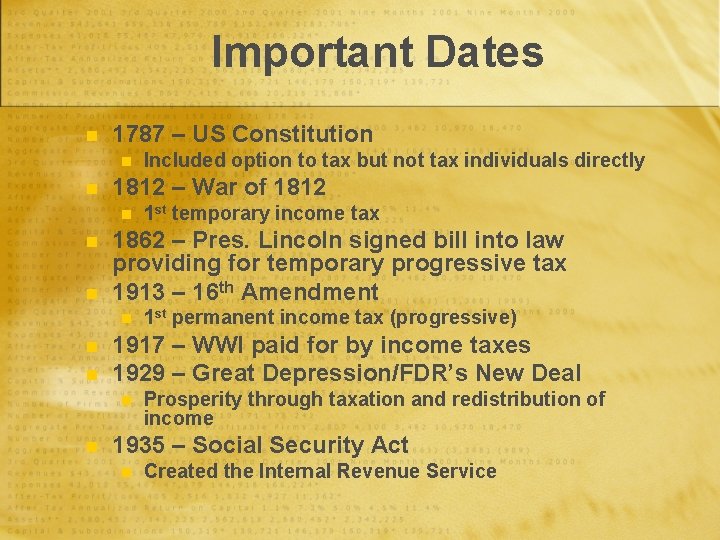
Important Dates n 1787 – US Constitution n n 1812 – War of 1812 n n 1 st permanent income tax (progressive) 1917 – WWI paid for by income taxes 1929 – Great Depression/FDR’s New Deal n n 1 st temporary income tax 1862 – Pres. Lincoln signed bill into law providing for temporary progressive tax 1913 – 16 th Amendment n n Included option to tax but not tax individuals directly Prosperity through taxation and redistribution of income 1935 – Social Security Act n Created the Internal Revenue Service
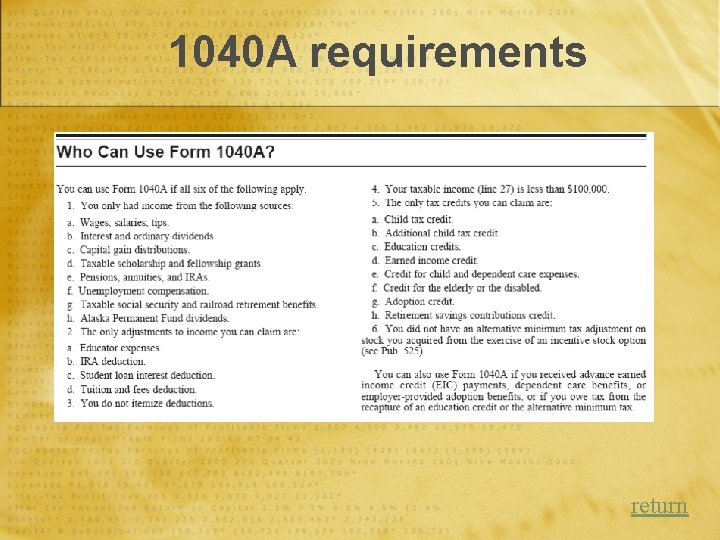
1040 A requirements return
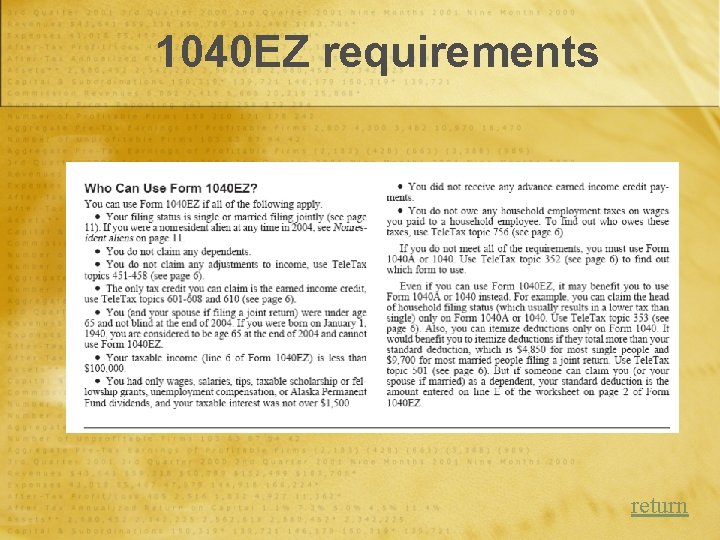
1040 EZ requirements return
- Slides: 20