
Chapter 7 Family planning NATIONAL DEPARTMENT OF HEALTH

- Slides: 10
Chapter 7: Family planning NATIONAL DEPARTMENT OF HEALTH AFFORDABLE MEDICINES ESSENTIAL MEDICINES PROGRAMME PRIMARY HEALTHCARE GUIDELINES 2018 1
EVIDENCE Please access the National Essential Medicines List Committee (NEMLC) report for detailed evidence (including rationale, references and costings) informing decision-making on medicine addition, amendments and deletions: http: //www. health. gov. za/index. php/standard-treatment-guidelines-andessential-medicines-list/category/285 -phc DISCLAIMER This slide set is an implementation tool and should be used alongside the most recently published STG available on the EML Clinical Guide Application. This information does not supersede or replace the STG itself. 2
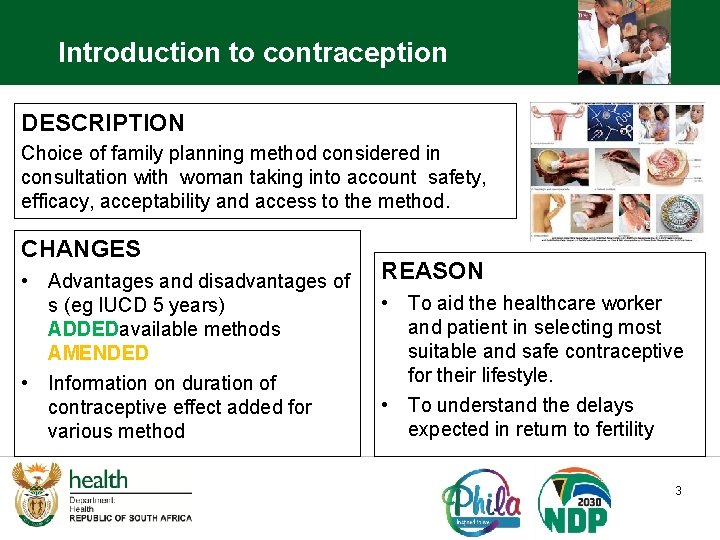
Introduction to contraception DESCRIPTION Choice of family planning method considered in consultation with woman taking into account safety, efficacy, acceptability and access to the method. CHANGES • Advantages and disadvantages of s (eg IUCD 5 years) ADDEDavailable methods AMENDED • Information on duration of contraceptive effect added for various method REASON • To aid the healthcare worker and patient in selecting most suitable and safe contraceptive for their lifestyle. • To understand the delays expected in return to fertility 3
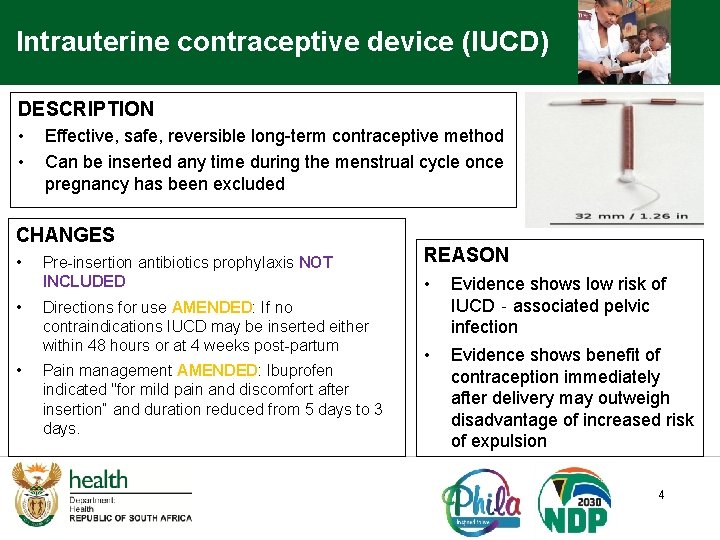
Intrauterine contraceptive device (IUCD) DESCRIPTION • • Effective, safe, reversible long-term contraceptive method Can be inserted any time during the menstrual cycle once pregnancy has been excluded CHANGES • • • Pre-insertion antibiotics prophylaxis NOT INCLUDED Directions for use AMENDED: If no contraindications IUCD may be inserted either within 48 hours or at 4 weeks post-partum Pain management AMENDED: Ibuprofen indicated "for mild pain and discomfort after insertion“ and duration reduced from 5 days to 3 days. REASON • Evidence shows low risk of IUCD‐associated pelvic infection • Evidence shows benefit of contraception immediately after delivery may outweigh disadvantage of increased risk of expulsion 4
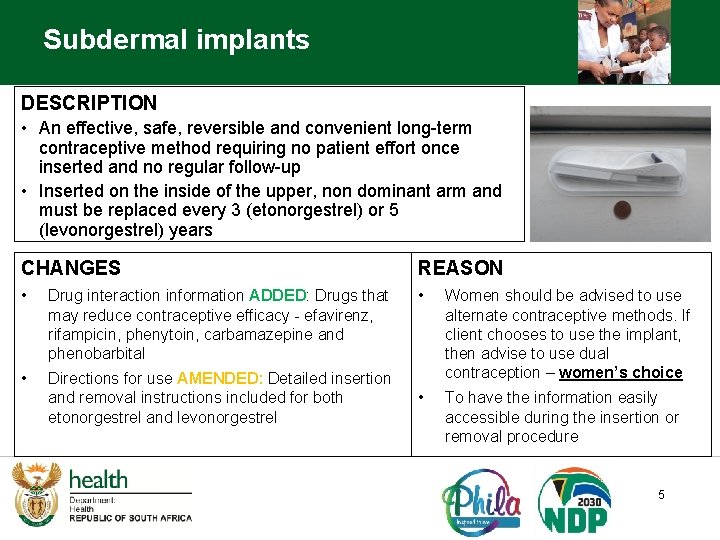
Subdermal implants DESCRIPTION • An effective, safe, reversible and convenient long-term contraceptive method requiring no patient effort once inserted and no regular follow-up • Inserted on the inside of the upper, non dominant arm and must be replaced every 3 (etonorgestrel) or 5 (levonorgestrel) years CHANGES REASON • Drug interaction information ADDED: Drugs that may reduce contraceptive efficacy - efavirenz, rifampicin, phenytoin, carbamazepine and phenobarbital • • Directions for use AMENDED: Detailed insertion and removal instructions included for both etonorgestrel and levonorgestrel Women should be advised to use alternate contraceptive methods. If client chooses to use the implant, then advise to use dual contraception – women’s choice • To have the information easily accessible during the insertion or removal procedure 5
Injectable contraceptives DESCRIPTION • Long-acting hormonal contraceptive i. e. given IM every 8 or 12 weeks • Daily adherence is not required CHANGES REASON • Directions for use AMENDED: Timing of postpartum use not restricted • Potential for HIV acquisition risk NOT INCLUDED • No evidence for restricting use in first 48 hours post-partum or at 6 weeks postpartum • Current evidence insufficient, pending the results of the ECHO RCT 6
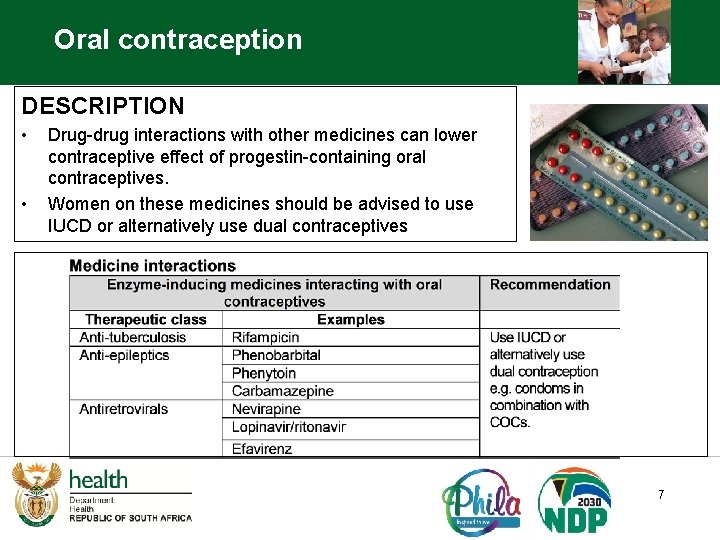
Oral contraception DESCRIPTION • • Drug-drug interactions with other medicines can lower contraceptive effect of progestin-containing oral contraceptives. Women on these medicines should be advised to use IUCD or alternatively use dual contraceptives 7
Emergency contraception DESCRIPTION Use of a contraceptive method following an episode of unprotected sexual intercourse to reduce risk of pregnancy CHANGES • Women on concomitant enzyme‐inducing medicines should be advised to use copper IUCD or double‐dose levonorgestrel, oral for emergency contraception • Women > 80 kg or BMI ≥ 30 should be given twice standard dose of levonorgestrel REASON Enzyme-inducing medicines and obesity result in significant reduction of LNG concentrations 8
Breakthrough bleeding with contraceptive use DESCRIPTION Unscheduled or irregular vaginal bleeding which often presents as spotting, prolonged or frequent bleeding in women using hormonal contraception CHANGES • BREAKTHROUGH BLEEDING WITH CONTRACEPTIVE USE management ADDED • Hormonal management ADDED • For failure of hormonal management, refer REASON • To provide guidance on unscheduled bleeding associated with contraceptive use at PHC 9
THANK YOU