
Chapter 7 Factors Affecting Instruction Science School Programs
- Slides: 58
Chapter 7 Factors Affecting Instruction Science
School Programs and Practices
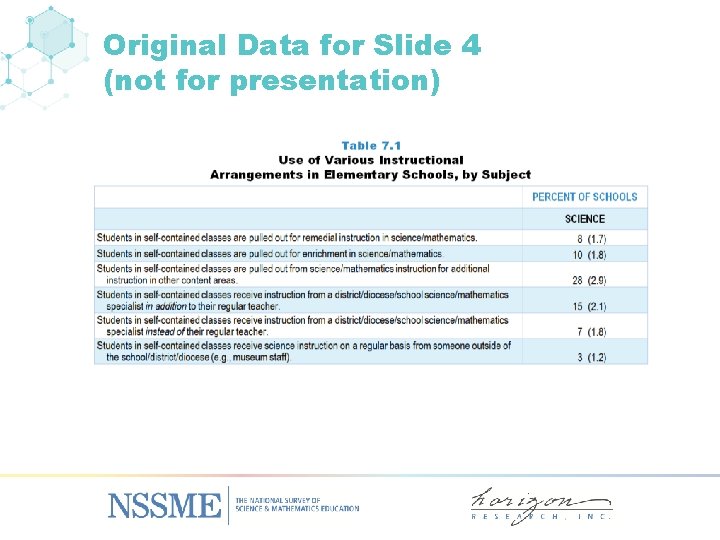
Original Data for Slide 4 (not for presentation)
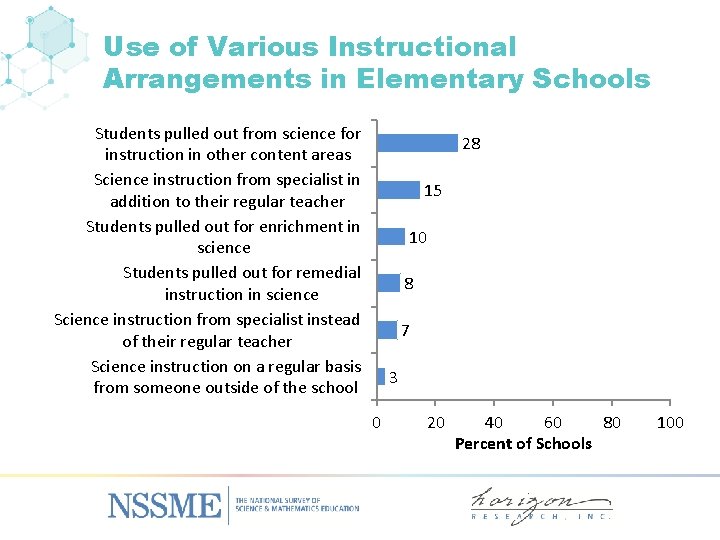
Use of Various Instructional Arrangements in Elementary Schools Students pulled out from science for instruction in other content areas Science instruction from specialist in addition to their regular teacher Students pulled out for enrichment in science Students pulled out for remedial instruction in science Science instruction from specialist instead of their regular teacher Science instruction on a regular basis from someone outside of the school 28 15 10 8 7 3 0 20 40 60 80 Percent of Schools 100
Original Data for Slides 6– 7 (not for presentation)
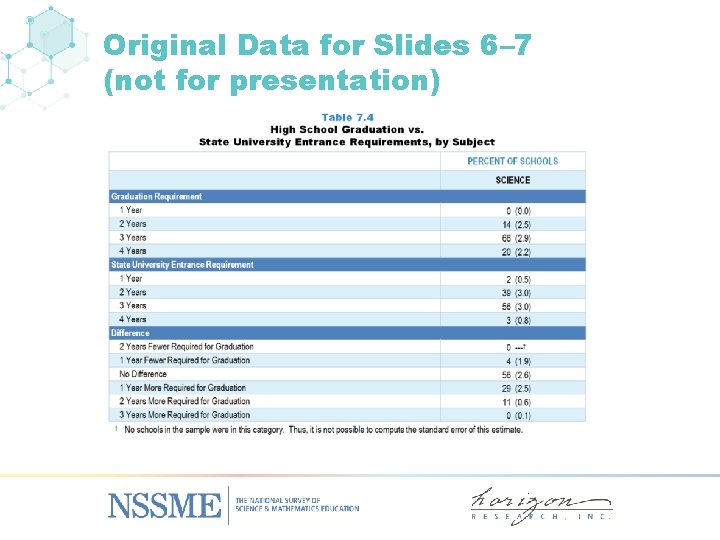
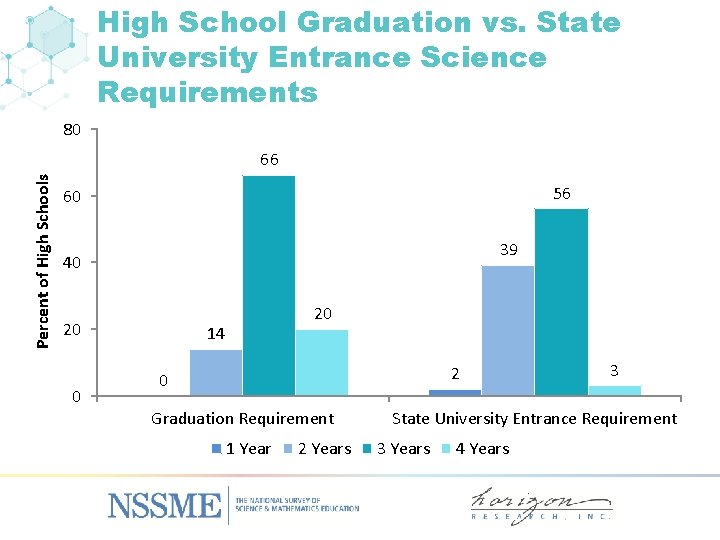
High School Graduation vs. State University Entrance Science Requirements 80 Percent of High Schools 66 56 60 39 40 20 14 2 0 Graduation Requirement 1 Year 2 Years 3 State University Entrance Requirement 3 Years 4 Years
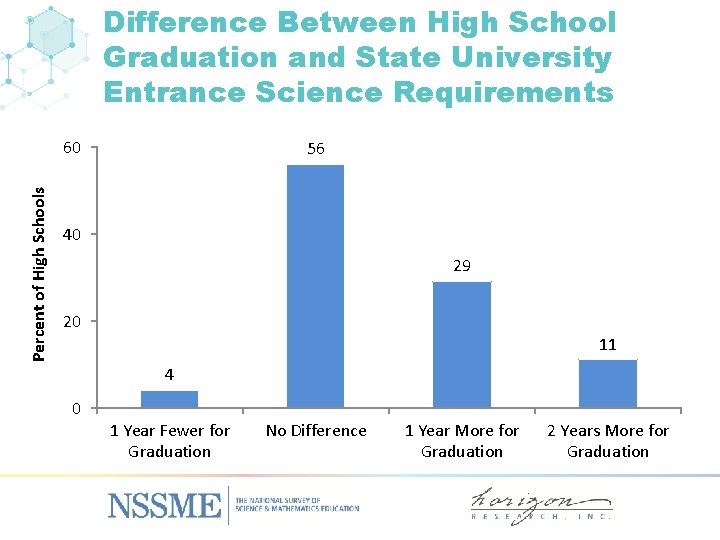
Difference Between High School Graduation and State University Entrance Science Requirements Percent of High Schools 60 56 40 29 20 11 4 0 1 Year Fewer for Graduation No Difference 1 Year More for Graduation 2 Years More for Graduation
Original Data for Slides 9– 14 (not for presentation)
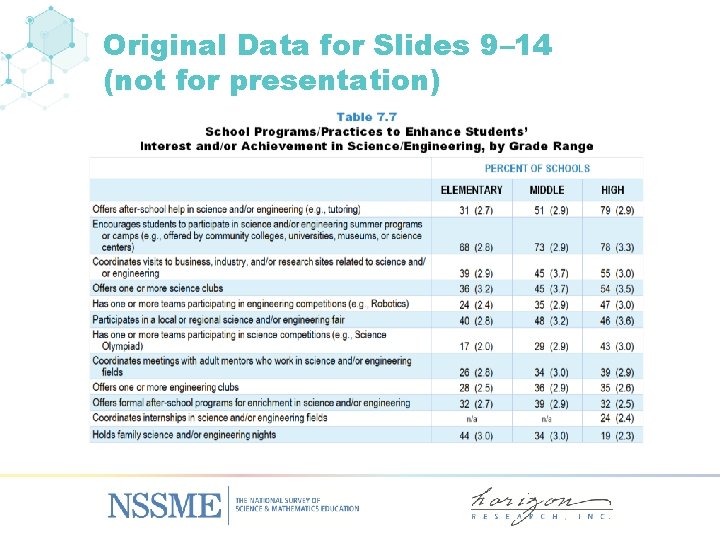
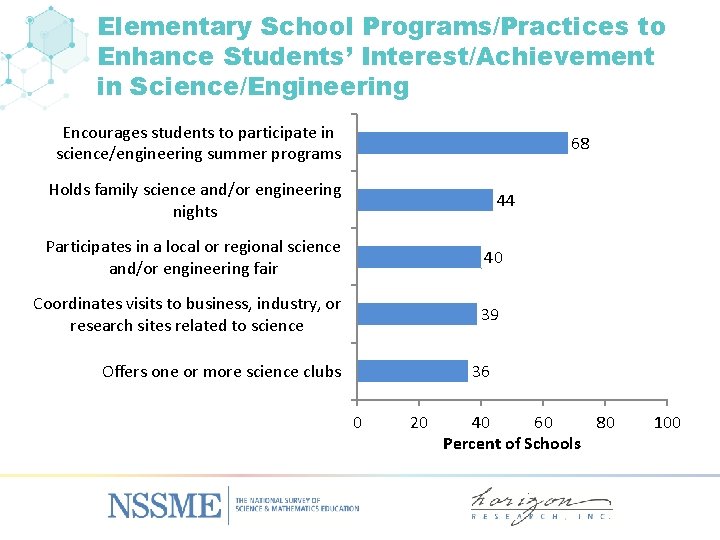
Elementary School Programs/Practices to Enhance Students’ Interest/Achievement in Science/Engineering Encourages students to participate in science/engineering summer programs 68 Holds family science and/or engineering nights 44 Participates in a local or regional science and/or engineering fair 40 Coordinates visits to business, industry, or research sites related to science 39 Offers one or more science clubs 36 0 20 40 60 80 Percent of Schools 100
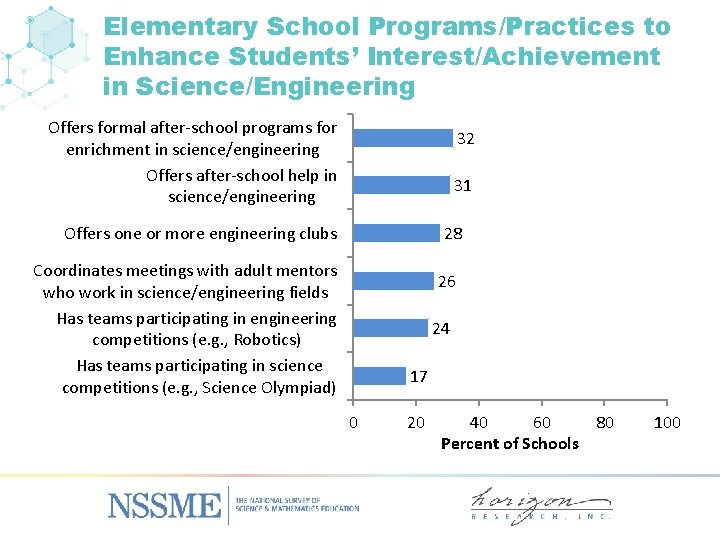
Elementary School Programs/Practices to Enhance Students’ Interest/Achievement in Science/Engineering Offers formal after-school programs for enrichment in science/engineering Offers after-school help in science/engineering 32 31 Offers one or more engineering clubs 28 Coordinates meetings with adult mentors who work in science/engineering fields Has teams participating in engineering competitions (e. g. , Robotics) Has teams participating in science competitions (e. g. , Science Olympiad) 26 24 17 0 20 40 60 80 Percent of Schools 100
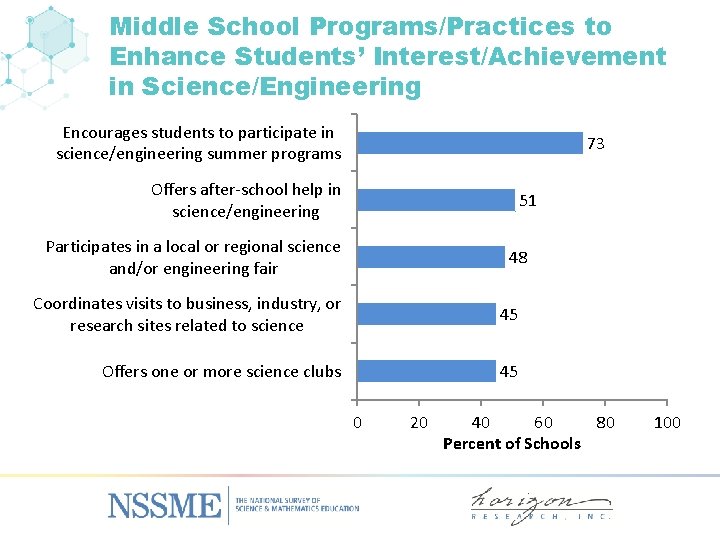
Middle School Programs/Practices to Enhance Students’ Interest/Achievement in Science/Engineering Encourages students to participate in science/engineering summer programs 73 Offers after-school help in science/engineering 51 Participates in a local or regional science and/or engineering fair 48 Coordinates visits to business, industry, or research sites related to science 45 Offers one or more science clubs 45 0 20 40 60 80 Percent of Schools 100
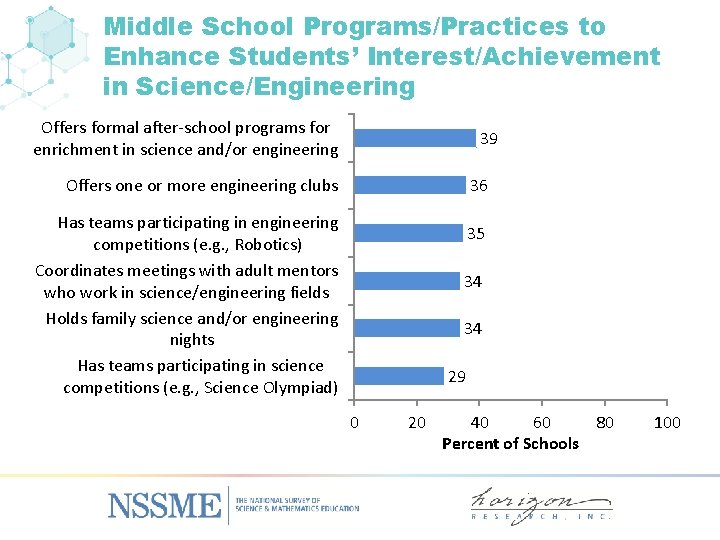
Middle School Programs/Practices to Enhance Students’ Interest/Achievement in Science/Engineering Offers formal after-school programs for enrichment in science and/or engineering 39 Offers one or more engineering clubs 36 Has teams participating in engineering competitions (e. g. , Robotics) Coordinates meetings with adult mentors who work in science/engineering fields Holds family science and/or engineering nights Has teams participating in science competitions (e. g. , Science Olympiad) 35 34 34 29 0 20 40 60 80 Percent of Schools 100
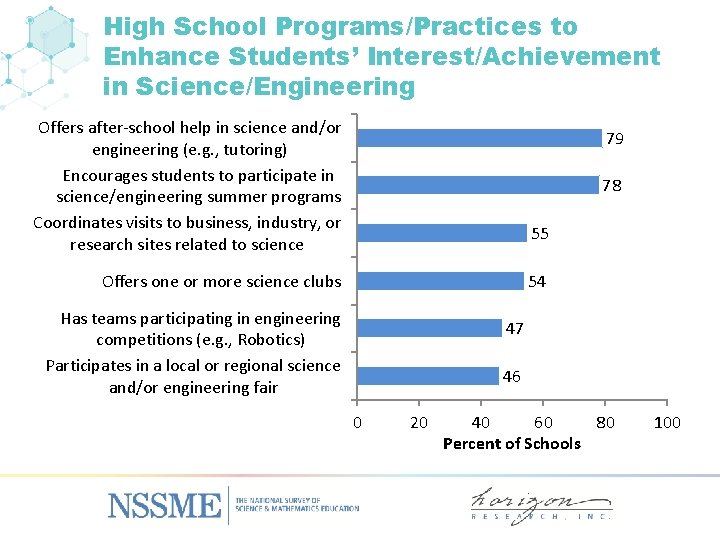
High School Programs/Practices to Enhance Students’ Interest/Achievement in Science/Engineering Offers after-school help in science and/or engineering (e. g. , tutoring) Encourages students to participate in science/engineering summer programs Coordinates visits to business, industry, or research sites related to science 79 78 55 Offers one or more science clubs 54 Has teams participating in engineering competitions (e. g. , Robotics) Participates in a local or regional science and/or engineering fair 47 46 0 20 40 60 80 Percent of Schools 100
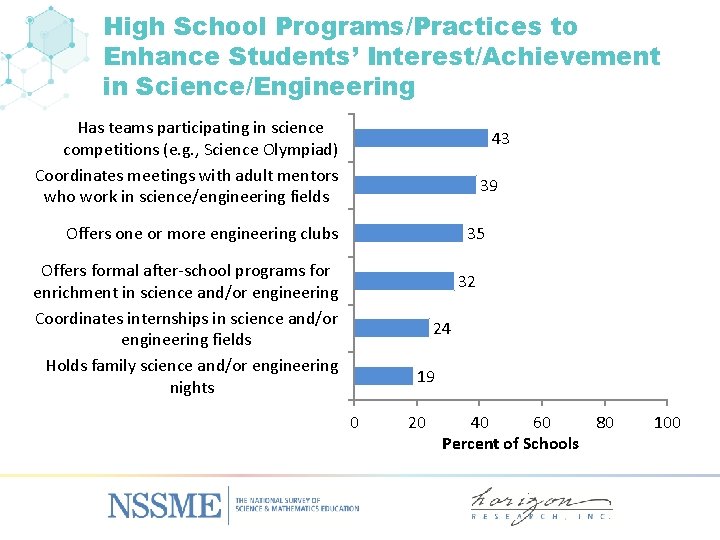
High School Programs/Practices to Enhance Students’ Interest/Achievement in Science/Engineering Has teams participating in science competitions (e. g. , Science Olympiad) Coordinates meetings with adult mentors who work in science/engineering fields 43 39 Offers one or more engineering clubs 35 Offers formal after-school programs for enrichment in science and/or engineering Coordinates internships in science and/or engineering fields Holds family science and/or engineering nights 32 24 19 0 20 40 60 80 Percent of Schools 100
Original Data for Slides 16– 19 (not for presentation)
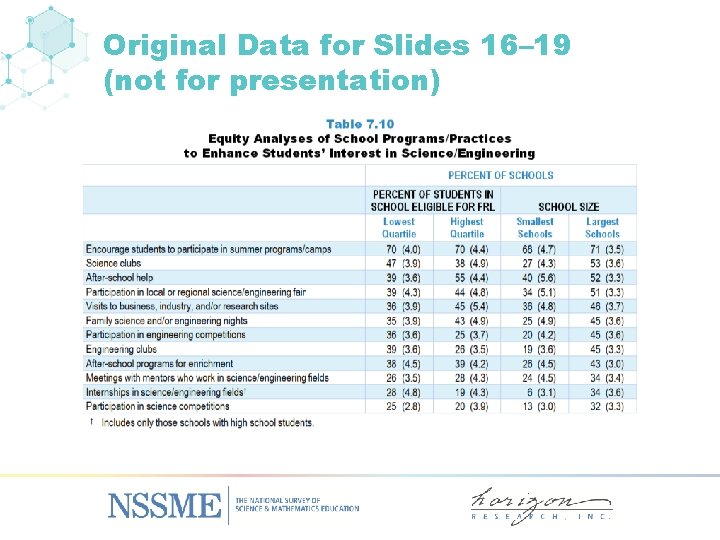
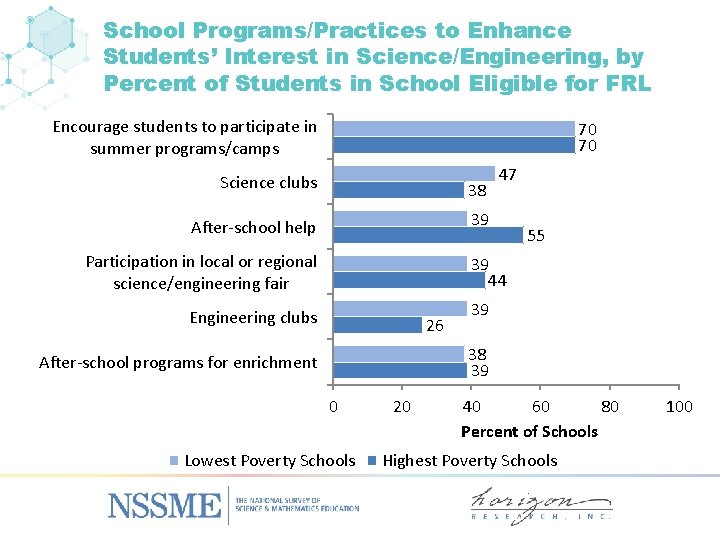
School Programs/Practices to Enhance Students’ Interest in Science/Engineering, by Percent of Students in School Eligible for FRL Encourage students to participate in summer programs/camps 70 70 Science clubs 38 After-school help 39 Participation in local or regional science/engineering fair 47 55 39 44 Engineering clubs 26 39 38 39 After-school programs for enrichment 0 Lowest Poverty Schools 20 40 60 80 Percent of Schools Highest Poverty Schools 100
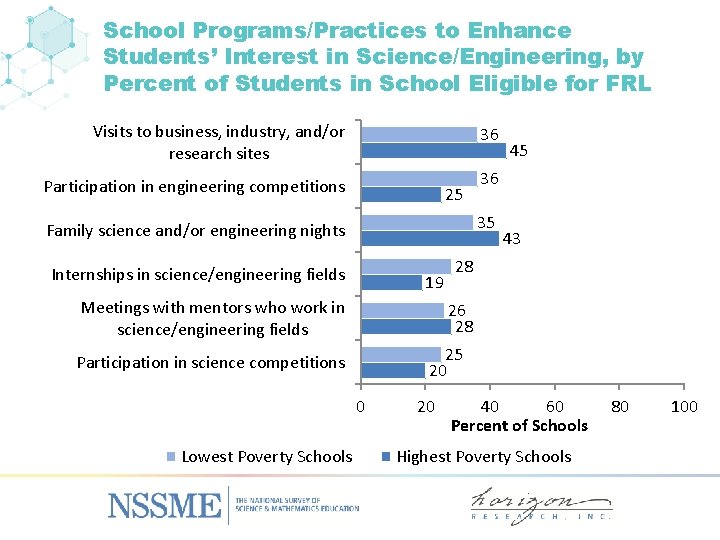
School Programs/Practices to Enhance Students’ Interest in Science/Engineering, by Percent of Students in School Eligible for FRL Visits to business, industry, and/or research sites 36 Participation in engineering competitions 36 25 35 Family science and/or engineering nights Internships in science/engineering fields 19 Meetings with mentors who work in science/engineering fields 43 28 26 28 25 20 Participation in science competitions 0 Lowest Poverty Schools 45 20 40 60 Percent of Schools Highest Poverty Schools 80 100
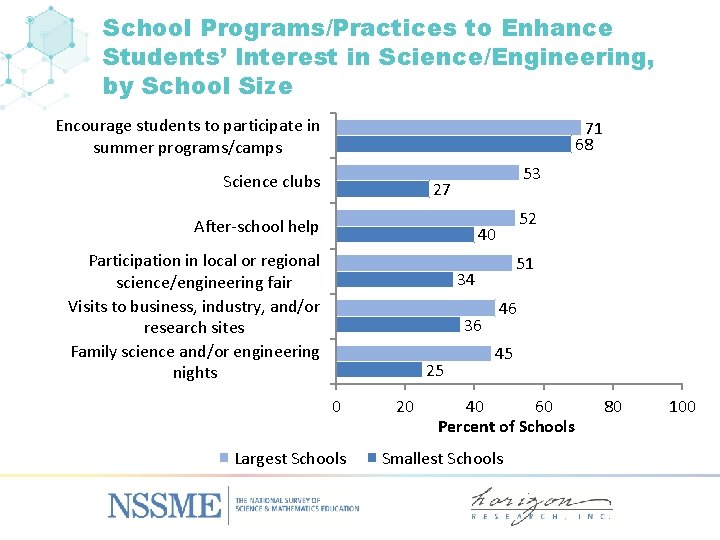
School Programs/Practices to Enhance Students’ Interest in Science/Engineering, by School Size Encourage students to participate in summer programs/camps 71 68 Science clubs 53 27 After-school help 52 40 Participation in local or regional science/engineering fair Visits to business, industry, and/or research sites Family science and/or engineering nights 51 34 36 25 0 Largest Schools 20 46 45 40 60 Percent of Schools Smallest Schools 80 100
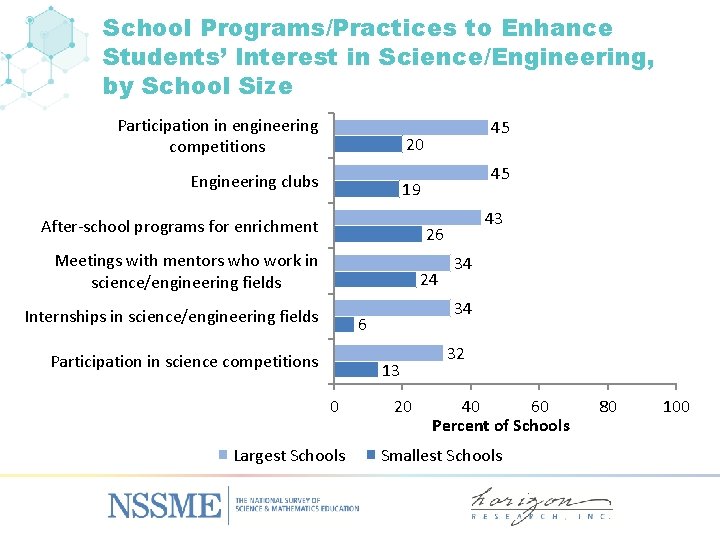
School Programs/Practices to Enhance Students’ Interest in Science/Engineering, by School Size Participation in engineering competitions 45 20 Engineering clubs 45 19 After-school programs for enrichment 43 26 Meetings with mentors who work in science/engineering fields 24 Internships in science/engineering fields 34 6 Participation in science competitions 13 0 Largest Schools 34 20 32 40 60 Percent of Schools Smallest Schools 80 100
Extent of Influence of State Standards
Original Data for Slides 22– 24 (not for presentation)
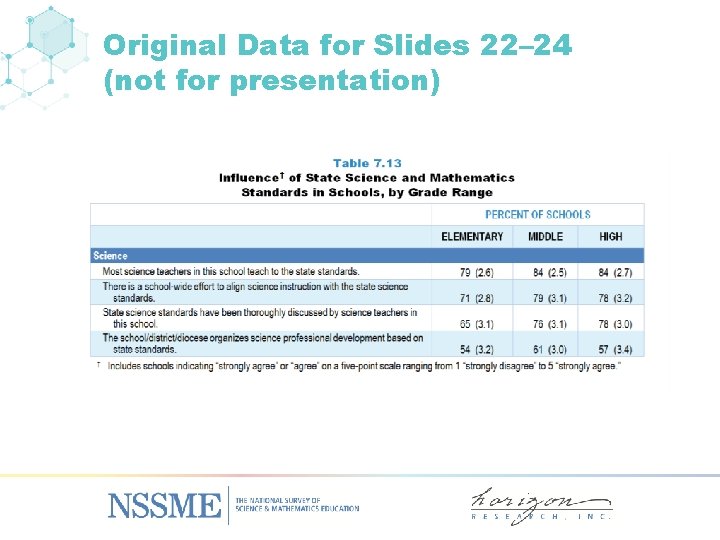
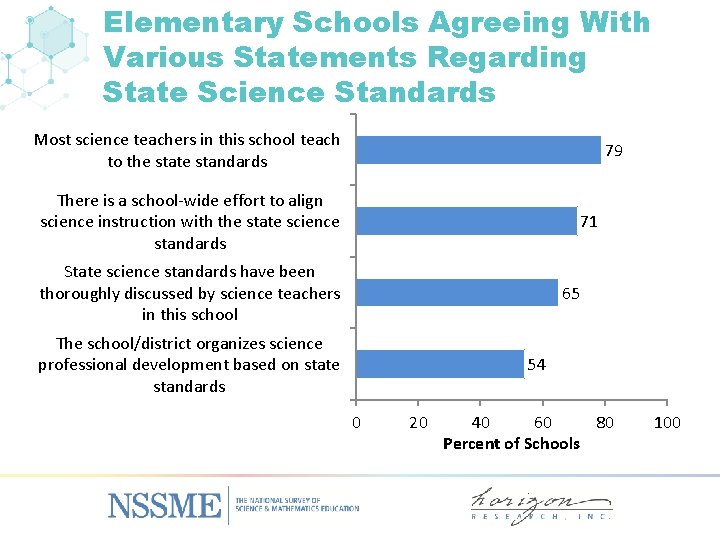
Elementary Schools Agreeing With Various Statements Regarding State Science Standards Most science teachers in this school teach to the state standards 79 There is a school-wide effort to align science instruction with the state science standards 71 State science standards have been thoroughly discussed by science teachers in this school 65 The school/district organizes science professional development based on state standards 54 0 20 40 60 80 Percent of Schools 100
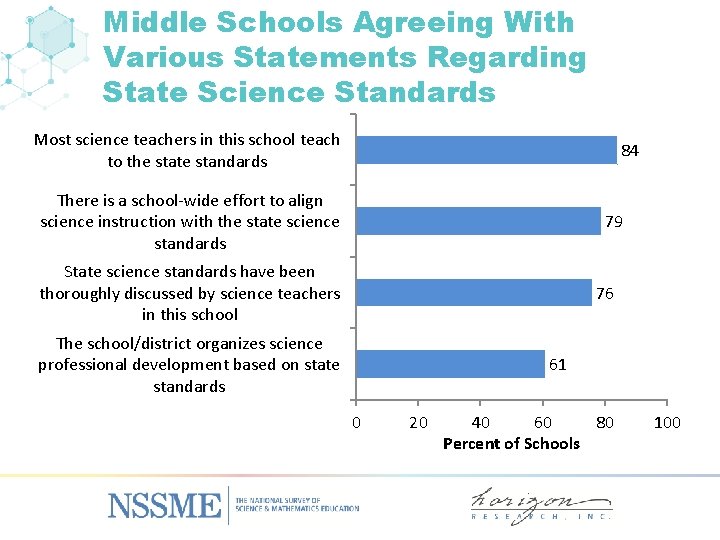
Middle Schools Agreeing With Various Statements Regarding State Science Standards Most science teachers in this school teach to the state standards 84 There is a school-wide effort to align science instruction with the state science standards 79 State science standards have been thoroughly discussed by science teachers in this school 76 The school/district organizes science professional development based on state standards 61 0 20 40 60 80 Percent of Schools 100
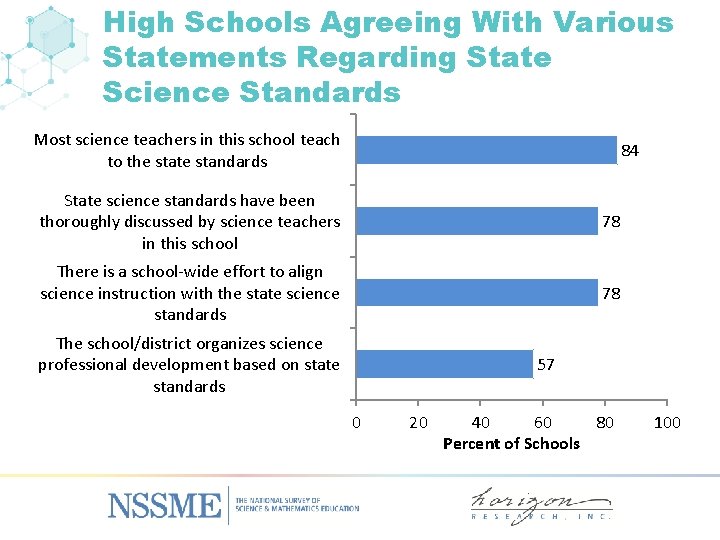
High Schools Agreeing With Various Statements Regarding State Science Standards Most science teachers in this school teach to the state standards 84 State science standards have been thoroughly discussed by science teachers in this school 78 There is a school-wide effort to align science instruction with the state science standards 78 The school/district organizes science professional development based on state standards 57 0 20 40 60 80 Percent of Schools 100
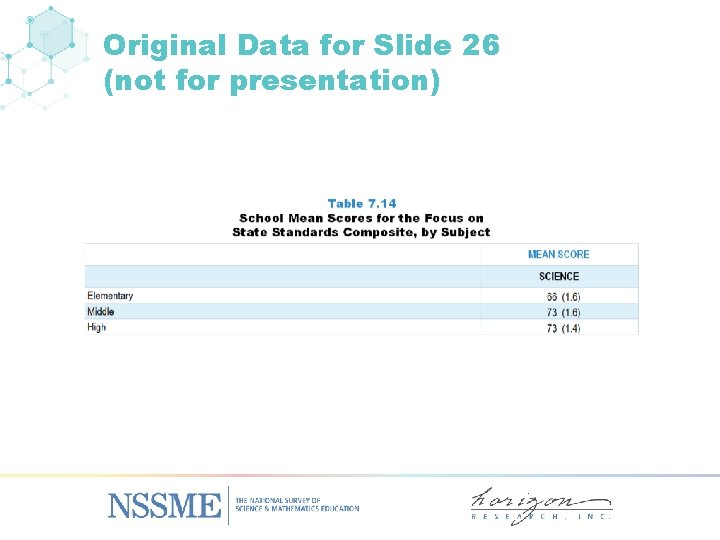
Original Data for Slide 26 (not for presentation)
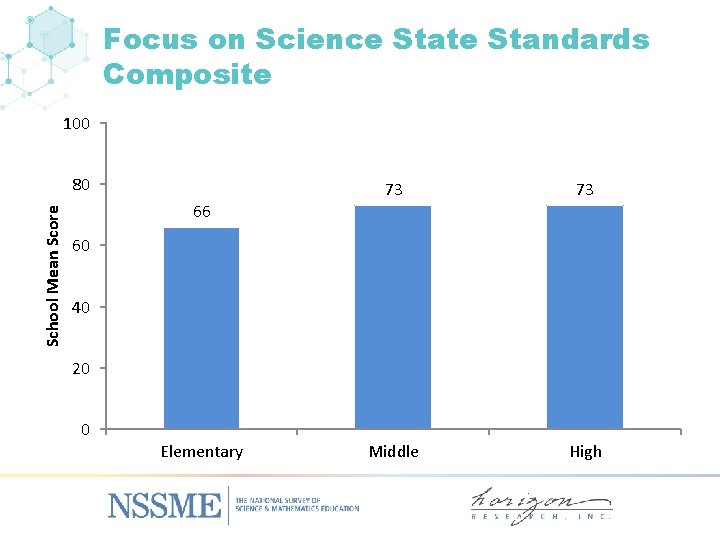
Focus on Science State Standards Composite 100 School Mean Score 80 66 73 73 Middle High 60 40 20 0 Elementary
Factors That Promote and Inhibit Effective Instruction
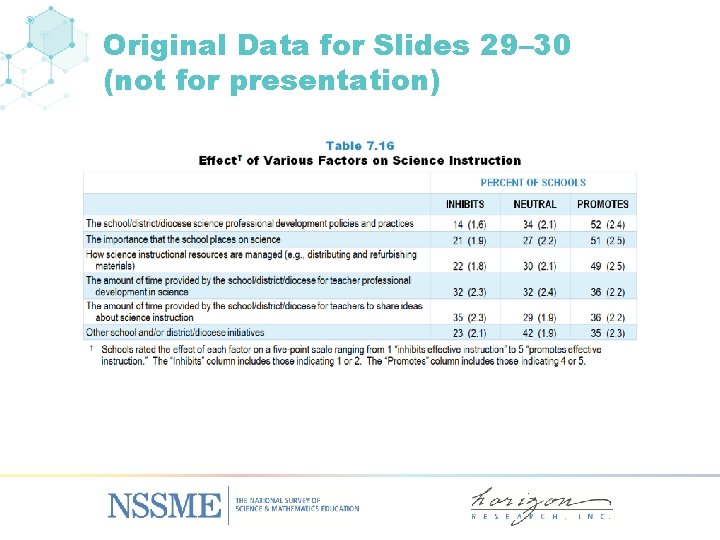
Original Data for Slides 29– 30 (not for presentation)
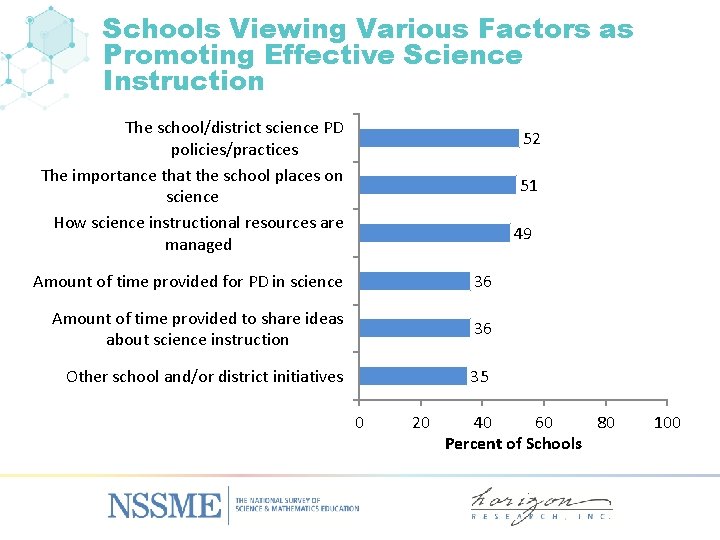
Schools Viewing Various Factors as Promoting Effective Science Instruction The school/district science PD policies/practices The importance that the school places on science How science instructional resources are managed 52 51 49 Amount of time provided for PD in science 36 Amount of time provided to share ideas about science instruction 36 Other school and/or district initiatives 35 0 20 40 60 80 Percent of Schools 100
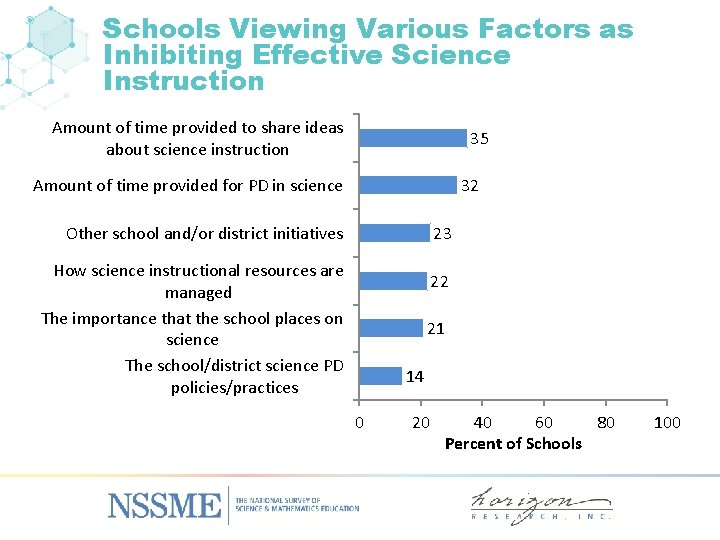
Schools Viewing Various Factors as Inhibiting Effective Science Instruction Amount of time provided to share ideas about science instruction 35 Amount of time provided for PD in science 32 Other school and/or district initiatives 23 How science instructional resources are managed The importance that the school places on science The school/district science PD policies/practices 22 21 14 0 20 40 60 80 Percent of Schools 100
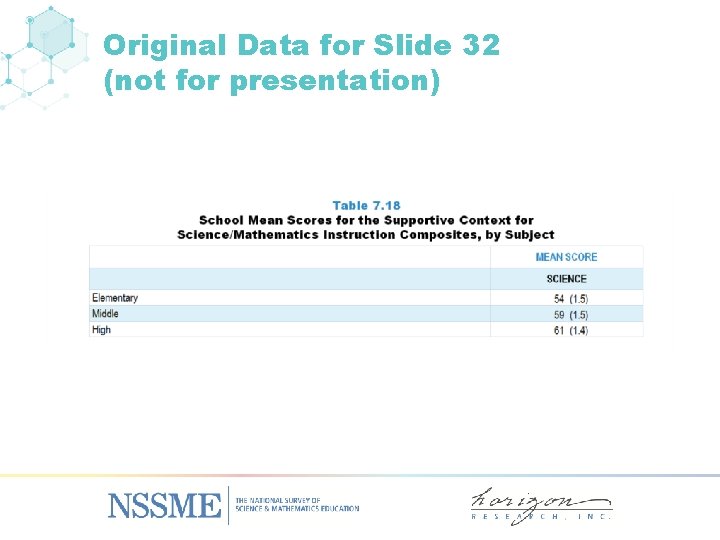
Original Data for Slide 32 (not for presentation)
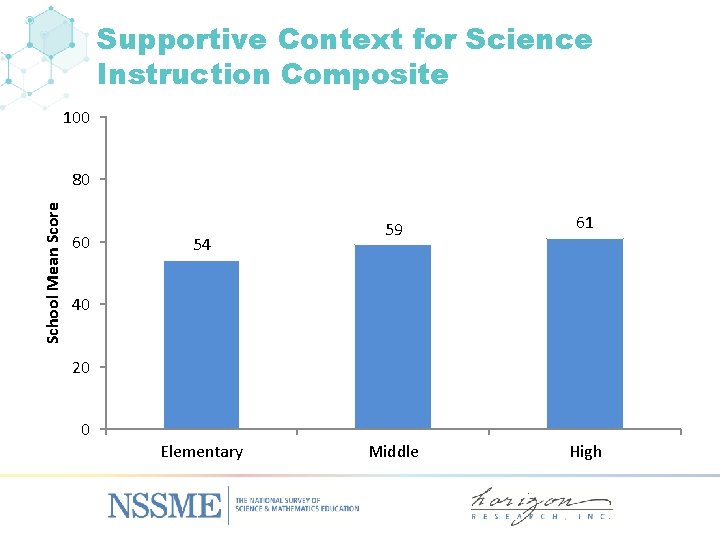
Supportive Context for Science Instruction Composite 100 School Mean Score 80 60 54 59 61 Middle High 40 20 0 Elementary
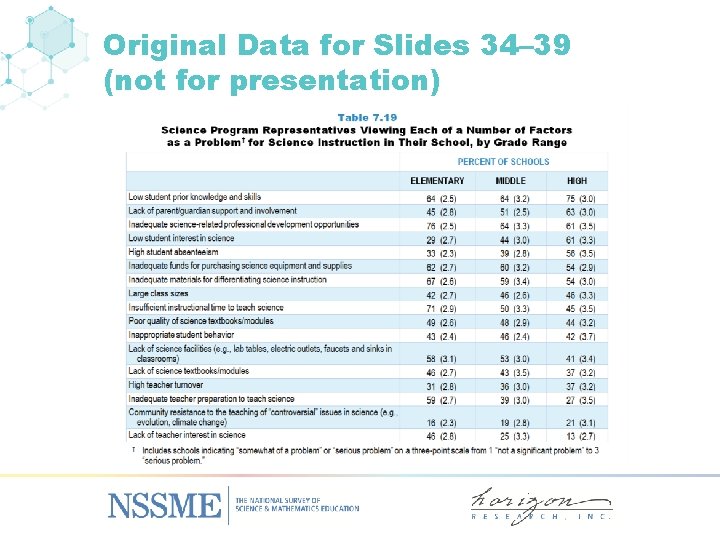
Original Data for Slides 34– 39 (not for presentation)
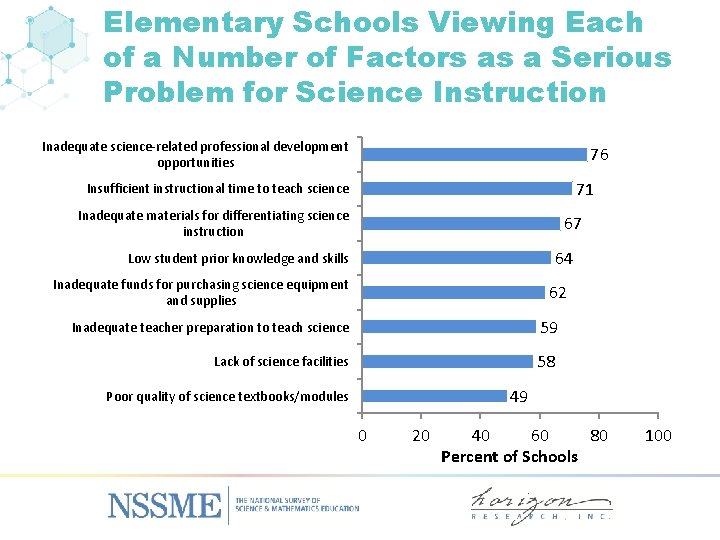
Elementary Schools Viewing Each of a Number of Factors as a Serious Problem for Science Instruction Inadequate science-related professional development opportunities 76 71 Insufficient instructional time to teach science Inadequate materials for differentiating science instruction 67 64 Low student prior knowledge and skills Inadequate funds for purchasing science equipment and supplies 62 Inadequate teacher preparation to teach science 59 Lack of science facilities 58 49 Poor quality of science textbooks/modules 0 20 40 60 80 Percent of Schools 100
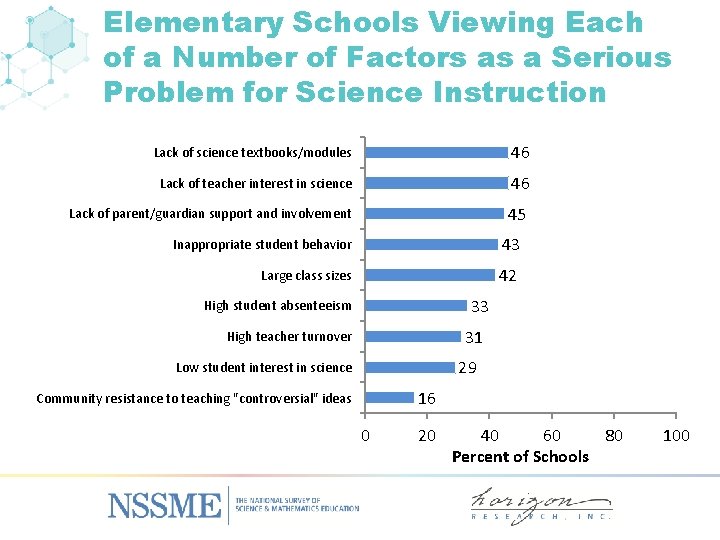
Elementary Schools Viewing Each of a Number of Factors as a Serious Problem for Science Instruction Lack of science textbooks/modules 46 Lack of teacher interest in science 46 Lack of parent/guardian support and involvement 45 Inappropriate student behavior 43 Large class sizes 42 33 High student absenteeism 31 High teacher turnover 29 Low student interest in science 16 Community resistance to teaching "controversial" ideas 0 20 40 60 80 Percent of Schools 100
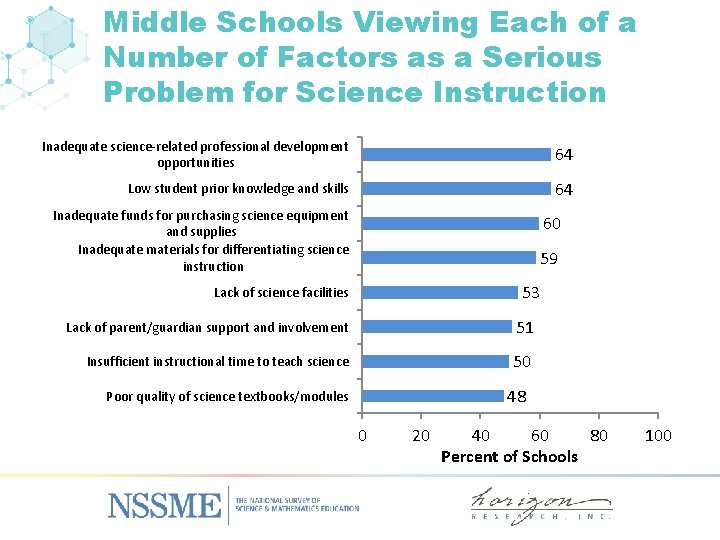
Middle Schools Viewing Each of a Number of Factors as a Serious Problem for Science Instruction Inadequate science-related professional development opportunities 64 Low student prior knowledge and skills 64 Inadequate funds for purchasing science equipment and supplies Inadequate materials for differentiating science instruction 60 59 53 Lack of science facilities Lack of parent/guardian support and involvement 51 Insufficient instructional time to teach science 50 48 Poor quality of science textbooks/modules 0 20 40 60 80 Percent of Schools 100
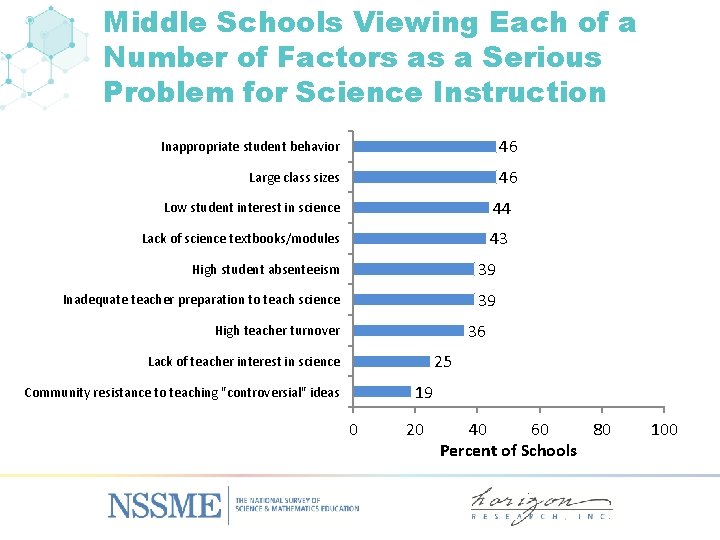
Middle Schools Viewing Each of a Number of Factors as a Serious Problem for Science Instruction Inappropriate student behavior 46 Large class sizes 46 Low student interest in science 44 Lack of science textbooks/modules 43 High student absenteeism 39 Inadequate teacher preparation to teach science 39 36 High teacher turnover 25 Lack of teacher interest in science 19 Community resistance to teaching "controversial" ideas 0 20 40 60 80 Percent of Schools 100
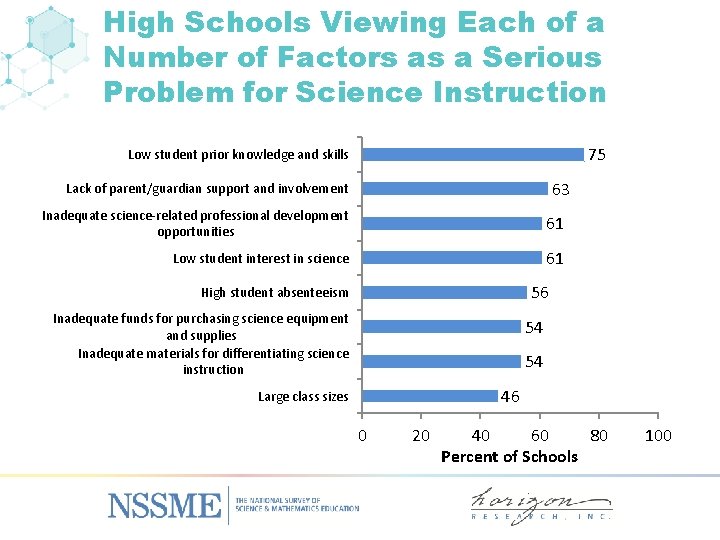
High Schools Viewing Each of a Number of Factors as a Serious Problem for Science Instruction 75 Low student prior knowledge and skills 63 Lack of parent/guardian support and involvement Inadequate science-related professional development opportunities 61 Low student interest in science 61 56 High student absenteeism Inadequate funds for purchasing science equipment and supplies Inadequate materials for differentiating science instruction 54 54 46 Large class sizes 0 20 40 60 80 Percent of Schools 100
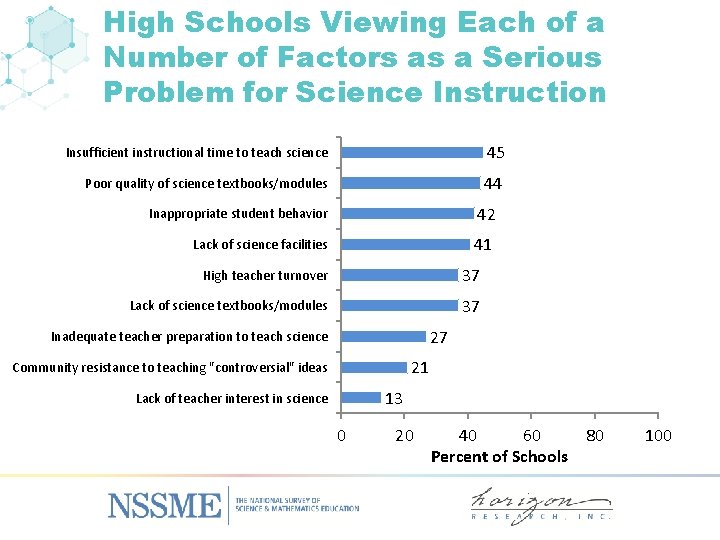
High Schools Viewing Each of a Number of Factors as a Serious Problem for Science Instruction Insufficient instructional time to teach science 45 Poor quality of science textbooks/modules 44 Inappropriate student behavior 42 Lack of science facilities 41 High teacher turnover 37 Lack of science textbooks/modules 37 27 Inadequate teacher preparation to teach science 21 Community resistance to teaching "controversial" ideas 13 Lack of teacher interest in science 0 20 40 60 80 Percent of Schools 100
Original Data for Slide 41 (not for presentation)
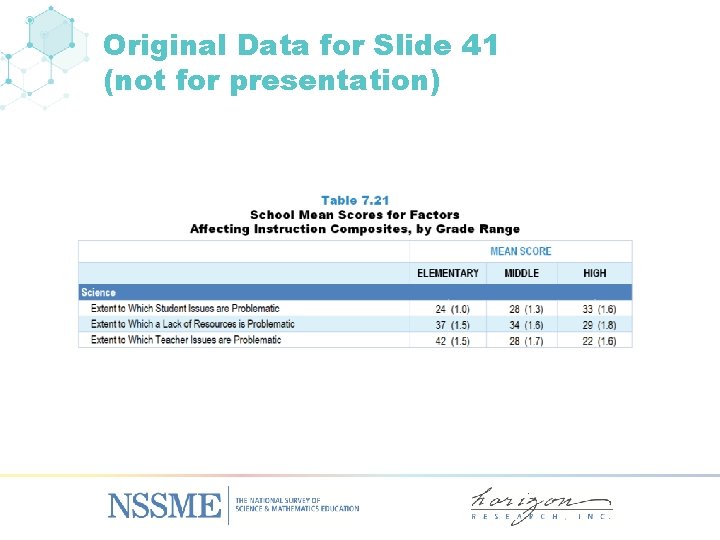
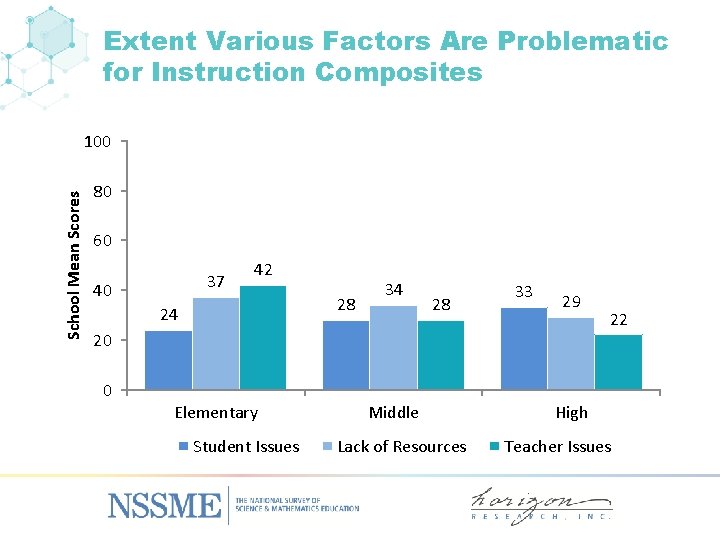
Extent Various Factors Are Problematic for Instruction Composites School Mean Scores 100 80 60 37 40 42 28 24 34 28 33 29 20 0 Elementary Student Issues Middle Lack of Resources 22 High Teacher Issues
Original Data for Slide 43 (not for presentation)
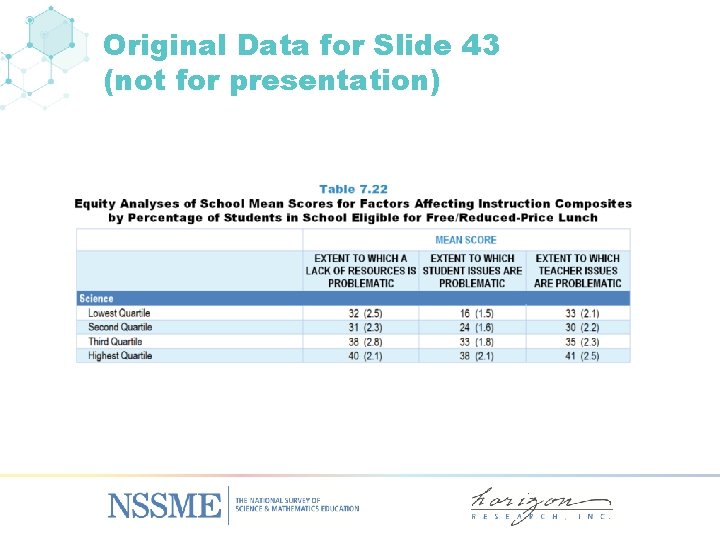
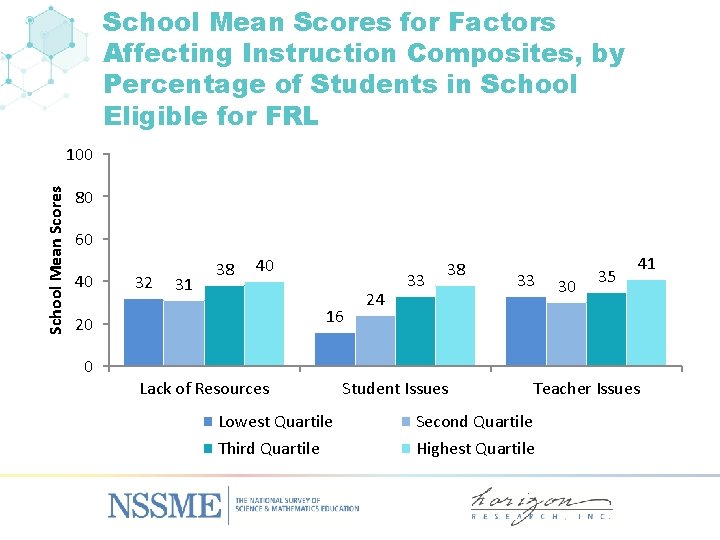
School Mean Scores for Factors Affecting Instruction Composites, by Percentage of Students in School Eligible for FRL School Mean Scores 100 80 60 40 32 31 38 40 16 20 0 Lack of Resources 24 33 38 33 Student Issues 30 35 41 Teacher Issues Lowest Quartile Second Quartile Third Quartile Highest Quartile
Original Data for Slides 45– 46 (not for presentation)
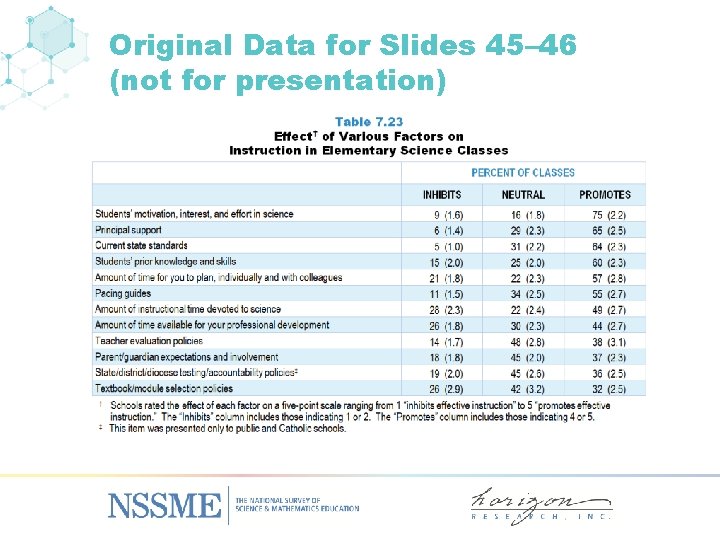
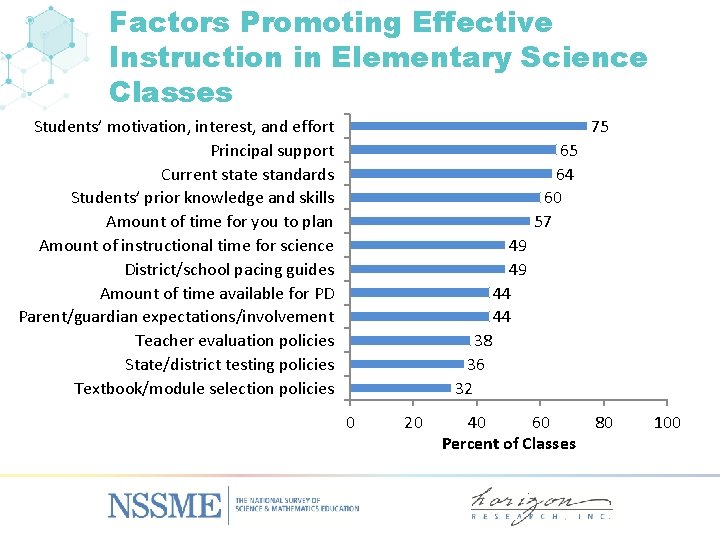
Factors Promoting Effective Instruction in Elementary Science Classes Students’ motivation, interest, and effort Principal support Current state standards Students’ prior knowledge and skills Amount of time for you to plan Amount of instructional time for science District/school pacing guides Amount of time available for PD Parent/guardian expectations/involvement Teacher evaluation policies State/district testing policies Textbook/module selection policies 75 65 64 60 57 49 49 44 44 38 36 32 0 20 40 60 Percent of Classes 80 100
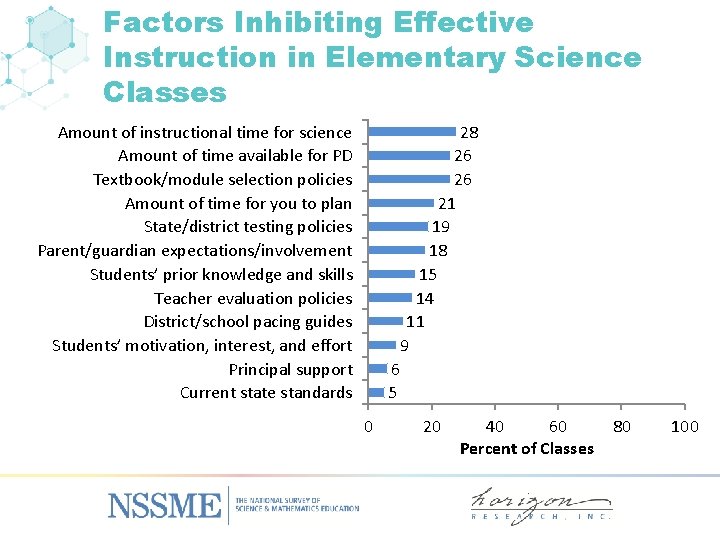
Factors Inhibiting Effective Instruction in Elementary Science Classes Amount of instructional time for science Amount of time available for PD Textbook/module selection policies Amount of time for you to plan State/district testing policies Parent/guardian expectations/involvement Students’ prior knowledge and skills Teacher evaluation policies District/school pacing guides Students’ motivation, interest, and effort Principal support Current state standards 28 26 26 21 19 18 15 14 11 9 6 5 0 20 40 60 Percent of Classes 80 100
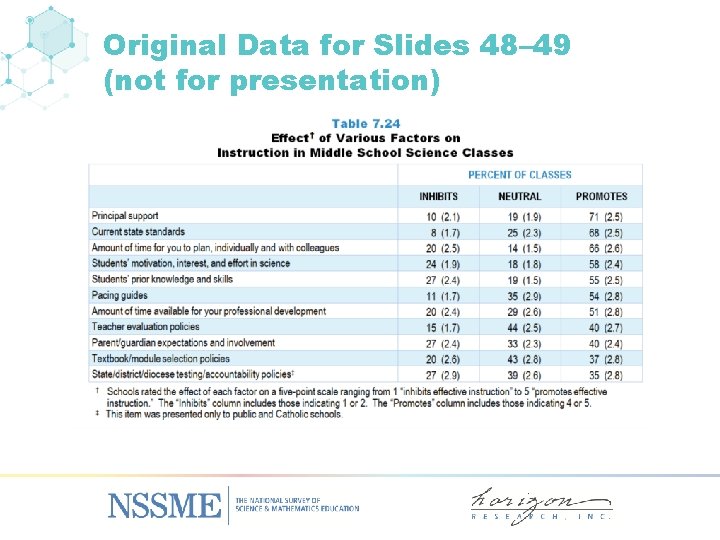
Original Data for Slides 48– 49 (not for presentation)
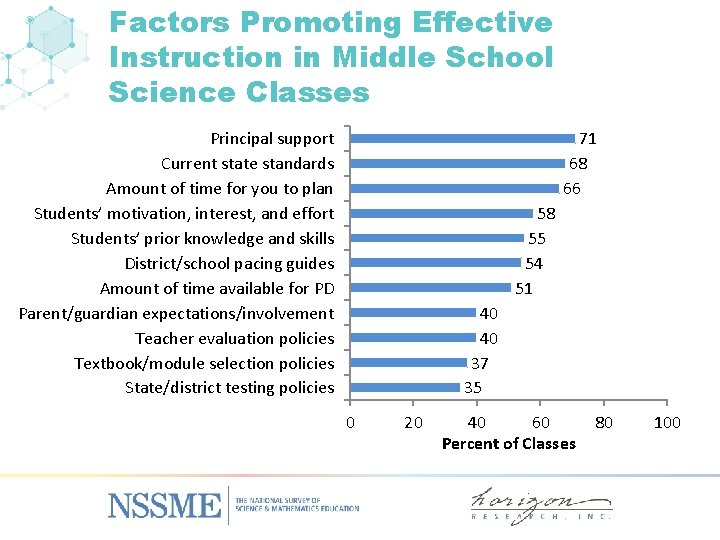
Factors Promoting Effective Instruction in Middle School Science Classes Principal support Current state standards Amount of time for you to plan Students’ motivation, interest, and effort Students’ prior knowledge and skills District/school pacing guides Amount of time available for PD Parent/guardian expectations/involvement Teacher evaluation policies Textbook/module selection policies State/district testing policies 71 68 66 58 55 54 51 40 40 37 35 0 20 40 60 Percent of Classes 80 100
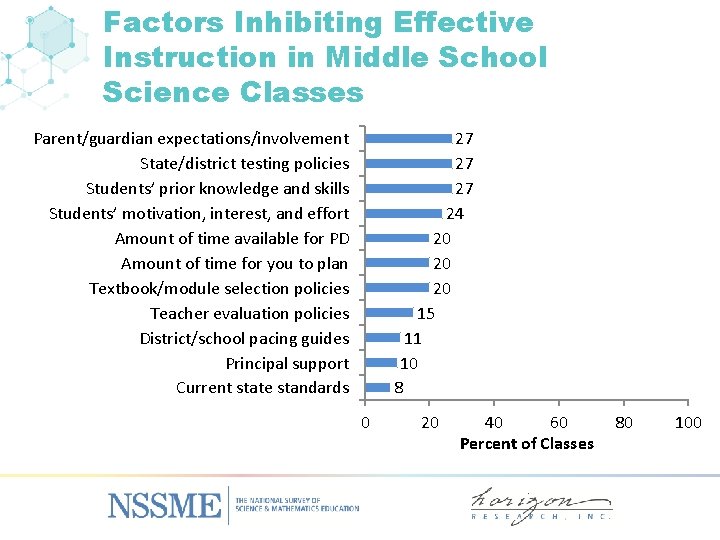
Factors Inhibiting Effective Instruction in Middle School Science Classes Parent/guardian expectations/involvement State/district testing policies Students’ prior knowledge and skills Students’ motivation, interest, and effort Amount of time available for PD Amount of time for you to plan Textbook/module selection policies Teacher evaluation policies District/school pacing guides Principal support Current state standards 27 27 27 24 20 20 20 15 11 10 8 0 20 40 60 Percent of Classes 80 100
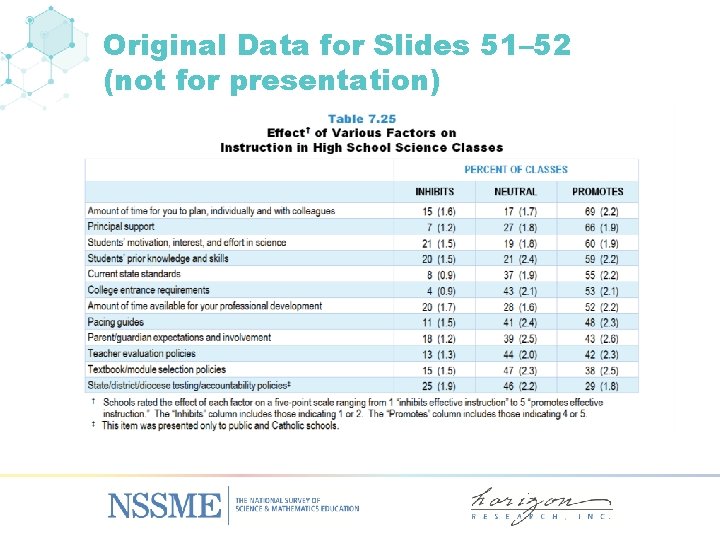
Original Data for Slides 51– 52 (not for presentation)
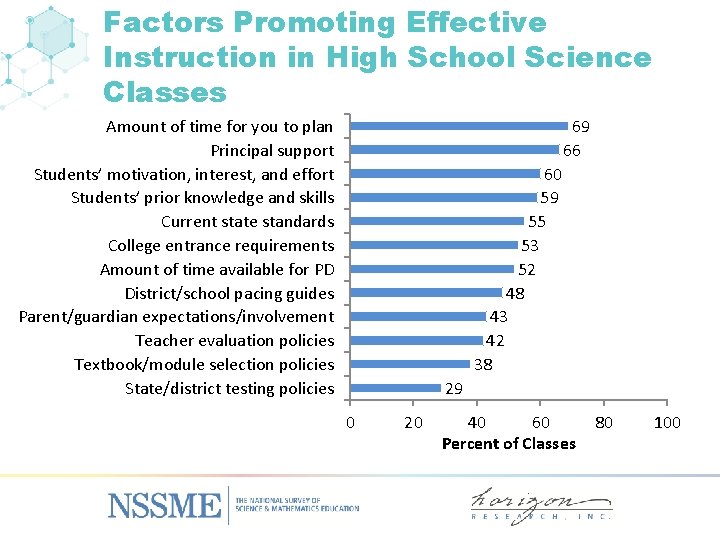
Factors Promoting Effective Instruction in High School Science Classes Amount of time for you to plan Principal support Students’ motivation, interest, and effort Students’ prior knowledge and skills Current state standards College entrance requirements Amount of time available for PD District/school pacing guides Parent/guardian expectations/involvement Teacher evaluation policies Textbook/module selection policies State/district testing policies 69 66 60 59 55 53 52 48 43 42 38 29 0 20 40 60 Percent of Classes 80 100
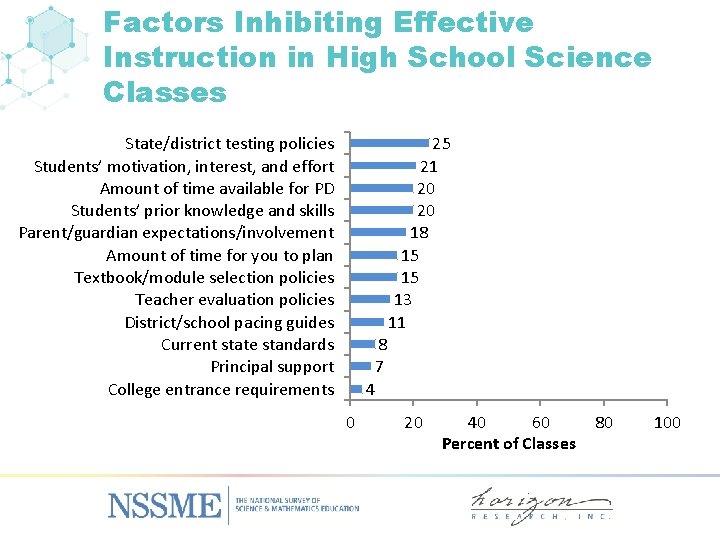
Factors Inhibiting Effective Instruction in High School Science Classes State/district testing policies Students’ motivation, interest, and effort Amount of time available for PD Students’ prior knowledge and skills Parent/guardian expectations/involvement Amount of time for you to plan Textbook/module selection policies Teacher evaluation policies District/school pacing guides Current state standards Principal support College entrance requirements 25 21 20 20 18 15 15 13 11 8 7 4 0 20 40 60 Percent of Classes 80 100
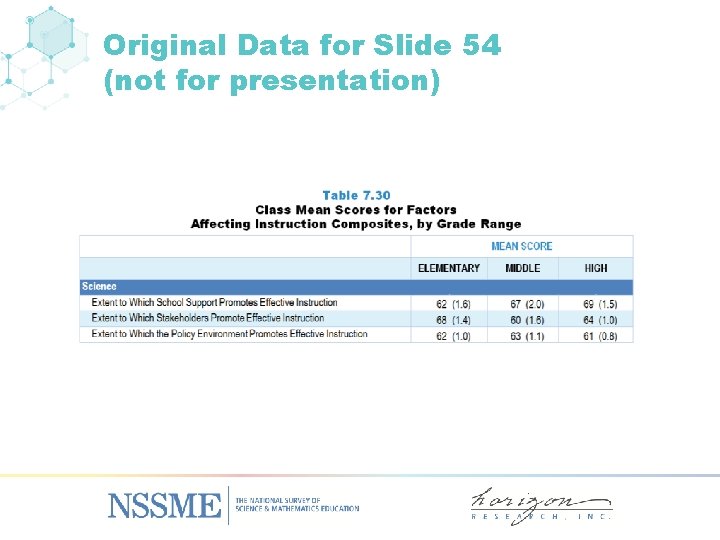
Original Data for Slide 54 (not for presentation)
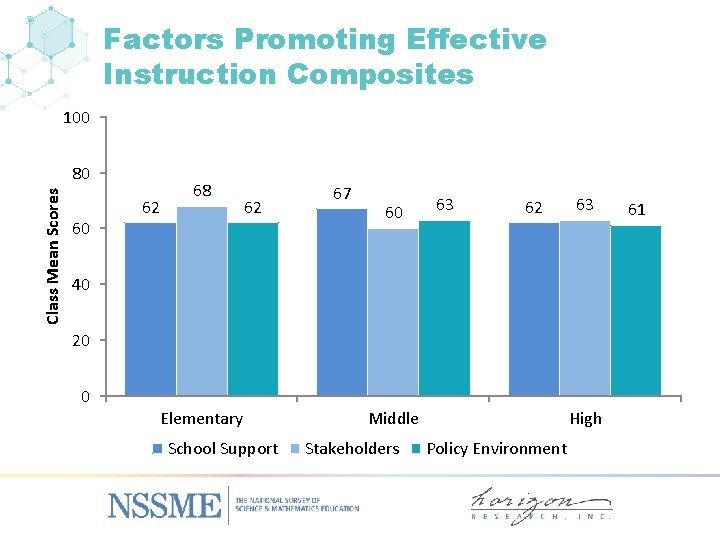
Factors Promoting Effective Instruction Composites 100 Class Mean Scores 80 60 62 68 62 67 60 63 62 63 40 20 0 Elementary School Support Middle Stakeholders High Policy Environment 61
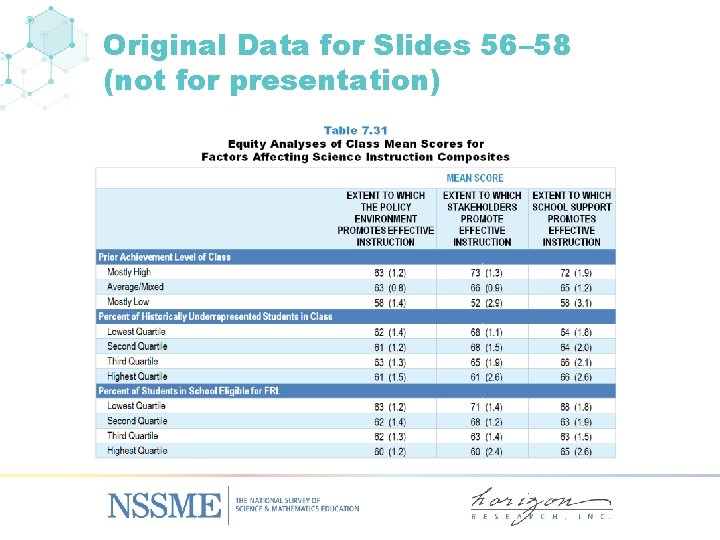
Original Data for Slides 56– 58 (not for presentation)
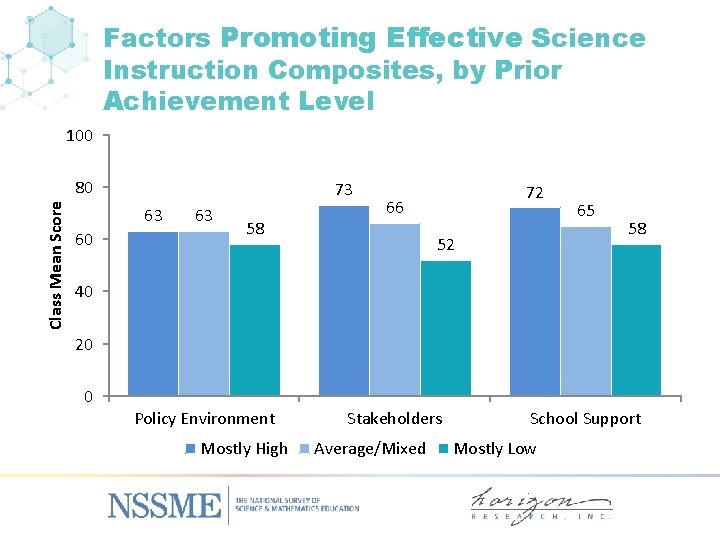
Factors Promoting Effective Science Instruction Composites, by Prior Achievement Level 100 Class Mean Score 80 73 63 60 63 58 72 66 52 65 58 40 20 0 Policy Environment Mostly High Stakeholders Average/Mixed School Support Mostly Low
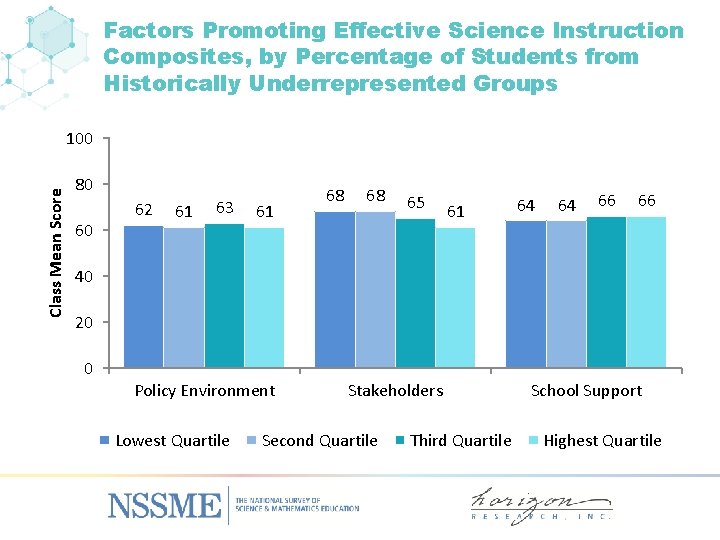
Factors Promoting Effective Science Instruction Composites, by Percentage of Students from Historically Underrepresented Groups Class Mean Score 100 80 60 62 61 63 61 68 68 65 61 64 64 66 66 40 20 0 Policy Environment Lowest Quartile Stakeholders Second Quartile Third Quartile School Support Highest Quartile
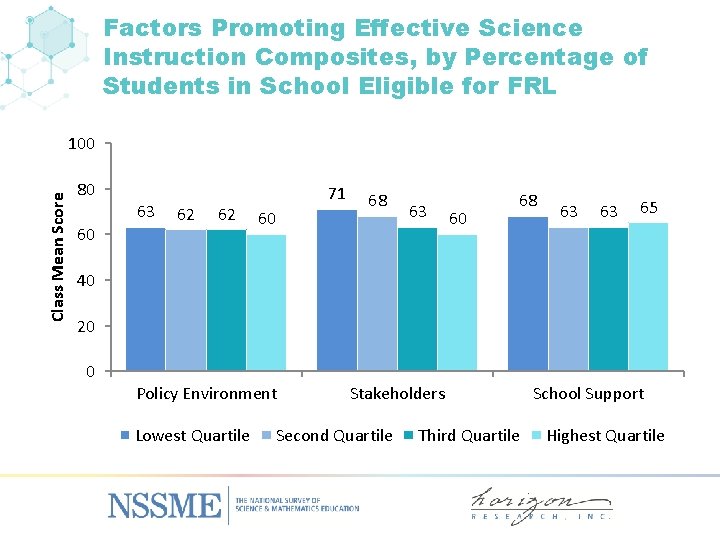
Factors Promoting Effective Science Instruction Composites, by Percentage of Students in School Eligible for FRL Class Mean Score 100 80 63 60 62 62 71 60 68 63 63 65 40 20 0 Policy Environment Lowest Quartile Stakeholders Second Quartile Third Quartile School Support Highest Quartile