
Chapter 7 Excitation of Skeletal Muscle Neuromuscular Transmission
- Slides: 21
Chapter 7: Excitation of Skeletal Muscle
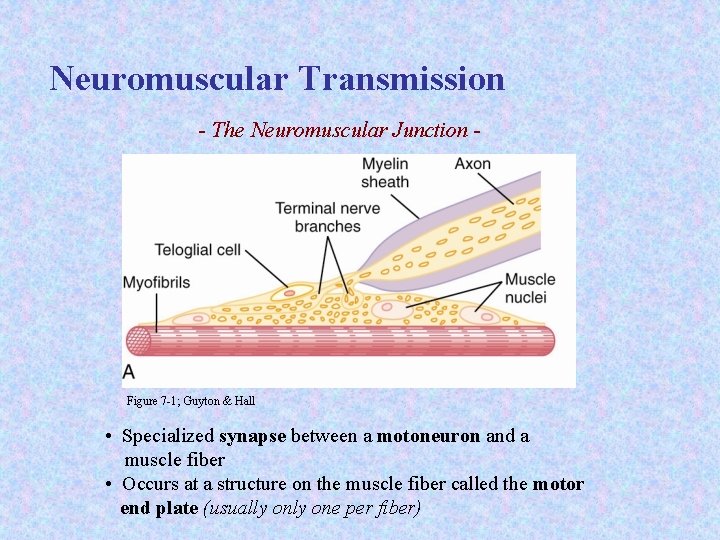
Neuromuscular Transmission - The Neuromuscular Junction - Figure 7 -1; Guyton & Hall • Specialized synapse between a motoneuron and a muscle fiber • Occurs at a structure on the muscle fiber called the motor end plate (usually one per fiber)
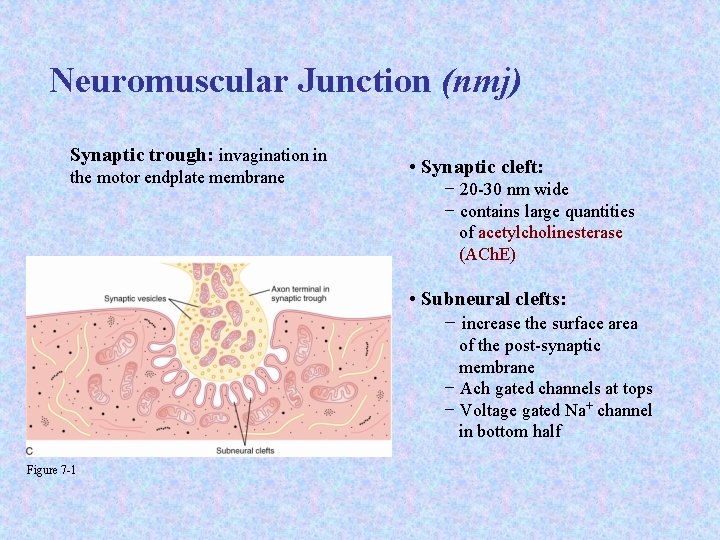
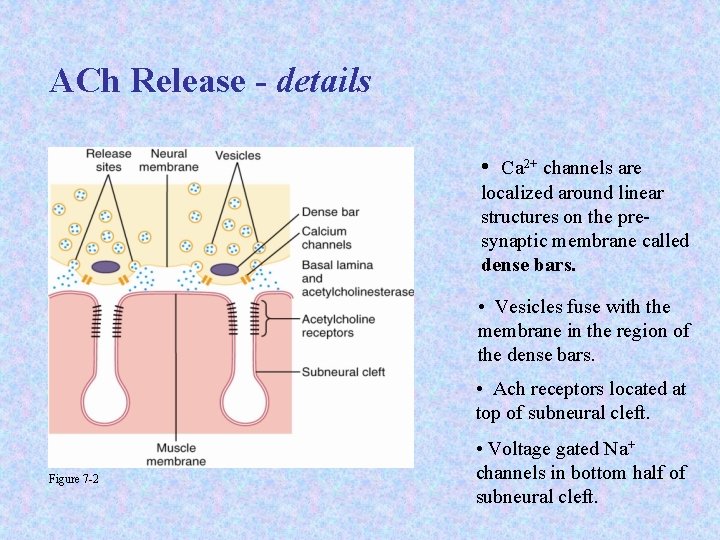
Neuromuscular Junction (nmj) Synaptic trough: invagination in the motor endplate membrane • Synaptic cleft: − 20 -30 nm wide − contains large quantities of acetylcholinesterase (ACh. E) • Subneural clefts: − increase the surface area of the post-synaptic membrane − Ach gated channels at tops − Voltage gated Na+ channel in bottom half Figure 7 -1
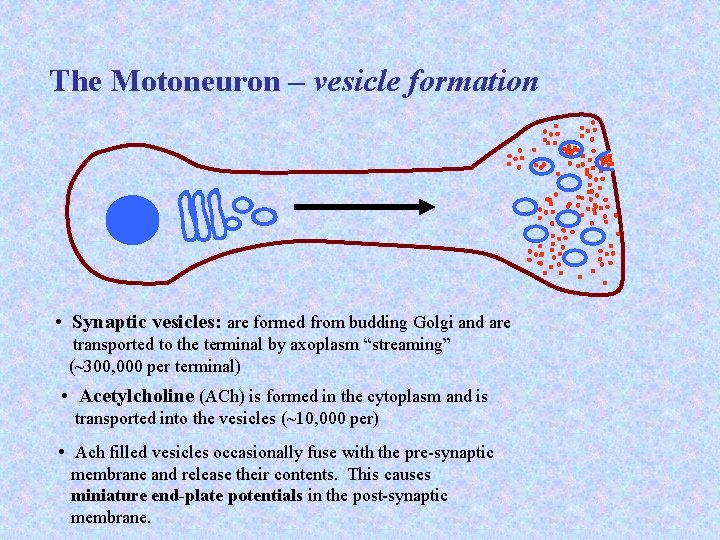
The Motoneuron – vesicle formation • Synaptic vesicles: are formed from budding Golgi and are transported to the terminal by axoplasm “streaming” (~300, 000 per terminal) • Acetylcholine (ACh) is formed in the cytoplasm and is transported into the vesicles (~10, 000 per) • Ach filled vesicles occasionally fuse with the pre-synaptic membrane and release their contents. This causes miniature end-plate potentials in the post-synaptic membrane.
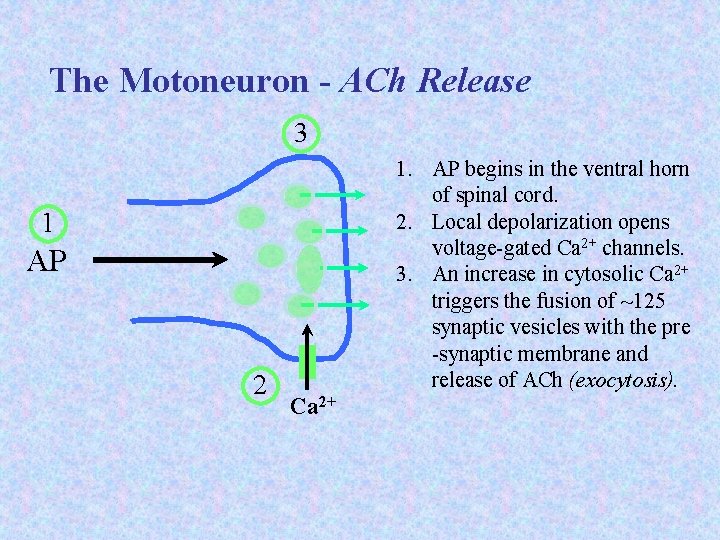
The Motoneuron - ACh Release 3 1. AP begins in the ventral horn of spinal cord. 2. Local depolarization opens voltage-gated Ca 2+ channels. 3. An increase in cytosolic Ca 2+ triggers the fusion of ~125 synaptic vesicles with the pre -synaptic membrane and release of ACh (exocytosis). 1 AP 2 Ca 2+
ACh Release - details • Ca 2+ channels are localized around linear structures on the presynaptic membrane called dense bars. • Vesicles fuse with the membrane in the region of the dense bars. • Ach receptors located at top of subneural cleft. Figure 7 -2 • Voltage gated Na+ channels in bottom half of subneural cleft.
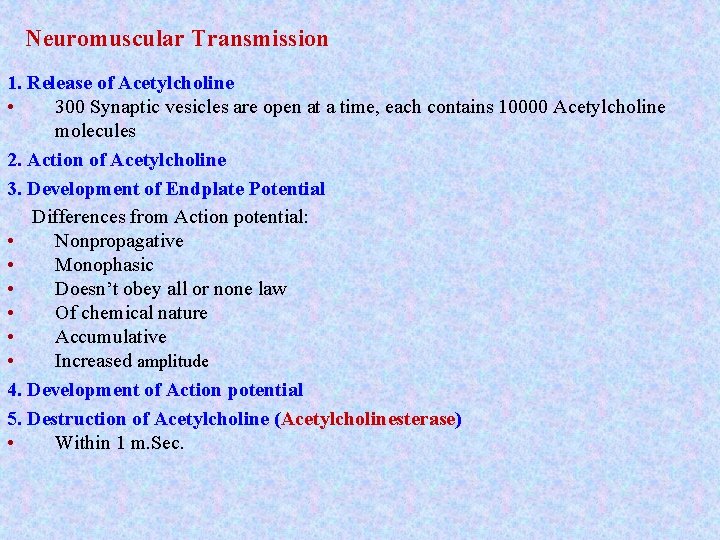
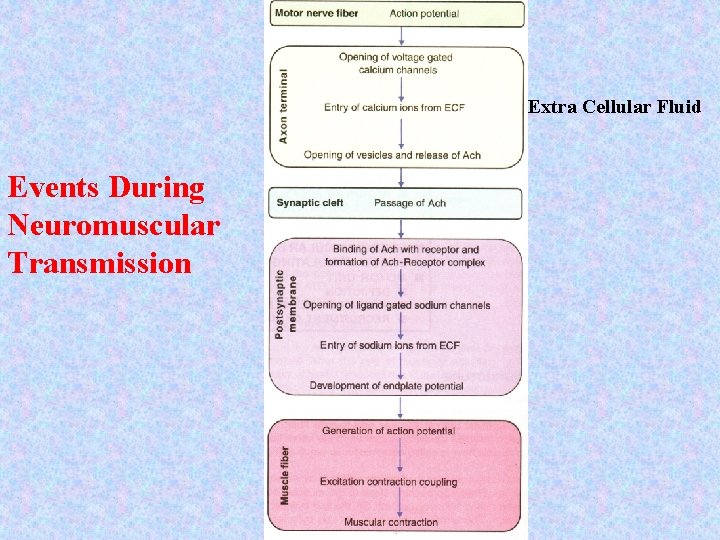
Neuromuscular Transmission 1. Release of Acetylcholine • 300 Synaptic vesicles are open at a time, each contains 10000 Acetylcholine molecules 2. Action of Acetylcholine 3. Development of Endplate Potential Differences from Action potential: • Nonpropagative • Monophasic • Doesn’t obey all or none law • Of chemical nature • Accumulative • Increased amplitude 4. Development of Action potential 5. Destruction of Acetylcholine (Acetylcholinesterase) • Within 1 m. Sec.
Extra Cellular Fluid Events During Neuromuscular Transmission
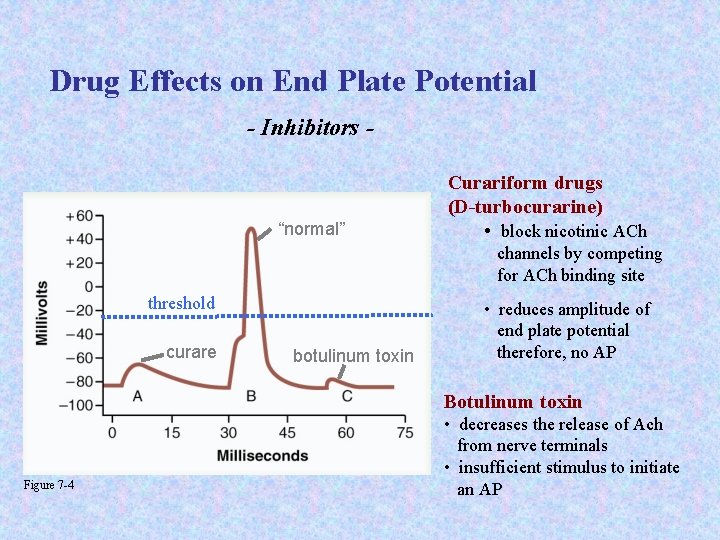
Drug Effects on End Plate Potential - Inhibitors - “normal” Curariform drugs (D-turbocurarine) • block nicotinic ACh channels by competing for ACh binding site threshold curare botulinum toxin • reduces amplitude of end plate potential therefore, no AP Botulinum toxin Figure 7 -4 • decreases the release of Ach from nerve terminals • insufficient stimulus to initiate an AP
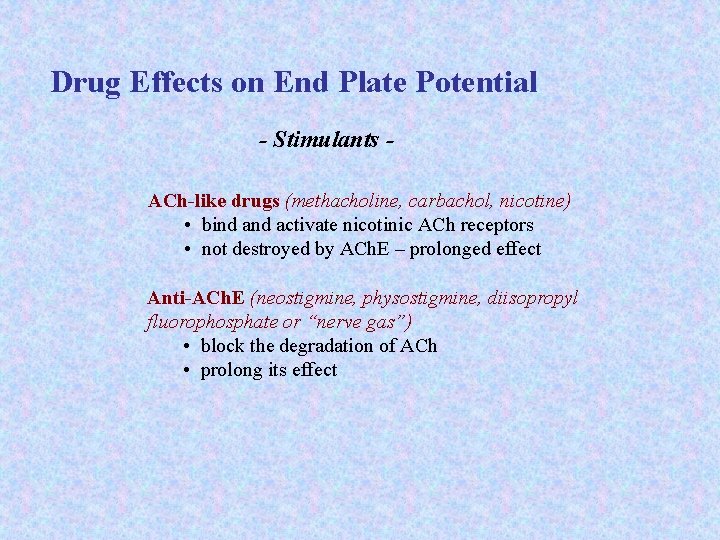
Drug Effects on End Plate Potential - Stimulants ACh-like drugs (methacholine, carbachol, nicotine) • bind activate nicotinic ACh receptors • not destroyed by ACh. E – prolonged effect Anti-ACh. E (neostigmine, physostigmine, diisopropyl fluorophosphate or “nerve gas”) • block the degradation of ACh • prolong its effect
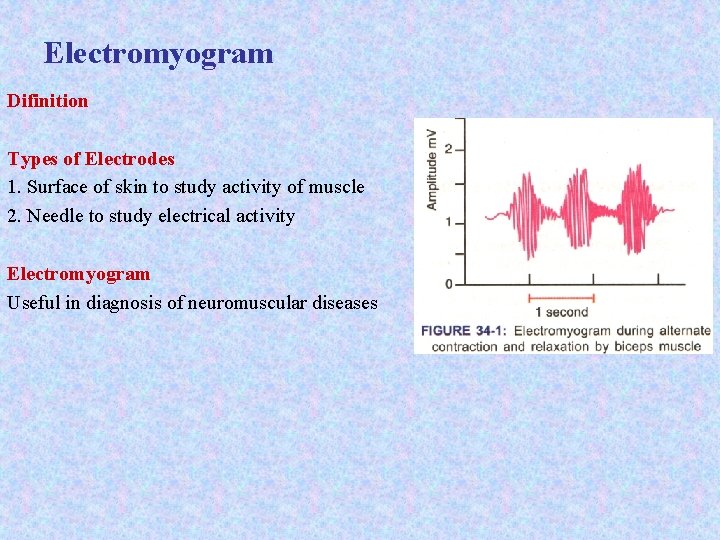
Electromyogram Difinition Types of Electrodes 1. Surface of skin to study activity of muscle 2. Needle to study electrical activity Electromyogram Useful in diagnosis of neuromuscular diseases
Myasthenia Gravis Incidence / symptoms: • paralysis - lethal in extreme cases when respiratory muscles are involved • 2 per 1, 000 people / year Cause: • autoimmune disease characterized by the presence of antibodies against the nicotinic ACh receptor which destroys them • weak end plate potentials Treatment: • usually ameliorated by anti-ACh. E (neostigmine) • increases amount of ACh in nmj
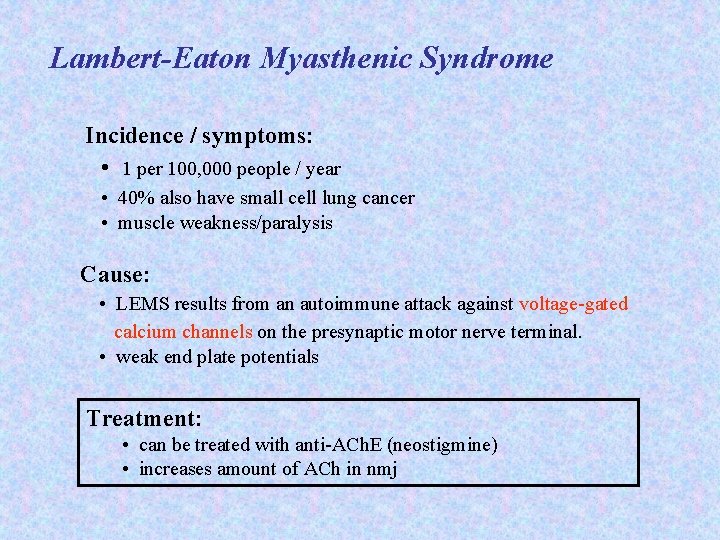
Lambert-Eaton Myasthenic Syndrome Incidence / symptoms: • 1 per 100, 000 people / year • 40% also have small cell lung cancer • muscle weakness/paralysis Cause: • LEMS results from an autoimmune attack against voltage-gated calcium channels on the presynaptic motor nerve terminal. • weak end plate potentials Treatment: • can be treated with anti-ACh. E (neostigmine) • increases amount of ACh in nmj
Excitation-Contraction Coupling - What’s Important - ++ Ca
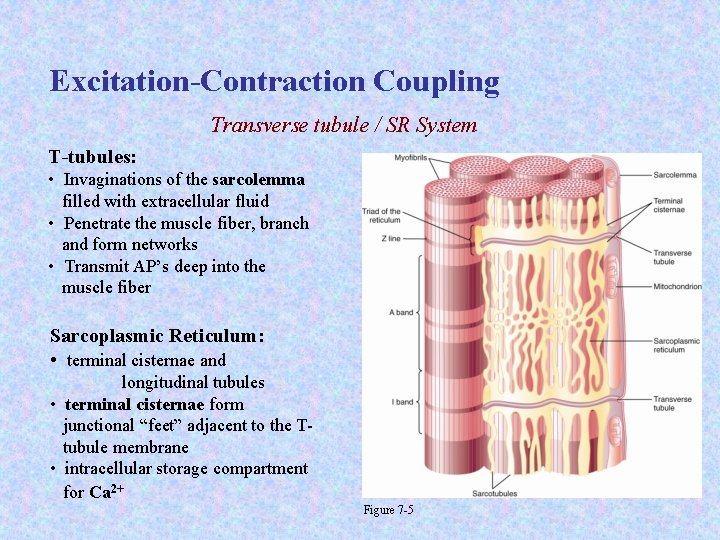
Excitation-Contraction Coupling Transverse tubule / SR System T-tubules: • Invaginations of the sarcolemma filled with extracellular fluid • Penetrate the muscle fiber, branch and form networks • Transmit AP’s deep into the muscle fiber Sarcoplasmic Reticulum: • terminal cisternae and longitudinal tubules • terminal cisternae form junctional “feet” adjacent to the Ttubule membrane • intracellular storage compartment for Ca 2+ Figure 7 -5
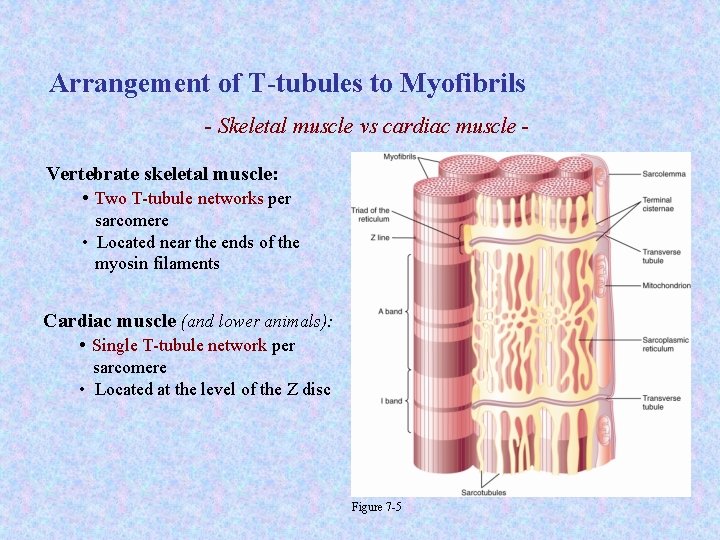
Arrangement of T-tubules to Myofibrils - Skeletal muscle vs cardiac muscle Vertebrate skeletal muscle: • Two T-tubule networks per sarcomere • Located near the ends of the myosin filaments Cardiac muscle (and lower animals): • Single T-tubule network per sarcomere • Located at the level of the Z disc Figure 7 -5
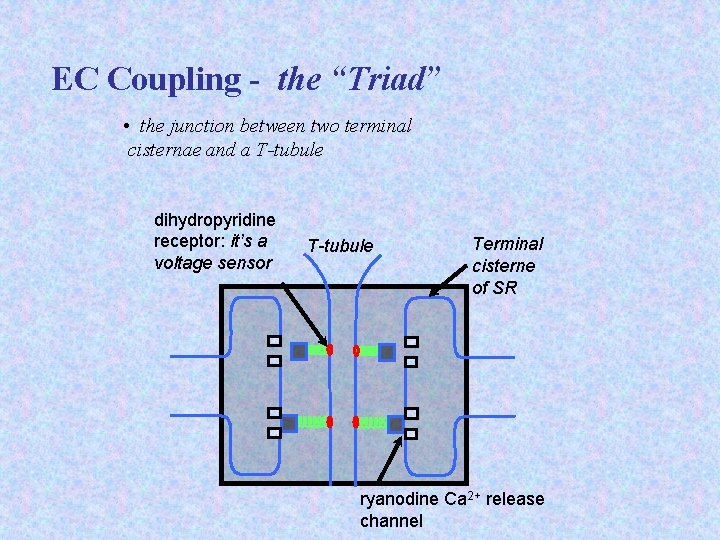
EC Coupling - the “Triad” • the junction between two terminal cisternae and a T-tubule dihydropyridine receptor: it’s a voltage sensor T-tubule Terminal cisterne of SR ryanodine Ca 2+ release channel
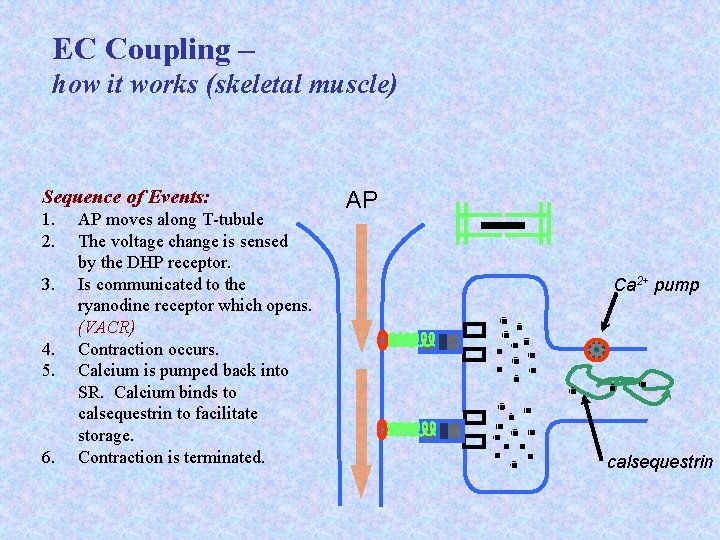
EC Coupling – how it works (skeletal muscle) Sequence of Events: 1. 2. 3. 4. 5. 6. AP moves along T-tubule The voltage change is sensed by the DHP receptor. Is communicated to the ryanodine receptor which opens. (VACR) Contraction occurs. Calcium is pumped back into SR. Calcium binds to calsequestrin to facilitate storage. Contraction is terminated. AP Ca 2+ pump calsequestrin
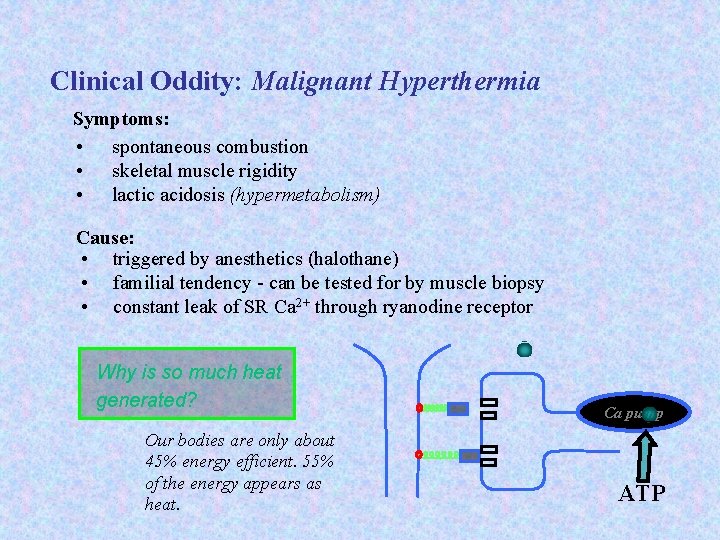
Clinical Oddity: Malignant Hyperthermia Symptoms: • spontaneous combustion • skeletal muscle rigidity • lactic acidosis (hypermetabolism) Cause: • triggered by anesthetics (halothane) • familial tendency - can be tested for by muscle biopsy • constant leak of SR Ca 2+ through ryanodine receptor Why is so much heat generated? Our bodies are only about 45% energy efficient. 55% of the energy appears as heat. Ca pump ATP
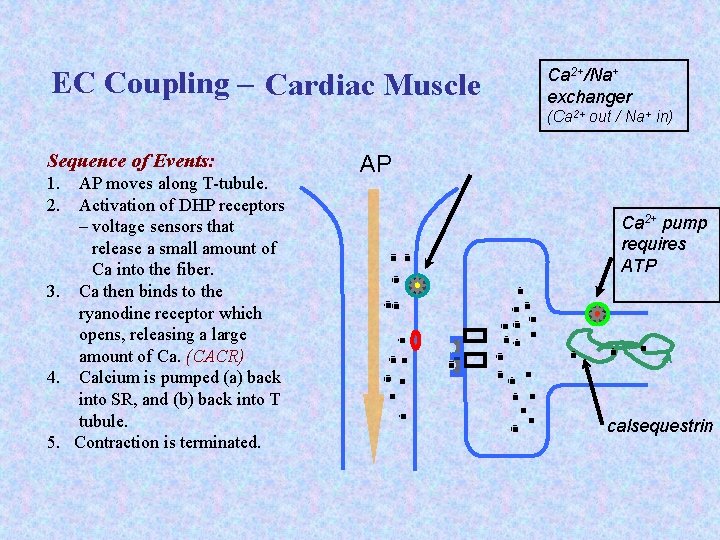
EC Coupling – Cardiac Muscle Ca 2+/Na+ exchanger (Ca 2+ out / Na+ in) Sequence of Events: 1. 2. AP moves along T-tubule. Activation of DHP receptors – voltage sensors that release a small amount of Ca into the fiber. 3. Ca then binds to the ryanodine receptor which opens, releasing a large amount of Ca. (CACR) 4. Calcium is pumped (a) back into SR, and (b) back into T tubule. 5. Contraction is terminated. AP Ca 2+ pump requires ATP calsequestrin
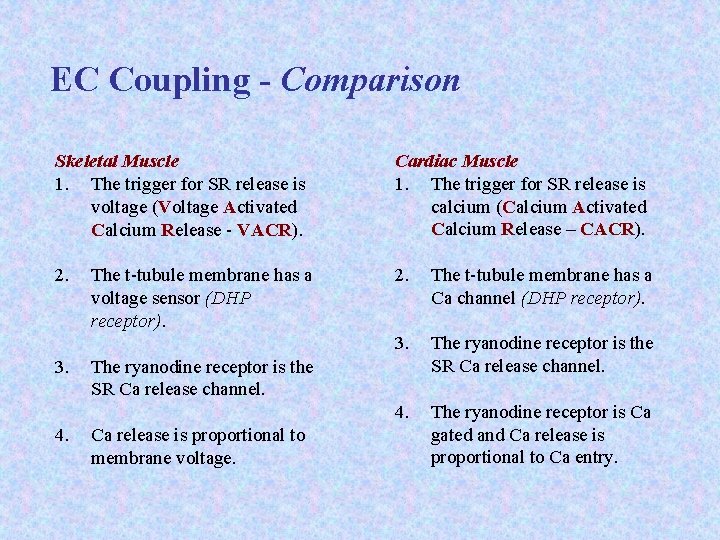
EC Coupling - Comparison Skeletal Muscle 1. The trigger for SR release is voltage (Voltage Activated Calcium Release - VACR). Cardiac Muscle 1. The trigger for SR release is calcium (Calcium Activated Calcium Release – CACR). 2. The t-tubule membrane has a Ca channel (DHP receptor). 3. The ryanodine receptor is the SR Ca release channel. 4. The ryanodine receptor is Ca gated and Ca release is proportional to Ca entry. 3. 4. The t-tubule membrane has a voltage sensor (DHP receptor). The ryanodine receptor is the SR Ca release channel. Ca release is proportional to membrane voltage.