
Chapter 7 Evaluation of Gait Copyright 2015 F

- Slides: 39
Chapter 7 Evaluation of Gait Copyright © 2015. F. A. Davis Company
Introduction § “Walking has been described as a series of narrowly averted catastrophes where the body falls forward, then the legs move under the body to establish a new base of support. ” § Gait analysis § Functional evaluation of walking or running style § Classic LE functional test § Gait evaluation identifies § Functional limitations § Chronic pain related to physical activity Copyright © 2015. F. A. Davis Company
Gait Terminology § Step—sequence of events from a specific point in the gait on one extremity to the same point in the opposite extremity § Step length—distance traveled between the initial contacts of the right and left foot § Step width—distance between the points of contact of both feet § Stride—two sequential steps Copyright © 2015. F. A. Davis Company
Gait Terminology § Cadence—number of steps taken per unit time (i. e. , steps per minute) § Adults average = 107 +/– 2. 7 steps per minute § Velocity—distance covered per unit time (i. e. , m/sec) § Gait velocity—meters per second § Gait cadence—steps per minute Copyright © 2015. F. A. Davis Company
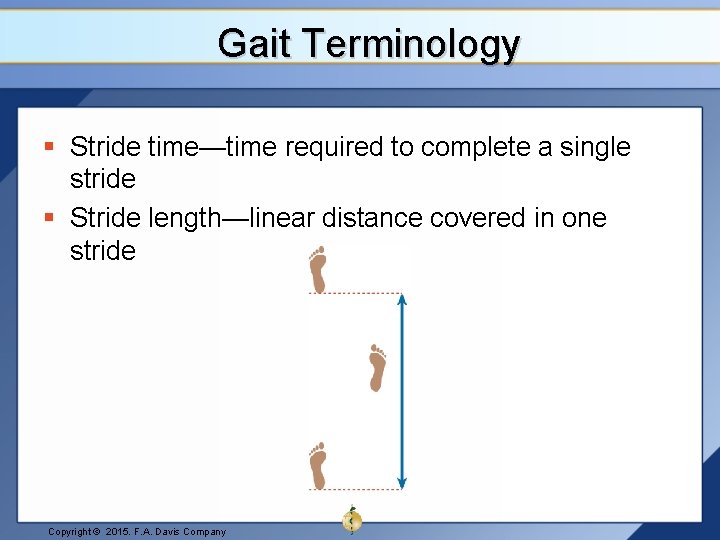
Gait Terminology § Stride time—time required to complete a single stride § Stride length—linear distance covered in one stride Copyright © 2015. F. A. Davis Company
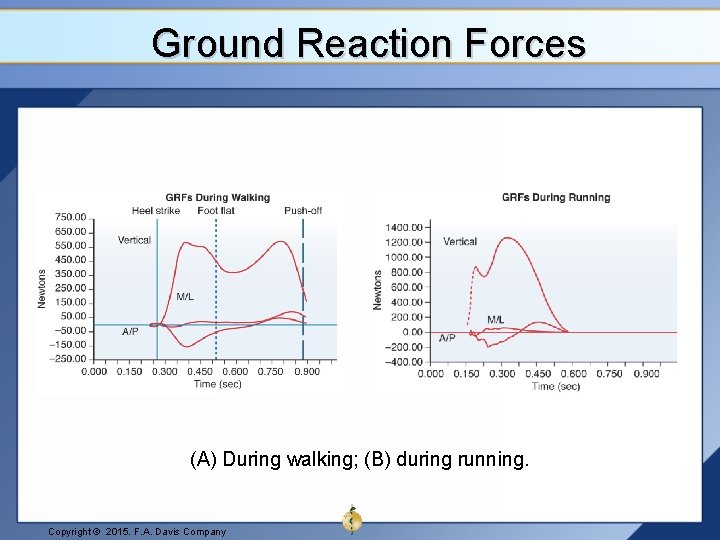
Gait Terminology § Ground reaction force (GRF) § Contact of the foot with the ground creates force yielding vertical, anteroposterior (A/P), and mediolateral (M/L) components § Center of pressure (Co. P) § Shows the path of the pressure point under the foot during gait Copyright © 2015. F. A. Davis Company
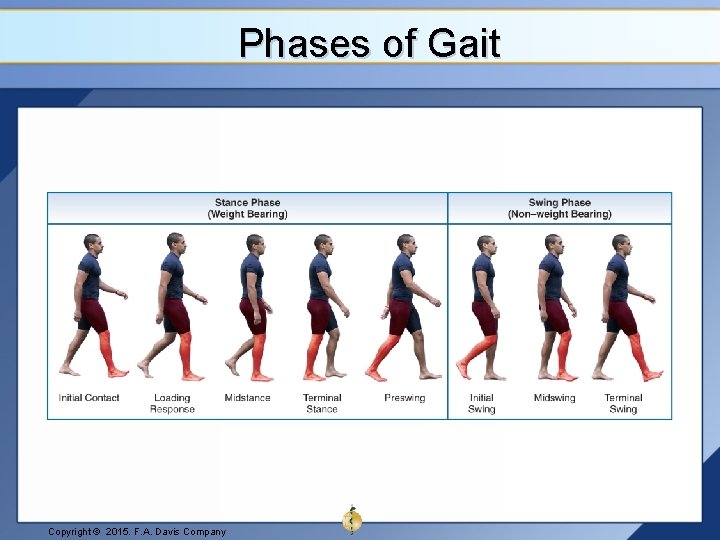
Phases of the Gait Cycle § With the right (facing) limb as an example, two distinct phases occur Weight-bearing (WB) stance phase § Non–weight-bearing (NWB) swing phase § Legs alternate between supportive (stance) and nonsupportive (swing) § Two points the body is supported by a single leg § Midstance § Terminal stance § Copyright © 2015. F. A. Davis Company
Phases of Gait Copyright © 2015. F. A. Davis Company
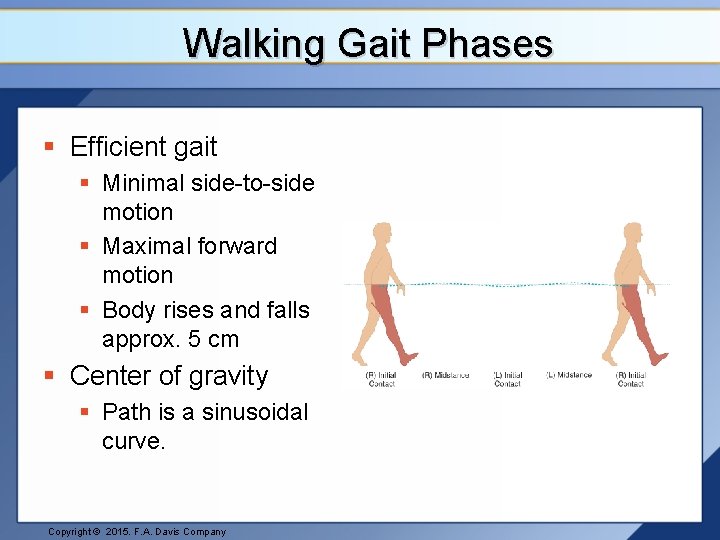
Walking Gait Phases § Efficient gait § Minimal side-to-side motion § Maximal forward motion § Body rises and falls approx. 5 cm § Center of gravity § Path is a sinusoidal curve. Copyright © 2015. F. A. Davis Company
More Terminology… § Kinematic—the characteristics of movement related to time and space (e. g. , range of motion, velocity, and acceleration); the effects of joint action § Kinetic—the forces being analyzed; the causes of joint action Copyright © 2015. F. A. Davis Company
Stance Phase § Five periods § The weight-bearing § Initial contact phase of gait; begins § Loading response on initial contact with the surface and ends § Midstance when contact is broken. § Terminal stance § High-energy phase § Kinetic energy is absorbed from the ground and transferred up the kinetic chain. Copyright © 2015. F. A. Davis Company § Preswing
Swing Phase § The non–weightbearing phase of gait; begins at the instant the foot leaves the surface and ends just before initial contact. § 38% of gait cycle § Low-energy phase Copyright © 2015. F. A. Davis Company § Three periods § Initial swing § Midswing § Terminal swing
Muscle Activity During Gait § Understanding muscle activity and ROM aids in identifying impairments and compensations associated with pathology. Copyright © 2015. F. A. Davis Company
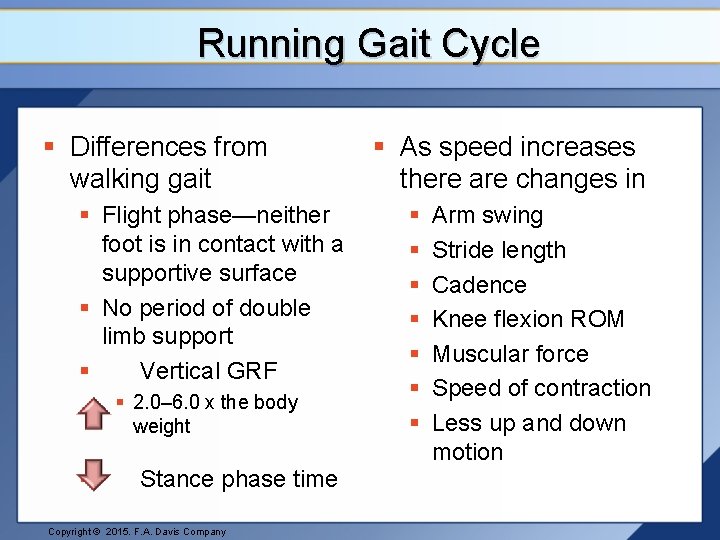
Running Gait Cycle § Differences from walking gait § Flight phase—neither foot is in contact with a supportive surface § No period of double limb support § Vertical GRF § 2. 0– 6. 0 x the body weight § Stance phase time Copyright © 2015. F. A. Davis Company § As speed increases there are changes in § § § § Arm swing Stride length Cadence Knee flexion ROM Muscular force Speed of contraction Less up and down motion
Ground Reaction Forces (A) During walking; (B) during running. Copyright © 2015. F. A. Davis Company
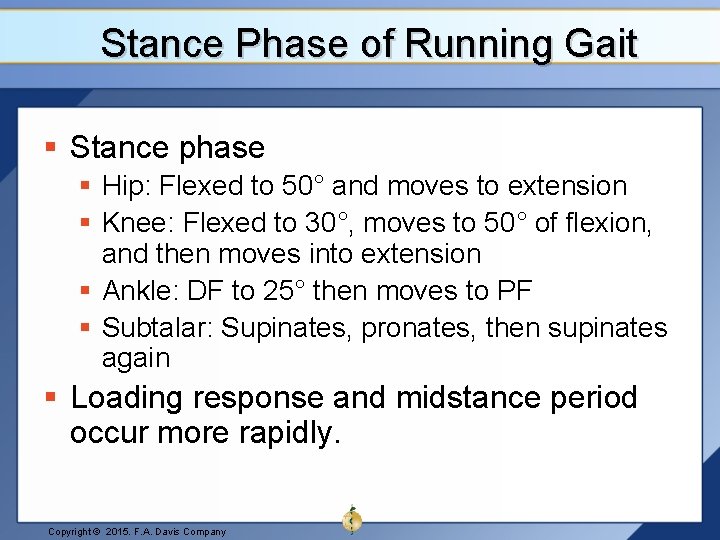
Stance Phase of Running Gait § Stance phase § Hip: Flexed to 50° and moves to extension § Knee: Flexed to 30°, moves to 50° of flexion, and then moves into extension § Ankle: DF to 25° then moves to PF § Subtalar: Supinates, pronates, then supinates again § Loading response and midstance period occur more rapidly. Copyright © 2015. F. A. Davis Company
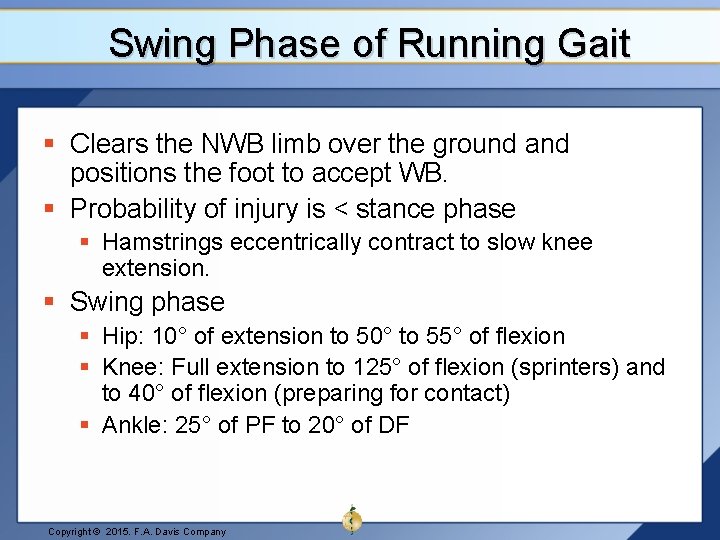
Swing Phase of Running Gait § Clears the NWB limb over the ground and positions the foot to accept WB. § Probability of injury is < stance phase § Hamstrings eccentrically contract to slow knee extension. § Swing phase § Hip: 10° of extension to 50° to 55° of flexion § Knee: Full extension to 125° of flexion (sprinters) and to 40° of flexion (preparing for contact) § Ankle: 25° of PF to 20° of DF Copyright © 2015. F. A. Davis Company
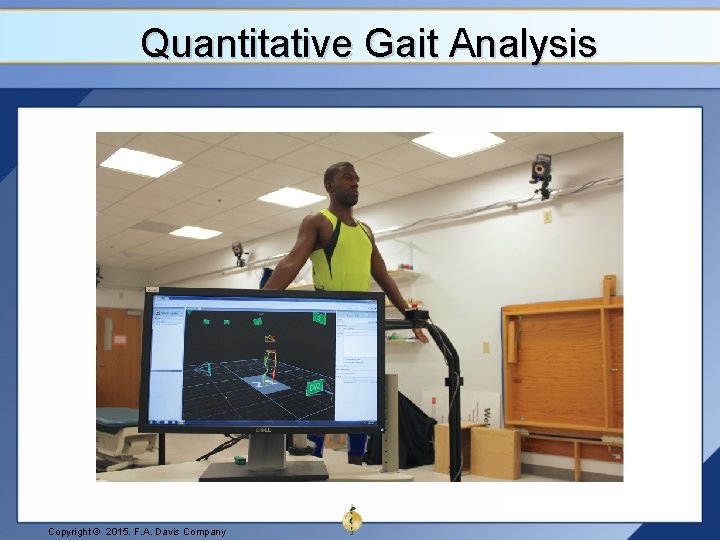
Gait Evaluation § Two basic methods § Qualitative assessment § Observational gait analysis (OGA) § Quantitative assessment Copyright © 2015. F. A. Davis Company
Quantitative Gait Analysis Copyright © 2015. F. A. Davis Company
Observational Gait Analysis § Poor to moderate reliability § Improves with experience, video equipment, and use of OGA tools § § Good observation Auditory clues Observe left and right sides separately Self-selected pace Copyright © 2015. F. A. Davis Company
Observational Gait Analysis Guidelines § Prepare the area and materials ahead of time. § Avoid clutter in the viewing background. § Have the patient wear clothing that does not restrict viewing of joints. § Ensure that the patient is at a self-selected walking pace; otherwise, gait will be altered. Copyright © 2015. F. A. Davis Company
Observational Gait Analysis Guidelines § Position yourself so you can view the individual segments. § Observe the subject from multiple views but not from an oblique angle. § Look at the individual body parts first, then the whole body, then the individual parts again. Copyright © 2015. F. A. Davis Company
Observational Gait Analysis Guidelines § Conduct multiple observations or trials. § Conduct the analysis with the patient barefoot and wearing shoes. § Label all video files. Copyright © 2015. F. A. Davis Company
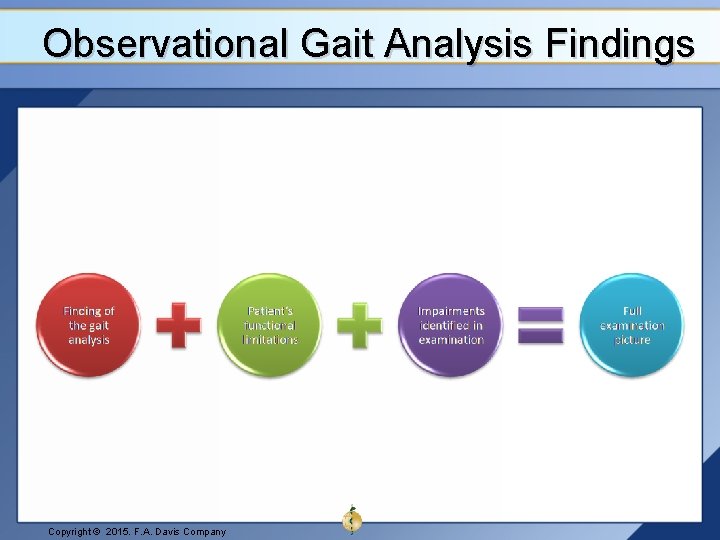
Observational Gait Analysis Findings Copyright © 2015. F. A. Davis Company
Interventions § Cue words or phrases during gait or exercise to improve gait § Footprints on the floor for visual feedback on technique § Hand on a body segment for kinesthetic feedback § Orthotics § Different shoes § Strength training exercises § Flexibility or ROM exercises Copyright © 2015. F. A. Davis Company
Excessive Pronation § Pronation is necessary for shock absorption. § Pronation through a range > 15. 5° has been linked with LE injury. § Related to § Genu valgum § Leg-length discrepancy § Pes planus § Hip musculature imbalance § Soft midsoles in shoes § Exhibits § Calcaneal eversion § Lowering and elongation of medial longitudinal arch § Increased pressure on the first MTP § Wear pattern on shoe § Medial knee pain Copyright © 2015. F. A. Davis Company
Toe In or Toe Out Found in midstance or just after push-off § Causes § Tibial rotation § Hip rotation § Excessive pronation during stance (places limb medial, lower leg compensates = toe out) § Copyright © 2015. F. A. Davis Company § Toe in § Stress on lateral soft tissues (peroneus longus) § Toe out § Stress on medial and plantar structures
Shortened Step Length § Causes § Pain (hip, knee, or ankle) § Shorten stride so as to not make symptoms worse with larger impacts on contact § Inadequate push-off (triceps surae) § Inadequate pull-off (hip flexors) Copyright © 2015. F. A. Davis Company
Shortened Stance Time § Antalgic gait pattern (i. e. , “limp“) § Causes § Pain § Acute or chronic § Avoid load absorption § Recommendations § Crutches § Protective brace Copyright © 2015. F. A. Davis Company
Unequal Hip Height § Causes § Leg-length discrepancy § Weak gluteus medius § Trendelenburg gait Copyright © 2015. F. A. Davis Company
Asymmetrical Arm Swing § Arm swing counterbalances hips and pelvis § Larger arm swing in running § Causes § Upper extremity injury § Leg-length discrepancies § Spine dysfunction § Scoliosis § Limited or exaggerated motion on one side of hip or pelvis Copyright © 2015. F. A. Davis Company
Plantarflexed Ankle at Initial Contact § Causes § Gastrocnemius spasticity § Can § only keep ankle in PF Drop foot § Nerve § pathology that prevents DF Hamstring pathology § Keeping § muscle short eases pain Knee joint pathology Copyright © 2015. F. A. Davis Company
Flat Foot Stance § Exhibits § Absence of initial heel contact § PF at the ankle is avoided in terminal stance and preswing § Causes § Ankle sprain § Gastocnemius sprain § Soleus sprain Copyright © 2015. F. A. Davis Company
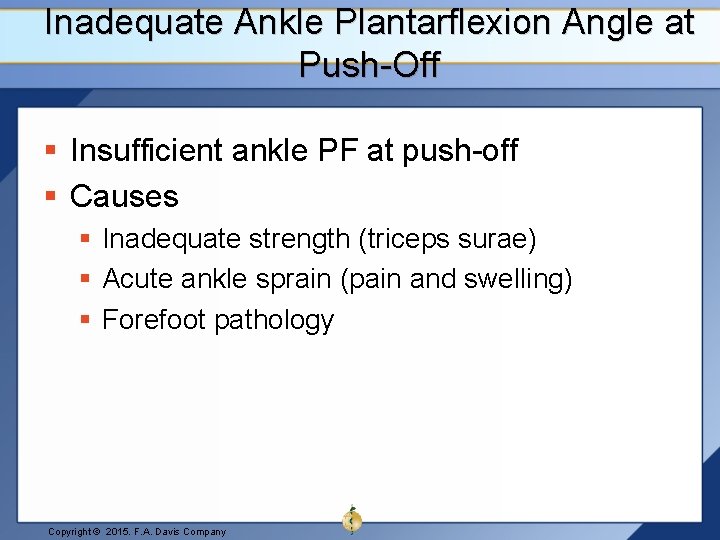
Inadequate Ankle Plantarflexion Angle at Push-Off § Insufficient ankle PF at push-off § Causes § Inadequate strength (triceps surae) § Acute ankle sprain (pain and swelling) § Forefoot pathology Copyright © 2015. F. A. Davis Company
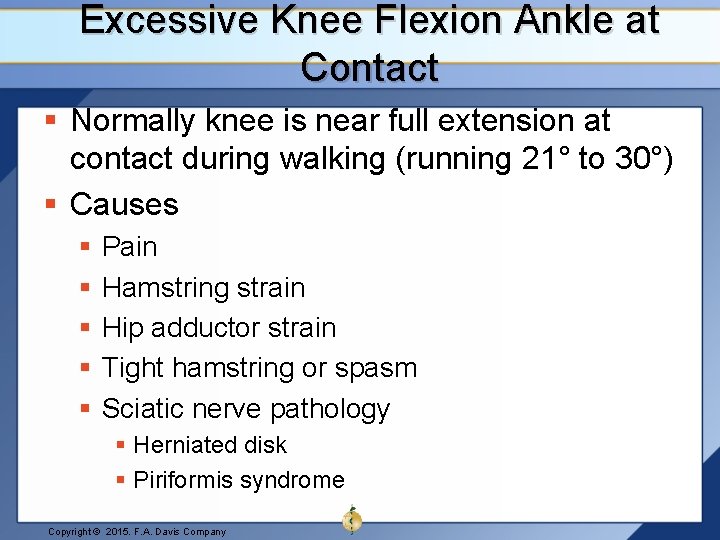
Excessive Knee Flexion Ankle at Contact § Normally knee is near full extension at contact during walking (running 21° to 30°) § Causes § § § Pain Hamstring strain Hip adductor strain Tight hamstring or spasm Sciatic nerve pathology § Herniated disk § Piriformis syndrome Copyright © 2015. F. A. Davis Company
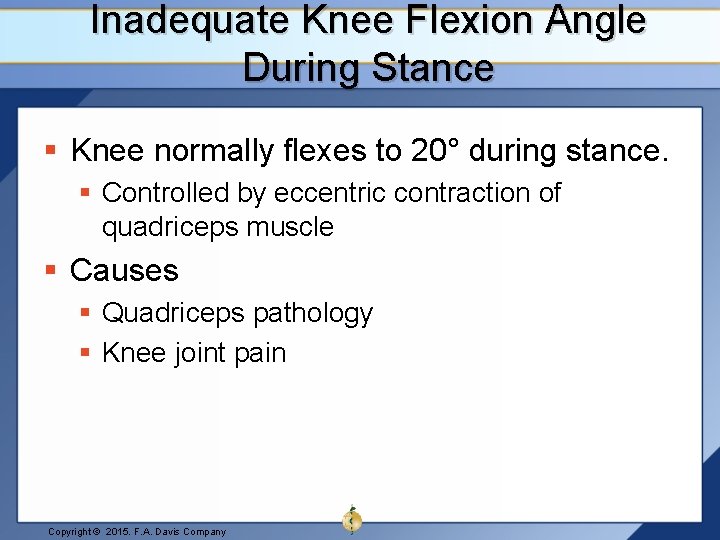
Inadequate Knee Flexion Angle During Stance § Knee normally flexes to 20° during stance. § Controlled by eccentric contraction of quadriceps muscle § Causes § Quadriceps pathology § Knee joint pain Copyright © 2015. F. A. Davis Company
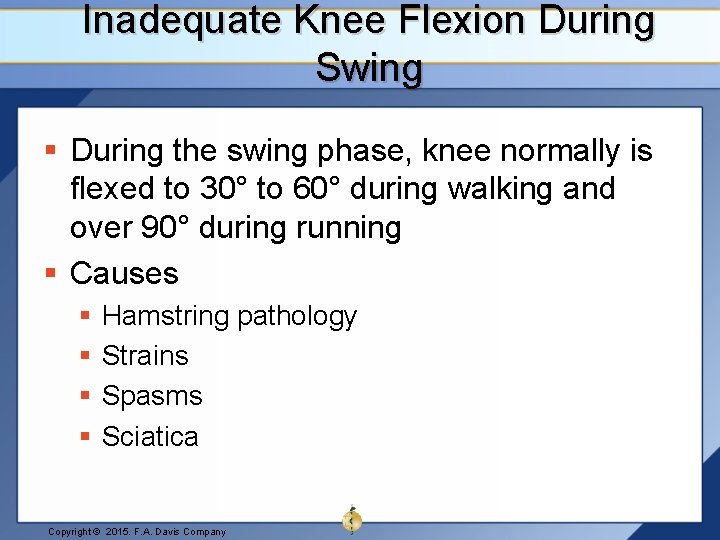
Inadequate Knee Flexion During Swing § During the swing phase, knee normally is flexed to 30° to 60° during walking and over 90° during running § Causes § § Hamstring pathology Strains Spasms Sciatica Copyright © 2015. F. A. Davis Company
Inadequate Hip Extension at Terminal Stance § Normally, hip extends as the body is propelled forward. § Causes § Contracture of the hip flexors Copyright © 2015. F. A. Davis Company
Forward Trunk Angle § Indicates § Low back pathology § For example, herniated disk § Weak and painful hip flexors § Weak ankle plantarflexors Copyright © 2015. F. A. Davis Company