
Chapter 7 Enhancing Business Processes Using Enterprise Information
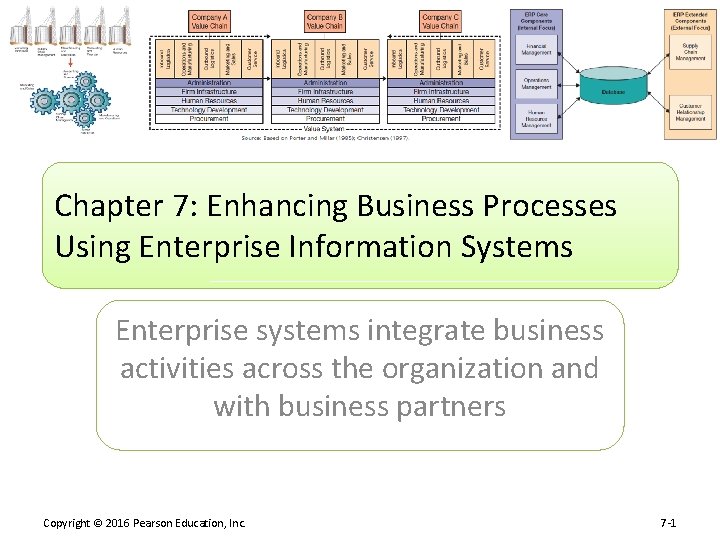
Chapter 7: Enhancing Business Processes Using Enterprise Information Systems Enterprise systems integrate business activities across the organization and with business partners Copyright © 2016 Pearson Education, Inc. 7 -1
Chapter 7 Learning Objectives Core Business Processes and Organizational Value Chains • Explain core business processes that are common in organizations. Enterprise Systems • Describe what enterprise systems are and how they have evolved. Enterprise Resource Planning • Describe enterprise resource planning systems and how they help to improve internal business processes. Achieving Enterprise System Success • Understand utilize the keys to successfully implementing enterprise systems. Copyright © 2016 Pearson Education, Inc. 7 -2
Core Business Processes and Organizational Value Chains Explain core business processes that are common in organizations. Enterprise Systems Describe what enterprise systems are and how they have evolved. Enterprise Resource Planning Describe enterprise resource planning systems and how they help to improve internal business processes. Achieving Enterprise System Success Understand utilize the keys to successfully implementing enterprise systems. Copyright © 2016 Pearson Education, Inc. 7 -3
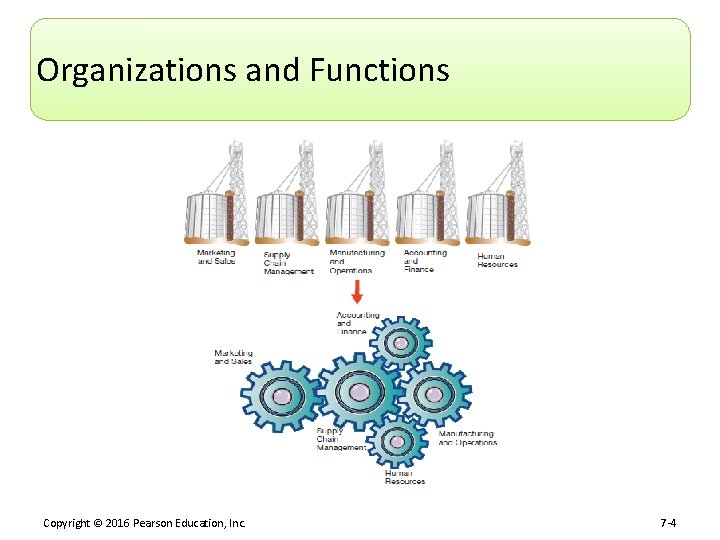
Organizations and Functions Copyright © 2016 Pearson Education, Inc. 7 -4
Core Business Processes • Order-to-Cash – The process of selling goods or services and collecting revenue for them • Procure-to-Pay – The process of ordering goods or services and paying for them • Make-to-Stock/Make-to-Order – The process of manufacturing goods, either based on forecasts or based on orders Copyright © 2016 Pearson Education, Inc. 7 -5
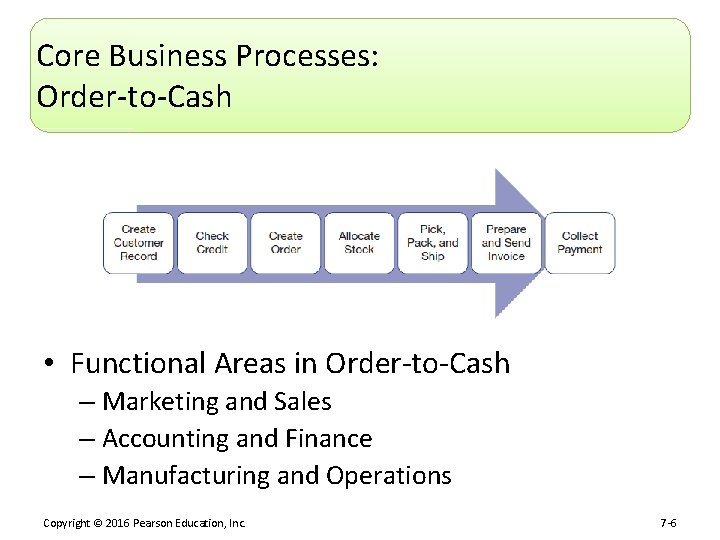
Core Business Processes: Order-to-Cash • Functional Areas in Order-to-Cash – Marketing and Sales – Accounting and Finance – Manufacturing and Operations Copyright © 2016 Pearson Education, Inc. 7 -6
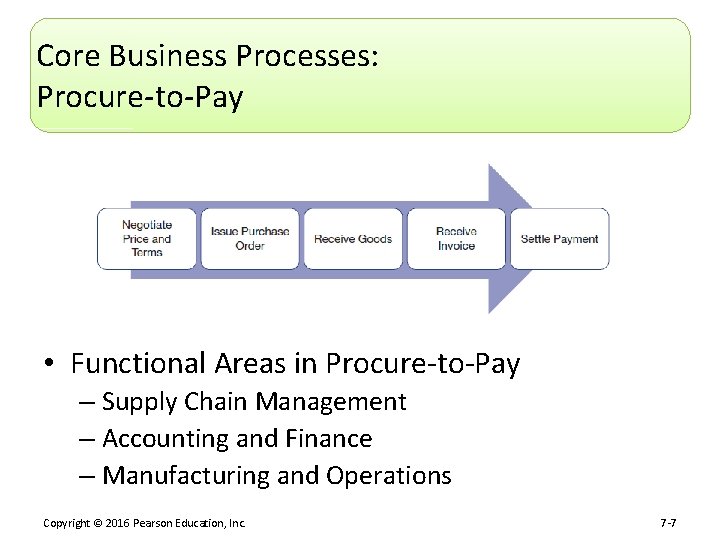
Core Business Processes: Procure-to-Pay • Functional Areas in Procure-to-Pay – Supply Chain Management – Accounting and Finance – Manufacturing and Operations Copyright © 2016 Pearson Education, Inc. 7 -7
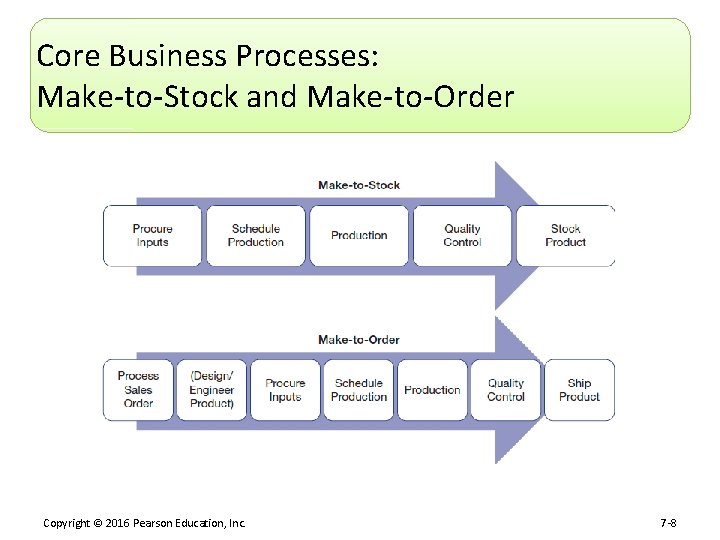
Core Business Processes: Make-to-Stock and Make-to-Order Copyright © 2016 Pearson Education, Inc. 7 -8
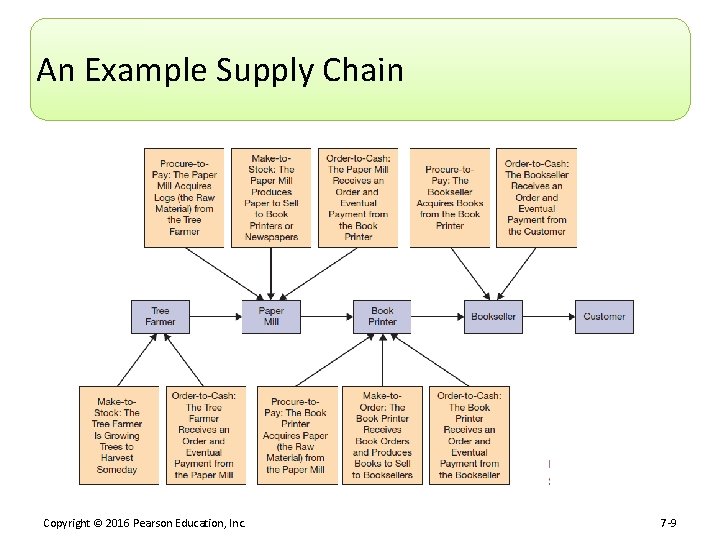
An Example Supply Chain Copyright © 2016 Pearson Education, Inc. 7 -9
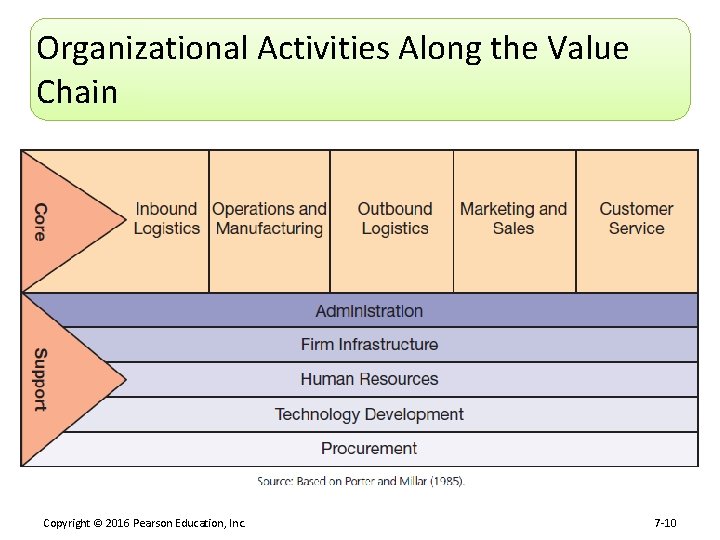
Organizational Activities Along the Value Chain Copyright © 2016 Pearson Education, Inc. 7 -10
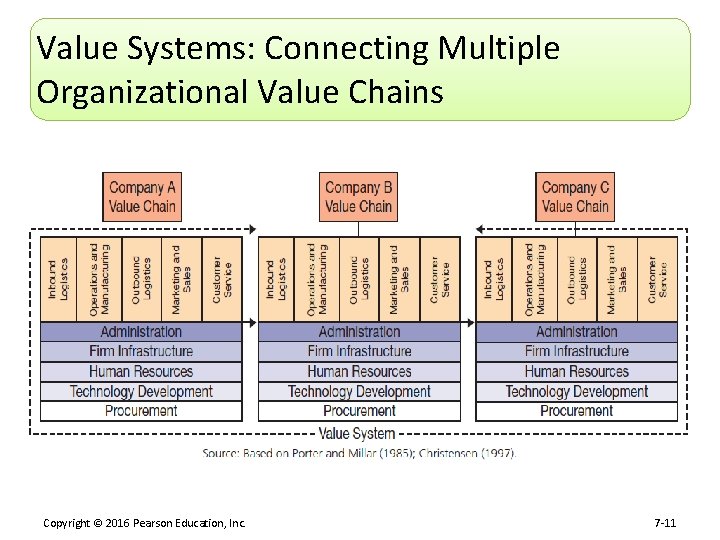
Value Systems: Connecting Multiple Organizational Value Chains Copyright © 2016 Pearson Education, Inc. 7 -11

Enterprise Systems Core Business Processes and Organizational Value Chains Explain core business processes that are common in organizations. Enterprise Systems Describe what enterprise systems are and how they have evolved. Enterprise Resource Planning Describe enterprise resource planning systems and how they help to improve internal business processes. Achieving Enterprise System Success Understand utilize the keys to successfully implementing enterprise systems. Copyright © 2016 Pearson Education, Inc. 7 -12
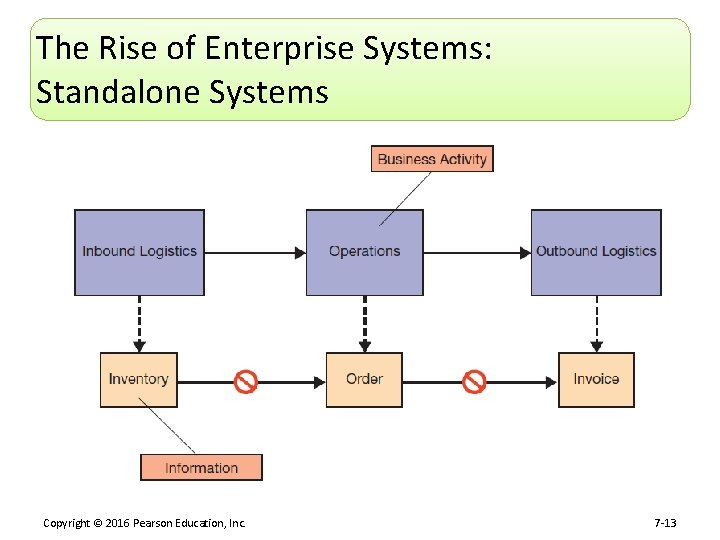
The Rise of Enterprise Systems: Standalone Systems Copyright © 2016 Pearson Education, Inc. 7 -13

The Rise of Enterprise Systems: Integrated Enterprise Systems Copyright © 2016 Pearson Education, Inc. 7 -14
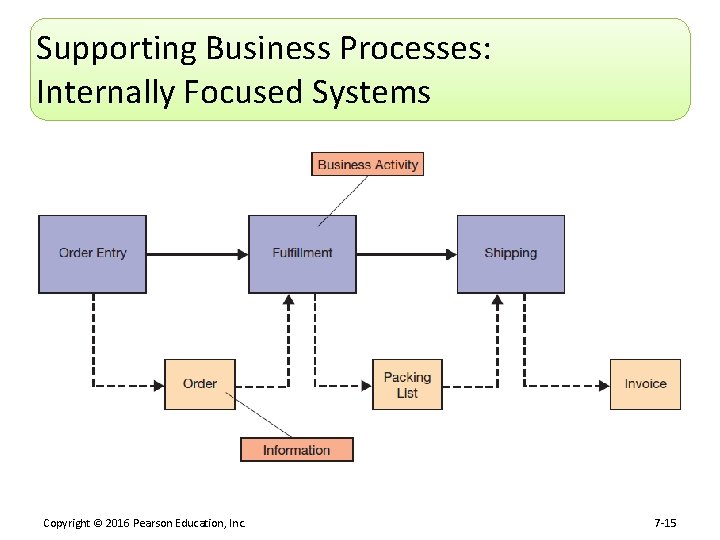
Supporting Business Processes: Internally Focused Systems Copyright © 2016 Pearson Education, Inc. 7 -15
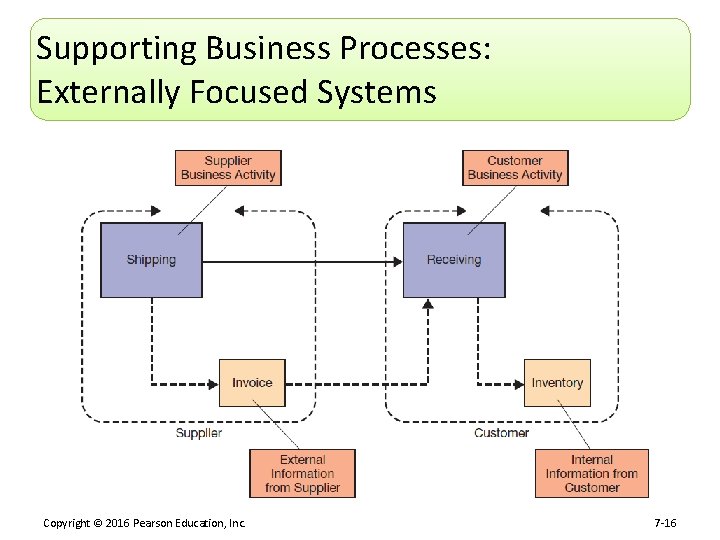
Supporting Business Processes: Externally Focused Systems Copyright © 2016 Pearson Education, Inc. 7 -16
Improving Business Processes Through Enterprise Systems: Software Types • Packaged Software – Also called “off-the-shelf” – May or may not require significant configuration – Enterprise software often divided into modules – Special functionality may require customizing the packaged (or vanilla) version • Custom Software – Designed and developed exclusively for a specific organization (Chapter 9) Copyright © 2016 Pearson Education, Inc. 7 -17

Improving Business Processes Through Enterprise Systems: Best Practices • Packaged Enterprise Software – Typically designed to operate with industry standard best practices – May not accommodate unique organizational practices that provide a competitive advantage – Modifying enterprise software can be a long and costly process, depending on the inherent flexibility of a given system Copyright © 2016 Pearson Education, Inc. 7 -18
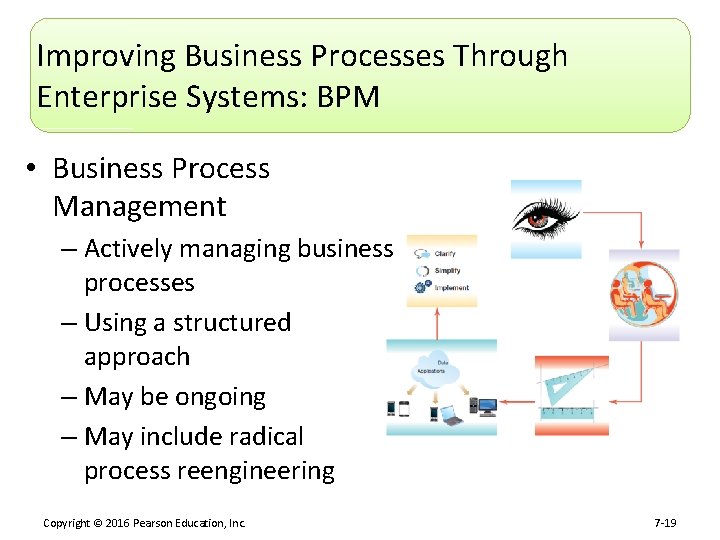
Improving Business Processes Through Enterprise Systems: BPM • Business Process Management – Actively managing business processes – Using a structured approach – May be ongoing – May include radical process reengineering Copyright © 2016 Pearson Education, Inc. 7 -19
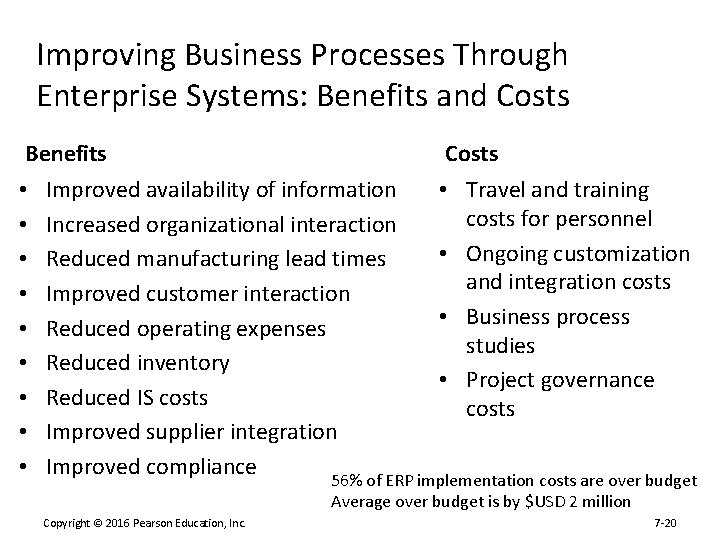
Improving Business Processes Through Enterprise Systems: Benefits and Costs Benefits Costs • Improved availability of information • Travel and training costs for personnel • Increased organizational interaction • Ongoing customization • Reduced manufacturing lead times and integration costs • Improved customer interaction • Business process • Reduced operating expenses studies • Reduced inventory • Project governance • Reduced IS costs • Improved supplier integration • Improved compliance 56% of ERP implementation costs are over budget Average over budget is by $USD 2 million Copyright © 2016 Pearson Education, Inc. 7 -20
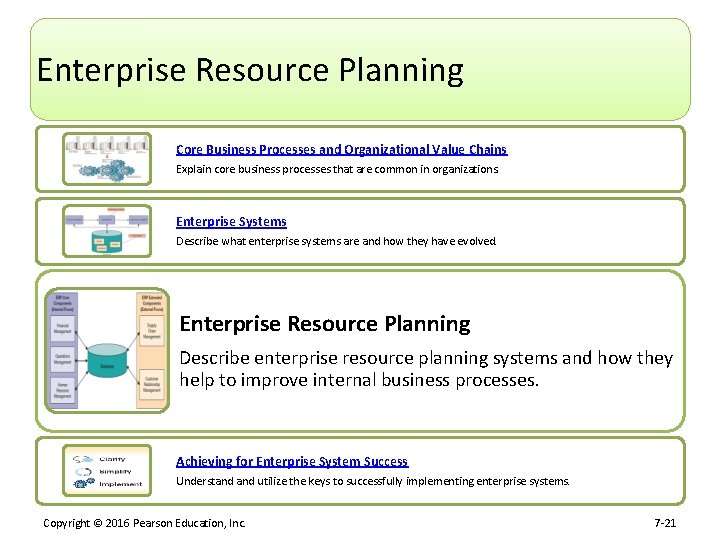
Enterprise Resource Planning Core Business Processes and Organizational Value Chains Explain core business processes that are common in organizations. Enterprise Systems Describe what enterprise systems are and how they have evolved. Enterprise Resource Planning Describe enterprise resource planning systems and how they help to improve internal business processes. Achieving for Enterprise System Success Understand utilize the keys to successfully implementing enterprise systems. Copyright © 2016 Pearson Education, Inc. 7 -21
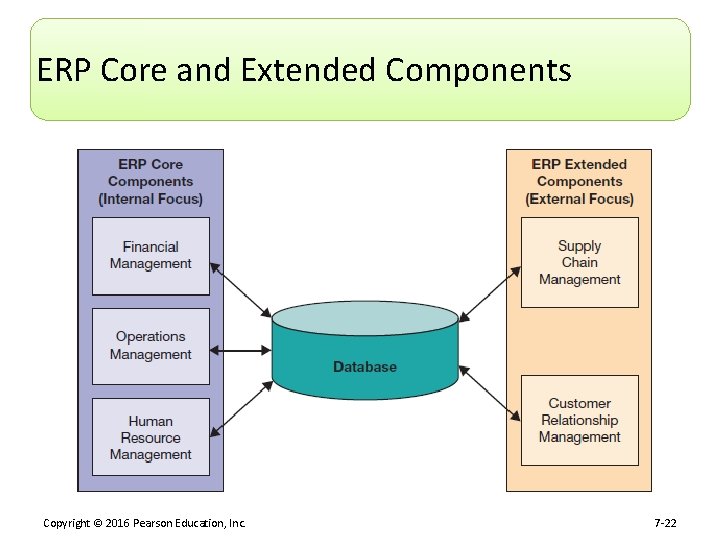
ERP Core and Extended Components Copyright © 2016 Pearson Education, Inc. 7 -22
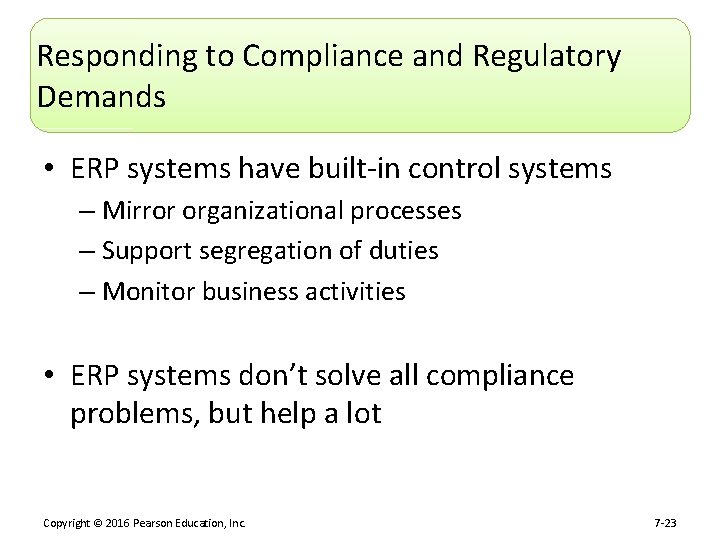
Responding to Compliance and Regulatory Demands • ERP systems have built-in control systems – Mirror organizational processes – Support segregation of duties – Monitor business activities • ERP systems don’t solve all compliance problems, but help a lot Copyright © 2016 Pearson Education, Inc. 7 -23
Choosing an ERP System • ERP Control – Centralized or decentralized across business units – Policies and procedures • Do they need to be flexible? • Do they need to be standardized? • ERP Business Requirements – What modules are available? – How well do they meet specific business needs? Copyright © 2016 Pearson Education, Inc. 7 -24
Enabling Business Processes Using ERP Core Components • ERP systems support core business processes • Assist with: – – Order-to-cash Procure-to-pay Make-to-stock/make-to-order Other business processes • Often packaged industry-specific ERP versions – Support industry-specific core processes • • • Health care Automotive Construction Retail Specialized manufacturing industries Copyright © 2016 Pearson Education, Inc. 7 -25
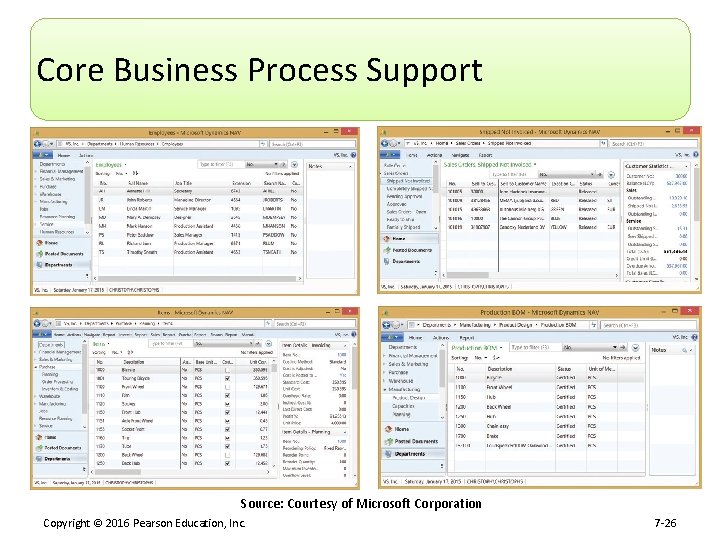
Core Business Process Support Source: Courtesy of Microsoft Corporation Copyright © 2016 Pearson Education, Inc. 7 -26
ERP Installation • Configuration is critical – Specifying the data to be in the underlying database – Thousands of decisions related to business processes – Companies need to understand how they do business to implement and configure their ERP systems Copyright © 2016 Pearson Education, Inc. 7 -27
ERP Limitations • ERP systems often require organizations to change their business processes • Once implemented, a company is locked in • Difficult and costly to make future changes • Modifications require extra and costly programming Copyright © 2016 Pearson Education, Inc. 7 -28
Achieving Enterprise System Success Core Business Processes and Organizational Value Chains Explain core business processes that are common in organizations. Enterprise Systems Describe what enterprise systems are and how they have evolved. Enterprise Resource Planning Describe enterprise resource planning systems and how they help to improve internal business processes. Achieving Enterprise System Success Understand utilize the keys to successfully implementing enterprise systems. Copyright © 2016 Pearson Education, Inc. 7 -29
ERP Recommendations • Recommendations 1. 2. 3. 4. Secure executive sponsorship Get help from outside experts Thoroughly train users Take a multidisciplinary approach to implementations 5. Evolve the implementation Copyright © 2016 Pearson Education, Inc. 7 -30
Secure Executive Sponsorship • Executive Sponsorship is Critical – Primary reason for ERP failure – Critical for buy-in – Dictates resource availability – Necessary to authorize business improvements – Key to removing obstacles Copyright © 2016 Pearson Education, Inc. 7 -31
Get Help from Outside Experts • ERP systems are very complex • Typically, IS departments aren’t familiar with new systems • Experts can help – Specify needs – Select a suitable vendor – Manage the implementation project – Provide technical expertise Copyright © 2016 Pearson Education, Inc. 7 -32
Thoroughly Train Users • ERP systems are complex from the user perspective as well – Training costs are often poorly judged – When systems go live it takes employees time to regain productivity • Proper training can alleviate concerns • Proper training can mitigate productivity loss • Proper training can set expectations Copyright © 2016 Pearson Education, Inc. 7 -33
Take a Multidisciplinary Approach to Implementations • ERP systems often affect the entire organization – The entire organization is a stakeholder – The entire organization needs involvement – Failure to have representatives can result in unmet critical needs – The project team can’t be experts in every aspect of user needs – Departments may become hostile if left out of the implementation and needs assessment Copyright © 2016 Pearson Education, Inc. 7 -34

Evolve the Implementation • Recent trend is to move away from large-scale ERP – Using cloud-based ERP allows scalability and agility • Another trend: managing businesses in real time – Take advantage of in-memory computing and mobile access Copyright © 2016 Pearson Education, Inc. 7 -35
END OF CHAPTER CONTENT Copyright © 2016 Pearson Education, Inc. 7 -36
Managing in the Digital World: Amazon. com • Amazon has grown from an online bookstore to a complete marketplace – Almost any product can be purchased though Amazon – Amazon uses enterprise information systems to optimize processes, and now provides this to others – Amazon Web Services (AWS) is an IS infrastructure rented to companies for their enterprise system needs – AWS provides cloud services and hosting for other companies Copyright © 2016 Pearson Education, Inc. 7 -37
Brief Case: Crowdsourcing Cinema at Amazon Studios • Amazon Studios is an innovative film production venture – Lets anyone submit screenplays and movies – Aims to discover talent that hasn’t yet made it to the big time – Original content is aired on Amazon Instant Video – After feedback, Amazon Studios decides whether to produce a full season – Two successes: Alpha House and Mozart in the Jungle Copyright © 2016 Pearson Education, Inc. 7 -38
Ethical Dilemma: Too Much Intelligence? RFID and Privacy • RFID tags being used to tag pharmaceuticals – RFID tags can be read by anyone with an RFID reader, creating concerns that a person’s medications could be revealed • RFID chips can be embedded in people – Mexico’s attorney general and senior staff – Alzheimer’s and diabetes patients – Implant in kids to prevent kidnapping? • Lots of public opposition, what are the dangers? Copyright © 2016 Pearson Education, Inc. 7 -39

Coming Attractions: Combating Counterfeits Using Liquid Crystal Lasers • University of Cambridge is developing a liquid crystal laser pattern print for product labels • Can distinguish a real product from fraudulent knockoffs • Inexpensive • Pharmaceutical application – Counterfeit pharmaceuticals is a big problem – Unlawful and potentially dangerous for patients – This technology can help prevent counterfeits Copyright © 2016 Pearson Education, Inc. 7 -40
Key Players: The Titans of ERP • SAP – German company founded in 1972 – Many of the worlds largest companies use SAP software – 24% of the ERP market in 2012 • Oracle – Best known for database software – ERP acquisitions: JD Edwards, People. Soft, Siebel CRM – 13% of the ERP market in 2012 • Microsoft – Largest software company in the world – Gained ERP software through acquisition of Great Plains – 5% of the ERP market in 2012 Copyright © 2016 Pearson Education, Inc. 7 -41
Who’s Going Mobile: Big ERP Systems Embracing Small Mobile Devices • ERP users originally used client PCs to access ERP systems • Mobile users can now access ERP systems on the road • There are many benefits to mobile ERP – Improved service quality – Improved productivity – Strengthened customer relationships – Improved competitive advantage – Improved data timeliness and accuracy • Examples: SAP, Microsoft Copyright © 2016 Pearson Education, Inc. 7 -42
When Things Go Wrong: The Not-So-Beautiful ERP Implementation • Avon announced its “Promise” program in 2009 – Mobile app and Web site for local sales reps entering product orders – Pilot launched in 2012 was a miserable failure – Difficult to use; sales reps quit in droves – $125 million loss, 30% stock price decline – Finger pointing: Avon, SAP, third party Copyright © 2016 Pearson Education, Inc. 7 -43
Industry Analysis: The Automobile Industry • More than 800 million cars on the road, 83 million sold worldwide in 2013 – Sales predicted to climb to 100 million by 2018 – China, Brazil, Russia, India, other developing nations • Growing global demand for energy-efficient cars • Auto industry efforts: – – – Evolving global network of suppliers Broader supply chains bring new innovations to market USB ports, hard drives, mobile data connectivity Google working on a self-driving car Marketing enhancements via virtual showrooms Copyright © 2016 Pearson Education, Inc. 7 -44
Copyright © 2016 Pearson Education, Inc. 7 -45
- Slides: 45