
CHAPTER 7 EMPLOYMENT LAW Copyright 2005 SouthWestern All
- Slides: 34
CHAPTER 7: EMPLOYMENT LAW Copyright © 2005 South-Western. All rights reserved.
Legal Issues: Critical and Strategic • Significant impact on cost structure – Establishment and maintenance of internal mechanisms – Violations can result in significant penalties • http: //www. eeoc. gov/stats/litigation. html • Makes sense to be an equal opportunity employer – Avoid penalties for violations – Hire most qualified applicant for job, or to promote most qualified individual Copyright © 2005 South-Western. All rights reserved. 2
Federal Anti-Discrimination Laws • Civil Rights Act of 1866 – Gave all citizens right to enter into contracts – No remedies for unjust treatment were provided • Civil Rights Act of 1871 – Gave individuals right to sue if they felt they had been deprived of rights under 1866 Act Copyright © 2005 South-Western. All rights reserved. 3
Federal Anti-Discrimination Laws • Equal Pay Act (1963) – Prohibits wage discrimination based on gender for jobs that require equal skill, effort, and responsibility, and that are performed under similar working conditions – Exceptions to equal pay • Bona fide seniority systems • Quality of job performance (i. e. , merit-based pay systems) • Quantity of output (i. e. , piece-rate pay systems) • Factors (contingencies) other than sex (gender) Copyright © 2005 South-Western. All rights reserved. 4
Federal Anti-Discrimination Laws • Civil Rights Act (1964) - Title VII (as amended) – Title VII prohibits discrimination in employment based on race, color, religion, sex, and national origin – Covers conditions of employment: hiring, firing, promotion, transfer, compensation, and admission to training – Applies to all private employers with 15 or more employees, state and local governments, educational institutions, employment agencies, and unions – Established the Equal Employment Opportunity Commission (EEOC) to oversee and enforce Title Copyright © 2005 South-Western. All rights reserved. 5
Federal Anti-Discrimination Laws • Age Discrimination in Employment Act, ADEA (1967, as amended) – Prohibits employment discrimination against employees age 40 or older – Prohibits setting of mandatory retirement ages, except in cases of public safety (e. g. , airline pilots) – Amended in 1990 by Older Workers Protection Act, which prohibits discrimination in provision of benefits, and required signing of age discrimination waivers at layoff – Covers all employers, including federal government Copyright © 2005 South-Western. All rights reserved. 6
Federal Anti-Discrimination Laws • Rehabilitation Act (1973) – Prohibited discrimination by federal (but not private) contractors against handicapped applicants or employees – Definition of handicapped individuals • Persons with physical or mental impairment that substantially limits one or more major life activities • Persons with history or record of such impairment • Persons regarded as having such an impairment – Handicapped individuals must be “otherwise qualified” to perform (with reasonable accommodation) essential functions of job (e. g. , Copyright © 2005 South-Western. rights reserved. no blind. Allbus drivers) 7
Federal Anti-Discrimination Laws • Pregnancy Discrimination Act (1978) – Prohibits employers from discriminating against pregnant employees by requiring that pregnancy be treated as any other medical disability or condition – Does not require reinstatement of returning employee to same job – Does not allow employer to determine dates of leave – Employer cannot refuse to hire or promote on basis of pregnancy – Employer cannot provide health plans that do not cover pregnancy Copyright © 2005 South-Western. All rights reserved. 8
Federal Anti-Discrimination Laws • American With Disabilities Act, ADA (1990) – Prohibits all employers with 15 or more employees from discriminating against disabled persons – Courts have issued ambiguous and sometimes conflicting rulings on “medical conditions, ” “major life activities, ” and what constitutes “disability. ” Decisions made on a case-by-case basis – Determination of “reasonable accommodation” • Cost of accommodation and resources of employer • Nature of job and workplace safety issues • Any relevant collective bargaining provisions Copyright © 2005 South-Western. All rights reserved. 9
A State Anti-Discrimination Law • California’s A. B. 2222 – Significantly less restrictive requirements for employees to show disability – No limits to damages – Burden of proof shifted from employee to employer – Relevance: California law is often harbinger of laws adopted elsewhere Copyright © 2005 South-Western. All rights reserved. 10
Federal Anti-Discrimination Laws • Civil Rights Act (1991) – Extended Title VII coverage to federal employees – Allows litigants to sue for compensatory and punitive damages – Requires heavier “burden of proof” on part of employers in rebutting claims of discrimination – Provided “extraterritorial enforcement” of federal labor laws in protecting U. S. employees on overseas assignments with Copyright © 2005 South-Western. All rights reserved. 11
Federal Anti-Discrimination Laws • Family and Medical Leave Act, FMLA (1992) – Requires employers to provide up to 12 weeks of unpaid leave for birth, adoption, or serious illness of a child, family member, or employee during a 12 month period – Act only covers organizations with fifty or more employees – Employee must have been employed minimum of 25 hours per week or 1, 250 hours yearly – Employees in top 10% of employer’s salary ranges not covered – Employer required to continue employee’s group health coverage during leave – Employee must be allowed to return to Copyright © 2005 South-Western. All rights reserved. 12
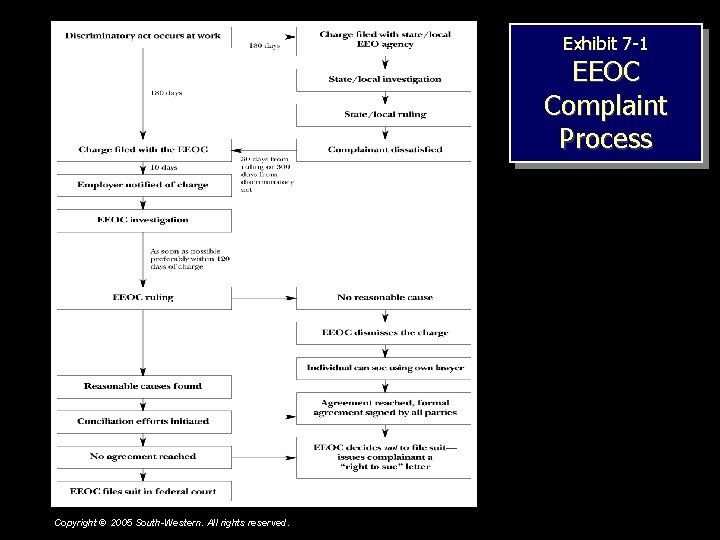
Exhibit 7 -1 EEOC Complaint Process Copyright © 2005 South-Western. All rights reserved. 13
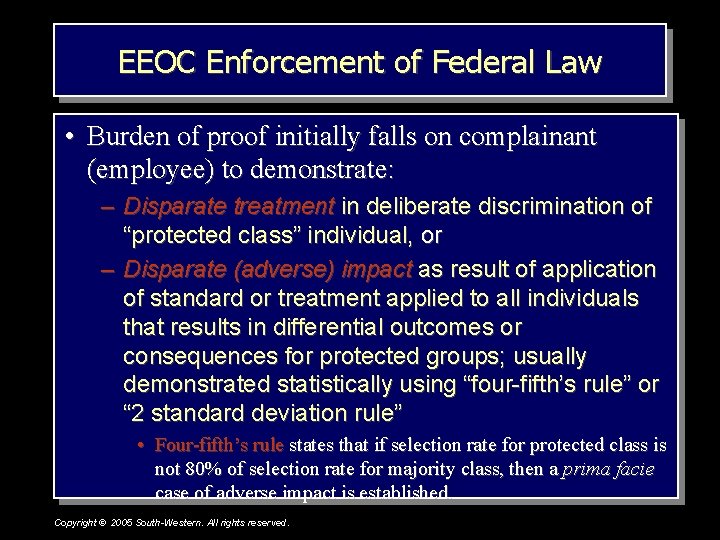
EEOC Enforcement of Federal Law • Burden of proof initially falls on complainant (employee) to demonstrate: – Disparate treatment in deliberate discrimination of “protected class” individual, or – Disparate (adverse) impact as result of application of standard or treatment applied to all individuals that results in differential outcomes or consequences for protected groups; usually demonstrated statistically using “four-fifth’s rule” or “ 2 standard deviation rule” • Four-fifth’s rule states that if selection rate for protected class is not 80% of selection rate for majority class, then a prima facie case of adverse impact is established. Copyright © 2005 South-Western. All rights reserved. 14
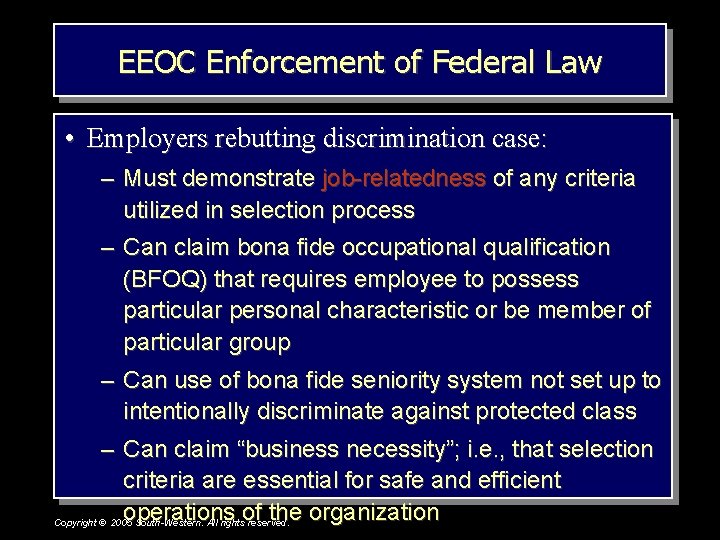
EEOC Enforcement of Federal Law • Employers rebutting discrimination case: – Must demonstrate job-relatedness of any criteria utilized in selection process – Can claim bona fide occupational qualification (BFOQ) that requires employee to possess particular personal characteristic or be member of particular group – Can use of bona fide seniority system not set up to intentionally discriminate against protected class – Can claim “business necessity”; i. e. , that selection criteria are essential for safe and efficient operations of the organization Copyright © 2005 South-Western. All rights reserved. 15
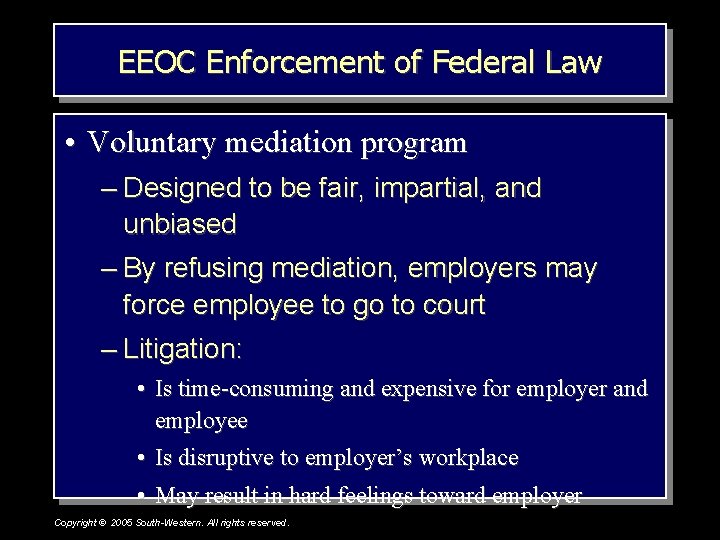
EEOC Enforcement of Federal Law • Voluntary mediation program – Designed to be fair, impartial, and unbiased – By refusing mediation, employers may force employee to go to court – Litigation: • Is time-consuming and expensive for employer and employee • Is disruptive to employer’s workplace • May result in hard feelings toward employer Copyright © 2005 South-Western. All rights reserved. 16
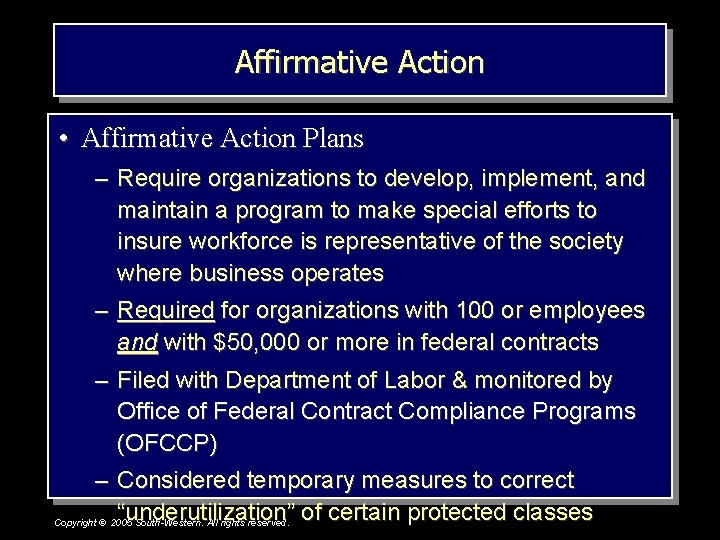
Affirmative Action • Affirmative Action Plans – Require organizations to develop, implement, and maintain a program to make special efforts to insure workforce is representative of the society where business operates – Required for organizations with 100 or employees and with $50, 000 or more in federal contracts – Filed with Department of Labor & monitored by Office of Federal Contract Compliance Programs (OFCCP) – Considered temporary measures to correct “underutilization” of certain protected classes Copyright © 2005 South-Western. All rights reserved. 17
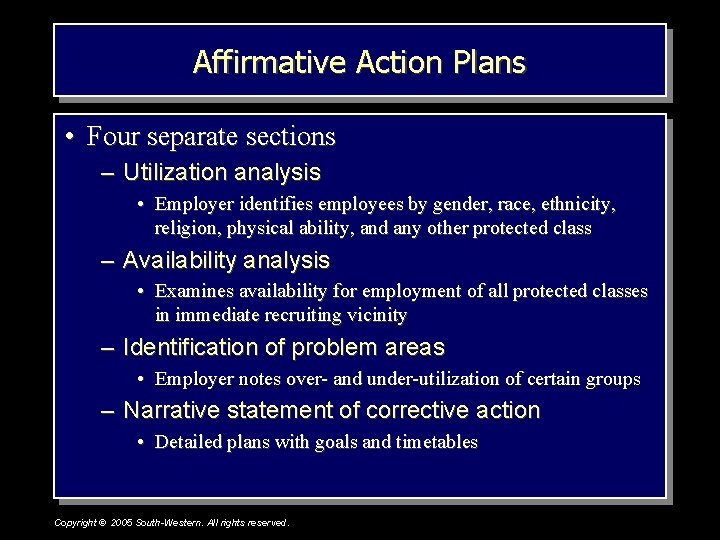
Affirmative Action Plans • Four separate sections – Utilization analysis • Employer identifies employees by gender, race, ethnicity, religion, physical ability, and any other protected class – Availability analysis • Examines availability for employment of all protected classes in immediate recruiting vicinity – Identification of problem areas • Employer notes over- and under-utilization of certain groups – Narrative statement of corrective action • Detailed plans with goals and timetables Copyright © 2005 South-Western. All rights reserved. 18
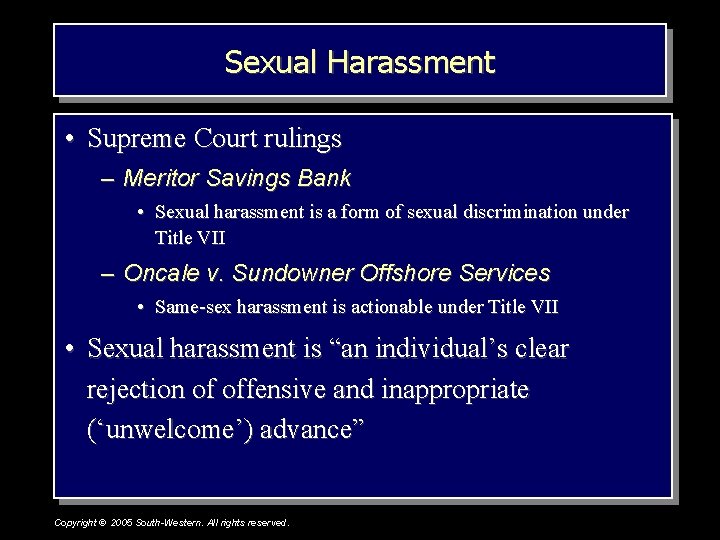
Sexual Harassment • Supreme Court rulings – Meritor Savings Bank • Sexual harassment is a form of sexual discrimination under Title VII – Oncale v. Sundowner Offshore Services • Same-sex harassment is actionable under Title VII • Sexual harassment is “an individual’s clear rejection of offensive and inappropriate (‘unwelcome’) advance” Copyright © 2005 South-Western. All rights reserved. 19
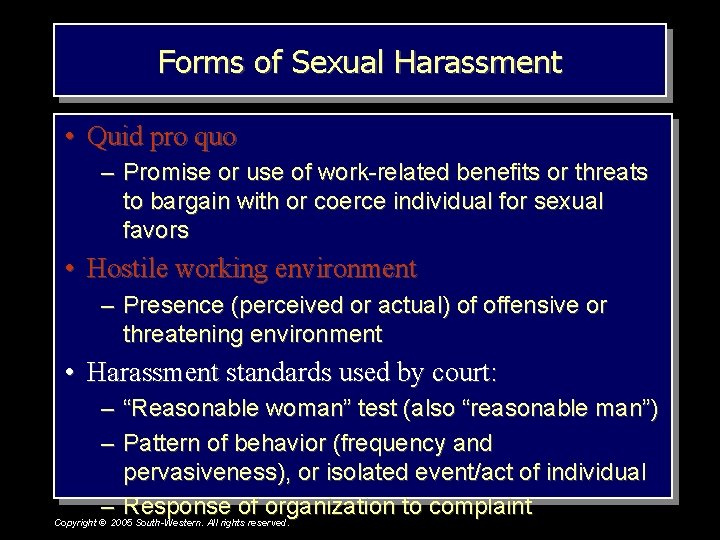
Forms of Sexual Harassment • Quid pro quo – Promise or use of work-related benefits or threats to bargain with or coerce individual for sexual favors • Hostile working environment – Presence (perceived or actual) of offensive or threatening environment • Harassment standards used by court: – “Reasonable woman” test (also “reasonable man”) – Pattern of behavior (frequency and pervasiveness), or isolated event/act of individual – Response of organization to complaint Copyright © 2005 South-Western. All rights reserved. 20
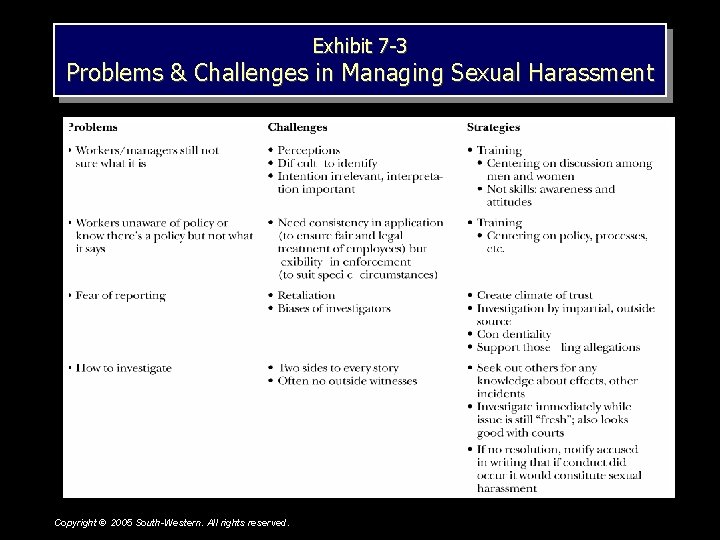
Exhibit 7 -3 Problems & Challenges in Managing Sexual Harassment Copyright © 2005 South-Western. All rights reserved. 21
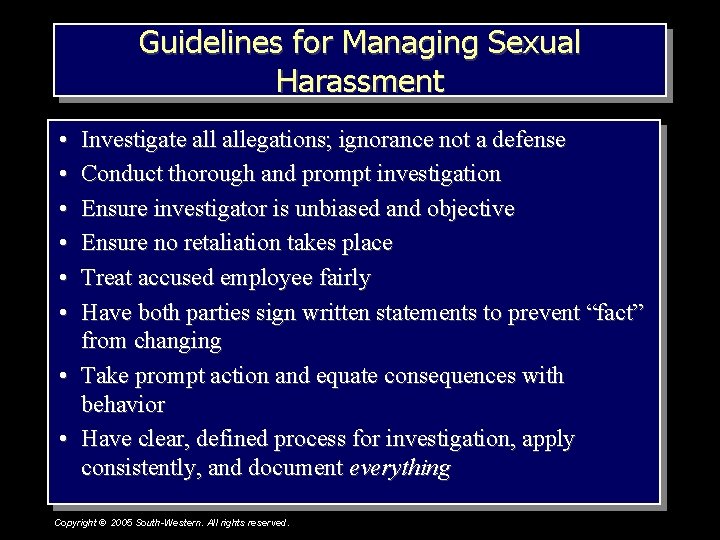
Guidelines for Managing Sexual Harassment • • • Investigate allegations; ignorance not a defense Conduct thorough and prompt investigation Ensure investigator is unbiased and objective Ensure no retaliation takes place Treat accused employee fairly Have both parties sign written statements to prevent “fact” from changing • Take prompt action and equate consequences with behavior • Have clear, defined process for investigation, apply consistently, and document everything Copyright © 2005 South-Western. All rights reserved. 22
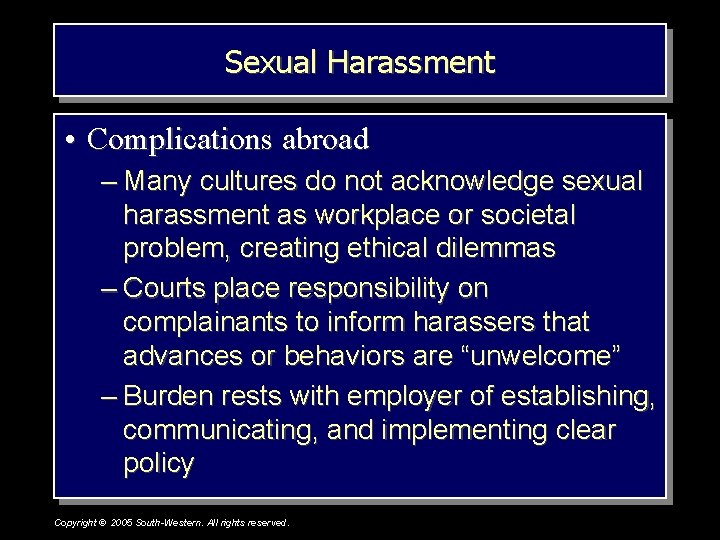
Sexual Harassment • Complications abroad – Many cultures do not acknowledge sexual harassment as workplace or societal problem, creating ethical dilemmas – Courts place responsibility on complainants to inform harassers that advances or behaviors are “unwelcome” – Burden rests with employer of establishing, communicating, and implementing clear policy Copyright © 2005 South-Western. All rights reserved. 23
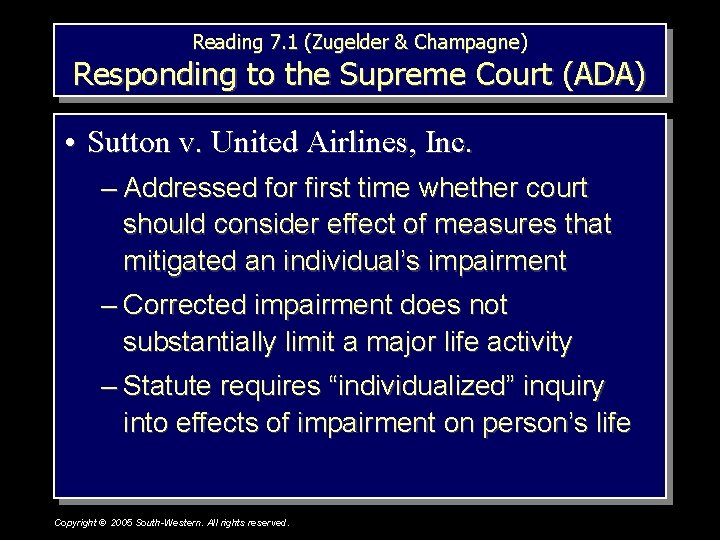
Reading 7. 1 (Zugelder & Champagne) Responding to the Supreme Court (ADA) • Sutton v. United Airlines, Inc. – Addressed for first time whether court should consider effect of measures that mitigated an individual’s impairment – Corrected impairment does not substantially limit a major life activity – Statute requires “individualized” inquiry into effects of impairment on person’s life Copyright © 2005 South-Western. All rights reserved. 24
Reading 7. 1 Responding to the Supreme Court • Murphy v. United Parcel Service, Inc. – Hypertension did not substantially limit major life activity because it was controlled with medication – His impairment did not exclude him from wide range of other mechanic jobs, so he was not disabled in major life activity of “working” – UPS did not consider him unable to perform a class of jobs, just one specific job Copyright © 2005 South-Western. All rights reserved. 25
Reading 7. 1 Responding to the Supreme Court • Albertson’s, Inc. v. Kirkingburg – Mitigation measures can include those undertaken by body’s own system in response to impairment – Employer was entitled to rely on minimum safety standards Copyright © 2005 South-Western. All rights reserved. 26
Reading 7. 1 Responding to the Supreme Court • Toyota v. Williams (2002) – Phrase “major life activity” means only those basic activities “of central importance to most people’s daily lives, ” rather than any work-related tasks – However, other cases have sided with employee – EEOC’s recently amended guidelines now take mitigative measures into account Copyright © 2005 South-Western. All rights reserved. 27
Reading 7. 1 Responding to the Supreme Court • Discriminating against fully mitigated individuals – Cases suggest that company is now allowed to reject applicant or terminate current employee whenever it is uncomfortable with corrected disability – Recent Supreme Court decisions make disability questions in employment more complex, rather than less so Copyright © 2005 South-Western. All rights reserved. 28
Reading 7. 2 (Mello) Dual Loyalty Dilemma for HR Managers • Role of HR manager – Whether HR manager is principally representative of management to handle employee problems, or advocate of employee concerns to management not always clear – HR is usually where employees initially file complaints of behaviors that violate Title VII rights – Manager’s role in developing and managing internal grievance policy Copyright © 2005 South-Western. All rights reserved. 29
Reading 7. 2 Dual Loyalty Dilemma for HR Managers • Anti-retaliation provision prohibits manager from any employee advocacy whatsoever • Burden falls on individual employees to challenge management and file own claims • EEOC is forced to assume advocacy role, opening floodgates of litigation Copyright © 2005 South-Western. All rights reserved. 30
Reading 7. 2 Dual Loyalty Dilemma for HR Managers • It is unlawful under Title VII to retaliate against employees who allege discrimination. – Almost 30% of EEOC complaints allege retaliation. • http: //www. eeoc. gov/stats/charges. html • Issue: To what extent are HR professionals protected from retaliation if they “go to bat” for employees alleging discrimination? – Recent lower court rulings would suggest that HR professionals have very little legal protection in such circumstances. – Q: Can an HR professional be an “employee champion, ” and still be viewed as loyal to the organization? Copyright © 2005 South-Western. All rights reserved. 31
Reading 7. 3 (Glazer) In Defense of Preference • Gap between educational performance of blacks and whites has persisted, even deepened • Gulf exists between educational and occupational status of blacks and whites, encompassing – – – Wealth Residential segregation Social relationships • Banning preference would be bad for country – Preference is no final answer – Elimination of preference is no final answer Copyright © 2005 South-Western. All rights reserved. 32
Reading 7. 3 In Defense of Preference • We are “two nations” – One nation cannot be excluded from institutions that confer access to positions of greatest prestige and power – Both nations must participate in society to some degree • Many difficult issues remain: – What kind? – To what extent? – How long? – Imposed by whom? – By what decision-making process? Copyright © 2005 South-Western. All rights reserved. 33
Reading 7. 3 In Defense of Preference • To what extent will the U. S. follow equal employment opportunity versus affirmative action in deciding major public policy issues (such as admissions into “elite” universities)? – Current “battleground” states: California, Texas, Florida, Georgia, and Michigan. – e. g. , University of California System proposed that entrance exams (such as the SAT or ACT) no longer be used as a part of the admissions process for UC universities. – 2003 Supreme Court decisions concerning the University of Michigan (Grutter - law school, and Gratz - undergraduate admissions). • Issue: How do we promote merit and diversity at the same time? Copyright © 2005 South-Western. All rights reserved. 34