
Chapter 7 Emission and Absorption and Rate Equations
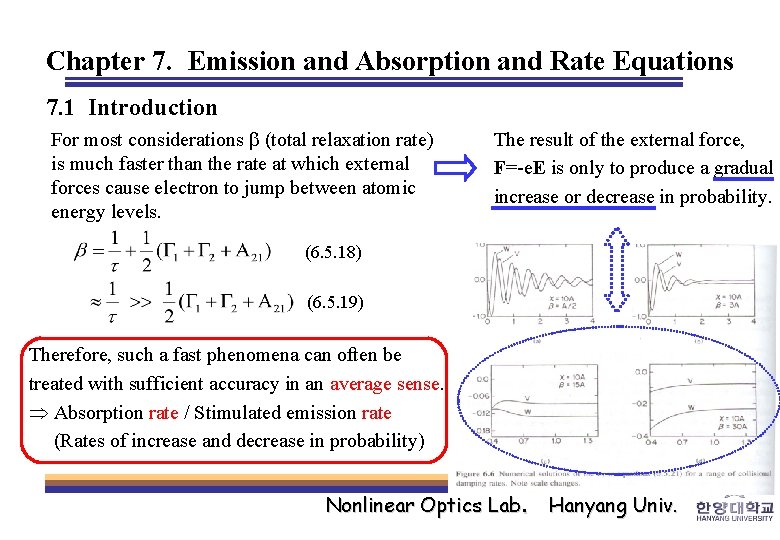
Chapter 7. Emission and Absorption and Rate Equations 7. 1 Introduction For most considerations b (total relaxation rate) is much faster than the rate at which external forces cause electron to jump between atomic energy levels. The result of the external force, F=-e. E is only to produce a gradual increase or decrease in probability. (6. 5. 18) (6. 5. 19) Therefore, such a fast phenomena can often be treated with sufficient accuracy in an average sense. Þ Absorption rate / Stimulated emission rate (Rates of increase and decrease in probability) Nonlinear Optics Lab. Hanyang Univ.
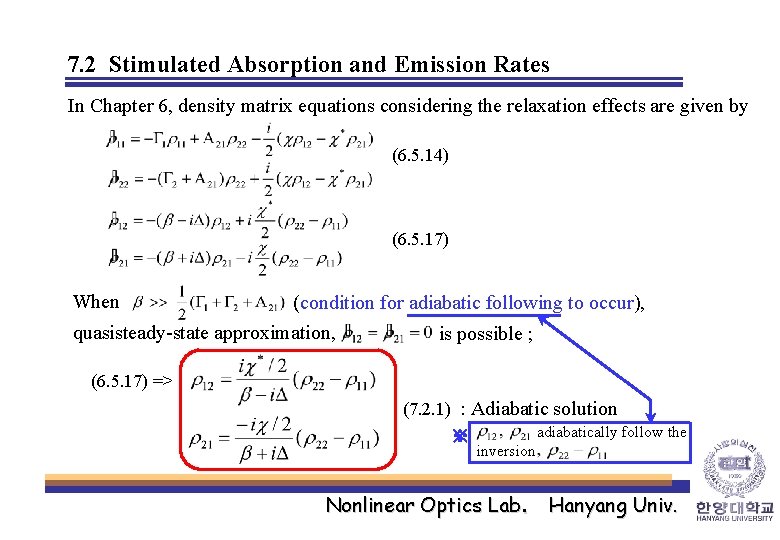
7. 2 Stimulated Absorption and Emission Rates In Chapter 6, density matrix equations considering the relaxation effects are given by (6. 5. 14) (6. 5. 17) When (condition for adiabatic following to occur), quasisteady-state approximation, is possible ; (6. 5. 17) => (7. 2. 1) : Adiabatic solution ※ adiabatically follow the inversion Nonlinear Optics Lab. Hanyang Univ.
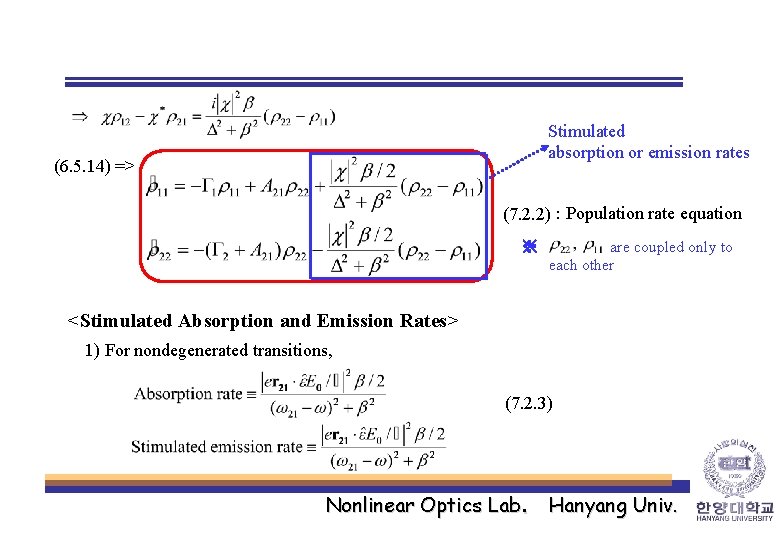
Stimulated absorption or emission rates (6. 5. 14) => (7. 2. 2) : Population rate equation ※ are coupled only to each other <Stimulated Absorption and Emission Rates> 1) For nondegenerated transitions, (7. 2. 3) Nonlinear Optics Lab. Hanyang Univ.
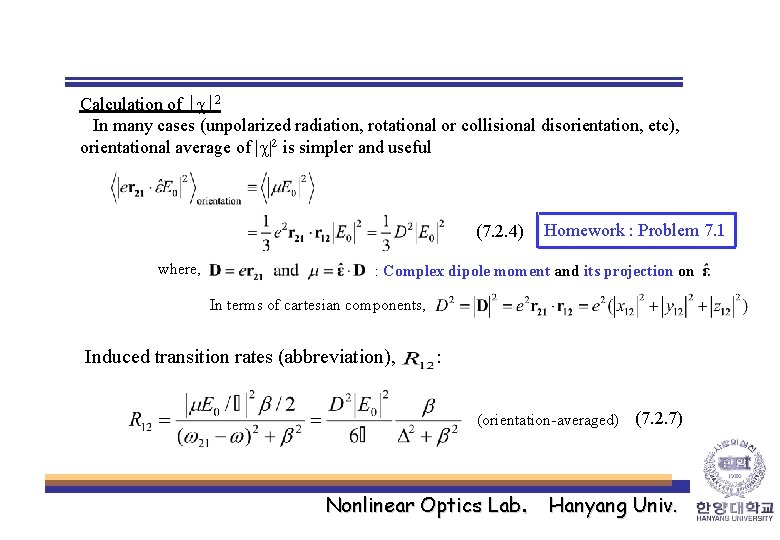
Calculation of |c|2 In many cases (unpolarized radiation, rotational or collisional disorientation, etc), orientational average of |c|2 is simpler and useful (7. 2. 4) where, Homework : Problem 7. 1 : Complex dipole moment and its projection on In terms of cartesian components, Induced transition rates (abbreviation), : (orientation-averaged) (7. 2. 7) Nonlinear Optics Lab. Hanyang Univ.
![Absorption cross section, : [Refer to (7. 4. 2)] (7. 2. 8) where, :](http://slidetodoc.com/presentation_image_h2/5d0e40984c330e1c97991d430415314e/image-5.jpg "Absorption cross section, : [Refer to (7. 4. 2)] (7. 2. 8) where, :")
Absorption cross section, : [Refer to (7. 4. 2)] (7. 2. 8) where, : photon flux 2) For degenerated transitions (Homework : Refer to Appen. 7. A) 2 g 2=5 1 g 1=3 : In the case of natural excitation (the # of atoms in each of the different degenerated states of the same level are equal) ; <Example of degenerated transition> Nonlinear Optics Lab. Hanyang Univ.
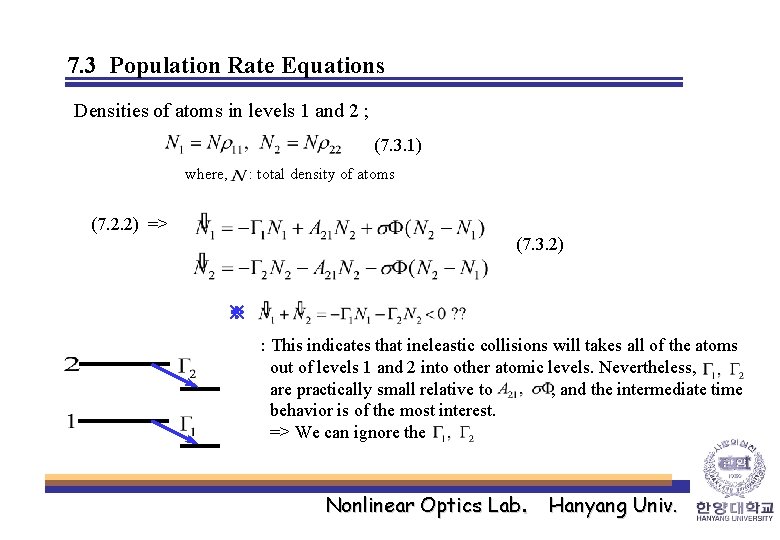
7. 3 Population Rate Equations Densities of atoms in levels 1 and 2 ; (7. 3. 1) where, : total density of atoms (7. 2. 2) => (7. 3. 2) ※ : This indicates that ineleastic collisions will takes all of the atoms out of levels 1 and 2 into other atomic levels. Nevertheless, are practically small relative to , and the intermediate time behavior is of the most interest. => We can ignore the Nonlinear Optics Lab. Hanyang Univ.
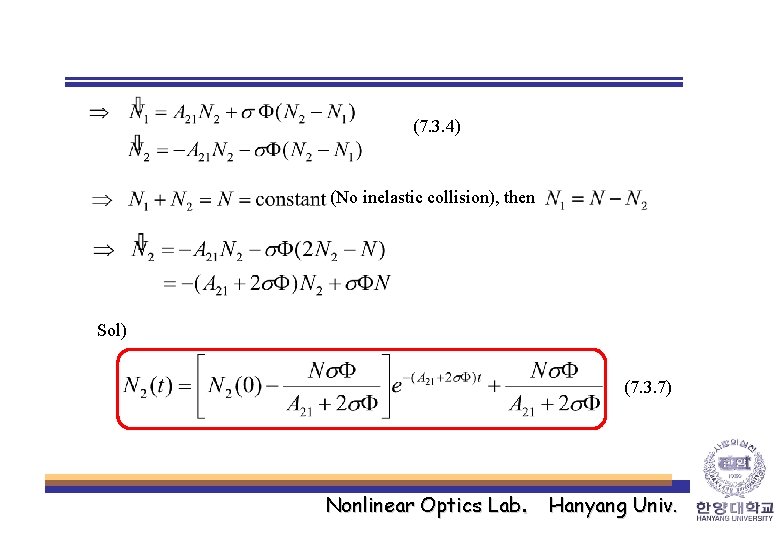
(7. 3. 4) (No inelastic collision), then Sol) (7. 3. 7) Nonlinear Optics Lab. Hanyang Univ.
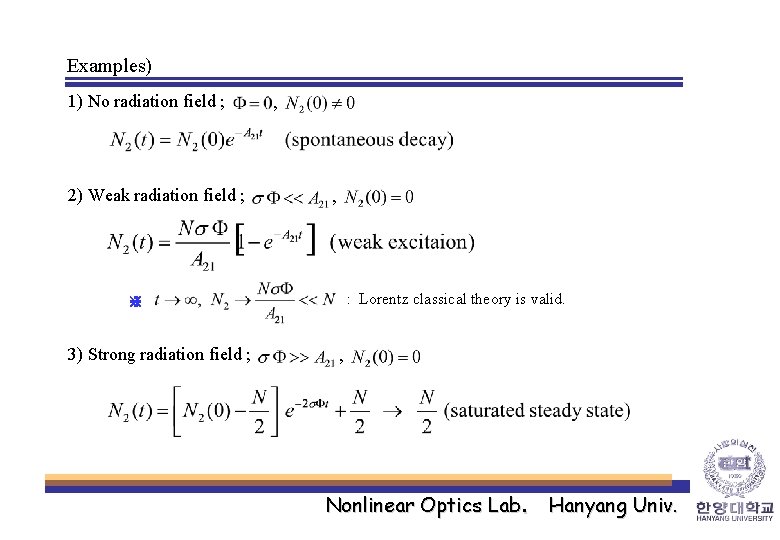
Examples) 1) No radiation field ; 2) Weak radiation field ; , , : Lorentz classical theory is valid. ※ 3) Strong radiation field ; , Nonlinear Optics Lab. Hanyang Univ.
![[Fig. 7. 1] Nonlinear Optics Lab. Hanyang Univ.](http://slidetodoc.com/presentation_image_h2/5d0e40984c330e1c97991d430415314e/image-9.jpg "[Fig. 7. 1] Nonlinear Optics Lab. Hanyang Univ.")
[Fig. 7. 1] Nonlinear Optics Lab. Hanyang Univ.
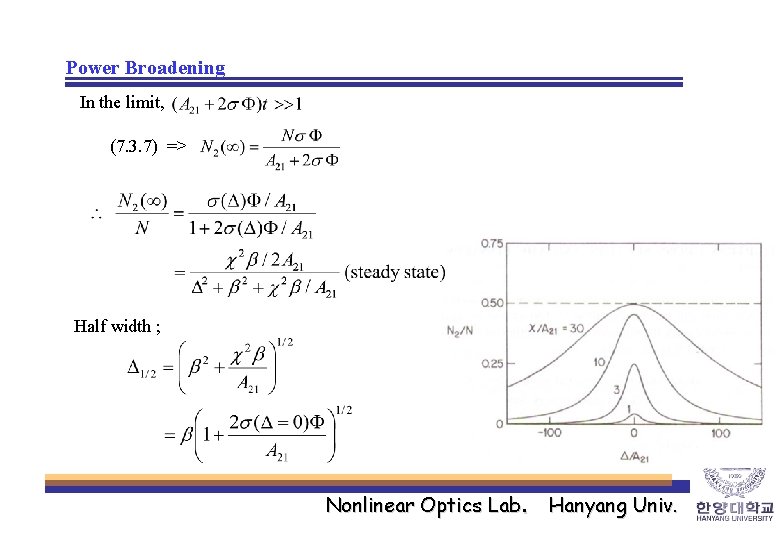
Power Broadening In the limit, (7. 3. 7) => Half width ; Nonlinear Optics Lab. Hanyang Univ.
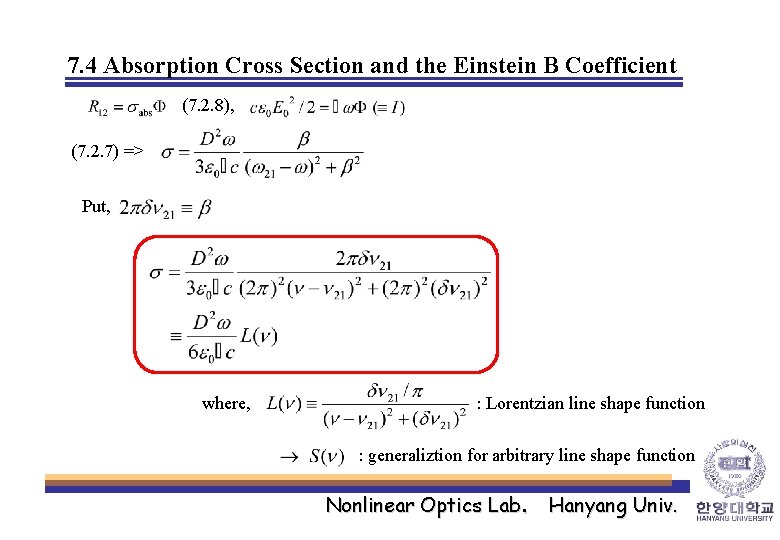
7. 4 Absorption Cross Section and the Einstein B Coefficient (7. 2. 8), (7. 2. 7) => Put, where, : Lorentzian line shape function : generaliztion for arbitrary line shape function Nonlinear Optics Lab. Hanyang Univ.
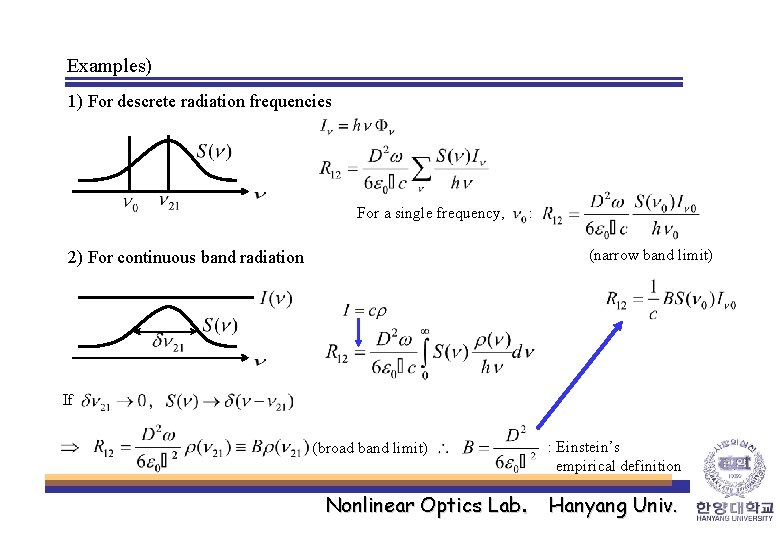
Examples) 1) For descrete radiation frequencies For a single frequency, : (narrow band limit) 2) For continuous band radiation If (broad band limit) Nonlinear Optics Lab. : Einstein’s empirical definition Hanyang Univ.
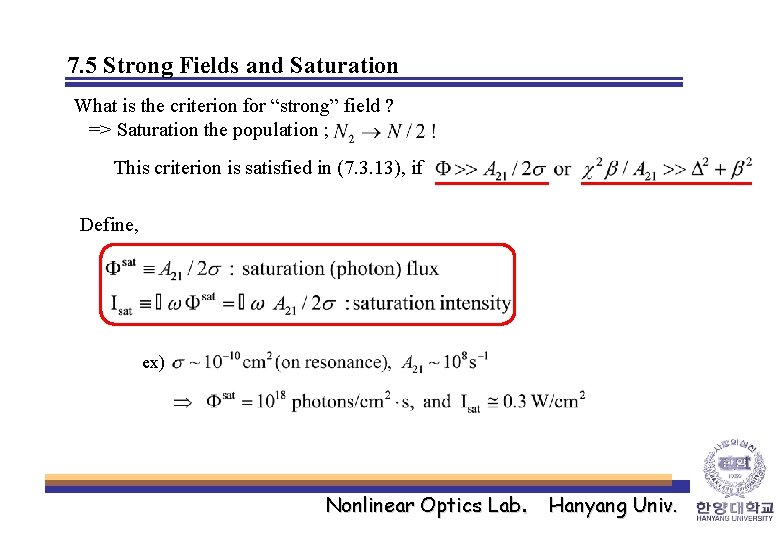
7. 5 Strong Fields and Saturation What is the criterion for “strong” field ? => Saturation the population ; This criterion is satisfied in (7. 3. 13), if Define, ex) Nonlinear Optics Lab. Hanyang Univ.
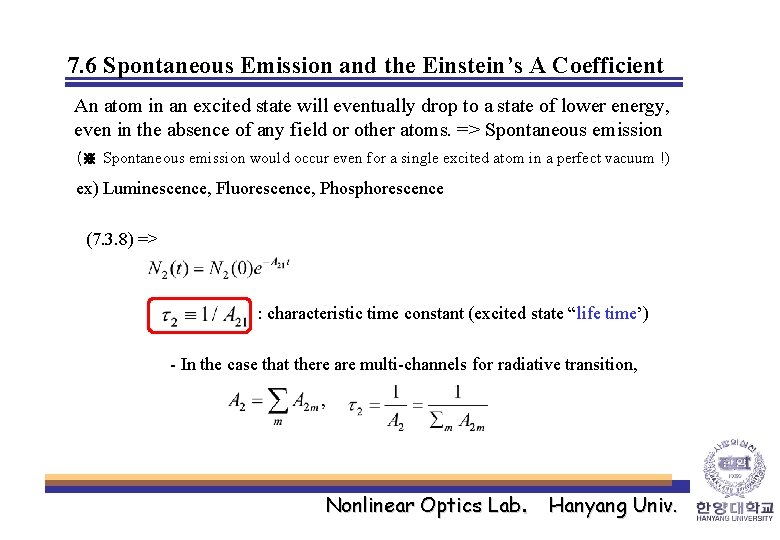
7. 6 Spontaneous Emission and the Einstein’s A Coefficient An atom in an excited state will eventually drop to a state of lower energy, even in the absence of any field or other atoms. => Spontaneous emission (※ Spontaneous emission would occur even for a single excited atom in a perfect vacuum !) ex) Luminescence, Fluorescence, Phosphorescence (7. 3. 8) => : characteristic time constant (excited state “life time’) - In the case that there are multi-channels for radiative transition, Nonlinear Optics Lab. Hanyang Univ.
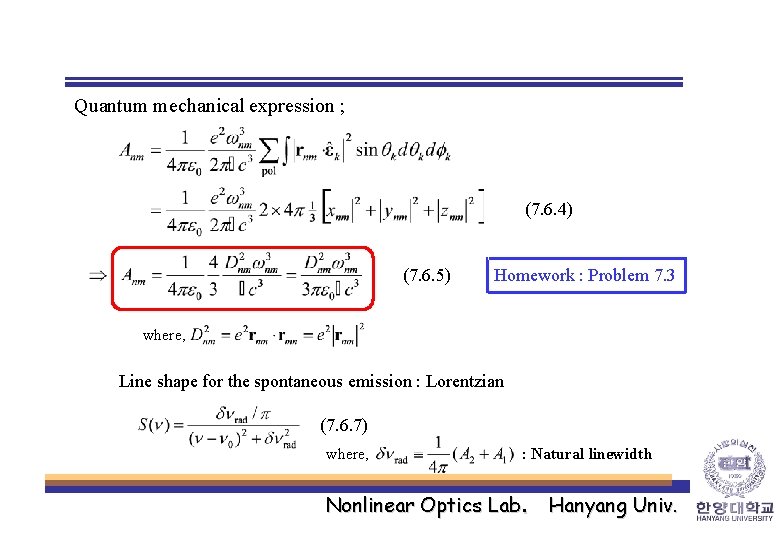
Quantum mechanical expression ; (7. 6. 4) (7. 6. 5) Homework : Problem 7. 3 where, Line shape for the spontaneous emission : Lorentzian (7. 6. 7) where, : Natural linewidth Nonlinear Optics Lab. Hanyang Univ.
- Slides: 15