
Chapter 7 Electron Configuration and the Periodic Table
Chapter 7 Electron Configuration and the Periodic Table Copyright Mc. Graw-Hill 2009
7. 1 Development of the Periodic Table • 1864 - John Newlands - Law of Octaves - every 8 th element had similar properties when arranged by atomic masses (not true past Ca) • 1869 - Dmitri Mendeleev & Lothar Meyer - independently proposed idea of periodicity (recurrence of properties) Copyright Mc. Graw-Hill 2009 2
• Mendeleev – Grouped elements (66) according to properties – Predicted properties for elements not yet discovered – Though a good model, Mendeleev could not explain inconsistencies, for instance, all elements were not in order according to atomic mass Copyright Mc. Graw-Hill 2009 3
• 1913 - Henry Moseley explained the discrepancy – Discovered correlation between number of protons (atomic number) and frequency of X rays generated – Today, elements are arranged in order of increasing atomic number Copyright Mc. Graw-Hill 2009 4
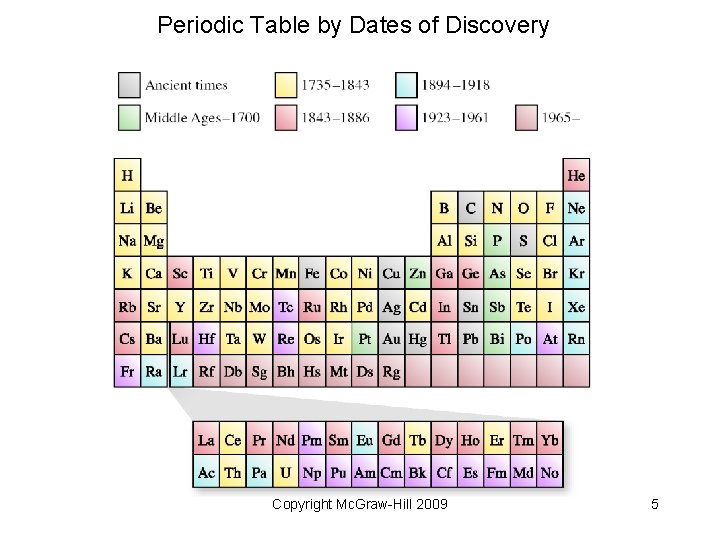
Periodic Table by Dates of Discovery Copyright Mc. Graw-Hill 2009 5
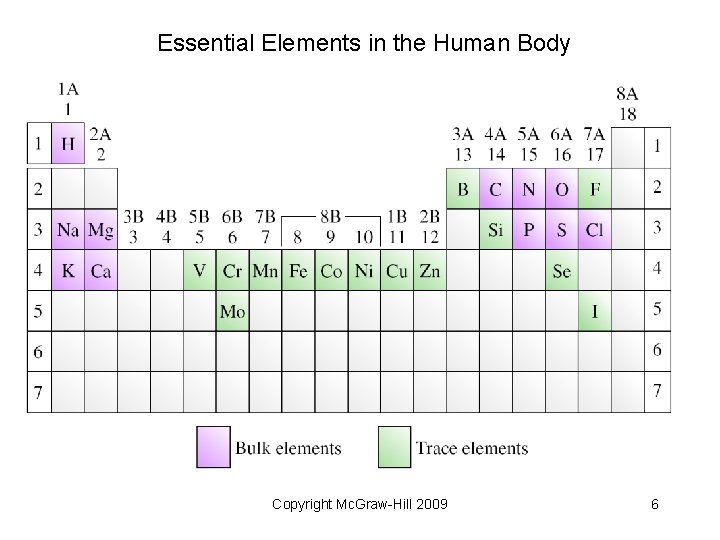
Essential Elements in the Human Body Copyright Mc. Graw-Hill 2009 6
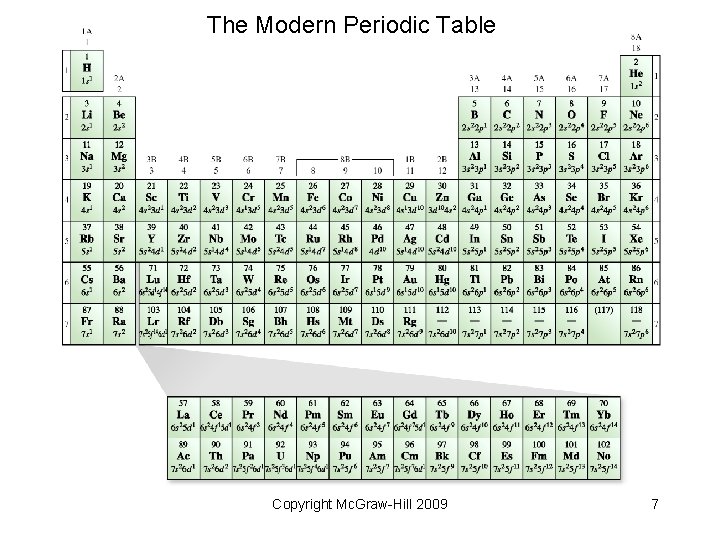
The Modern Periodic Table Copyright Mc. Graw-Hill 2009 7
7. 2 The Modern Periodic Table • Classification of Elements – Main group elements - “representative elements” Group 1 A-7 A – Noble gases - Group 8 A all have ns 2 np 6 configuration(exception-He) – Transition elements - 1 B, 3 B - 8 B “dblock” – Lanthanides/actinides - “f-block” Copyright Mc. Graw-Hill 2009 8
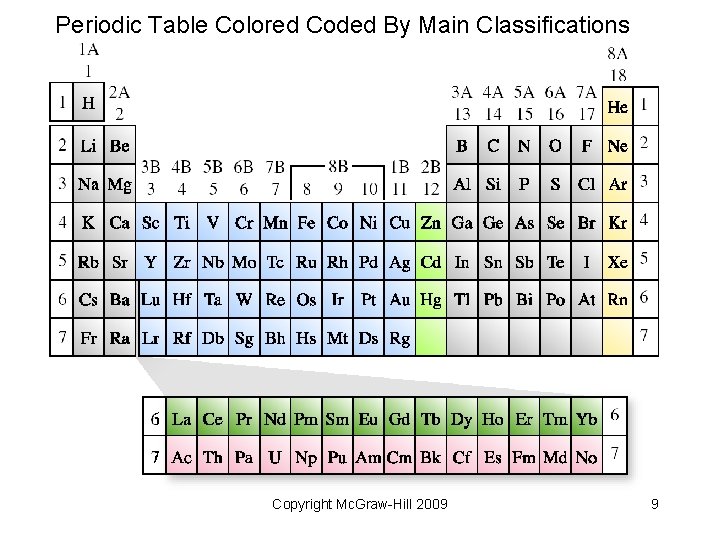
Periodic Table Colored Coded By Main Classifications Copyright Mc. Graw-Hill 2009 9
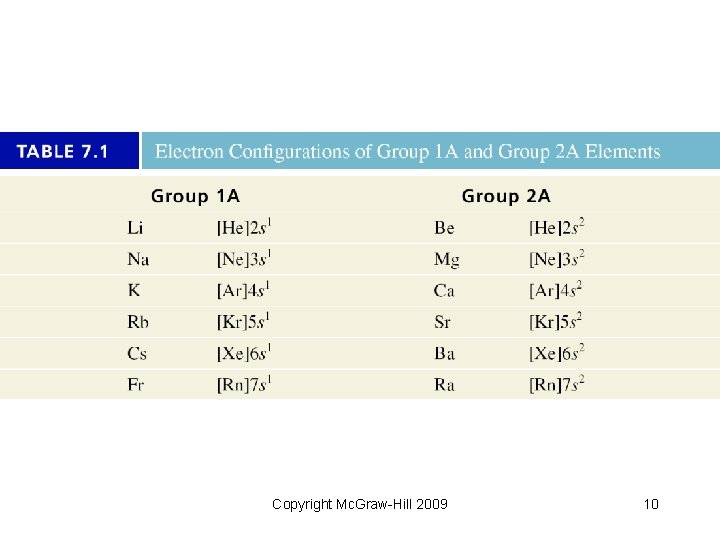
Copyright Mc. Graw-Hill 2009 10
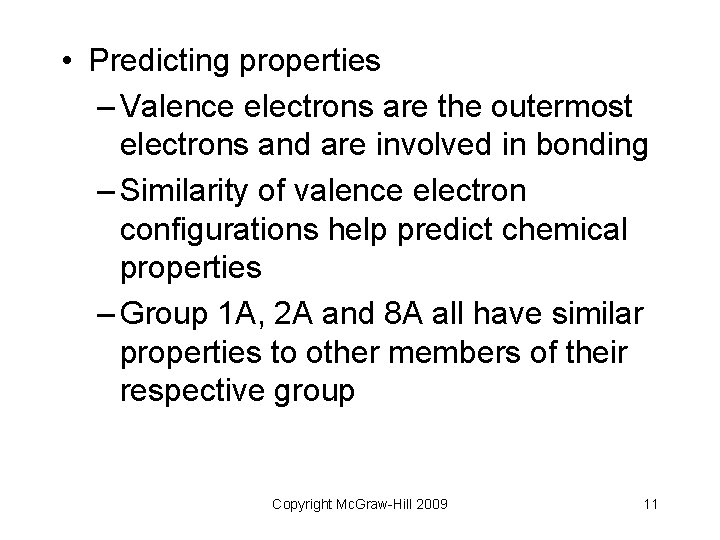
• Predicting properties – Valence electrons are the outermost electrons and are involved in bonding – Similarity of valence electron configurations help predict chemical properties – Group 1 A, 2 A and 8 A all have similar properties to other members of their respective group Copyright Mc. Graw-Hill 2009 11
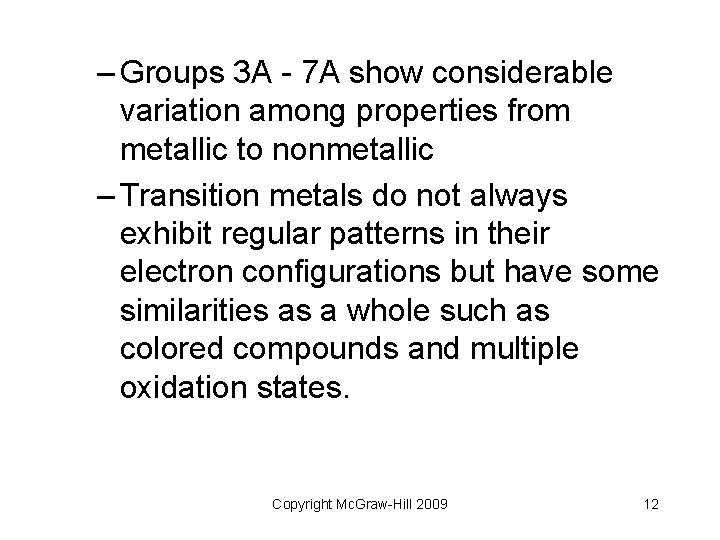
– Groups 3 A - 7 A show considerable variation among properties from metallic to nonmetallic – Transition metals do not always exhibit regular patterns in their electron configurations but have some similarities as a whole such as colored compounds and multiple oxidation states. Copyright Mc. Graw-Hill 2009 12
• Representing Free Elements in Chemical Equations – Metals are always represented by their empirical formulas (same as symbol for element) – Nonmetals may be written as empirical formula (C) or as polyatomic molecules (H 2, N 2, O 2, F 2, Cl 2, Br 2, I 2, and P 4). – Sulfur usually S instead of S 8 Copyright Mc. Graw-Hill 2009 13
– Noble Gases all exist as isolated atoms, so use symbols (Xe, He, etc. ) – Metalloids are represented with empirical formulas (B, Si, Ge, etc. ) Copyright Mc. Graw-Hill 2009 14
7. 3 Effective Nuclear Charge • Z (nuclear charge) = the number of protons in the nucleus of an atom • Zeff (effective nuclear charge) = the magnitude of positive charge “experienced” by an electron in the atom • Zeff increases from left to right across a period; changes very little down a column Copyright Mc. Graw-Hill 2009 15
• Shielding occurs when an electron in a many-electron atom is partially shielded from the positive charge of the nucleus by other electrons in the atom. • However, core electrons (inner electrons) shield the most and are constant across a period. Copyright Mc. Graw-Hill 2009 16
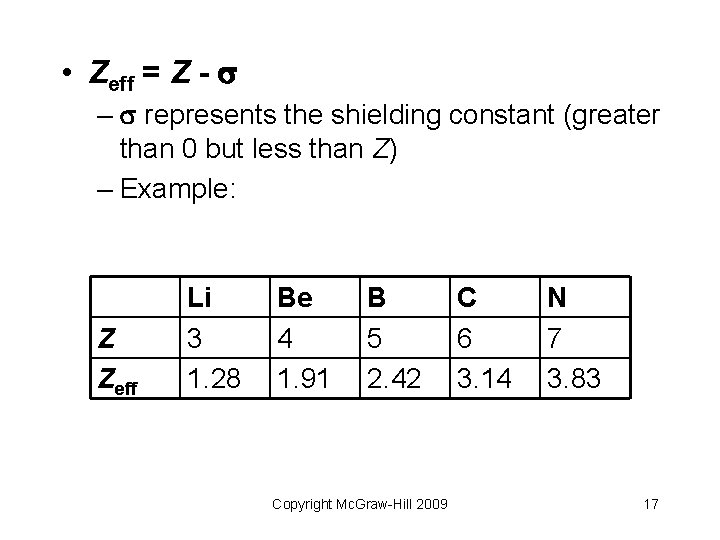
• Zeff = Z - – represents the shielding constant (greater than 0 but less than Z) – Example: Z Zeff Li 3 1. 28 Be 4 1. 91 B 5 2. 42 Copyright Mc. Graw-Hill 2009 C 6 3. 14 N 7 3. 83 17
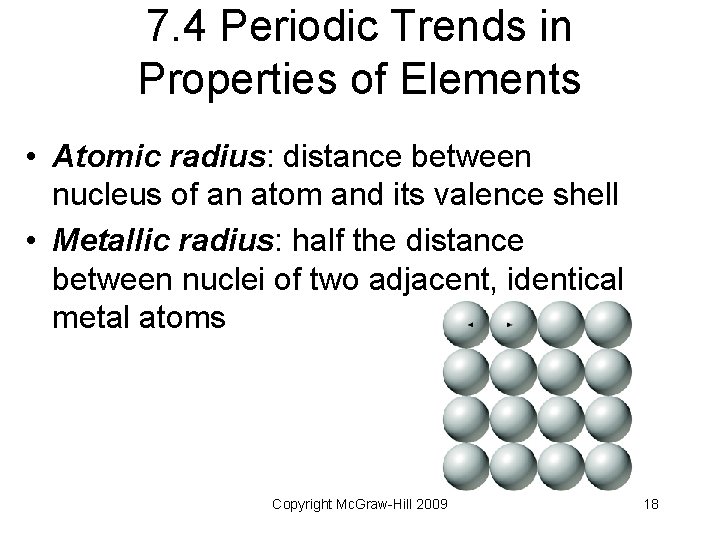
7. 4 Periodic Trends in Properties of Elements • Atomic radius: distance between nucleus of an atom and its valence shell • Metallic radius: half the distance between nuclei of two adjacent, identical metal atoms Copyright Mc. Graw-Hill 2009 18
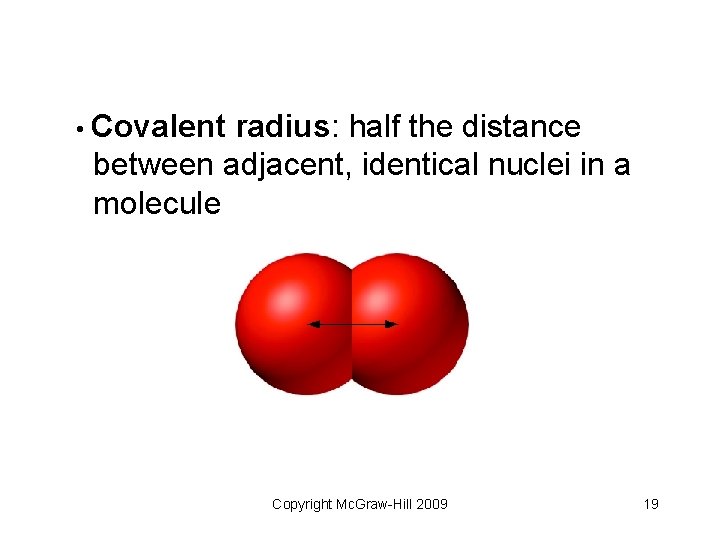
• Covalent radius: half the distance between adjacent, identical nuclei in a molecule Copyright Mc. Graw-Hill 2009 19
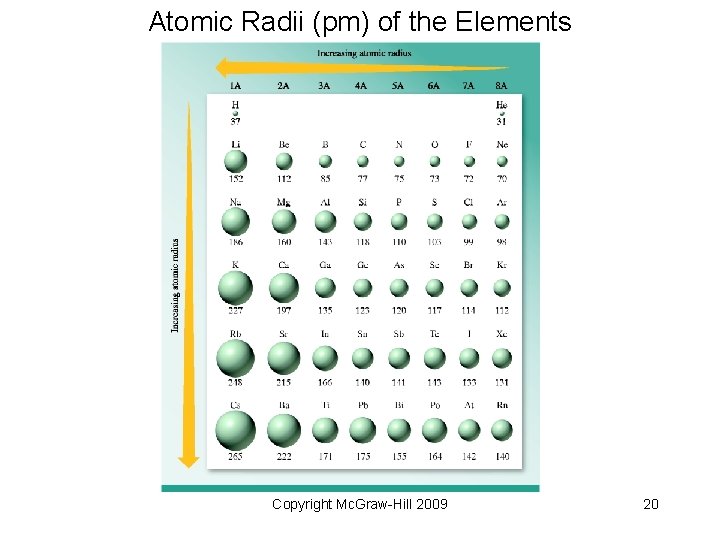
Atomic Radii (pm) of the Elements Copyright Mc. Graw-Hill 2009 20
Explain • What do you notice about the atomic radius across a period? Why? (hint: Zeff) • What do you notice about the atomic radius down a column? Why? (hint: n) Copyright Mc. Graw-Hill 2009 21
• What do you notice about the atomic radius across a period? Why? (hint: Zeff) Atomic radius decreases from left to right across a period due to increasing Zeff. • What do you notice about the atomic radius down a column? Why? (hint: n) Atomic radius increases down a column of the periodic table because the distance of the electron from the nucleus increases as n increases. Copyright Mc. Graw-Hill 2009 22
• Ionization energy (IE): minimum energy needed to remove an electron from an atom in the gas phase – Representation: Na(g) Na+(g) + e – IE for this 1 st ionization = 495. 8 k. J/mol • In general, ionization energy increases as Zeff increases – Exceptions occur due to the stability of specific electron configurations Copyright Mc. Graw-Hill 2009 23
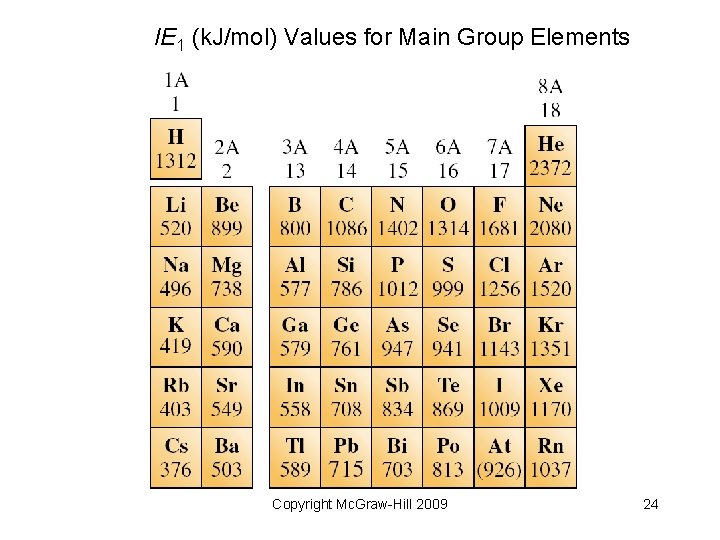
IE 1 (k. J/mol) Values for Main Group Elements Copyright Mc. Graw-Hill 2009 24
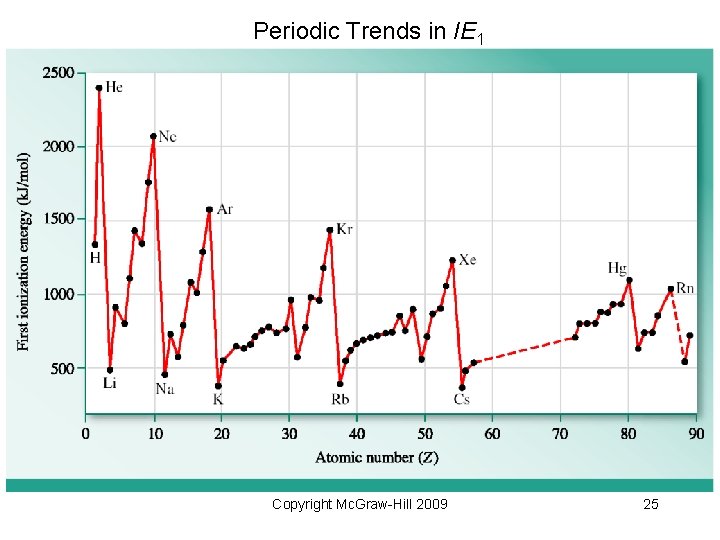
Periodic Trends in IE 1 Copyright Mc. Graw-Hill 2009 25
Explain • What do you notice about the 1 st IE across a period? Why? (hint: Zeff) • What do you notice about the 1 st IE down a column? Why? (hint: n) Copyright Mc. Graw-Hill 2009 26
• What do you notice about the 1 st IE across a period? Why? (hint: Zeff) IE 1 increases from left to right across a period due to increasing Zeff. • What do you notice about the 1 st IE down a column? Why? (hint: n) IE 1 decreases down a column of the periodic table because the distance of the electron from the nucleus increases as n increases. Copyright Mc. Graw-Hill 2009 27
Explain • What do you notice about the 1 st IE between 2 A and 3 A? Why? (hint: draw the electron configuration) • What do you notice about the 1 st IE between 5 A and 6 A? Why? (hint: draw the electron configuration) Copyright Mc. Graw-Hill 2009 28
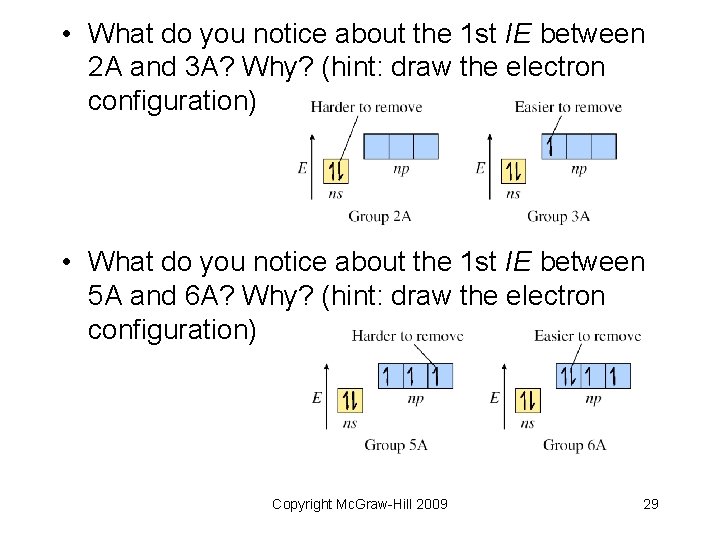
• What do you notice about the 1 st IE between 2 A and 3 A? Why? (hint: draw the electron configuration) • What do you notice about the 1 st IE between 5 A and 6 A? Why? (hint: draw the electron configuration) Copyright Mc. Graw-Hill 2009 29
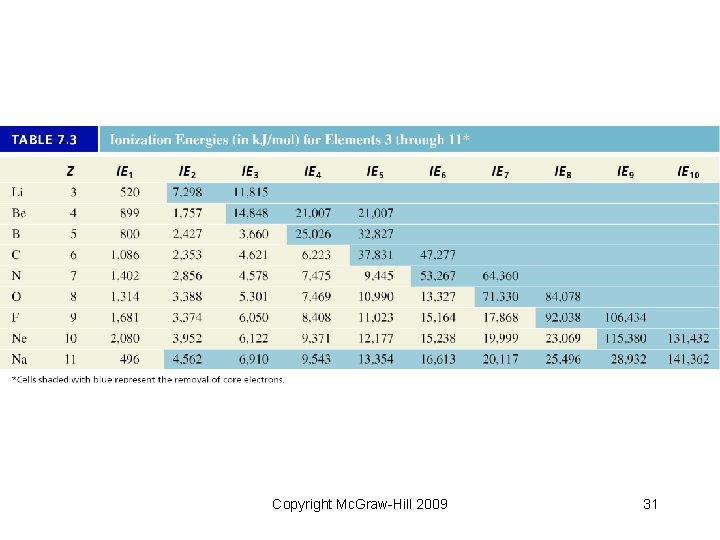
• Multiple Ionizations: it takes more energy to remove the 2 nd, 3 rd, 4 th, etc. electron and much more energy to remove core electrons • Why? – Core electrons are closer to nucleus – Core electrons experience greater Zeff Copyright Mc. Graw-Hill 2009 30
Copyright Mc. Graw-Hill 2009 31
• Electron Affinity (EA): energy released when an atom in the gas phase accepts an electron – Representation: Cl(g) + e Cl (g) – EA for this equation 349. 0 k. J/mol energy released ( H = negative) Copyright Mc. Graw-Hill 2009 32
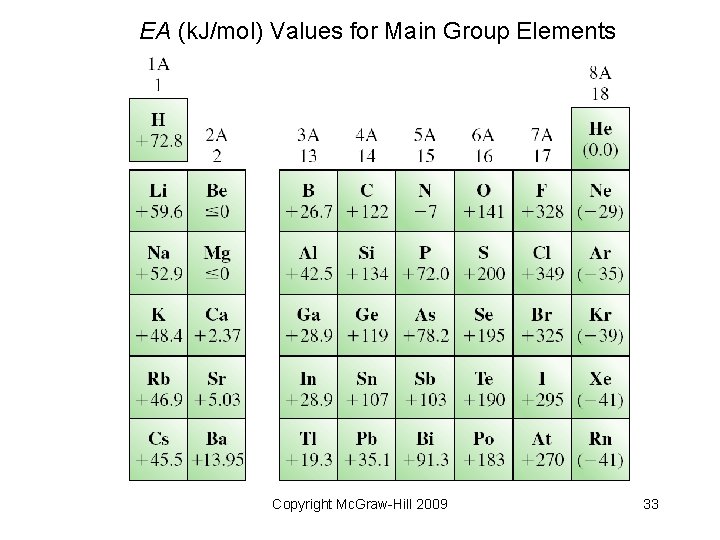
EA (k. J/mol) Values for Main Group Elements Copyright Mc. Graw-Hill 2009 33
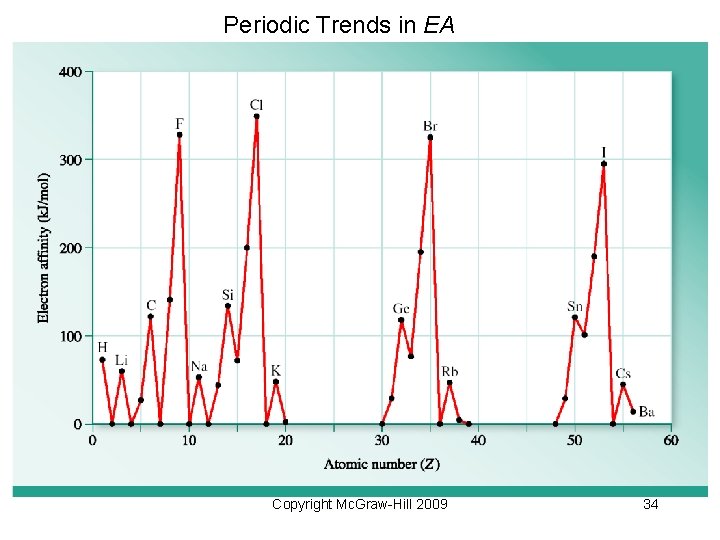
Periodic Trends in EA Copyright Mc. Graw-Hill 2009 34
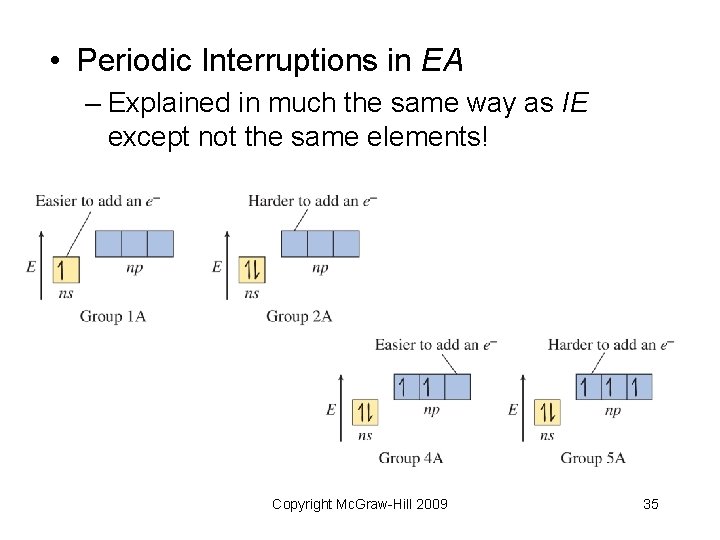
• Periodic Interruptions in EA – Explained in much the same way as IE except not the same elements! Copyright Mc. Graw-Hill 2009 35
• Metallic Character – Metals • Shiny, lustrous, malleable • Good conductors • Low IE (form cations) • Form ionic compounds with chlorine • Form basic, ionic compounds with oxygen • Metallic character increases top to bottom in group and decreases left to right across a period Copyright Mc. Graw-Hill 2009 36
– Nonmetals • Vary in color, not shiny • Brittle • Poor conductors • Form acidic, molecular compounds with oxygen • High EA (form anions) – Metalloids • Properties between the metals and nonmetals Copyright Mc. Graw-Hill 2009 37
7. 5 Electron Configuration of Ions • Follow Hund’s rule and Pauli exclusion principle as for atoms • Writing electron configurations helps explain charges memorized earlier Copyright Mc. Graw-Hill 2009 38
• Ions of main group elements – Noble gases (8 A) almost completely unreactive due to electron configuration • ns 2 np 6 (except He 1 s 2) – Main group elements tend to gain or lose electrons to become isoelectronic (same valence electron configuration as nearest noble gas) Copyright Mc. Graw-Hill 2009 39
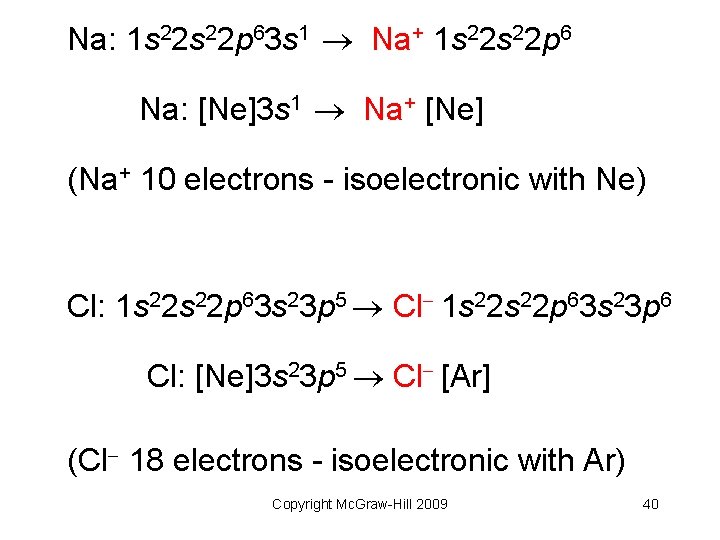
Na: 1 s 22 p 63 s 1 Na+ 1 s 22 p 6 Na: [Ne]3 s 1 Na+ [Ne] (Na+ 10 electrons - isoelectronic with Ne) Cl: 1 s 22 p 63 s 23 p 5 Cl 1 s 22 p 63 s 23 p 6 Cl: [Ne]3 s 23 p 5 Cl [Ar] (Cl 18 electrons - isoelectronic with Ar) Copyright Mc. Graw-Hill 2009 40
• Ions of d-Block Elements – Recall that the 4 s orbital fills before the 3 d orbital in the first row of transition metals – Electrons are always lost from the highest “n” value (then from d) Fe: [Ar]4 s 23 d 6 Fe 2+: [Ar]3 d 6 Fe: [Ar]4 s 23 d 6 Fe 3+: [Ar]3 d 5 Copyright Mc. Graw-Hill 2009 41
7. 6 Ionic Radius • When an atom gains or loses electrons, the radius changes • Cations are always smaller than their parent atoms (often losing an energy level) • Anions are always larger than their parent atoms (increased e repulsions) Copyright Mc. Graw-Hill 2009 42
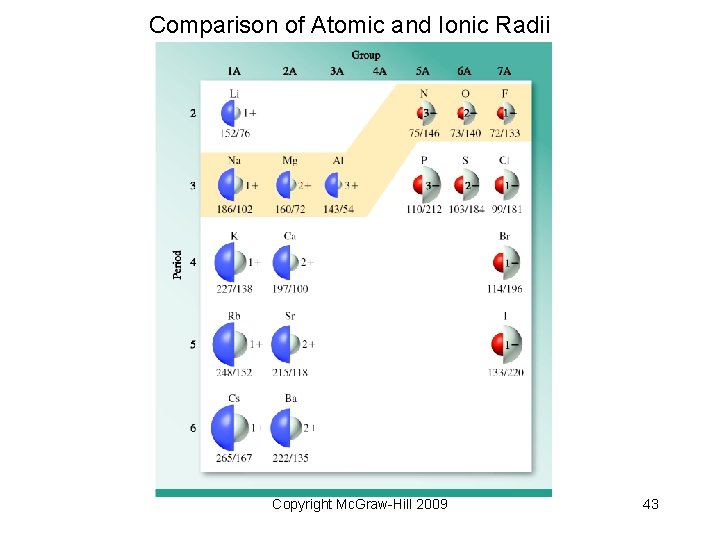
Comparison of Atomic and Ionic Radii Copyright Mc. Graw-Hill 2009 43
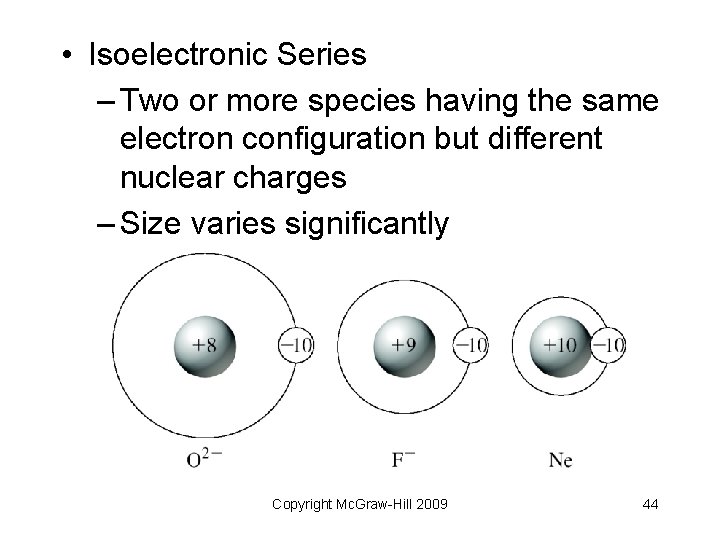
• Isoelectronic Series – Two or more species having the same electron configuration but different nuclear charges – Size varies significantly Copyright Mc. Graw-Hill 2009 44
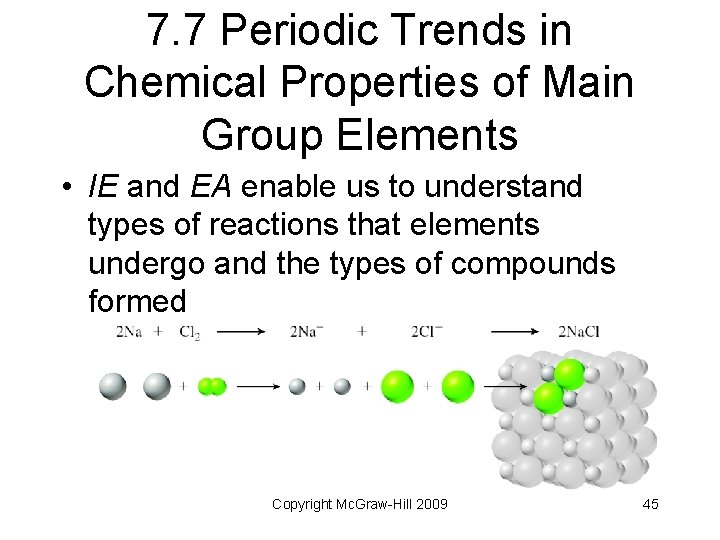
7. 7 Periodic Trends in Chemical Properties of Main Group Elements • IE and EA enable us to understand types of reactions that elements undergo and the types of compounds formed Copyright Mc. Graw-Hill 2009 45
• General Trends in Chemical Properties – Elements in same group have same valence electron configuration; similar properties – Same group comparison most valid if elements have same metallic or nonmetallic character – Group 1 A and 2 A; Group 7 A and 8 A – Careful with Group 3 A - 6 A Copyright Mc. Graw-Hill 2009 46
– Hydrogen (1 s 1) • Group by itself • Forms +1 (H+) –Most important compound is water • Forms 1 (H ), the hydride ion, with metals –Hydrides react with water to produce hydrogen gas and a base – Ca. H 2(s) + H 2 O(l) Ca(OH)2(aq) + H 2(g) Copyright Mc. Graw-Hill 2009 47
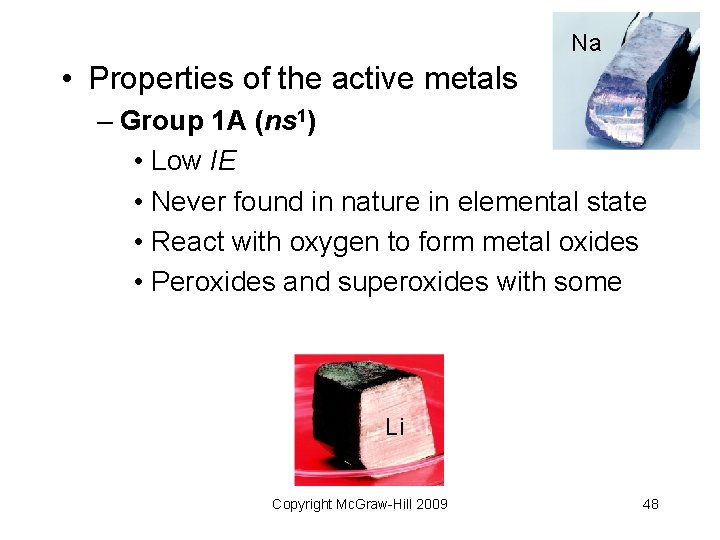
Na • Properties of the active metals – Group 1 A (ns 1) • Low IE • Never found in nature in elemental state • React with oxygen to form metal oxides • Peroxides and superoxides with some Li Copyright Mc. Graw-Hill 2009 48
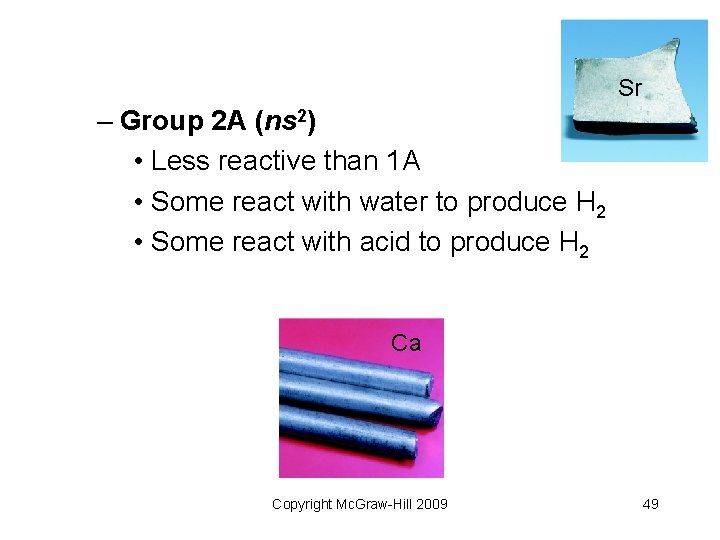
Sr – Group 2 A (ns 2) • Less reactive than 1 A • Some react with water to produce H 2 • Some react with acid to produce H 2 Ca Copyright Mc. Graw-Hill 2009 49
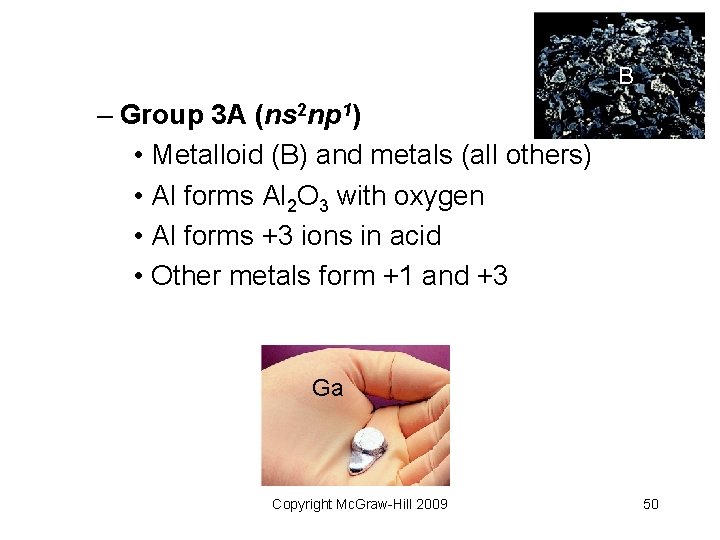
B – Group 3 A (ns 2 np 1) • Metalloid (B) and metals (all others) • Al forms Al 2 O 3 with oxygen • Al forms +3 ions in acid • Other metals form +1 and +3 Ga Copyright Mc. Graw-Hill 2009 50
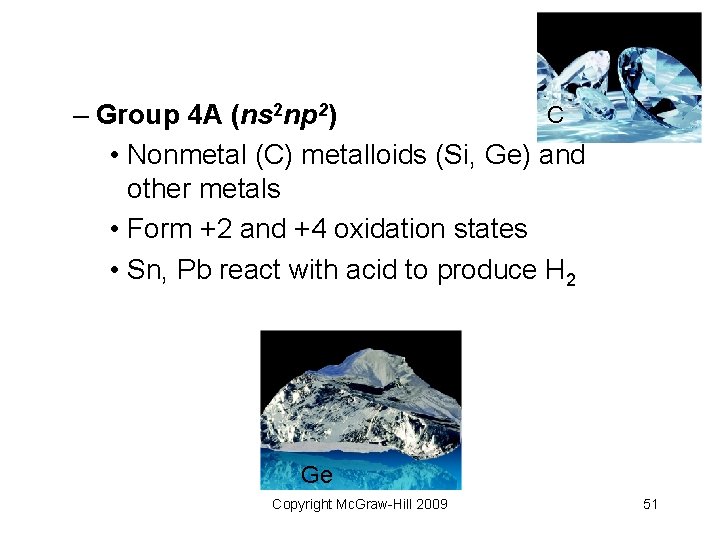
C – Group 4 A (ns 2 np 2) • Nonmetal (C) metalloids (Si, Ge) and other metals • Form +2 and +4 oxidation states • Sn, Pb react with acid to produce H 2 Ge Copyright Mc. Graw-Hill 2009 51
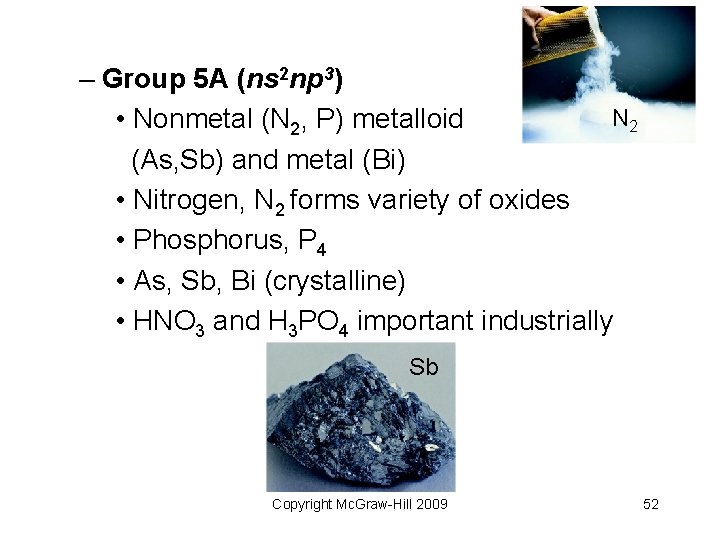
– Group 5 A (ns 2 np 3) N 2 • Nonmetal (N 2, P) metalloid (As, Sb) and metal (Bi) • Nitrogen, N 2 forms variety of oxides • Phosphorus, P 4 • As, Sb, Bi (crystalline) • HNO 3 and H 3 PO 4 important industrially Sb Copyright Mc. Graw-Hill 2009 52
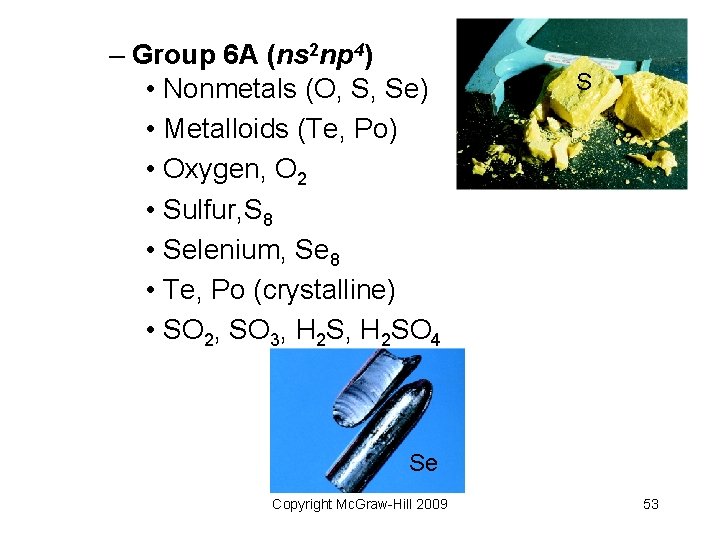
– Group 6 A (ns 2 np 4) • Nonmetals (O, S, Se) • Metalloids (Te, Po) • Oxygen, O 2 • Sulfur, S 8 • Selenium, Se 8 • Te, Po (crystalline) • SO 2, SO 3, H 2 SO 4 S Se Copyright Mc. Graw-Hill 2009 53
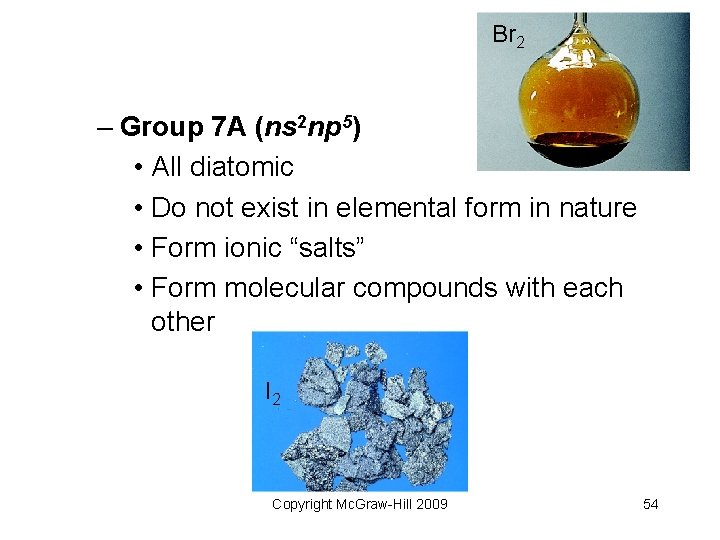
Br 2 – Group 7 A (ns 2 np 5) • All diatomic • Do not exist in elemental form in nature • Form ionic “salts” • Form molecular compounds with each other I 2 Copyright Mc. Graw-Hill 2009 54
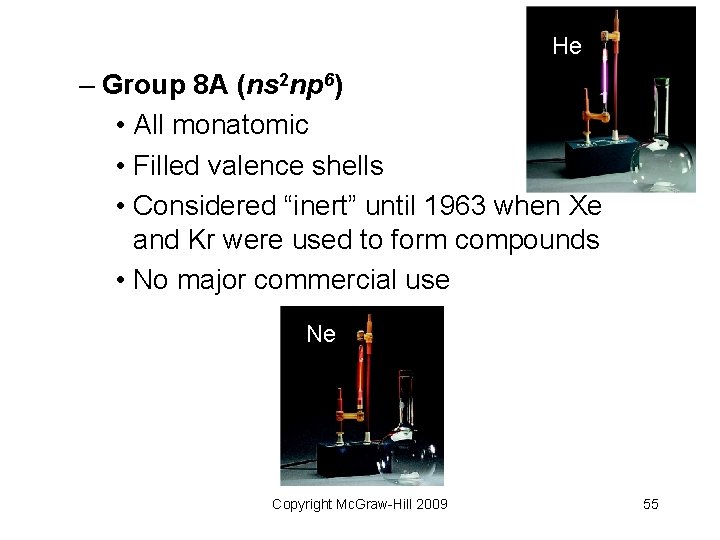
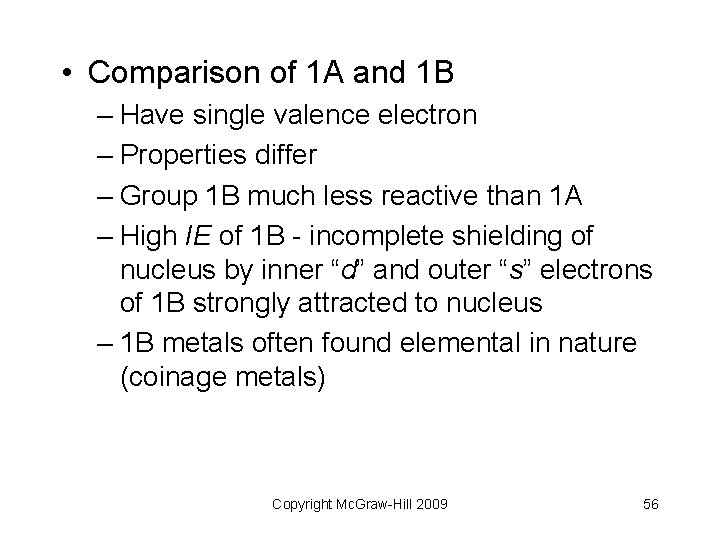
He – Group 8 A (ns 2 np 6) • All monatomic • Filled valence shells • Considered “inert” until 1963 when Xe and Kr were used to form compounds • No major commercial use Ne Copyright Mc. Graw-Hill 2009 55
• Comparison of 1 A and 1 B – Have single valence electron – Properties differ – Group 1 B much less reactive than 1 A – High IE of 1 B - incomplete shielding of nucleus by inner “d” and outer “s” electrons of 1 B strongly attracted to nucleus – 1 B metals often found elemental in nature (coinage metals) Copyright Mc. Graw-Hill 2009 56
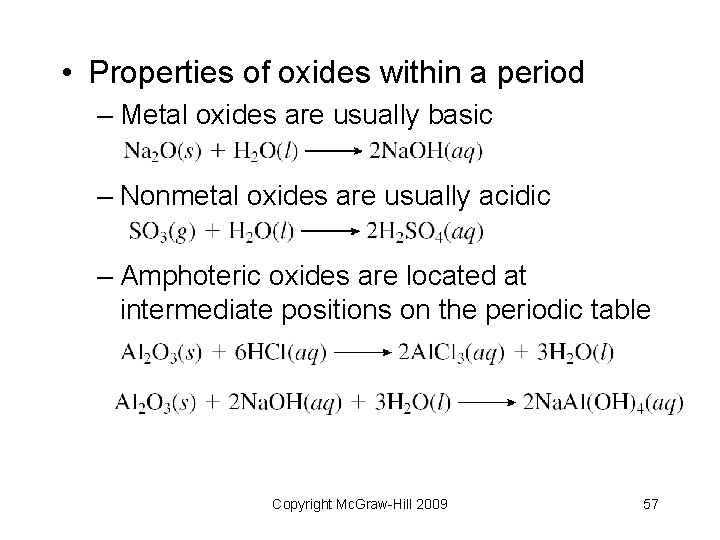
• Properties of oxides within a period – Metal oxides are usually basic – Nonmetal oxides are usually acidic – Amphoteric oxides are located at intermediate positions on the periodic table Copyright Mc. Graw-Hill 2009 57
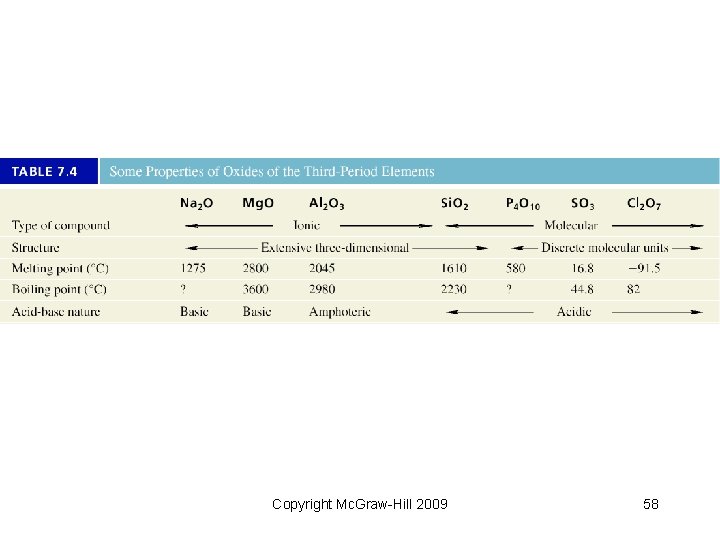
Copyright Mc. Graw-Hill 2009 58
Key Points • • • Development of the periodic table Modern table and its arrangement Main group elements Valence electrons Effective nuclear charge and relationship to periodic trends • Atomic radius (ionic radii, covalent radii, metallic radii) Copyright Mc. Graw-Hill 2009 59
Key Points • Ionization energy (IE) - trends of 1 st and multiple IE’s • Electron affinity (EA) - trends • Properties of metals, metalloids and nonmetals • Isoelectronic - predict charges of ions and electron configurations of ions Copyright Mc. Graw-Hill 2009 60
Key Points • Write and/or recognize an isoelectronic series • Characteristics of main group elements • Know the most reactive metal and nonmetal groups and why • Variability among groups • Acidic, basic and amphoteric substances Copyright Mc. Graw-Hill 2009 61
- Slides: 61