
Chapter 7 Effective Oral Presentations Delivery is Important
- Slides: 57
Chapter 7 Effective Oral Presentations
Delivery is Important l Fear of public speaking is the number one fear l Public speaking is a necessary skill l Companies expect employees to convey information before groups of all sizes
Coping With Speaker Anxiety l Physical sensations associated with speaker anxiety are the most difficult to bear. – Heart rate increases – Breathing rate increases – Blood pressure rises – Metabolism increases – Sweat is produced
Coping With Speaker Anxiety l Examine unrealistic beliefs you may have – The audience will sense your nervousness. l Most audiences are not as aware of this as you are. – Your delivery must be perfect. l You do not have to be perfect. l Audiences respond to speakers who are genuine. – You cannot deliver an effective speech because you are not a professional speaker. l Even those who are not experienced can deliver a memorable, heart-felt presentation with sincerity.
Coping With Speaker Anxiety l Examine unrealistic beliefs you may have – I have to gain approval of the entire audience. l Some people will be tired that day, some will be plain rude; not listening and looking at you l Focus on interested audience members. – What will my classmates think? l They don’t care how you do, they care about how they do
Coping With Speaker Anxiety l Guidelines for coping with anxiety – Be well prepared. l Practice can reduce anxiety by 75%. – Some tension is natural. – Practice slow, deep breathing prior to speaking. l Can slow heart rate and reduce nervousness – Have a strong introduction.
Fear, continued… l l l Use only normal amount of caffeine Avoid alcoholic beverages Practice positive self-talk – Re-label your nerves – Not fear - scared – nervous – Say adrenaline – energetic – excited
Types of Oral Presentations 1. Short Oral Presentations 2. Long Formal Presentations
Short Oral Presentations Introductory Remarks l l An individual is invited to introduce someone who is to be the main speaker. The individual either knows that person well, or familiar with the subject
Short Oral Presentations Welcoming Remarks l Whenever a visiting group arrives at an organisation, welcoming remarks are made. – – Be brief Be friendly Be safety oriented Be complete
Short Oral Presentations Presentational speeches l l At ceremonial times, one may be asked to present awards to employees or to members of the community Presenter should learn and explain the audience as much as possible about the person who is to be honored
Short Oral Presentations Presentational speeches l l Mention the history of the award Relate what the award signifies Explain what someone must do to qualify for this award Tell what the receipent has done to be worthy of this honor
Short Oral Presentations Recognition speeches l l Meant to honor someone for a specific accomplishment Usually followed by applause, rather than the presentation of an award Less formal May occur spontantaneously
Short Oral Presentations Briefings l l Briefings are designed to give clear, brief instructions or information to an audience about a planned or current project Important focus of business communication
Short Oral Presentations Explanatory remarks l l Explanatory remarks are designed to convey knowledge Requires the listener to understand or to carry out a process
Short Oral Presentations Informational speeches l Informational presentation informs the audience about something that they have little or no previous knowledge
Short Oral Presentations Dedication remarks l l l When a new building is finished, a new product is launched, dedication speech is made. Speaker should thank key people whose sacrifices made the project completion possible Talk concludes by focusing on the expected value of the project to the future of the organisation
Short Oral Presentations Acceptance speeches l Made when someone is given an award
Short Oral Presentations l Farewell speeches l A ceremonial occasion when special recognition is given to someone who is leaving the organisation. Speaker thanks this person for his/her efforts in the past l
Long Formal Presentations l Lasts from 30 minutes to an hour
Long Formal Presentations After-Dinner speeches l l l Lasts 30 minutes to an hour Inform the audience about a particular topic Can be motivational Planned in detail A typed manuscript or notes can be used
Long Formal Presentations Strategic plan presentations l l l A long range plan that is presented to the board of directors and top managers Has two objectives; to inform and to persuade Designed and tested before
Long Formal Presentations New product proposals l l To gain acceptance for initial funding for either the design and development of a new product or its production and marketing Motivate the audience into giving a go-ahead to the proposal
Long Formal Presentations Progress reports l l l To compare the current status of a project with its anticipated status Aims at “show-and-tell” If progress is not as expected, the reasons are set forth and future progress projected
Planning the Effective Oral Presentation Purpose l l Most of the business presentations are designed to inform, to motivate or to persuade Once the purpose of the speech is determined, the desired results should be identified
Purpose of the Speech Informal l Should be based on factual material l To increase the audience’s knowledge about the subject l Lectures, explanations, descriptions
Purpose of the Speech Persuasive or motivational l Deal more with feelings, attitudes and the stirring of emotion
Planning the Effective Oral Presentation Logistics l l Relate to where and when the talk will be given Presentations on Monday morning or Friday afternoon often are not well attended Middle of the week presentations are the best Physical facilities should be well arranged
Planning the Effective Oral Presentation Audience l l Audience should be analyzed before preparing the talk Needs and wants of the audience should be regarded
Designing the presentation A good speech l Audience interest is immediately aroused l Only two or three main points are presented l Key points are followed by careful development, by showing statistics and visual aids l Key points are repeated l Organised in a logical way
Presentation outline Introduction l To establish rapport between the speaker and audience l To introduce the topic to the audience l To gain audience interest
Presentation outline Introduction l A famous or intriguing quotation l A question l A stunning statement l A story l A joke or anecdote l An expression of gratitude
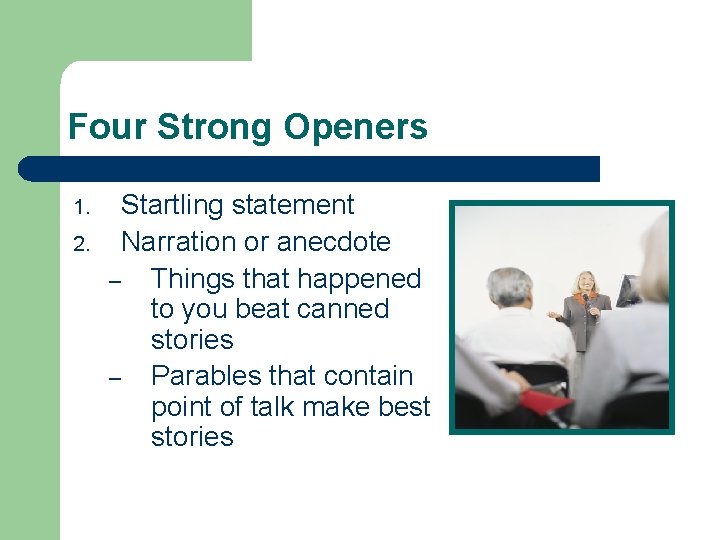
Four Strong Openers 1. 2. Startling statement Narration or anecdote – Things that happened to you beat canned stories – Parables that contain point of talk make best stories
Presentation outline Body l Should be arranged according to major headings and subheadings l Can be: – chronological, – causal or – problem-solving
Presentation outline Body l Chronological Outline: present topics in historical order
Presentation outline Body l Causal design: – uses a cause-and-effect sequence. – Aprropriate for a motivational speech
Presentation outline Body l Problem-solving: – Involve the audience in investigating a problem, considering alternative actions uses a cause-and-effect sequence. – Aprropriate for a motivational speech –
Presentation outline Conclusion l Summarize and repeat important points l Answer any questions in the audience’s mind l Quotations or anecdotes can be used l Emotional appeal can be applied l Question and Answer part can be included
Delivering the Speech l Characterized as; – Impromptu speeches – Written speeches – Memorization – Extemporaneous speeches
Delivering the speech Impromptu Speeches l Occur when a person is asked to speak without time for planning l Require the speaker to quickly organize his/her thoughts into a coherent presentation
Delivering the speech Written Speeches l Read from a prepared manuscript l Useful when the materail is highly technical and the speaker wants to ensure accuracy l Have some disadvantages as breaking the eye-contact, limiting the movement of speakers gestures and mimics
Delivering the speech Memorized Speeches l The least popular presentation mode in business l Requires a great deal of time l May sound monotonic and stilled l Have disadvantage like being unable to process feedback from the audience and make approppriate modifications
Delivering the speech Extemporaneous Speeches l Spontaneously delivered l Thoroughly researched and designed l Prefferable to other styles l Allows the speaker to show a wide range of emotion, movement and vocal inflection l Seems more genuine and convinvcing to the audience l Most natural mode of presentations
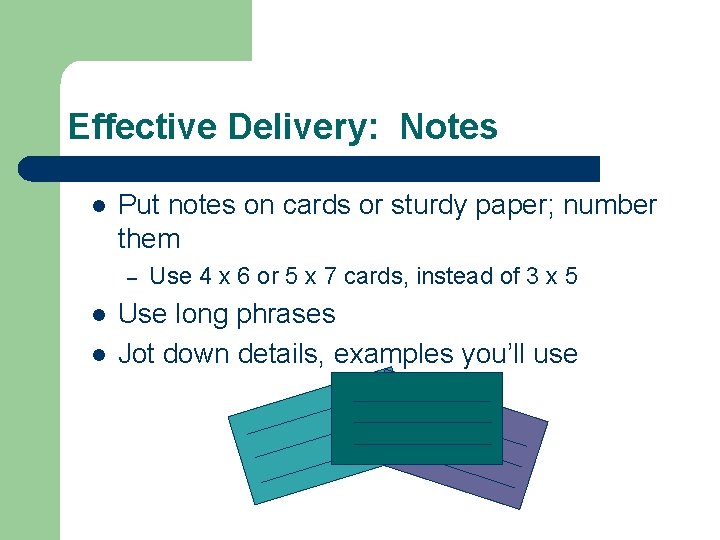
Effective Delivery: Notes l Put notes on cards or sturdy paper; number them – l l Use 4 x 6 or 5 x 7 cards, instead of 3 x 5 Use long phrases Jot down details, examples you’ll use
Notes, continued… l l l Indicate where you’ll refer to visual Look at notes rarely Hold notes high so head doesn’t bob up and down
Oral communication skills To overcome prespeech jitters l Try deep diaphragmatic breathing l Stand in a relaxed position in front of the audience l Begin the speech Establish eye contact l Makes the audience feel important and involved
Nonverbal communication • Speech delivery begins the moment you leave your seat • Stand tall, walk confidently • Balance your weight, don’t cross ankles • Don’t grip the lectern • Gesture naturally • Insert cues into your outline for gestures • Practice your gestures
Nonverbal communication • Avoid fidgeting, nervous or distracting gestures • Keep hands out of pockets • Smile with eye contact • Facial expressions change with different thoughts and experiences
Oral communication skills Vocal characteristics l Should not talk too slow or too fast l The volume of the voice should be well arranged l The pitch of the voice should be carefully examined l Speech rate is important
Effective Delivery: Voice l Make voice easy to listen to l Talk loudly enough so entire audience can hear l Sound energetic and enthusiastic
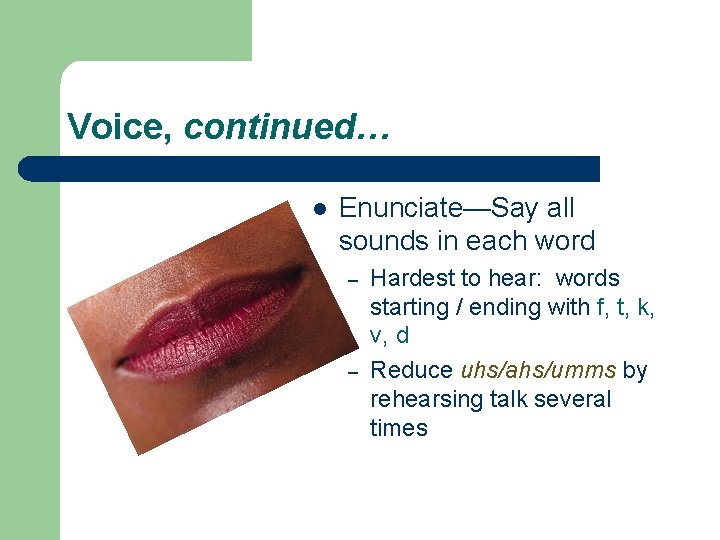
Voice, continued… l Enunciate—Say all sounds in each word – – Hardest to hear: words starting / ending with f, t, k, v, d Reduce uhs/ahs/umms by rehearsing talk several times
Oral communication skills Gestures and movements l Very supportive if effectively used l Speaker must becareful not to exaggerate movements which would look phony
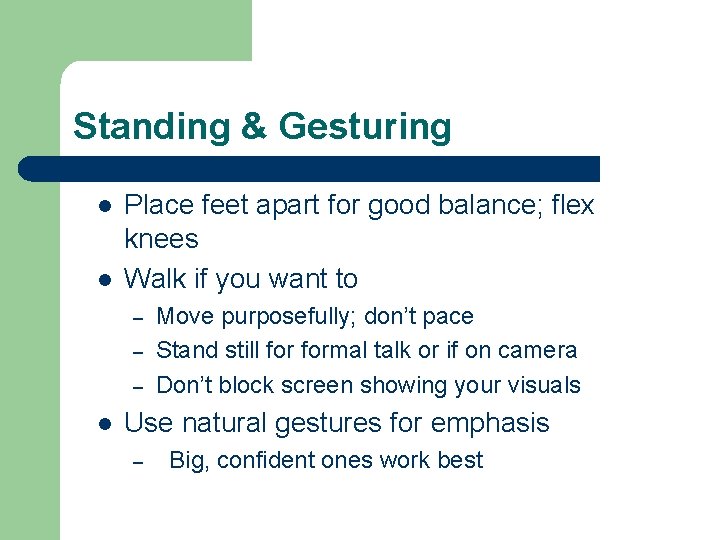
Standing & Gesturing l l Place feet apart for good balance; flex knees Walk if you want to – – – l Move purposefully; don’t pace Stand still formal talk or if on camera Don’t block screen showing your visuals Use natural gestures for emphasis – Big, confident ones work best
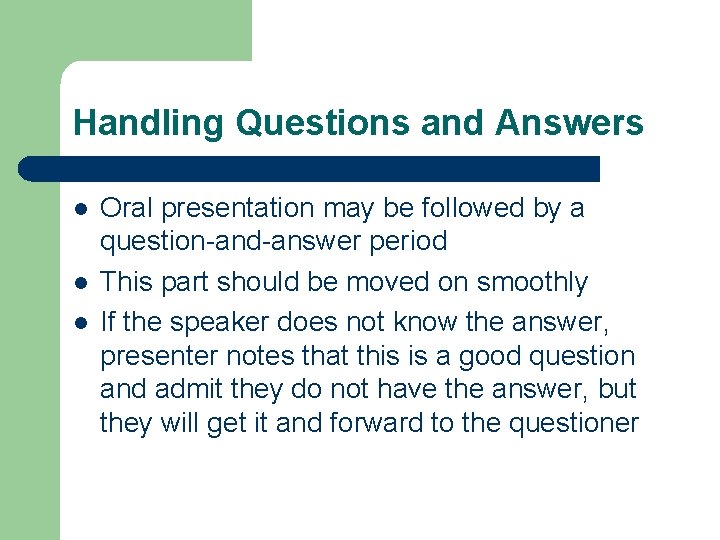
Handling Questions and Answers l l l Oral presentation may be followed by a question-and-answer period This part should be moved on smoothly If the speaker does not know the answer, presenter notes that this is a good question and admit they do not have the answer, but they will get it and forward to the questioner
Handling Questions and Answers l When a quesitoner tries to monopolize the floor and establish a dialogue with the speaker, then the speaker must take control of the situation
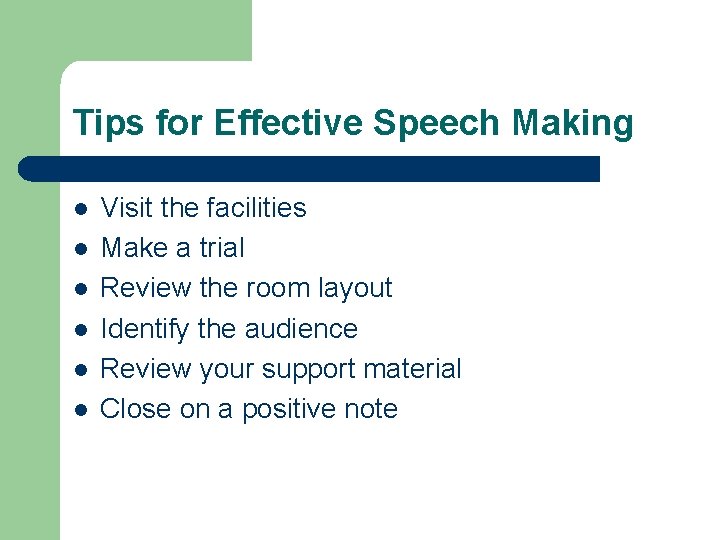
Tips for Effective Speech Making l l l Visit the facilities Make a trial Review the room layout Identify the audience Review your support material Close on a positive note
EXAMPLES Funny presentation 2 Good & bad presentations