
Chapter 7 Decision Making Learning Creativity and Entrepreneurship
- Slides: 40
Chapter 7 Decision Making, Learning, Creativity, and Entrepreneurship © 2016 by Mc. Graw-Hill Education. This is proprietary material solely for authorized instructor use. Not authorized for sale or distribution in any manner. This document may not be copied, scanned, duplicated, forwarded, distributed, or posted on a website, in whole or part.
Learning Objectives 1. Understand the nature of managerial decision making, differentiate between programmed and non-programmed decisions, and explain why non-programmed decision making is a complex, uncertain process. 2. Describe the six steps that managers should take to make the best decisions and explain how cognitive biases can lead managers to make poor decisions. © 2016 by Mc. Graw-Hill Education. This is proprietary material solely for authorized instructor use. Not authorized for sale or distribution in any manner. This document may not be copied, scanned, duplicated, forwarded, distributed, or posted on a website, in whole or part. 7 -2
Learning Objectives 3. Identify the advantages and disadvantages of group decision making, and describe techniques that can improve it. 4. Explain the role that organizational learning and creativity play in helping managers to improve their decisions. 5. Describe how managers can encourage and promote entrepreneurship to create a learning organization and differentiate between entrepreneurs and intrapreneurs © 2016 by Mc. Graw-Hill Education. This is proprietary material solely for authorized instructor use. Not authorized for sale or distribution in any manner. This document may not be copied, scanned, duplicated, forwarded, distributed, or posted on a website, in whole or part. 7 -3
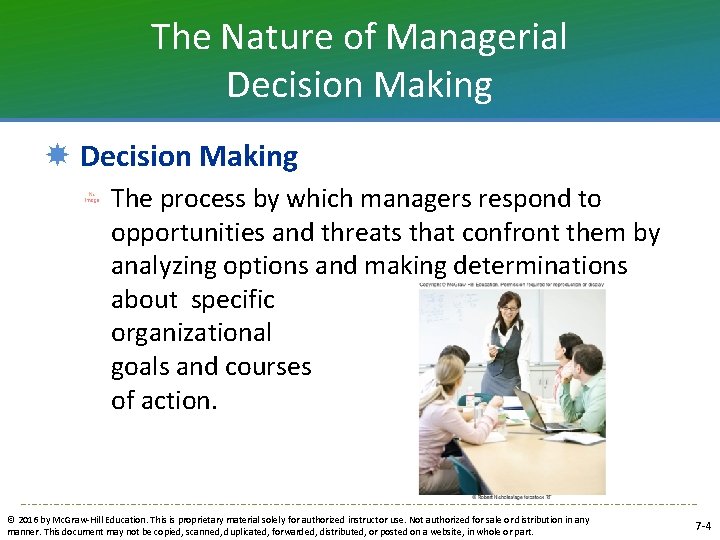
The Nature of Managerial Decision Making The process by which managers respond to opportunities and threats that confront them by analyzing options and making determinations about specific organizational goals and courses of action. © 2016 by Mc. Graw-Hill Education. This is proprietary material solely for authorized instructor use. Not authorized for sale or distribution in any manner. This document may not be copied, scanned, duplicated, forwarded, distributed, or posted on a website, in whole or part. 7 -4
The Nature of Managerial Decision Making Decisions in response to opportunities occurs when managers respond to ways to improve organizational performance to benefit customers, employees, and other stakeholder groups Decisions in response to threats events inside or outside the organization are adversely affecting organizational performance © 2016 by Mc. Graw-Hill Education. This is proprietary material solely for authorized instructor use. Not authorized for sale or distribution in any manner. This document may not be copied, scanned, duplicated, forwarded, distributed, or posted on a website, in whole or part. 7 -5
Decision Making Programmed Decision Routine, virtually automatic decision making that follows established rules or guidelines. Decisions have been made so many times in the past that managers have developed rules or guidelines to be applied when certain situations inevitably occur © 2016 by Mc. Graw-Hill Education. This is proprietary material solely for authorized instructor use. Not authorized for sale or distribution in any manner. This document may not be copied, scanned, duplicated, forwarded, distributed, or posted on a website, in whole or part. 7 -6
Decision Making Non-Programmed Decisions Nonroutine decision making that occurs in response to unusual, unpredictable opportunities and threats Rules do not exist because the situation is unexpected or uncertain and managers lack the information they would need to develop rules to cover it. © 2016 by Mc. Graw-Hill Education. This is proprietary material solely for authorized instructor use. Not authorized for sale or distribution in any manner. This document may not be copied, scanned, duplicated, forwarded, distributed, or posted on a website, in whole or part. 7 -7
Decision Making Intuition feelings, beliefs, and hunches that come readily to mind, require little effort and information gathering and result in on-the-spot decisions Reasoned judgment decision that requires time and effort and results from careful information gathering, generation of alternatives, and evaluation of alternatives © 2016 by Mc. Graw-Hill Education. This is proprietary material solely for authorized instructor use. Not authorized for sale or distribution in any manner. This document may not be copied, scanned, duplicated, forwarded, distributed, or posted on a website, in whole or part. 7 -8
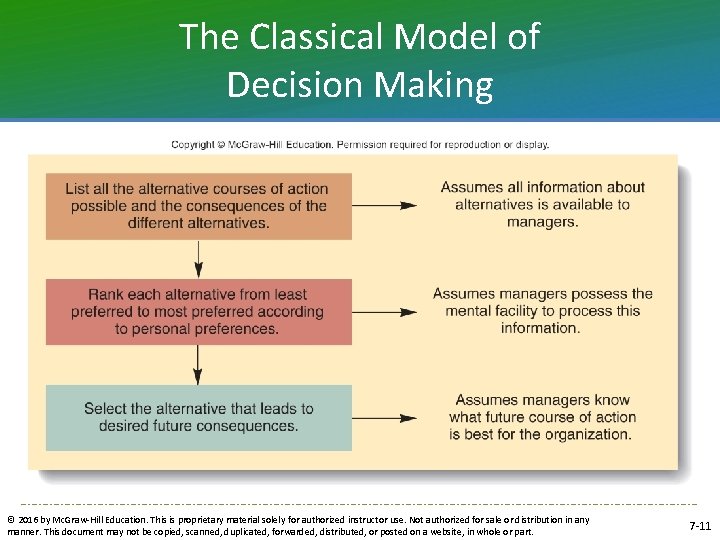
The Classical Model of Decision Making A prescriptive model of decision making that assumes the decision maker can identify and evaluate all possible alternatives and their consequences and rationally choose the most appropriate course of action. © 2016 by Mc. Graw-Hill Education. This is proprietary material solely for authorized instructor use. Not authorized for sale or distribution in any manner. This document may not be copied, scanned, duplicated, forwarded, distributed, or posted on a website, in whole or part. 7 -9
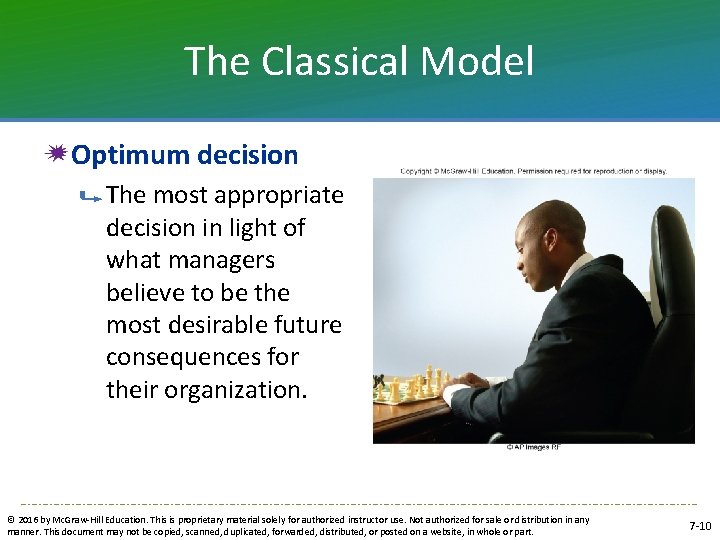
The Classical Model Optimum decision The most appropriate decision in light of what managers believe to be the most desirable future consequences for their organization. © 2016 by Mc. Graw-Hill Education. This is proprietary material solely for authorized instructor use. Not authorized for sale or distribution in any manner. This document may not be copied, scanned, duplicated, forwarded, distributed, or posted on a website, in whole or part. 7 -10
The Classical Model of Decision Making © 2016 by Mc. Graw-Hill Education. This is proprietary material solely for authorized instructor use. Not authorized for sale or distribution in any manner. This document may not be copied, scanned, duplicated, forwarded, distributed, or posted on a website, in whole or part. 7 -11
The Administrative Model An approach to decision making that explains why decision making is inherently uncertain and risky and why managers usually make satisfactory rather than optimum decisions. © 2016 by Mc. Graw-Hill Education. This is proprietary material solely for authorized instructor use. Not authorized for sale or distribution in any manner. This document may not be copied, scanned, duplicated, forwarded, distributed, or posted on a website, in whole or part. 7 -12
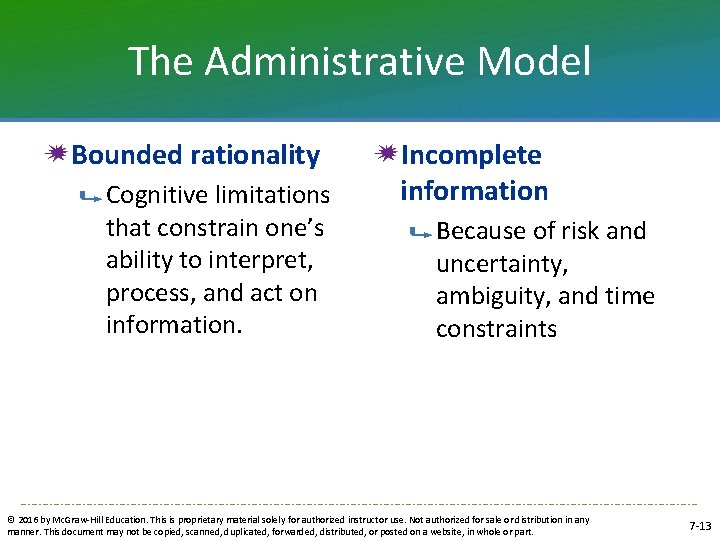
The Administrative Model Bounded rationality Cognitive limitations that constrain one’s ability to interpret, process, and act on information. Incomplete information Because of risk and uncertainty, ambiguity, and time constraints © 2016 by Mc. Graw-Hill Education. This is proprietary material solely for authorized instructor use. Not authorized for sale or distribution in any manner. This document may not be copied, scanned, duplicated, forwarded, distributed, or posted on a website, in whole or part. 7 -13
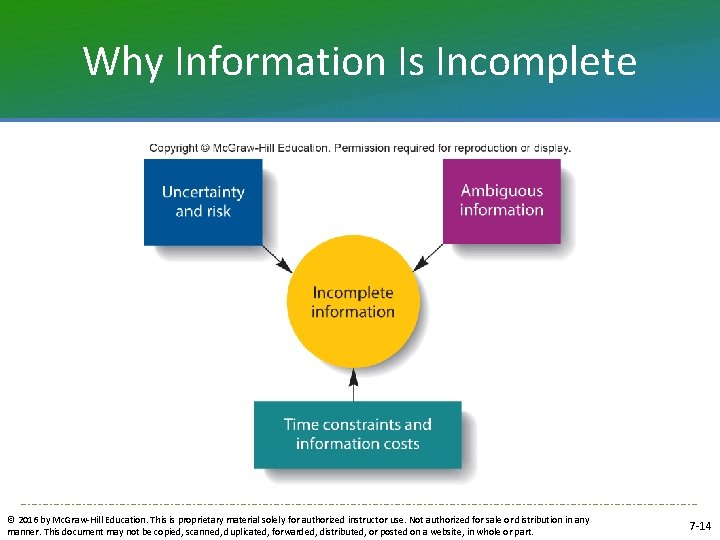
Why Information Is Incomplete © 2016 by Mc. Graw-Hill Education. This is proprietary material solely for authorized instructor use. Not authorized for sale or distribution in any manner. This document may not be copied, scanned, duplicated, forwarded, distributed, or posted on a website, in whole or part. 7 -14
Causes of Incomplete Information Risk The degree of probability that the possible outcomes of a particular course of action will occur. Uncertainty the probabilities of alternative outcomes cannot be determined and future outcomes are unknown © 2016 by Mc. Graw-Hill Education. This is proprietary material solely for authorized instructor use. Not authorized for sale or distribution in any manner. This document may not be copied, scanned, duplicated, forwarded, distributed, or posted on a website, in whole or part. 7 -15
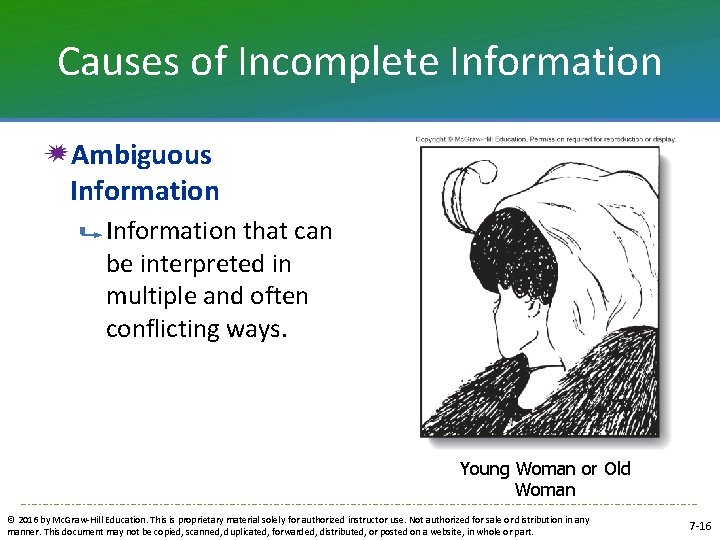
Causes of Incomplete Information Ambiguous Information that can be interpreted in multiple and often conflicting ways. Young Woman or Old Woman © 2016 by Mc. Graw-Hill Education. This is proprietary material solely for authorized instructor use. Not authorized for sale or distribution in any manner. This document may not be copied, scanned, duplicated, forwarded, distributed, or posted on a website, in whole or part. 7 -16
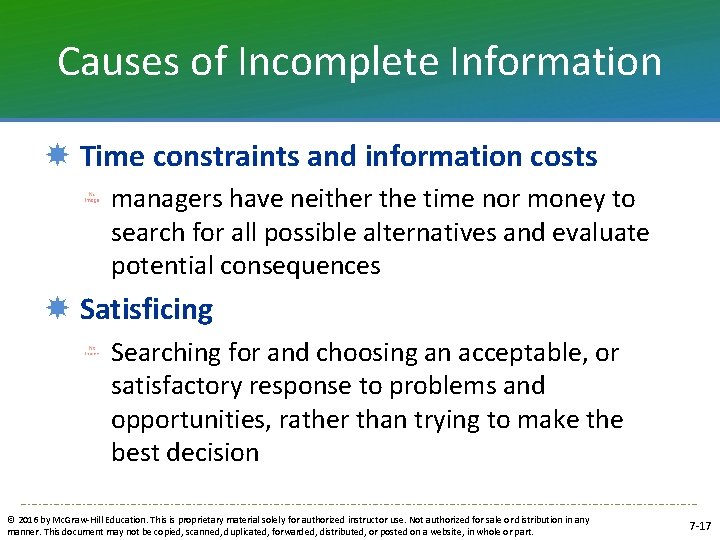
Causes of Incomplete Information Time constraints and information costs managers have neither the time nor money to search for all possible alternatives and evaluate potential consequences Satisficing Searching for and choosing an acceptable, or satisfactory response to problems and opportunities, rather than trying to make the best decision © 2016 by Mc. Graw-Hill Education. This is proprietary material solely for authorized instructor use. Not authorized for sale or distribution in any manner. This document may not be copied, scanned, duplicated, forwarded, distributed, or posted on a website, in whole or part. 7 -17
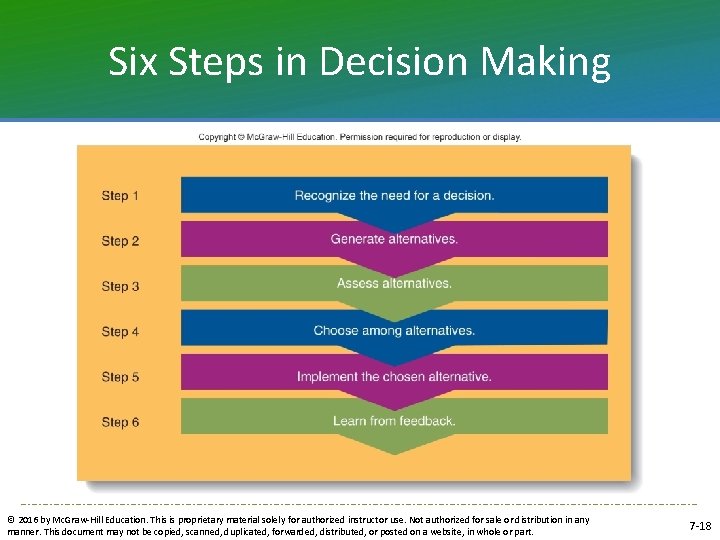
Six Steps in Decision Making © 2016 by Mc. Graw-Hill Education. This is proprietary material solely for authorized instructor use. Not authorized for sale or distribution in any manner. This document may not be copied, scanned, duplicated, forwarded, distributed, or posted on a website, in whole or part. 7 -18
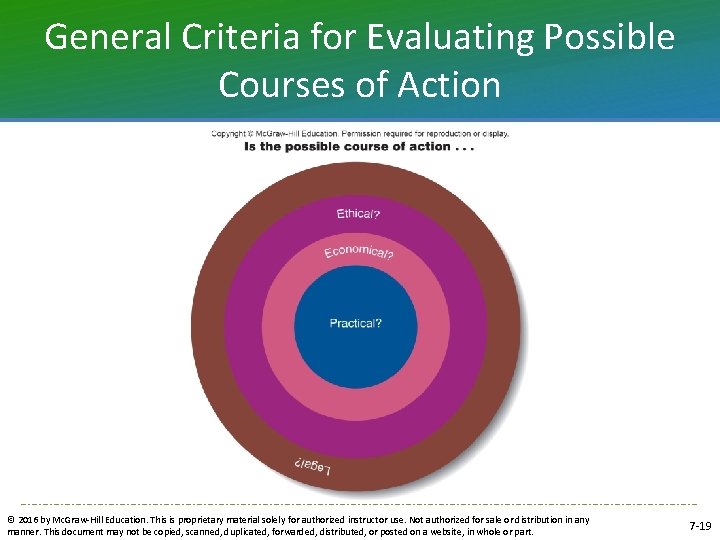
General Criteria for Evaluating Possible Courses of Action © 2016 by Mc. Graw-Hill Education. This is proprietary material solely for authorized instructor use. Not authorized for sale or distribution in any manner. This document may not be copied, scanned, duplicated, forwarded, distributed, or posted on a website, in whole or part. 7 -19
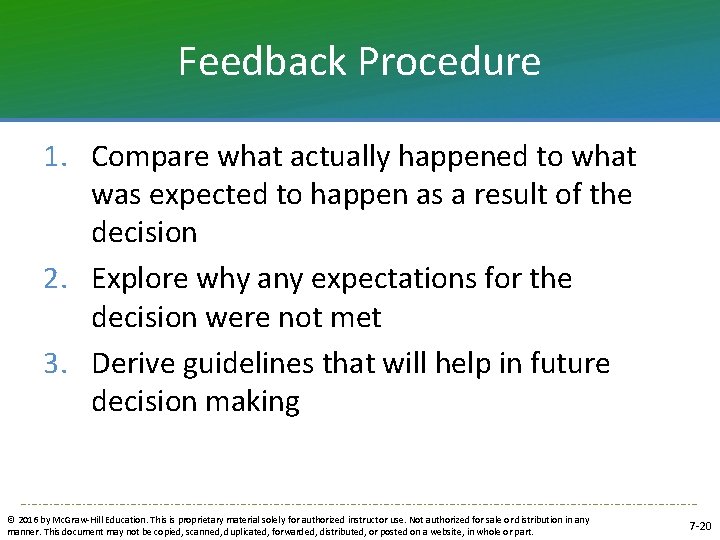
Feedback Procedure 1. Compare what actually happened to what was expected to happen as a result of the decision 2. Explore why any expectations for the decision were not met 3. Derive guidelines that will help in future decision making © 2016 by Mc. Graw-Hill Education. This is proprietary material solely for authorized instructor use. Not authorized for sale or distribution in any manner. This document may not be copied, scanned, duplicated, forwarded, distributed, or posted on a website, in whole or part. 7 -20
Cognitive Biases and Decision Making Heuristics Rules of thumb that simplify the process of making decisions. Systematic errors that people make over and that result in poor decision making © 2016 by Mc. Graw-Hill Education. This is proprietary material solely for authorized instructor use. Not authorized for sale or distribution in any manner. This document may not be copied, scanned, duplicated, forwarded, distributed, or posted on a website, in whole or part. 7 -21
Sources of Cognitive Biases Prior Hypothesis Bias A cognitive bias resulting from the tendency to base decisions on strong prior beliefs even if evidence shows that those beliefs are wrong. Representativeness A cognitive bias resulting from the tendency to generalize inappropriately from a small sample or from a single vivid event or episode. © 2016 by Mc. Graw-Hill Education. This is proprietary material solely for authorized instructor use. Not authorized for sale or distribution in any manner. This document may not be copied, scanned, duplicated, forwarded, distributed, or posted on a website, in whole or part. 7 -22
Sources of Cognitive Biases Illusion of Control The tendency to overestimate one’s own ability to control activities and events. Escalating Commitment A source of cognitive bias resulting from the tendency to commit additional resources to a project even if evidence shows that the project is failing. © 2016 by Mc. Graw-Hill Education. This is proprietary material solely for authorized instructor use. Not authorized for sale or distribution in any manner. This document may not be copied, scanned, duplicated, forwarded, distributed, or posted on a website, in whole or part. 7 -23
Group Decision Making Superior to individual making Choices less likely to fall victim to bias Able to draw on combined skills of group members Improve ability to generate feasible alternatives © 2016 by Mc. Graw-Hill Education. This is proprietary material solely for authorized instructor use. Not authorized for sale or distribution in any manner. This document may not be copied, scanned, duplicated, forwarded, distributed, or posted on a website, in whole or part. 7 -24
Group Decision Making Potential Disadvantages: 1. Can take much longer than individuals to make decisions 2. Can be difficult to get two or more managers to agree because of different interests and preferences 3. Can be undermined by biases © 2016 by Mc. Graw-Hill Education. This is proprietary material solely for authorized instructor use. Not authorized for sale or distribution in any manner. This document may not be copied, scanned, duplicated, forwarded, distributed, or posted on a website, in whole or part. 7 -25
Group Decision Making Groupthink Pattern of faulty and biased decision making that occurs in groups whose members strive for agreement among themselves at the expense of accurately assessing information relevant to a decision © 2016 by Mc. Graw-Hill Education. This is proprietary material solely for authorized instructor use. Not authorized for sale or distribution in any manner. This document may not be copied, scanned, duplicated, forwarded, distributed, or posted on a website, in whole or part. 7 -26
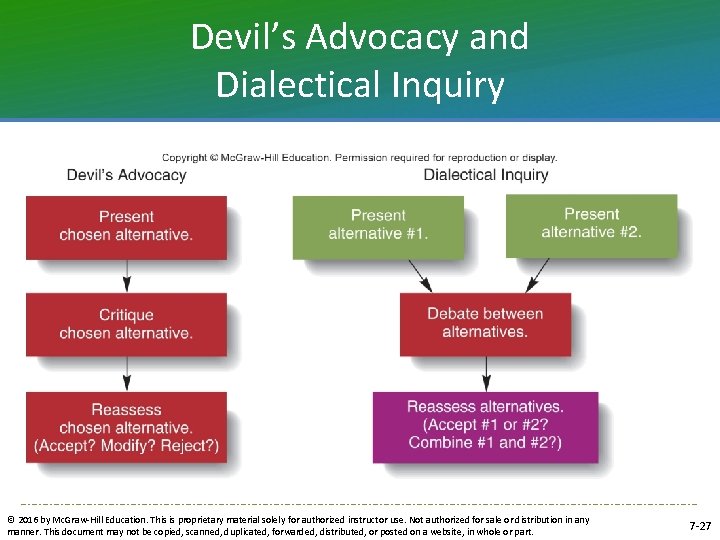
Devil’s Advocacy and Dialectical Inquiry © 2016 by Mc. Graw-Hill Education. This is proprietary material solely for authorized instructor use. Not authorized for sale or distribution in any manner. This document may not be copied, scanned, duplicated, forwarded, distributed, or posted on a website, in whole or part. 7 -27
Organizational Learning and Creativity Organizational learning Managers seek to improve a employee’s desire and ability to understand manage the organization and its task environment. Learning organization An organization in which managers try to maximize the ability of individuals and groups to think and behave creatively and thus maximize the potential for organizational learning to take place. © 2016 by Mc. Graw-Hill Education. This is proprietary material solely for authorized instructor use. Not authorized for sale or distribution in any manner. This document may not be copied, scanned, duplicated, forwarded, distributed, or posted on a website, in whole or part. 7 -28
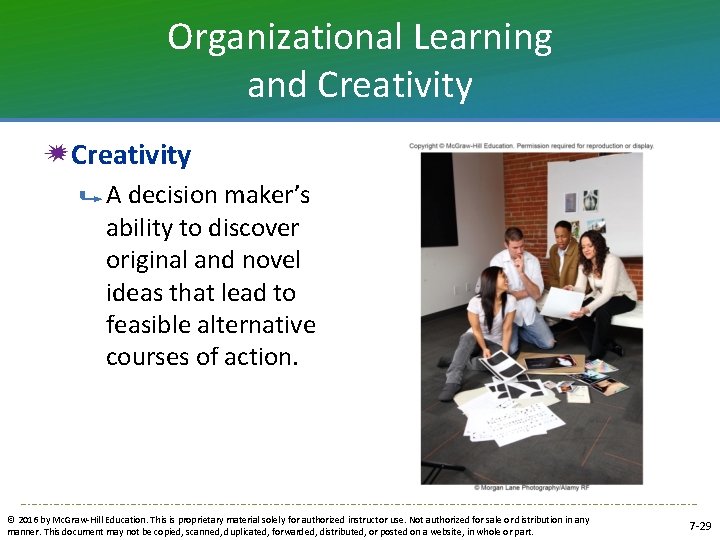
Organizational Learning and Creativity A decision maker’s ability to discover original and novel ideas that lead to feasible alternative courses of action. © 2016 by Mc. Graw-Hill Education. This is proprietary material solely for authorized instructor use. Not authorized for sale or distribution in any manner. This document may not be copied, scanned, duplicated, forwarded, distributed, or posted on a website, in whole or part. 7 -29
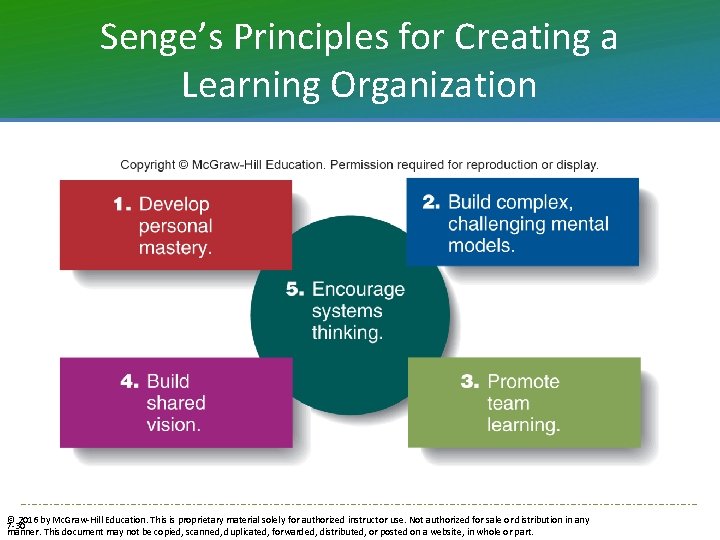
Senge’s Principles for Creating a Learning Organization © 2016 by Mc. Graw-Hill Education. This is proprietary material solely for authorized instructor use. Not authorized for sale or distribution in any 7 -30 manner. This document may not be copied, scanned, duplicated, forwarded, distributed, or posted on a website, in whole or part.
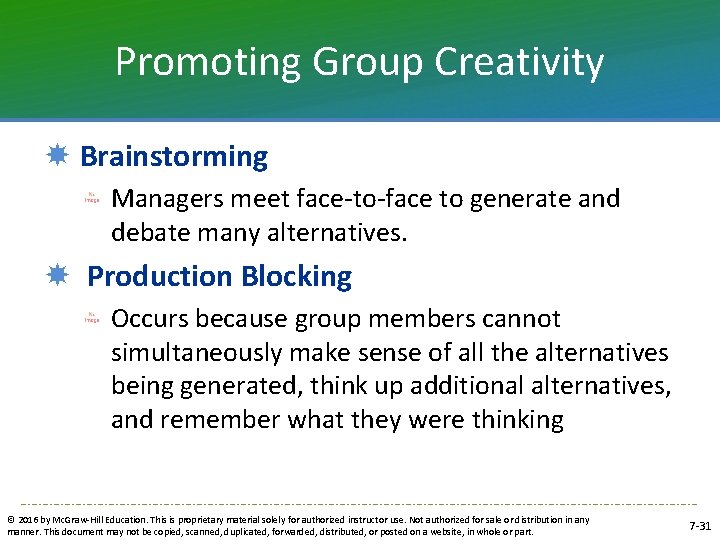
Promoting Group Creativity Brainstorming Managers meet face-to-face to generate and debate many alternatives. Production Blocking Occurs because group members cannot simultaneously make sense of all the alternatives being generated, think up additional alternatives, and remember what they were thinking © 2016 by Mc. Graw-Hill Education. This is proprietary material solely for authorized instructor use. Not authorized for sale or distribution in any manner. This document may not be copied, scanned, duplicated, forwarded, distributed, or posted on a website, in whole or part. 7 -31
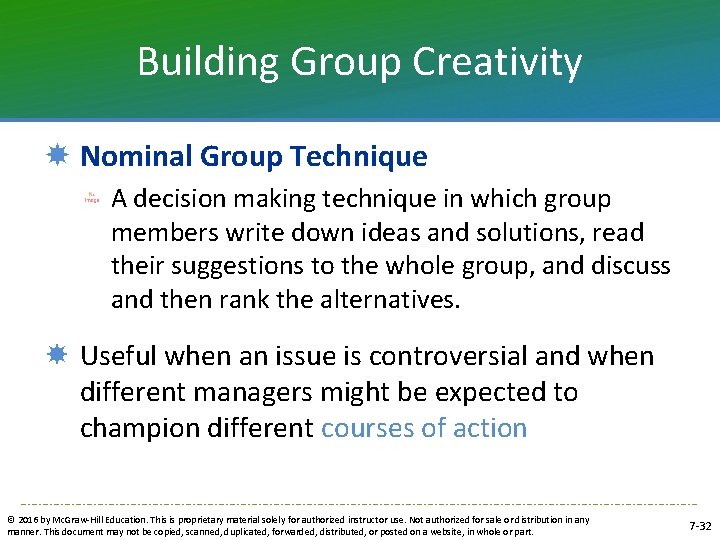
Building Group Creativity Nominal Group Technique A decision making technique in which group members write down ideas and solutions, read their suggestions to the whole group, and discuss and then rank the alternatives. Useful when an issue is controversial and when different managers might be expected to champion different courses of action © 2016 by Mc. Graw-Hill Education. This is proprietary material solely for authorized instructor use. Not authorized for sale or distribution in any manner. This document may not be copied, scanned, duplicated, forwarded, distributed, or posted on a website, in whole or part. 7 -32
Building Group Creativity Delphi Technique A decision-making technique in which group members do not meet face-to-face but respond in writing to questions posed by the group leader. © 2016 by Mc. Graw-Hill Education. This is proprietary material solely for authorized instructor use. Not authorized for sale or distribution in any manner. This document may not be copied, scanned, duplicated, forwarded, distributed, or posted on a website, in whole or part. 7 -33
Entrepreneurship Entrepreneurs An individual who notices opportunities and decides how to mobilize the resources necessary to produce new and improved goods and services. Social entrepreneurs An individual who pursues initiatives and opportunities and mobilizes resources to address social problems and needs in order to improve society and well-being through creative solutions. © 2016 by Mc. Graw-Hill Education. This is proprietary material solely for authorized instructor use. Not authorized for sale or distribution in any manner. This document may not be copied, scanned, duplicated, forwarded, distributed, or posted on a website, in whole or part. 7 -34
Entrepreneurship Intrapreneurs A manager, scientist, or researcher who works inside an organization and notices opportunities to develop new or improved products and better ways to make them. © 2016 by Mc. Graw-Hill Education. This is proprietary material solely for authorized instructor use. Not authorized for sale or distribution in any manner. This document may not be copied, scanned, duplicated, forwarded, distributed, or posted on a website, in whole or part. 7 -35
Characteristics of Entrepreneurs Open to experience: they are original thinkers and take risks. Internal locus of control: they take responsibility for their own actions. High self-esteem: they feel competent and capable. High need for achievement: they set high goals and enjoy working toward them. © 2016 by Mc. Graw-Hill Education. This is proprietary material solely for authorized instructor use. Not authorized for sale or distribution in any manner. This document may not be copied, scanned, duplicated, forwarded, distributed, or posted on a website, in whole or part. 7 -36
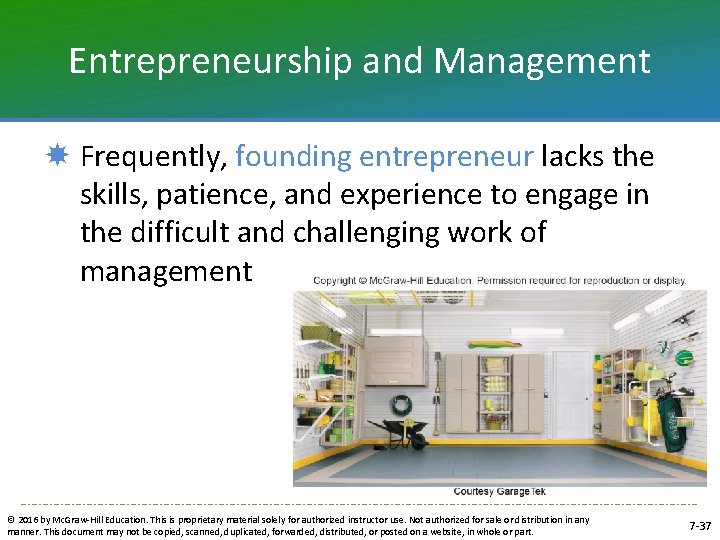
Entrepreneurship and Management Frequently, founding entrepreneur lacks the skills, patience, and experience to engage in the difficult and challenging work of management © 2016 by Mc. Graw-Hill Education. This is proprietary material solely for authorized instructor use. Not authorized for sale or distribution in any manner. This document may not be copied, scanned, duplicated, forwarded, distributed, or posted on a website, in whole or part. 7 -37
Intrapreneurship and Organizational Learning Product champion A manager who takes “ownership” of a project and provides the leadership and vision that take a product from the idea stage to the final customer. Skunkworks A group of intrapreneurs who are deliberately separated from the normal operation of an organization to encourage them to devote all their attention to developing new products © 2016 by Mc. Graw-Hill Education. This is proprietary material solely for authorized instructor use. Not authorized for sale or distribution in any manner. This document may not be copied, scanned, duplicated, forwarded, distributed, or posted on a website, in whole or part. 7 -38
Example – Xerox PARC The Palo Alto Research Center is a Xerox Research & Development division Many innovations such as the laser printer, personal workstation, WYSIWYG printing, and GUI came out of PARC © 2016 by Mc. Graw-Hill Education. This is proprietary material solely for authorized instructor use. Not authorized for sale or distribution in any manner. This document may not be copied, scanned, duplicated, forwarded, distributed, or posted on a website, in whole or part. 7 -39
Video: Opportunity International How does Opportunity International empower entrepreneurs through microfinance? © 2016 by Mc. Graw-Hill Education. This is proprietary material solely for authorized instructor use. Not authorized for sale or distribution in any manner. This document may not be copied, scanned, duplicated, forwarded, distributed, or posted on a website, in whole or part. 7 -40