
Chapter 7 Deadlocks Operating System Concepts with Java
![Detection Algorithm (Cont. ) 3. Work = Work + Allocationi Finish[i] = true go](https://slidetodoc.com/presentation_image/951f8c3eabda9ab7b4b65122ff2e43c9/image-49.jpg "Detection Algorithm (Cont. ) 3. Work = Work + Allocationi Finish[i] = true go")
- Slides: 54
Chapter 7: Deadlocks Operating System Concepts with Java – 8 th Edition 7. 1 Silberschatz, Galvin and Gagne © 2009
Chapter 7: Deadlocks n The Deadlock Problem n System Model n Deadlock Characterization n Methods for Handling Deadlocks n Deadlock Prevention n Deadlock Avoidance n Deadlock Detection n Recovery from Deadlock Operating System Concepts with Java – 8 th Edition 7. 2 Silberschatz, Galvin and Gagne © 2009
Chapter Objectives n To develop a description of deadlocks, which prevent sets of concurrent processes from completing their tasks n To present a number of different methods for preventing or avoiding deadlocks in a computer system Operating System Concepts with Java – 8 th Edition 7. 3 Silberschatz, Galvin and Gagne © 2009
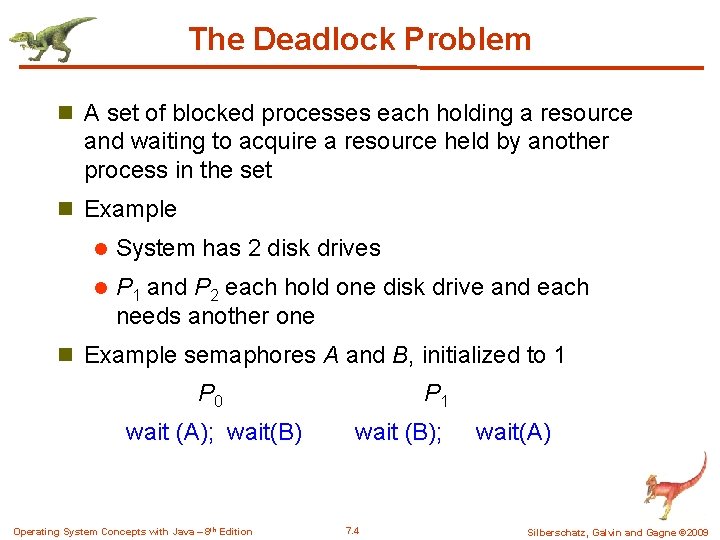
The Deadlock Problem n A set of blocked processes each holding a resource and waiting to acquire a resource held by another process in the set n Example l System has 2 disk drives l P 1 and P 2 each hold one disk drive and each needs another one n Example semaphores A and B, initialized to 1 P 0 wait (A); wait(B) Operating System Concepts with Java – 8 th Edition P 1 wait (B); 7. 4 wait(A) Silberschatz, Galvin and Gagne © 2009
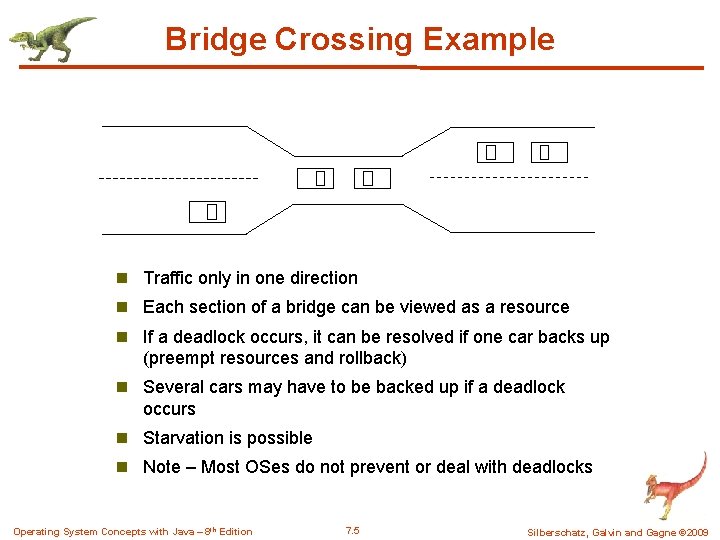
Bridge Crossing Example n Traffic only in one direction n Each section of a bridge can be viewed as a resource n If a deadlock occurs, it can be resolved if one car backs up (preempt resources and rollback) n Several cars may have to be backed up if a deadlock occurs n Starvation is possible n Note – Most OSes do not prevent or deal with deadlocks Operating System Concepts with Java – 8 th Edition 7. 5 Silberschatz, Galvin and Gagne © 2009
System Model n Resource types R 1, R 2, . . . , Rm CPU cycles, memory space, I/O devices n Each resource type Ri has Wi instances l Any instance can satisfy request for a resource l If not, then the resource definition is not alright n Each process utilizes a resource as follows: l request l use l release Operating System Concepts with Java – 8 th Edition 7. 6 Silberschatz, Galvin and Gagne © 2009
System Model n Resource types R 1, R 2, . . . , Rm CPU cycles, memory space, I/O devices n Each resource type Ri has Wi instances l Any instance can satisfy request for a resource l If not, then the resource definition is not alright n Each process utilizes a resource as follows: l request l use l release Operating System Concepts with Java – 8 th Edition 7. 7 Silberschatz, Galvin and Gagne © 2009
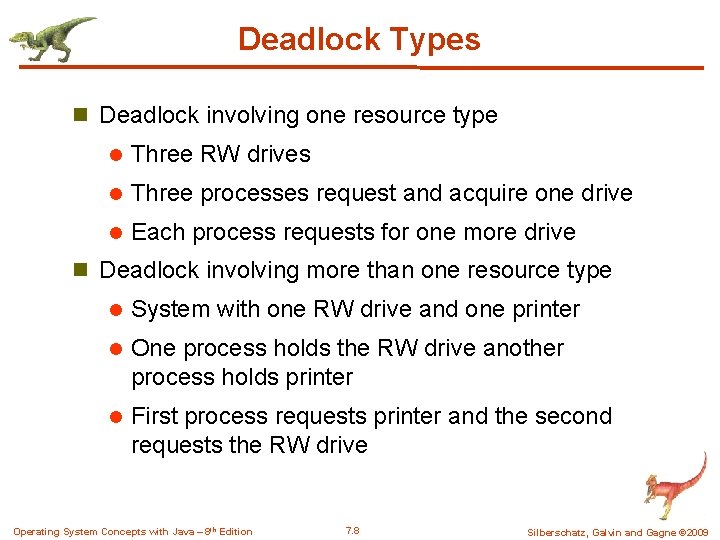
Deadlock Types n Deadlock involving one resource type l Three RW drives l Three processes request and acquire one drive l Each process requests for one more drive n Deadlock involving more than one resource type l System with one RW drive and one printer l One process holds the RW drive another process holds printer l First process requests printer and the second requests the RW drive Operating System Concepts with Java – 8 th Edition 7. 8 Silberschatz, Galvin and Gagne © 2009
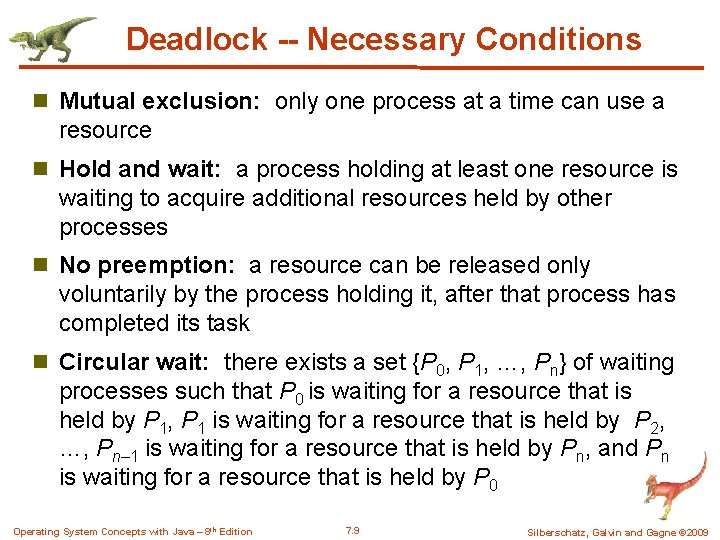
Deadlock -- Necessary Conditions n Mutual exclusion: only one process at a time can use a resource n Hold and wait: a process holding at least one resource is waiting to acquire additional resources held by other processes n No preemption: a resource can be released only voluntarily by the process holding it, after that process has completed its task n Circular wait: there exists a set {P 0, P 1, …, Pn} of waiting processes such that P 0 is waiting for a resource that is held by P 1, P 1 is waiting for a resource that is held by P 2, …, Pn– 1 is waiting for a resource that is held by Pn, and Pn is waiting for a resource that is held by P 0 Operating System Concepts with Java – 8 th Edition 7. 9 Silberschatz, Galvin and Gagne © 2009
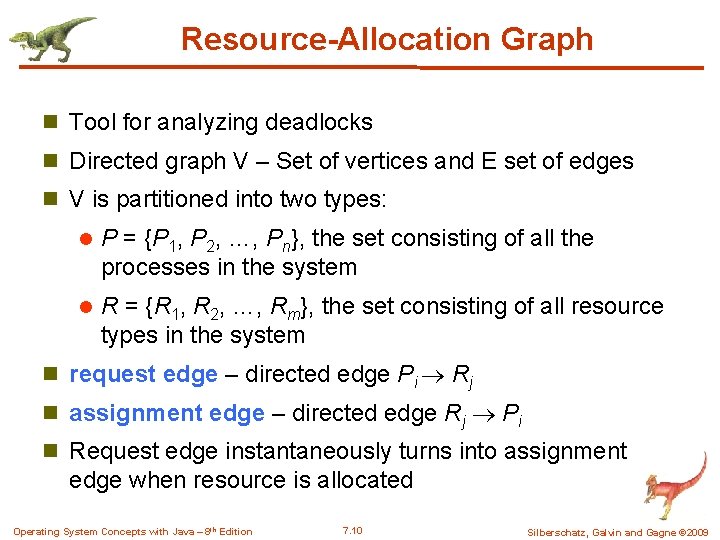
Resource-Allocation Graph n Tool for analyzing deadlocks n Directed graph V – Set of vertices and E set of edges n V is partitioned into two types: l P = {P 1, P 2, …, Pn}, the set consisting of all the processes in the system l R = {R 1, R 2, …, Rm}, the set consisting of all resource types in the system n request edge – directed edge Pi Rj n assignment edge – directed edge Rj Pi n Request edge instantaneously turns into assignment edge when resource is allocated Operating System Concepts with Java – 8 th Edition 7. 10 Silberschatz, Galvin and Gagne © 2009
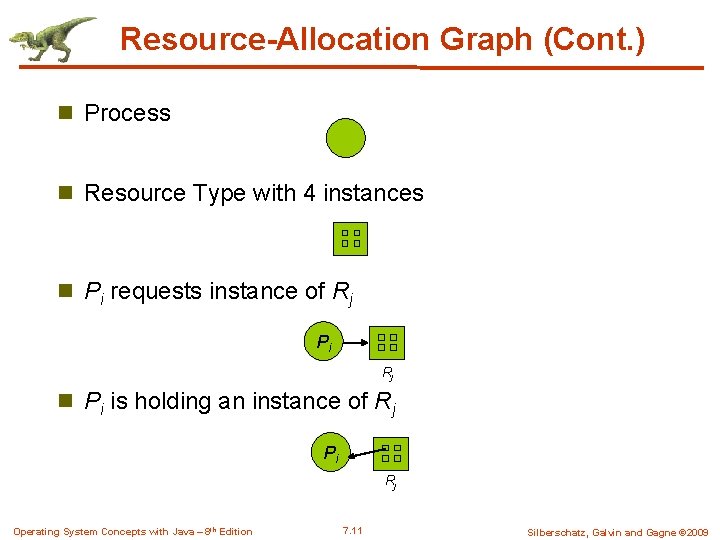
Resource-Allocation Graph (Cont. ) n Process n Resource Type with 4 instances n Pi requests instance of Rj Pi Rj n Pi is holding an instance of Rj Pi Rj Operating System Concepts with Java – 8 th Edition 7. 11 Silberschatz, Galvin and Gagne © 2009
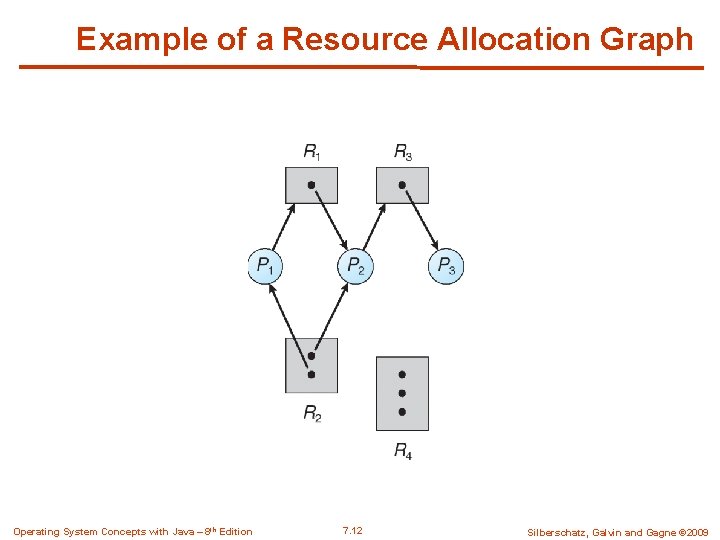
Example of a Resource Allocation Graph Operating System Concepts with Java – 8 th Edition 7. 12 Silberschatz, Galvin and Gagne © 2009
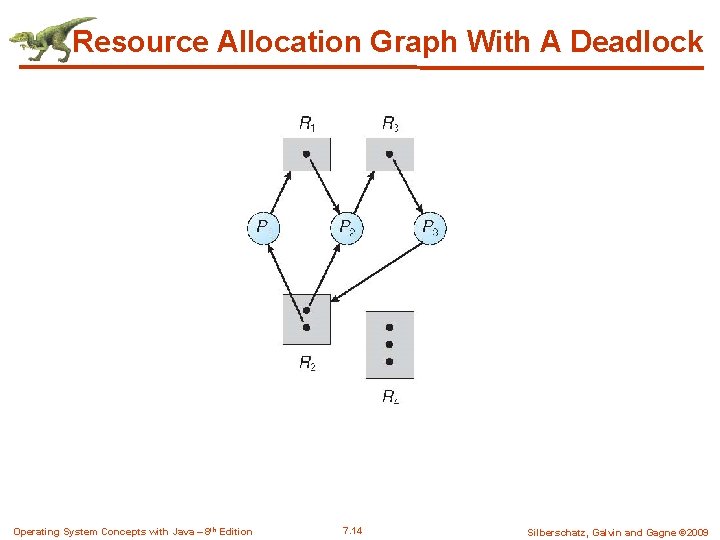
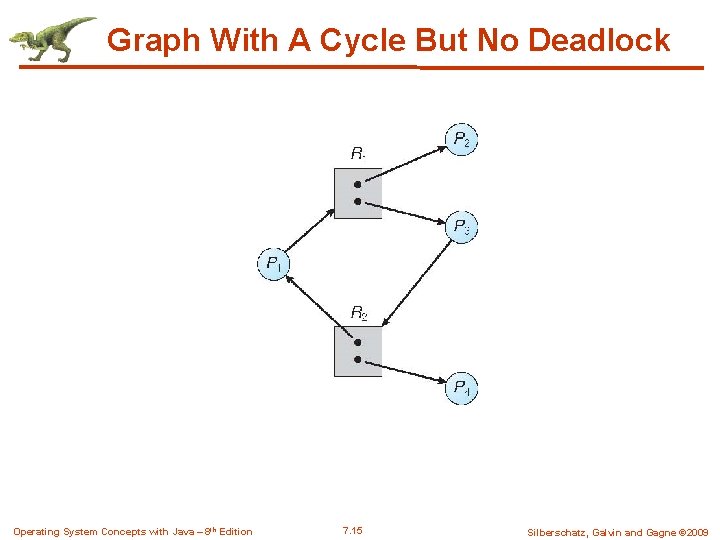
Checking for Deadlocks n Existence of cycles in resource allocation graph – A necessary but not sufficient condition for existence of deadlock n If graph contains no cycles no deadlock n If graph contains a cycle l if only one instance per resource type, then guaranteed deadlock l if several instances per resource type, possibility of deadlock Operating System Concepts with Java – 8 th Edition 7. 13 Silberschatz, Galvin and Gagne © 2009
Resource Allocation Graph With A Deadlock Operating System Concepts with Java – 8 th Edition 7. 14 Silberschatz, Galvin and Gagne © 2009
Graph With A Cycle But No Deadlock Operating System Concepts with Java – 8 th Edition 7. 15 Silberschatz, Galvin and Gagne © 2009
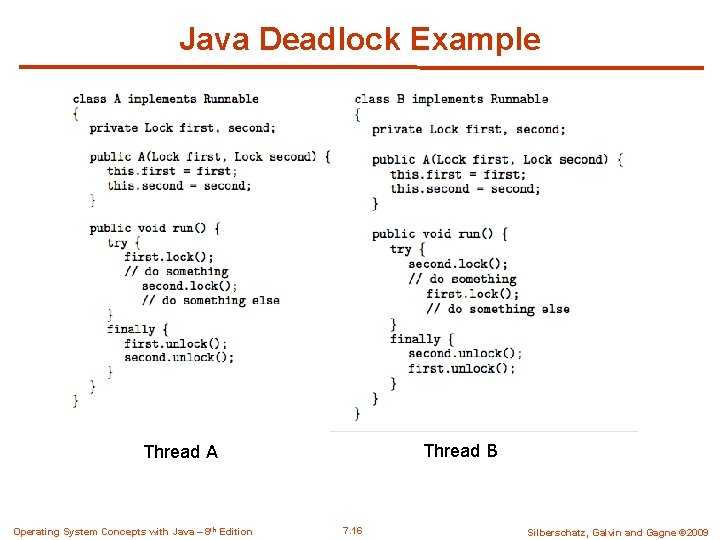
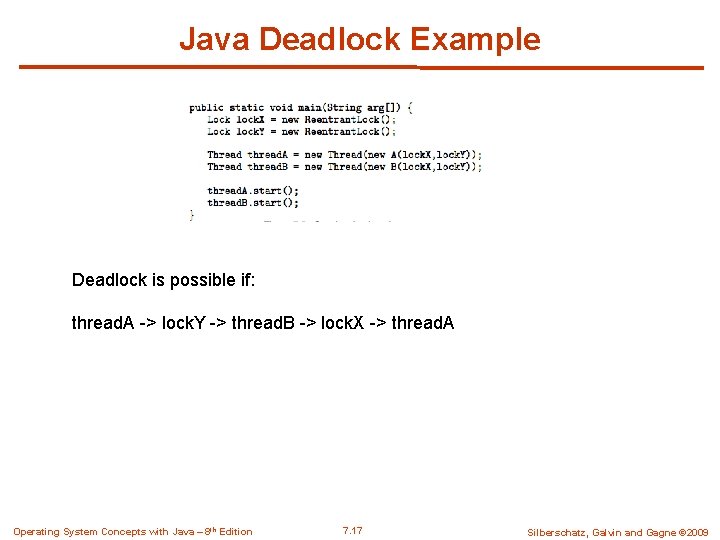
Java Deadlock Example Thread B Thread A Operating System Concepts with Java – 8 th Edition 7. 16 Silberschatz, Galvin and Gagne © 2009
Java Deadlock Example Deadlock is possible if: thread. A -> lock. Y -> thread. B -> lock. X -> thread. A Operating System Concepts with Java – 8 th Edition 7. 17 Silberschatz, Galvin and Gagne © 2009
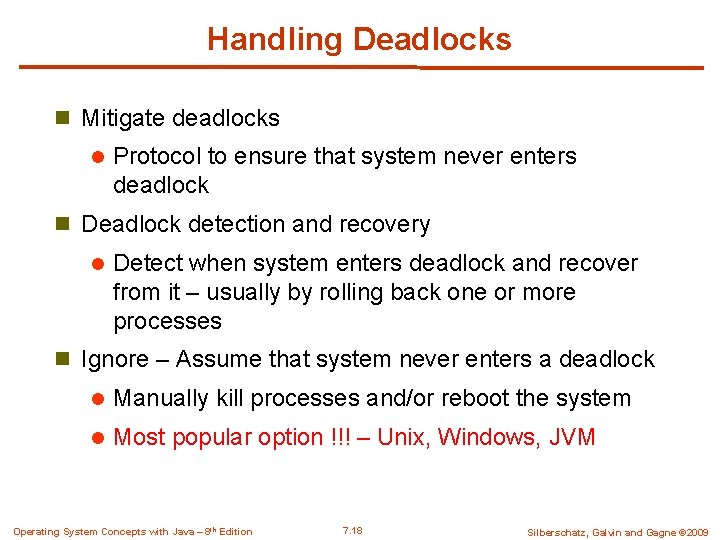
Handling Deadlocks n Mitigate deadlocks l Protocol to ensure that system never enters deadlock n Deadlock detection and recovery l Detect when system enters deadlock and recover from it – usually by rolling back one or more processes n Ignore – Assume that system never enters a deadlock l Manually kill processes and/or reboot the system l Most popular option !!! – Unix, Windows, JVM Operating System Concepts with Java – 8 th Edition 7. 18 Silberschatz, Galvin and Gagne © 2009
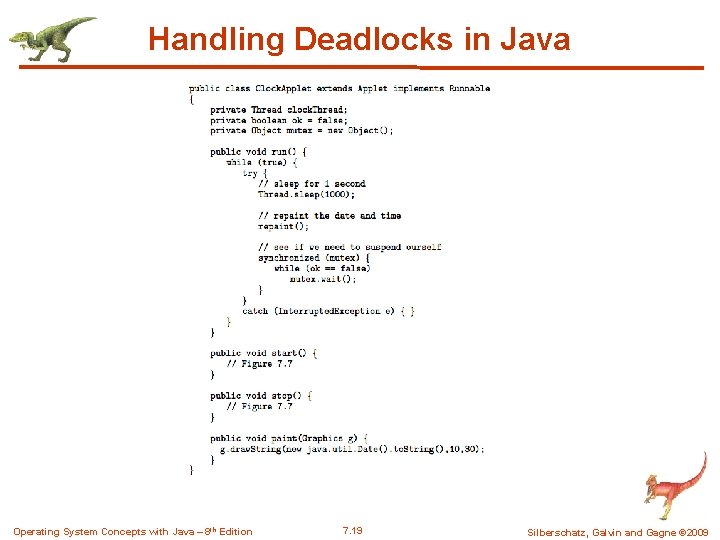
Handling Deadlocks in Java Operating System Concepts with Java – 8 th Edition 7. 19 Silberschatz, Galvin and Gagne © 2009
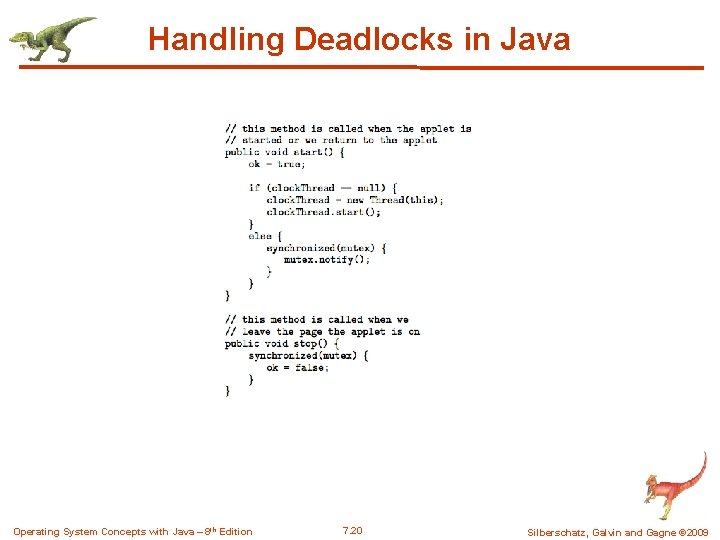
Handling Deadlocks in Java Operating System Concepts with Java – 8 th Edition 7. 20 Silberschatz, Galvin and Gagne © 2009
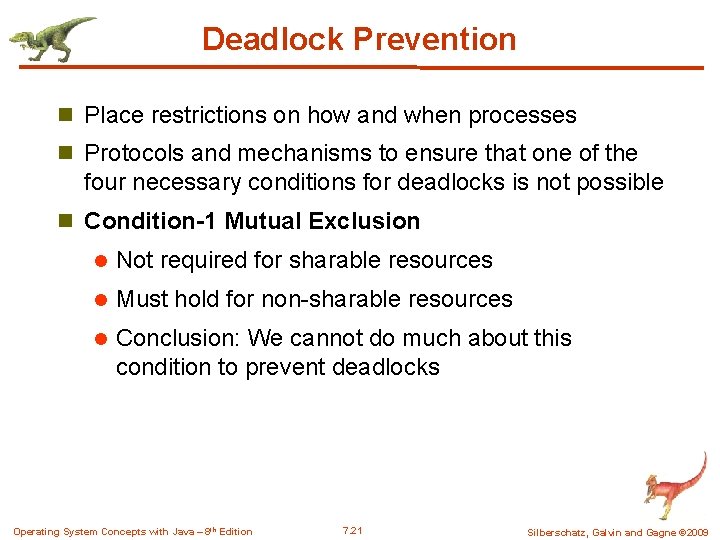
Deadlock Prevention n Place restrictions on how and when processes n Protocols and mechanisms to ensure that one of the four necessary conditions for deadlocks is not possible n Condition-1 Mutual Exclusion l Not required for sharable resources l Must hold for non-sharable resources l Conclusion: We cannot do much about this condition to prevent deadlocks Operating System Concepts with Java – 8 th Edition 7. 21 Silberschatz, Galvin and Gagne © 2009
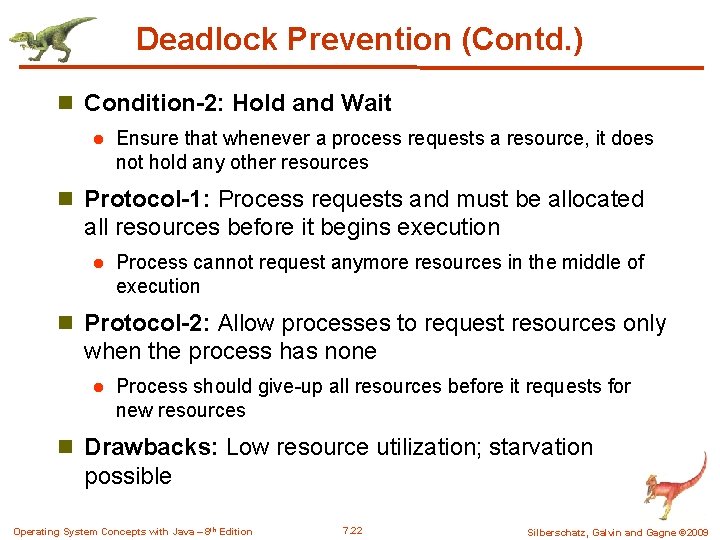
Deadlock Prevention (Contd. ) n Condition-2: Hold and Wait l Ensure that whenever a process requests a resource, it does not hold any other resources n Protocol-1: Process requests and must be allocated all resources before it begins execution l Process cannot request anymore resources in the middle of execution n Protocol-2: Allow processes to request resources only when the process has none l Process should give-up all resources before it requests for new resources n Drawbacks: Low resource utilization; starvation possible Operating System Concepts with Java – 8 th Edition 7. 22 Silberschatz, Galvin and Gagne © 2009
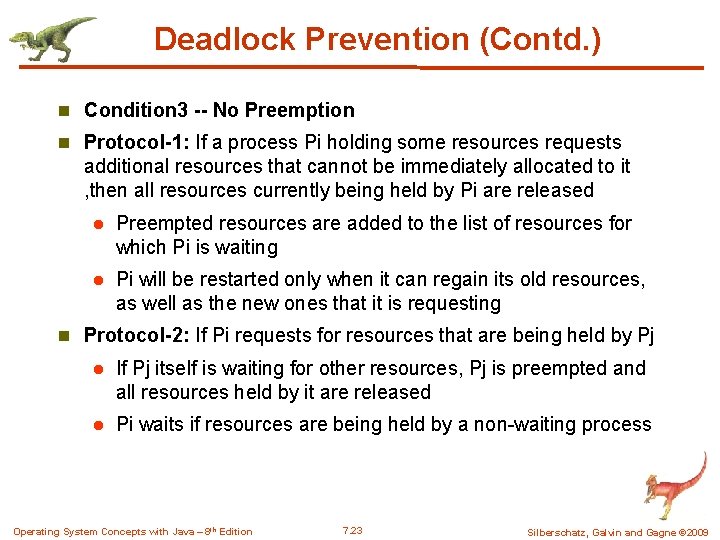
Deadlock Prevention (Contd. ) n Condition 3 -- No Preemption n Protocol-1: If a process Pi holding some resources requests additional resources that cannot be immediately allocated to it , then all resources currently being held by Pi are released l Preempted resources are added to the list of resources for which Pi is waiting l Pi will be restarted only when it can regain its old resources, as well as the new ones that it is requesting n Protocol-2: If Pi requests for resources that are being held by Pj l If Pj itself is waiting for other resources, Pj is preempted and all resources held by it are released l Pi waits if resources are being held by a non-waiting process Operating System Concepts with Java – 8 th Edition 7. 23 Silberschatz, Galvin and Gagne © 2009
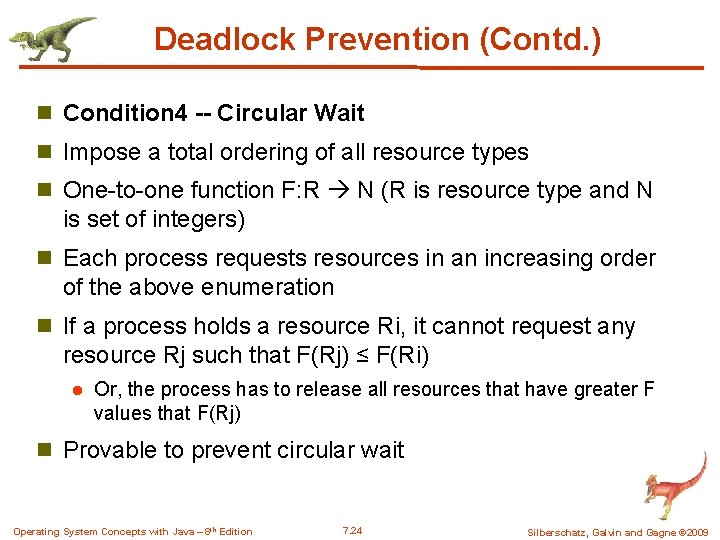
Deadlock Prevention (Contd. ) n Condition 4 -- Circular Wait n Impose a total ordering of all resource types n One-to-one function F: R N (R is resource type and N is set of integers) n Each process requests resources in an increasing order of the above enumeration n If a process holds a resource Ri, it cannot request any resource Rj such that F(Rj) ≤ F(Ri) l Or, the process has to release all resources that have greater F values that F(Rj) n Provable to prevent circular wait Operating System Concepts with Java – 8 th Edition 7. 24 Silberschatz, Galvin and Gagne © 2009
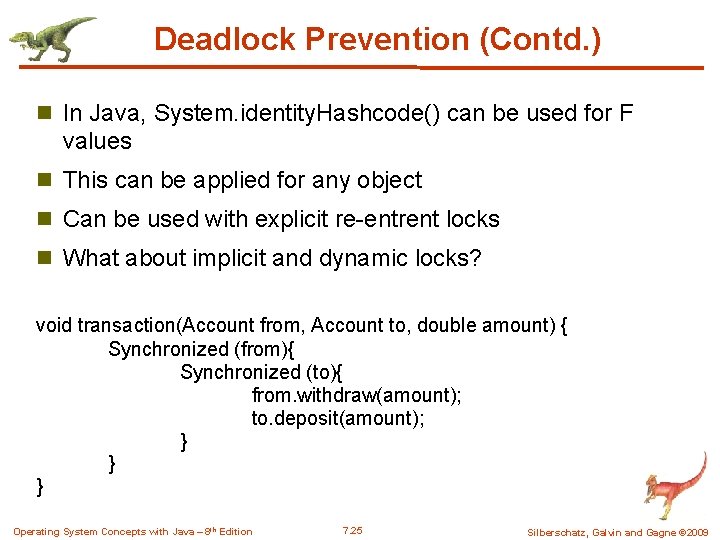
Deadlock Prevention (Contd. ) n In Java, System. identity. Hashcode() can be used for F values n This can be applied for any object n Can be used with explicit re-entrent locks n What about implicit and dynamic locks? void transaction(Account from, Account to, double amount) { Synchronized (from){ Synchronized (to){ from. withdraw(amount); to. deposit(amount); } } } Operating System Concepts with Java – 8 th Edition 7. 25 Silberschatz, Galvin and Gagne © 2009
Deadlock Avoidance n Deadlock prevention protocols are static and lead to low resource utilization n Deadlock avoidance is more dynamic – allows the system to allocate or deny requested resources n Several different type of models n Most intuitive model -- Requires processes to declare maximum number of instances of each resource type that it is going to ever request l Resource allocator will check for violations Operating System Concepts with Java – 8 th Edition 7. 26 Silberschatz, Galvin and Gagne © 2009
Deadlock Avoidance (Contd. ) n When a process makes a request for one or more resources l DA algorithm dynamically examines the current state to ensure that circular-wait condition can never occur n Resource-allocation state is defined by the number of available and allocated resources, and the maximum demands of the processes n When a process requests an available resource, system must decide if immediate allocation leaves the system in a safe state. Operating System Concepts with Java – 8 th Edition 7. 27 Silberschatz, Galvin and Gagne © 2009
Safe State n System is in safe state if there exists at least one sequence <P 1, P 2, …, Pn> of ALL the processes is the systems such that for each Pi, the resources that Pi can still request can be satisfied by currently available resources + resources held by all the Pj, with j < I n That is: l If Pi resource needs are not immediately available, then Pi can wait until all Pj have finished l When Pj is finished, Pi can obtain needed resources, execute, return allocated resources, and terminate l When Pi terminates, Pi +1 can obtain its needed resources, and so on Operating System Concepts with Java – 8 th Edition 7. 28 Silberschatz, Galvin and Gagne © 2009
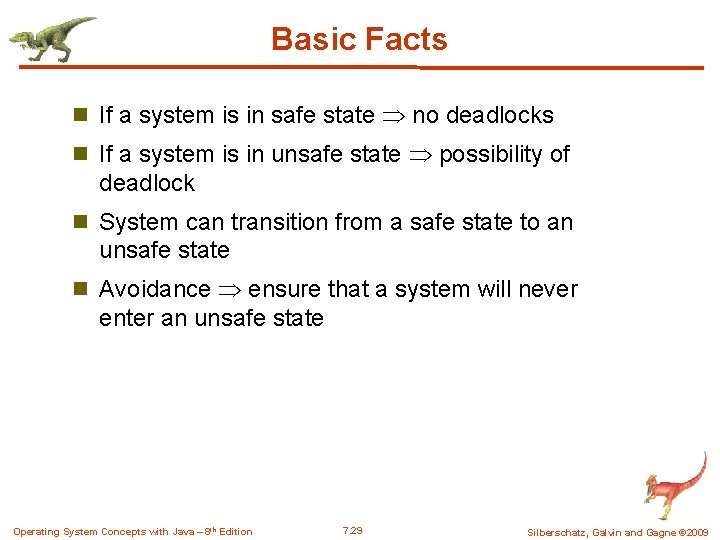
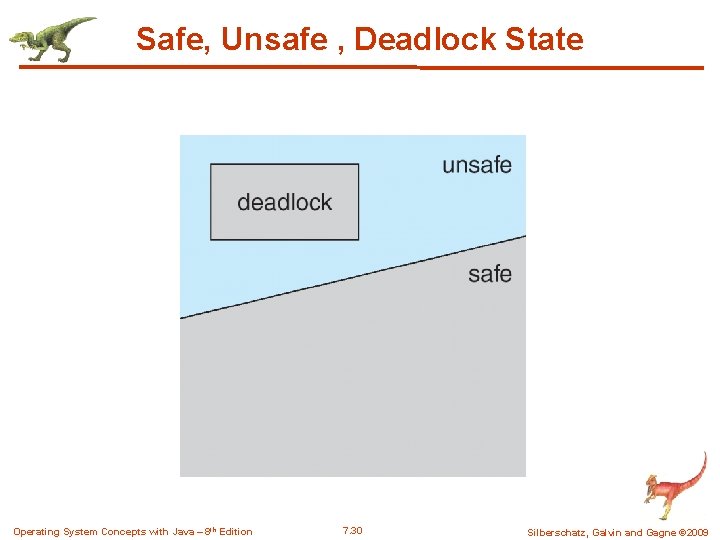
Basic Facts n If a system is in safe state no deadlocks n If a system is in unsafe state possibility of deadlock n System can transition from a safe state to an unsafe state n Avoidance ensure that a system will never enter an unsafe state Operating System Concepts with Java – 8 th Edition 7. 29 Silberschatz, Galvin and Gagne © 2009
Safe, Unsafe , Deadlock State Operating System Concepts with Java – 8 th Edition 7. 30 Silberschatz, Galvin and Gagne © 2009
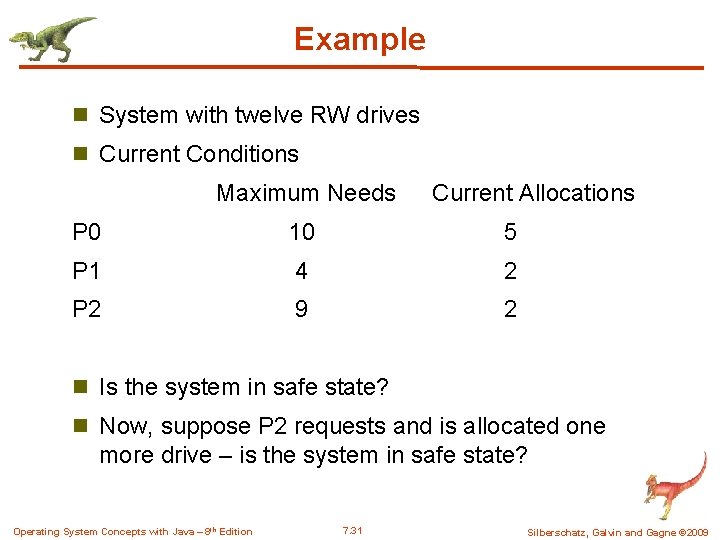
Example n System with twelve RW drives n Current Conditions Maximum Needs Current Allocations P 0 10 5 P 1 4 2 P 2 9 2 n Is the system in safe state? n Now, suppose P 2 requests and is allocated one more drive – is the system in safe state? Operating System Concepts with Java – 8 th Edition 7. 31 Silberschatz, Galvin and Gagne © 2009
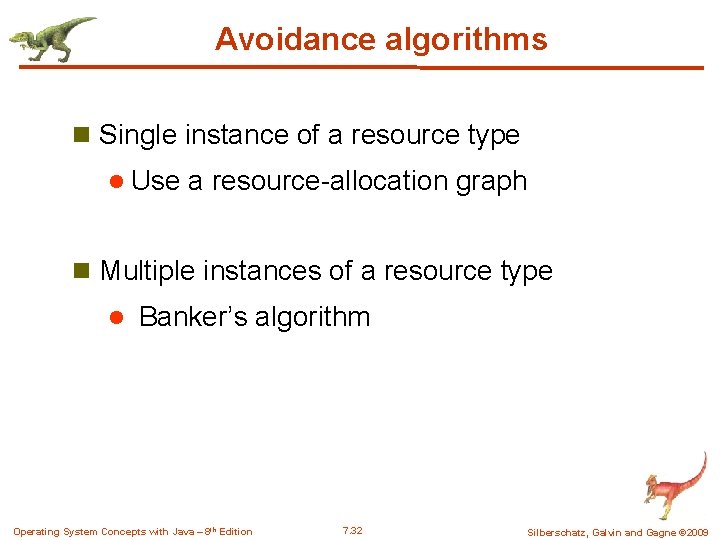
Avoidance algorithms n Single instance of a resource type l Use a resource-allocation graph n Multiple instances of a resource type l Banker’s algorithm Operating System Concepts with Java – 8 th Edition 7. 32 Silberschatz, Galvin and Gagne © 2009
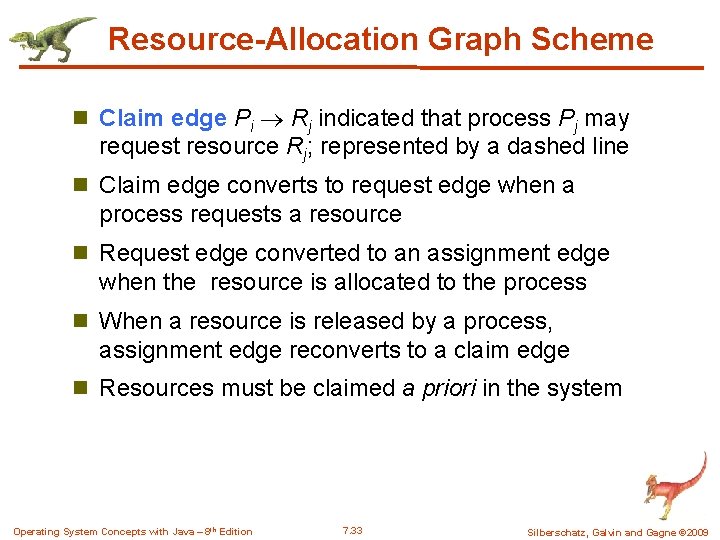
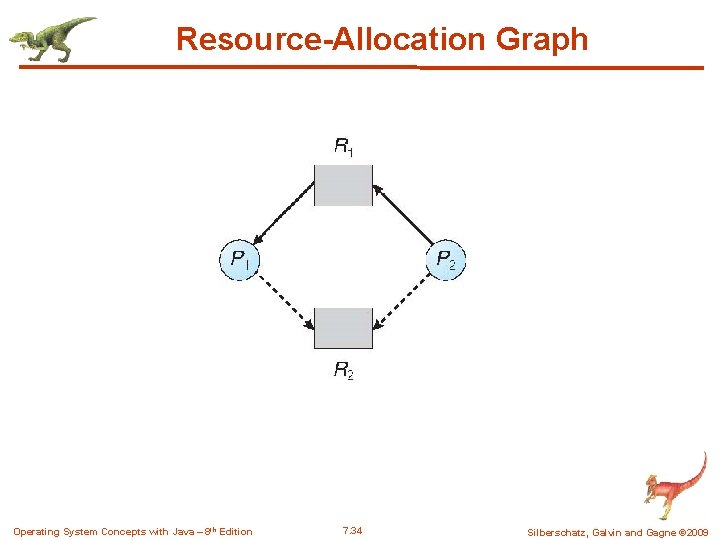
Resource-Allocation Graph Scheme n Claim edge Pi Rj indicated that process Pj may request resource Rj; represented by a dashed line n Claim edge converts to request edge when a process requests a resource n Request edge converted to an assignment edge when the resource is allocated to the process n When a resource is released by a process, assignment edge reconverts to a claim edge n Resources must be claimed a priori in the system Operating System Concepts with Java – 8 th Edition 7. 33 Silberschatz, Galvin and Gagne © 2009
Resource-Allocation Graph Operating System Concepts with Java – 8 th Edition 7. 34 Silberschatz, Galvin and Gagne © 2009
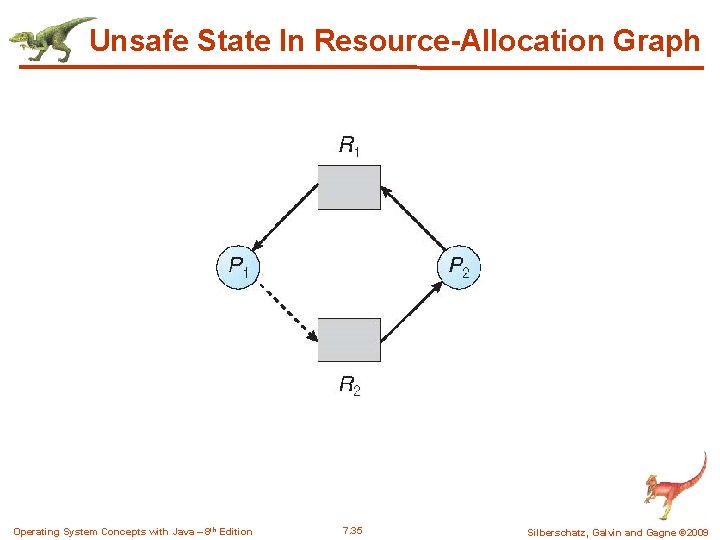
Unsafe State In Resource-Allocation Graph Operating System Concepts with Java – 8 th Edition 7. 35 Silberschatz, Galvin and Gagne © 2009
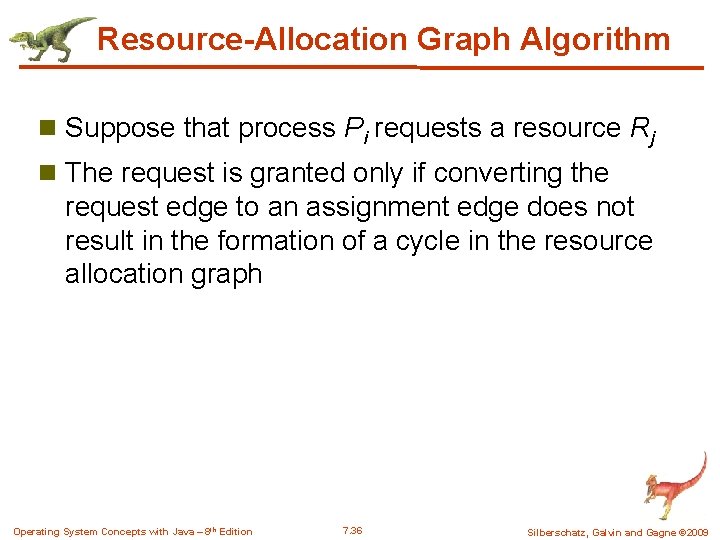
Resource-Allocation Graph Algorithm n Suppose that process Pi requests a resource Rj n The request is granted only if converting the request edge to an assignment edge does not result in the formation of a cycle in the resource allocation graph Operating System Concepts with Java – 8 th Edition 7. 36 Silberschatz, Galvin and Gagne © 2009
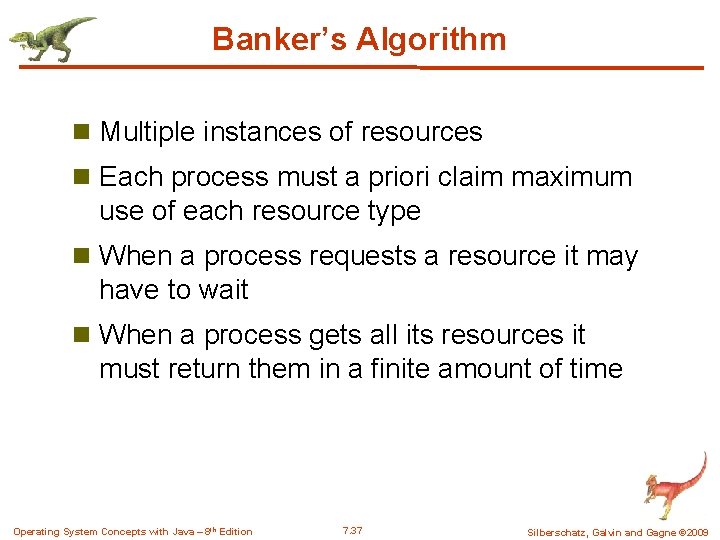
Banker’s Algorithm n Multiple instances of resources n Each process must a priori claim maximum use of each resource type n When a process requests a resource it may have to wait n When a process gets all its resources it must return them in a finite amount of time Operating System Concepts with Java – 8 th Edition 7. 37 Silberschatz, Galvin and Gagne © 2009
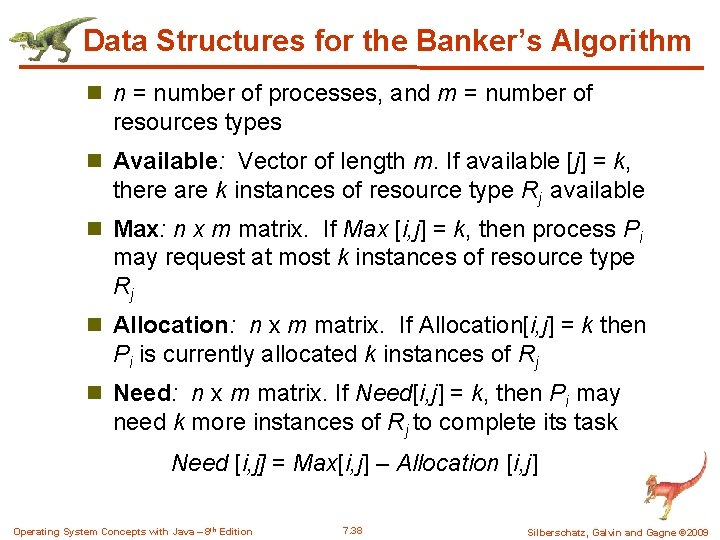
Data Structures for the Banker’s Algorithm n n = number of processes, and m = number of resources types n Available: Vector of length m. If available [j] = k, there are k instances of resource type Rj available n Max: n x m matrix. If Max [i, j] = k, then process Pi may request at most k instances of resource type Rj n Allocation: n x m matrix. If Allocation[i, j] = k then Pi is currently allocated k instances of Rj n Need: n x m matrix. If Need[i, j] = k, then Pi may need k more instances of Rj to complete its task Need [i, j] = Max[i, j] – Allocation [i, j] Operating System Concepts with Java – 8 th Edition 7. 38 Silberschatz, Galvin and Gagne © 2009
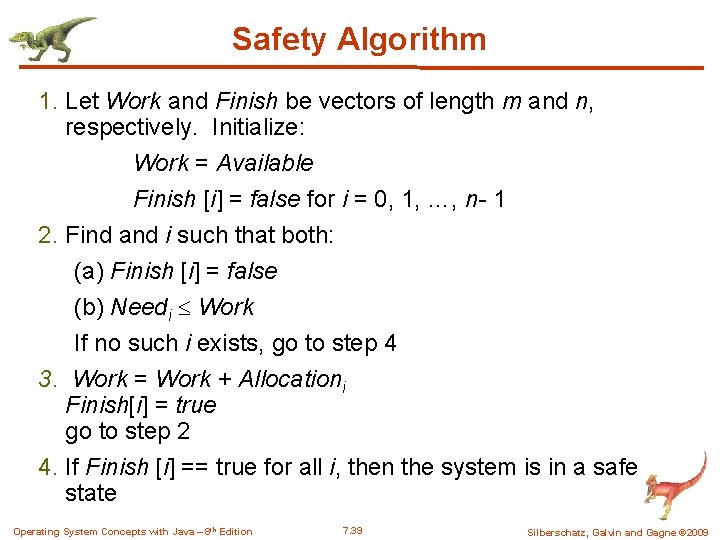
Safety Algorithm 1. Let Work and Finish be vectors of length m and n, respectively. Initialize: Work = Available Finish [i] = false for i = 0, 1, …, n- 1 2. Find and i such that both: (a) Finish [i] = false (b) Needi Work If no such i exists, go to step 4 3. Work = Work + Allocationi Finish[i] = true go to step 2 4. If Finish [i] == true for all i, then the system is in a safe state Operating System Concepts with Java – 8 th Edition 7. 39 Silberschatz, Galvin and Gagne © 2009
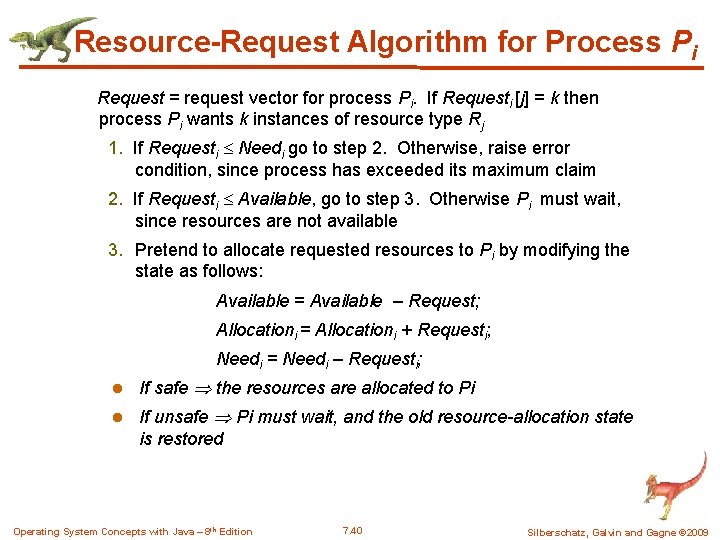
Resource-Request Algorithm for Process Pi Request = request vector for process Pi. If Requesti [j] = k then process Pi wants k instances of resource type Rj 1. If Requesti Needi go to step 2. Otherwise, raise error condition, since process has exceeded its maximum claim 2. If Requesti Available, go to step 3. Otherwise Pi must wait, since resources are not available 3. Pretend to allocate requested resources to Pi by modifying the state as follows: Available = Available – Request; Allocationi = Allocationi + Requesti; Needi = Needi – Requesti; l If safe the resources are allocated to Pi l If unsafe Pi must wait, and the old resource-allocation state is restored Operating System Concepts with Java – 8 th Edition 7. 40 Silberschatz, Galvin and Gagne © 2009
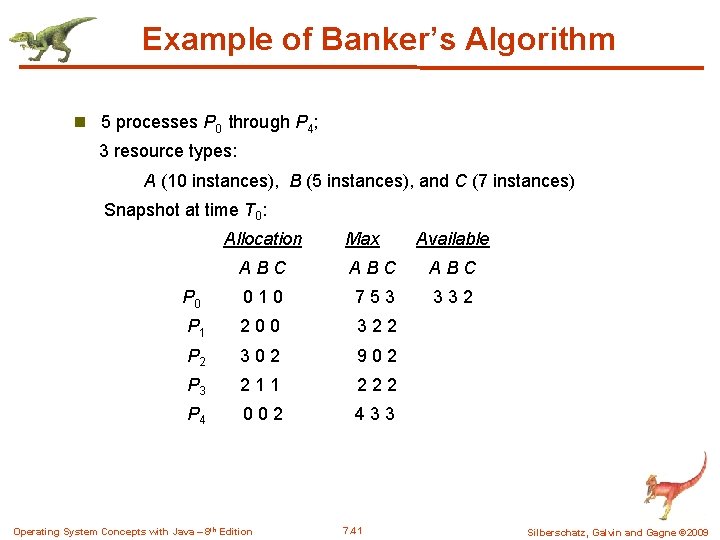
Example of Banker’s Algorithm n 5 processes P 0 through P 4; 3 resource types: A (10 instances), B (5 instances), and C (7 instances) Snapshot at time T 0: Allocation Max Available ABC ABC P 0 010 753 332 P 1 200 322 P 2 302 902 P 3 211 222 P 4 002 433 Operating System Concepts with Java – 8 th Edition 7. 41 Silberschatz, Galvin and Gagne © 2009
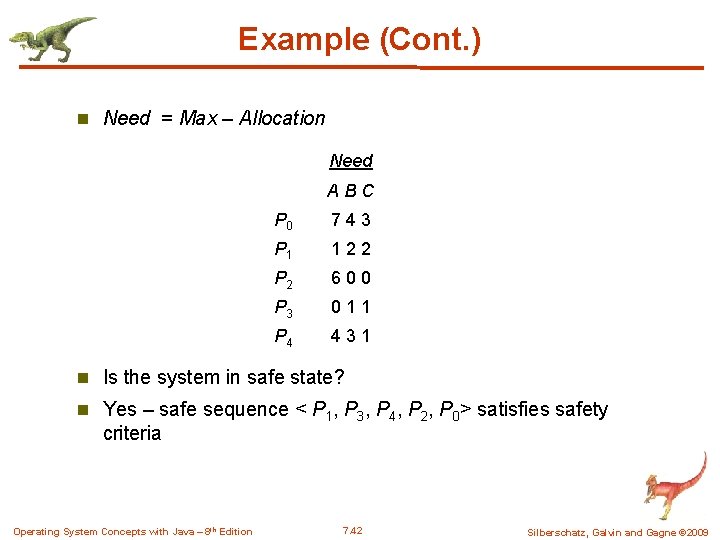
Example (Cont. ) n Need = Max – Allocation Need ABC P 0 743 P 1 122 P 2 600 P 3 011 P 4 431 n Is the system in safe state? n Yes – safe sequence < P 1, P 3, P 4, P 2, P 0> satisfies safety criteria Operating System Concepts with Java – 8 th Edition 7. 42 Silberschatz, Galvin and Gagne © 2009
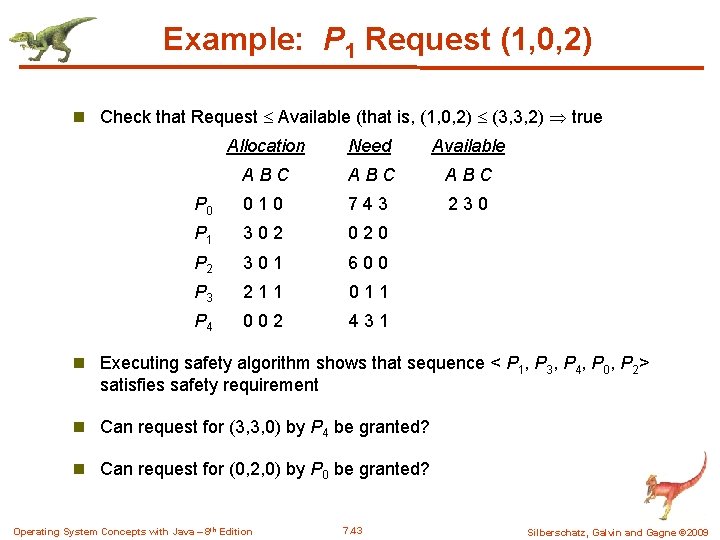
Example: P 1 Request (1, 0, 2) n Check that Request Available (that is, (1, 0, 2) (3, 3, 2) true Allocation Need Available ABC ABC P 0 010 743 230 P 1 302 020 P 2 301 600 P 3 211 011 P 4 002 431 n Executing safety algorithm shows that sequence < P 1, P 3, P 4, P 0, P 2> satisfies safety requirement n Can request for (3, 3, 0) by P 4 be granted? n Can request for (0, 2, 0) by P 0 be granted? Operating System Concepts with Java – 8 th Edition 7. 43 Silberschatz, Galvin and Gagne © 2009
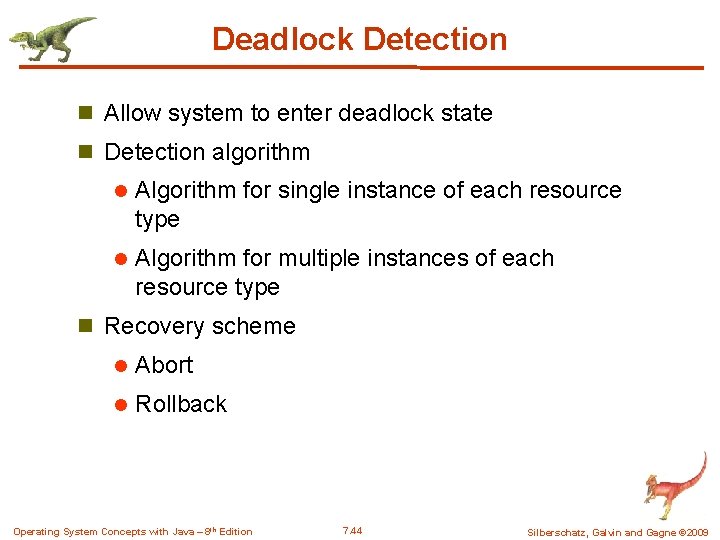
Deadlock Detection n Allow system to enter deadlock state n Detection algorithm l Algorithm for single instance of each resource type l Algorithm for multiple instances of each resource type n Recovery scheme l Abort l Rollback Operating System Concepts with Java – 8 th Edition 7. 44 Silberschatz, Galvin and Gagne © 2009
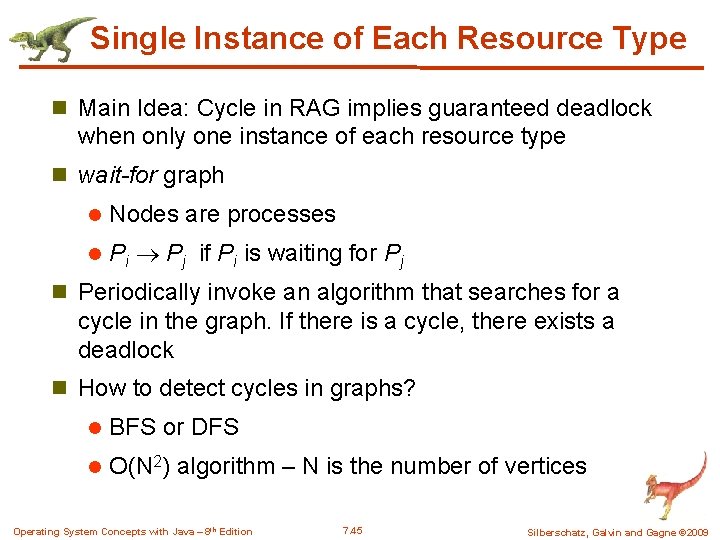
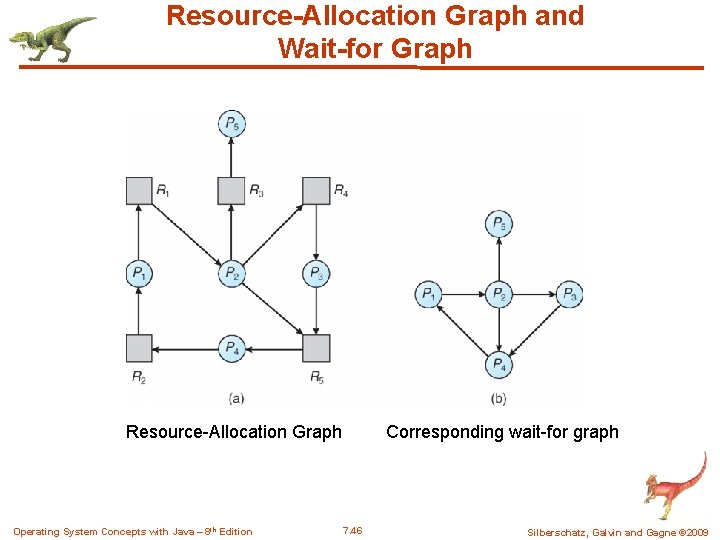
Single Instance of Each Resource Type n Main Idea: Cycle in RAG implies guaranteed deadlock when only one instance of each resource type n wait-for graph l Nodes are processes l Pi Pj if Pi is waiting for Pj n Periodically invoke an algorithm that searches for a cycle in the graph. If there is a cycle, there exists a deadlock n How to detect cycles in graphs? l BFS or DFS l O(N 2) algorithm – N is the number of vertices Operating System Concepts with Java – 8 th Edition 7. 45 Silberschatz, Galvin and Gagne © 2009
Resource-Allocation Graph and Wait-for Graph Resource-Allocation Graph Operating System Concepts with Java – 8 th Edition Corresponding wait-for graph 7. 46 Silberschatz, Galvin and Gagne © 2009
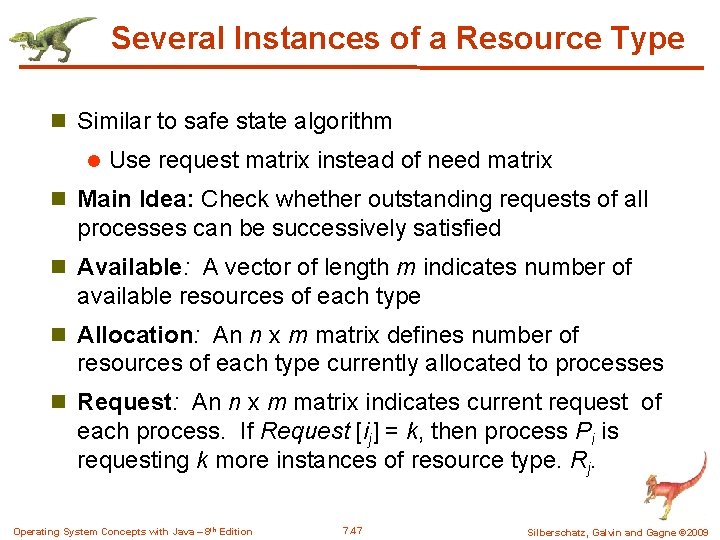
Several Instances of a Resource Type n Similar to safe state algorithm l Use request matrix instead of need matrix n Main Idea: Check whether outstanding requests of all processes can be successively satisfied n Available: A vector of length m indicates number of available resources of each type n Allocation: An n x m matrix defines number of resources of each type currently allocated to processes n Request: An n x m matrix indicates current request of each process. If Request [ij] = k, then process Pi is requesting k more instances of resource type. Rj. Operating System Concepts with Java – 8 th Edition 7. 47 Silberschatz, Galvin and Gagne © 2009
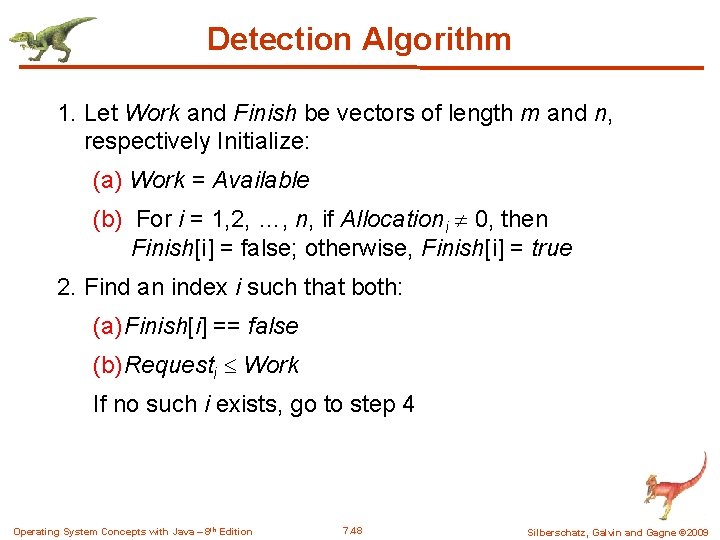
Detection Algorithm 1. Let Work and Finish be vectors of length m and n, respectively Initialize: (a) Work = Available (b) For i = 1, 2, …, n, if Allocationi 0, then Finish[i] = false; otherwise, Finish[i] = true 2. Find an index i such that both: (a)Finish[i] == false (b)Requesti Work If no such i exists, go to step 4 Operating System Concepts with Java – 8 th Edition 7. 48 Silberschatz, Galvin and Gagne © 2009
Detection Algorithm (Cont. ) 3. Work = Work + Allocationi Finish[i] = true go to step 2 4. If Finish[i] == false, for some i, 1 i n, then the system is in deadlock state. Moreover, if Finish[i] == false, then Pi is deadlocked Algorithm requires an order of O(m x n 2) operations to detect whether the system is in deadlocked state Operating System Concepts with Java – 8 th Edition 7. 49 Silberschatz, Galvin and Gagne © 2009
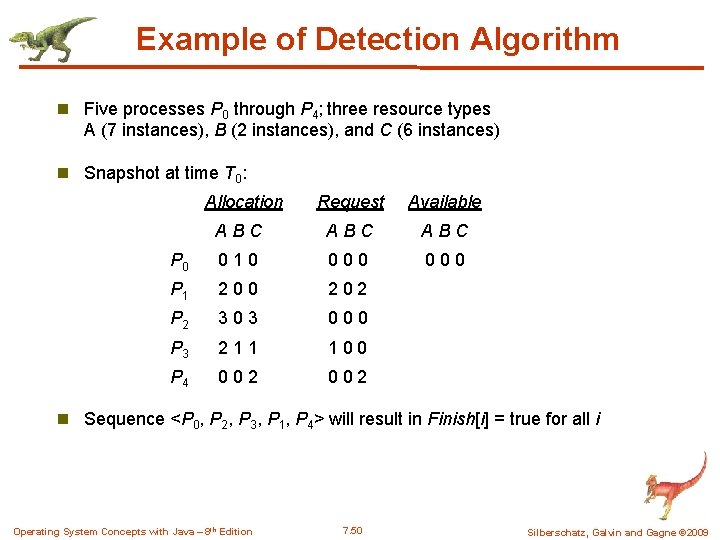
Example of Detection Algorithm n Five processes P 0 through P 4; three resource types A (7 instances), B (2 instances), and C (6 instances) n Snapshot at time T 0: Allocation Request Available ABC ABC P 0 010 000 P 1 200 202 P 2 303 000 P 3 211 100 P 4 002 n Sequence <P 0, P 2, P 3, P 1, P 4> will result in Finish[i] = true for all i Operating System Concepts with Java – 8 th Edition 7. 50 Silberschatz, Galvin and Gagne © 2009
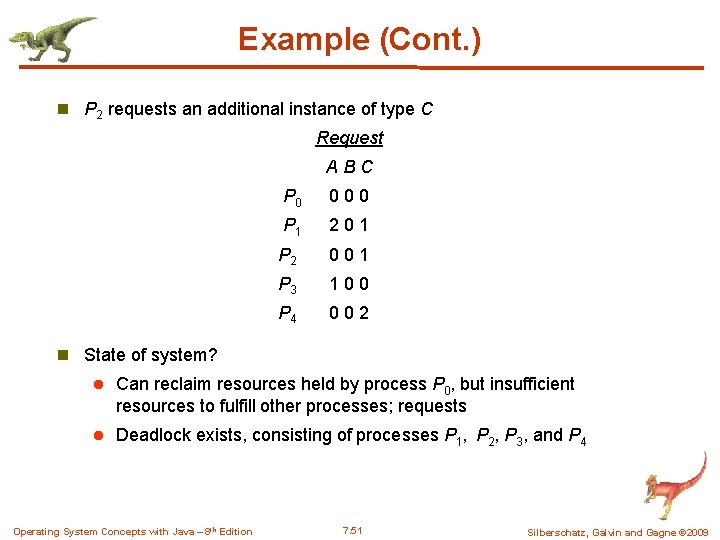
Example (Cont. ) n P 2 requests an additional instance of type C Request ABC P 0 000 P 1 201 P 2 001 P 3 100 P 4 002 n State of system? l Can reclaim resources held by process P 0, but insufficient resources to fulfill other processes; requests l Deadlock exists, consisting of processes P 1, P 2, P 3, and P 4 Operating System Concepts with Java – 8 th Edition 7. 51 Silberschatz, Galvin and Gagne © 2009
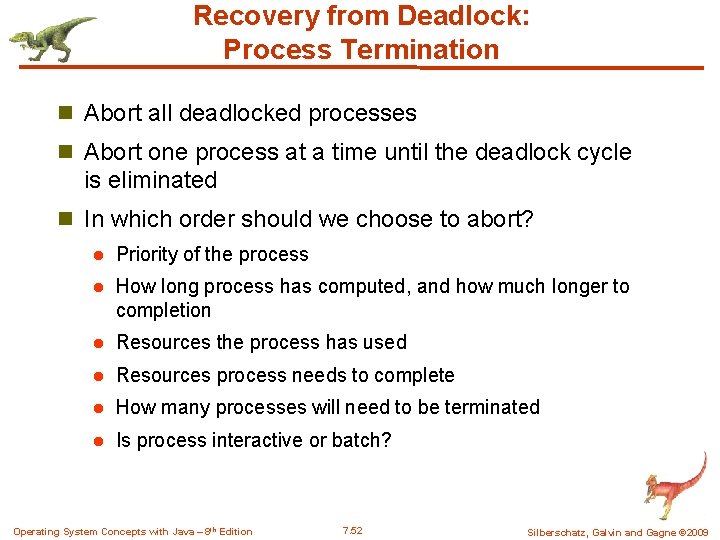
Recovery from Deadlock: Process Termination n Abort all deadlocked processes n Abort one process at a time until the deadlock cycle is eliminated n In which order should we choose to abort? l Priority of the process l How long process has computed, and how much longer to completion l Resources the process has used l Resources process needs to complete l How many processes will need to be terminated l Is process interactive or batch? Operating System Concepts with Java – 8 th Edition 7. 52 Silberschatz, Galvin and Gagne © 2009
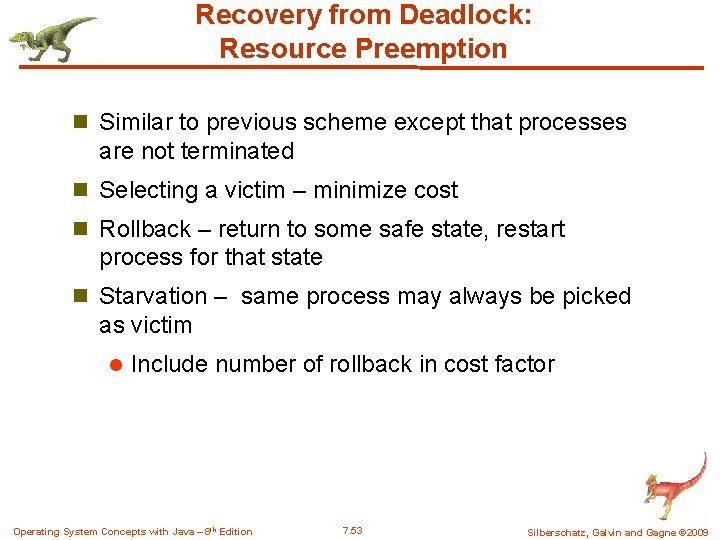
Recovery from Deadlock: Resource Preemption n Similar to previous scheme except that processes are not terminated n Selecting a victim – minimize cost n Rollback – return to some safe state, restart process for that state n Starvation – same process may always be picked as victim l Include number of rollback in cost factor Operating System Concepts with Java – 8 th Edition 7. 53 Silberschatz, Galvin and Gagne © 2009
End of Chapter 7 Operating System Concepts with Java – 8 th Edition 7. 54 Silberschatz, Galvin and Gagne © 2009