
Chapter 7 Creating High Quality Environments 2012 Cengage

- Slides: 16
Chapter 7 Creating High Quality Environments © 2012 Cengage Learning. All Rights Reserved.
What Determines Program Quality? • Researchers have identified three factors that are associated with quality programs: – Small group size – Low teacher/child ratios – Teacher preparation and qualifications © 2012 Cengage Learning. All Rights Reserved.
Locating High-Quality Programs • Resource and referral agencies (R&Rs) are located throughout the country to assist families in locating early childhood programs. • Families must determine which program best meets their needs. © 2012 Cengage Learning. All Rights Reserved.
Program Accreditation • Several professional organizations recognize exceptional programs – Each organization has established its own standards and review criteria. – Participation is usually voluntary and requires a combination of self-study and program review. © 2012 Cengage Learning. All Rights Reserved.
Licensing…… • There are no uniform national standards. • Each state establishes and enforces its own regulations. – What are the advantages and disadvantages of this approach? – What is the objective of state licensing? • Some programs are exempt from state licensing requirements. © 2012 Cengage Learning. All Rights Reserved.
Licensing (continued) • Areas that are commonly examined as part of the licensing process include – Teacher qualifications – Staffing ratios – Group size – Curriculum plans – Emergency services (plans, policies, protection) © 2012 Cengage Learning. All Rights Reserved.
Learn More about the Licensing Regulations in Your State Click on the link below: National Resource Center for Health & Safety in Child Care & Early Education http: //nrckids. org/STATES/states. htm © 2012 Cengage Learning. All Rights Reserved.
Indoor Safety • Teachers have an ethical and professional obligation to safeguard children’s safety and well-being – Young children are especially vulnerable to hazards in their environment – Young children have limited ability to recognize unsafe conditions © 2012 Cengage Learning. All Rights Reserved.
Indoor Safety (continued) • When creating safe indoor environments, special attention should be given to: – Building location and adequate space – Room arrangement – Building security (Table 7 -2) – Fire safety and evacuation plans (Table 7 -3) – Bathroom facilities and sanitation – Lighting, ventilation and air quality (Table 7 -5) © 2012 Cengage Learning. All Rights Reserved.
Outdoor Safety • When outdoor environments are carefully planned and supervised they provide all children with unique learning opportunities. – Safe outdoor play areas reduce the risk of unintentional injury and liability issues. – They are also less stressful for teachers to monitor. © 2012 Cengage Learning. All Rights Reserved.
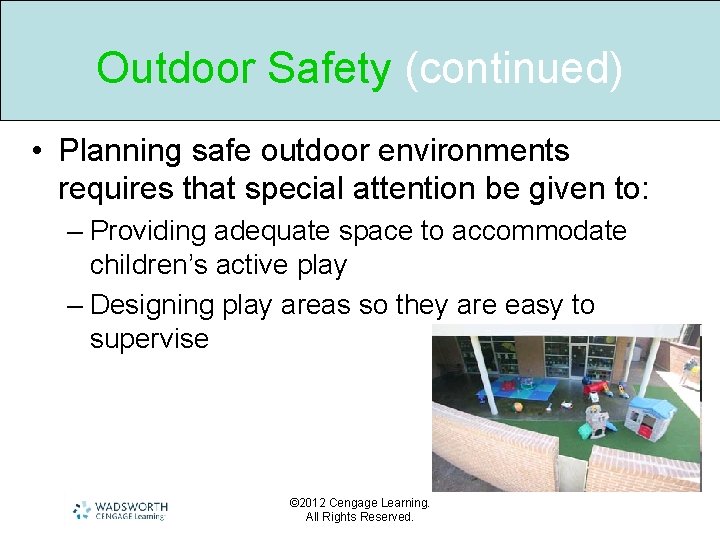
Outdoor Safety (continued) • Planning safe outdoor environments requires that special attention be given to: – Providing adequate space to accommodate children’s active play – Designing play areas so they are easy to supervise © 2012 Cengage Learning. All Rights Reserved.
Outdoor Safety (continued) – Selecting play equipment that is developmentally appropriate, safely constructed, properly installed and accessible to all children (Tables 7 -7 and 7 -9) – Eliminating poisonous plants and vegetation – Maintaining play equipment and surface materials in safe condition – Supervising children’s play at all times © 2012 Cengage Learning. All Rights Reserved.
Transportation • When programs transport children: – Children’s safety must always be a major concern. – Programs should be aware of insurance and liability issues. – Vehicles should be equipped with proper safety seats, seat restraints and fire extinguisher. © 2012 Cengage Learning. All Rights Reserved.
Transportation Facts • Motor vehicle injuries are the leading cause of death for children under 14 years in the U. S. (National Center for Health Statistics, 2008). • In 2008, 1347 children under 14 years of age died as occupants in motor vehicle crashes; 168, 000 were injured. That’s an average of 4 deaths and 529 injuries each day (NHTSA 2008). © 2012 Cengage Learning. All Rights Reserved.
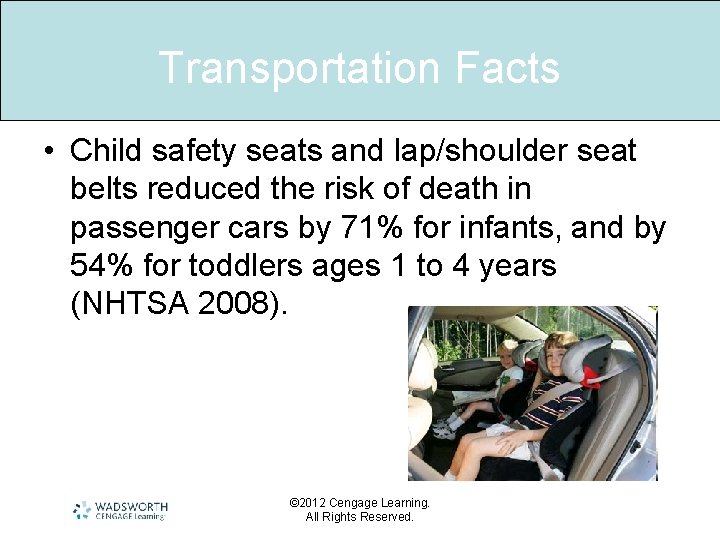
Transportation Facts • Child safety seats and lap/shoulder seat belts reduced the risk of death in passenger cars by 71% for infants, and by 54% for toddlers ages 1 to 4 years (NHTSA 2008). © 2012 Cengage Learning. All Rights Reserved.
Transportation (continued) • The use of privately-owned vehicles should be discouraged to limit a program’s liability. If they are used: – Drivers should possess the appropriate license and be insured. – Vehicles should be inspected for safety. – Travel plans should be developed, reviewed, left with the director, and followed precisely. © 2012 Cengage Learning. All Rights Reserved.