
Chapter 7 Consumer Attitude Formation and Change Consumer
- Slides: 24
Chapter 7 Consumer Attitude Formation and Change Consumer Behaviour Canadian Edition Schiffman/Kanuk/Das Copyright © 2006 Pearson Education Canada Inc.
Opening Vignette q The impact of SARS on tourism - real risk was low, but perceived risk was high - led to negative attitude towards Canada, especially Toronto q Attitude change through - value-expressive appeals - use of celebrities Copyright © 2006 Pearson Education Canada Inc. 7 -2
Attitudes n A learned predisposition to behave in a consistently favorable or unfavorable manner with respect to a given object n A positive attitude is generally a necessary, but not sufficient, condition for purchase – Mercedes seen as ‘top of class’ but intention to purchase was low Copyright © 2006 Pearson Education Canada Inc. 7 -3
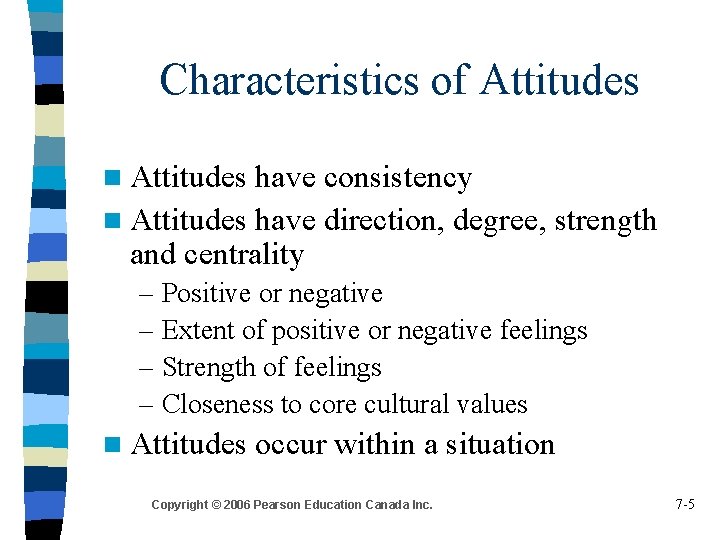
Characteristics of Attitudes n Attitudes have an “object” n Attitudes are learned – Can ‘unlearn’ n Attitudes have behavioural, evaluative and affective components – Predisposition to act – Overall evaluation – Positive or negative feelings » continued Copyright © 2006 Pearson Education Canada Inc. 7 -4
Characteristics of Attitudes n Attitudes have consistency n Attitudes have direction, degree, strength and centrality – Positive or negative – Extent of positive or negative feelings – Strength of feelings – Closeness to core cultural values n Attitudes occur within a situation Copyright © 2006 Pearson Education Canada Inc. 7 -5
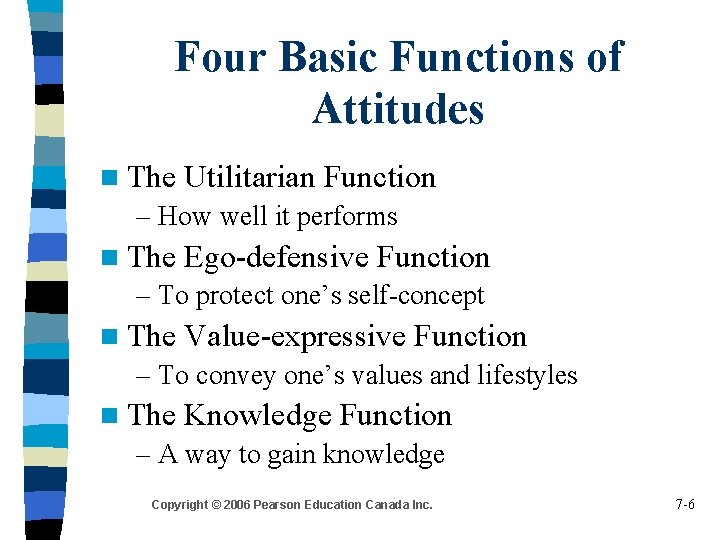
Four Basic Functions of Attitudes n The Utilitarian Function – How well it performs n The Ego-defensive Function – To protect one’s self-concept n The Value-expressive Function – To convey one’s values and lifestyles n The Knowledge Function – A way to gain knowledge Copyright © 2006 Pearson Education Canada Inc. 7 -6
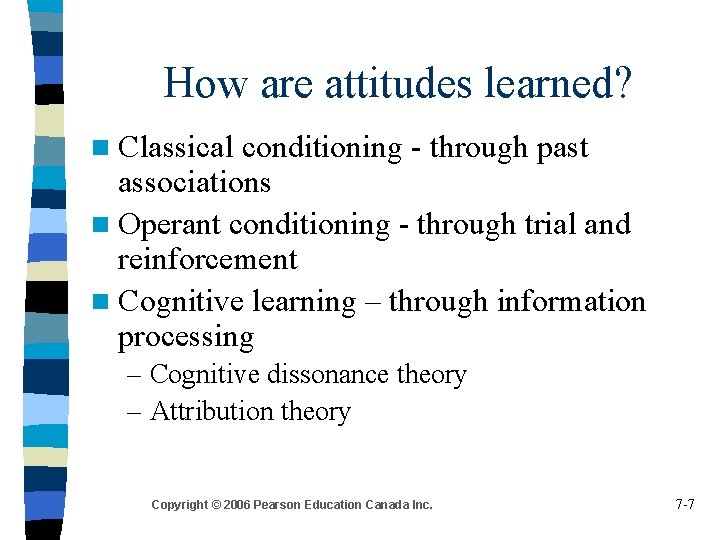
How are attitudes learned? n Classical conditioning - through past associations n Operant conditioning - through trial and reinforcement n Cognitive learning – through information processing – Cognitive dissonance theory – Attribution theory Copyright © 2006 Pearson Education Canada Inc. 7 -7
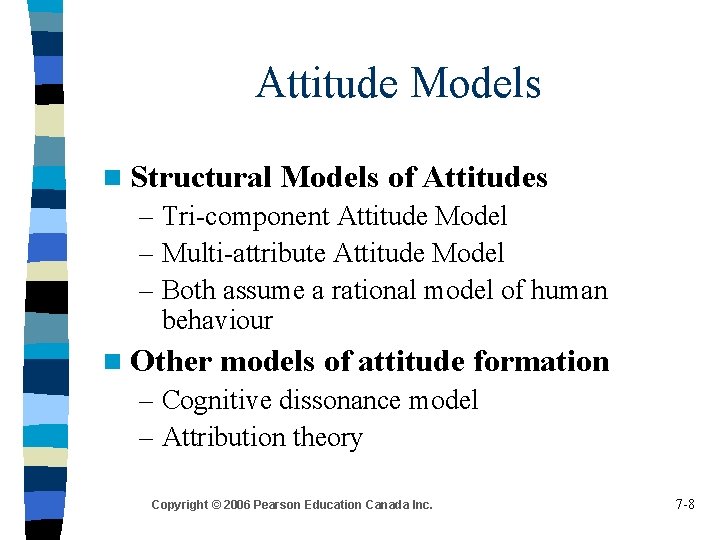
Attitude Models n Structural Models of Attitudes – Tri-component Attitude Model – Multi-attribute Attitude Model – Both assume a rational model of human behaviour n Other models of attitude formation – Cognitive dissonance model – Attribution theory Copyright © 2006 Pearson Education Canada Inc. 7 -8
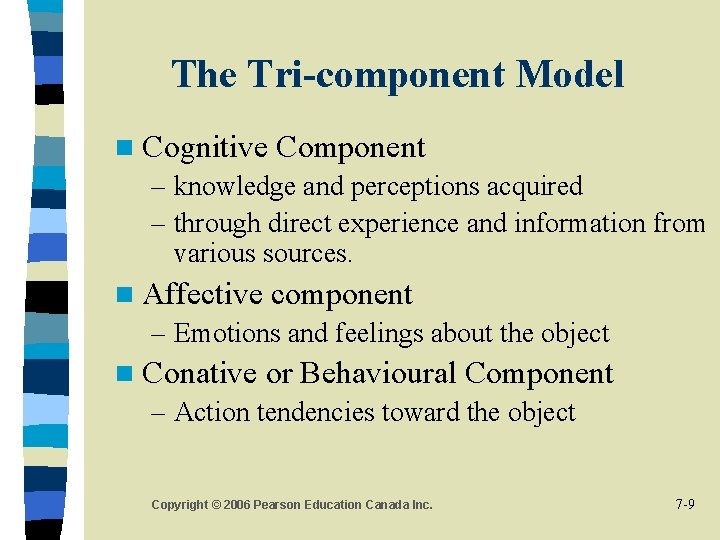
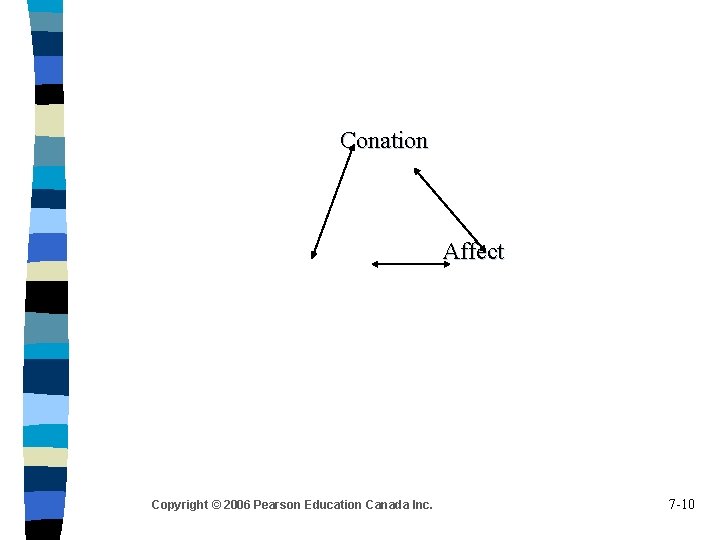
The Tri-component Model n Cognitive Component – knowledge and perceptions acquired – through direct experience and information from various sources. n Affective component – Emotions and feelings about the object n Conative or Behavioural Component – Action tendencies toward the object Copyright © 2006 Pearson Education Canada Inc. 7 -9
Conation Cognition Copyright © 2006 Pearson Education Canada Inc. Affect 7 -10
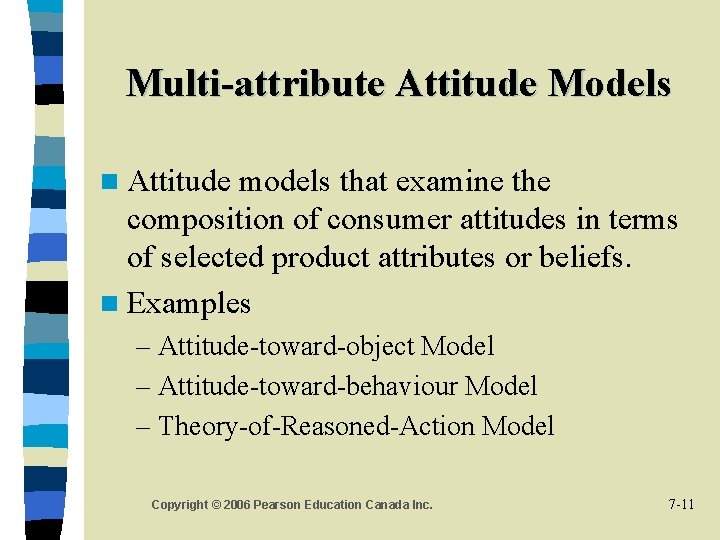
Multi-attribute Attitude Models n Attitude models that examine the composition of consumer attitudes in terms of selected product attributes or beliefs. n Examples – Attitude-toward-object Model – Attitude-toward-behaviour Model – Theory-of-Reasoned-Action Model Copyright © 2006 Pearson Education Canada Inc. 7 -11
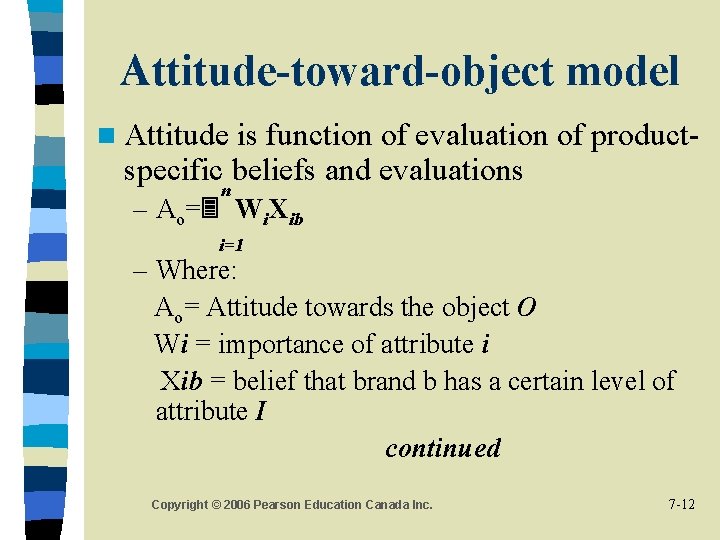
Attitude-toward-object model n Attitude is function of evaluation of productspecificnbeliefs and evaluations – Ao= Wi. Xib i=1 – Where: Ao= Attitude towards the object O Wi = importance of attribute i Xib = belief that brand b has a certain level of attribute I continued Copyright © 2006 Pearson Education Canada Inc. 7 -12
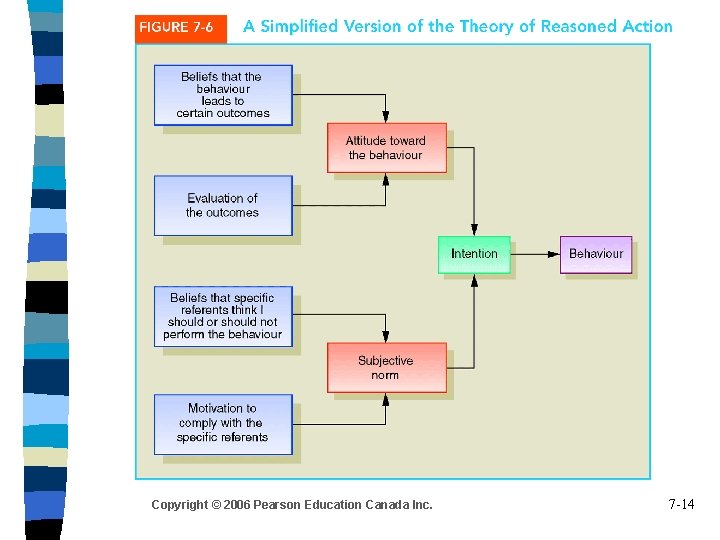
Theory of Reasoned Action – A comprehensive theory of the interrelationship among attitudes, intentions, and behaviour Copyright © 2006 Pearson Education Canada Inc. 7 -13
Copyright © 2006 Pearson Education Canada Inc. 7 -14
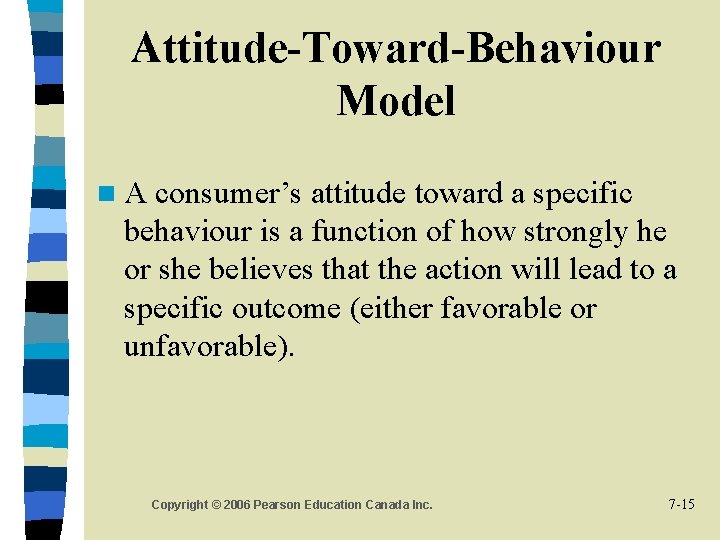
Attitude-Toward-Behaviour Model n. A consumer’s attitude toward a specific behaviour is a function of how strongly he or she believes that the action will lead to a specific outcome (either favorable or unfavorable). Copyright © 2006 Pearson Education Canada Inc. 7 -15
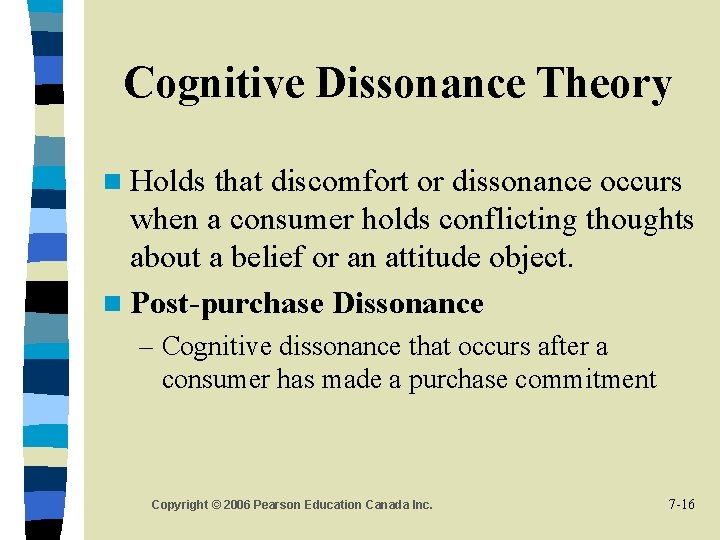
Cognitive Dissonance Theory n Holds that discomfort or dissonance occurs when a consumer holds conflicting thoughts about a belief or an attitude object. n Post-purchase Dissonance – Cognitive dissonance that occurs after a consumer has made a purchase commitment Copyright © 2006 Pearson Education Canada Inc. 7 -16
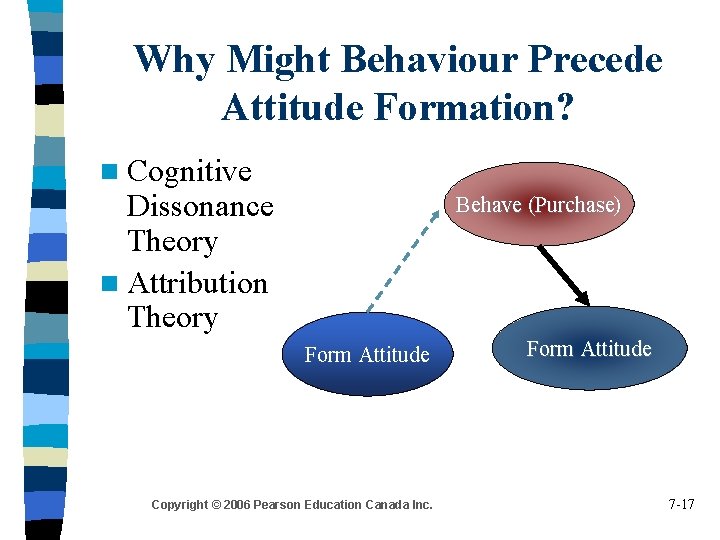
Why Might Behaviour Precede Attitude Formation? n Cognitive Dissonance Theory n Attribution Theory Behave (Purchase) Form Attitude Copyright © 2006 Pearson Education Canada Inc. Form Attitude 7 -17
Attribution Theory n Examines how people assign casualty to events and form or alter their attitudes as an outcome of assessing their own or other people’s behaviour. n Examples – Self-perception Theory – Attribution toward others Copyright © 2006 Pearson Education Canada Inc. 7 -18
Self-Perception Theory n Attitudes developed by reflecting on their own behaviour n Judgments about own behaviour n Internal and external attributions » Continued Copyright © 2006 Pearson Education Canada Inc. 7 -19
Self-Perception Theory n Consumers are likely to accept credit for successful outcomes (internal attribution) and to blame other persons or products for failure (external attribution). n Foot-In-The-Door Technique Copyright © 2006 Pearson Education Canada Inc. 7 -20
How We Test Our Attributions n Distinctiveness n Consistency over time n Consistency over modality n Consensus Copyright © 2006 Pearson Education Canada Inc. 7 -21
Attitudes and Marketing Strategy n Appeal to motivational functions of attitudes n Associate product with a special group, cause or event n Resolve conflicts among attitudes n Influence consumer attributions » Continued Copyright © 2006 Pearson Education Canada Inc. 7 -22
Attitudes and Marketing Strategy n Alter components of the attitude – Change relative evaluation of attributes – Change brand beliefs – Add an attribute – Change overall brand evaluation n Change beliefs about competitors’ brands » Continued Copyright © 2006 Pearson Education Canada Inc. 7 -23
Attitudes and Marketing Strategy n Change affect first through classical conditioning n Change behaviour first through operant conditioning Copyright © 2006 Pearson Education Canada Inc. 7 -24