
Chapter 7 Competitive Advantage with Information Systems within


- Slides: 23
Chapter 7 Competitive Advantage with Information Systems within Organizations © 2008 Pearson Prentice Hall, Experiencing MIS, David Kroenke
Study Questions l l l l 7 -2 How do organizations gain a competitive advantage using IS inside the organization? What are three fundamental types of information systems within organizations? How do functional systems relate to the value chain? What are the basic types of functional systems? What are the problems of functional systems? How do cross-functional systems relate to the value chain? How does knowledge from this chapter help you at DSI? © 2008 Pearson Prentice Hall, Experiencing MIS, David Kroenke
Achieving Competitive Advantage l l l Businesses determine competitive strategies Create processes to achieve strategies Information systems developed to support business processes – – 7 -3 Help organizations achieve competitive advantage Need to avoid creating systems that are unrelated to organization’s strategy © 2008 Pearson Prentice Hall, Experiencing MIS, David Kroenke
Fundamental Types of Information Systems within Organizations l l l 7 -4 Calculation systems Functional systems Cross-functional systems © 2008 Pearson Prentice Hall, Experiencing MIS, David Kroenke
Calculation Systems l l l 7 -5 Antiquated system Relieved workers of repetitive calculations Labor-saving devices Produced little information Examples: systems that computed payroll and wrote paychecks; inventory tracking © 2008 Pearson Prentice Hall, Experiencing MIS, David Kroenke
Functional Systems l l l Facilitates work of single department or function Functions added to calculation system programs to provide more value Islands of automation – – – l 7 -6 Work independently from each other Effective as independent functions Inefficient working in cooperation with other processes across entire business Examples: human resources; financial reporting © 2008 Pearson Prentice Hall, Experiencing MIS, David Kroenke
Integrated, Cross-Functional Systems l Cross-department systems operate across departmental boundaries – l Process-based systems support complete business processes – – 7 -7 Increased functionality Integrated processing systems are more efficient Needs clear line of authority © 2008 Pearson Prentice Hall, Experiencing MIS, David Kroenke
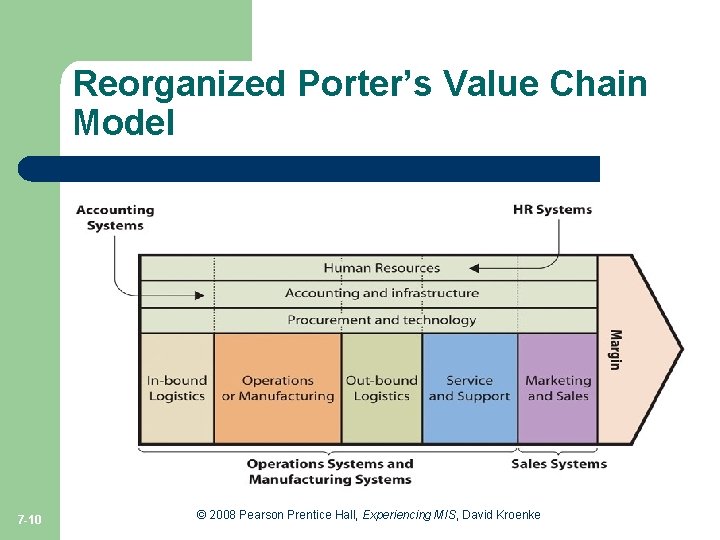
Value Chain Activities l Primary activities – Relate directly to organization’s customers and products l l l 7 -8 Marketing and sales Inbound logistics Operations and manufacturing Outbound logistics Service and support © 2008 Pearson Prentice Hall, Experiencing MIS, David Kroenke
Primary Activities – Facilitated by support activities l l 7 -9 Human resource Accounting and infrastructure Procurement Technology activities © 2008 Pearson Prentice Hall, Experiencing MIS, David Kroenke
Reorganized Porter’s Value Chain Model Figure 7 -3 7 -10 © 2008 Pearson Prentice Hall, Experiencing MIS, David Kroenke
Basic Types of Functional Systems l l l 7 -11 Marketing and Sales Systems Operations systems Manufacturing systems Human resource systems Accounting systems © 2008 Pearson Prentice Hall, Experiencing MIS, David Kroenke
Marketing and Sales Systems l Few systems support marketing – Product management l l Many systems support sales – – Blog Sales forecasting l – Used for planning production, managing inventory, financial reporting Customer management l 7 -12 Assess product marketing efforts Generate follow-on business © 2008 Pearson Prentice Hall, Experiencing MIS, David Kroenke
Operations Systems l l Used by non-manufacturing companies Key operations functional systems – – 7 -13 Order entry Order management systems Inventory management systems Customer service © 2008 Pearson Prentice Hall, Experiencing MIS, David Kroenke
Manufacturing Systems l l l Support production and planning Process data about inventories Push production planning – l Pull production planning – – l 7 -14 Organization creates schedule and pushes goods through manufacturing and sales Responds to customer demand Reduction in inventory triggers production One-off producers fall into neither category © 2008 Pearson Prentice Hall, Experiencing MIS, David Kroenke
Additional Functional Manufacturing Systems and Technologies l Manufacturing scheduling systems – l Operations systems – l Control manufacturing plants and machines Radio-frequency identification tags (RFIDs) – – 7 -15 Assist organizations to determine optimal methods Computer chips that transmit data about items Sensors connected to functional systems receive signals and record information © 2008 Pearson Prentice Hall, Experiencing MIS, David Kroenke
Human Resources Systems l l l 7 -16 Payroll Compensation systems Recruiting Assessing employee performance, skills, and training Human resource planning systems © 2008 Pearson Prentice Hall, Experiencing MIS, David Kroenke
Accounting Systems l Support organization’s accounting activities – – – – 7 -17 General ledger Financial reporting Accounts receivable Accounts payable Cost accounting Cash management Treasury management © 2008 Pearson Prentice Hall, Experiencing MIS, David Kroenke
The Sarbanes-Oxley Act of 2002 l l l Revision of Exchange Act of 1934 Enacted to prevent corporate fraud Requires management: – – l l 7 -18 Create internal controls for production of financial statements Issue statement attesting to control activities External auditor must issue opinion on quality of controls Exposes both management and external auditor to financial and criminal liability © 2008 Pearson Prentice Hall, Experiencing MIS, David Kroenke
Controls Examples l l Internal control: separation of duties and authorities All computer-based systems must have controls – – Increases burden on development of systems Assets subject to contingent liability l 7 -19 Customer information © 2008 Pearson Prentice Hall, Experiencing MIS, David Kroenke
MIS in Use: Sarbanes-Oxley: Boon or Bane? l l Goal was to upgrade financial reporting Intended to improve trust in financial reports More than 15 percent of IS will be diverted to SOx compliance No one knows exactly what is necessary for compliance – – l 7 -20 Act requires external auditors become more independent Act is vague and is often given broadest possible interpretation Potential for millions of dollars to be wasted in compliance © 2008 Pearson Prentice Hall, Experiencing MIS, David Kroenke
Functional Systems Problems l Systems provide tremendous benefits, but are limited because they operate in isolation – Data duplication results from each application having own database l – Business processes disjointed across functions l – – – 7 -21 Potential lack of data integrity Produces lack of integrated enterprise information Limited information available at any one source Inefficient decisions based on limited knowledge Increased costs to organization © 2008 Pearson Prentice Hall, Experiencing MIS, David Kroenke
Cross-Functional Systems and the Value Chain l l Cross-functional systems designed to overcome problems in functional systems Customer relationship management systems (CRM) – – – l Enterprise resource management systems (ERP) – – 7 -22 Integrates all of the primary business activities Makes the organization customer-centric All customer data stored in single database Integrates primary value chain activities with human resources and accounting Enterprise-wide systems © 2008 Pearson Prentice Hall, Experiencing MIS, David Kroenke
Active Review l l l l 7 -23 How do organizations gain a competitive advantage using IS inside the organization? What are three fundamental types of information systems within organizations? How do functional systems relate to the value chain? What are the basic types of functional systems? What are the problems of functional systems? How do cross-functional systems relate to the value chain? How does knowledge from this chapter help you at DSI? © 2008 Pearson Prentice Hall, Experiencing MIS, David Kroenke