
Chapter 7 Communication Organizational Behaviour 5 th Canadian
Chapter 7: Communication Organizational Behaviour 5 th Canadian Edition Langton / Robbins / Judge Copyright © 2010 Pearson Education Canada 7 -1
Chapter Outline • The Communication Process • Barriers to Effective Communication • Organizational Communication • Other Issues in Communication 7 -2
Communication 1. How does communication work? 2. What are the barriers to communication? 3. How does communication flow in organizations? 4. What are other issues in communication? 7 -3
The Communication Process • People spend nearly 70 percent of their waking hours communicating—writing, reading, speaking, listening • Work Canada survey of 2039 Canadians in six industrial and service categories found: – 61 percent of senior executives believed that they did a good job of communicating with employees. – Only 33 percent of managers and department heads believed that senior executives were effective communicators. – Only 22 percent of hourly workers, 27% of clerical employees, and 22% of professional staff reported that senior executives did a good job of communicating with them. • Canadians reported less favourable perceptions about their company’s communications than did Americans. Langton, Robbins and Judge, Organizational Behaviour, Fifth Cdn. Ed. Copyright © 2010 Pearson Education Canada 7 -4
Communication Terms • Communication – The transfer and understanding of a message between two or more people. • Sender – Establishes a message, encodes the message, and chooses the channel to send it. • Receiver – Decodes the message and provides feedback to the sender. Langton, Robbins and Judge, Organizational Behaviour, Fifth Cdn. Ed. Copyright © 2010 Pearson Education Canada 7 -5
Communication Terms • Encoding – Converting a message to symbolic form. • Decoding – Interpreting a sender’s message. • Message – What is communicated. • Channel – The medium through which a message travels. Langton, Robbins and Judge, Organizational Behaviour, Fifth Cdn. Ed. Copyright © 2010 Pearson Education Canada 7 -6

Exhibit 7 -1 The Communication Process Model Chooses Encodes the a message Chooses the message channel Considers the receiver Sender Receiver Considers the sender Provides feedback Decodes the message Langton, Robbins and Judge, Organizational Behaviour, Fifth Cdn. Ed. Copyright © 2010 Pearson Education Canada 7 -7
Choosing Channels • Channels differ in their capacity to convey information. • Rich channels have the ability to: – Handle multiple cues simultaneously. – Facilitate rapid feedback. – Be very personal. Langton, Robbins and Judge, Organizational Behaviour, Fifth Cdn. Ed. Copyright © 2010 Pearson Education Canada 7 -8
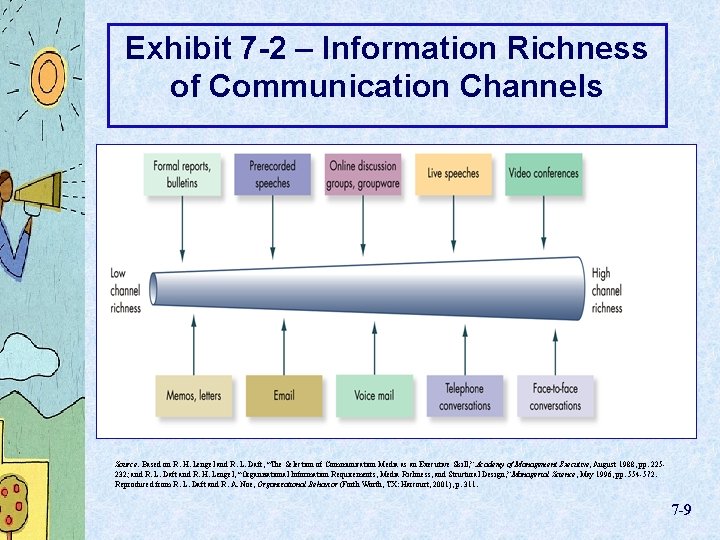
Exhibit 7 -2 – Information Richness of Communication Channels Source: Based on R. H. Lengel and R. L. Daft, “The Selection of Communication Media as an Executive Skill, ” Academy of Management Executive, August 1988, pp. 225232; and R. L. Daft and R. H. Lengel, “Organizational Information Requirements, Media Richness, and Structural Design, ” Managerial Science, May 1996, pp. 554 -572. Reproduced from R. L. Daft and R. A. Noe, Organizational Behavior (Forth Worth, TX: Harcourt, 2001), p. 311. 7 -9
Barriers to Effective Communication • Filtering – The sender manipulates information so that it will be seen more favourably by the receiver. • Selective Perception – The receivers selectively sees and hears based on their needs, motivations, experience, background, and other personal characteristics. Langton, Robbins and Judge, Organizational Behaviour, Fifth Cdn. Ed. Copyright © 2010 Pearson Education Canada 7 -10
Barriers to Effective Communication • Defensiveness – When individuals interpret a message as threatening, they often respond in ways that retard effective communication. • Information Overload – Occurs when the information we have to work with exceeds our processing capacity. • Language – Words mean different things to different people. Langton, Robbins and Judge, Organizational Behaviour, Fifth Cdn. Ed. Copyright © 2010 Pearson Education Canada 7 -11
Communicating Under Stress • Speak clearly. • Be aware of the nonverbal part of communicating. • Think carefully about how you state things. Langton, Robbins and Judge, Organizational Behaviour, Fifth Cdn. Ed. Copyright © 2010 Pearson Education Canada 7 -12
Organizational Communication – Direction of Communication • Downward – Communication that flows from one level of a group to a lower level. • Managers to employees • Upward – Communication that flows to a higher level of a group. • Employees to manager • Becoming increasingly difficult • Lateral – Communication among members of the same work group, or individuals at the same level. Langton, Robbins and Judge, Organizational Behaviour, Fifth Cdn. Ed. Copyright © 2010 Pearson Education Canada 7 -13
Networks • Connections by which information flow. – Formal Networks. • Task-related communications that follow the authority chain – The Grapevine – Informal Networks. • Communications that flow along social and relational lines Langton, Robbins and Judge, Organizational Behaviour, Fifth Cdn. Ed. Copyright © 2010 Pearson Education Canada 7 -14
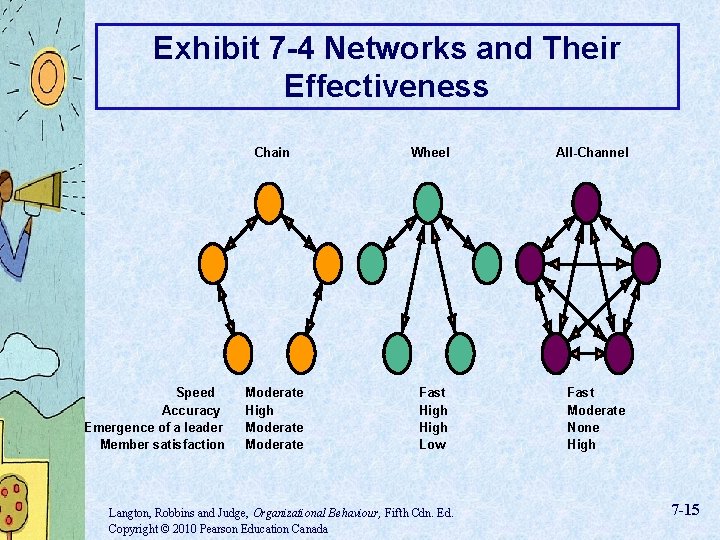
Exhibit 7 -4 Networks and Their Effectiveness Speed Accuracy Emergence of a leader Member satisfaction Chain Wheel All-Channel Moderate High Moderate Fast High Low Fast Moderate None High Langton, Robbins and Judge, Organizational Behaviour, Fifth Cdn. Ed. Copyright © 2010 Pearson Education Canada 7 -15
The Grapevine • 75 percent of employees hear about matters first through rumours on the grapevine. • The grapevine has three main characteristics: – Not controlled by management. – Most employees perceive it as being more believable and reliable than formal communication. – Largely used to serve the self-interests of those people within it. Langton, Robbins and Judge, Organizational Behaviour, Fifth Cdn. Ed. Copyright © 2010 Pearson Education Canada 7 -16
Purpose of Rumours 1. To structure and reduce anxiety 2. To make sense of limited or fragmented information 3. To serve as a vehicle to organize group members, and possibly outsiders, into coalitions 4. To signal a sender’s status or power Langton, Robbins and Judge, Organizational Behaviour, Fifth Cdn. Ed. Copyright © 2010 Pearson Education Canada 7 -17
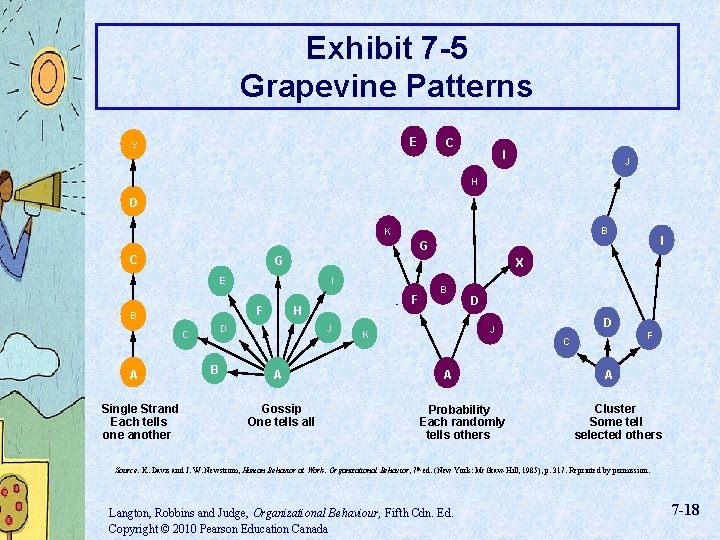
Exhibit 7 -5 Grapevine Patterns E Y C I J H D B K I G C G X E D C Single Strand Each tells one another B F H F B A I J A Gossip One tells all B D D J K F C A Probability Each randomly tells others A Cluster Some tell selected others Source: K. Davis and J. W. Newstrom, Human Behavior at Work: Organizational Behavior, 7 th ed. (New York: Mc. Graw-Hill, 1985), p. 317. Reprinted by permission. Langton, Robbins and Judge, Organizational Behaviour, Fifth Cdn. Ed. Copyright © 2010 Pearson Education Canada 7 -18
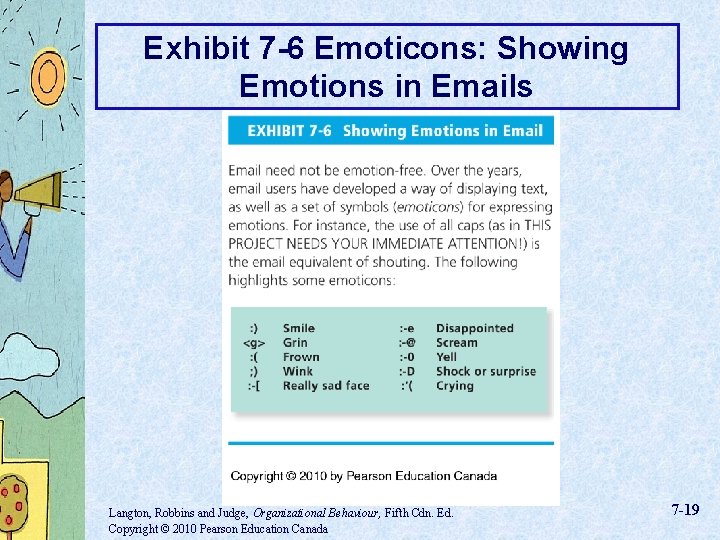
Exhibit 7 -6 Emoticons: Showing Emotions in Emails Langton, Robbins and Judge, Organizational Behaviour, Fifth Cdn. Ed. Copyright © 2010 Pearson Education Canada 7 -19
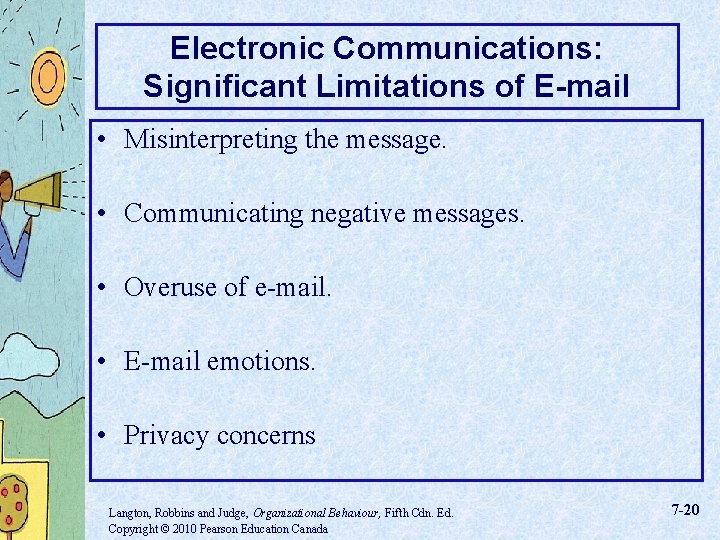
Electronic Communications: Significant Limitations of E-mail • Misinterpreting the message. • Communicating negative messages. • Overuse of e-mail. • E-mail emotions. • Privacy concerns Langton, Robbins and Judge, Organizational Behaviour, Fifth Cdn. Ed. Copyright © 2010 Pearson Education Canada 7 -20
Instant Messaging (IM) and Text Messaging (TM) • Instant Messaging (IM) and Text Messaging (TM) – Rapidly gaining popularity in business. – Fast and inexpensive way for managers to stay in touch with employees and peers with each other. – IM is better for short messages that will be quickly deleted. • Despite exponential growth in usage, IM and TM are not likely to replace email. – Email is better for long messages that need to be saved. – There additional security fears in using IM/TM • More easily intercepted Langton, Robbins and Judge, Organizational Behaviour, Fifth Cdn. Ed. Copyright © 2010 Pearson Education Canada 7 -21
Nonverbal Communication • Messages conveyed through body movements, facial expressions, and the physical distance between the sender and the receiver. – Kinesics • The study of body motions, such as gestures, facial configurations, and other movements of the body. – Proxemics • The study of physical space in interpersonal relationships. Langton, Robbins and Judge, Organizational Behaviour, Fifth Cdn. Ed. Copyright © 2010 Pearson Education Canada 7 -22
Silence as Communication • Defined as an absence of speech or noise. • Not necessarily inaction—can convey: • – – Thinking or contemplating a response to a question. Anxiety about speaking. – Agreement, dissent, frustration, or anger. Individuals should be aware of what silence might mean in any communication. Langton, Robbins and Judge, Organizational Behaviour, Fifth Cdn. Ed. Copyright © 2010 Pearson Education Canada 7 -23
Communication Barriers Between Women and Men • Men use talk to emphasize status, women use it to create connection. • Women and men tend to approach points of conflict differently. • Men and women view directness and indirectness differently. – Women interpret male directness as an assertion of status and oneupmanship. – Men interpret female indirectness as covert, sneaky, and weak. • Men criticize women for apologizing, but women say “I’m sorry” to express empathy. 7 -24
Cross-Cultural Communication Difficulties • Sources of barriers: – Semantics – Word connotations – Tonal differences 7 -25
Culture Contexts • Cultures differ in how much the context makes a difference in communication. – High-context cultures • Cultures that rely heavily on nonverbal and subtle situational cues in communication. – Low-context cultures • Cultures that rely heavily on words to convey meaning in communication. Langton, Robbins and Judge, Organizational Behaviour, Fifth Cdn. Ed. Copyright © 2010 Pearson Education Canada 7 -26
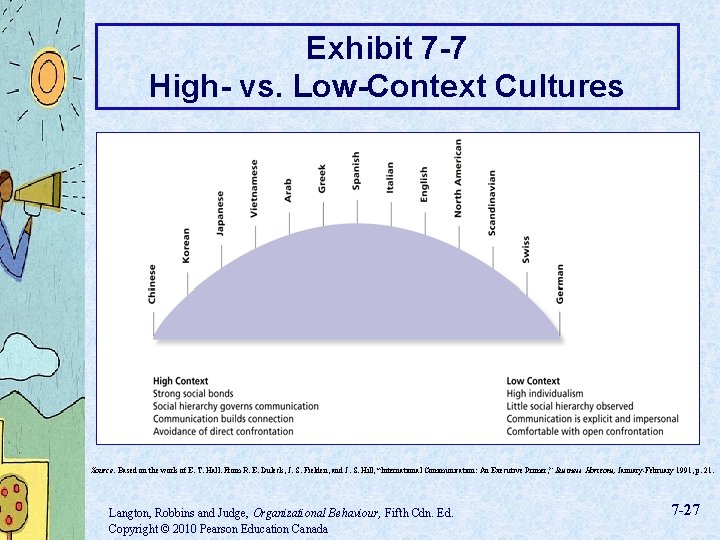
Exhibit 7 -7 High- vs. Low-Context Cultures Source: Based on the work of E. T. Hall. From R. E. Duleck, J. S. Fielden, and J. S. Hill, “International Communication: An Executive Primer, ” Business Horizons, January-February 1991, p. 21. Langton, Robbins and Judge, Organizational Behaviour, Fifth Cdn. Ed. Copyright © 2010 Pearson Education Canada 7 -27
Cross-Cultural Communications: Helpful Rules • Assume differences until similarity is proven. • Emphasize description rather than interpretation or evaluation. • Practise empathy. • Treat your interpretations as a working hypothesis. 7 -28
Summary and Implications 1. How does communication work? • 2. Communication works through choosing the correct channel, being an effective listener, and using feedback. What are the barriers to communication? • 3. Errors arise from filtering, selective perception, defensiveness, information overload, and language. How does communication flow in organizations? • 4. Communication can flow vertically and laterally, and by formal and informal channels in organizations. What are the other issues in communication? • The big topics in communication are the importance of nonverbal communication and silence, gender, and cross-cultural differences in communication. 7 -29
OB at Work Langton, Robbins and Judge, Organizational Behaviour, Fifth Cdn. Ed. Copyright © 2010 Pearson Education Canada 7 -30
For Review 1. Describe the communication process and identify its key components. Give an example of how this process operates with both oral and written messages. 2. Contrast encoding and decoding. 3. Identify three common formal small-group networks and give the advantages of each. 4. What conditions stimulate the emergence of rumours? 5. What are the advantages and disadvantage of email? Of instant messaging? Langton, Robbins and Judge, Organizational Behaviour, Fifth Cdn. Ed. Copyright © 2010 Pearson Education Canada 7 -31
For Review 6. What is nonverbal communication? Does it aid or hinder verbal communication? 7. What does the expression “sometimes the real message in a communication is buried in the silence” mean? 8. What are the managerial implications from the research contrasting male and female communication styles? 9. List four specific problems related to language difficulties in cross-cultural communication. 10. Contrast high- and low-context cultures. What do the differences mean for communication? Langton, Robbins and Judge, Organizational Behaviour, Fifth Cdn. Ed. Copyright © 2010 Pearson Education Canada 7 -32
For Critical Thinking 1. “Ineffective communication is the fault of the sender. ” Do you agree or disagree? Discuss 2. What can you do to improve the likelihood that your message will be received and understood as you intended? 3. How might managers use the grapevine for their benefit? 4. Using the concept of channel richness, give examples of messages best conveyed by email, by face-to-face communication, and on the company bulletin board. 5. “Most people are poor listeners. ” Do you agree or disagree? Defend your position. Langton, Robbins and Judge, Organizational Behaviour, Fifth Cdn. Ed. Copyright © 2010 Pearson Education Canada 7 -33
Breakout Group Exercises • Form small groups to discuss the following topics: 1. What differences have you observed in the ways that men and women communicate? 2. How do you know when a person is listening to you? When someone is ignoring you? 3. Describe a situation in which you ignored someone. What impact did it have on that person’s subsequent communication behaviours? Langton, Robbins and Judge, Organizational Behaviour, Fifth Cdn. Ed. Copyright © 2010 Pearson Education Canada 7 -34
Effective Listening If you want to improve your listening skills, look to these behaviours as guides 1. Make eye contact. 2. Exhibit affirmative head nods and appropriate facial expressions. 3. Avoid distracting actions or gestures. 4. Ask questions. 5. Paraphrase. 6. Avoid interrupting the speaker. 7. Don’t over-talk. 8. Make smooth transitions between the roles of speaker and listener Langton, Robbins and Judge, Organizational Behaviour, Fifth Cdn. Ed. Copyright © 2010 Pearson Education Canada 7 -35
Supplemental Material Slides for activities I do in my own classroom Langton, Robbins and Judge, Organizational Behaviour, Fifth Cdn. Ed. Copyright © 2010 Pearson Education Canada 7 -36
Nonverbal Exercise • Rank order in terms of importance for leadership: – – – – Extroverted personality Sensitivity to others Technical expertise Strong ethical values Concern for getting the task done Charisma Internal locus of control Power • Directions: Sit on your hands. Use NO nonverbal communication (gestures, facial movements, body movements, etc. ). Langton, Robbins and Judge, Organizational Behaviour, Fifth Cdn. Ed. Copyright © 2010 Pearson Education Canada 7 -37
Nonverbal Exercise Questions • How effective was communication? • What barriers to communication existed? • What happens when nonverbal communication is absent? • What purpose does nonverbal communication serve? Langton, Robbins and Judge, Organizational Behaviour, Fifth Cdn. Ed. Copyright © 2010 Pearson Education Canada 7 -38
Communication Questions • What types of difficulties have you experienced when communicating with someone from a different culture than yours? • How do you let the other person know you have heard what they are saying? How often do you do this? • Describe an example of communication breakdown. What led to the breakdown? Langton, Robbins and Judge, Organizational Behaviour, Fifth Cdn. Ed. Copyright © 2010 Pearson Education Canada 7 -39
- Slides: 39