
Chapter 7 Common stock characteristics valuation and issuance

- Slides: 18
Chapter 7 Common stock: characteristics, valuation, and issuance © 2001 South-Western College Publishing
Common Stock u. Common stock (C/S) is the permanent long- term financing of the firm u. Represents the true residual ownership of the firm 2
Balance Sheet Accounts Associated With C/S u. Par value of C/S u. Contributed capital in excess of par ä Additional paid in capital ä Capital surplus u. Retained earnings ( R/E ) u. Book value per share = equity # of shares outstanding 3
Rights of Common Stockholders u. Dividend rights u. Asset rights u. Preemptive rights u. Voting rights 4
Voting for the Board of Directors u. Majority voting requires more than 50% of the votes to elect a director u. Cumulative voting u. Shareholders may concentrate votes on a few candidates u. Proxy - signing over your voting rights to someone else 5
Features of C/S u C/S classes Voting and nonvoting ä Specific ownership ä u Stock dividends ä Transfer from R/E account to the C/S and additional paid-in capital accounts u Stock repurchases Disposition of excess cash ä Financial restructuring ä Future corporate needs ä Reduction of takeover risk ä u Stock splits u Reverse stock splits 6
C/S Advantages and Disadvantages u. Advantages çFlexible çReduced financial leverage çLower cost of capital u. Disadvantages çDiluted EPS çExpensive 7
Investment Banking u. Long-range financial planning u. Timing of security issues u. Purchase of securities u. Marketing of securities u. Arrangement of private loans and leases u. Negotiation of mergers 8
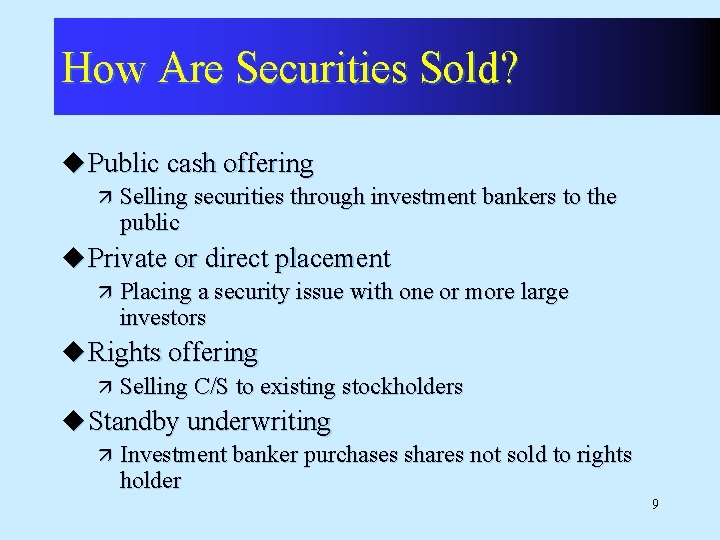
How Are Securities Sold? u Public cash offering ä Selling securities through investment bankers to the public u Private or direct placement ä Placing a security issue with one or more large investors u Rights offering ä Selling C/S to existing stockholders u Standby underwriting ä Investment banker purchases shares not sold to rights holder 9
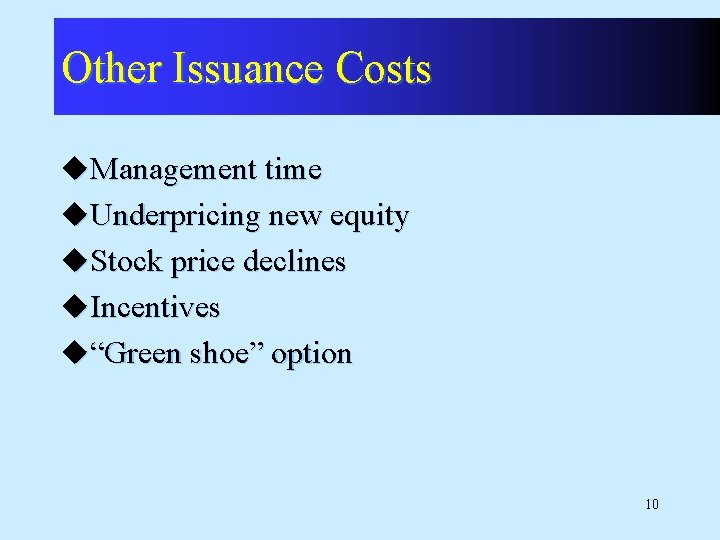
Other Issuance Costs u. Management time u. Underpricing new equity u. Stock price declines u. Incentives u“Green shoe” option 10
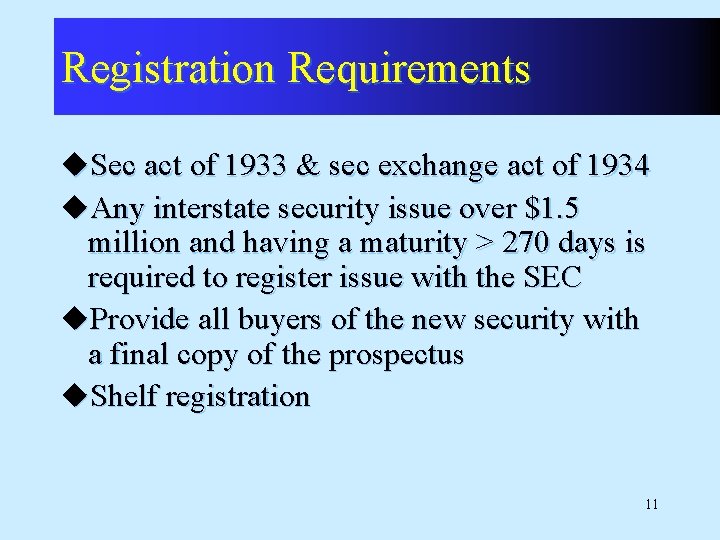
Registration Requirements u. Sec act of 1933 & sec exchange act of 1934 u. Any interstate security issue over $1. 5 million and having a maturity > 270 days is required to register issue with the SEC u. Provide all buyers of the new security with a final copy of the prospectus u. Shelf registration 11
Global Equity Markets u Multinational firms can take advantage of institutional differences from one country to another u Stock markets in U. S. , Japan, London and Paris u Nearly 24 -hour per day trading of C/S u Provide investors with opportunities to buy and sell shares any time they wish u Global name and product recognition 12
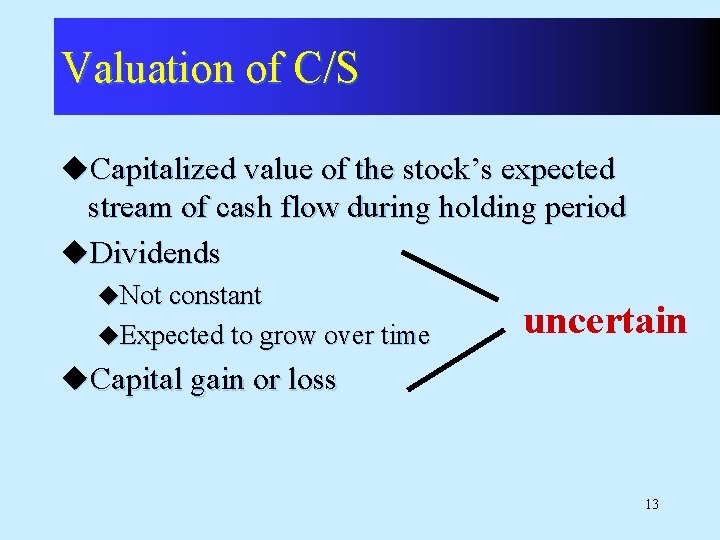
Valuation of C/S u. Capitalized value of the stock’s expected stream of cash flow during holding period u. Dividends u. Not constant u. Expected to grow over time uncertain u. Capital gain or loss 13
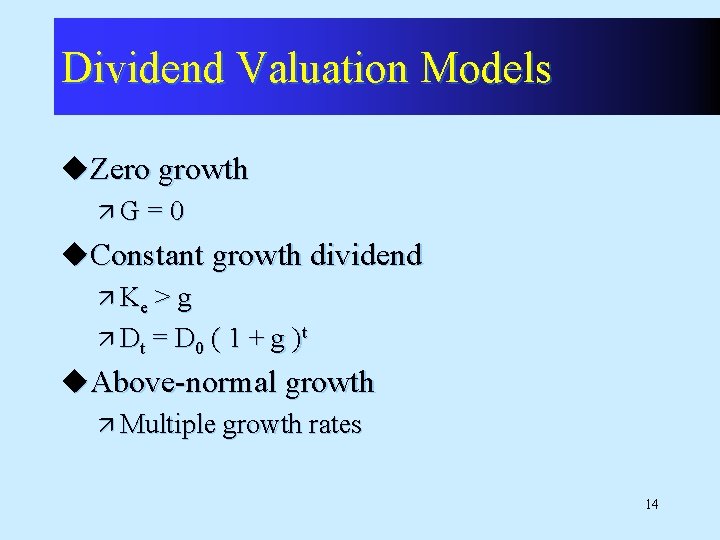
Dividend Valuation Models u. Zero growth äG = 0 u. Constant growth dividend ä Ke > g ä Dt = D 0 ( 1 + g ) t u. Above-normal growth ä Multiple growth rates 14
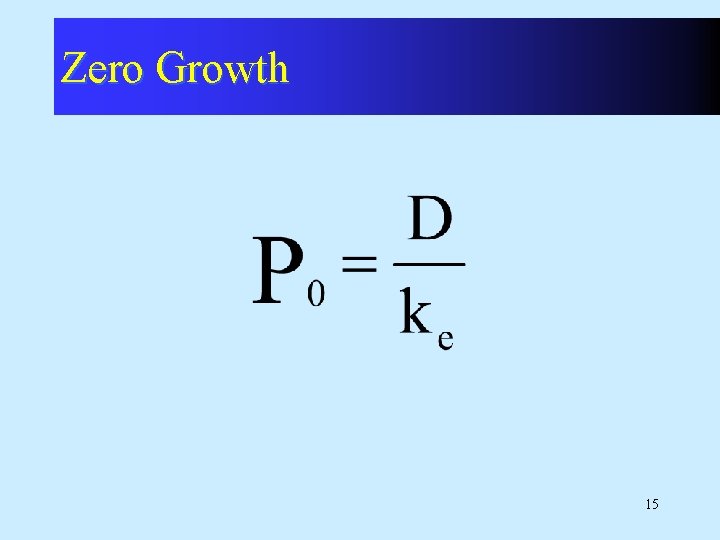
Zero Growth 15
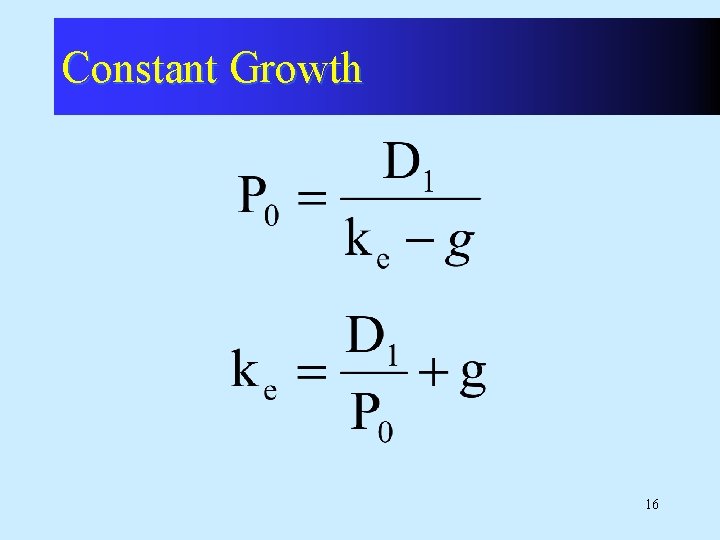
Constant Growth 16
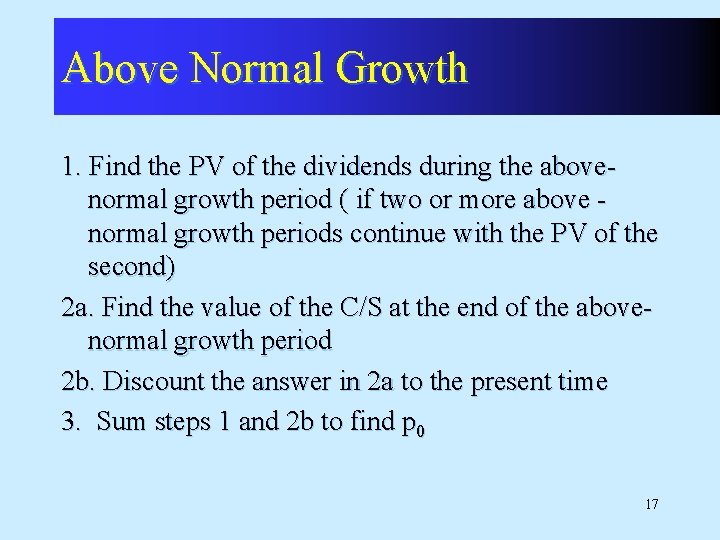
Above Normal Growth 1. Find the PV of the dividends during the abovenormal growth period ( if two or more above normal growth periods continue with the PV of the second) 2 a. Find the value of the C/S at the end of the abovenormal growth period 2 b. Discount the answer in 2 a to the present time 3. Sum steps 1 and 2 b to find p 0 17
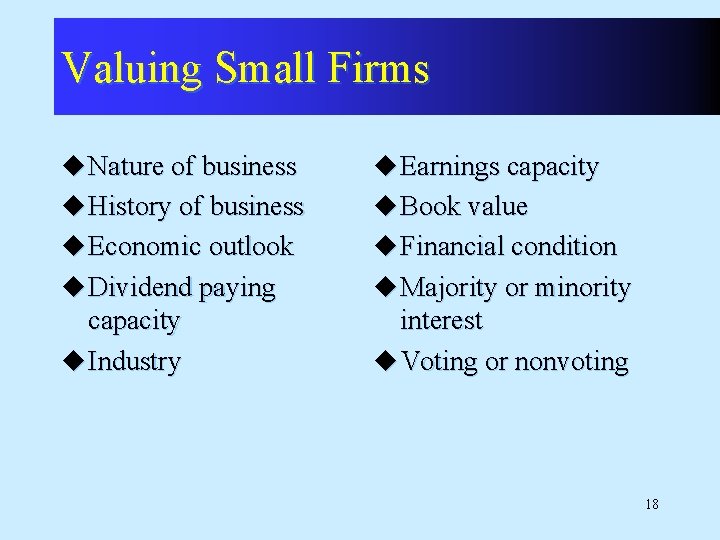
Valuing Small Firms u Nature of business u Earnings capacity u History of business u Book value u Economic outlook u Financial condition u Dividend paying u Majority or minority capacity u Industry interest u Voting or nonvoting 18