
Chapter 7 Cognitive Processes Copyright 2016 Pearson Education

- Slides: 43
Chapter 7 Cognitive Processes Copyright © 2016 Pearson Education, Inc. All Rights Reserved
Learning Objectives • • • 7. 1 a Describe how concepts, scripts, and schemas are used to organize information. 7. 1 b Discuss the role of algorithms and heuristics in problem solving and identify some of the obstacles to good reasoning. 7. 1 c Explain the social cognitive processes of stereotyping, attributions, and attitudes. Copyright © 2016 Pearson Education, Inc. All Rights Reserved
Thinking • Thinking – the action of using one’s mind to produce thoughts • Cognition – all of the mental processes involved in knowing, such as perception, reasoning, and judgment Copyright © 2016 Pearson Education, Inc. All Rights Reserved
The Basics of Thought (1 of 3) • Mental representations – stored ideas and images • Concept – mental representation or idea about something formed by mentally combining all of its characteristics – Organized into hierarchical fashion Copyright © 2016 Pearson Education, Inc. All Rights Reserved
The Basics of Thought (2 of 3) • Ways of representing concepts: – Prototypes – most typical representation of a category – Exemplars – comparison of new, yet-to-be-categorized items with learned examples already stored in memory Copyright © 2016 Pearson Education, Inc. All Rights Reserved
The Basics of Thought (3 of 3) • Schemas – more complex mental constructs that enable recognition of things seen before – used to solve problems, set goals, and predict and explain behaviors – provide a frame of reference • Script – type of schema that provides information about a sequence of familiar events or routine activities Copyright © 2016 Pearson Education, Inc. All Rights Reserved
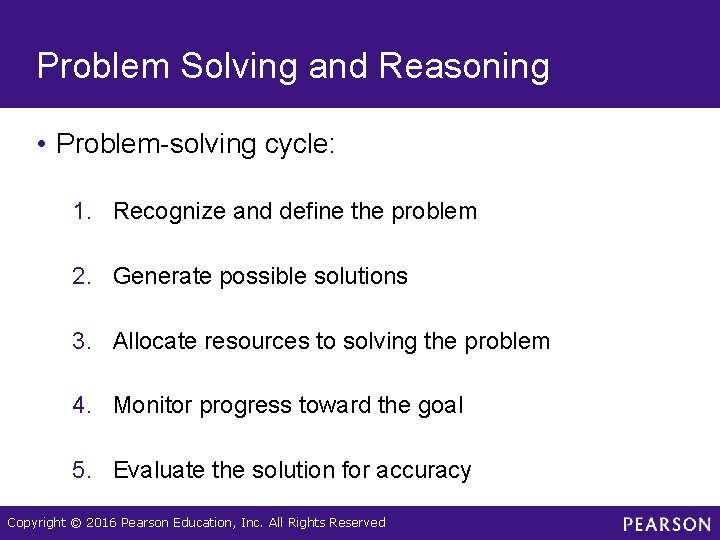
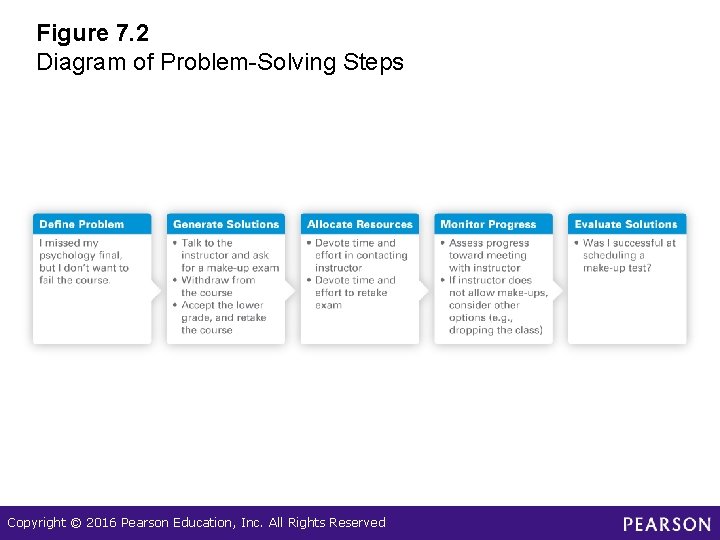
Problem Solving and Reasoning • Problem-solving cycle: 1. Recognize and define the problem 2. Generate possible solutions 3. Allocate resources to solving the problem 4. Monitor progress toward the goal 5. Evaluate the solution for accuracy Copyright © 2016 Pearson Education, Inc. All Rights Reserved
Figure 7. 2 Diagram of Problem-Solving Steps Copyright © 2016 Pearson Education, Inc. All Rights Reserved
Problem-Solving Strategies (3 of 3) • Insight – moments of insight when the problem solver realizes a new approach can solve the problem Copyright © 2016 Pearson Education, Inc. All Rights Reserved
Problem Solving and Reasoning • Two types of reasoning: – Inductive reasoning – forming a conclusion based on specific observations – Deductive reasoning – coming to a conclusion based on a general premise Copyright © 2016 Pearson Education, Inc. All Rights Reserved
Stereotyping • Stereotypes – fixed beliefs about social groups – Conserves cognitive energy via categorization of objects – Difficult to change – Often implicit (unconscious) – May be activated without people realizing that behavior has been influenced Copyright © 2016 Pearson Education, Inc. All Rights Reserved
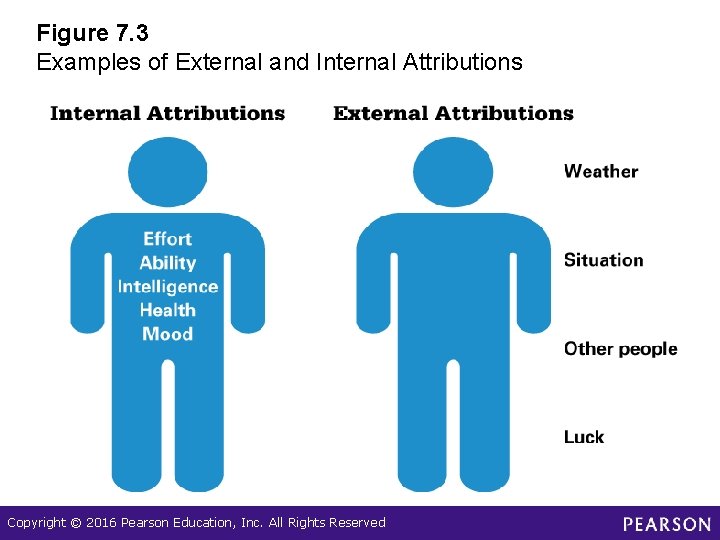
Attributions • Attributions – causal explanations for behavior – used to assign causality to own and others’ behavior • Internal attributions – result from characteristics internal to the person • External attributions – result from situational factors outside the person Copyright © 2016 Pearson Education, Inc. All Rights Reserved
Figure 7. 3 Examples of External and Internal Attributions Copyright © 2016 Pearson Education, Inc. All Rights Reserved
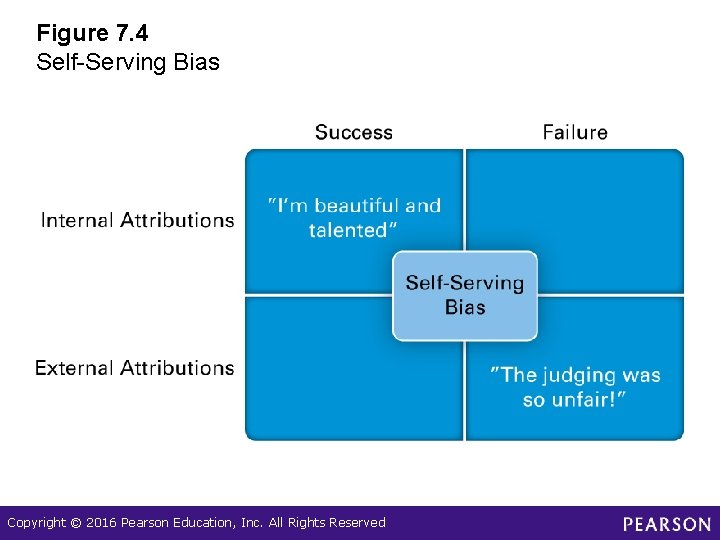
Figure 7. 4 Self-Serving Bias Copyright © 2016 Pearson Education, Inc. All Rights Reserved
Social Cognition • Fundamental attribution error – tendency to make internal, or dispositional, attributions and ignore external situational factors when explaining the behavior of others • Self-serving attributions – making internal attributions for successes and external attributions for failure when explaining own behavior Copyright © 2016 Pearson Education, Inc. All Rights Reserved
Attitudes (1 of 2) • Attitude – judgments or evaluations of a target – Acquired through classical conditioning, operant conditioning, cognitive learning, and observation Copyright © 2016 Pearson Education, Inc. All Rights Reserved
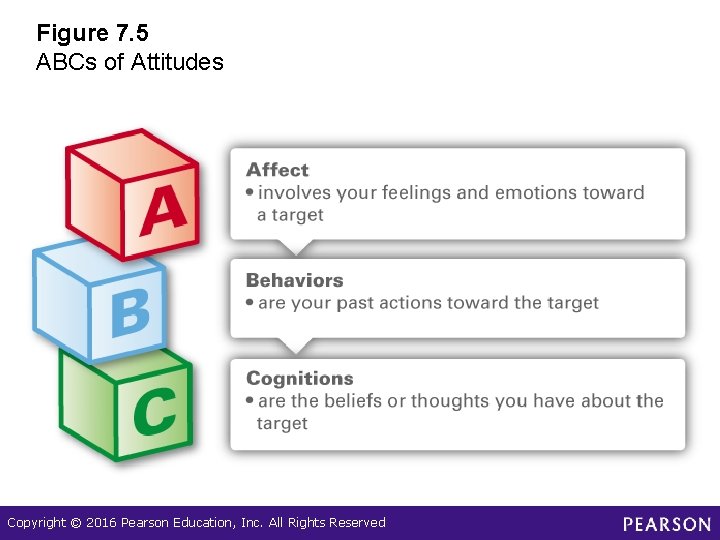
Attitudes (2 of 2) • Three important elements: 1. Affect – feelings and emotions toward a target 2. Behaviors – past actions toward the target 3. Cognitions – beliefs or thoughts about the target Copyright © 2016 Pearson Education, Inc. All Rights Reserved
Figure 7. 5 ABCs of Attitudes Copyright © 2016 Pearson Education, Inc. All Rights Reserved
Functions of Attitudes • Organizing information • Contrasting new information with old • Guiding behavior • A form of self-expression • A way to gain social approval Copyright © 2016 Pearson Education, Inc. All Rights Reserved
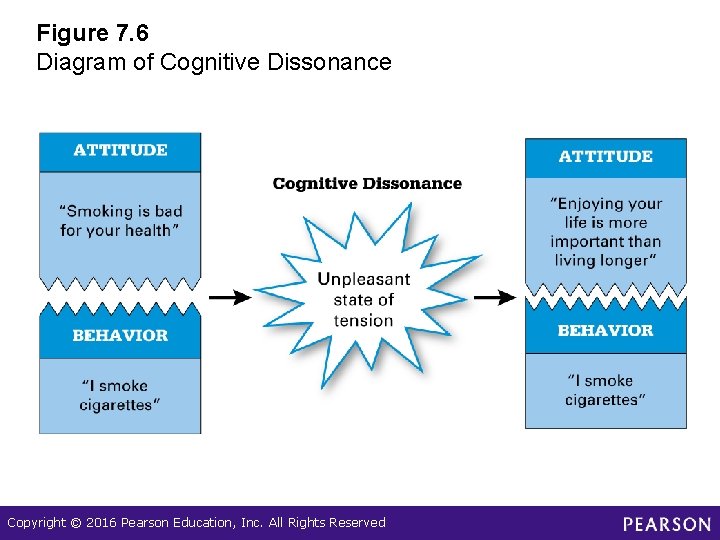
Paths to Attitude Change • Persuasion – external efforts to change attitudes through some kind of message • Cognitive dissonance – uncomfortable psychological state that occurs when attitudes and behaviors don’t align – Motivates a change in attitudes Copyright © 2016 Pearson Education, Inc. All Rights Reserved
Figure 7. 6 Diagram of Cognitive Dissonance Copyright © 2016 Pearson Education, Inc. All Rights Reserved
Learning Objectives • • • 7. 2 a Define language and identify its basic properties. 7. 2 b Describe the parts of the brain that are heavily involved in language and explain the cognitive benefits of bilingualism. 7. 2 c Discuss whether animals have language. Copyright © 2016 Pearson Education, Inc. All Rights Reserved
Language • Language – a symbol-based system used to convey or communicate ideas Copyright © 2016 Pearson Education, Inc. All Rights Reserved
Neurolinguistics (3 of 6) • Left hemisphere – ability to hear the sounds of language – understand the rules of language – produce language stems from Copyright © 2016 Pearson Education, Inc. All Rights Reserved
Neurolinguistics (4 of 6) • Right hemisphere – involved in the rules for social language (elements dependent on the combination of the speaker, the listener, and the context) – pragmatics – the social rules of language Copyright © 2016 Pearson Education, Inc. All Rights Reserved
Neurolinguistics (5 of 6) • Bilingualism – the ability to speak two languages • Cognitive benefits: – controlled cognitive processes – enhanced ability to shift between tasks – improved mental flexibility – protective function against Alzheimer’s Copyright © 2016 Pearson Education, Inc. All Rights Reserved
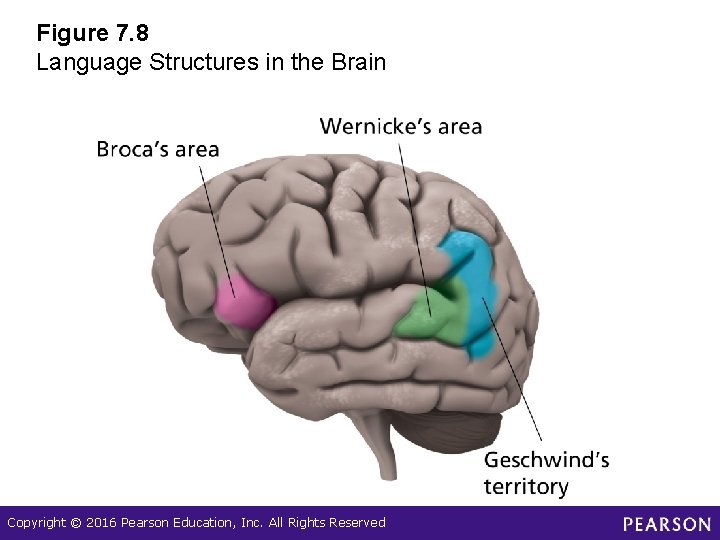
Figure 7. 8 Language Structures in the Brain Copyright © 2016 Pearson Education, Inc. All Rights Reserved
Learning Objectives • • 7. 3 a Define intelligence and discuss Spearman’s, Gardner’s, and Sternberg’s theories of intelligence. 7. 3 b Explain what neuroimaging studies indicate about our understanding of the biology of intelligence. 7. 3 c Discuss intelligence testing, including the qualities of a good test, some of the commonly used tests, and variations in IQ scores. 7. 3 d Present some of the reasons for differences in intelligence between individuals and groups. Copyright © 2016 Pearson Education, Inc. All Rights Reserved
Intelligence • Intelligence – ability to acquire and apply knowledge and skills • Key issue: – A single, all-encompassing ability versus bunch of individual skills? Copyright © 2016 Pearson Education, Inc. All Rights Reserved
Spearman’s Theory • g factor/general intelligence – underlying ability to process information accurately, perceive and respond to information quickly, and reason logically – High g factor correlated with academic achievement and life success Copyright © 2016 Pearson Education, Inc. All Rights Reserved
Gardner’s Theory: Multiple Intelligences • Comprised of nine major types of intelligence • Each reflects a computational capacity to process certain kinds of information • Language, math, logic, and spatial skills, understanding people, emotions, body awareness, and music; and existential Copyright © 2016 Pearson Education, Inc. All Rights Reserved
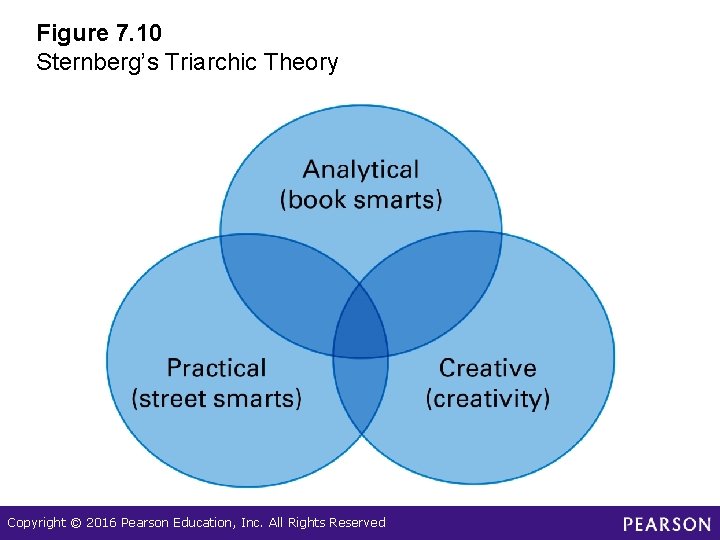
Sternberg’s Triarchic Theory of Intelligence • Three key components: 1. Analytic intelligence – ability for logical reasoning, verbal, and mathematical skills § ability to analyze, evaluate, and contrast information 2. Creative intelligence – ability to generate new ideas and solve problems in novel ways 3. Practical intelligence – ability to apply previous learning to a given situation Copyright © 2016 Pearson Education, Inc. All Rights Reserved
Figure 7. 10 Sternberg’s Triarchic Theory Copyright © 2016 Pearson Education, Inc. All Rights Reserved
Measuring Intelligence (1 of 2) • First widely used intelligence tests created by French scientist Alfred Binet • Used with school children to identify areas of strength and weakness • Starts with easier tasks • Sees how far child able to go in skill level • Allowed calculation of a mental age Copyright © 2016 Pearson Education, Inc. All Rights Reserved
Measuring Intelligence (2 of 2) • Aptitude tests – measure one’s potential for success • Achievement tests – measure one’s level of knowledge or mastery of a subject or skill • Both used to make educational placement and employment decisions Copyright © 2016 Pearson Education, Inc. All Rights Reserved
Commonly Used Tests (2 of 3) 2. Weschler tests – IQ test that yields three separate scores (verbal IQ, performance IQ, and one composite score for overall intelligence) – reduced dependence on language Copyright © 2016 Pearson Education, Inc. All Rights Reserved
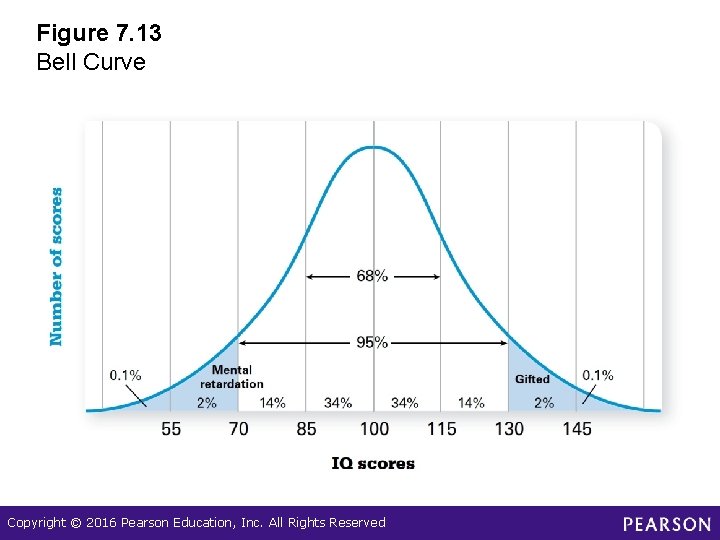
Extremes in IQ Scores • Average IQ score is 100 – 95% of the population has an IQ between 70 and 130 • Intellectual disability – IQ of less than 70 and impairments in adaptive behavior • Giftedness – intellectual ability significantly higher than average Copyright © 2016 Pearson Education, Inc. All Rights Reserved
Figure 7. 13 Bell Curve Copyright © 2016 Pearson Education, Inc. All Rights Reserved
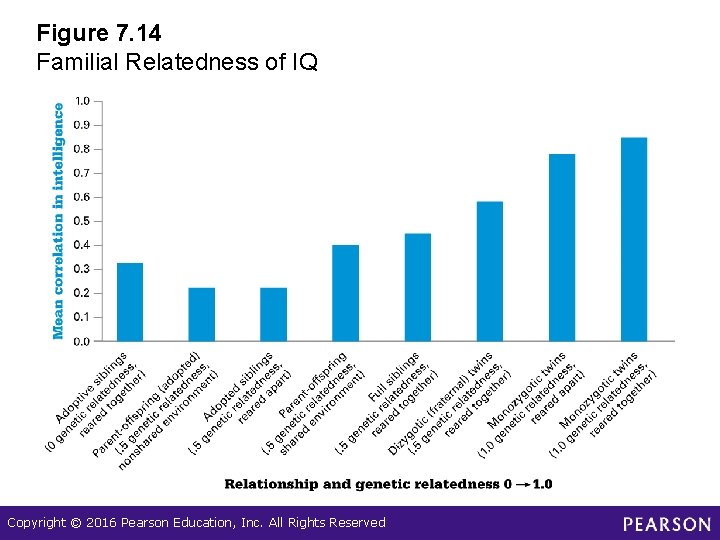
Genetic and Environmental Contributions to IQ • Heritability – proportion of variation in a population that can be accounted for by genetic variation among individuals – assumed to be around 50% • Quality and quantity of education • Family environment • Social and cultural values Copyright © 2016 Pearson Education, Inc. All Rights Reserved
Figure 7. 14 Familial Relatedness of IQ Copyright © 2016 Pearson Education, Inc. All Rights Reserved
Race and IQ 1. Poverty levels, access to education, and experience with test taking 2. Stereotype threat – person is afraid that his or her scores will confirm existing negative stereotypes Copyright © 2016 Pearson Education, Inc. All Rights Reserved
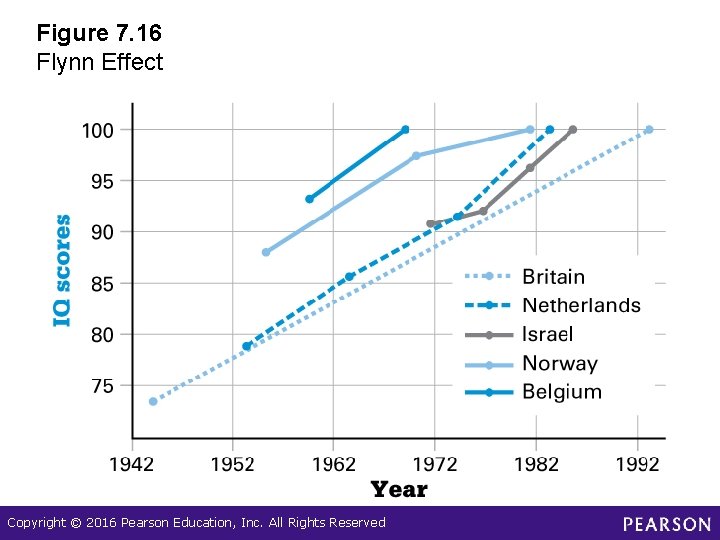
The Flynn Effect • Flynn effect – tendency for IQ scores to increase from one generation to the next • Particularly strong in developing nations Copyright © 2016 Pearson Education, Inc. All Rights Reserved
Figure 7. 16 Flynn Effect Copyright © 2016 Pearson Education, Inc. All Rights Reserved