
Chapter 7 COGNITION Learning outcomes to keep in
- Slides: 16
Chapter 7 COGNITION
Learning outcomes to keep in mind whilst studying this chapter What is cognition and why is it important? • Name and discuss forms of productive thinking • Describe the importance of language in cognition • Discuss the format and promotion of memory • Discuss the significance of intelligence in learning.
Forms of productive thinking Concept formation • Prototype A concept is an abstract idea or mental category by which similarities are grouped. − Typical features of a phenomenon • Schema − Mental structure used to organise information Problem-solving • Trial-and-error Problem-solving entails finding effective solutions to problems. − Random, time consuming searches • Algorithm − Always produces solutions • Heuristics − Selection searched using only solutions most likely to yield results.
Problem solving strategies using heuristics Analogy • Use previous solution to solve new problem Changing representation • Altering representation can clarify the essential as of a problem Barriers to problem solving • Mental set − When one has learnt to do things in a certain way • Functional fixedness − Focussing on the main meaning of an object, not seeing that it can be used effectively in other ways.
How heuristics influence decision making Anchoring and adjustment • Making estimates and making adjustment Availability • When an estimate is made of how easy something thought of Representation • When one event resembles another event.
Heuristics can lead to errors in reasoning Over-reliance on the anchor • Relying heavily on an anchor with limited adjustment Overestimating the improbable • To exaggerate the possibility of an event that will not occur Confirmation bias • Seeking support from those who already share one’s view Framing • Approaching a problem by putting it in a particular context Escalating of commitment • Holding on to a bad decision even when counter evident increases. Volition (the use of will power) can be used to control escalation of commitment.
Creativity is generally defined as the ability to produce work that is novel (original and unexpected) and appropriate (useful and adaptive to task constraints). Convergent thinking • Applies to existing knowledge and rule of logic to narrow the range of potential solutions to focus on a single answer Divergent thinking • Move outwards from conventional knowledge into unexplored paths and unconventional solutions.
Stages of the creative process Preparation • Become aware of problem, start gathering data to solve problem Incubation • Set problem aside following lack of success Illumination or inspiration • Solution with sudden burst (unexpectedly) Verification or elaboration • Conduct research to verify findings.
Fostering creativity Creativity in individuals may be facilitated by: • Establishing the purpose and intention to be creative • Building creativity enhancing skills • Developing metacognitive skills • Rewarding curiosity and exploration • Encouraging risk-taking • Providing opportunities for choice and discovery.
Factors that influence meaningful conversation Quantity • Amount of information required Quality • The truth of the statement Manner • Clarity and avoidance of ambiguous, obscure statements Relation • Relevance attached to a particular word.
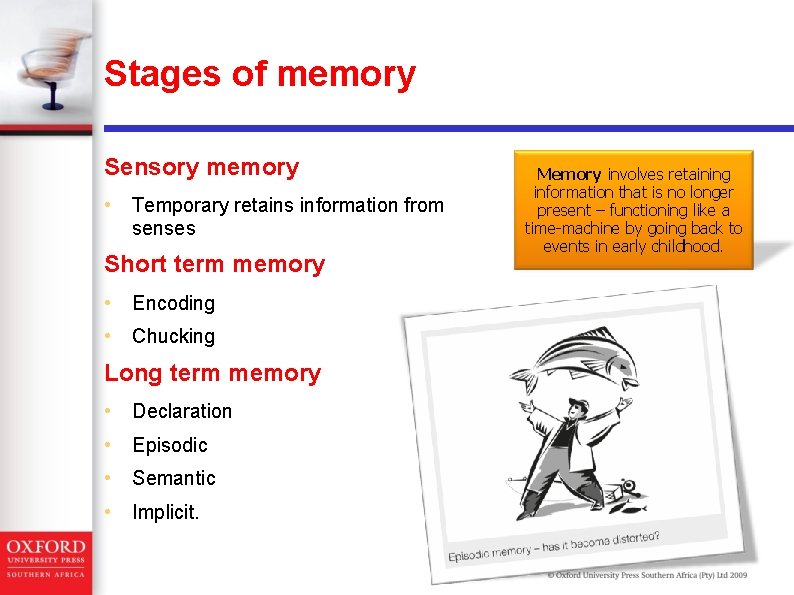
Stages of memory Sensory memory • Temporary retains information from senses Short term memory • Encoding • Chucking Long term memory • Declaration • Episodic • Semantic • Implicit. Memory involves retaining information that is no longer present – functioning like a time-machine by going back to events in early childhood.
Promoting memory Elaborative rehearsals • Making connection between object be remembered and something one already easily remembers Mnemonics • Organising information into specific visual field to aid recalling Improving memory • Organising − Breaking information into smaller amount for memorising • Mood − Associating memory promoted with mood • Humour and exaggeration − Attempting to make information stand out.
Forgetting Interference effects • Pro active and retroactive interference Motivated forgetting • Use of repression to consciously forget Distortion • Changed perception over time False memories • Error in remembering schema groupings Mood • Incongruent moods can affect memory. Forgetting is essentially the inability to retrieve information stored in long-term memory.
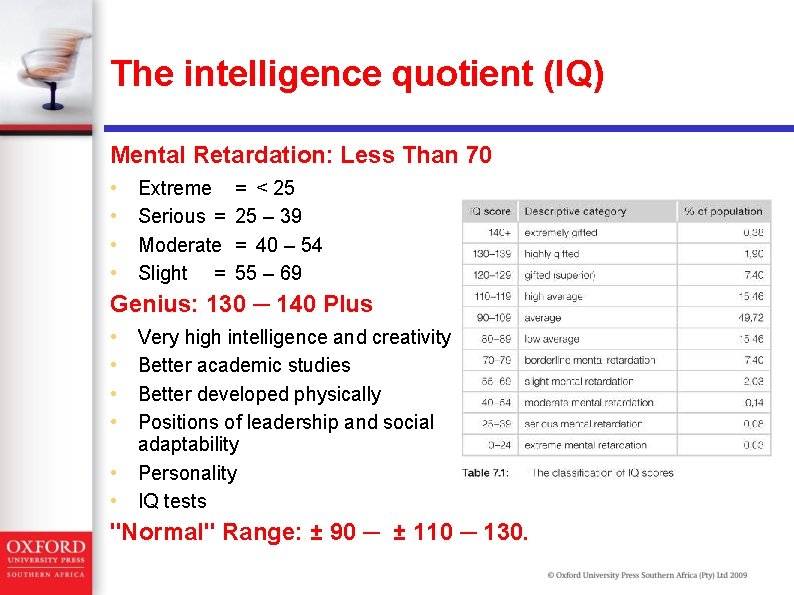
The intelligence quotient (IQ) Mental Retardation: Less Than 70 • • Extreme Serious = Moderate Slight = = < 25 25 – 39 = 40 – 54 55 – 69 Genius: 130 ─ 140 Plus • • • Very high intelligence and creativity Better academic studies Better developed physically Positions of leadership and social adaptability Personality IQ tests "Normal" Range: ± 90 ─ ± 110 ─ 130.
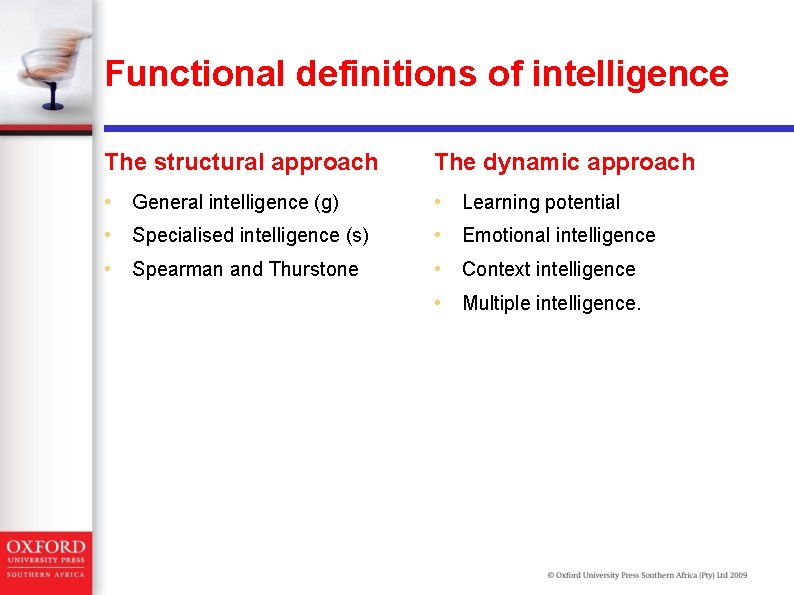
Functional definitions of intelligence The structural approach The dynamic approach • General intelligence (g) • Learning potential • Specialised intelligence (s) • Emotional intelligence • Spearman and Thurstone • Context intelligence • Multiple intelligence.
Thank you.