
Chapter 7 Cell Structure and Function 7 1
- Slides: 45
Chapter 7 Cell Structure and Function
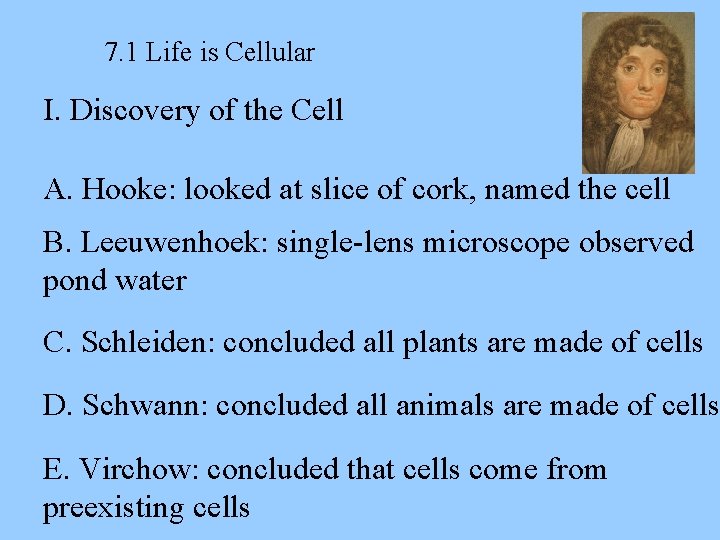
7. 1 Life is Cellular I. Discovery of the Cell A. Hooke: looked at slice of cork, named the cell B. Leeuwenhoek: single-lens microscope observed pond water C. Schleiden: concluded all plants are made of cells D. Schwann: concluded all animals are made of cells E. Virchow: concluded that cells come from preexisting cells
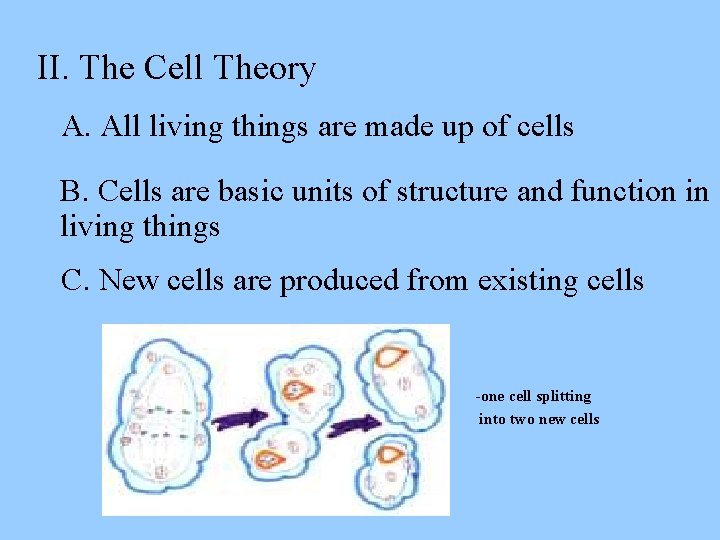
II. The Cell Theory A. All living things are made up of cells B. Cells are basic units of structure and function in living things C. New cells are produced from existing cells -one cell splitting into two new cells
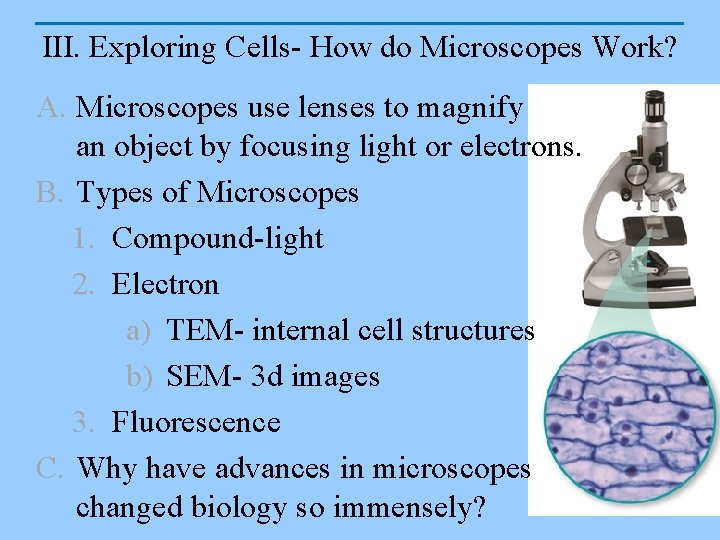
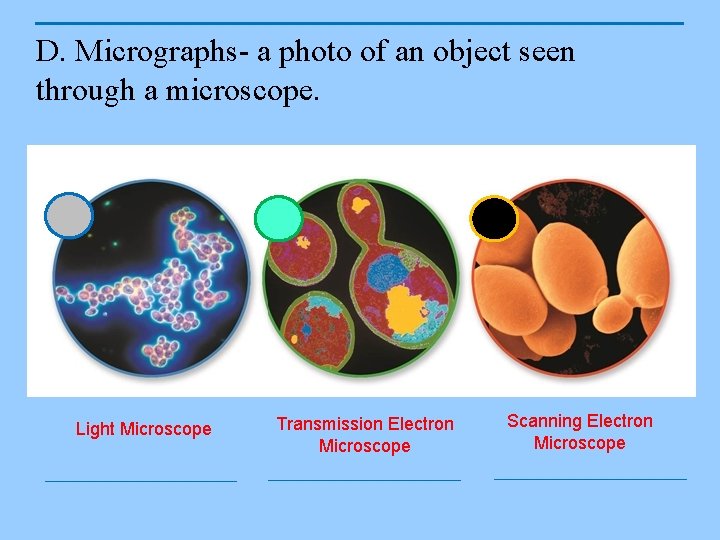
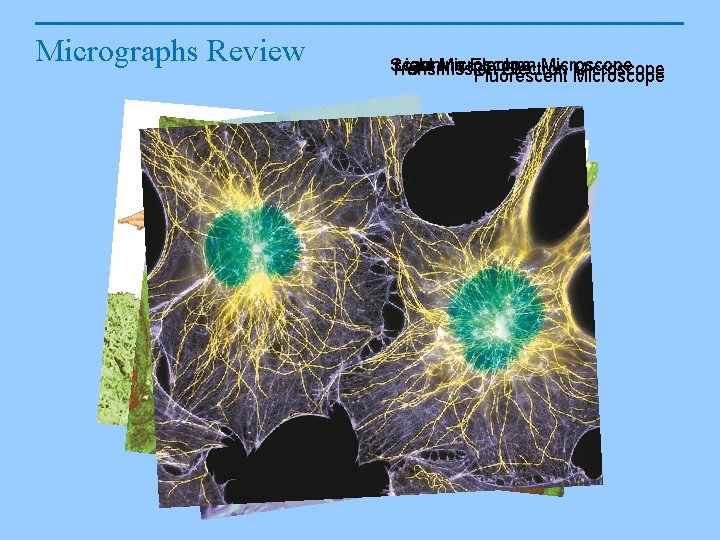
III. Exploring Cells- How do Microscopes Work? A. Microscopes use lenses to magnify an object by focusing light or electrons. B. Types of Microscopes 1. Compound-light 2. Electron a) TEM- internal cell structures b) SEM- 3 d images 3. Fluorescence C. Why have advances in microscopes changed biology so immensely?
D. Micrographs- a photo of an object seen through a microscope. Light Microscope Transmission Electron Microscope Scanning Electron Microscope
Micrographs Review Scanning Light Microscope Electron Microscope Transmission Electron Microscope Fluorescent Microscope
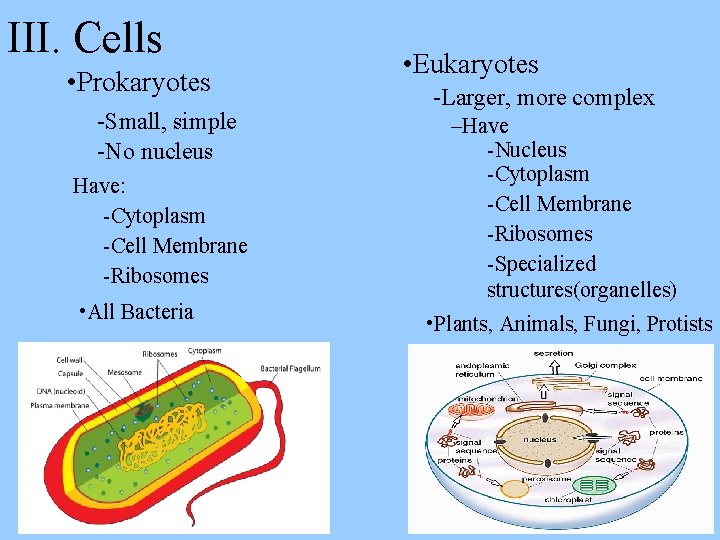
III. Cells • Prokaryotes -Small, simple -No nucleus Have: -Cytoplasm -Cell Membrane -Ribosomes • All Bacteria • Eukaryotes -Larger, more complex –Have -Nucleus -Cytoplasm -Cell Membrane -Ribosomes -Specialized structures(organelles) • Plants, Animals, Fungi, Protists
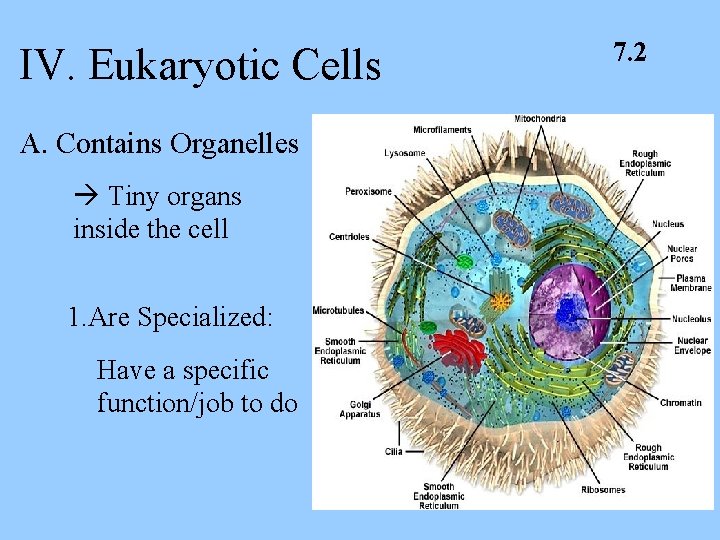
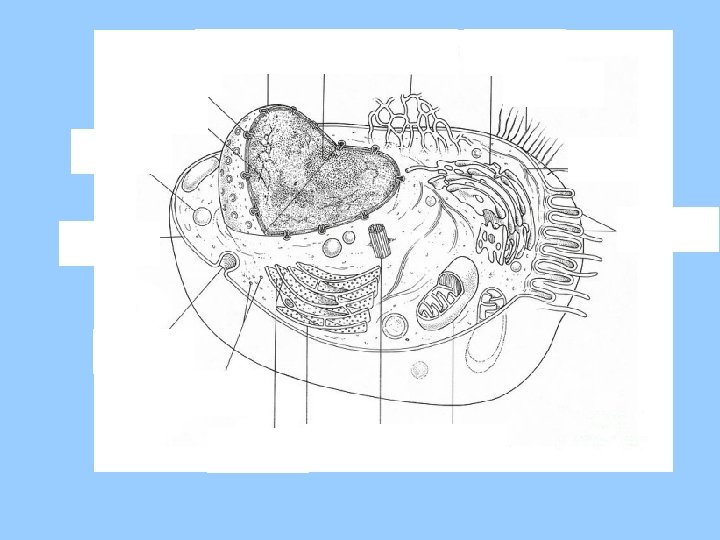
IV. Eukaryotic Cells A. Contains Organelles Tiny organs inside the cell 1. Are Specialized: Have a specific function/job to do 7. 2
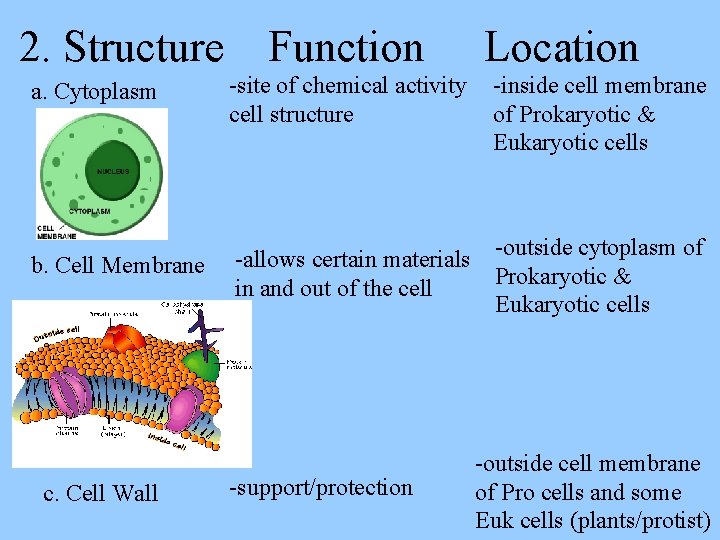
2. Structure Function Location a. Cytoplasm -site of chemical activity cell structure -inside cell membrane of Prokaryotic & Eukaryotic cells b. Cell Membrane -allows certain materials in and out of the cell -outside cytoplasm of Prokaryotic & Eukaryotic cells c. Cell Wall -support/protection -outside cell membrane of Pro cells and some Euk cells (plants/protist)
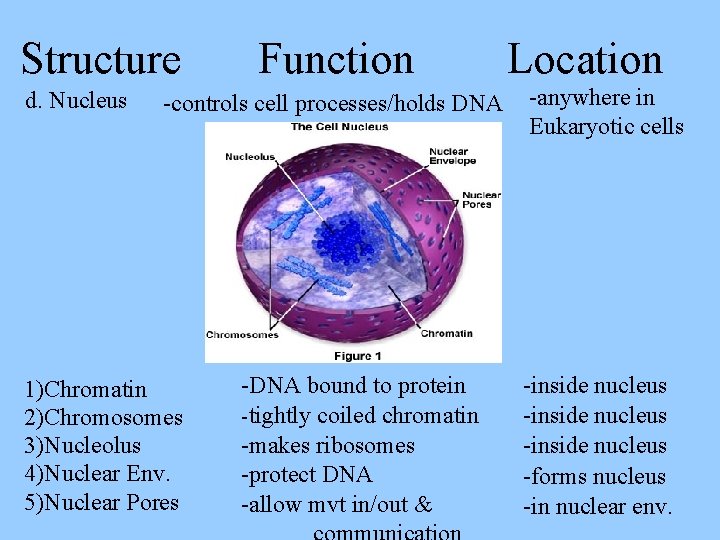
Structure d. Nucleus Function -controls cell processes/holds DNA 1)Chromatin 2)Chromosomes 3)Nucleolus 4)Nuclear Env. 5)Nuclear Pores -DNA bound to protein -tightly coiled chromatin -makes ribosomes -protect DNA -allow mvt in/out & Location -anywhere in Eukaryotic cells -inside nucleus -forms nucleus -in nuclear env.
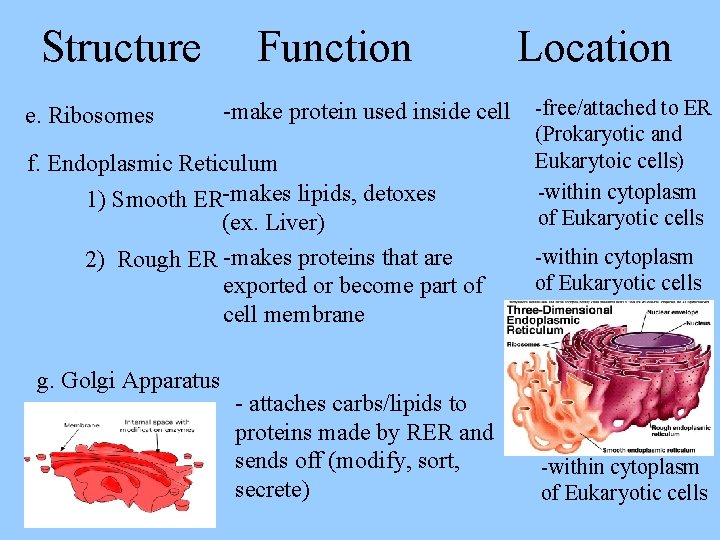
Structure e. Ribosomes Function -make protein used inside cell f. Endoplasmic Reticulum 1) Smooth ER-makes lipids, detoxes (ex. Liver) 2) Rough ER -makes proteins that are exported or become part of cell membrane g. Golgi Apparatus - attaches carbs/lipids to proteins made by RER and sends off (modify, sort, secrete) Location -free/attached to ER (Prokaryotic and Eukarytoic cells) -within cytoplasm of Eukaryotic cells
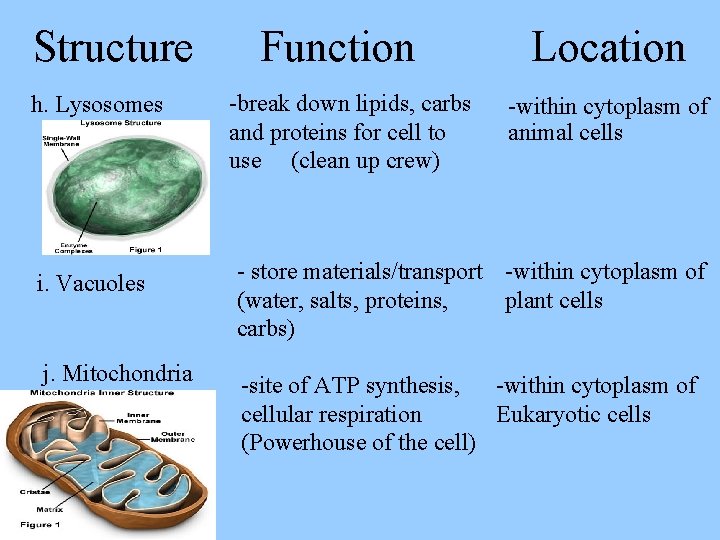
Structure h. Lysosomes Function -break down lipids, carbs and proteins for cell to use (clean up crew) Location -within cytoplasm of animal cells i. Vacuoles - store materials/transport -within cytoplasm of (water, salts, proteins, plant cells carbs) j. Mitochondria -site of ATP synthesis, -within cytoplasm of cellular respiration Eukaryotic cells (Powerhouse of the cell)
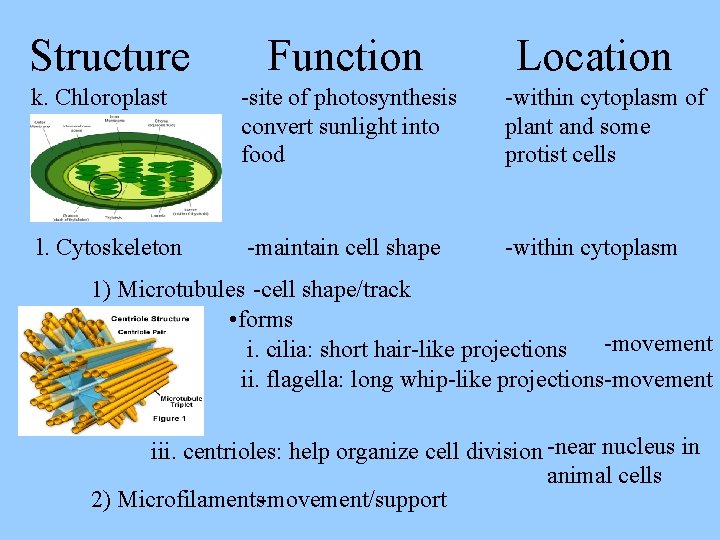
Structure Function Location k. Chloroplast -site of photosynthesis convert sunlight into food -within cytoplasm of plant and some protist cells l. Cytoskeleton -maintain cell shape -within cytoplasm 1) Microtubules -cell shape/track • forms -movement i. cilia: short hair-like projections ii. flagella: long whip-like projections-movement iii. centrioles: help organize cell division -near nucleus in animal cells 2) Microfilaments-movement/support
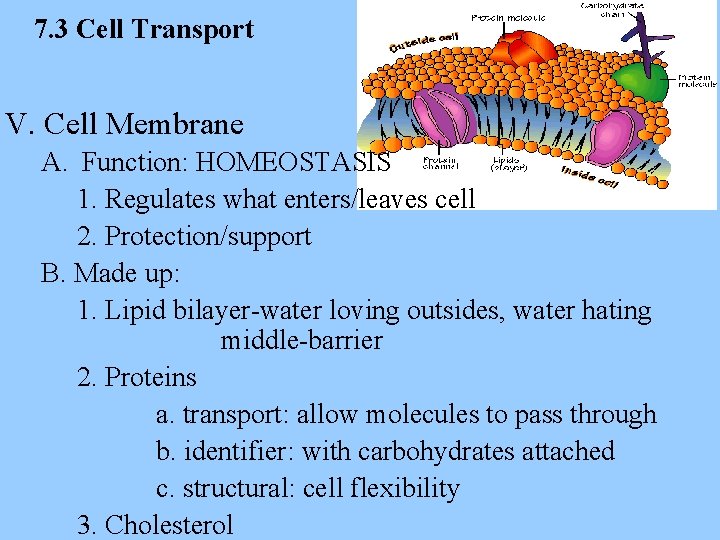
7. 3 Cell Transport V. Cell Membrane A. Function: HOMEOSTASIS 1. Regulates what enters/leaves cell 2. Protection/support B. Made up: 1. Lipid bilayer-water loving outsides, water hating middle-barrier 2. Proteins a. transport: allow molecules to pass through b. identifier: with carbohydrates attached c. structural: cell flexibility 3. Cholesterol
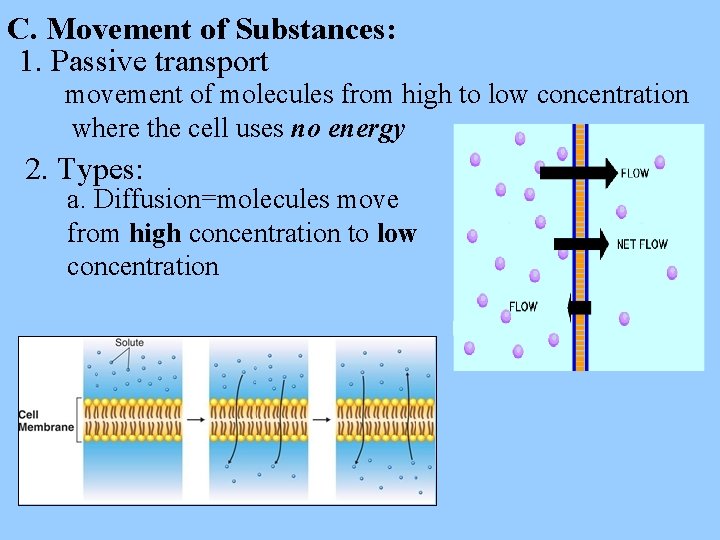
C. Movement of Substances: 1. Passive transport movement of molecules from high to low concentration where the cell uses no energy 2. Types: a. Diffusion=molecules move from high concentration to low concentration
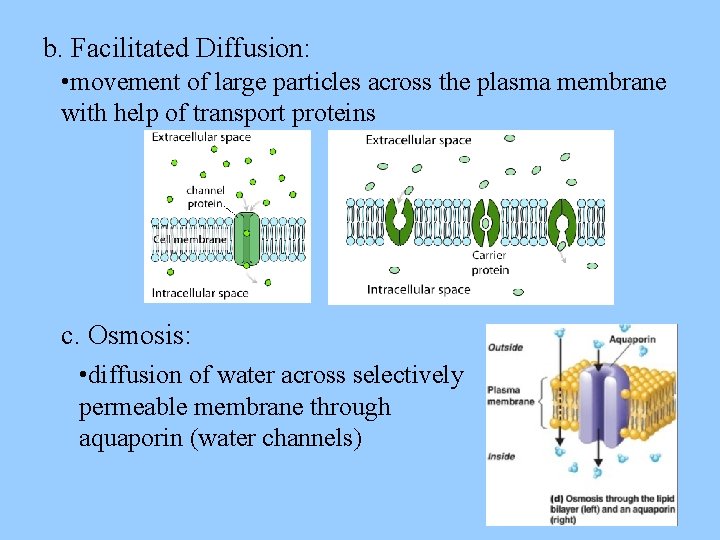
b. Facilitated Diffusion: • movement of large particles across the plasma membrane with help of transport proteins c. Osmosis: • diffusion of water across selectively permeable membrane through aquaporin (water channels)
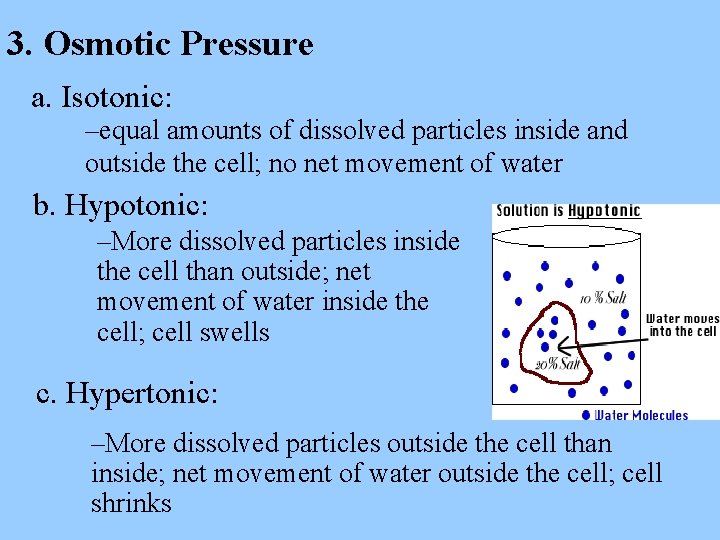
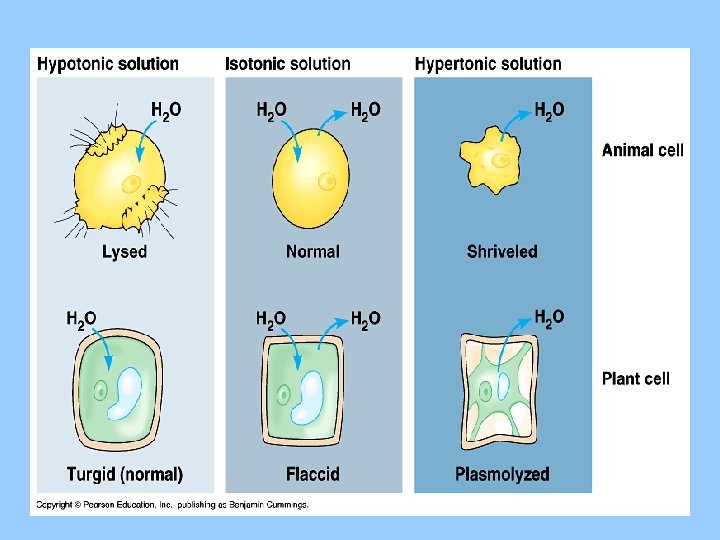
3. Osmotic Pressure a. Isotonic: –equal amounts of dissolved particles inside and outside the cell; no net movement of water b. Hypotonic: –More dissolved particles inside the cell than outside; net movement of water inside the cell; cell swells c. Hypertonic: –More dissolved particles outside the cell than inside; net movement of water outside the cell; cell shrinks
Osmosis
Diffusion
Active Transport
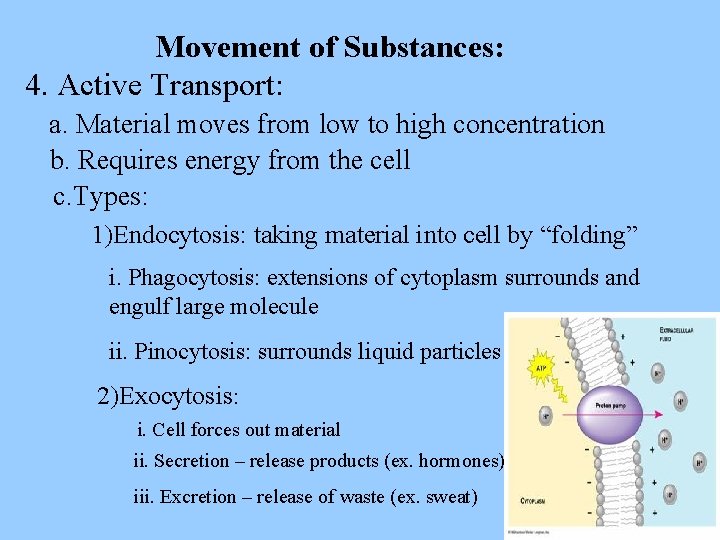
Movement of Substances: 4. Active Transport: a. Material moves from low to high concentration b. Requires energy from the cell c. Types: 1)Endocytosis: taking material into cell by “folding” i. Phagocytosis: extensions of cytoplasm surrounds and engulf large molecule ii. Pinocytosis: surrounds liquid particles 2)Exocytosis: i. Cell forces out material ii. Secretion – release products (ex. hormones) iii. Excretion – release of waste (ex. sweat)
7. 4 VI. Diversity of Cellular Life A. Unicellular: one cell 1. Prokaryotes = all bacteria 2. Eukaryotes = yeast, some protists B. Multicellular: many cells that are interdependent 1. Eukaryotes = humans, animals, plants, most fungi C. Cell Specialization: cell have a specific job/function to do
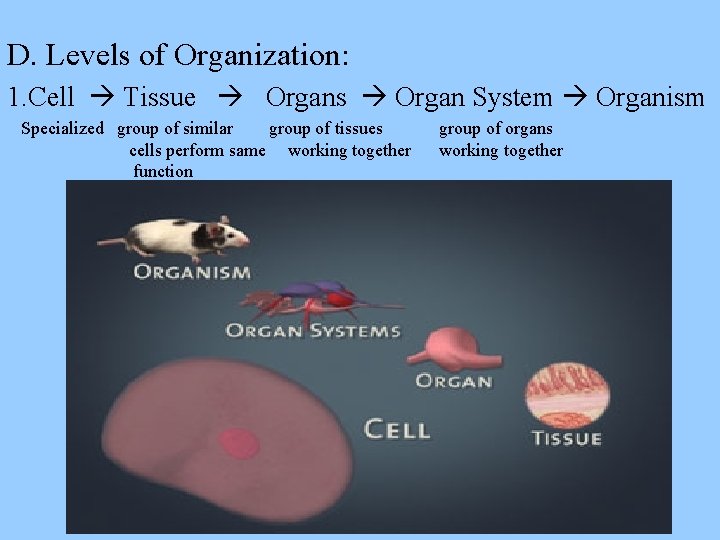
D. Levels of Organization: 1. Cell Tissue Organs Organ System Organism Specialized group of similar group of tissues cells perform same working together function group of organs working together
7 -1 The cell theory states that new cells are produced from a. nonliving material. b. existing cells. c. cytoplasm. d. animals.
7 -1 The person who first used the term cell was a. Matthias Schleiden. b. Lynn Margulis. c. Anton van Leeuwenhoek. d. Robert Hooke.
7 -1 Electron microscopes are capable of revealing more details than light microscopes because a. electron microscopes can be used with live organisms. b. light microscopes cannot be used to examine thin tissues. c. the wavelengths of electrons are longer than those of light. d. the wavelengths of electrons are shorter than those of light.
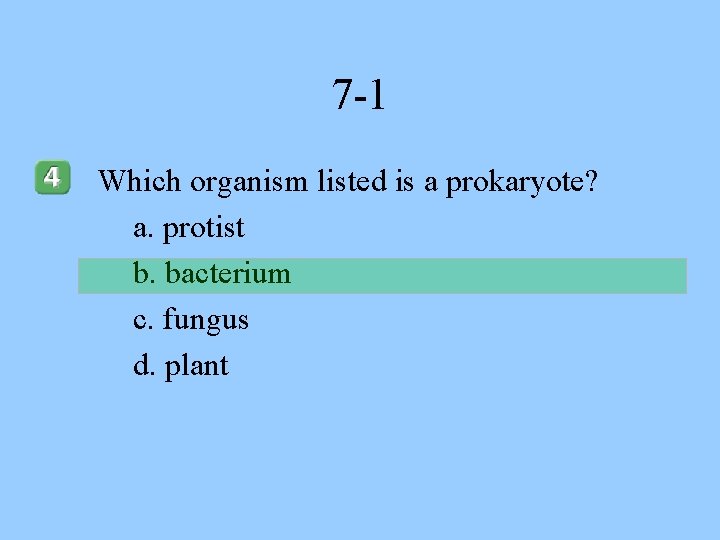
7 -1 Which organism listed is a prokaryote? a. protist b. bacterium c. fungus d. plant
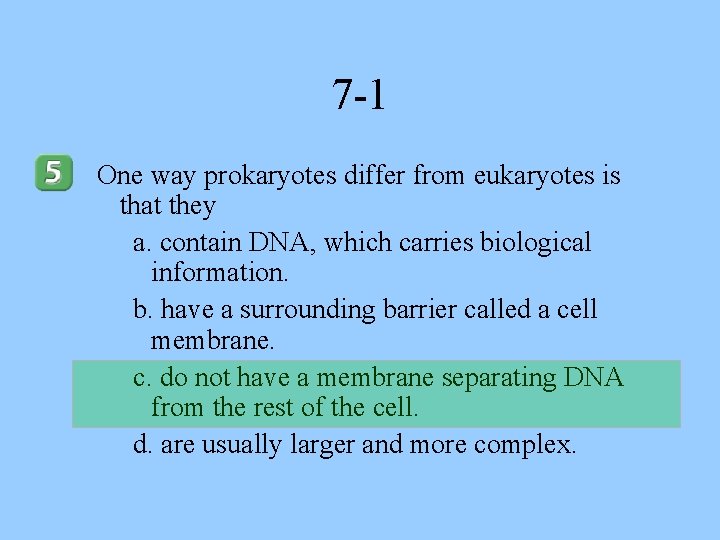
7 -1 One way prokaryotes differ from eukaryotes is that they a. contain DNA, which carries biological information. b. have a surrounding barrier called a cell membrane. c. do not have a membrane separating DNA from the rest of the cell. d. are usually larger and more complex.
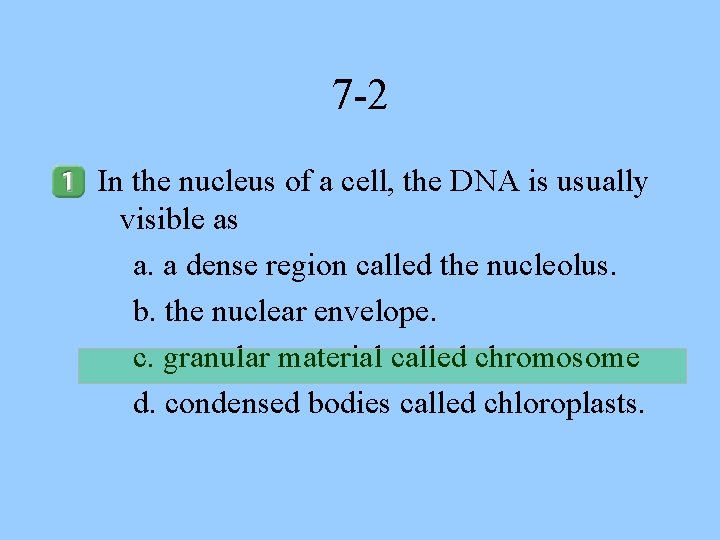
7 -2 In the nucleus of a cell, the DNA is usually visible as a. a dense region called the nucleolus. b. the nuclear envelope. c. granular material called chromosome d. condensed bodies called chloroplasts.
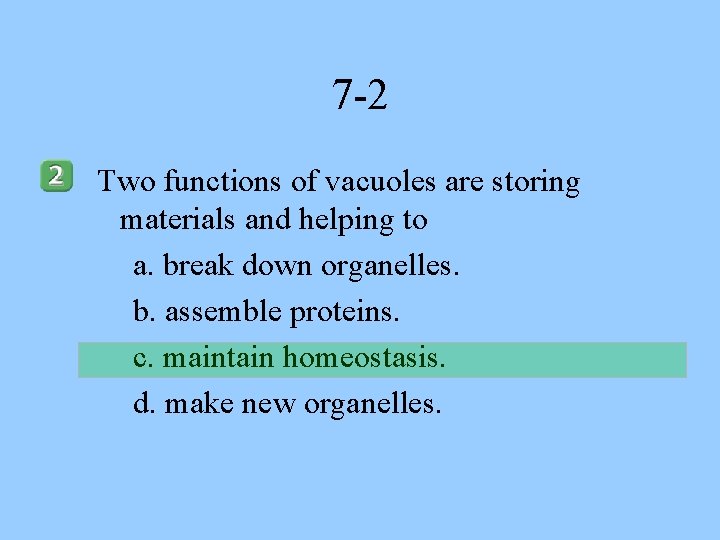
7 -2 Two functions of vacuoles are storing materials and helping to a. break down organelles. b. assemble proteins. c. maintain homeostasis. d. make new organelles.
7 -2 Chloroplasts are found in the cells of a. plants only. b. plants and some other organisms. c. all eukaryotes. d. most prokaryotes.
7 -2 Which of the following is NOT a function of the Golgi apparatus? a. synthesize proteins. b. modify proteins. c. sort proteins. d. package proteins.
7 -2 Which of the following is a function of the cytoskeleton? a. manufactures new cell organelles b. assists in movement of some cells from one place to another c. releases energy in cells d. modifies, sorts, and packages proteins
7 -3 Unlike a cell wall, a cell membrane a. is composed of a lipid bilayer. b. provides rigid support for the surrounding cell. c. allows most small molecules and ions to pass through easily. d. is found only in plants, fungi, algae, and many prokaryotes.
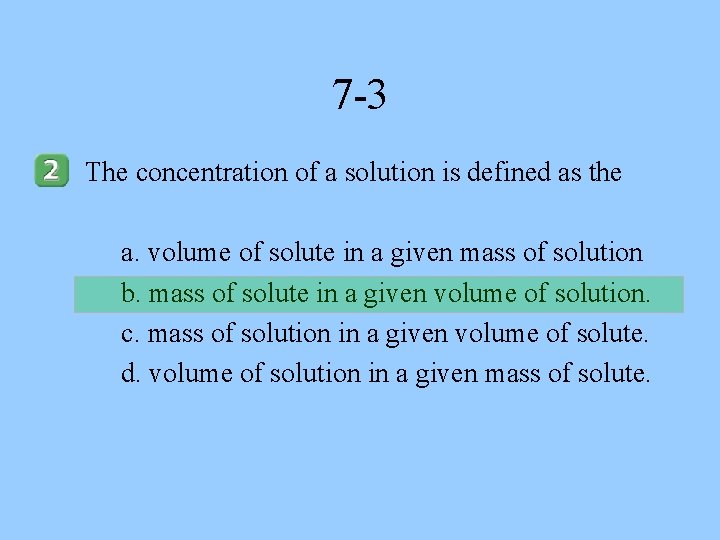
7 -3 The concentration of a solution is defined as the a. volume of solute in a given mass of solution b. mass of solute in a given volume of solution. c. mass of solution in a given volume of solute. d. volume of solution in a given mass of solute.
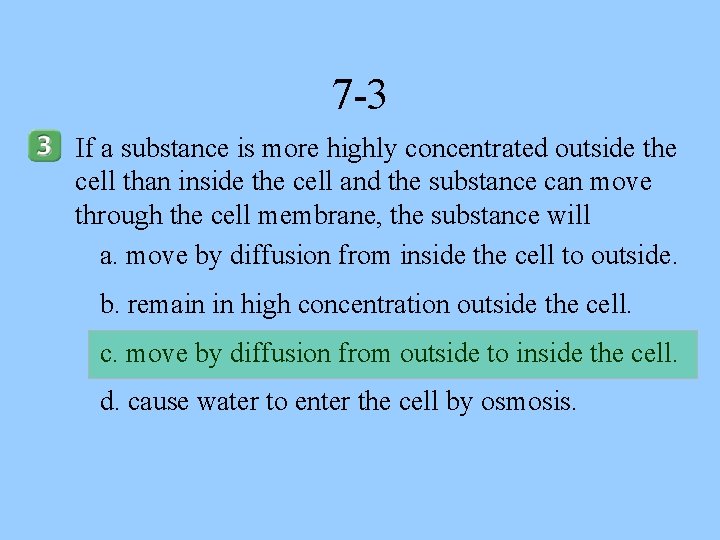
7 -3 If a substance is more highly concentrated outside the cell than inside the cell and the substance can move through the cell membrane, the substance will a. move by diffusion from inside the cell to outside. b. remain in high concentration outside the cell. c. move by diffusion from outside to inside the cell. d. cause water to enter the cell by osmosis.
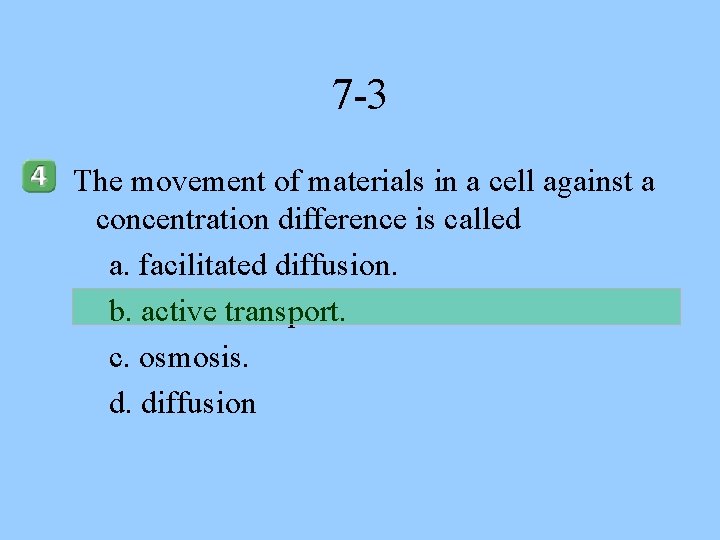
7 -3 The movement of materials in a cell against a concentration difference is called a. facilitated diffusion. b. active transport. c. osmosis. d. diffusion
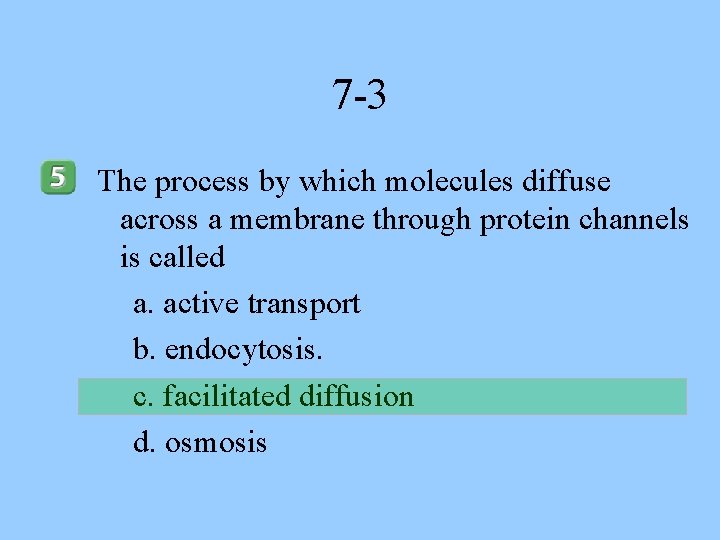
7 -3 The process by which molecules diffuse across a membrane through protein channels is called a. active transport b. endocytosis. c. facilitated diffusion d. osmosis
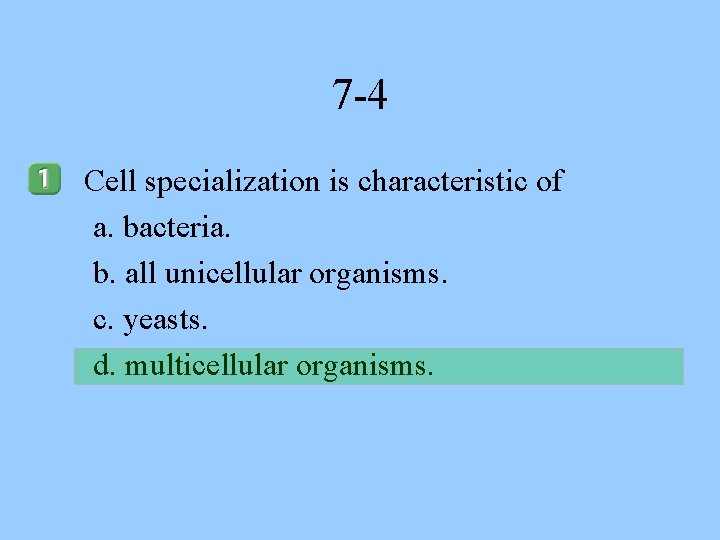
7 -4 Cell specialization is characteristic of a. bacteria. b. all unicellular organisms. c. yeasts. d. multicellular organisms.
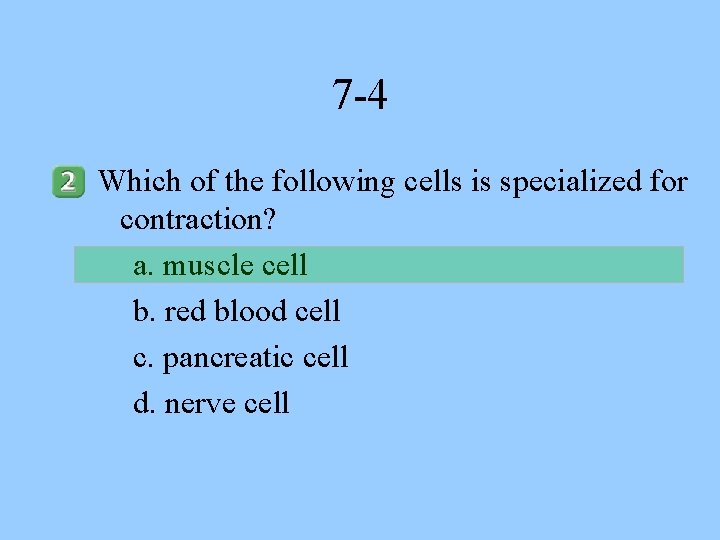
7 -4 Which of the following cells is specialized for contraction? a. muscle cell b. red blood cell c. pancreatic cell d. nerve cell
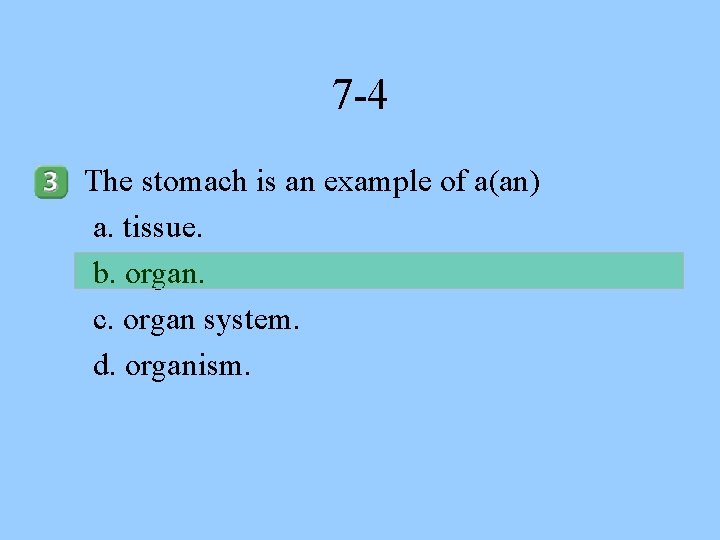
7 -4 The stomach is an example of a(an) a. tissue. b. organ. c. organ system. d. organism.
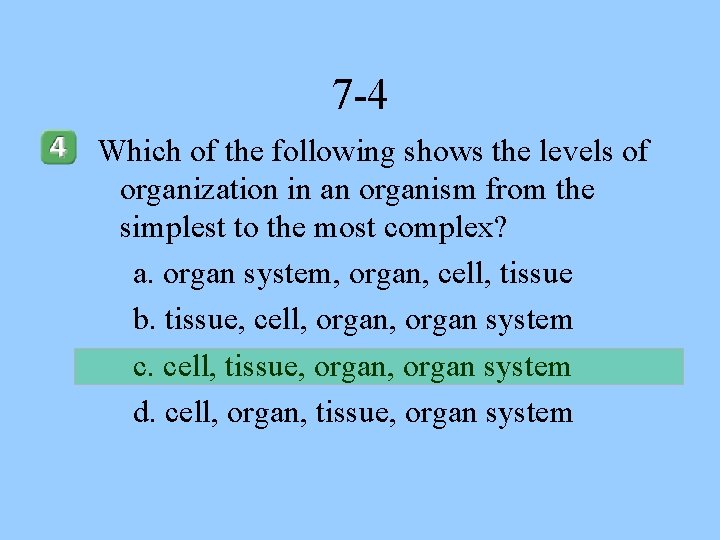
7 -4 Which of the following shows the levels of organization in an organism from the simplest to the most complex? a. organ system, organ, cell, tissue b. tissue, cell, organ system c. cell, tissue, organ system d. cell, organ, tissue, organ system
7 -4 Which of the following would probably contain the greatest variety of specialized cells? a. an organ system b. a tissue c. an organ d. a multicellular organism