
Chapter 7 Authority and Power Objectives o o
Chapter 7: Authority and Power Objectives: o o Define political anthropology, authority, and power. Distinguish between coercive, persuasive, and hegemonic power. Understand how anthropologists model systems of political organization with the typology of bands, tribes, chiefdoms and kingdoms, and states. Appreciate the variety of ways in which Christians may engage in politics.
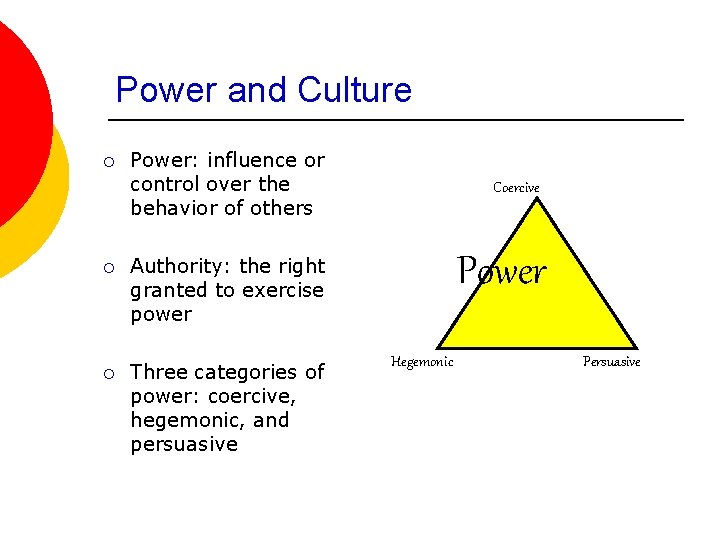
Power and Culture ¡ Power: influence or control over the behavior of others ¡ Authority: the right granted to exercise power ¡ Three categories of power: coercive, hegemonic, and persuasive Coercive Power Hegemonic Persuasive
Power and Culture Coercive Power ¡ The use or threat of force, legitimate or illegitimate, whether by individuals or groups. l What makes the use of coercive power legitimate or illegitimate is whether individual or group has the authority to use that power.
Power and Culture Persuasive Power ¡ The use of words, relationships, and actions that influence others. l Unlike coercive power, persuasive power can strengthen or create relationships.
Power and Culture Hegemonic Power ¡ The dominance of ideas or culture, such that a social or cultural status quo is maintained. l Often the most powerful force for social control. l To be successful, it requires widely shared cultural beliefs.
Power and Culture Power in Action It is helpful to conceptualize power as three discrete types, but in practice all three types act simultaneously. l Coercive and persuasive power can be enacted formally or informally, through official organizations or by any individual or group. l In practice, coercive and persuasive power usually require the willing cooperation of others.
Power and Culture Power in Action (continued) ¡ Social sanctions: the responses, positive and negative, that people receive for their behavior. l Formal sanctions: social sanctions that are approved or delivered by institutions holding official power. ¡ ¡ l Formal negative sanctions: fines or other punishments meted out for breaking official rules. Formal positive sanctions: official rewards for socially desirable behavior. Informal sanctions: positive or negative actions or words intended to shape behavior. Not approved or delivered by an official organization such as a government.
Political Organization ¡ Power and authority are configured in a variety of ways as political systems that guide entire societies. ¡ Types of political organization: bands, tribes, chiefdoms and kingdoms, and states. ¡ Today no bands, tribes, chiefdoms, or kingdoms exist apart from the influence of states.
Political Organization: Bands The most ancient political system, in which power and authority are organized in informal, decentralized ways. ¡ ¡ Usually fewer than one hundred people; most members are held together by kinship, but membership is flexible Leadership is temporary and informal. Egalitarianism in division of labor, authority, and decision making. Highly effective at avoiding and resolving conflict; conflict resolution done mostly through informal sanctions.
Political Organization: Tribes A decentralized political system that may be associated with any economic form. ¡ ¡ Leadership usually based on personal ability and unique qualities. Different tribes can create regional associations for temporary purposes, such as defense against external threats. Organization in and between tribes is based on kinship or age-set systems. Conflict resolution is informal but requires a third party negotiator. War is a rarely-used option because of the effort it takes to organize various tribes and because of the high risk for population loss.
Political Organization: Chiefdoms/Kingdoms ¡ Political power is centralized. l l ¡ Leadership is an inheritable office, often passed through a family line. Power adheres to the occupant of the office rather than being a product of his or her individual gifts, abilities, or qualities. Community is organized hierarchically according to social status; the power and status of families and individuals depends on their relational distance from the central leader.
Political Organization: Chiefdoms/Kingdoms ¡ ¡ ¡ Ability to consolidate control through coercive measures. Interpersonal conflicts handled through informal sanctions. Rules developed and delivered by chiefs or kings, who regulate interactions between groups of higher and lower status, which serves to reinforce social stratification. l l Breach in rules brings punishment or encouragement of reconciliation, decided upon by the ruler. Conflicts escalate into war at a higher frequency than in tribes or bands.
Political Organization: States ¡ Highly centralized form of political organization. l l ¡ authority rests in institutions and offices. real locus of power is in the office rather than in the individual. A focus on ideology and culture distinguishes a state from a chiefdom/kingdom.
Christians and Politics ¡ The Bible does not favor one political system over another. l ¡ Prevents the ethnocentrism regarding the superiority of the state system. Christians should both engage and critique political systems. l l Obey and follow political organizations in ways that are faithful to God’s word. Challenge and reject parts of political organizations that do not bring glory to God and that are unjust.
Discussion Questions 1. What is one way that God’s power is like human power? What is one difference? 2. Tell a story about a successful use of persuasive power and an unsuccessful attempt to use persuasive power. What factors make persuasion more or less likely to work? 3. Consider the similarities and differences between band societies, tribes, chiefdoms/kingdoms, and state societies. What is one way in which being a Christian would be the same in all societies? What is one distinctive Christian practice or belief that would be particularly important in a band? In a tribe? In a chiefdom/kingdom? In a state?
- Slides: 15