
Chapter 7 Atomic Structure and Periodicity Section 7






- Slides: 32
Chapter 7 Atomic Structure and Periodicity
Section 7. 10 The History of the Periodic Table § Originally constructed to represent the patterns observed in the chemical properties of the elements. § Mendeleev is given the most credit for the current version of the periodic table because he emphasized how useful the periodic table could be in predicting the existence and properties of still unknown elements. Copyright © Cengage Learning. All rights reserved 2
Section 7. 11 The Aufbau Principle and the Periodic Table Aufbau Principle § As protons are added one by one to the nucleus to build up the elements, electrons are similarly added to hydrogen-like orbitals. § An oxygen atom has an electron arrangement of two electrons in the 1 s subshell, two electrons in the 2 s subshell, and four electrons in the 2 p subshell. Oxygen: 1 s 22 p 4 Copyright © Cengage Learning. All rights reserved 3
Section 7. 11 The Aufbau Principle and the Periodic Table Hund’s Rule § The lowest energy configuration for an atom is the one having the maximum number of unpaired electrons allowed by the Pauli principle in a particular set of degenerate (same energy) orbitals. Copyright © Cengage Learning. All rights reserved 4
Section 7. 11 The Aufbau Principle and the Periodic Table Orbital Diagram § A notation that shows how many electrons an atom has in each of its occupied electron orbitals. Oxygen: 1 s 22 p 4 Oxygen: 1 s 2 s 2 p Copyright © Cengage Learning. All rights reserved 5
Section 7. 11 The Aufbau Principle and the Periodic Table Valence Electrons § The electrons in the outermost principal quantum level of an atom. 1 s 22 p 6 (valence electrons = 8) § The elements in the same group on the periodic table have the same valence electron configuration. Copyright © Cengage Learning. All rights reserved 6
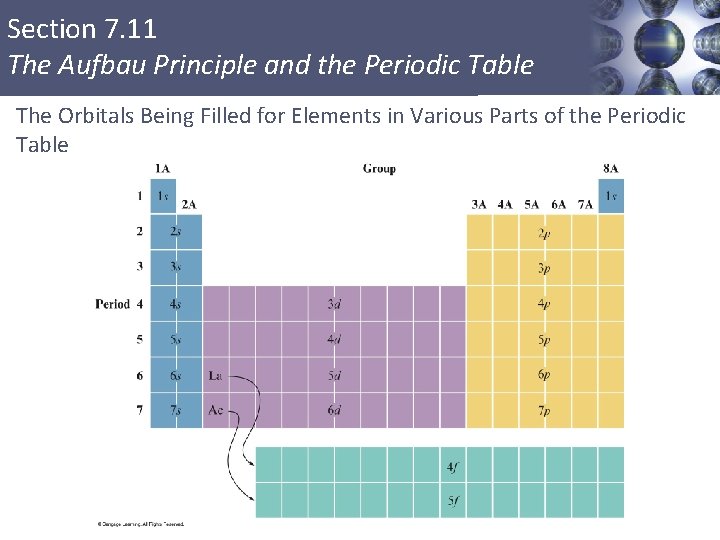
Section 7. 11 The Aufbau Principle and the Periodic Table The Orbitals Being Filled for Elements in Various Parts of the Periodic Table Copyright © Cengage Learning. All rights reserved 7
Section 7. 11 The Aufbau Principle and the Periodic Table EXERCISE! Determine the expected electron configurations for each of the following. a) S 1 s 22 p 63 s 23 p 4 or [Ne]3 s 23 p 4 b) Ba [Xe]6 s 2 c) Eu [Xe]6 s 24 f 7 Copyright © Cengage Learning. All rights reserved 8
Section 7. 12 Periodic Trends in Atomic Properties Periodic Trends § Ionization Energy § Electron Affinity § Atomic Radius
Section 7. 12 Periodic Trends in Atomic Properties Ionization Energy § Energy required to remove an electron from a gaseous atom or ion. § X(g) → X+(g) + e– Mg → Mg+ + e– Mg+ → Mg 2+ + e– Mg 2+ → Mg 3+ + e– I 1 = 735 k. J/mol(1 st IE) I 2 = 1445 k. J/mol (2 nd IE) I 3 = 7730 k. J/mol *(3 rd IE) *Core electrons are bound much more tightly than valence electrons.
Section 7. 12 Periodic Trends in Atomic Properties Ionization Energy § In general, as we go across a period from left to right, the first ionization energy increases. § Why? § Electrons added in the same principal quantum level do not completely shield the increasing nuclear charge caused by the added protons. § Electrons in the same principal quantum level are generally more strongly bound from left to right on the periodic table.
Section 7. 12 Periodic Trends in Atomic Properties Ionization Energy § In general, as we go down a group from top to bottom, the first ionization energy decreases. § Why? § The electrons being removed are, on average, farther from the nucleus.
Section 7. 12 Periodic Trends in Atomic Properties The Values of First Ionization Energy for the Elements in the First Six Periods
Section 7. 12 Periodic Trends in Atomic Properties CONCEPT CHECK! Explain why the graph of ionization energy versus atomic number (across a row) is not linear. electron repulsions Where are the exceptions? some include from Be to B and N to O
Section 7. 12 Periodic Trends in Atomic Properties CONCEPT CHECK! Which atom would require more energy to remove an electron? Why? Na Cl
Section 7. 12 Periodic Trends in Atomic Properties CONCEPT CHECK! Which atom would require more energy to remove an electron? Why? Li Cs
Section 7. 12 Periodic Trends in Atomic Properties CONCEPT CHECK! Which has the larger second ionization energy? Why? Lithium or Beryllium
Section 7. 12 Periodic Trends in Atomic Properties Successive Ionization Energies (KJ per Mole) for the Elements in Period 3
Section 7. 12 Periodic Trends in Atomic Properties Electron Affinity § Energy change associated with the addition of an electron to a gaseous atom. § X(g) + e– → X–(g) § In general as we go across a period from left to right, the electron affinities become more negative. § In general electron affinity becomes more positive in going down a group.
Section 7. 12 Periodic Trends in Atomic Properties Atomic Radius § In general as we go across a period from left to right, the atomic radius decreases. § Effective nuclear charge increases, therefore the valence electrons are drawn closer to the nucleus, decreasing the size of the atom. § In general atomic radius increases in going down a group. § Orbital sizes increase in successive principal quantum levels.
Section 7. 12 Periodic Trends in Atomic Properties Atomic Radii for Selected Atoms
Section 7. 12 Periodic Trends in Atomic Properties CONCEPT CHECK! Which should be the larger atom? Why? Na Cl
Section 7. 12 Periodic Trends in Atomic Properties CONCEPT CHECK! Which should be the larger atom? Why? Li Cs
Section 7. 12 Periodic Trends in Atomic Properties CONCEPT CHECK! Which is larger? § The hydrogen 1 s orbital § The lithium 1 s orbital Which is lower in energy? §The hydrogen 1 s orbital §The lithium 1 s orbital
Section 7. 12 Periodic Trends in Atomic Properties Atomic Radius of a Metal To play movie you must be in Slide Show Mode PC Users: Please wait for content to load, then click to play Mac Users: CLICK HERE
Section 7. 12 Periodic Trends in Atomic Properties Atomic Radius of a Nonmetal To play movie you must be in Slide Show Mode PC Users: Please wait for content to load, then click to play Mac Users: CLICK HERE
Section 7. 12 Periodic Trends in Atomic Properties EXERCISE! Arrange the elements oxygen, fluorine, and sulfur according to increasing: § Ionization energy S, O, F § Atomic size F, O, S
Section 7. 13 The Properties of a Group: The Alkali Metals The Periodic Table – Final Thoughts 1. It is the number and type of valence electrons that primarily determine an atom’s chemistry. 2. Electron configurations can be determined from the organization of the periodic table. 3. Certain groups in the periodic table have special names. Copyright © Cengage Learning. All rights reserved 28
Section 7. 13 The Properties of a Group: The Alkali Metals Special Names for Groups in the Periodic Table Copyright © Cengage Learning. All rights reserved 29
Section 7. 13 The Properties of a Group: The Alkali Metals The Periodic Table – Final Thoughts 4. Basic division of the elements in the periodic table is into metals and nonmetals. Copyright © Cengage Learning. All rights reserved 30
Section 7. 13 The Properties of a Group: The Alkali Metals Versus Nonmetals Copyright © Cengage Learning. All rights reserved 31
Section 7. 13 The Properties of a Group: The Alkali Metals § Li, Na, K, Rb, Cs, and Fr § Most chemically reactive of the metals Ø React with nonmetals to form ionic solids § Going down group: Ø Ø Ionization energy decreases Atomic radius increases Density increases Melting and boiling points smoothly decrease Copyright © Cengage Learning. All rights reserved 32