
Chapter 7 Atmospheric Transmission Key concepts Extinction absorption
Chapter 7: Atmospheric Transmission • Key concepts: • Extinction, absorption, and scattering cross sections, coefficients, and mass scattering efficiencies for gases, particles, and bulk samples. • Distinguish the direct beam from the diffuse beam for transmitted light. Beer’s ‘law’ ONLY describes the direct beam!!!! • Optical depth as a coordinate, replaces the vertical coordinate for radiation transfer. • Particle dispersions, mono versus polydisperse distributions. • First link of cloud microphysics (cloud condensation nuclei number) with cloud optical depth in the visible. Pat Arnott, ATMS 749 Atmospheric Radiation Transfer
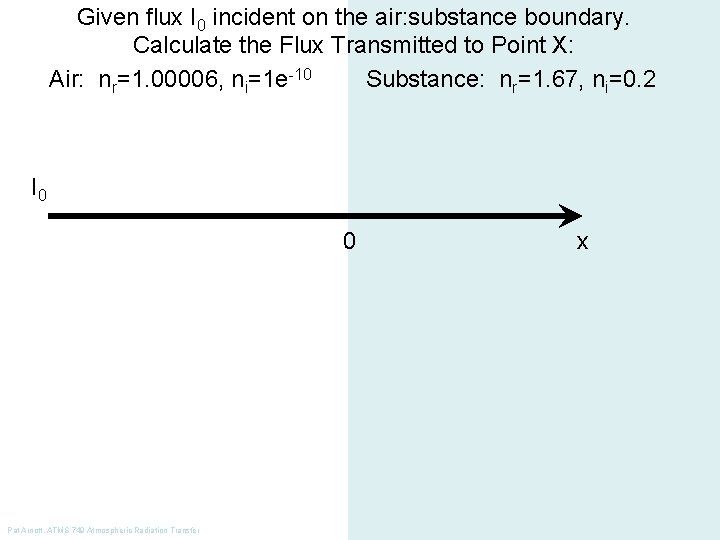
Given flux I 0 incident on the air: substance boundary. Calculate the Flux Transmitted to Point X: Air: nr=1. 00006, ni=1 e-10 Substance: nr=1. 67, ni=0. 2 I 0 0 Pat Arnott, ATMS 749 Atmospheric Radiation Transfer x
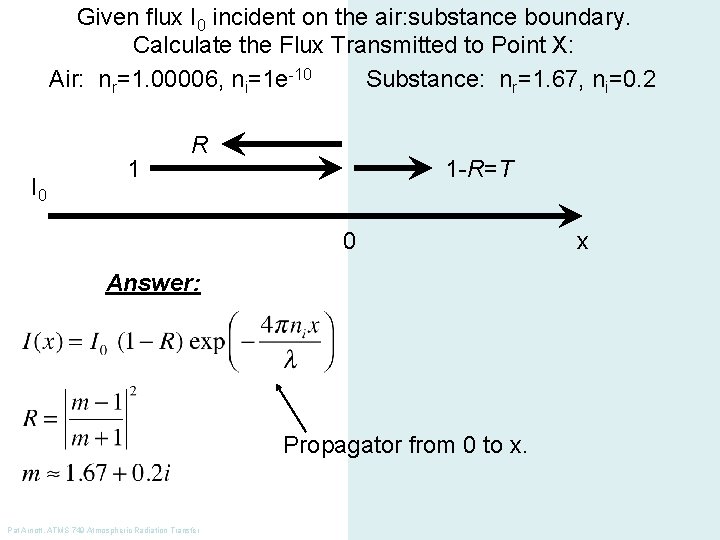
Given flux I 0 incident on the air: substance boundary. Calculate the Flux Transmitted to Point X: Air: nr=1. 00006, ni=1 e-10 Substance: nr=1. 67, ni=0. 2 I 0 1 R 1 -R=T 0 Answer: Propagator from 0 to x. Pat Arnott, ATMS 749 Atmospheric Radiation Transfer x
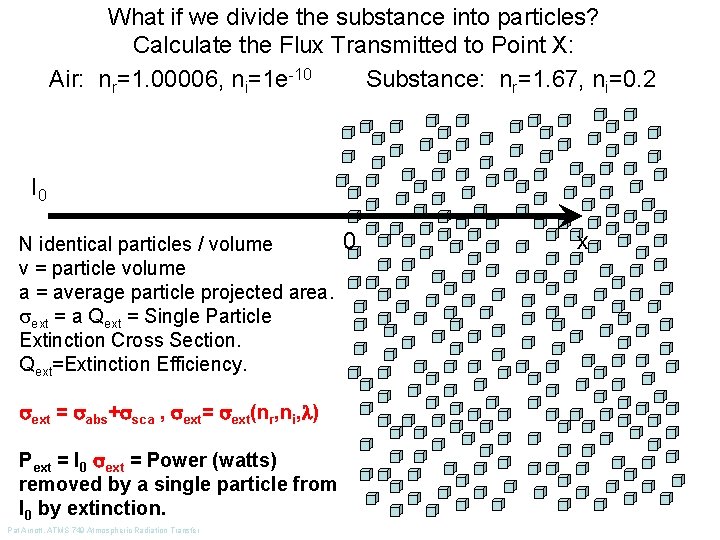
What if we divide the substance into particles? Calculate the Flux Transmitted to Point X: Air: nr=1. 00006, ni=1 e-10 Substance: nr=1. 67, ni=0. 2 I 0 N identical particles / volume v = particle volume a = average particle projected area. ext = a Qext = Single Particle Extinction Cross Section. Qext=Extinction Efficiency. ext = abs+ sca , ext= ext(nr, ni, ) Pext = I 0 ext = Power (watts) removed by a single particle from I 0 by extinction. Pat Arnott, ATMS 749 Atmospheric Radiation Transfer 0 x
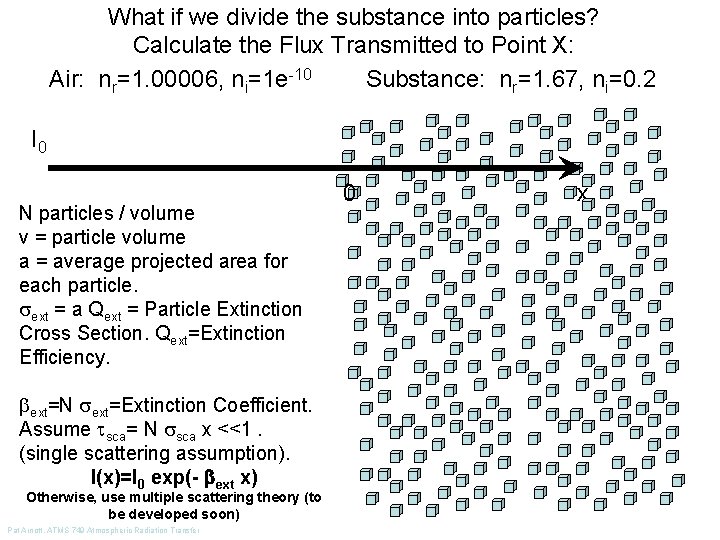
What if we divide the substance into particles? Calculate the Flux Transmitted to Point X: Air: nr=1. 00006, ni=1 e-10 Substance: nr=1. 67, ni=0. 2 I 0 N particles / volume v = particle volume a = average projected area for each particle. ext = a Qext = Particle Extinction Cross Section. Qext=Extinction Efficiency. ext=N ext=Extinction Coefficient. Assume sca= N sca x <<1. (single scattering assumption). I(x)=I 0 exp(- ext x) Otherwise, use multiple scattering theory (to be developed soon) Pat Arnott, ATMS 749 Atmospheric Radiation Transfer 0 x

What if we divide the substance into particles? Calculate the Flux Transmitted to Point X: reflection direct I 0 absorption diffuse (scattered) reflection Direct Beam: I(x)=I 0 exp(- ext x) Transmission Coefficient for the Direct Beam: tdirect=exp(- ext x) Otherwise, use multiple scattering theory: I(x) = Idirect + Idiffuse More Generally, Captures fate of photons: tdirect + tdiffuse + r + a = 1 transmission + reflection + absorption coefficients = 1. Often calculate ‘r’ and ‘t’, and obtain ‘a’ as residual. Pat Arnott, ATMS 749 Atmospheric Radiation Transfer
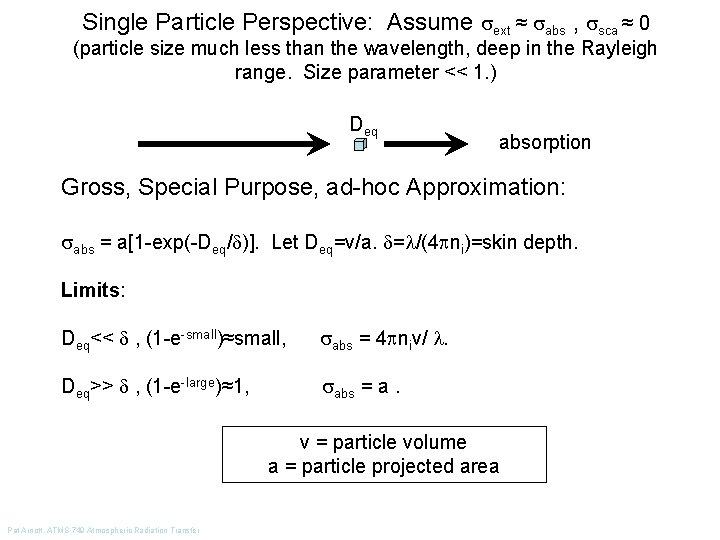
Single Particle Perspective: Assume ext ≈ abs , sca ≈ 0 (particle size much less than the wavelength, deep in the Rayleigh range. Size parameter << 1. ) Deq absorption Gross, Special Purpose, ad-hoc Approximation: abs = a[1 -exp(-Deq/ )]. Let Deq=v/a. = /(4 ni)=skin depth. Limits: Deq<< , (1 -e-small)≈small, abs = 4 niv/ Deq>> , (1 -e-large)≈1, abs = a. v = particle volume a = particle projected area Pat Arnott, ATMS 749 Atmospheric Radiation Transfer
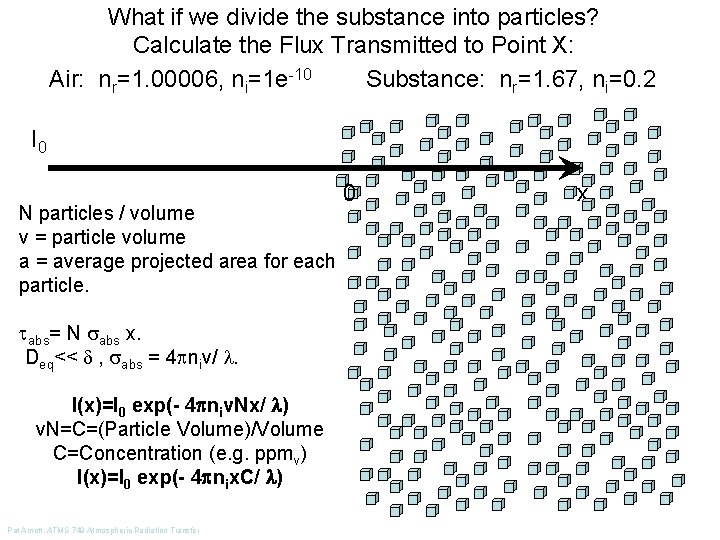
What if we divide the substance into particles? Calculate the Flux Transmitted to Point X: Air: nr=1. 00006, ni=1 e-10 Substance: nr=1. 67, ni=0. 2 I 0 N particles / volume v = particle volume a = average projected area for each particle. abs= N abs x. Deq<< , abs = 4 niv/ I(x)=I 0 exp(- 4 niv. Nx/ ) v. N=C=(Particle Volume)/Volume C=Concentration (e. g. ppmv) I(x)=I 0 exp(- 4 nix. C/ ) Pat Arnott, ATMS 749 Atmospheric Radiation Transfer 0 x
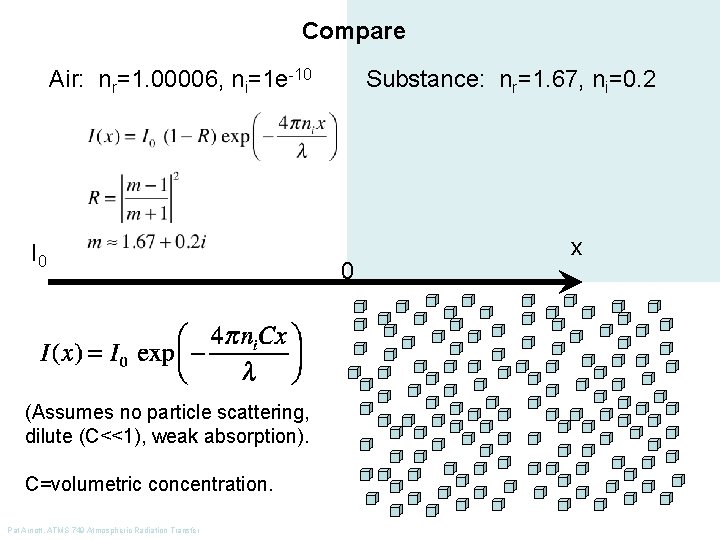
Compare Air: nr=1. 00006, ni=1 e-10 I 0 (Assumes no particle scattering, dilute (C<<1), weak absorption). C=volumetric concentration. Pat Arnott, ATMS 749 Atmospheric Radiation Transfer Substance: nr=1. 67, ni=0. 2 0 x
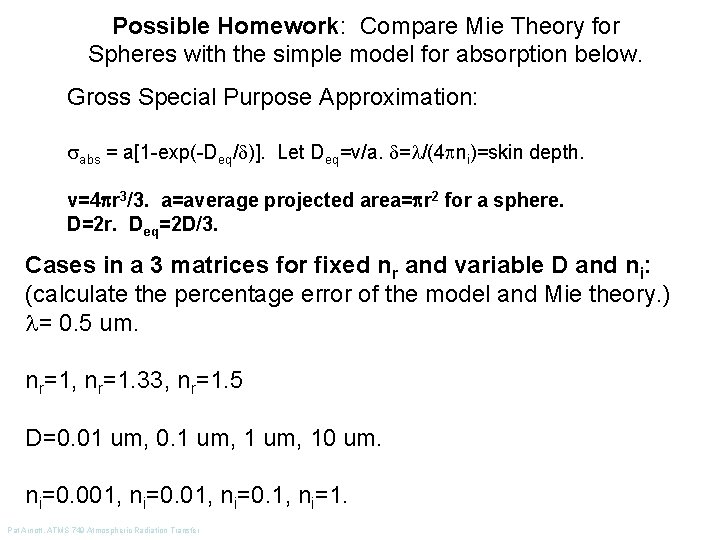
Possible Homework: Compare Mie Theory for Spheres with the simple model for absorption below. Gross Special Purpose Approximation: abs = a[1 -exp(-Deq/ )]. Let Deq=v/a. = /(4 ni)=skin depth. v=4 r 3/3. a=average projected area= r 2 for a sphere. D=2 r. Deq=2 D/3. Cases in a 3 matrices for fixed nr and variable D and ni: (calculate the percentage error of the model and Mie theory. ) = 0. 5 um. nr=1, nr=1. 33, nr=1. 5 D=0. 01 um, 0. 1 um, 10 um. ni=0. 001, ni=0. 1, ni=1. Pat Arnott, ATMS 749 Atmospheric Radiation Transfer
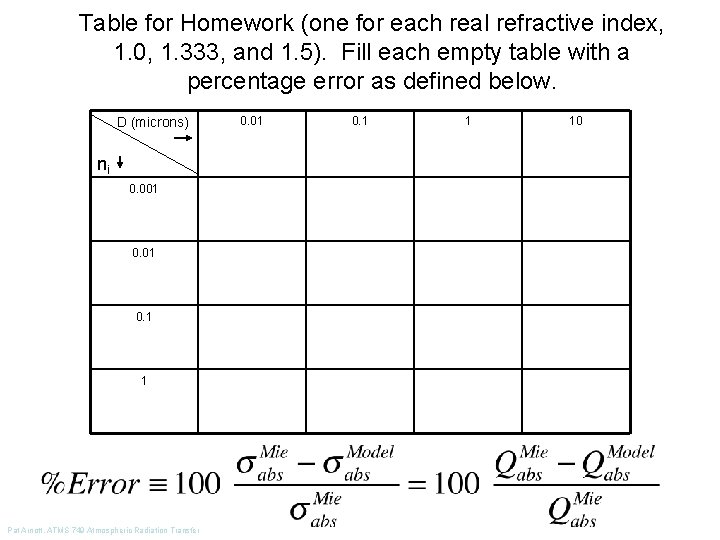
Table for Homework (one for each real refractive index, 1. 0, 1. 333, and 1. 5). Fill each empty table with a percentage error as defined below. D (microns) ni 0. 001 0. 1 1 Pat Arnott, ATMS 749 Atmospheric Radiation Transfer 0. 01 0. 1 1 10

Compare: Bulk Substance, Gas, and Particles Air: nr=1. 00006, ni=1 e-10 Bulk Substance: nr=1. 67, ni=0. 2 I 0 0 x Gas (Assumes no particle scattering, dilute (C<<1), weak absorption). C=volumetric concentration. Pat Arnott, ATMS 749 Atmospheric Radiation Transfer Particles
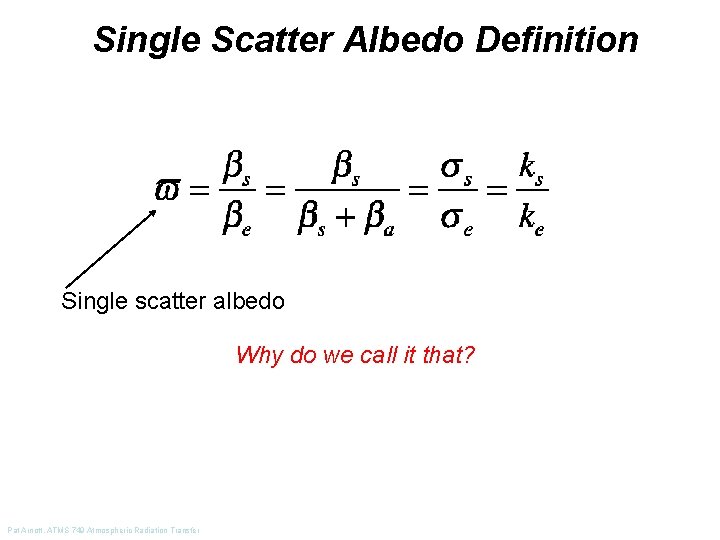
Single Scatter Albedo Definition Single scatter albedo Why do we call it that? Pat Arnott, ATMS 749 Atmospheric Radiation Transfer
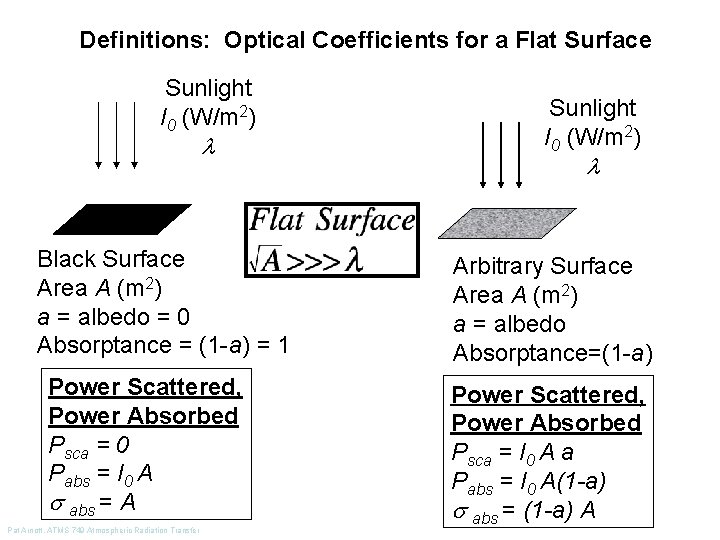
Definitions: Optical Coefficients for a Flat Surface Sunlight I 0 (W/m 2) Black Surface Area A (m 2) a = albedo = 0 Absorptance = (1 -a) = 1 Power Scattered, Power Absorbed Psca = 0 Pabs = I 0 A abs = A Pat Arnott, ATMS 749 Atmospheric Radiation Transfer Sunlight I 0 (W/m 2) Arbitrary Surface Area A (m 2) a = albedo Absorptance=(1 -a) Power Scattered, Power Absorbed Psca = I 0 A a Pabs = I 0 A(1 -a) abs = (1 -a) A
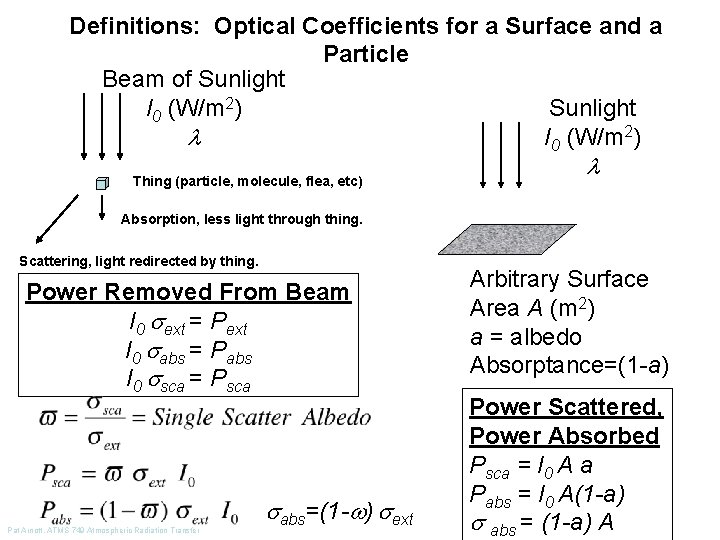
Definitions: Optical Coefficients for a Surface and a Particle Beam of Sunlight I 0 (W/m 2) Thing (particle, molecule, flea, etc) Absorption, less light through thing. Scattering, light redirected by thing. Power Removed From Beam I 0 ext = Pext I 0 abs = Pabs I 0 sca = Psca Pat Arnott, ATMS 749 Atmospheric Radiation Transfer abs=(1 - ) ext Arbitrary Surface Area A (m 2) a = albedo Absorptance=(1 -a) Power Scattered, Power Absorbed Psca = I 0 A a Pabs = I 0 A(1 -a) abs = (1 -a) A
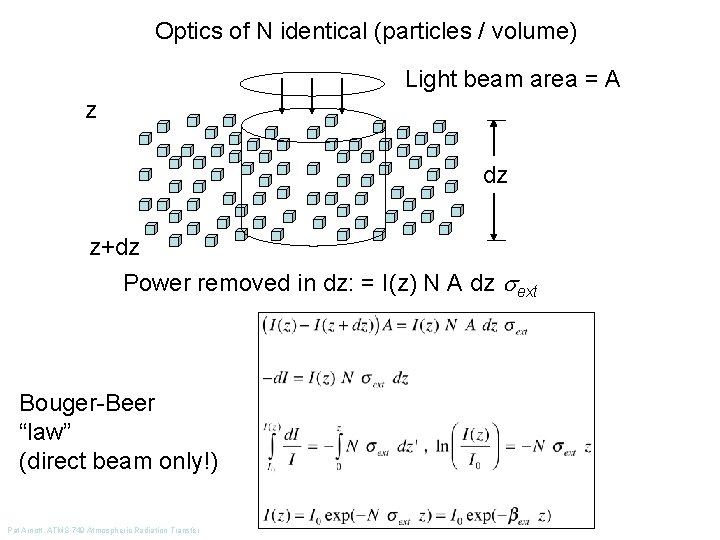
Optics of N identical (particles / volume) Light beam area = A z dz z+dz Power removed in dz: = I(z) N A dz ext Bouger-Beer “law” (direct beam only!) Pat Arnott, ATMS 749 Atmospheric Radiation Transfer
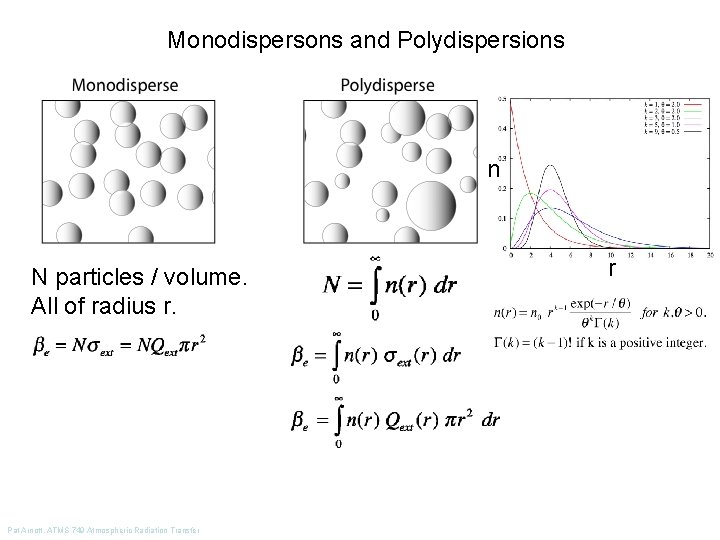
Monodispersons and Polydispersions n N particles / volume. All of radius r. Pat Arnott, ATMS 749 Atmospheric Radiation Transfer r
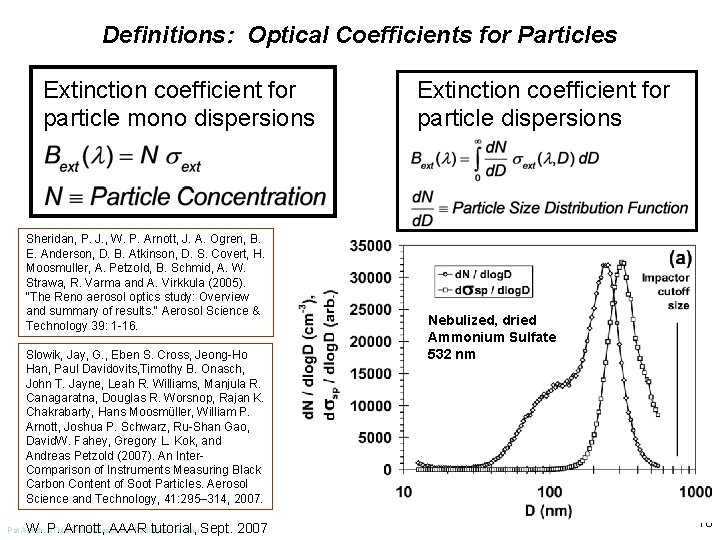
Definitions: Optical Coefficients for Particles Extinction coefficient for particle mono dispersions Sheridan, P. J. , W. P. Arnott, J. A. Ogren, B. E. Anderson, D. B. Atkinson, D. S. Covert, H. Moosmuller, A. Petzold, B. Schmid, A. W. Strawa, R. Varma and A. Virkkula (2005). "The Reno aerosol optics study: Overview and summary of results. " Aerosol Science & Technology 39: 1 -16. Slowik, Jay, G. , Eben S. Cross, Jeong-Ho Han, Paul Davidovits, Timothy B. Onasch, John T. Jayne, Leah R. Williams, Manjula R. Canagaratna, Douglas R. Worsnop, Rajan K. Chakrabarty, Hans Moosmüller, William P. Arnott, Joshua P. Schwarz, Ru-Shan Gao, David. W. Fahey, Gregory L. Kok, and Andreas Petzold (2007). An Inter. Comparison of Instruments Measuring Black Carbon Content of Soot Particles. Aerosol Science and Technology, 41: 295– 314, 2007. W. P. Arnott, AAAR tutorial, Sept. 2007 Pat Arnott, ATMS 749 Atmospheric Radiation Transfer Extinction coefficient for particle dispersions Nebulized, dried Ammonium Sulfate 532 nm 18
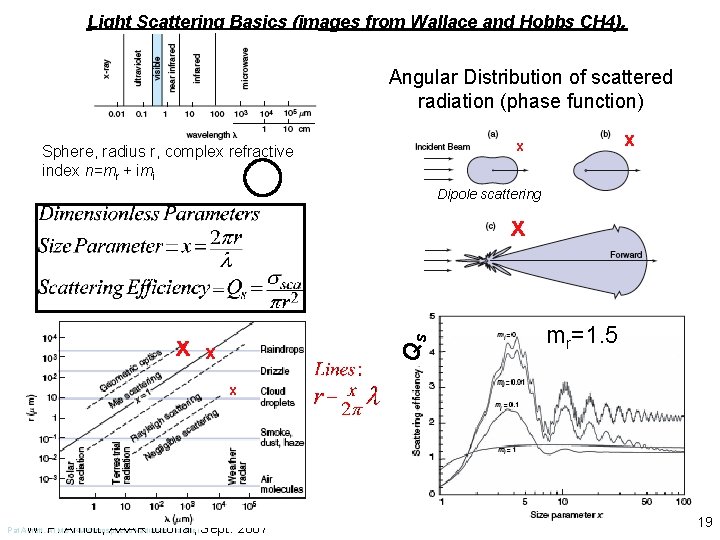
Light Scattering Basics (images from Wallace and Hobbs CH 4). Angular Distribution of scattered radiation (phase function) x x Sphere, radius r, complex refractive index n=mr + imi Dipole scattering x Qs x x mr=1. 5 x W. P. Arnott, AAAR tutorial, Sept. 2007 Pat Arnott, ATMS 749 Atmospheric Radiation Transfer 19
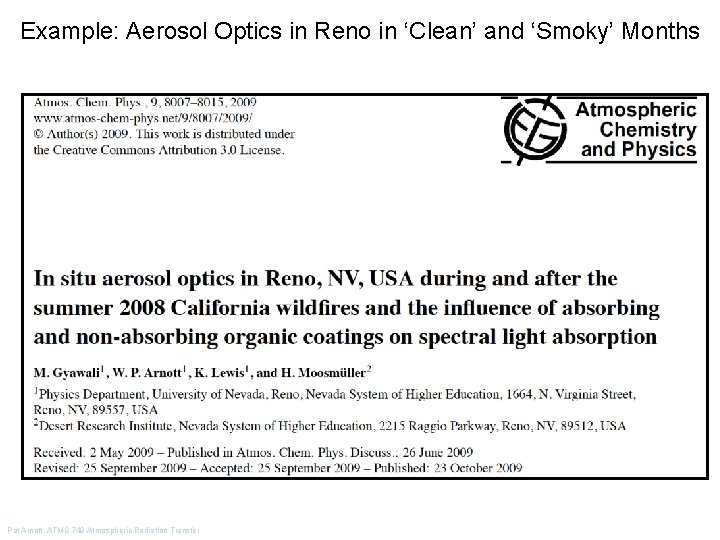
Example: Aerosol Optics in Reno in ‘Clean’ and ‘Smoky’ Months Pat Arnott, ATMS 749 Atmospheric Radiation Transfer
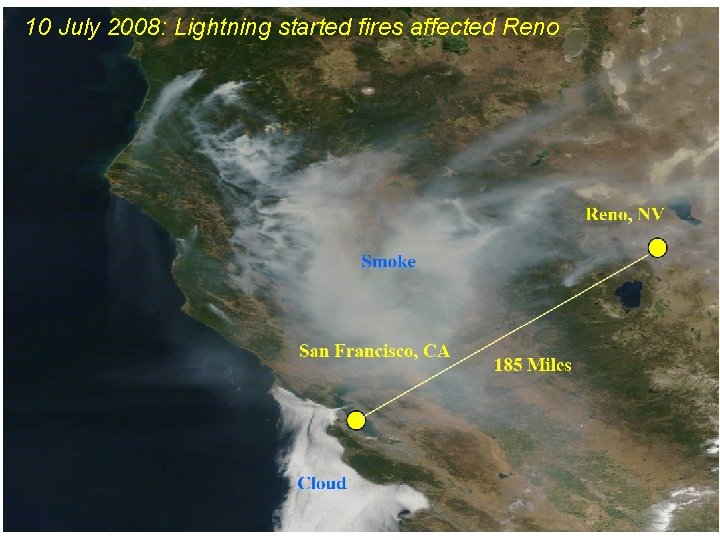
10 July 2008: Lightning started fires affected Reno Pat Arnott, ATMS 749 Atmospheric Radiation Transfer
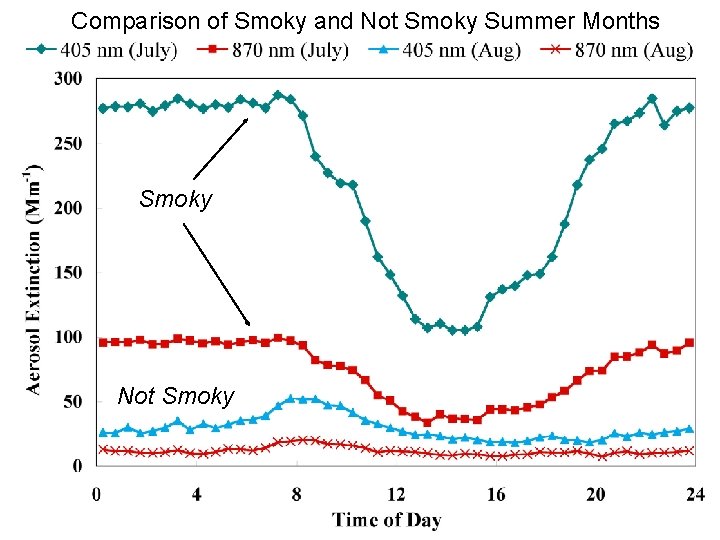
Comparison of Smoky and Not Smoky Summer Months Smoky Not Smoky Pat Arnott, ATMS 749 Atmospheric Radiation Transfer
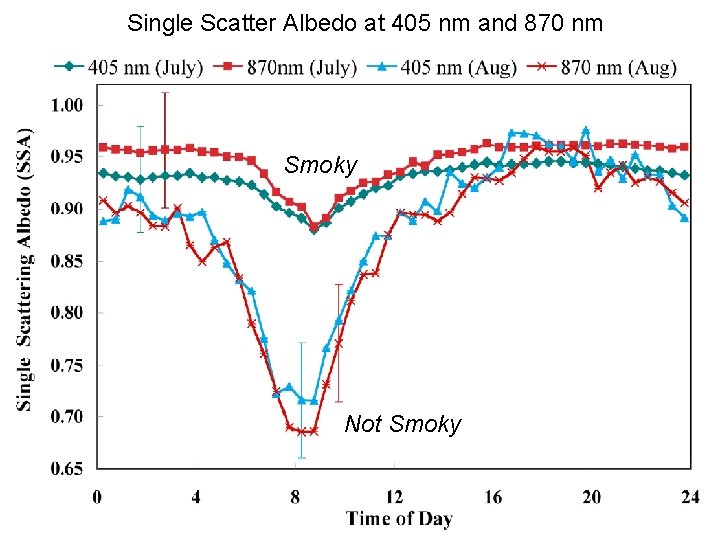
Single Scatter Albedo at 405 nm and 870 nm Smoky Not Smoky Pat Arnott, ATMS 749 Atmospheric Radiation Transfer
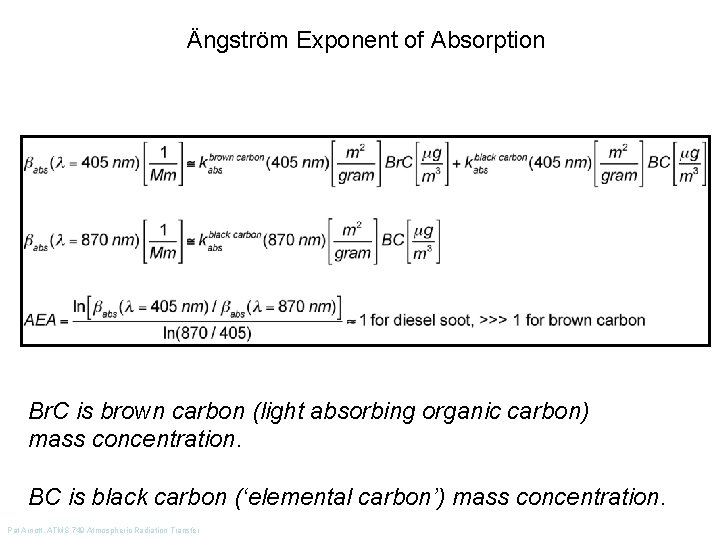
Ängström Exponent of Absorption Br. C is brown carbon (light absorbing organic carbon) mass concentration. BC is black carbon (‘elemental carbon’) mass concentration. Pat Arnott, ATMS 749 Atmospheric Radiation Transfer
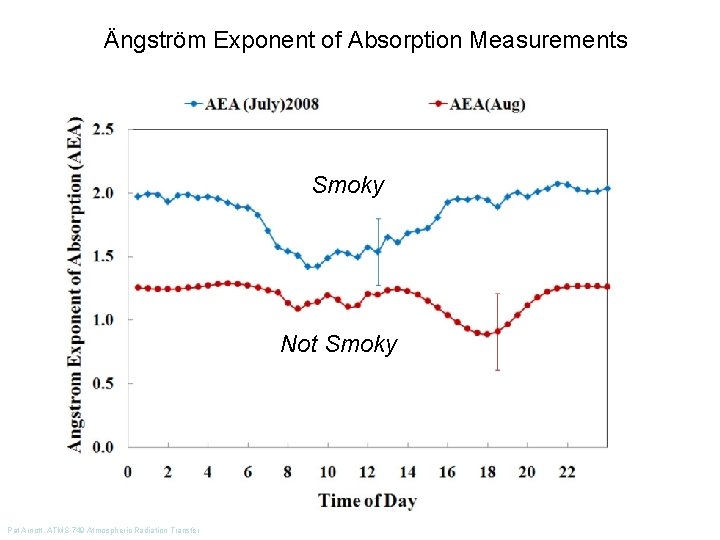
Ängström Exponent of Absorption Measurements Smoky Not Smoky Pat Arnott, ATMS 749 Atmospheric Radiation Transfer
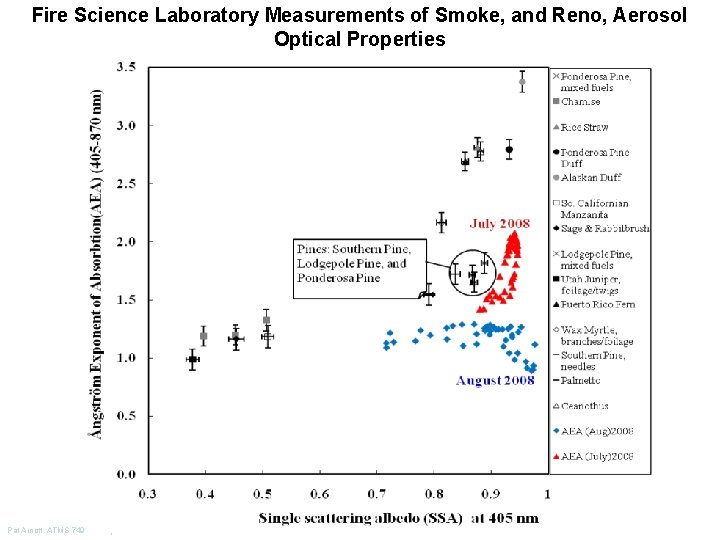
Fire Science Laboratory Measurements of Smoke, and Reno, Aerosol Optical Properties Pat Arnott, ATMS 749 Atmospheric Radiation Transfer
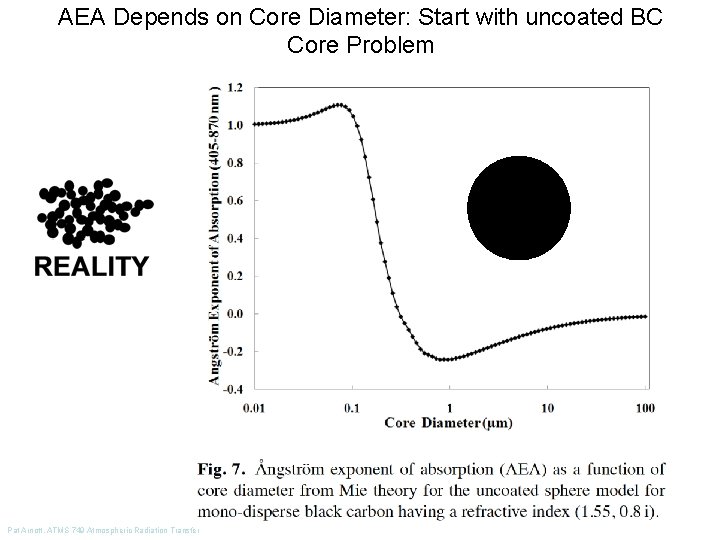
AEA Depends on Core Diameter: Start with uncoated BC Core Problem Pat Arnott, ATMS 749 Atmospheric Radiation Transfer
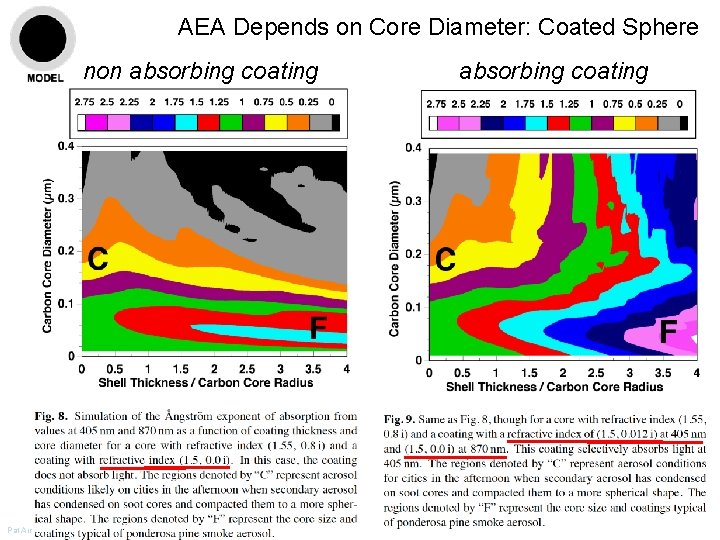
AEA Depends on Core Diameter: Coated Sphere non absorbing coating Pat Arnott, ATMS 749 Atmospheric Radiation Transfer absorbing coating
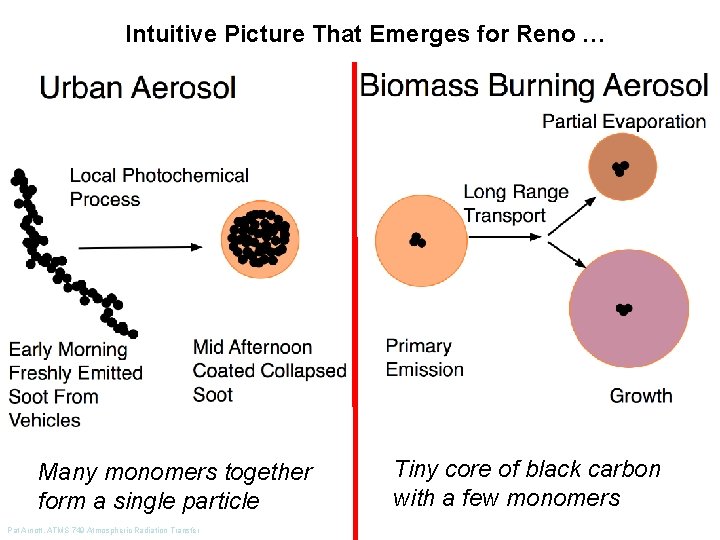
Intuitive Picture That Emerges for Reno … Many monomers together form a single particle Pat Arnott, ATMS 749 Atmospheric Radiation Transfer Tiny core of black carbon with a few monomers
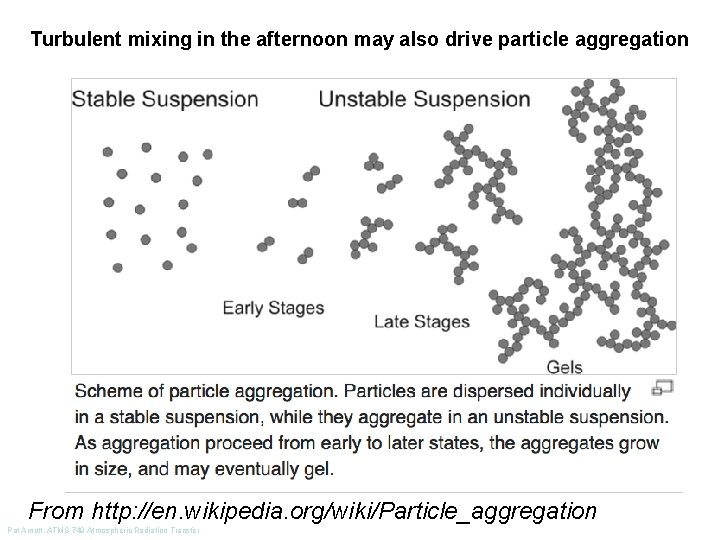
Turbulent mixing in the afternoon may also drive particle aggregation From http: //en. wikipedia. org/wiki/Particle_aggregation Pat Arnott, ATMS 749 Atmospheric Radiation Transfer
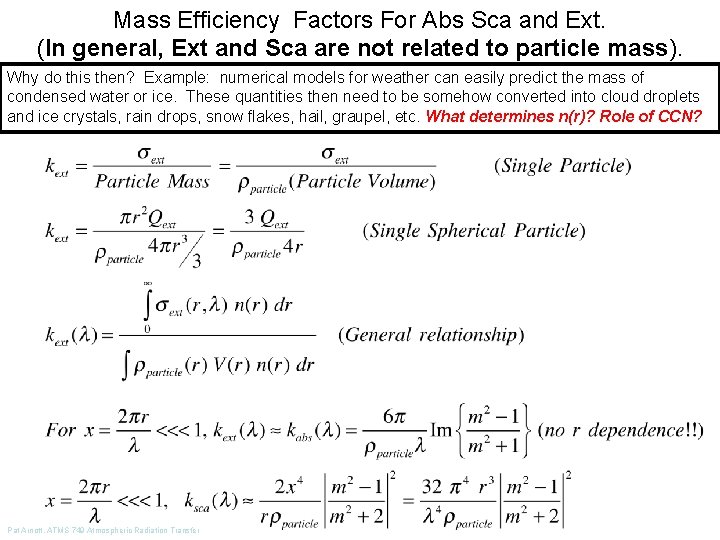
Mass Efficiency Factors For Abs Sca and Ext. (In general, Ext and Sca are not related to particle mass). Why do this then? Example: numerical models for weather can easily predict the mass of condensed water or ice. These quantities then need to be somehow converted into cloud droplets and ice crystals, rain drops, snow flakes, hail, graupel, etc. What determines n(r)? Role of CCN? Pat Arnott, ATMS 749 Atmospheric Radiation Transfer
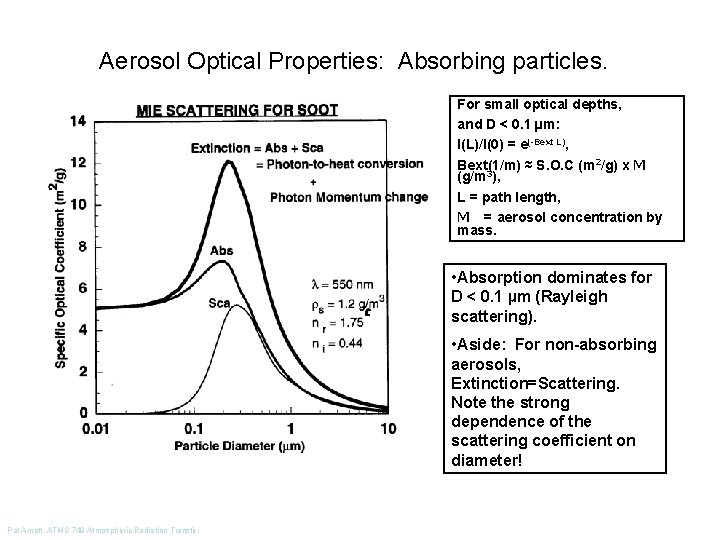
Aerosol Optical Properties: Absorbing particles. For small optical depths, and D < 0. 1 µm: I(L)/I(0) = e(-Bext L), Bext(1/m) ≈ S. O. C (m 2/g) x M (g/m 3), L = path length, M = aerosol concentration by mass. • Absorption dominates for D < 0. 1 µm (Rayleigh scattering). • Aside: For non-absorbing aerosols, Extinction=Scattering. Note the strong dependence of the scattering coefficient on diameter! Pat Arnott, ATMS 749 Atmospheric Radiation Transfer
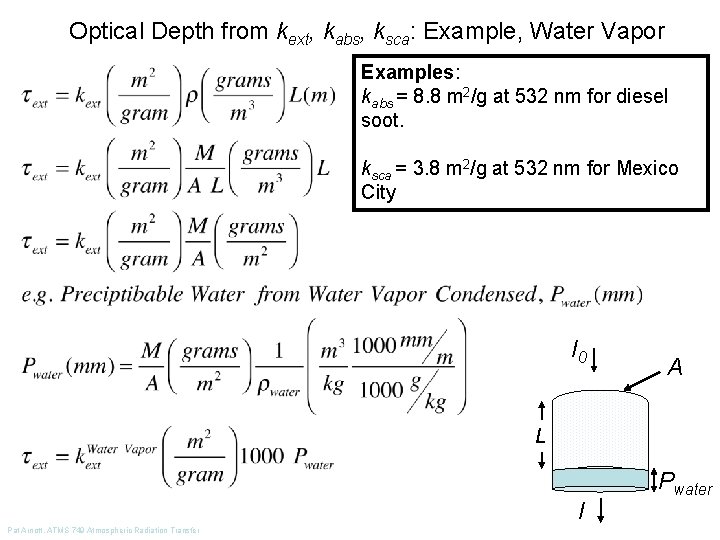
Optical Depth from kext, kabs, ksca: Example, Water Vapor Examples: kabs = 8. 8 m 2/g at 532 nm for diesel soot. ksca = 3. 8 m 2/g at 532 nm for Mexico City I 0 A L I Pat Arnott, ATMS 749 Atmospheric Radiation Transfer Pwater
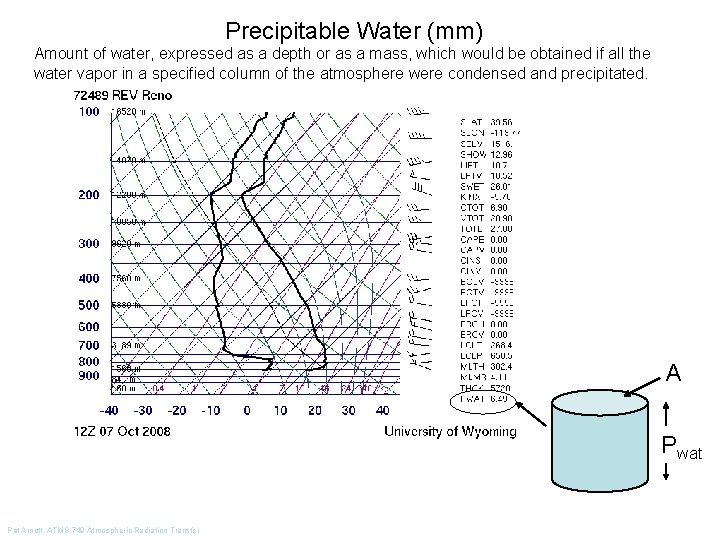
Precipitable Water (mm) Amount of water, expressed as a depth or as a mass, which would be obtained if all the water vapor in a specified column of the atmosphere were condensed and precipitated. A Pwat Pat Arnott, ATMS 749 Atmospheric Radiation Transfer
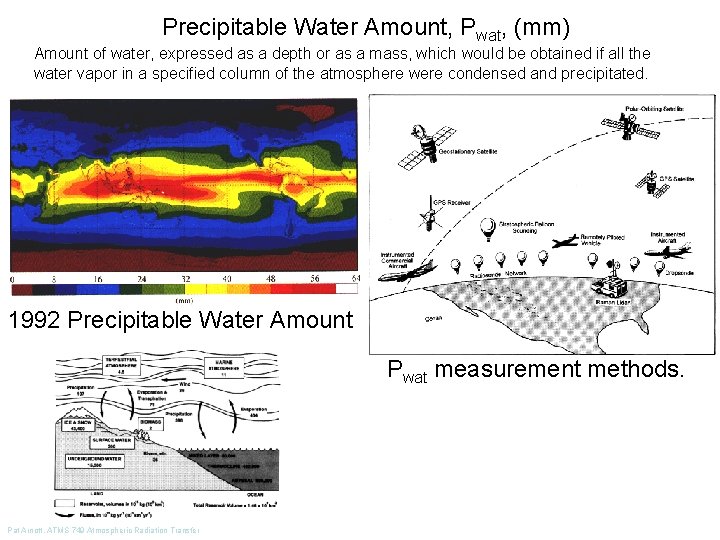
Precipitable Water Amount, Pwat, (mm) Amount of water, expressed as a depth or as a mass, which would be obtained if all the water vapor in a specified column of the atmosphere were condensed and precipitated. 1992 Precipitable Water Amount Pwat measurement methods. Pat Arnott, ATMS 749 Atmospheric Radiation Transfer
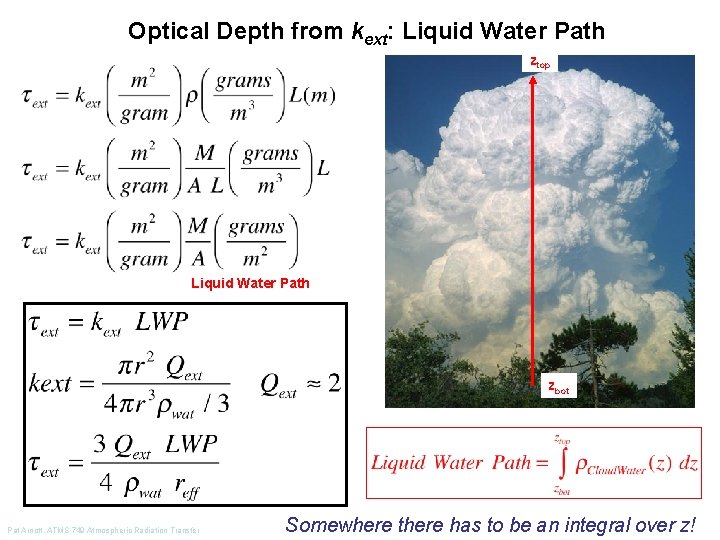
Optical Depth from kext: Liquid Water Path ztop Liquid Water Path zbot Pat Arnott, ATMS 749 Atmospheric Radiation Transfer Somewhere there has to be an integral over z!
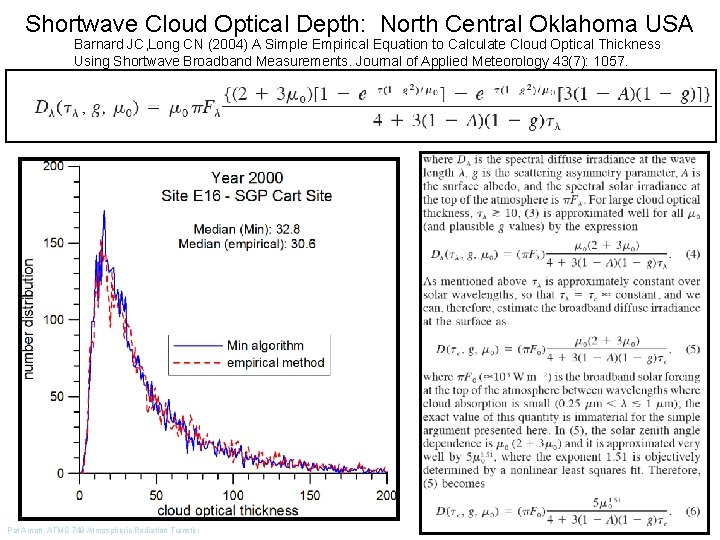
Shortwave Cloud Optical Depth: North Central Oklahoma USA Barnard JC, Long CN (2004) A Simple Empirical Equation to Calculate Cloud Optical Thickness Using Shortwave Broadband Measurements. Journal of Applied Meteorology 43(7): 1057. Pat Arnott, ATMS 749 Atmospheric Radiation Transfer
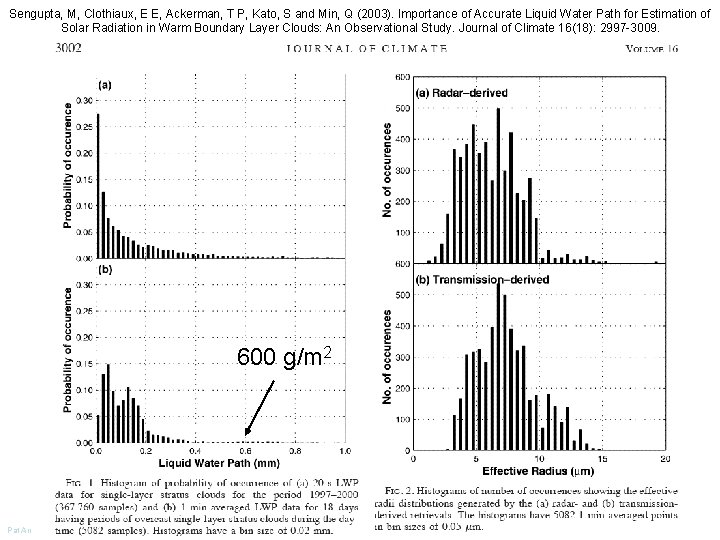
Sengupta, M, Clothiaux, E E, Ackerman, T P, Kato, S and Min, Q (2003). Importance of Accurate Liquid Water Path for Estimation of Solar Radiation in Warm Boundary Layer Clouds: An Observational Study. Journal of Climate 16(18): 2997 -3009. 600 g/m 2 Pat Arnott, ATMS 749 Atmospheric Radiation Transfer
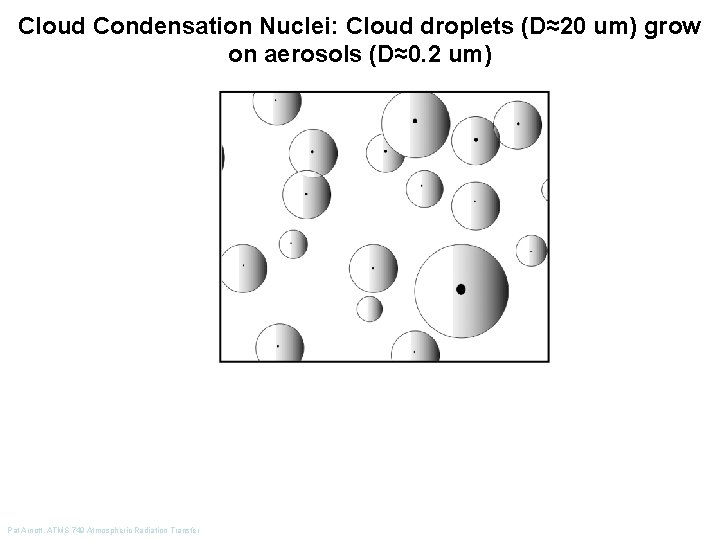
Cloud Condensation Nuclei: Cloud droplets (D≈20 um) grow on aerosols (D≈0. 2 um) Pat Arnott, ATMS 749 Atmospheric Radiation Transfer
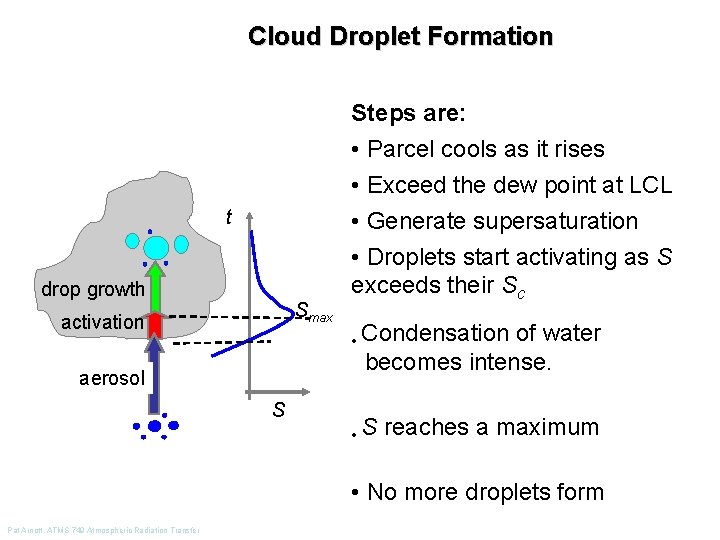
Cloud Droplet Formation Steps are: • Parcel cools as it rises t drop growth Smax activation • Exceed the dew point at LCL • Generate supersaturation • Droplets start activating as S exceeds their Sc • Condensation of water becomes intense. aerosol S • S reaches a maximum • No more droplets form Pat Arnott, ATMS 749 Atmospheric Radiation Transfer
Aerosol Indirect Effect The impact of aerosols on cloud radiative properties Pat Arnott, ATMS 749 Atmospheric Radiation Transfer
What is the Aerosol Indirect Effect? • The climatic impact of aerosols on cloud properties is called the aerosol indirect effect • A high concentration of aerosols overseed cloud droplets to generate highly concentrated, narrowly distributed cloud droplet spectra • This can increase the cloud albedo up to 30% reducing the amount of radiation reaching the surface • Narrowly distributed cloud droplet spectra prevent the formulation of precipitation and could increase cloud lifetime that further cools the Earth’s surface (Matsui et al. , 2004) Pat Arnott, ATMS 749 Atmospheric Radiation Transfer
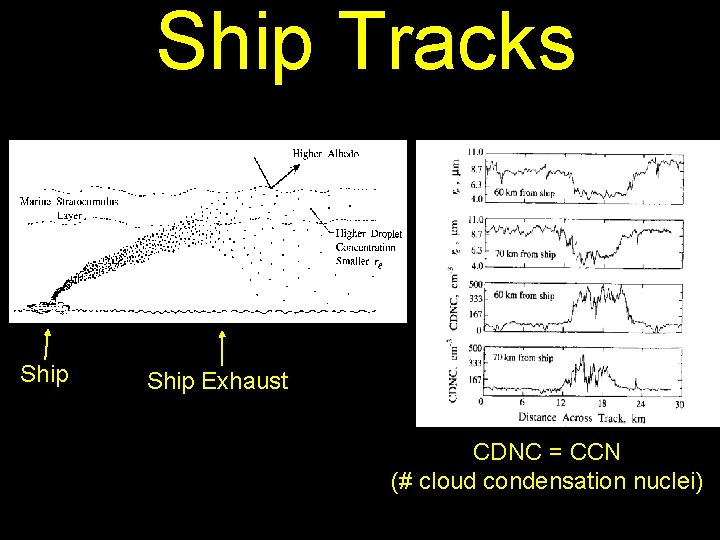
Ship Tracks Ship Exhaust CDNC = CCN (# cloud condensation nuclei)
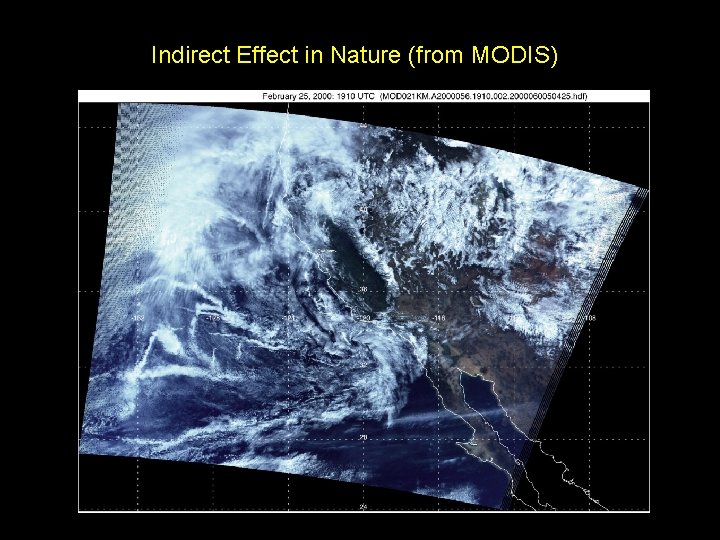
Indirect Effect in Nature (from MODIS)
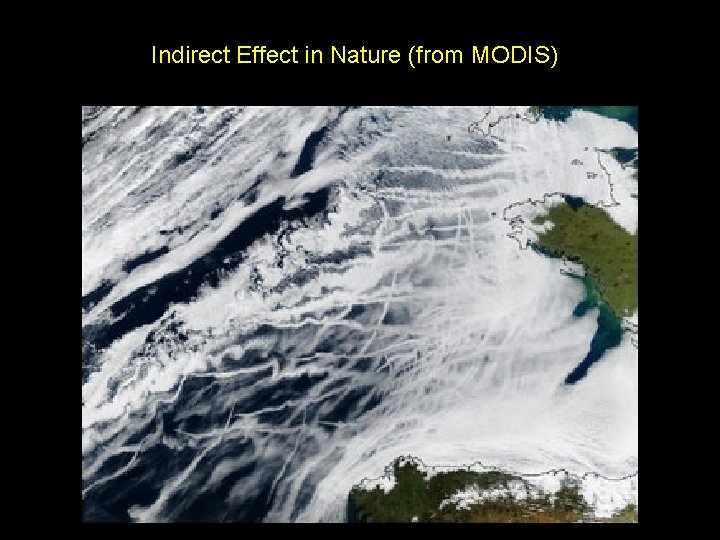
Indirect Effect in Nature (from MODIS)
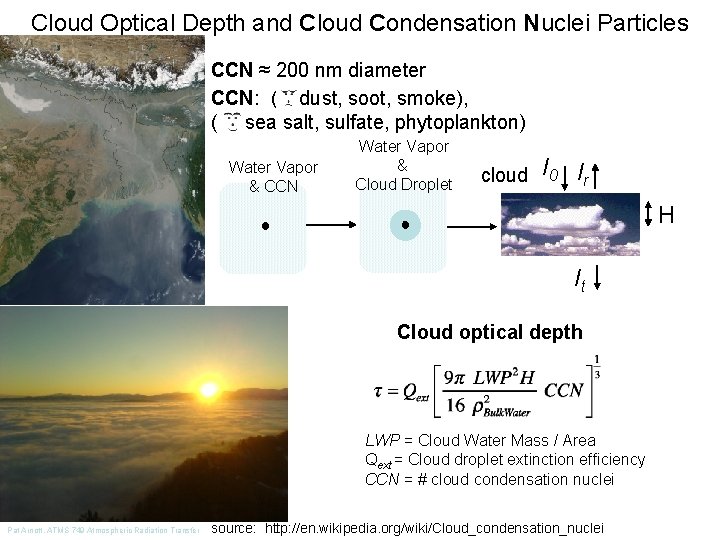
Cloud Optical Depth and Cloud Condensation Nuclei Particles CCN ≈ 200 nm diameter CCN: ( dust, soot, smoke), ( sea salt, sulfate, phytoplankton) Water Vapor & CCN Water Vapor & Cloud Droplet cloud I 0 Ir H It Cloud optical depth LWP = Cloud Water Mass / Area Qext = Cloud droplet extinction efficiency CCN = # cloud condensation nuclei Pat Arnott, ATMS 749 Atmospheric Radiation Transfer source: http: //en. wikipedia. org/wiki/Cloud_condensation_nuclei
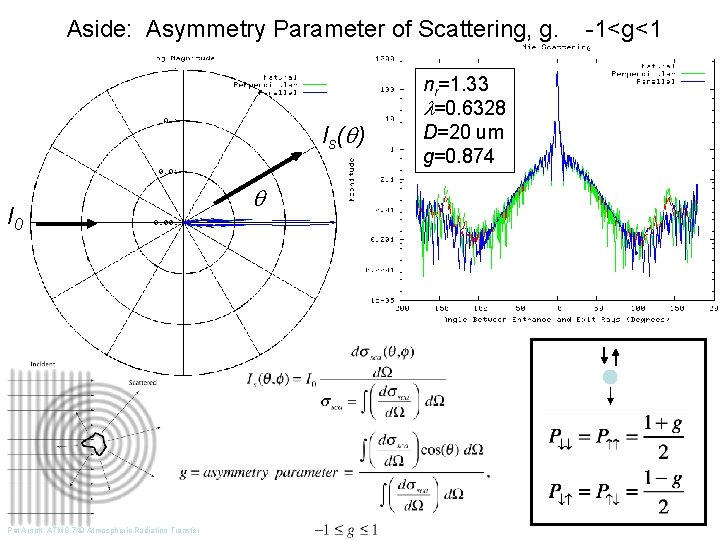
Aside: Asymmetry Parameter of Scattering, g. -1<g<1 Is( ) I 0 Pat Arnott, ATMS 749 Atmospheric Radiation Transfer nr=1. 33 =0. 6328 D=20 um g=0. 874
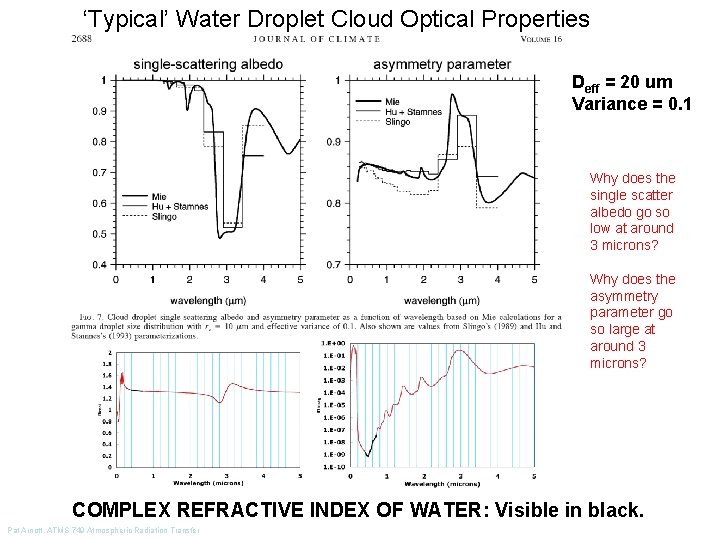
‘Typical’ Water Droplet Cloud Optical Properties Deff = 20 um Variance = 0. 1 Why does the single scatter albedo go so low at around 3 microns? Why does the asymmetry parameter go so large at around 3 microns? COMPLEX REFRACTIVE INDEX OF WATER: Visible in black. Pat Arnott, ATMS 749 Atmospheric Radiation Transfer
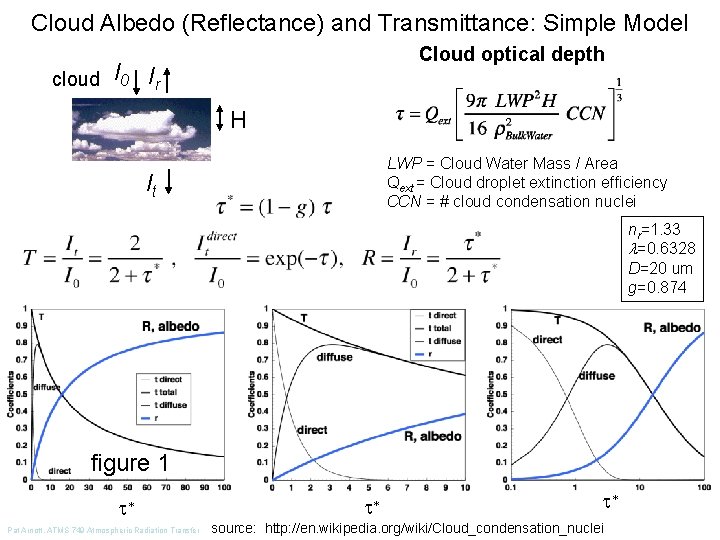
Cloud Albedo (Reflectance) and Transmittance: Simple Model cloud Cloud optical depth I 0 Ir H LWP = Cloud Water Mass / Area Qext = Cloud droplet extinction efficiency CCN = # cloud condensation nuclei It nr=1. 33 =0. 6328 D=20 um g=0. 874 figure 1 Pat Arnott, ATMS 749 Atmospheric Radiation Transfer source: http: //en. wikipedia. org/wiki/Cloud_condensation_nuclei
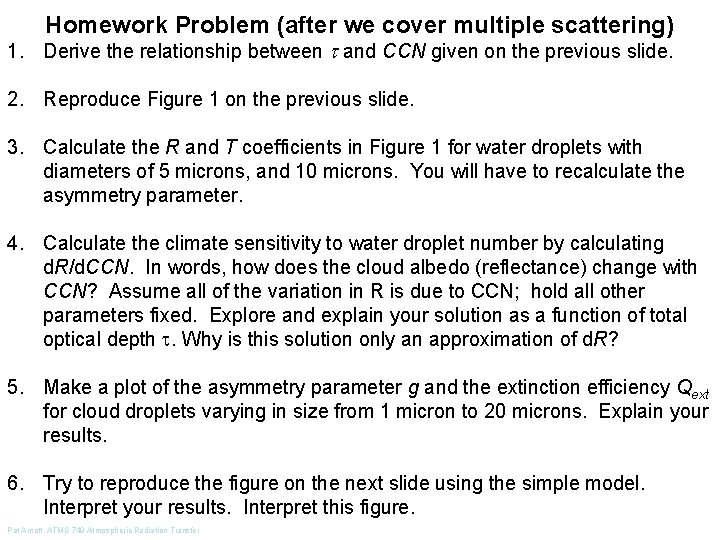
Homework Problem (after we cover multiple scattering) 1. Derive the relationship between and CCN given on the previous slide. 2. Reproduce Figure 1 on the previous slide. 3. Calculate the R and T coefficients in Figure 1 for water droplets with diameters of 5 microns, and 10 microns. You will have to recalculate the asymmetry parameter. 4. Calculate the climate sensitivity to water droplet number by calculating d. R/d. CCN. In words, how does the cloud albedo (reflectance) change with CCN? Assume all of the variation in R is due to CCN; hold all other parameters fixed. Explore and explain your solution as a function of total optical depth . Why is this solution only an approximation of d. R? 5. Make a plot of the asymmetry parameter g and the extinction efficiency Qext for cloud droplets varying in size from 1 micron to 20 microns. Explain your results. 6. Try to reproduce the figure on the next slide using the simple model. Interpret your results. Interpret this figure. Pat Arnott, ATMS 749 Atmospheric Radiation Transfer
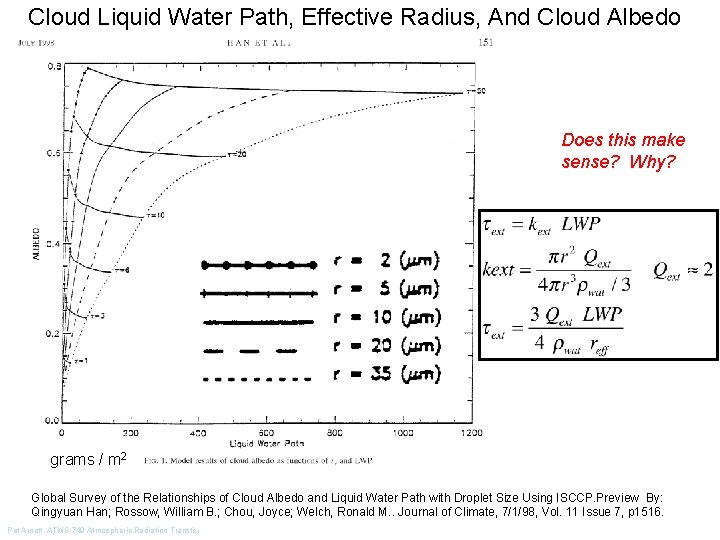
Cloud Liquid Water Path, Effective Radius, And Cloud Albedo Does this make sense? Why? grams / m 2 Global Survey of the Relationships of Cloud Albedo and Liquid Water Path with Droplet Size Using ISCCP. Preview By: Qingyuan Han; Rossow, William B. ; Chou, Joyce; Welch, Ronald M. . Journal of Climate, 7/1/98, Vol. 11 Issue 7, p 1516. Pat Arnott, ATMS 749 Atmospheric Radiation Transfer
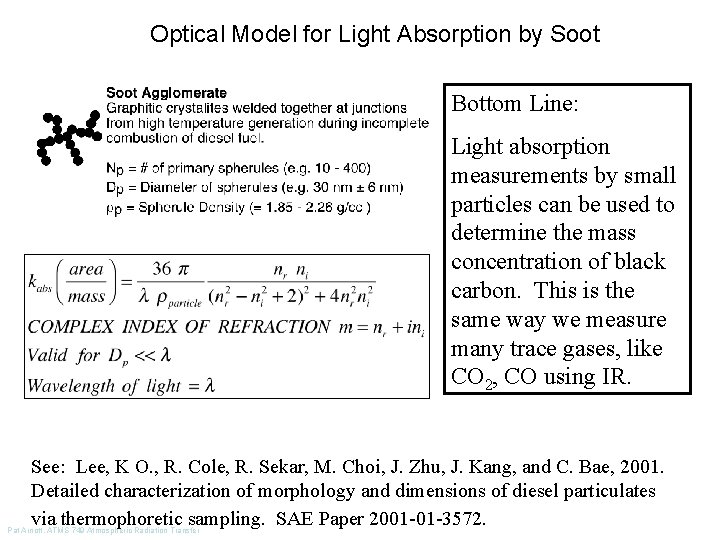
Optical Model for Light Absorption by Soot Bottom Line: Light absorption measurements by small particles can be used to determine the mass concentration of black carbon. This is the same way we measure many trace gases, like CO 2, CO using IR. See: Lee, K O. , R. Cole, R. Sekar, M. Choi, J. Zhu, J. Kang, and C. Bae, 2001. Detailed characterization of morphology and dimensions of diesel particulates via thermophoretic sampling. SAE Paper 2001 -01 -3572. Pat Arnott, ATMS 749 Atmospheric Radiation Transfer
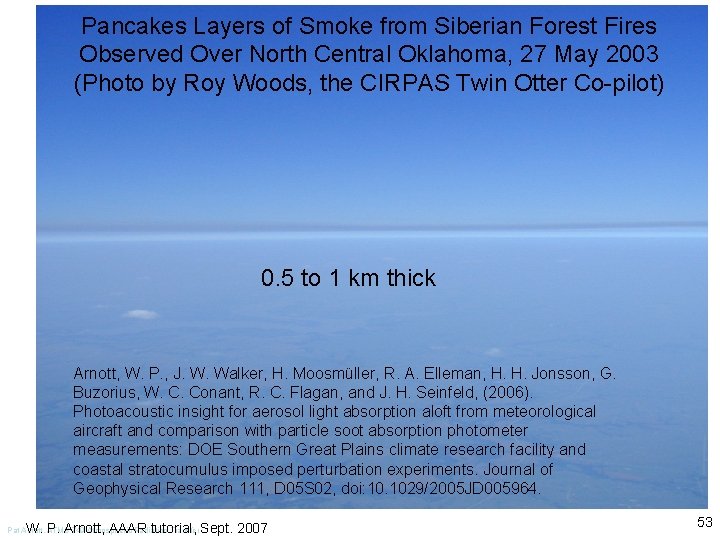
Pancakes Layers of Smoke from Siberian Forest Fires Observed Over North Central Oklahoma, 27 May 2003 (Photo by Roy Woods, the CIRPAS Twin Otter Co-pilot) 0. 5 to 1 km thick Arnott, W. P. , J. W. Walker, H. Moosmüller, R. A. Elleman, H. H. Jonsson, G. Buzorius, W. C. Conant, R. C. Flagan, and J. H. Seinfeld, (2006). Photoacoustic insight for aerosol light absorption aloft from meteorological aircraft and comparison with particle soot absorption photometer measurements: DOE Southern Great Plains climate research facility and coastal stratocumulus imposed perturbation experiments. Journal of Geophysical Research 111, D 05 S 02, doi: 10. 1029/2005 JD 005964. W. P. Arnott, AAAR tutorial, Sept. 2007 Pat Arnott, ATMS 749 Atmospheric Radiation Transfer 53
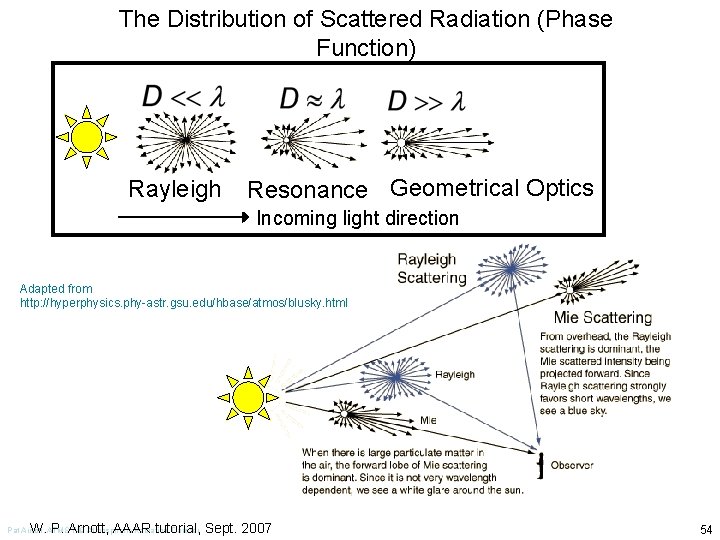
The Distribution of Scattered Radiation (Phase Function) Rayleigh Resonance Geometrical Optics Incoming light direction Adapted from http: //hyperphysics. phy-astr. gsu. edu/hbase/atmos/blusky. html W. P. Arnott, AAAR tutorial, Sept. 2007 Pat Arnott, ATMS 749 Atmospheric Radiation Transfer 54
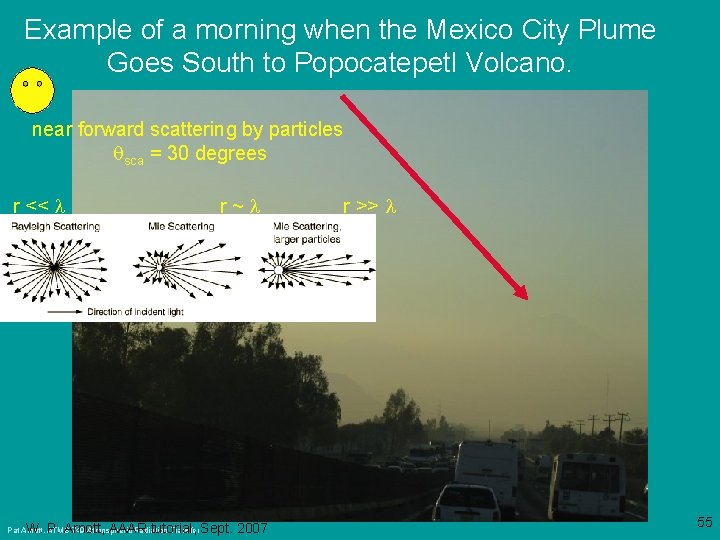
Example of a morning when the Mexico City Plume Goes South to Popocatepetl Volcano. near forward scattering by particles sca = 30 degrees r << r ~ r >> W. P. Arnott, AAAR tutorial, Sept. 2007 Pat Arnott, ATMS 749 Atmospheric Radiation Transfer 55
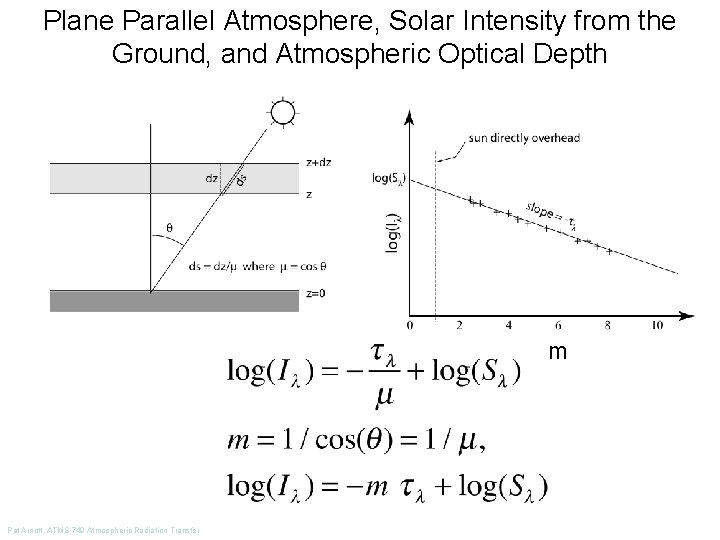
Plane Parallel Atmosphere, Solar Intensity from the Ground, and Atmospheric Optical Depth m Pat Arnott, ATMS 749 Atmospheric Radiation Transfer
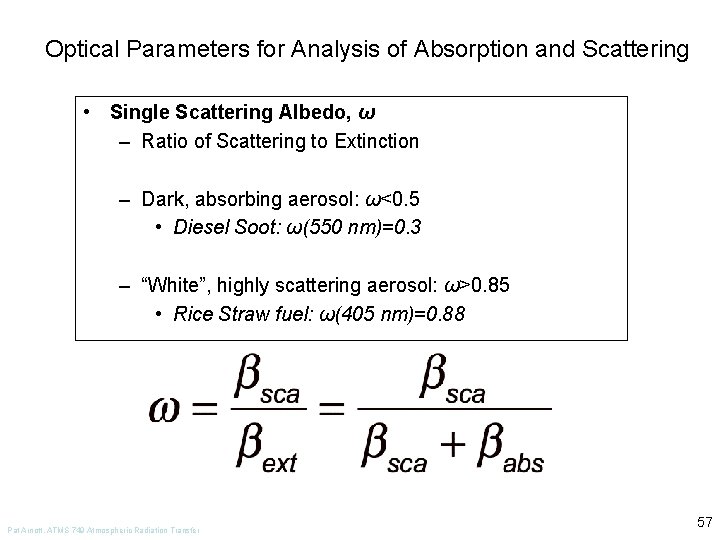
Optical Parameters for Analysis of Absorption and Scattering • Single Scattering Albedo, ω – Ratio of Scattering to Extinction – Dark, absorbing aerosol: ω<0. 5 • Diesel Soot: ω(550 nm)=0. 3 – “White”, highly scattering aerosol: ω>0. 85 • Rice Straw fuel: ω(405 nm)=0. 88 Pat Arnott, ATMS 749 Atmospheric Radiation Transfer 57
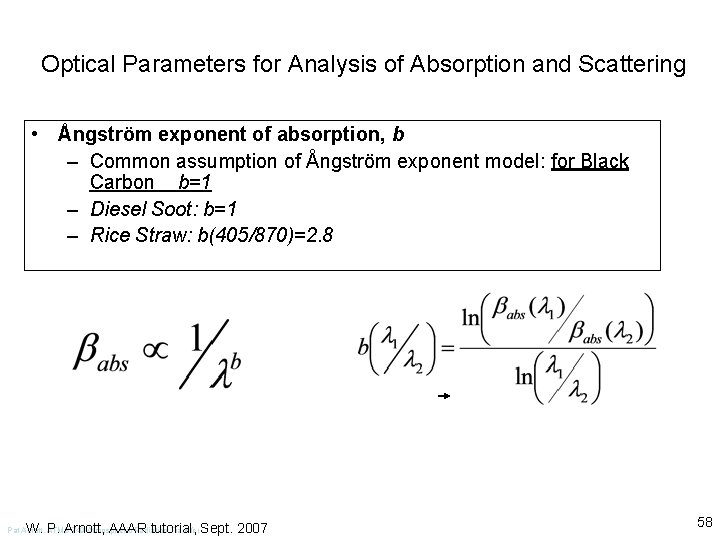
Optical Parameters for Analysis of Absorption and Scattering • Ångström exponent of absorption, b – Common assumption of Ångström exponent model: for Black Carbon b=1 – Diesel Soot: b=1 – Rice Straw: b(405/870)=2. 8 W. P. Arnott, AAAR tutorial, Sept. 2007 Pat Arnott, ATMS 749 Atmospheric Radiation Transfer 58
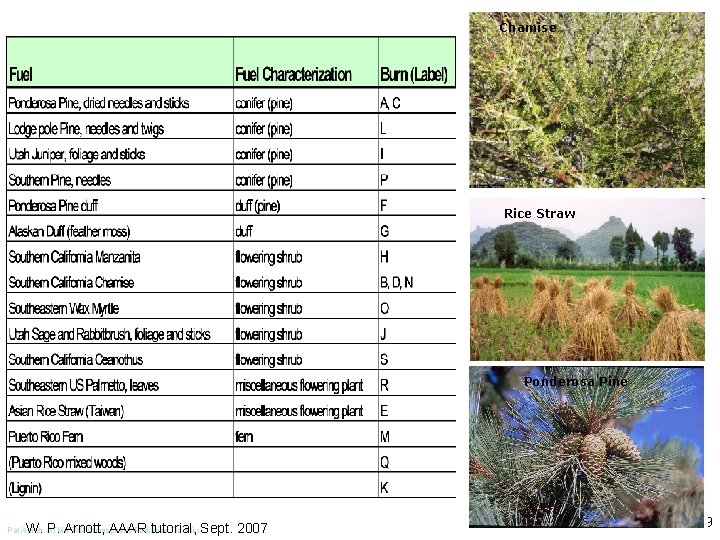
Chamise Rice Straw Ponderosa Pine W. P. Arnott, AAAR tutorial, Sept. 2007 Pat Arnott, ATMS 749 Atmospheric Radiation Transfer 59
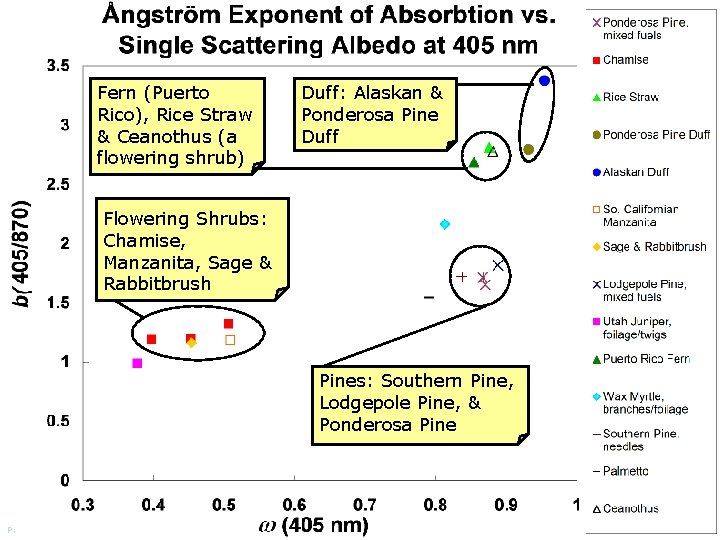
Fern (Puerto Rico), Rice Straw & Ceanothus (a flowering shrub) Duff: Alaskan & Ponderosa Pine Duff Flowering Shrubs: Chamise, Manzanita, Sage & Rabbitbrush Pines: Southern Pine, Lodgepole Pine, & Ponderosa Pine W. P. Arnott, AAAR tutorial, Sept. 2007 Pat Arnott, ATMS 749 Atmospheric Radiation Transfer 60
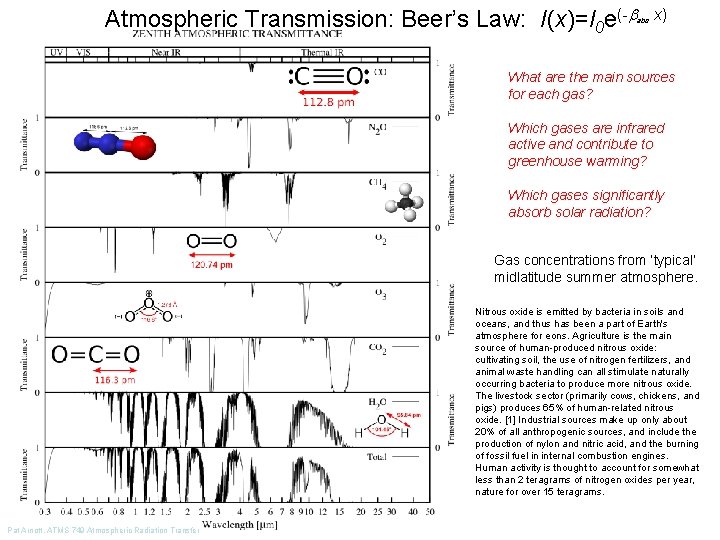
Atmospheric Transmission: Beer’s Law: I(x)=I 0 e(- abs x) What are the main sources for each gas? Which gases are infrared active and contribute to greenhouse warming? Which gases significantly absorb solar radiation? Gas concentrations from ‘typical’ midlatitude summer atmosphere. Nitrous oxide is emitted by bacteria in soils and oceans, and thus has been a part of Earth's atmosphere for eons. Agriculture is the main source of human-produced nitrous oxide: cultivating soil, the use of nitrogen fertilizers, and animal waste handling can all stimulate naturally occurring bacteria to produce more nitrous oxide. The livestock sector (primarily cows, chickens, and pigs) produces 65% of human-related nitrous oxide. [1] Industrial sources make up only about 20% of all anthropogenic sources, and include the production of nylon and nitric acid, and the burning of fossil fuel in internal combustion engines. Human activity is thought to account for somewhat less than 2 teragrams of nitrogen oxides per year, nature for over 15 teragrams. Pat Arnott, ATMS 749 Atmospheric Radiation Transfer

Microwave Transmittance of Atmosphere Pat Arnott, ATMS 749 Atmospheric Radiation Transfer
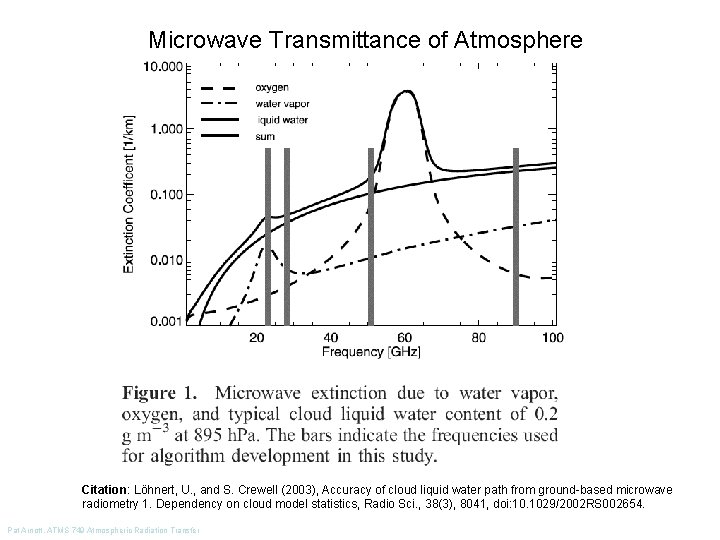
Microwave Transmittance of Atmosphere Citation: Löhnert, U. , and S. Crewell (2003), Accuracy of cloud liquid water path from ground-based microwave radiometry 1. Dependency on cloud model statistics, Radio Sci. , 38(3), 8041, doi: 10. 1029/2002 RS 002654. Pat Arnott, ATMS 749 Atmospheric Radiation Transfer
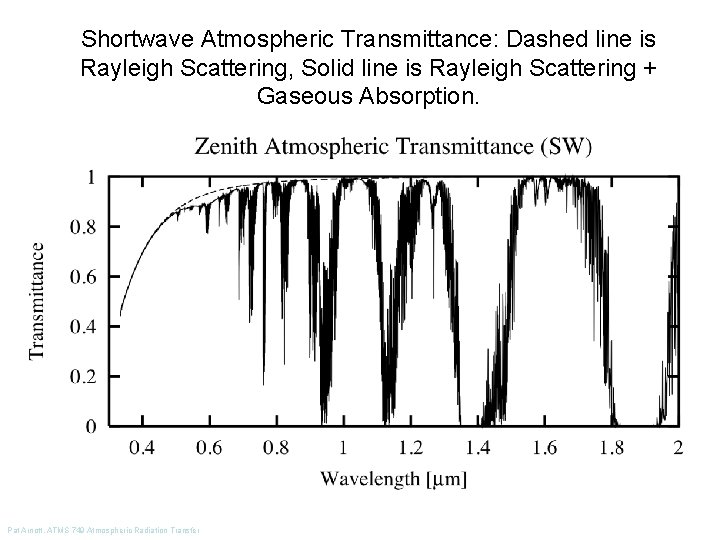
Shortwave Atmospheric Transmittance: Dashed line is Rayleigh Scattering, Solid line is Rayleigh Scattering + Gaseous Absorption. Pat Arnott, ATMS 749 Atmospheric Radiation Transfer
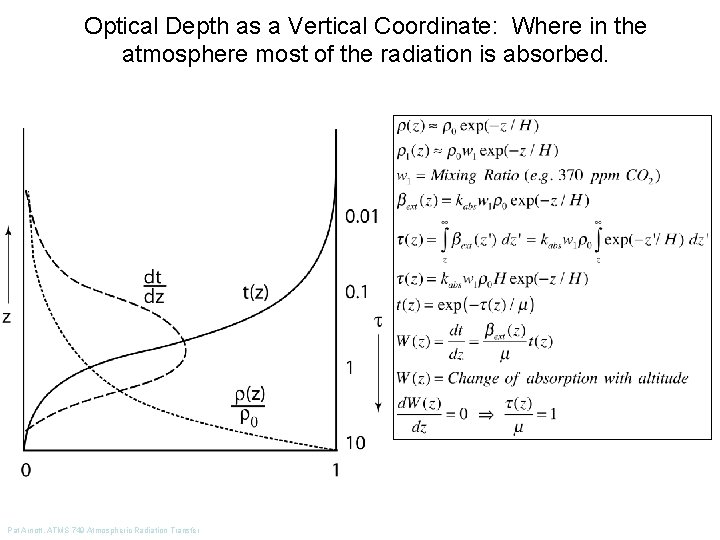
Optical Depth as a Vertical Coordinate: Where in the atmosphere most of the radiation is absorbed. Pat Arnott, ATMS 749 Atmospheric Radiation Transfer
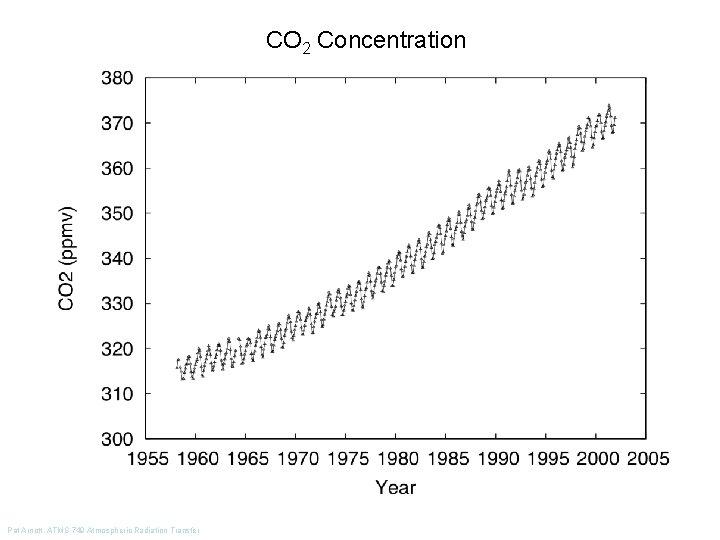
CO 2 Concentration Pat Arnott, ATMS 749 Atmospheric Radiation Transfer
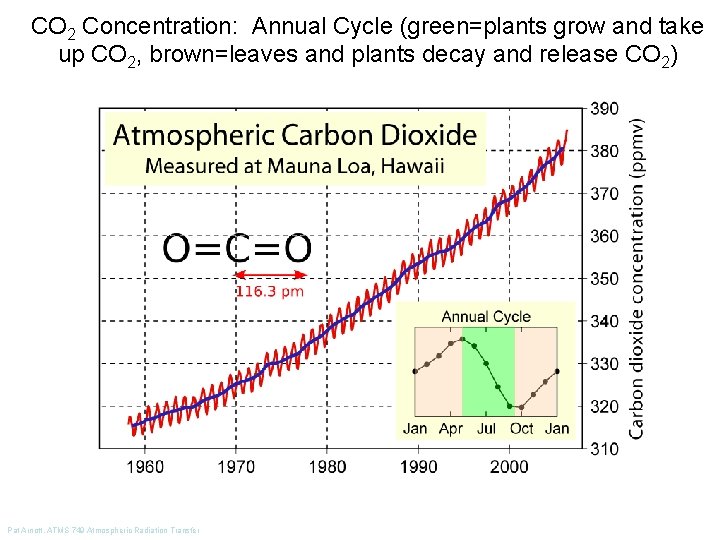
CO 2 Concentration: Annual Cycle (green=plants grow and take up CO 2, brown=leaves and plants decay and release CO 2) Pat Arnott, ATMS 749 Atmospheric Radiation Transfer
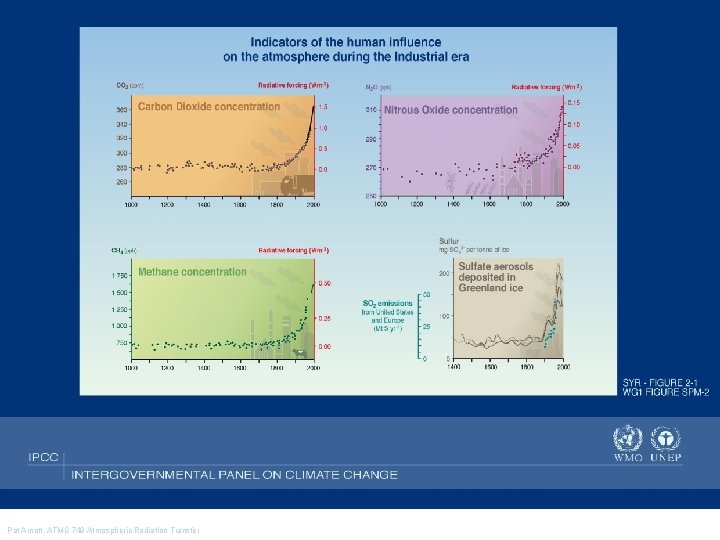
Pat Arnott, ATMS 749 Atmospheric Radiation Transfer
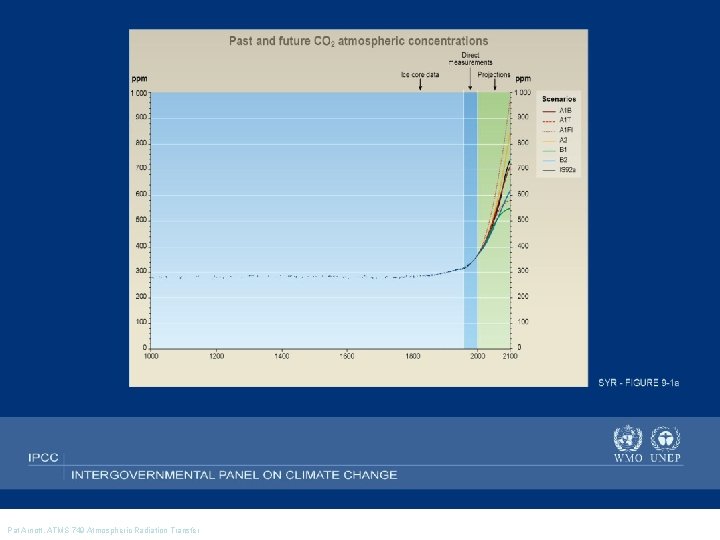
Pat Arnott, ATMS 749 Atmospheric Radiation Transfer
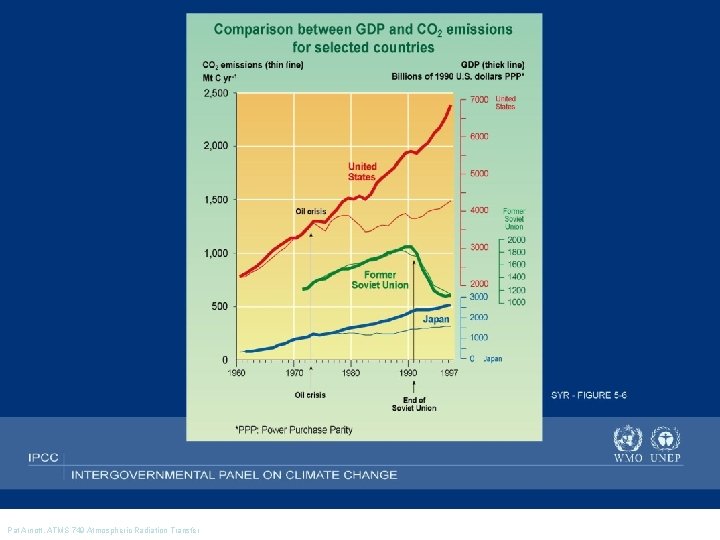
Pat Arnott, ATMS 749 Atmospheric Radiation Transfer
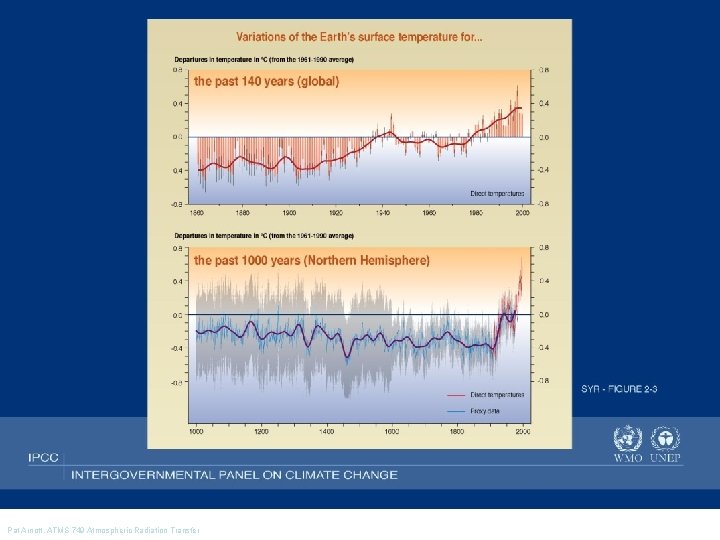
Pat Arnott, ATMS 749 Atmospheric Radiation Transfer
Pat Arnott, ATMS 749 Atmospheric Radiation Transfer
Pat Arnott, ATMS 749 Atmospheric Radiation Transfer
Pat Arnott, ATMS 749 Atmospheric Radiation Transfer
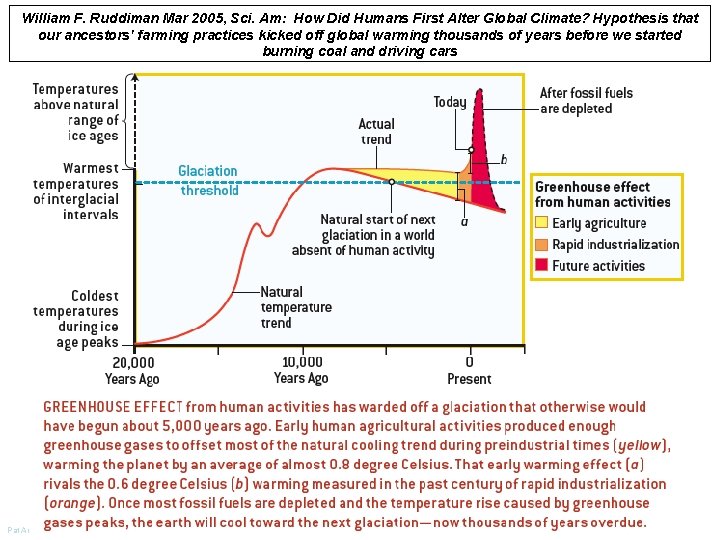
William F. Ruddiman Mar 2005, Sci. Am: How Did Humans First Alter Global Climate? Hypothesis that our ancestors' farming practices kicked off global warming thousands of years before we started burning coal and driving cars Pat Arnott, ATMS 749 Atmospheric Radiation Transfer
- Slides: 75