
Chapter 7 Astronomy Overview of the Solar System
- Slides: 22
Chapter 7 Astronomy • Overview of the Solar System • Shaped like a thin disk • Held in place by the Sun’s gravitational force 1 Copyright © The Mc. Graw-Hill Companies, Inc. Permission required for reproduction or display
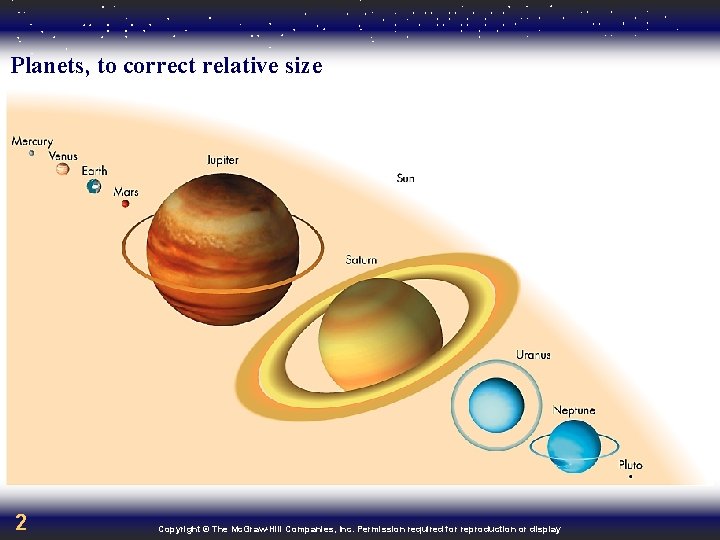
Planets, to correct relative size 2 Copyright © The Mc. Graw-Hill Companies, Inc. Permission required for reproduction or display
1 AU Astronomical Unit Average distance from Earth to Sun 149, 597, 870. 691 kilometers 3 Copyright © The Mc. Graw-Hill Companies, Inc. Permission required for reproduction or display
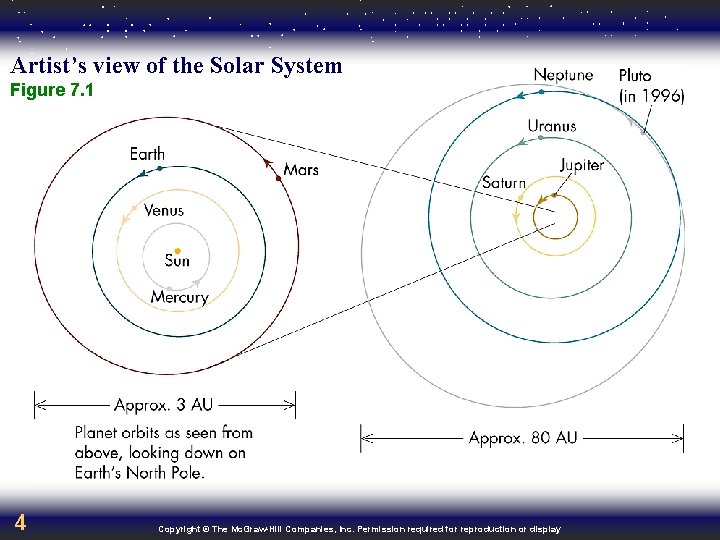
Artist’s view of the Solar System Figure 7. 1 4 Copyright © The Mc. Graw-Hill Companies, Inc. Permission required for reproduction or display
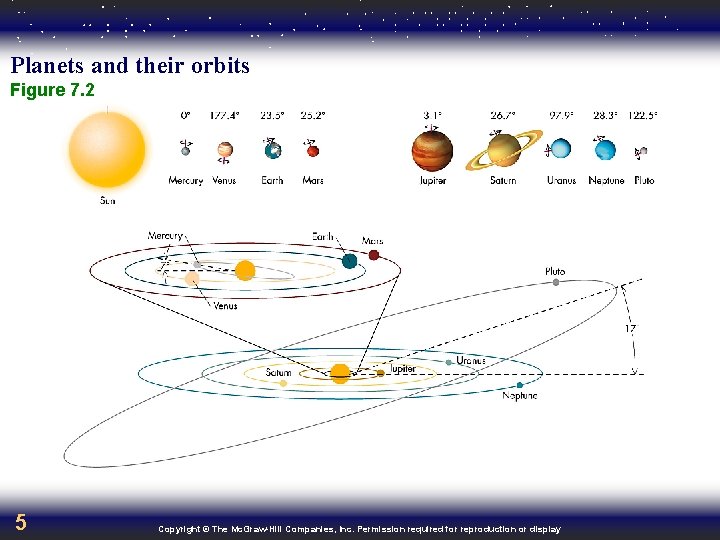
Planets and their orbits Figure 7. 2 5 Copyright © The Mc. Graw-Hill Companies, Inc. Permission required for reproduction or display
Sun • Over 700 times more massive than rest of bodies in solar system • Mostly hydrogen and helium (from spectroscopy) • Fusion of hydrogen into helium creates heat & light 6 Copyright © The Mc. Graw-Hill Companies, Inc. Permission required for reproduction or display
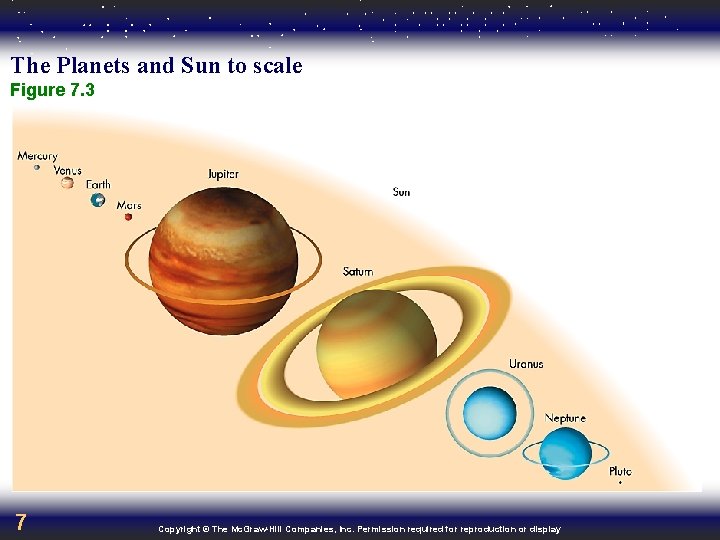
The Planets and Sun to scale Figure 7. 3 7 Copyright © The Mc. Graw-Hill Companies, Inc. Permission required for reproduction or display
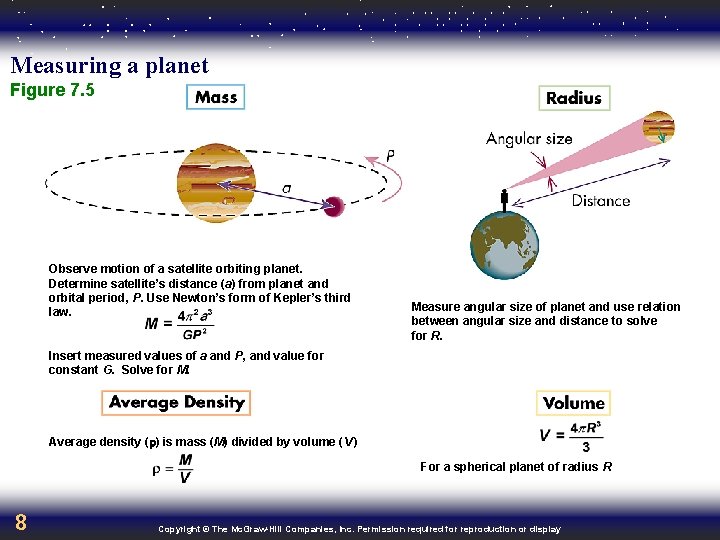
Measuring a planet Figure 7. 5 Observe motion of a satellite orbiting planet. Determine satellite’s distance (a) from planet and orbital period, P. Use Newton’s form of Kepler’s third law. Measure angular size of planet and use relation between angular size and distance to solve for R. Insert measured values of a and P, and value for constant G. Solve for M. Average density ( ) is mass (M) divided by volume (V ) For a spherical planet of radius R 8 Copyright © The Mc. Graw-Hill Companies, Inc. Permission required for reproduction or display
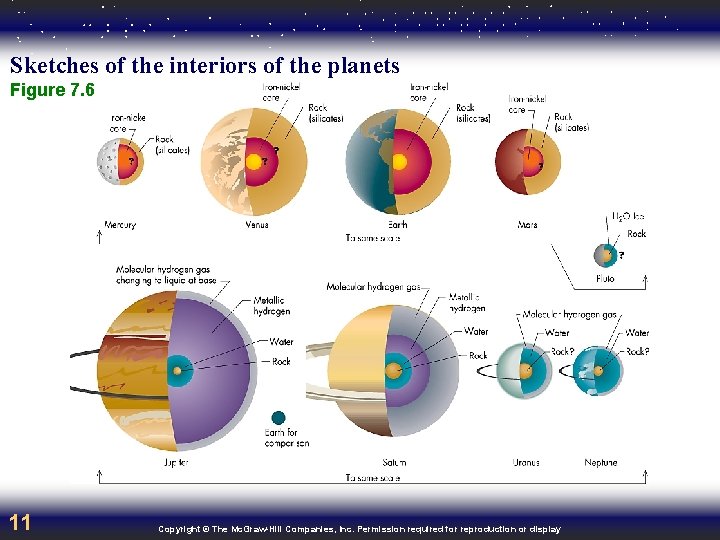
Inner Planets • Mercury, Venus, Earth, Mars • Smaller • Thin or no atmosphere • Made of rock w/ iron rich cores 9 Copyright © The Mc. Graw-Hill Companies, Inc. Permission required for reproduction or display
Outer planets • Jupiter, Neptune, Saturn and Uranus • Same core • 70% hydrogen • No solid surface, massive atmospheres, covered in oceans 10 Copyright © The Mc. Graw-Hill Companies, Inc. Permission required for reproduction or display
Sketches of the interiors of the planets Figure 7. 6 11 Copyright © The Mc. Graw-Hill Companies, Inc. Permission required for reproduction or display
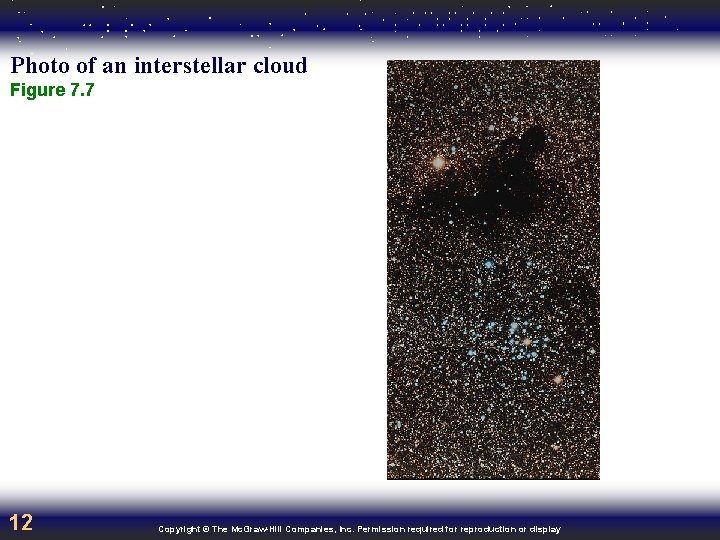
Photo of an interstellar cloud Figure 7. 7 12 Copyright © The Mc. Graw-Hill Companies, Inc. Permission required for reproduction or display
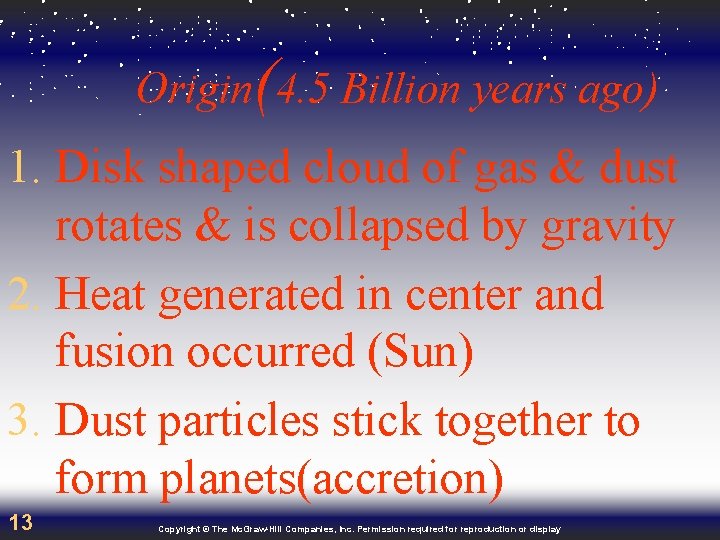
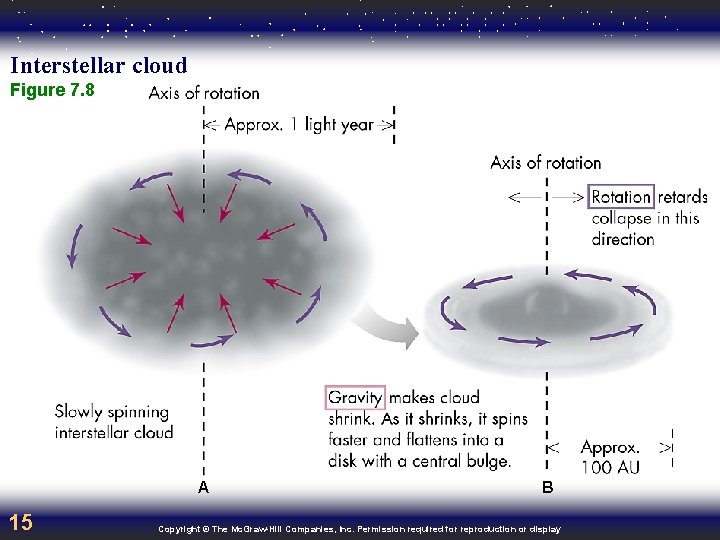
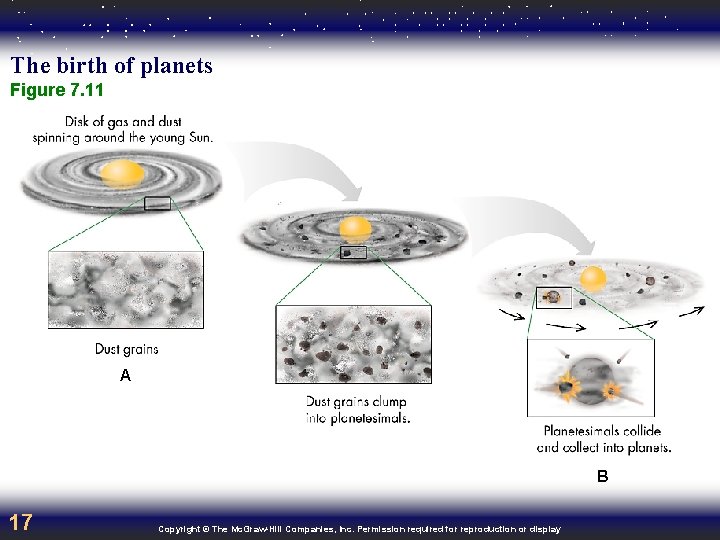
Origin(4. 5 Billion years ago) 1. Disk shaped cloud of gas & dust rotates & is collapsed by gravity 2. Heat generated in center and fusion occurred (Sun) 3. Dust particles stick together to form planets(accretion) 13 Copyright © The Mc. Graw-Hill Companies, Inc. Permission required for reproduction or display
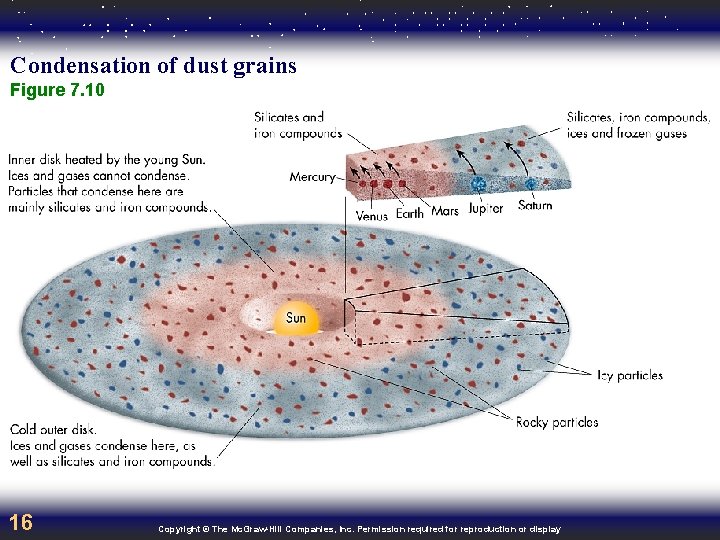
• 4. Outer planets become bigger due to lower temperature (water condensation) • 5. Outer planets were massive and drew in Hydrogen & Helium from gravitational attraction (atmosphere) 14 Copyright © The Mc. Graw-Hill Companies, Inc. Permission required for reproduction or display
Interstellar cloud Figure 7. 8 A 15 B Copyright © The Mc. Graw-Hill Companies, Inc. Permission required for reproduction or display
Condensation of dust grains Figure 7. 10 16 Copyright © The Mc. Graw-Hill Companies, Inc. Permission required for reproduction or display
The birth of planets Figure 7. 11 A B 17 Copyright © The Mc. Graw-Hill Companies, Inc. Permission required for reproduction or display
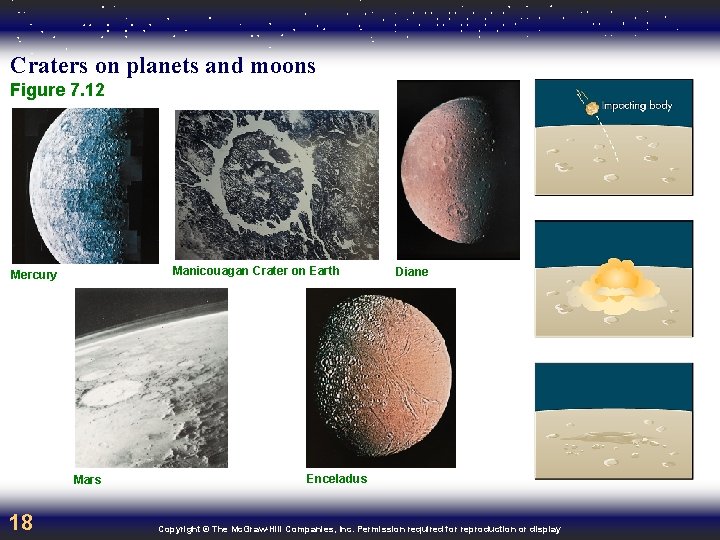
Craters on planets and moons Figure 7. 12 Manicouagan Crater on Earth Mercury Mars 18 Diane Enceladus Copyright © The Mc. Graw-Hill Companies, Inc. Permission required for reproduction or display
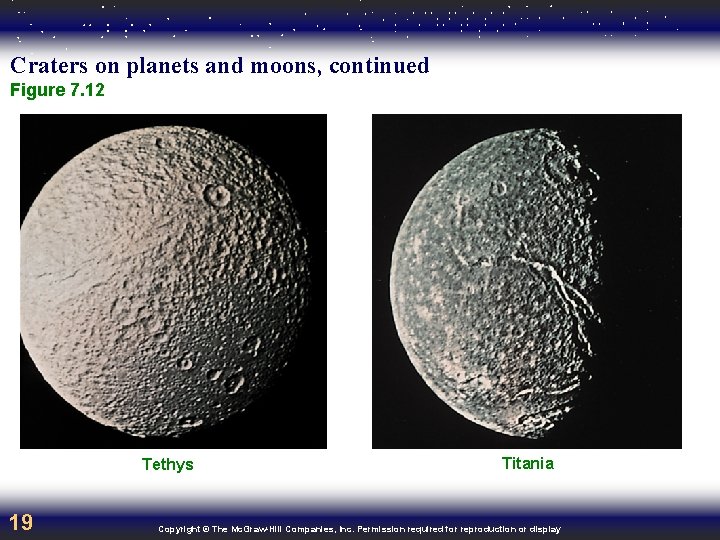
Craters on planets and moons, continued Figure 7. 12 Tethys 19 Titania Copyright © The Mc. Graw-Hill Companies, Inc. Permission required for reproduction or display
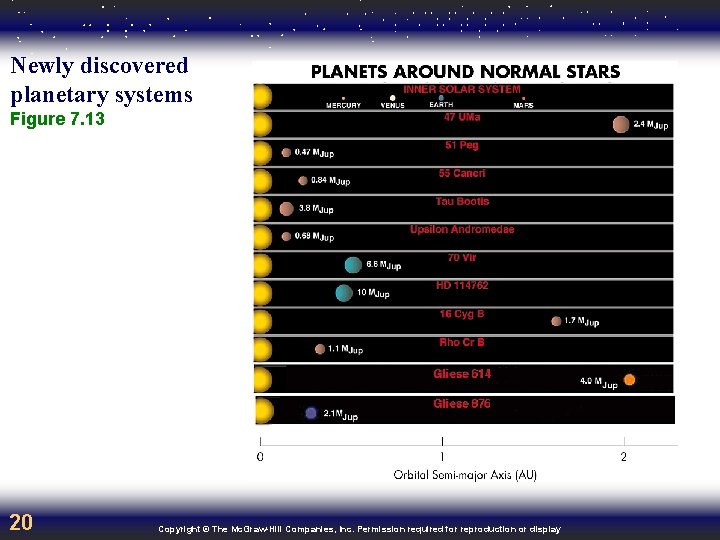
Newly discovered planetary systems Figure 7. 13 20 Copyright © The Mc. Graw-Hill Companies, Inc. Permission required for reproduction or display
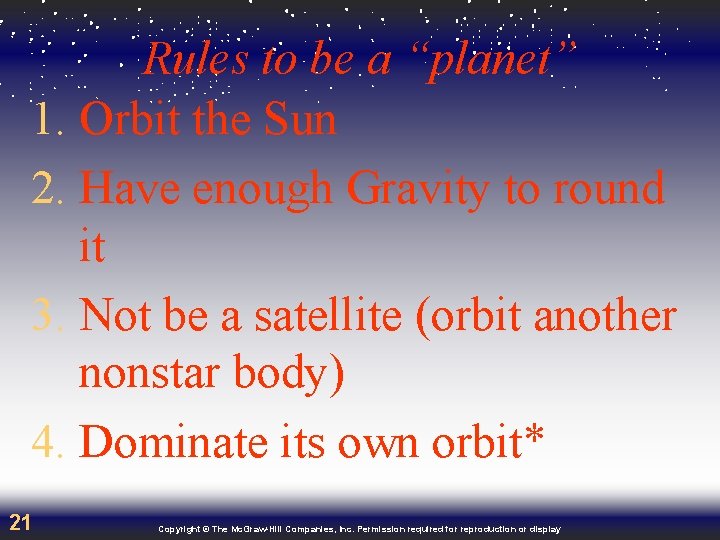
Rules to be a “planet” 1. Orbit the Sun 2. Have enough Gravity to round it 3. Not be a satellite (orbit another nonstar body) 4. Dominate its own orbit* 21 Copyright © The Mc. Graw-Hill Companies, Inc. Permission required for reproduction or display
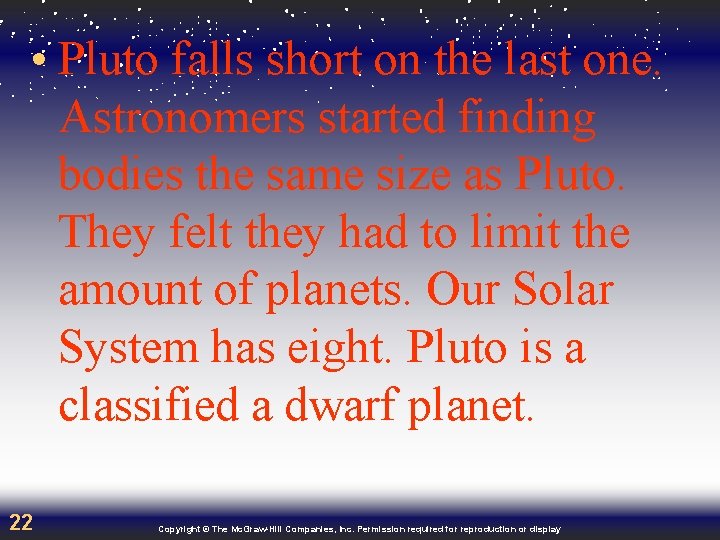
• Pluto falls short on the last one. Astronomers started finding bodies the same size as Pluto. They felt they had to limit the amount of planets. Our Solar System has eight. Pluto is a classified a dwarf planet. 22 Copyright © The Mc. Graw-Hill Companies, Inc. Permission required for reproduction or display