
Chapter 7 Aldehydes and Ketones I Nucleophilic Addition

- Slides: 23
Chapter 7 Aldehydes and Ketones I. Nucleophilic Addition to the Carbonyl Group
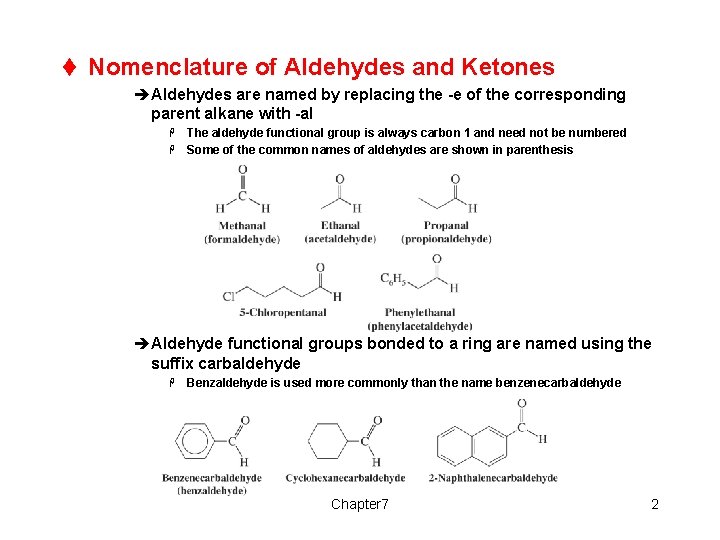
t Nomenclature of Aldehydes and Ketones èAldehydes are named by replacing the -e of the corresponding parent alkane with -al The aldehyde functional group is always carbon 1 and need not be numbered H Some of the common names of aldehydes are shown in parenthesis H èAldehyde functional groups bonded to a ring are named using the suffix carbaldehyde H Benzaldehyde is used more commonly than the name benzenecarbaldehyde Chapter 7 2
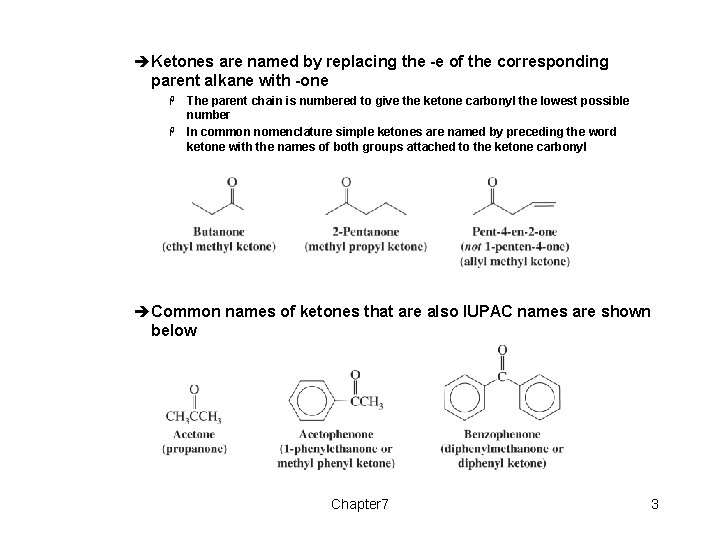
èKetones are named by replacing the -e of the corresponding parent alkane with -one The parent chain is numbered to give the ketone carbonyl the lowest possible number H In common nomenclature simple ketones are named by preceding the word ketone with the names of both groups attached to the ketone carbonyl H èCommon names of ketones that are also IUPAC names are shown below Chapter 7 3
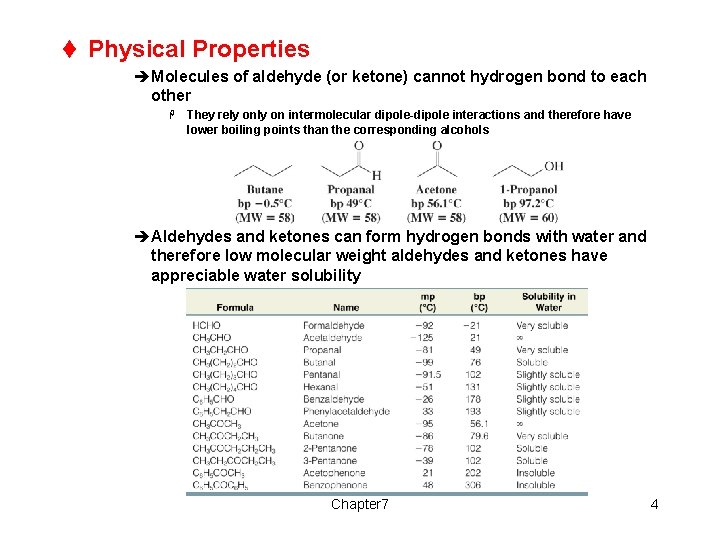
t Physical Properties èMolecules of aldehyde (or ketone) cannot hydrogen bond to each other H They rely on intermolecular dipole-dipole interactions and therefore have lower boiling points than the corresponding alcohols èAldehydes and ketones can form hydrogen bonds with water and therefore low molecular weight aldehydes and ketones have appreciable water solubility Chapter 7 4
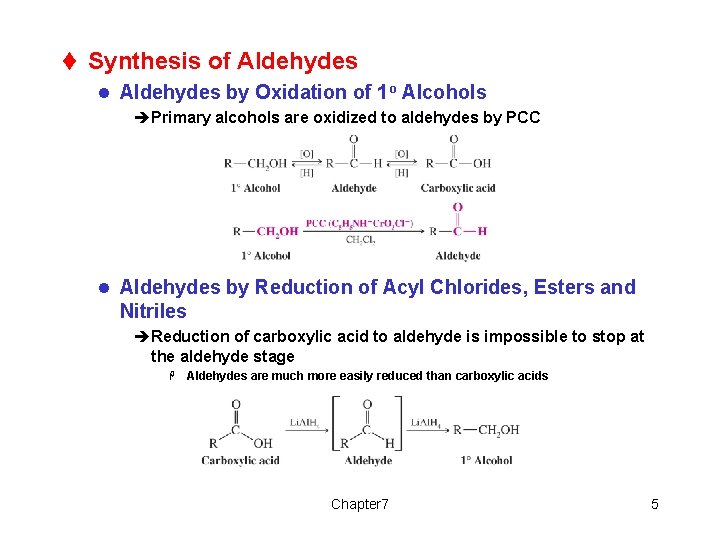
t Synthesis of Aldehydes l Aldehydes by Oxidation of 1 o Alcohols èPrimary alcohols are oxidized to aldehydes by PCC l Aldehydes by Reduction of Acyl Chlorides, Esters and Nitriles èReduction of carboxylic acid to aldehyde is impossible to stop at the aldehyde stage H Aldehydes are much more easily reduced than carboxylic acids Chapter 7 5
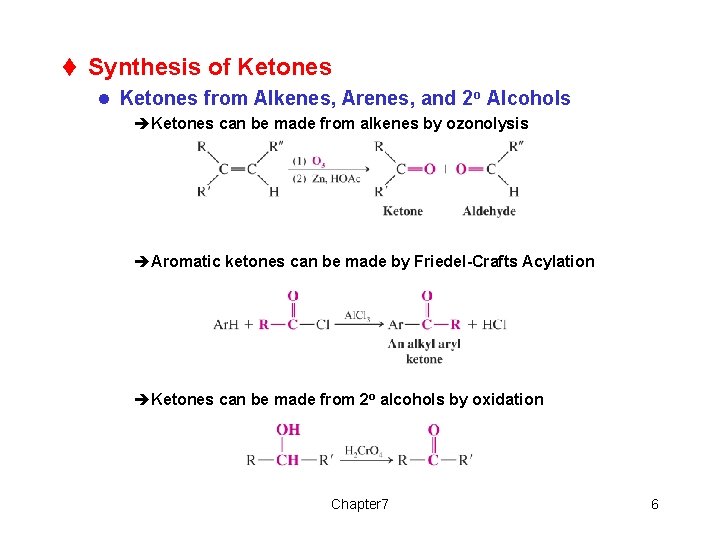
t Synthesis of Ketones l Ketones from Alkenes, Arenes, and 2 o Alcohols èKetones can be made from alkenes by ozonolysis èAromatic ketones can be made by Friedel-Crafts Acylation èKetones can be made from 2 o alcohols by oxidation Chapter 7 6
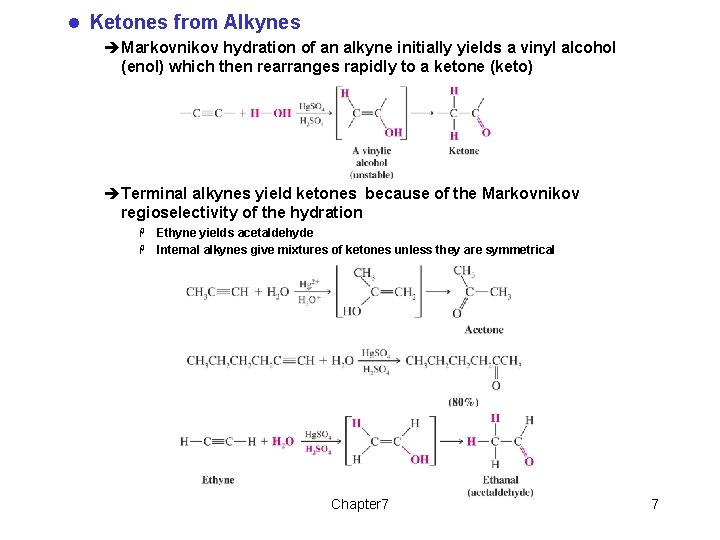
l Ketones from Alkynes èMarkovnikov hydration of an alkyne initially yields a vinyl alcohol (enol) which then rearranges rapidly to a ketone (keto) èTerminal alkynes yield ketones because of the Markovnikov regioselectivity of the hydration Ethyne yields acetaldehyde H Internal alkynes give mixtures of ketones unless they are symmetrical H Chapter 7 7
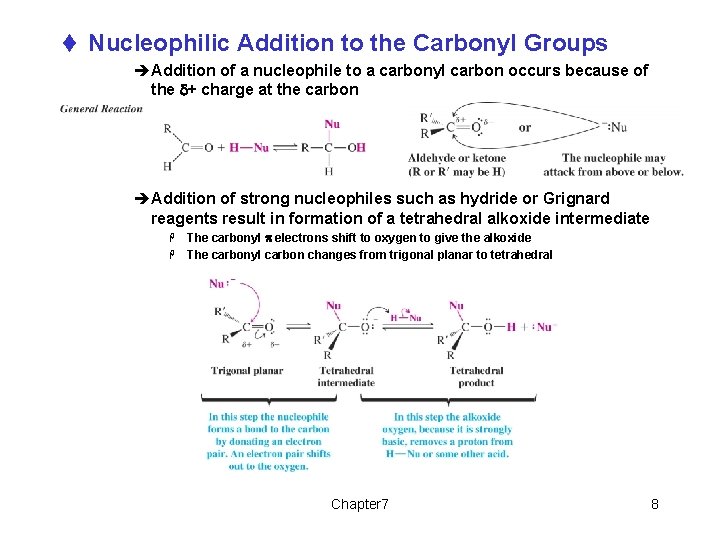
t Nucleophilic Addition to the Carbonyl Groups èAddition of a nucleophile to a carbonyl carbon occurs because of the d+ charge at the carbon èAddition of strong nucleophiles such as hydride or Grignard reagents result in formation of a tetrahedral alkoxide intermediate The carbonyl p electrons shift to oxygen to give the alkoxide H The carbonyl carbon changes from trigonal planar to tetrahedral H Chapter 7 8
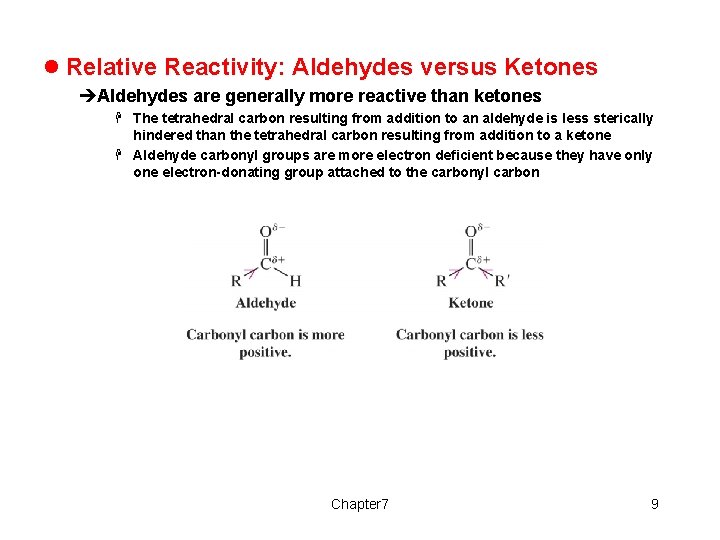
l Relative Reactivity: Aldehydes versus Ketones èAldehydes are generally more reactive than ketones H The tetrahedral carbon resulting from addition to an aldehyde is less sterically hindered than the tetrahedral carbon resulting from addition to a ketone H Aldehyde carbonyl groups are more electron deficient because they have only one electron-donating group attached to the carbonyl carbon Chapter 7 9
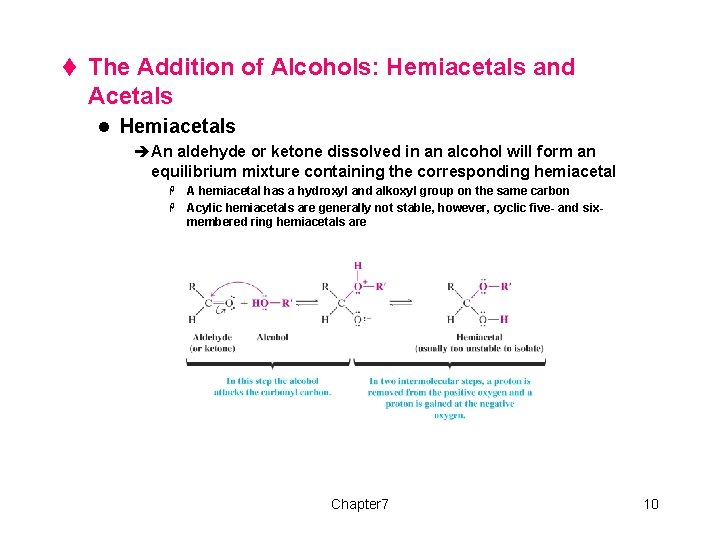
t The Addition of Alcohols: Hemiacetals and Acetals l Hemiacetals èAn aldehyde or ketone dissolved in an alcohol will form an equilibrium mixture containing the corresponding hemiacetal A hemiacetal has a hydroxyl and alkoxyl group on the same carbon H Acylic hemiacetals are generally not stable, however, cyclic five- and sixmembered ring hemiacetals are H Chapter 7 10
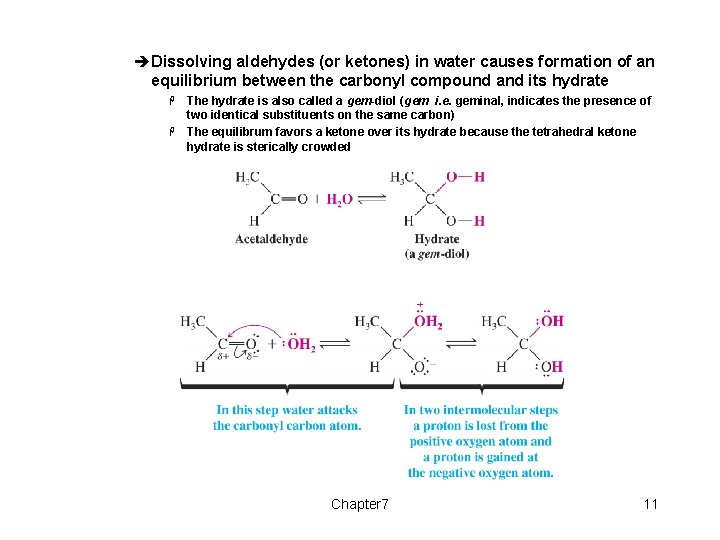
èDissolving aldehydes (or ketones) in water causes formation of an equilibrium between the carbonyl compound and its hydrate The hydrate is also called a gem-diol (gem i. e. geminal, indicates the presence of two identical substituents on the same carbon) H The equilibrum favors a ketone over its hydrate because the tetrahedral ketone hydrate is sterically crowded H Chapter 7 11
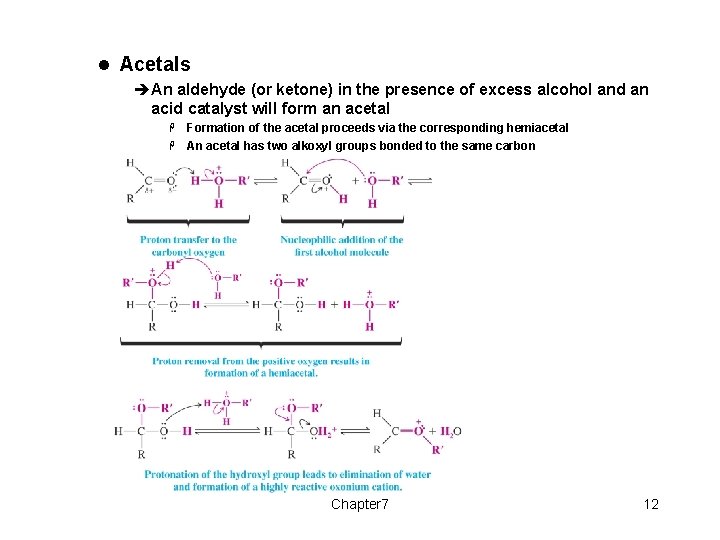
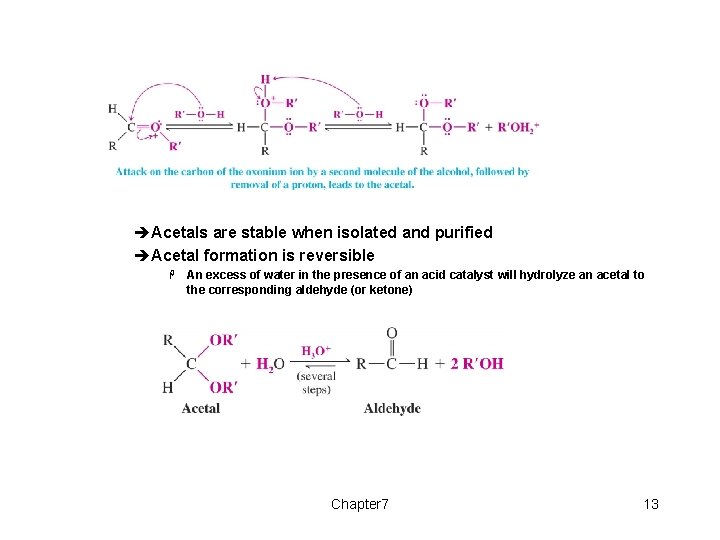
l Acetals èAn aldehyde (or ketone) in the presence of excess alcohol and an acid catalyst will form an acetal Formation of the acetal proceeds via the corresponding hemiacetal H An acetal has two alkoxyl groups bonded to the same carbon H Chapter 7 12
èAcetals are stable when isolated and purified èAcetal formation is reversible H An excess of water in the presence of an acid catalyst will hydrolyze an acetal to the corresponding aldehyde (or ketone) Chapter 7 13
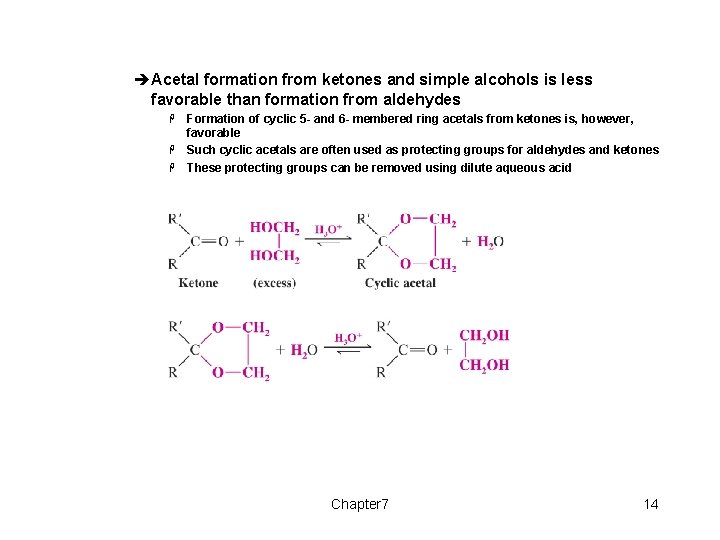
èAcetal formation from ketones and simple alcohols is less favorable than formation from aldehydes Formation of cyclic 5 - and 6 - membered ring acetals from ketones is, however, favorable H Such cyclic acetals are often used as protecting groups for aldehydes and ketones H These protecting groups can be removed using dilute aqueous acid H Chapter 7 14
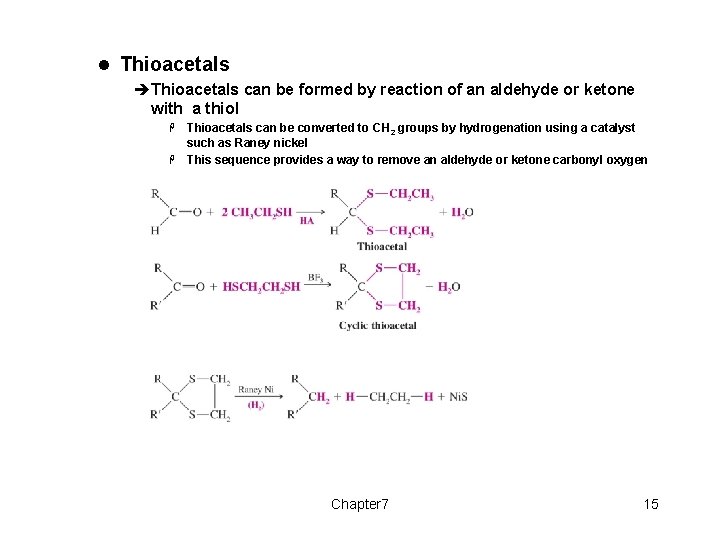
l Thioacetals èThioacetals can be formed by reaction of an aldehyde or ketone with a thiol Thioacetals can be converted to CH 2 groups by hydrogenation using a catalyst such as Raney nickel H This sequence provides a way to remove an aldehyde or ketone carbonyl oxygen H Chapter 7 15
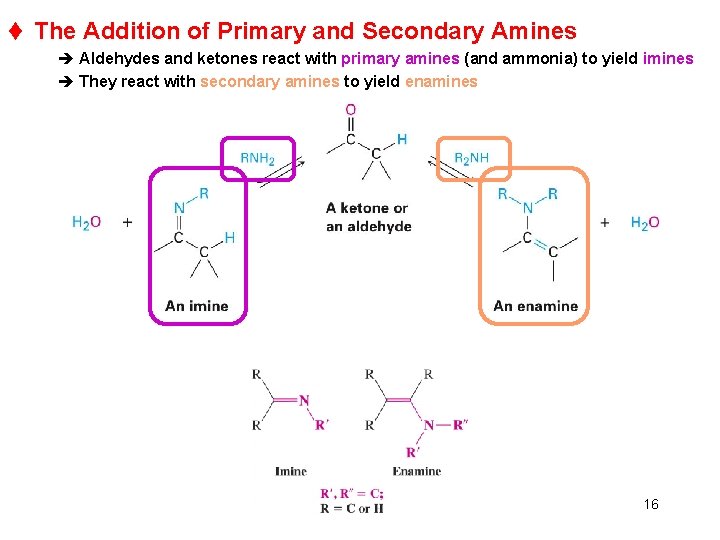
t The Addition of Primary and Secondary Amines è Aldehydes and ketones react with primary amines (and ammonia) to yield imines è They react with secondary amines to yield enamines 16
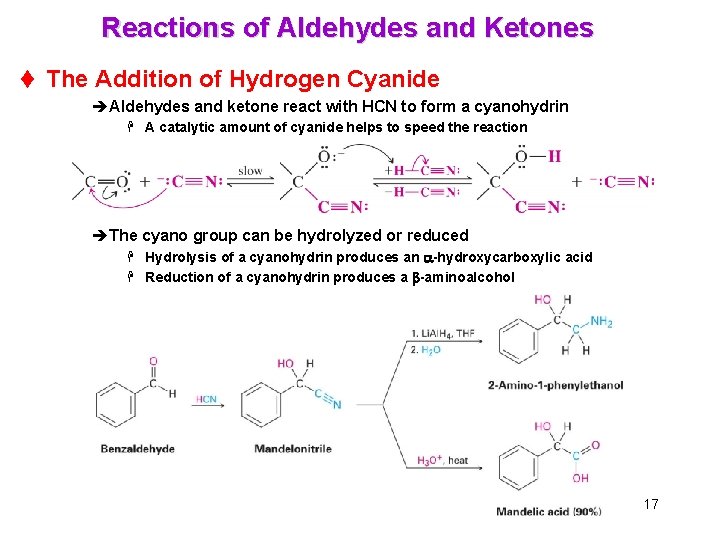
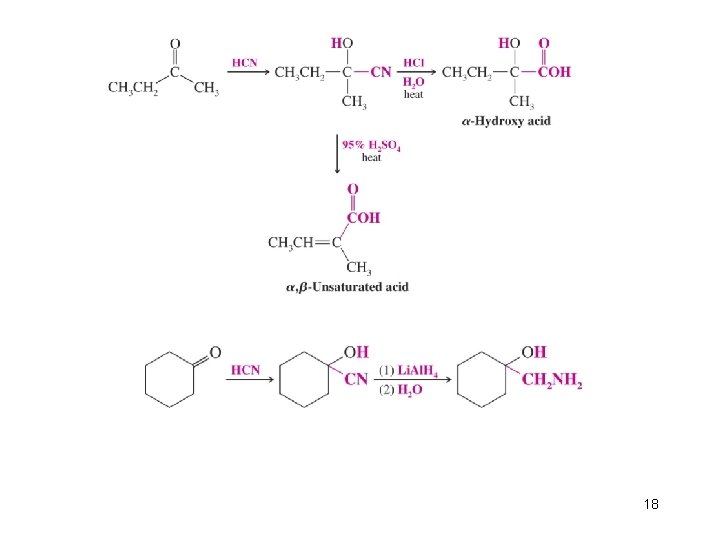
Reactions of Aldehydes and Ketones t The Addition of Hydrogen Cyanide èAldehydes and ketone react with HCN to form a cyanohydrin H A catalytic amount of cyanide helps to speed the reaction èThe cyano group can be hydrolyzed or reduced H Hydrolysis of a cyanohydrin produces an a-hydroxycarboxylic acid H Reduction of a cyanohydrin produces a -aminoalcohol 17
18
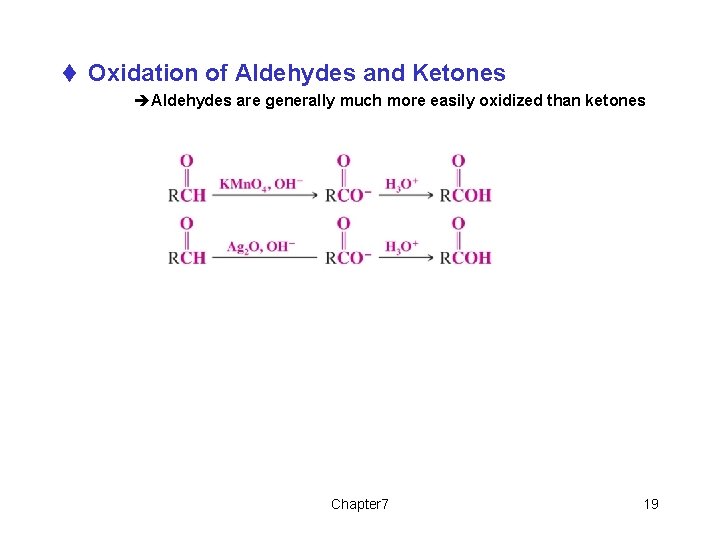
t Oxidation of Aldehydes and Ketones èAldehydes are generally much more easily oxidized than ketones Chapter 7 19
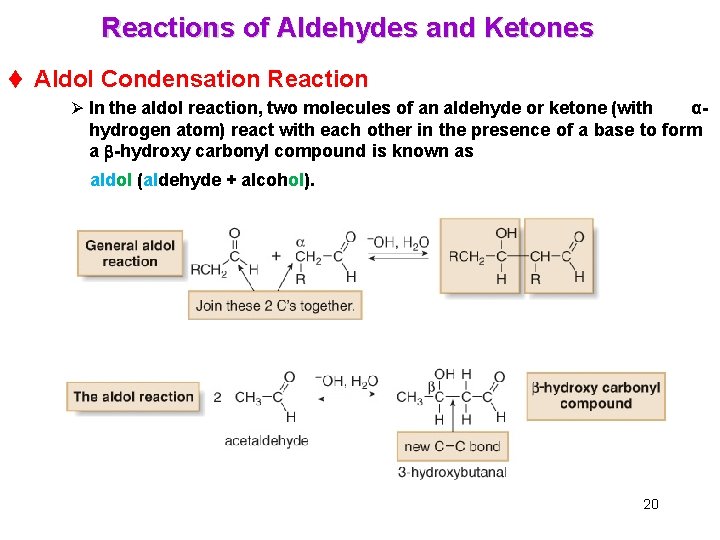
Reactions of Aldehydes and Ketones t Aldol Condensation Reaction Ø In the aldol reaction, two molecules of an aldehyde or ketone (with αhydrogen atom) react with each other in the presence of a base to form a -hydroxy carbonyl compound is known as aldol (aldehyde + alcohol). 20
t Aldol Condensation Reaction Ø The mechanism of the Aldol Reaction occurs in three steps. 21 21
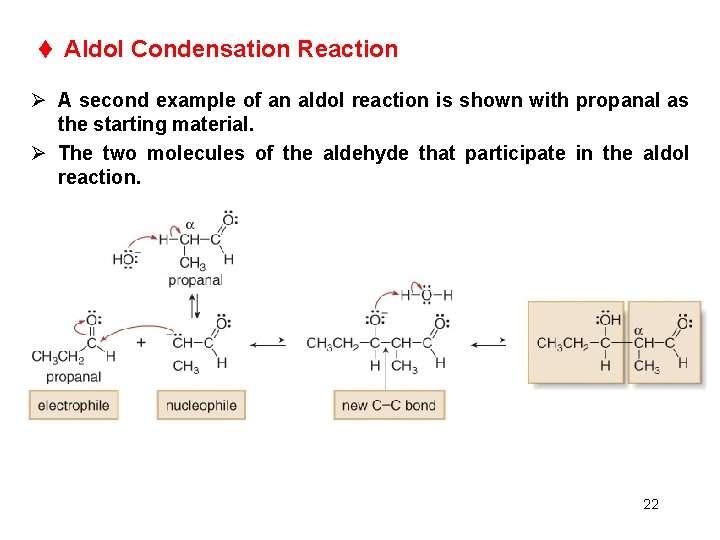
t Aldol Condensation Reaction Ø A second example of an aldol reaction is shown with propanal as the starting material. Ø The two molecules of the aldehyde that participate in the aldol reaction. 22
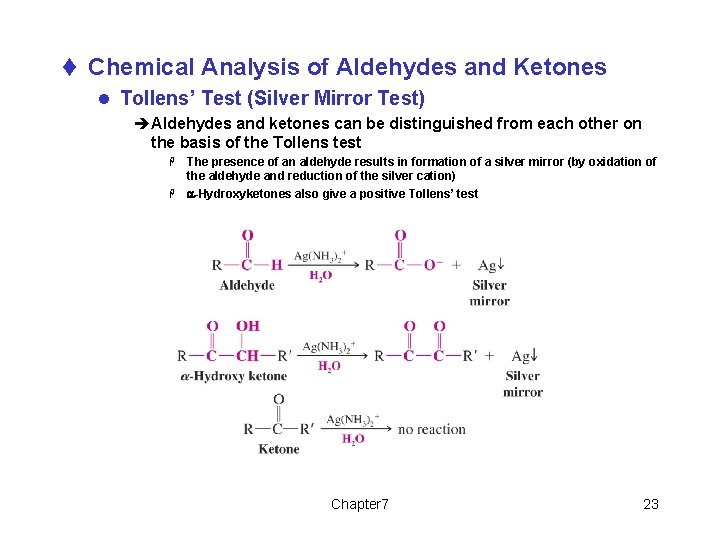
t Chemical Analysis of Aldehydes and Ketones l Tollens’ Test (Silver Mirror Test) èAldehydes and ketones can be distinguished from each other on the basis of the Tollens test The presence of an aldehyde results in formation of a silver mirror (by oxidation of the aldehyde and reduction of the silver cation) H a-Hydroxyketones also give a positive Tollens’ test H Chapter 7 23