
CHAPTER 7 8 BONDING Atoms and their Electrons
CHAPTER 7 & 8 BONDING
Atoms and their Electrons Valence Electrons – the outer most electrons that are involved in bonding Ex. or Ion – an atom or group of atoms that has a positive negative charge Cation – an ion with a positive charge (Na+ or Mg 2+) – usually a metal that has lost e. Anion – an ion with a negative charge (Cl- or O 2 -) – usually a non-metal that has gained e-
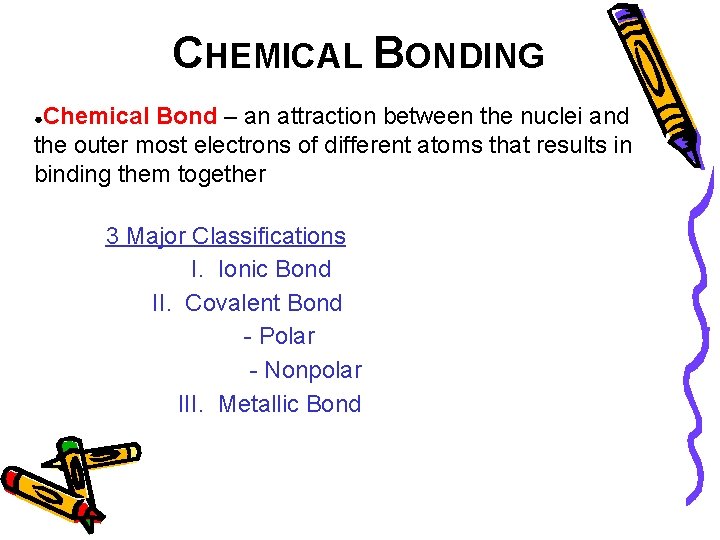
CHEMICAL BONDING Chemical Bond – an attraction between the nuclei and the outer most electrons of different atoms that results in binding them together ● 3 Major Classifications I. Ionic Bond II. Covalent Bond - Polar - Nonpolar III. Metallic Bond

Ionic Bond - resulting from an electrostatic attraction between positive and negative ions. ● Metals lose e¯ and nonmetals gain e¯ ● One atom gives up e¯ to the other Covalent Bond – resulting from the sharing of e- between two atoms. ● Polar: unequal attraction (sharing) of e¯ ● Nonpolar: equal attraction (sharing) of e¯ Metallic Bond – e¯ are free to roam through material (“electron sea”)
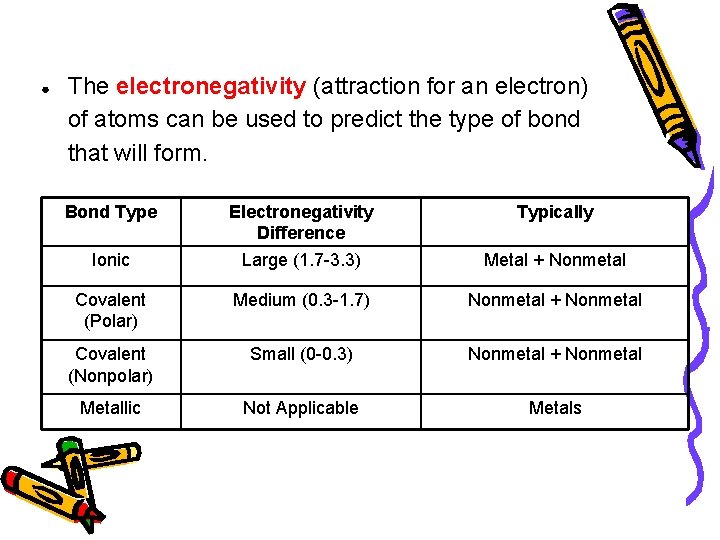
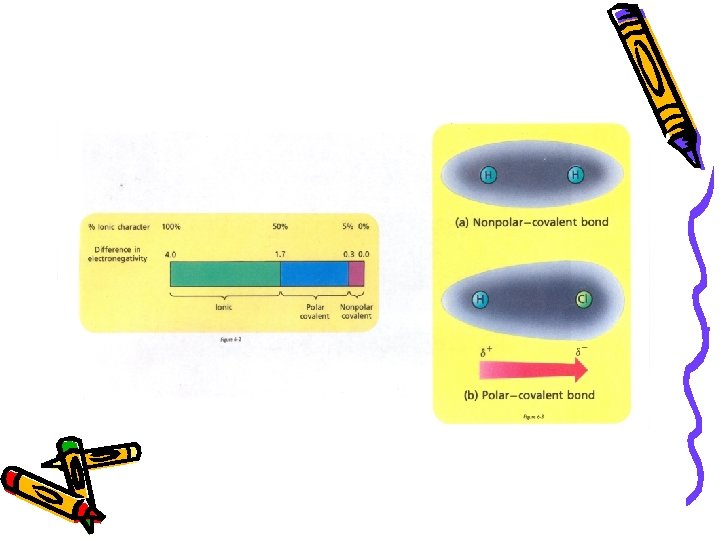
● The electronegativity (attraction for an electron) of atoms can be used to predict the type of bond that will form. Bond Type Electronegativity Difference Typically Ionic Large (1. 7 -3. 3) Metal + Nonmetal Covalent (Polar) Medium (0. 3 -1. 7) Nonmetal + Nonmetal Covalent (Nonpolar) Small (0 -0. 3) Nonmetal + Nonmetal Metallic Not Applicable Metals
Formation of Ionic Bonds Ionic bonds are formed when there is a transfer of electrons: lose e¯ => form (+) ions gain e¯ => form (-) ions REDOX Reactions – combination of reduction and oxidation ● Reduction: gain of e¯ Cl + 1 e¯ → Cl¯ ● Oxidation: loss of e¯ Na → Na+ + 1 e¯

Reduction and Oxidation must occur together Na+ → ← Cl¯ (cation) (anion) Na. Cl LEO says GER
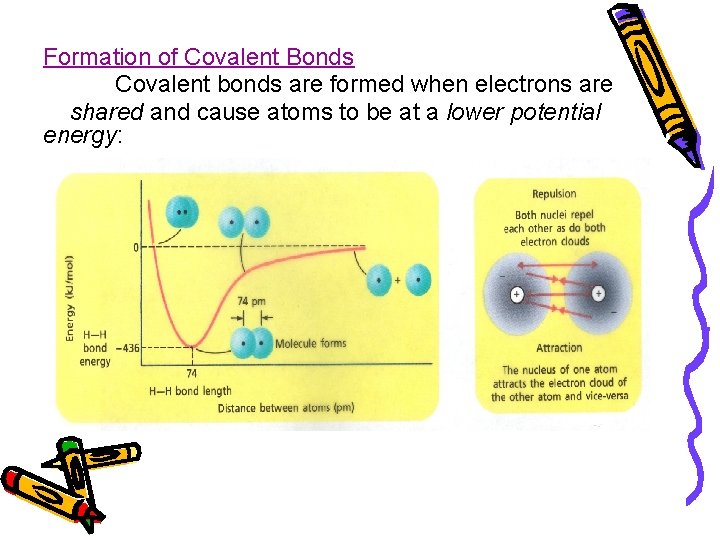
Formation of Covalent Bonds Covalent bonds are formed when electrons are shared and cause atoms to be at a lower potential energy:

Bond Length – distance between two bonded atoms at their minimum potential energy ● Bond Energy – energy required to break a chemical bond and form neutral isolated atoms ●
The Octet Rule chemical compounds tend to form so that each atom, by gaining, losing, or sharing electrons, has an octet of electrons in its highest occupied energy level ● (exceptions – H and He)
Draw the Lewis Dot Diagram for each and identify how many electrons would have to be gained/lost to fulfill the Octet Rule: Cl Li F Mg Al H Na Br Ar
VSEPR Theory (Valence-Shell, Electron Pair Repulsion) Electron pairs repel each other, and so they want to be as far apart from each other as possible For example: ICl CH 4 (Linear) (Tetrahedral) NH 3 (Trigonal-Pyramidal) H 2 O (Bent) * Lone pairs occupy space around the central atom just as bonding pairs do.

Molecular Geometry 3 -D arrangement of a molecule’s atoms in space
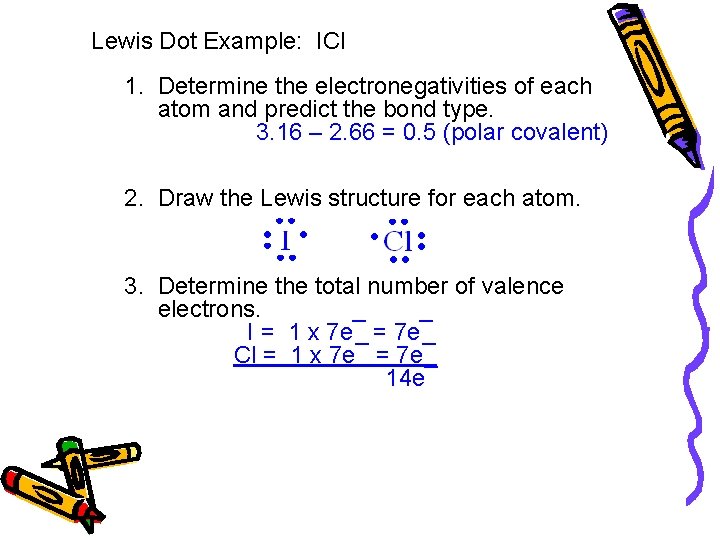
Lewis Dot Example: ICl 1. Determine the electronegativities of each atom and predict the bond type. 3. 16 – 2. 66 = 0. 5 (polar covalent) 2. Draw the Lewis structure for each atom. 3. Determine the total number of valence electrons. I = 1 x 7 e¯ = 7 e¯ Cl = 1 x 7 e¯ = 7 e¯ 14 e¯
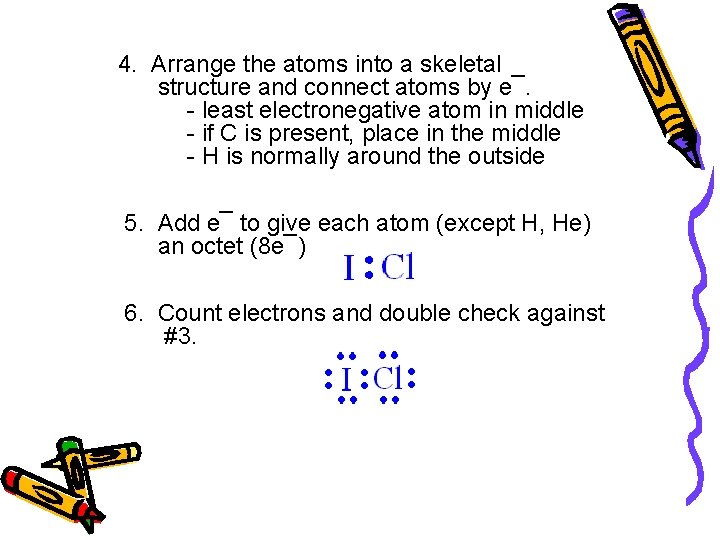
4. Arrange the atoms into a skeletal structure and connect atoms by e¯. - least electronegative atom in middle - if C is present, place in the middle - H is normally around the outside 5. Add e¯ to give each atom (except H, He) an octet (8 e¯) 6. Count electrons and double check against #3.
Multiple Bonds ●Double Bond – sharing of two pairs of e¯ ●Triple Bond – sharing of three pairs of e¯ For example: 1) CH 2 O 2) HCN
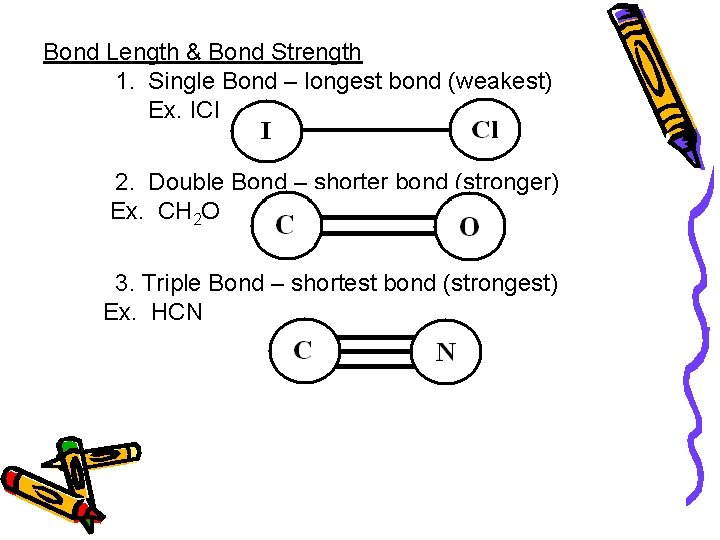
Bond Length & Bond Strength 1. Single Bond – longest bond (weakest) Ex. ICl 2. Double Bond – shorter bond (stronger) Ex. CH 2 O 3. Triple Bond – shortest bond (strongest) Ex. HCN
Polyatomic Ions The charge tells you if you are gaining or losing electrons. (+) => losing e¯ (-) => gaining e¯ For example: 1) NH 4+ 2) SO 42 -
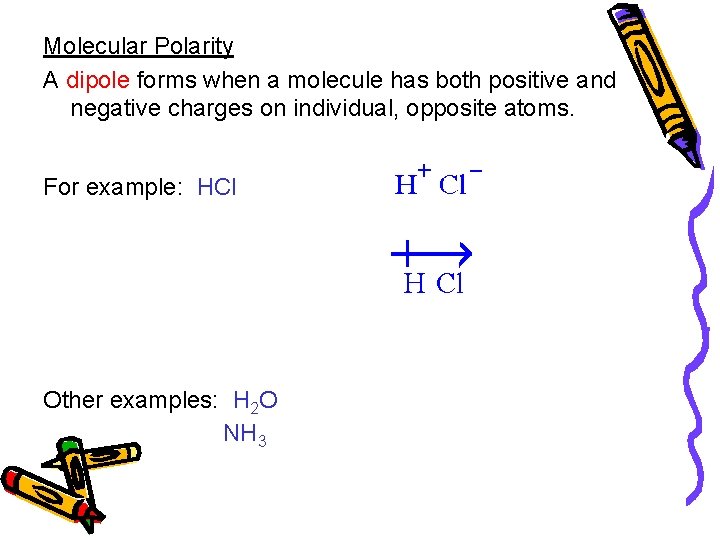
Molecular Polarity A dipole forms when a molecule has both positive and negative charges on individual, opposite atoms. For example: HCl Other examples: H 2 O NH 3
Ionic vs. Covalent Compounds The melting points, boiling points, and hardness of compounds are dependent upon how strongly basic units are attracted to each other. Ionic – greater forces of attraction (+ and -) – – – higher melting points higher boiling points greater hardness brittle (shift causes repulsion) conduct electricity in solution (ions move freely) Covalent – weaker forces of attraction – lower melting points – lower boiling points – softer Metallic – strong bonds – ductile (drawn, pulled, extruded to produce wire) – malleable (hammered or beaten into thin sheets)
Intermolecular Forces – Forces of attraction between molecules Weak forces Van der Waals Forces: 1) Dipole-Dipole forces 2) London Dispersion forces Stronger forces Hydrogen Bonds
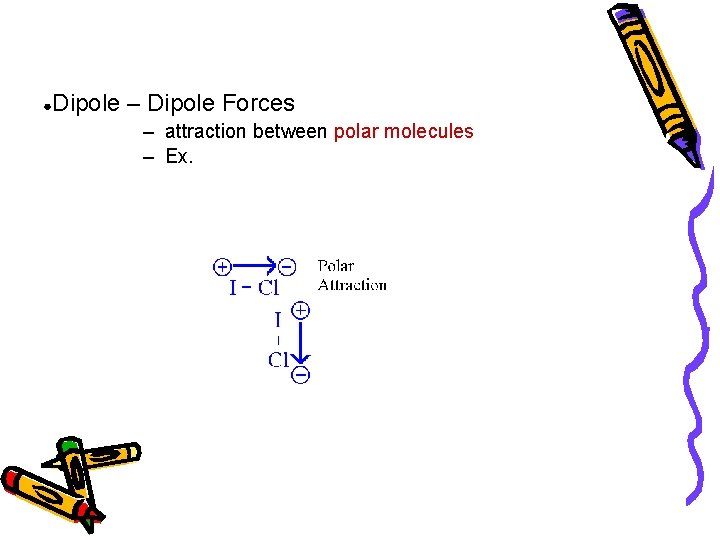
● Dipole – Dipole Forces – attraction between polar molecules – Ex.
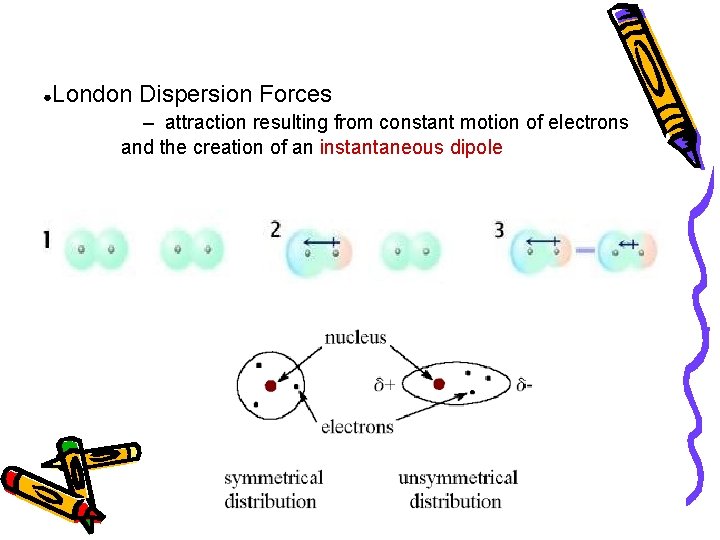
● London Dispersion Forces – attraction resulting from constant motion of electrons and the creation of an instantaneous dipole
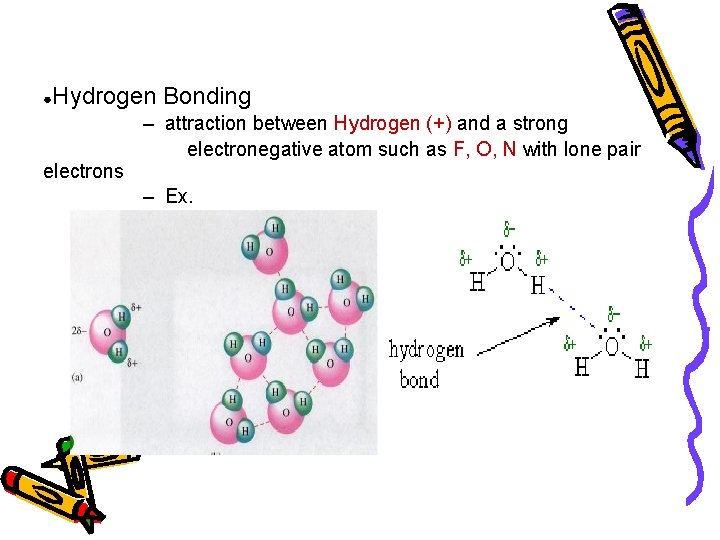
● Hydrogen Bonding electrons – attraction between Hydrogen (+) and a strong electronegative atom such as F, O, N with lone pair – Ex.
- Slides: 25