
Chapter 7 7 1 Area between Two Curves
Chapter 7 7. 1 Area between Two Curves 7. 2 Volumes by Slicing; Disks and Washers 7. 3 Volumes by Cylindrical Shells 7. 4 Length of a Plane Curve 7. 5 Area of a Surface of Revolution 7. 6 Average Value of a Function and its Appliations.
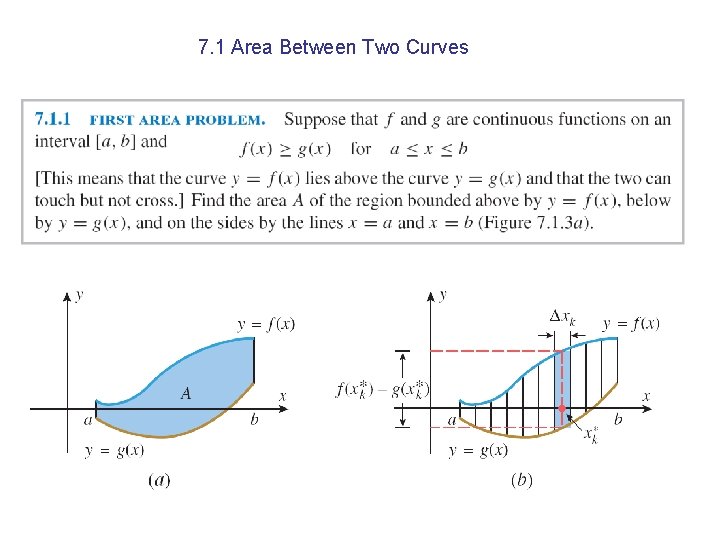
7. 1 Area Between Two Curves
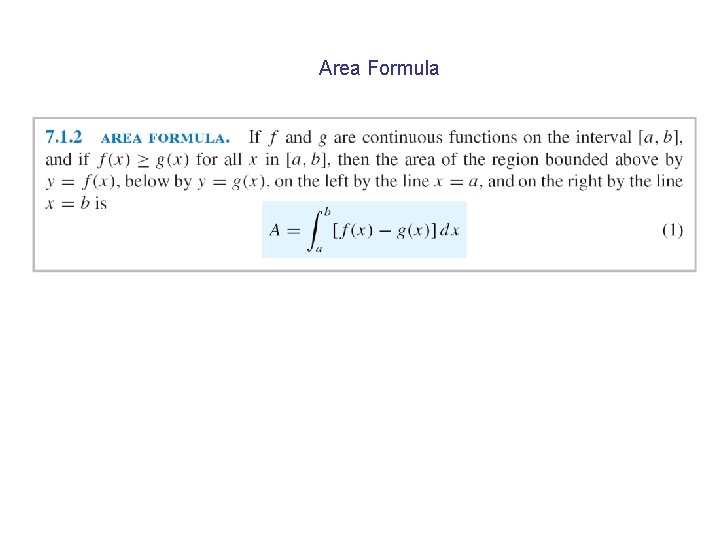
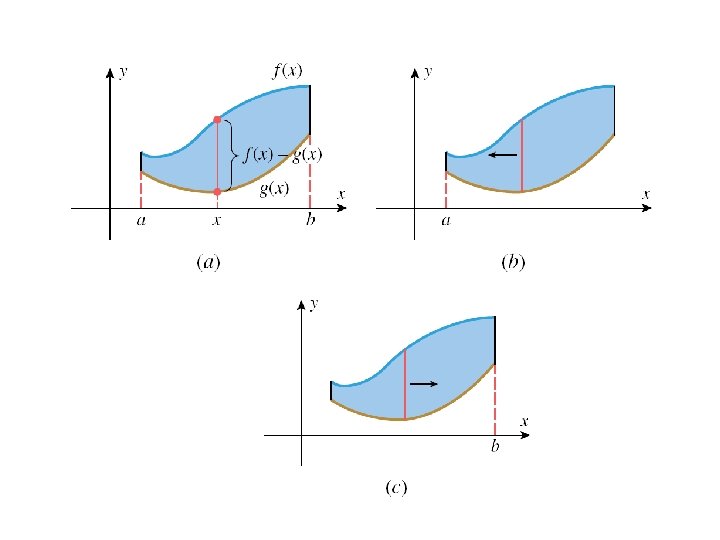
Area Formula
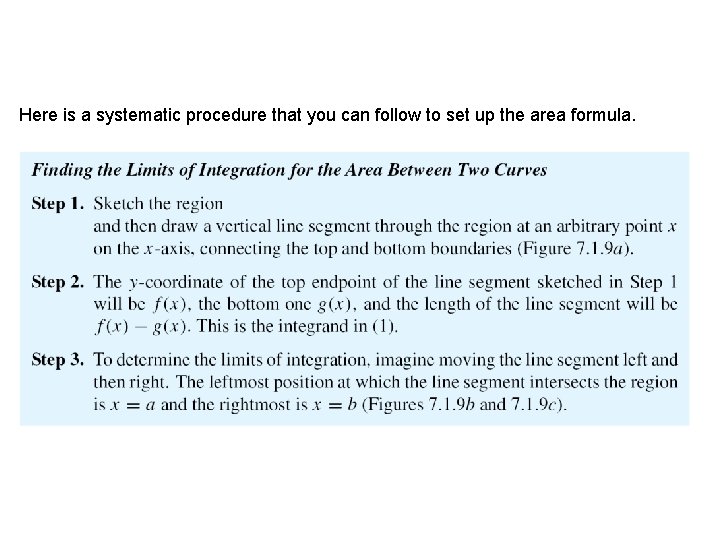
Here is a systematic procedure that you can follow to set up the area formula.
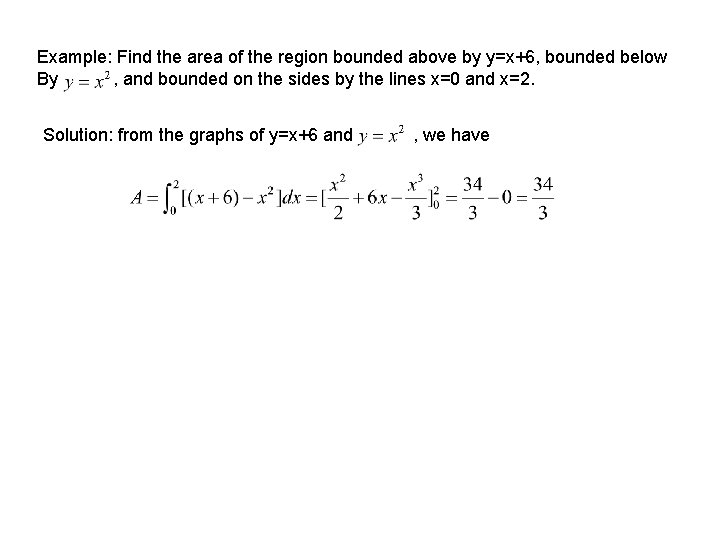
Example: Find the area of the region bounded above by y=x+6, bounded below By , and bounded on the sides by the lines x=0 and x=2. Solution: from the graphs of y=x+6 and , we have
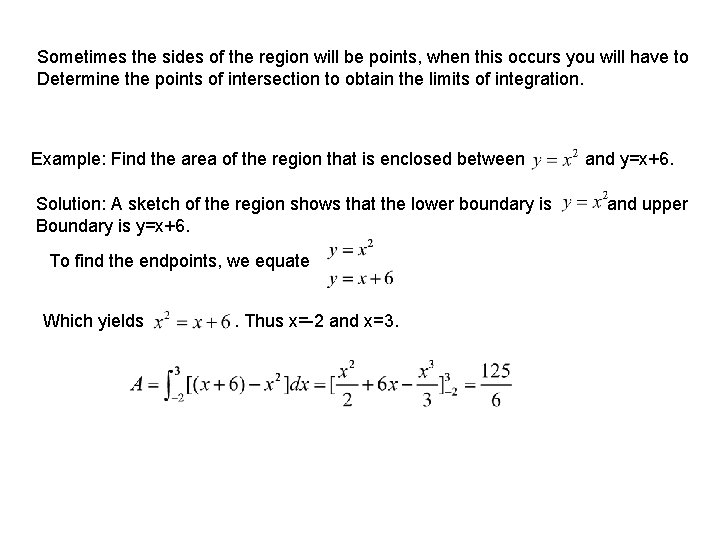
Sometimes the sides of the region will be points, when this occurs you will have to Determine the points of intersection to obtain the limits of integration. Example: Find the area of the region that is enclosed between Solution: A sketch of the region shows that the lower boundary is Boundary is y=x+6. To find the endpoints, we equate Which yields . Thus x=-2 and x=3. and y=x+6. and upper

Second Area Problem
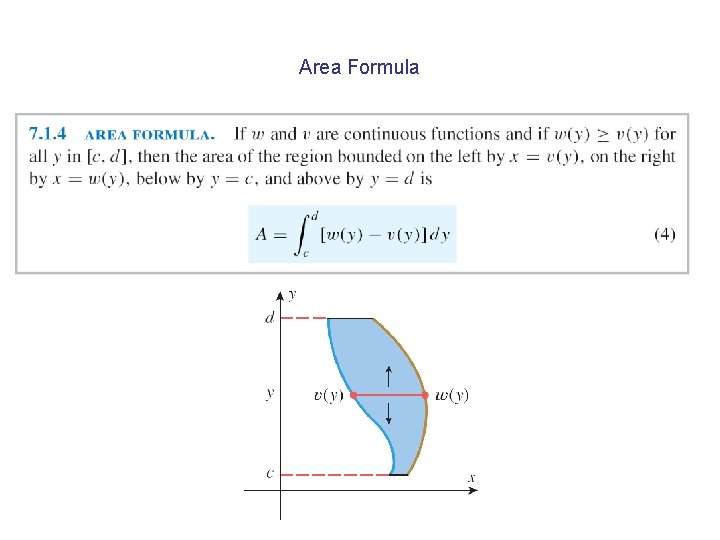
Area Formula
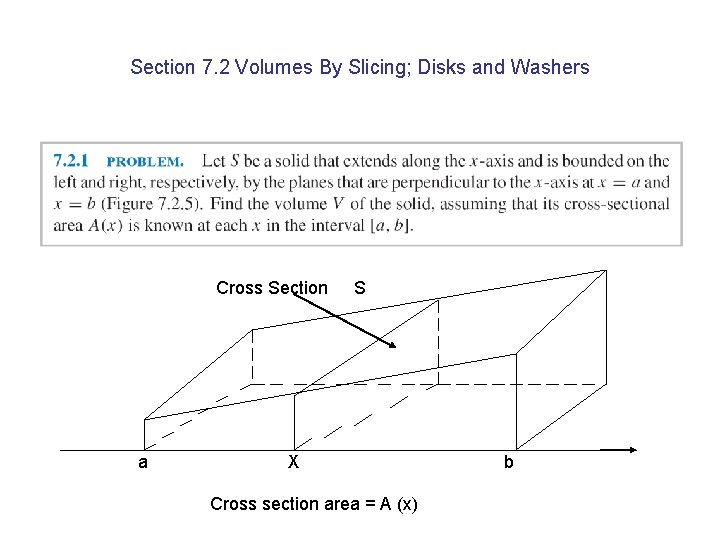
Section 7. 2 Volumes By Slicing; Disks and Washers Cross Section a S X Cross section area = A (x) b
Right Cylinder A right cylinder is a solid that is generated when a plane region is translated along a line or axis that is perpendicular to the region. If a right cylinder is generated y translating a region of area A through a distant h, then h is called the height of the cylinder, and the volume V of the cylinder is defined to be V=Ah =[area of a cross section] X [height]
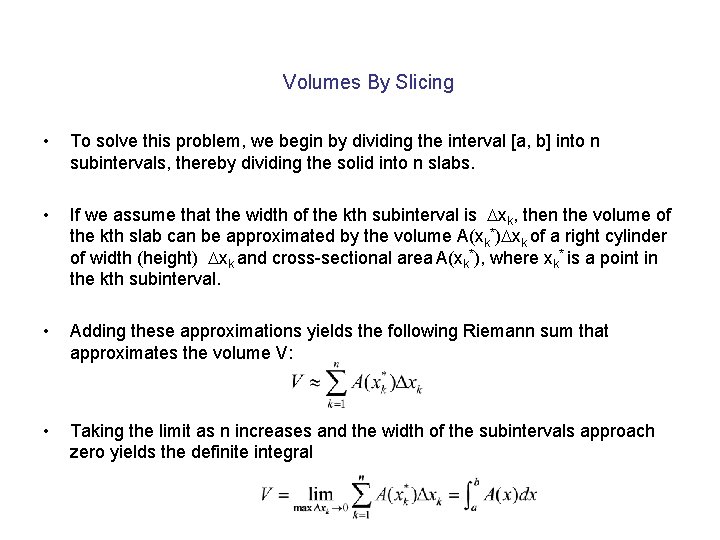
Volumes By Slicing • To solve this problem, we begin by dividing the interval [a, b] into n subintervals, thereby dividing the solid into n slabs. • If we assume that the width of the kth subinterval is xk, then the volume of the kth slab can be approximated by the volume A(xk*) xk of a right cylinder of width (height) xk and cross-sectional area A(xk*), where xk* is a point in the kth subinterval. • Adding these approximations yields the following Riemann sum that approximates the volume V: • Taking the limit as n increases and the width of the subintervals approach zero yields the definite integral
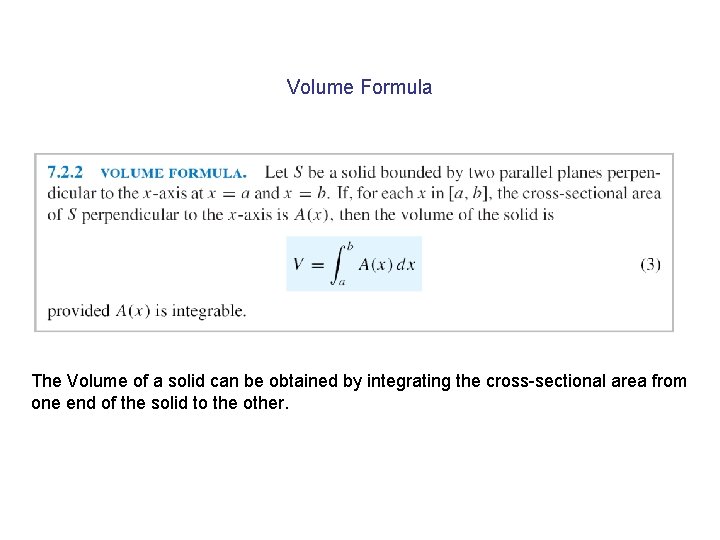
Volume Formula The Volume of a solid can be obtained by integrating the cross-sectional area from one end of the solid to the other.
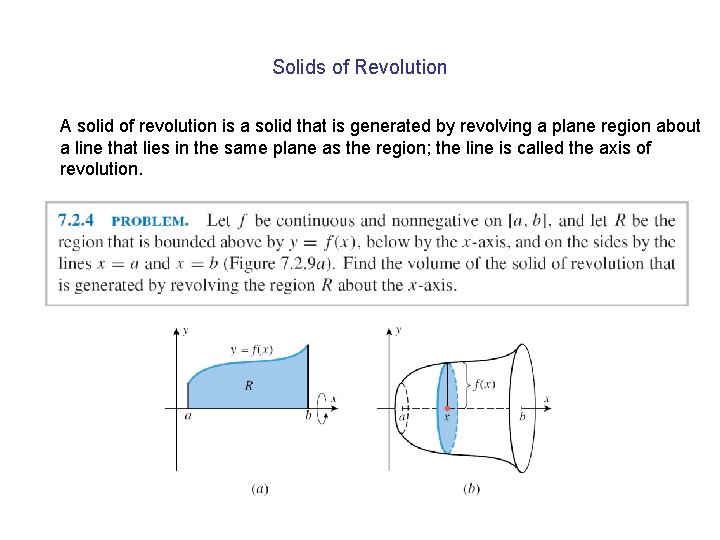
Solids of Revolution A solid of revolution is a solid that is generated by revolving a plane region about a line that lies in the same plane as the region; the line is called the axis of revolution.
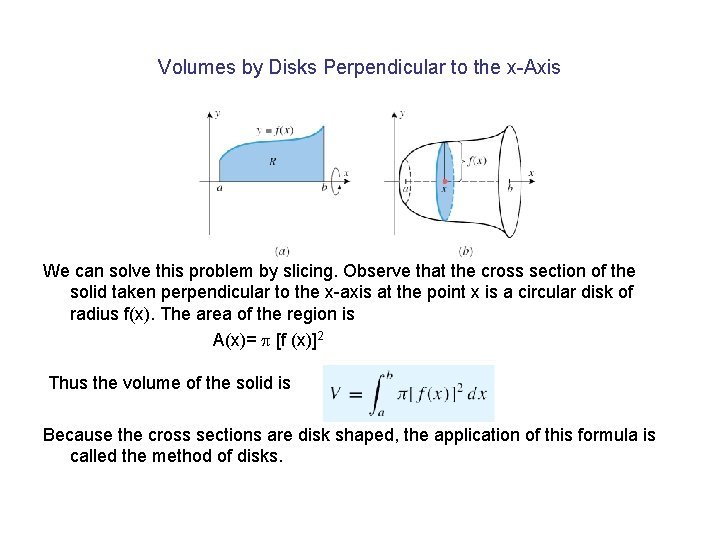
Volumes by Disks Perpendicular to the x-Axis We can solve this problem by slicing. Observe that the cross section of the solid taken perpendicular to the x-axis at the point x is a circular disk of radius f(x). The area of the region is A(x)= [f (x)]2 Thus the volume of the solid is Because the cross sections are disk shaped, the application of this formula is called the method of disks.
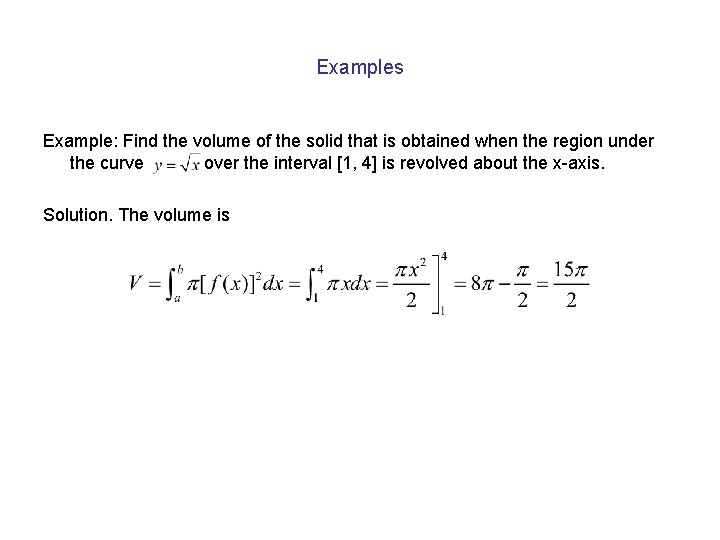
Examples Example: Find the volume of the solid that is obtained when the region under the curve over the interval [1, 4] is revolved about the x-axis. Solution. The volume is
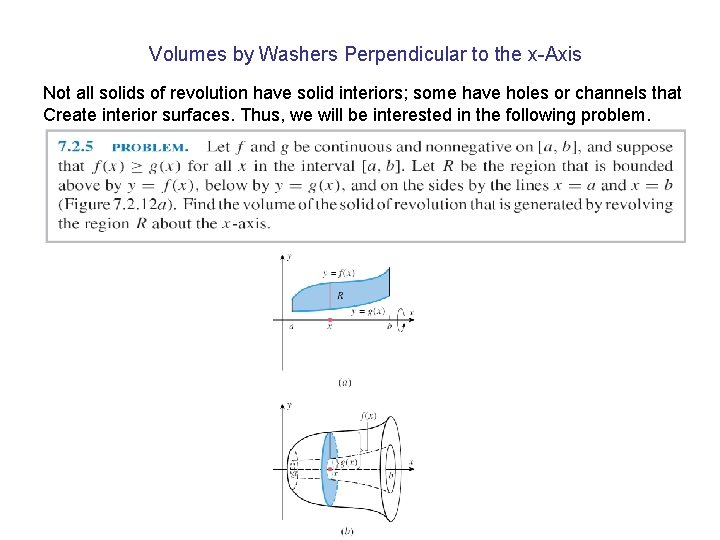
Volumes by Washers Perpendicular to the x-Axis Not all solids of revolution have solid interiors; some have holes or channels that Create interior surfaces. Thus, we will be interested in the following problem.
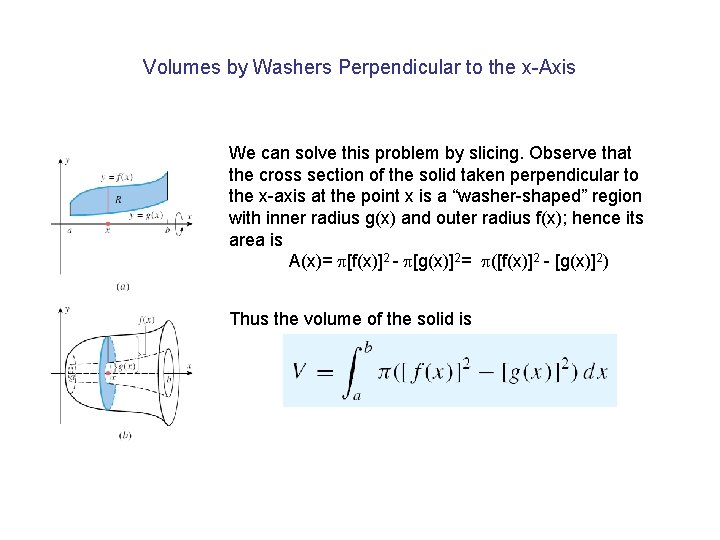
Volumes by Washers Perpendicular to the x-Axis We can solve this problem by slicing. Observe that the cross section of the solid taken perpendicular to the x-axis at the point x is a “washer-shaped” region with inner radius g(x) and outer radius f(x); hence its area is A(x)= [f(x)]2 - [g(x)]2= ([f(x)]2 - [g(x)]2) Thus the volume of the solid is
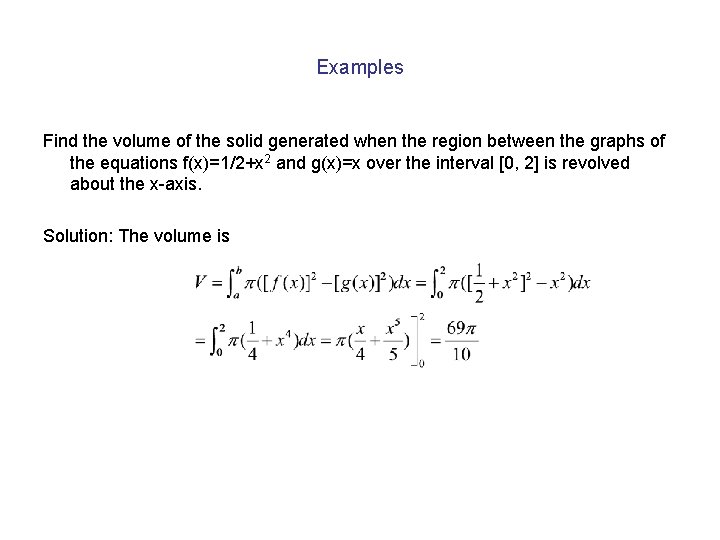
Examples Find the volume of the solid generated when the region between the graphs of the equations f(x)=1/2+x 2 and g(x)=x over the interval [0, 2] is revolved about the x-axis. Solution: The volume is
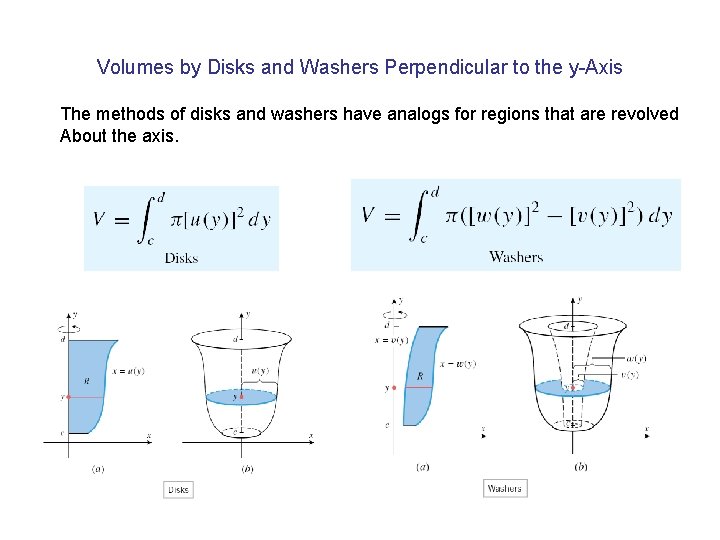
Volumes by Disks and Washers Perpendicular to the y-Axis The methods of disks and washers have analogs for regions that are revolved About the axis.
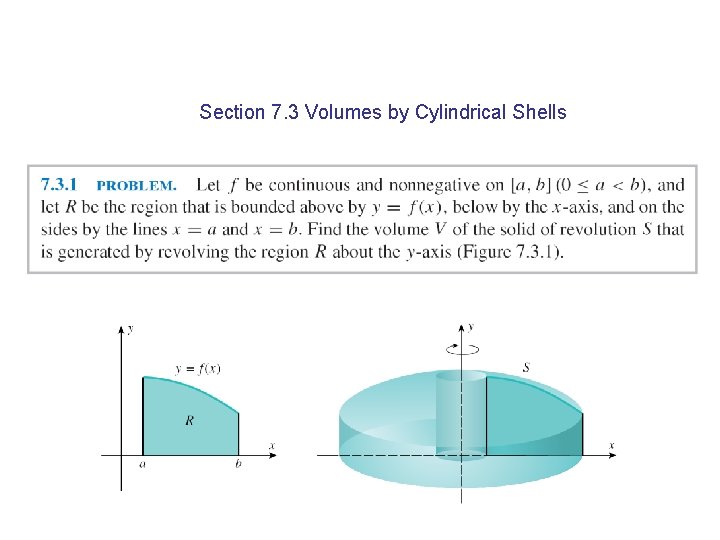
Section 7. 3 Volumes by Cylindrical Shells
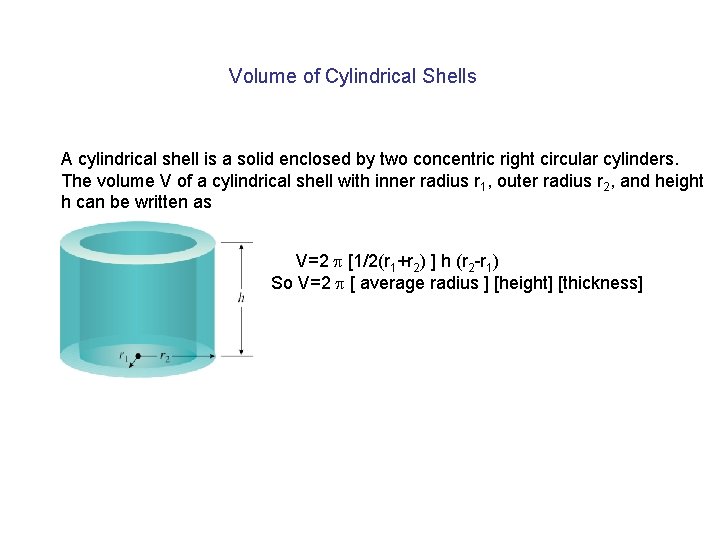
Volume of Cylindrical Shells A cylindrical shell is a solid enclosed by two concentric right circular cylinders. The volume V of a cylindrical shell with inner radius r 1, outer radius r 2, and height h can be written as V=2 [1/2(r 1+r 2) ] h (r 2 -r 1) So V=2 [ average radius ] [height] [thickness]
![Method of Cylindrical Shells • The idea is to divide the interval [a, b]](http://slidetodoc.com/presentation_image_h2/9d50875097e089960220d37f66abea41/image-23.jpg "Method of Cylindrical Shells • The idea is to divide the interval [a, b]")
Method of Cylindrical Shells • The idea is to divide the interval [a, b] into n subintervals, thereby subdividing the region R into n strips, R 1, R 2, , …, Rn. • When the region R is revolved about the y-axis, these strips generate “tubelike” solids S 1, S 2, …, Sn that are nested one inside the other and together comprise the entire solid S. • Thus the volume V of the solid can be obtained by adding together the volumes of the tubes; that is V=V(S 1)+V(S 2)+…+V(Sn).
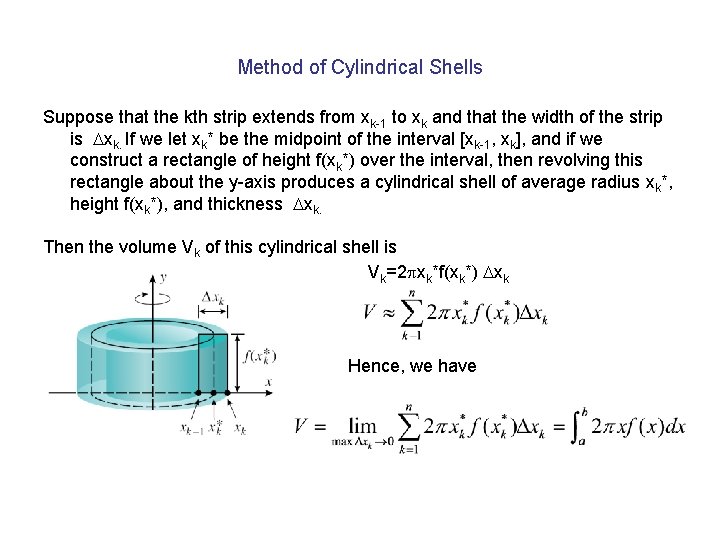
Method of Cylindrical Shells Suppose that the kth strip extends from xk-1 to xk and that the width of the strip is xk. If we let xk* be the midpoint of the interval [xk-1, xk], and if we construct a rectangle of height f(xk*) over the interval, then revolving this rectangle about the y-axis produces a cylindrical shell of average radius xk*, height f(xk*), and thickness xk. Then the volume Vk of this cylindrical shell is Vk=2 xk*f(xk*) xk Hence, we have
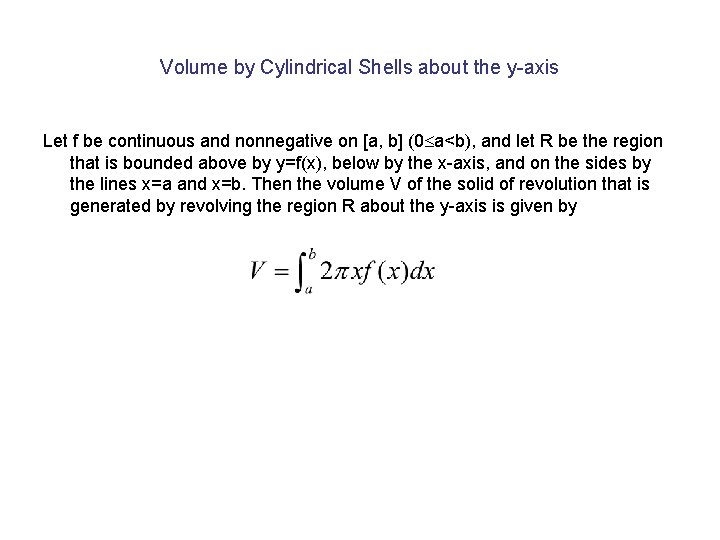
Volume by Cylindrical Shells about the y-axis Let f be continuous and nonnegative on [a, b] (0 a<b), and let R be the region that is bounded above by y=f(x), below by the x-axis, and on the sides by the lines x=a and x=b. Then the volume V of the solid of revolution that is generated by revolving the region R about the y-axis is given by
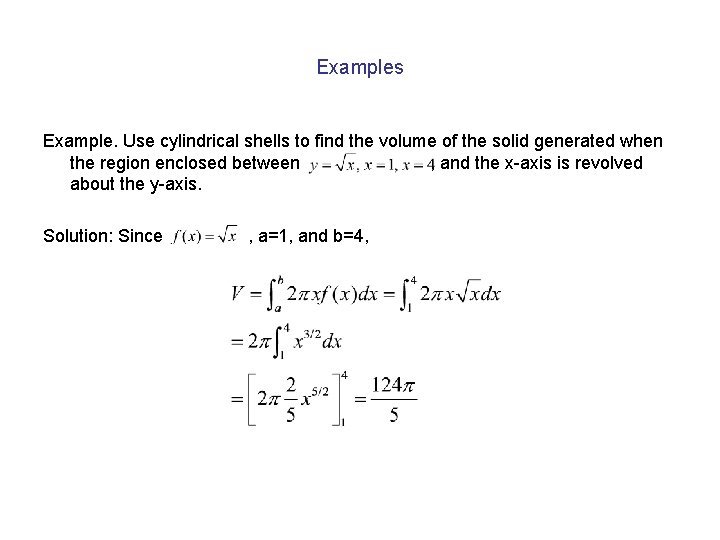
Examples Example. Use cylindrical shells to find the volume of the solid generated when the region enclosed between , and the x-axis is revolved about the y-axis. Solution: Since , a=1, and b=4,
- Slides: 26