
Chapter 7 2015 Cengage Learning All rights reserved

- Slides: 27
Chapter 7 © 2015. Cengage Learning. All rights reserved.
� “The underlying theme of this chapter is the need for helpers to be honest and self-searching in determining the impact of their behavior on clients. In cases that are not clear-cut, it is especially important to make an honest appraisal of your behavior and its effect on clients. ” � “To us, behavior is unethical when it reflects a lack of awareness or concern about the impact of the behavior on clients. Some counselors may place their personal needs above the needs of their clients, engaging in more than one role with clients to meet their own financial, social, or emotional needs. ” § © 2015. Cengage Learning. All rights reserved. (Corey, Corey & Callanan, 2007, p. 262)
The rationale for abstaining from boundary crossings or multiple relationships involves the potential for therapists to misuse their power to influence and exploit clients for their own benefit and to the clients’ detriment. � The viewpoints on multiple relationships vary: � Some focus on the problems inherent in multiple relationships. � Others view them as common, inevitable, unavoidable, normal, and a healthy part of communal life in many settings. © 2015. Cengage Learning. All rights reserved.
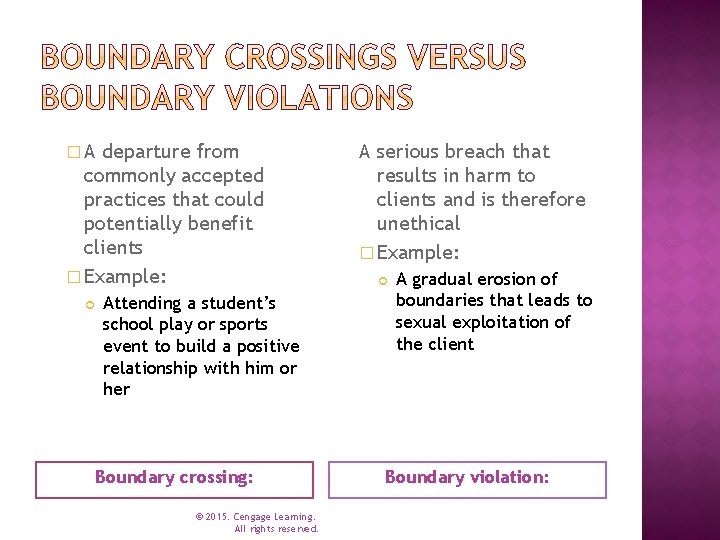
�A departure from commonly accepted practices that could potentially benefit clients � Example: Attending a student’s school play or sports event to build a positive relationship with him or her Boundary crossing: © 2015. Cengage Learning. All rights reserved. A serious breach that results in harm to clients and is therefore unethical � Example: A gradual erosion of boundaries that leads to sexual exploitation of the client Boundary violation:
�“Not all boundary crossings are dual relationships, but all dual relationships are boundary crossings. ”
BEFORE ENTERING INTO A MULTIPLE RELATIONSHIP • • • Is entering into a relationship in addition to the professional one necessary or should I avoid it? Can the dual relationships cause harm to the client? If harm seems unlikely, would the additional relationship prove beneficial? Is there a risk that the dual relationship could disrupt therapeutic relationship? Can I evaluate this matter objectively?
Identify measures aimed at minimizing the risks: �Set healthy boundaries from the outset �Secure informed consent of clients �Discuss both potential risks and benefits �Consult with other professionals to resolve any dilemmas © 2015. Cengage Learning. All rights reserved. �Seek supervision when needed �Document in clinical case notes �Examine your own motivations �Refer when necessary
� Practitioners who work in small communities often have to blend several professional roles and functions. � They have to become an integral part of the community to be accepted as a credible mental health resource. � If these practitioners isolate themselves from the surrounding community, they are likely to alienate potential clients and thus reduce their effectiveness in the settings where they work. � Read page 269 for Marianne’s story © 2015. Cengage Learning. All rights reserved.
� Guidelines to clarify barter arrangements: �Minimize unique financial arrangements �If bartering is used, it is better to exchange goods rather than services �Both therapist and client should have a written agreement for the compensation by bartering �If a misunderstanding develops, the matter should be dealt with by a mediator, not by you and your client © 2015. Cengage Learning. All rights reserved.
� Evaluate whether it puts you at risk of impaired professional judgment � Determine the value of goods or services in a collaborative fashion � Determine appropriate length of time for arrangement � Document arrangement and consult with experienced colleagues or supervisors © 2015. Cengage Learning. All rights reserved.
� When deciding whether or not to accept a gift from a client, ask yourself: �What is the monetary value of the gift? �What are the clinical implications of accepting or rejecting the gift? �When in therapy process is the offering of a gift occurring? �What are my motivations for accepting or rejecting a gift? �What are the cultural implications of offering a gift? © 2015. Cengage Learning. All rights reserved.
SOCIALIZING WITH CURRENT OR FORMER CLIENTS Potential disadvantages: �Therapists may not be as challenging as they need to be with clients they know socially because of a need to be liked and accepted by the client. �Counselors’ own needs may be enmeshed with those of their clients to the point that objectivity is lost. �Counselors are at greater risk of exploiting clients because of the power differential in therapeutic relationship. �If you develop a friendship with a former client, then he or she is not eligible to use your professional services in the future. Issues and Ethics - Chapter 7 (8) Corey, 8 e, © 2011, Brooks/ Cole – Cengage Learning
SEXUAL ATTRACTIONS IN THE CLIENTTHERAPIST RELATIONSHIP �Attraction to clients is a prevalent experience among both male and female therapists. �The most common reactions of therapists: Surprise Guilt Anxiety about unresolved personal problems Fear of losing control Fear of being criticized Confusion about boundaries and roles Confusion about actions Issues and Ethics - Chapter 7 (9) Corey, 8 e, © 2011, Brooks/ Cole – Cengage Learning
To minimize the likelihood of sexual transgressions by clinicians: �Learn to recognize sexual attractions and how to deal with these feelings constructively and therapeutically. �Seek professional support during times of personal loss or crisis. �Examine and monitor feelings and behaviors toward clients continually. �Know the difference between having sexual attraction to clients and acting on this attraction. Issues and Ethics - Chapter 7 (10) Corey, 8 e, © 2011, Brooks/ Cole – Cengage Learning
�Learn about the possible adverse consequences for clients and therapists who engage in sexual activity. �Establish and maintain clear boundaries when a client makes sexual advances toward you. �Terminate therapeutic relationship when sexual feelings obscure objectivity. �Recognize that direct explicit disclosures of sexual feelings can run the risk of harming clients and may therefore be unethical. Issues and Ethics - Chapter 7 (11) Corey, 8 e, © 2011, Brooks/ Cole – Cengage Learning
�Rather than making any explicit communication of sexual feelings for clients, acknowledge caring and warmth within therapeutic relationship. �Practice a risk management approach (e. g. , be aware of timing and the location of scheduled appointments, nonerotic touch, and general self-disclosure. �Be open to using supervision, consultation, and personal therapy throughout your career. Issues and Ethics - Chapter 7 (12) Corey, 8 e, © 2011, Brooks/ Cole – Cengage Learning
� Clients who are the victims of sexual misconduct suffer dire consequences: �Distrust of the opposite sex �Distrust of therapists and therapeutic process �Guilt �Depression �Anger �Feeling of rejection �Suicidal ideation �Low self-esteem. Issues and Ethics - Chapter 7 (13) Corey, 8 e, © 2011, Brooks/ Cole – Cengage Learning
� Negative consequences for therapists include: � being �being the target of a lawsuit convicted of a felony �having their license revoked or suspended by the state �being expelled from professional organizations �losing their insurance coverage �losing their jobs Issues and Ethics - Chapter 7 (14) Corey, 8 e, © 2011, Brooks/ Cole – Cengage Learning
Professional Competence and Training Corey, 8 e, © 2011, Brooks/ Cole – Cengage Learning
PERSPECTIVES ON COMPETENCE � Professional codes of ethics on competence have common themes. � Counselors practice only within the boundaries of competence, based on: �education �training �supervised �state experience and national professional credentials �appropriate professional experience Issues and Ethics - Chapter 8 (1) Corey, 8 e, © 2011, Brooks/ Cole – Cengage Learning
ASSESSMENT OF COMPETENCE � Assessment approaches are most effective when they integrate both formative and summative evaluations: � Formative assessment is a developmentally informed process that provides useful feedback during one’s training and throughout one’s professional career. � Summative assessment is an end point evaluation typically completed at the end of a professional program or when applying for licensure status. Issues and Ethics - Chapter 8 (2) Corey, 8 e, © 2011, Brooks/ Cole – Cengage Learning
DEVELOPING OR UPGRADING SKILLS � Work with colleagues or professionals who have more experience. � Seek consultation before moving outside the areas in which you have received education and training. � Learn new skills by attending conferences and conventions, reading books and professional journal articles, taking additional courses, and participating in workshops that combine didactic work with supervised practice. Issues and Ethics - Chapter 8 (3) Corey, 8 e, © 2011, Brooks/ Cole – Cengage Learning
MAKING REFERRALS � When: �Counselors become aware that they do not have skills to offer client needed services �Counselors’ do not possess the competency for effective service. � How: �counselors must have thorough knowledge of the type and caliber of service available in the community � Who: �client must agree that problem exists and be willing to work with referral Issues and Ethics - Chapter 8 (4) Corey, 8 e, © 2011, Brooks/ Cole – Cengage Learning
ETHICAL ISSUES IN TRAINING THERAPISTS � Training programs have an ethical responsibility to: �establish clear selection criteria �provide exposure to major contemporary counseling theories �teach students strengths and limitations of theories �combine academic and personal learning �screen candidates to protect public from incompetent practitioners �teach range of skills to work with diverse clients �provide training in ethics Issues and Ethics - Chapter 8 (5) Corey, 8 e, © 2011, Brooks/ Cole – Cengage Learning
EVALUATING THE CHARACTER AND PSYCHOLOGICAL FITNESS OF TRAINEES � Interpersonal behaviors of trainees have a direct bearing on their clinical effectiveness, so these factors must be taken into consideration in the evaluation process. � Character �the honesty and integrity with which a person deals with others. � Psychological fitness �the emotional or mental stability necessary to practice safely and effectively. Fitness can be evidenced by the presence of personality adjustment, absence of psychological disorder, and appropriate use of substances. Issues and Ethics - Chapter 8 (6) Corey, 8 e, © 2011, Brooks/ Cole – Cengage Learning
� The academic faculty in a professional program generally has a gatekeeper’s role, protecting consumers by identifying and intervening with graduate students who exhibit problematic behaviors. � The gatekeeper role is addressed in the ethics codes of most professional organizations. � When a student has good grades but demonstrates substandard interpersonal behavior, indicating serious unresolved conflicts, action needs to be taken. � Dismissal from a program is a measure of last resort. Issues and Ethics - Chapter 8 (7) Corey, 8 e, © 2011, Brooks/ Cole – Cengage Learning
CERTIFICATION AND LICENSURE � Certification �voluntary attempt by a group to promote professional identity �attempts to verify qualifications �sets minimum standards �does not assure quality practice � Licensure �governs professional practice �highlights uniqueness of an occupation �restricts both use of title and practice of occupation Issues and Ethics - Chapter 8 (8) Corey, 8 e, © 2011, Brooks/ Cole – Cengage Learning