
Chapter 7 1 CHAPTER 7 CASH AND RECEIVABLES

Chapter 7 -1
CHAPTER 7 CASH AND RECEIVABLES Intermediate Accounting 13 th Edition Kieso, Weygandt, and Warfield Chapter 7 -2
Learning Objectives 1. Identify items considered cash. 2. Indicate how to report cash and related items. 3. Define receivables and identify the different types of receivables. 4. Explain accounting issues related to recognition of accounts receivable. 5. Explain accounting issues related to valuation of accounts receivable. 6. Explain accounting issues related to recognition of notes receivable. 7. Explain accounting issues related to valuation of notes receivable. 8. Explain accounting issues related to disposition of accounts and notes receivable. 9. Describe how to report and analyze receivables. Chapter 7 -3
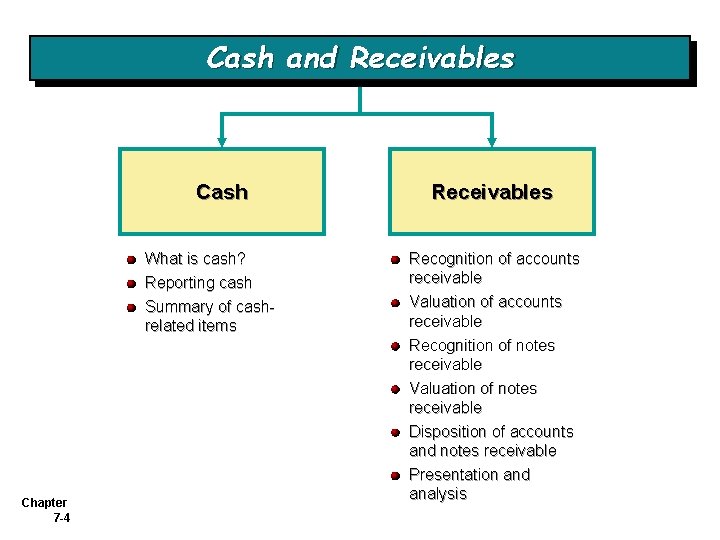
Cash and Receivables Cash What is cash? Reporting cash Summary of cashrelated items Chapter 7 -4 Receivables Recognition of accounts receivable Valuation of accounts receivable Recognition of notes receivable Valuation of notes receivable Disposition of accounts and notes receivable Presentation and analysis
What is Cash? Cash Most liquid asset Standard medium of exchange Basis for measuring and accounting for all items Current asset Examples: coin, currency, available funds on deposit at the bank, money orders, certified checks, cashier’s checks, personal checks, bank drafts and savings accounts. Chapter 7 -5 LO 1 Identify items considered cash.
Reporting Cash Equivalents Short-term, highly liquid investments that are both (a) readily convertible to cash, and (b) so near their maturity that they present insignificant risk of changes in interest rates. Examples: Treasury bills, Commercial paper, and Money market funds. Chapter 7 -6 LO 2 Indicate how to report cash and related items.
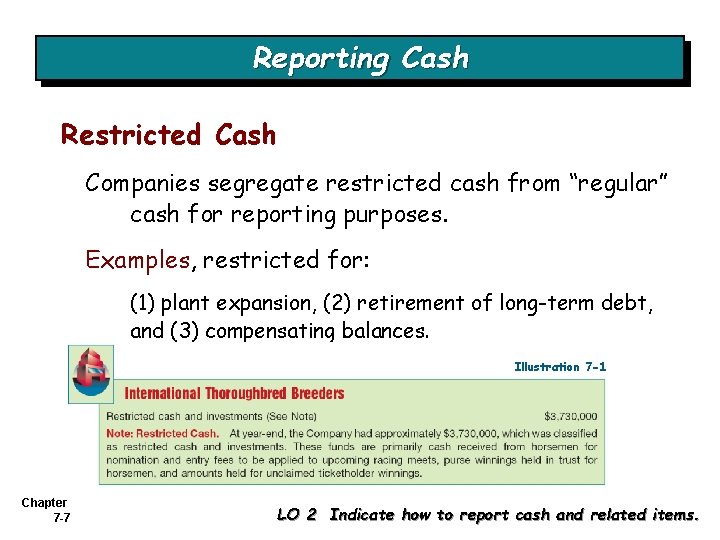
Reporting Cash Restricted Cash Companies segregate restricted cash from “regular” cash for reporting purposes. Examples, restricted for: (1) plant expansion, (2) retirement of long-term debt, and (3) compensating balances. Illustration 7 -1 Chapter 7 -7 LO 2 Indicate how to report cash and related items.
Reporting Cash Bank Overdrafts When a company writes a check for more than the amount in its cash account. Generally reported as a current liability. Offset against cash account only when available cash is present in another account in the same bank on which the overdraft occurred. Chapter 7 -8 LO 2 Indicate how to report cash and related items.
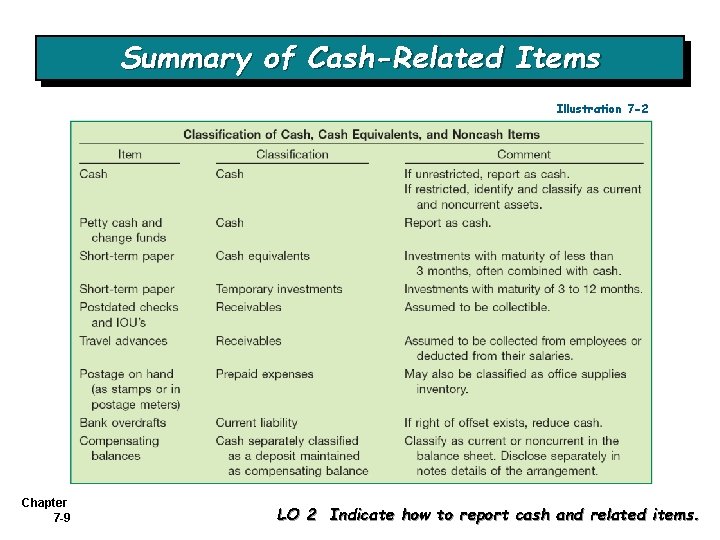
Summary of Cash-Related Items Illustration 7 -2 Chapter 7 -9 LO 2 Indicate how to report cash and related items.
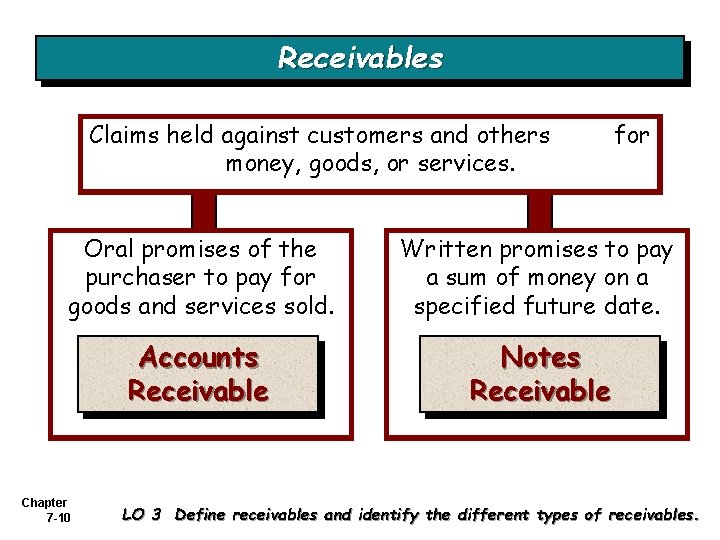
Receivables Claims held against customers and others money, goods, or services. for Oral promises of the purchaser to pay for goods and services sold. Written promises to pay a sum of money on a specified future date. Accounts Receivable Notes Receivable Chapter 7 -10 LO 3 Define receivables and identify the different types of receivables.
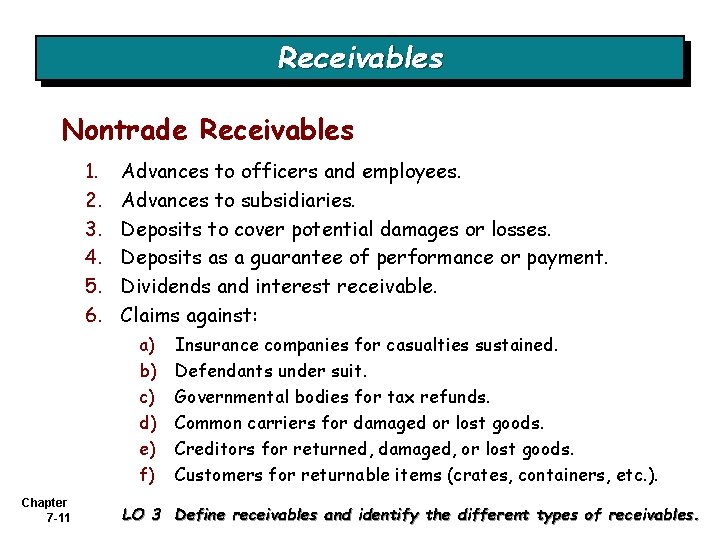
Receivables Nontrade Receivables 1. 2. 3. 4. 5. 6. Advances to officers and employees. Advances to subsidiaries. Deposits to cover potential damages or losses. Deposits as a guarantee of performance or payment. Dividends and interest receivable. Claims against: a) b) c) d) e) f) Chapter 7 -11 Insurance companies for casualties sustained. Defendants under suit. Governmental bodies for tax refunds. Common carriers for damaged or lost goods. Creditors for returned, damaged, or lost goods. Customers for returnable items (crates, containers, etc. ). LO 3 Define receivables and identify the different types of receivables.
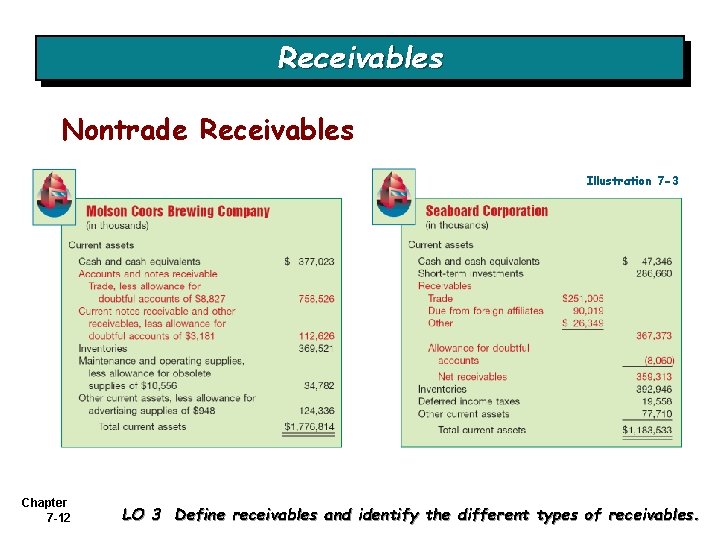
Receivables Nontrade Receivables Illustration 7 -3 Chapter 7 -12 LO 3 Define receivables and identify the different types of receivables.
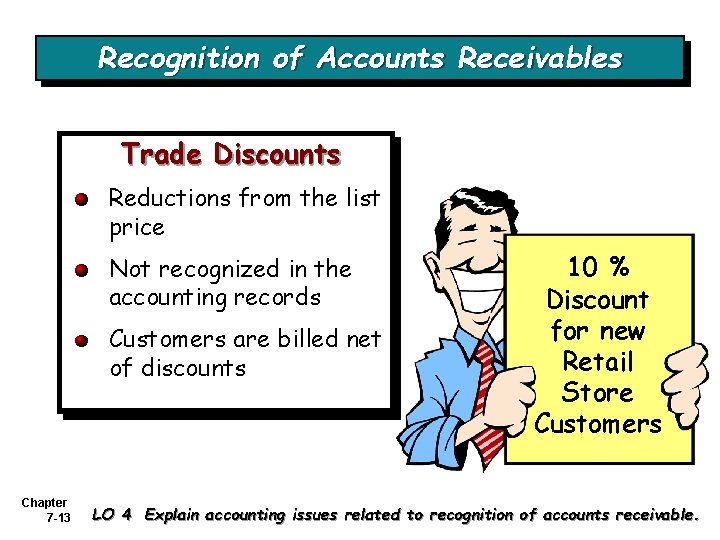
Recognition of Accounts Receivables Trade Discounts Reductions from the list price Not recognized in the accounting records Customers are billed net of discounts Chapter 7 -13 10 % Discount for new Retail Store Customers LO 4 Explain accounting issues related to recognition of accounts receivable.
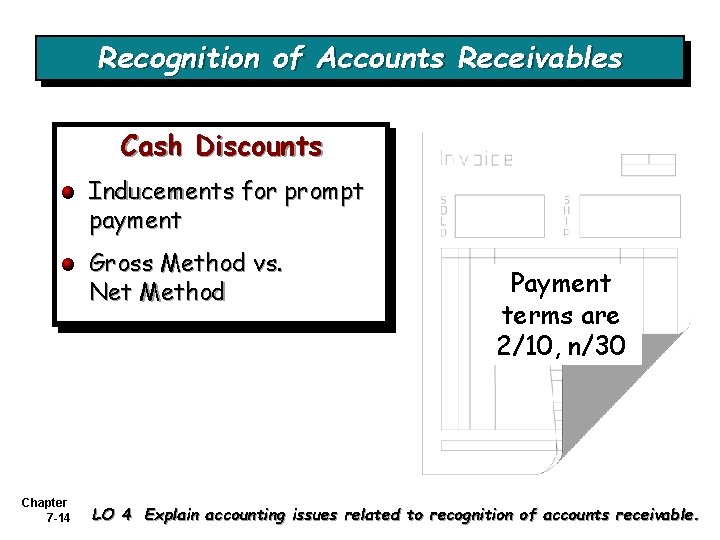
Recognition of Accounts Receivables Cash Discounts Inducements for prompt payment Gross Method vs. Net Method Chapter 7 -14 Payment terms are 2/10, n/30 LO 4 Explain accounting issues related to recognition of accounts receivable.
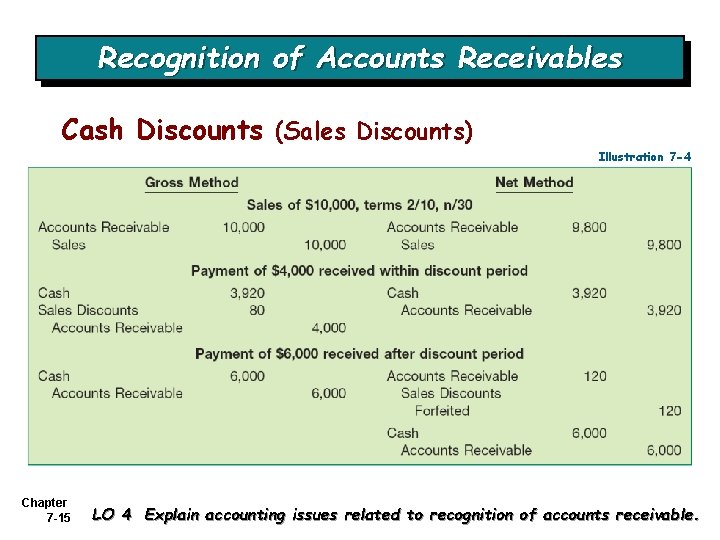
Recognition of Accounts Receivables Cash Discounts (Sales Discounts) Illustration 7 -4 Chapter 7 -15 LO 4 Explain accounting issues related to recognition of accounts receivable.
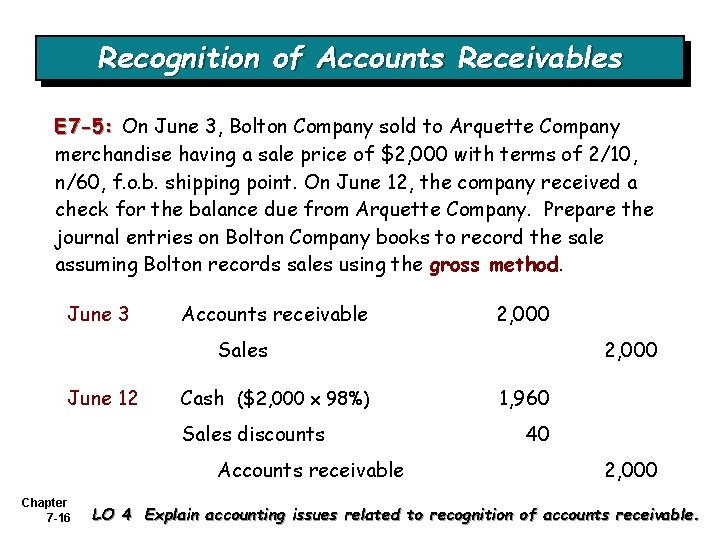
Recognition of Accounts Receivables E 7 -5: On June 3, Bolton Company sold to Arquette Company merchandise having a sale price of $2, 000 with terms of 2/10, n/60, f. o. b. shipping point. On June 12, the company received a check for the balance due from Arquette Company. Prepare the journal entries on Bolton Company books to record the sale assuming Bolton records sales using the gross method. June 3 Accounts receivable 2, 000 Sales June 12 Cash ($2, 000 x 98%) Sales discounts Accounts receivable Chapter 7 -16 2, 000 1, 960 40 2, 000 LO 4 Explain accounting issues related to recognition of accounts receivable.
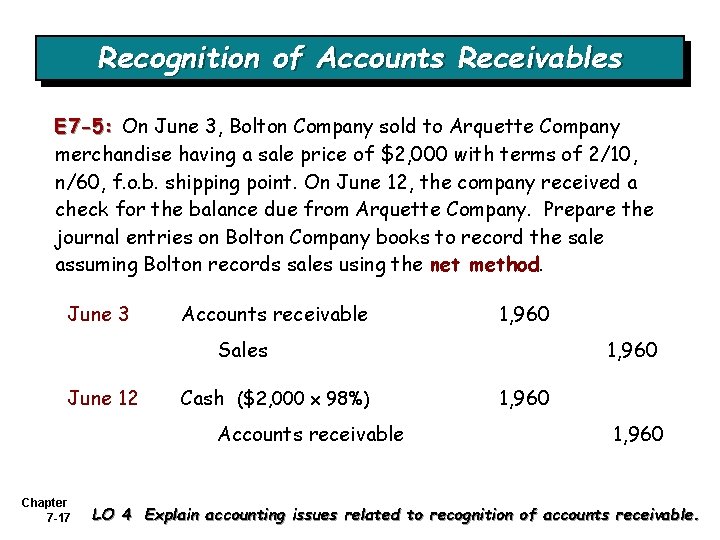
Recognition of Accounts Receivables E 7 -5: On June 3, Bolton Company sold to Arquette Company merchandise having a sale price of $2, 000 with terms of 2/10, n/60, f. o. b. shipping point. On June 12, the company received a check for the balance due from Arquette Company. Prepare the journal entries on Bolton Company books to record the sale assuming Bolton records sales using the net method. June 3 Accounts receivable 1, 960 Sales June 12 Cash ($2, 000 x 98%) Accounts receivable Chapter 7 -17 1, 960 LO 4 Explain accounting issues related to recognition of accounts receivable.
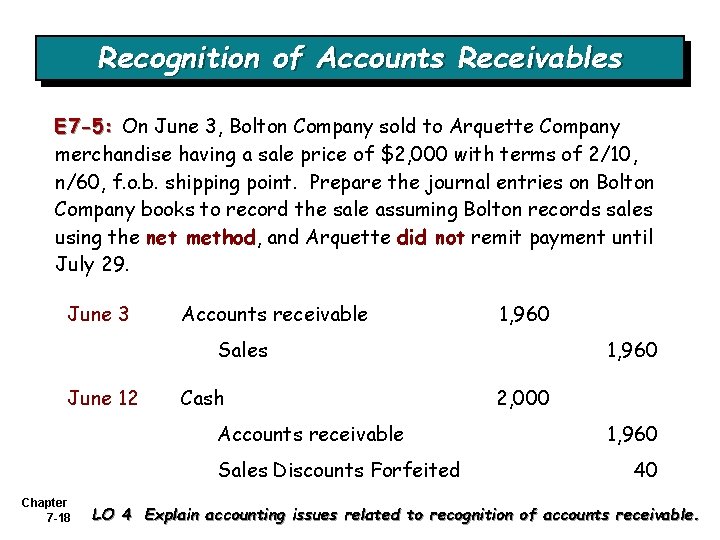
Recognition of Accounts Receivables E 7 -5: On June 3, Bolton Company sold to Arquette Company merchandise having a sale price of $2, 000 with terms of 2/10, n/60, f. o. b. shipping point. Prepare the journal entries on Bolton Company books to record the sale assuming Bolton records sales using the net method, and Arquette did not remit payment until July 29. June 3 Accounts receivable 1, 960 Sales June 12 Cash Accounts receivable Sales Discounts Forfeited Chapter 7 -18 1, 960 2, 000 1, 960 40 LO 4 Explain accounting issues related to recognition of accounts receivable.
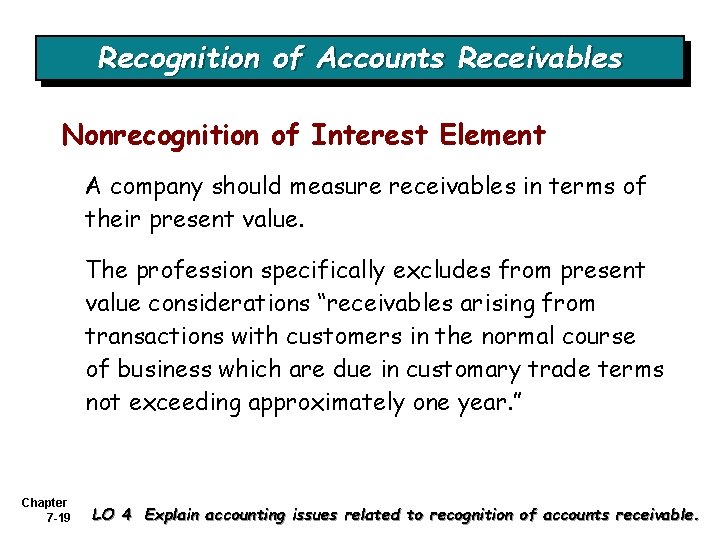
Recognition of Accounts Receivables Nonrecognition of Interest Element A company should measure receivables in terms of their present value. The profession specifically excludes from present value considerations “receivables arising from transactions with customers in the normal course of business which are due in customary trade terms not exceeding approximately one year. ” Chapter 7 -19 LO 4 Explain accounting issues related to recognition of accounts receivable.
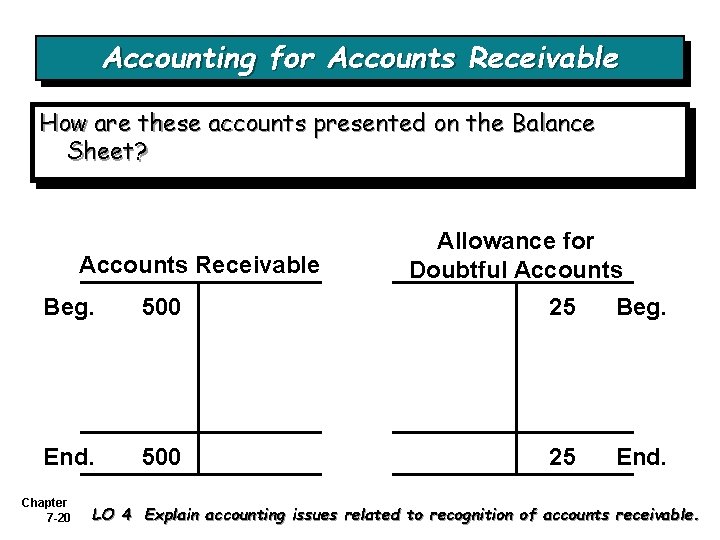
Accounting for Accounts Receivable How are these accounts presented on the Balance Sheet? Accounts Receivable Allowance for Doubtful Accounts Beg. 500 25 Beg. End. 500 25 End. Chapter 7 -20 LO 4 Explain accounting issues related to recognition of accounts receivable.
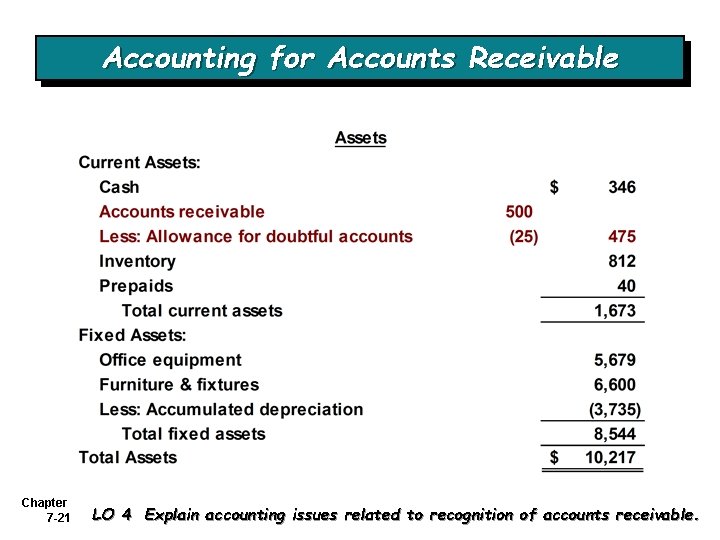
Accounting for Accounts Receivable Chapter 7 -21 LO 4 Explain accounting issues related to recognition of accounts receivable.
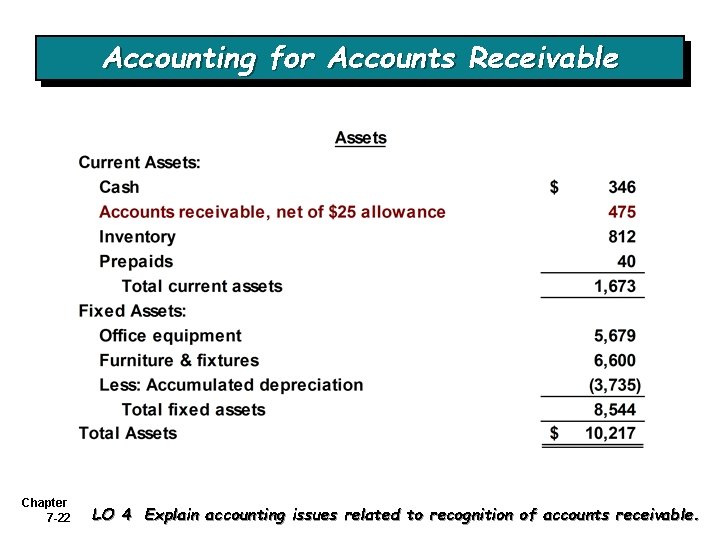
Accounting for Accounts Receivable Chapter 7 -22 LO 4 Explain accounting issues related to recognition of accounts receivable.
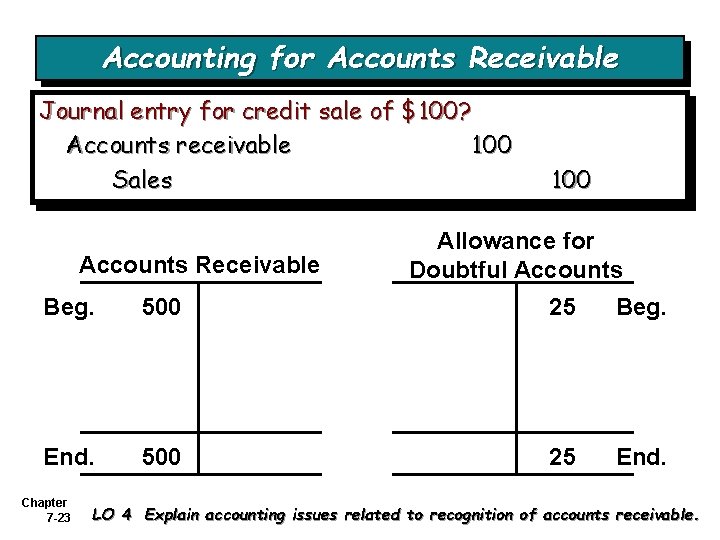
Accounting for Accounts Receivable Journal entry for credit sale of $100? Accounts receivable 100 Sales Accounts Receivable 100 Allowance for Doubtful Accounts Beg. 500 25 Beg. End. 500 25 End. Chapter 7 -23 LO 4 Explain accounting issues related to recognition of accounts receivable.
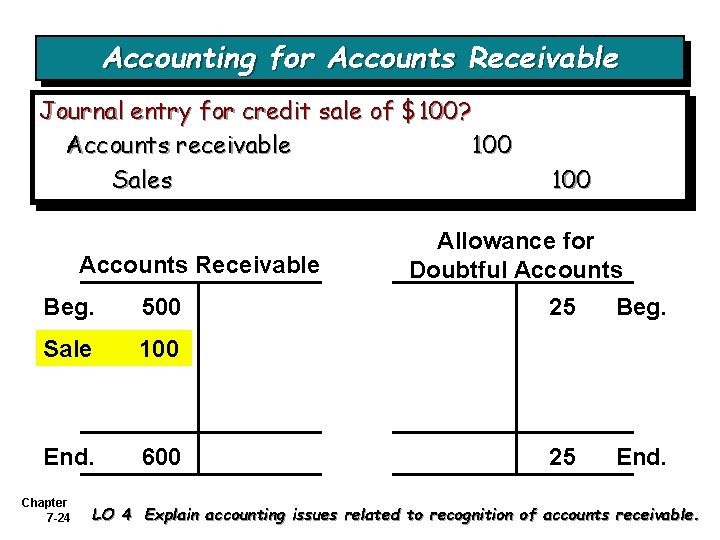
Accounting for Accounts Receivable Journal entry for credit sale of $100? Accounts receivable 100 Sales Accounts Receivable Beg. 500 Sale 100 End. 600 Chapter 7 -24 100 Allowance for Doubtful Accounts 25 Beg. 25 End. LO 4 Explain accounting issues related to recognition of accounts receivable.
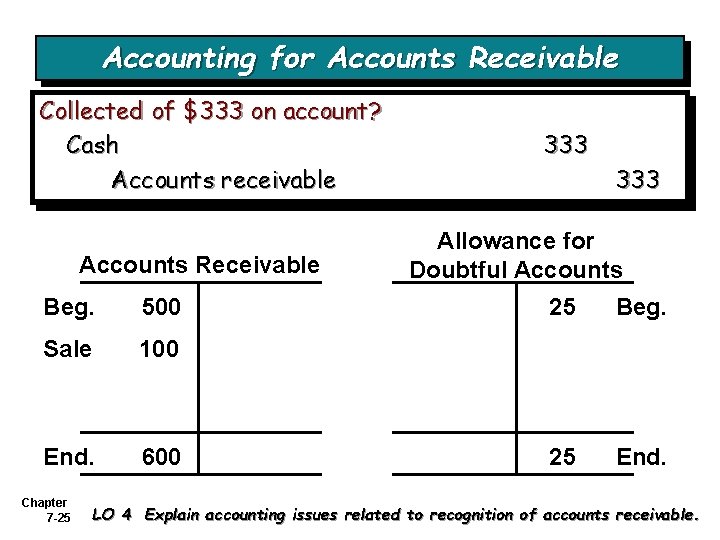
Accounting for Accounts Receivable Collected of $333 on account? Cash Accounts receivable Accounts Receivable Beg. 500 Sale 100 End. 600 Chapter 7 -25 333 Allowance for Doubtful Accounts 25 Beg. 25 End. LO 4 Explain accounting issues related to recognition of accounts receivable.
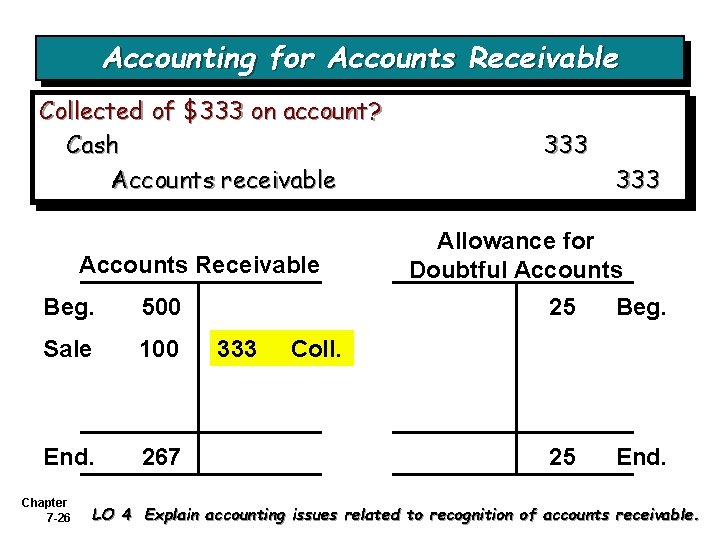
Accounting for Accounts Receivable Collected of $333 on account? Cash Accounts receivable Accounts Receivable Beg. 500 Sale 100 End. 267 Chapter 7 -26 333 333 Allowance for Doubtful Accounts 25 Beg. 25 End. Coll. LO 4 Explain accounting issues related to recognition of accounts receivable.
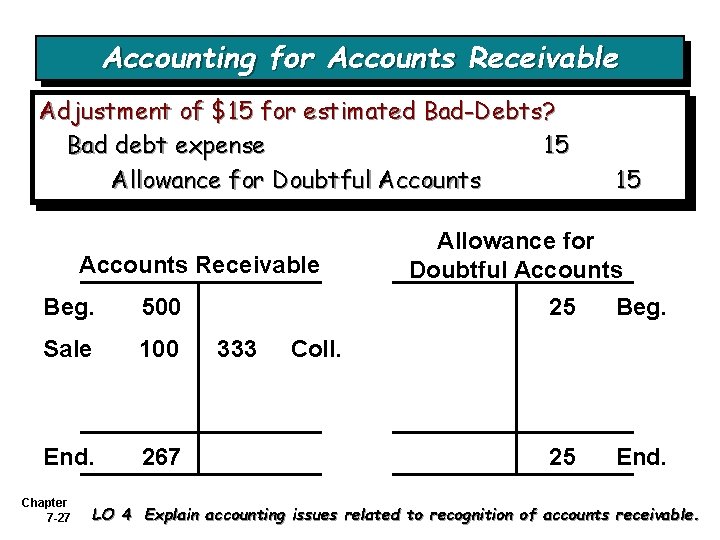
Accounting for Accounts Receivable Adjustment of $15 for estimated Bad-Debts? Bad debt expense 15 Allowance for Doubtful Accounts Receivable Beg. 500 Sale 100 End. 267 Chapter 7 -27 333 15 Allowance for Doubtful Accounts 25 Beg. 25 End. Coll. LO 4 Explain accounting issues related to recognition of accounts receivable.
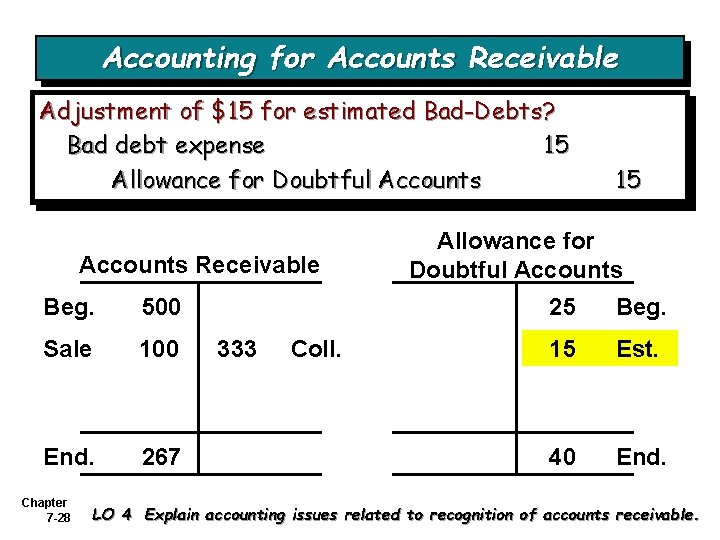
Accounting for Accounts Receivable Adjustment of $15 for estimated Bad-Debts? Bad debt expense 15 Allowance for Doubtful Accounts Receivable Beg. 500 Sale 100 End. 267 Chapter 7 -28 333 Coll. 15 Allowance for Doubtful Accounts 25 Beg. 15 Est. 40 End. LO 4 Explain accounting issues related to recognition of accounts receivable.
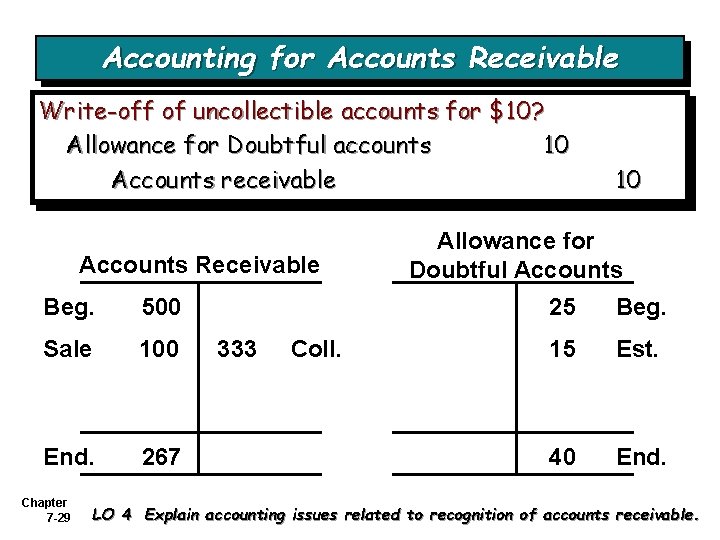
Accounting for Accounts Receivable Write-off of uncollectible accounts for $10? Allowance for Doubtful accounts 10 Accounts receivable Accounts Receivable Beg. 500 Sale 100 End. 267 Chapter 7 -29 333 Coll. 10 Allowance for Doubtful Accounts 25 Beg. 15 Est. 40 End. LO 4 Explain accounting issues related to recognition of accounts receivable.
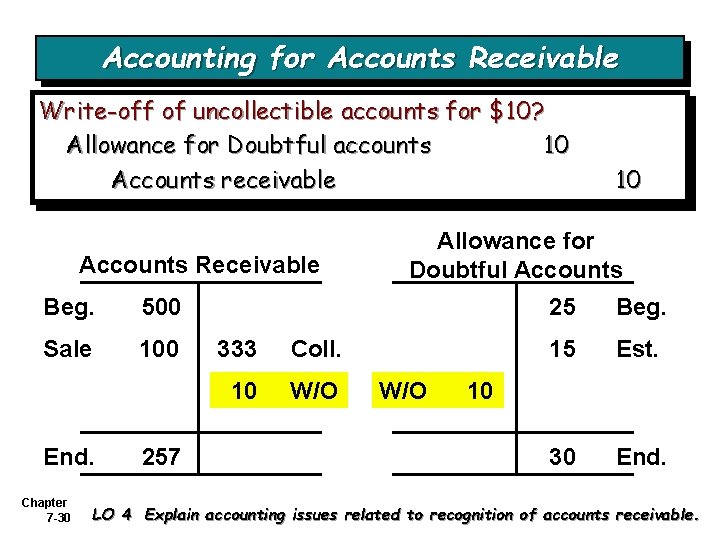
Accounting for Accounts Receivable Write-off of uncollectible accounts for $10? Allowance for Doubtful accounts 10 Accounts receivable Accounts Receivable Beg. 500 Sale 100 End. Chapter 7 -30 257 333 Coll. 10 W/O 10 Allowance for Doubtful Accounts W/O 25 Beg. 15 Est. 30 End. 10 LO 4 Explain accounting issues related to recognition of accounts receivable.
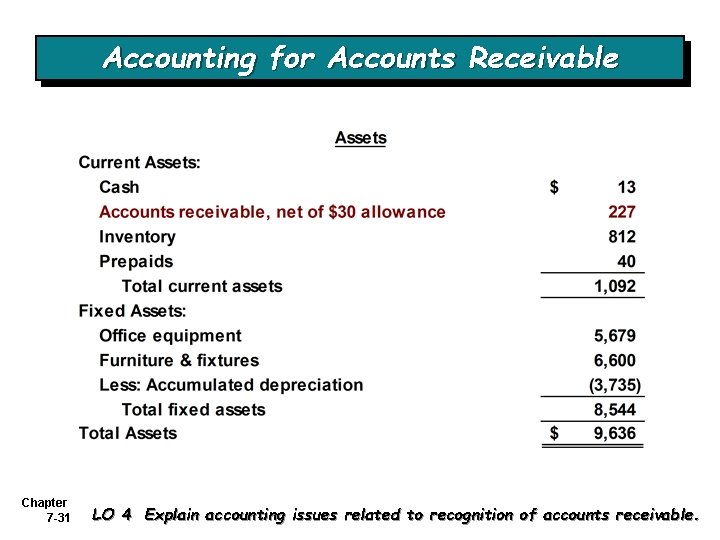
Accounting for Accounts Receivable Chapter 7 -31 LO 4 Explain accounting issues related to recognition of accounts receivable.
Valuation of Accounts Receivable Reporting Receivables Classification Valuation (net realizable value) Uncollectible Accounts Receivable Sales on account raise the possibility of accounts not being collected. Chapter 7 -32 LO 5 Explain accounting issues related to valuation of accounts receivable.
Valuation of Accounts Receivable Uncollectible Accounts Receivable An uncollectible account receivable is a loss of revenue that requires, through proper entry in the accounts, Ø a decrease in the asset accounts receivable and Ø a related decrease in income and stockholders’ equity. Chapter 7 -33 LO 5 Explain accounting issues related to valuation of accounts receivable.
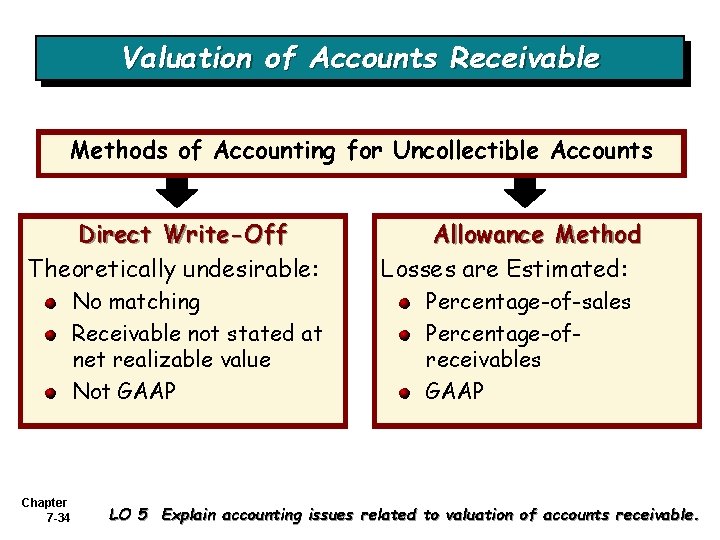
Valuation of Accounts Receivable Methods of Accounting for Uncollectible Accounts Direct Write-Off Theoretically undesirable: No matching Receivable not stated at net realizable value Not GAAP Chapter 7 -34 Allowance Method Losses are Estimated: Percentage-of-sales Percentage-ofreceivables GAAP LO 5 Explain accounting issues related to valuation of accounts receivable.
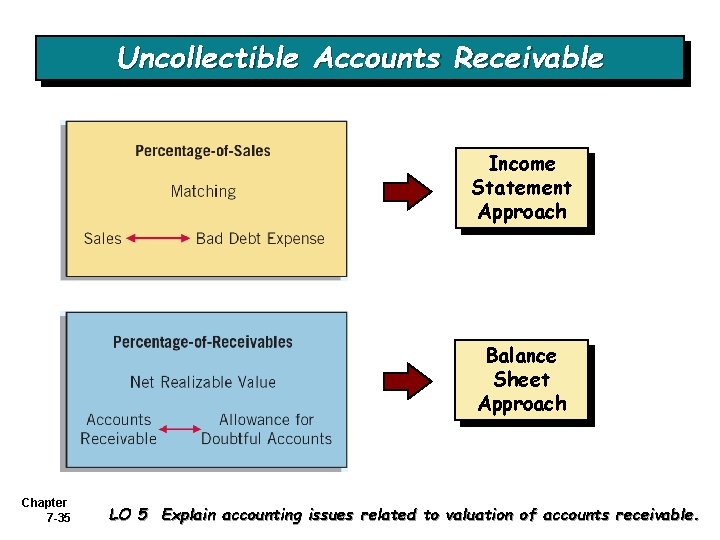
Uncollectible Accounts Receivable Income Statement Approach Balance Sheet Approach Chapter 7 -35 LO 5 Explain accounting issues related to valuation of accounts receivable.
- Slides: 35