
Chapter 6 World History Chapter 6 section 1




- Slides: 30
Chapter 6 World History
Chapter 6, section 1
Chapter 6 Section 2: The Arab Empire & Its Successors Who did Muhammad name as his successor?
Chapter 6 Section 2: The Arab Empire & Its Successors No one!
Chapter 6 Section 2: The Arab Empire & Its Successors His closest followers chose _________, Muhammad’s father-in-law to be the leader.
Chapter 6 Section 2: The Arab Empire & Its Successors Abu Bakr
Chapter 6 Section 2: The Arab Empire & Its Successors • Define Caliph:
Chapter 6 Section 2: The Arab Empire & Its Successors successor to Muhammad
Chapter 6 Section 2: The Arab Empire & Its Successors • Define Jihad:
Chapter 6 Section 2: The Arab Empire & Its Successors “Struggle in the way of God”
Chapter 6 Section 2: The Arab Empire & Its Successors • After the death of Abu Bakr what happens to the next 2 Caliphs? They were assassinated. • In 656, _Ali____, Muhammad’s son-in-law was chosen as Caliph, he rules for ____5___ years before he was ___assassinated_____.
Chapter 6 Section 2: The Arab Empire & Its Successors • Explain: Did people of conquered territories have to convert to Islam? • No. Those who chose not to convert were required only to be loyal to Muslim rule and to pay taxes.
Chapter 6 Section 2: The Arab Empire & Its Successors • The Umayyad • How did General Mu’awiyah create the Umayyad dynasty? • He moved quickly to make the office of caliph, called the caliphate, hereditary in his own family. • The Abbasids • List the occupations that were given increased respect under the Abbasids: Judges, merchants, government officials
Chapter 6 Section 2: The Arab Empire & Its Successors • https: //www. youtube. com/watch? v=q 3 fx 6 Tug. N 7 g
Chapter 6 Section 2: The Arab Empire & Its Successors What were the lasting effects of the Crusades on Southwest Asia? __Bred centuries of mistrust between Muslims & Christians____ The Mongols Explain: The initial Mongol reaction to Islam was hatred and destruction, yet over time that changed. Why do you think the Mongols gradually accepted Islam? city-life, caravan trade, intermarriage Define: Mosque- Muslim house of worship
Chapter 6 Section 2: The Arab Empire & Its Successors Genghis Khan! • https: //www. youtube. com/watch? v=Q 8 UGAb. APPkk
Chapter 6 Section 3: Islamic Civilization • Trade was carried by both ship and camel caravan.
Chapter 6 Section 3: Islamic Civilization • What products came from the following places? • South of the Sahara- gold and slaves • China- silk and porcelain • Eastern Africa- gold and ivory • Southeast Asia and India- sandalwood and spices • Egypt Iraq- grain, linens, dates, stones • Western India- textiles
Chapter 6 Section 3: Islamic Civilization • Explain: What makes it easier to exchange goods during this time? • Development of banking and use of coins
Chapter 6 Section 3: Islamic Civilization • Define: Bazaar • Covered market
Chapter 6 Section 3: Islamic Civilization • Explain how high standards were ensured at bazaars? • inspectors enforced rules: daily washing of counters and containers • List what was sold at bazaars. • Meats, crafts, laundries and bathhouses
Chapter 6 Section 3: Islamic Civilization • When was the Quran compiled? __635____ The Quran granted women spiritual and social ____equality_______with men. • Could a woman own or inherit property? _____yes_______ • Every woman had a male _______guardian________. • Who arranged marriages for their children? ____parents or guardians___
Chapter 6 Section 3: Islamic Civilization • How many wives could a Muslim have? _____not more than 4____ Explain: Why did most only have one? • Unable to afford more than one • The custom of requiring women to cover all parts of their bodies when appearing in public comes from where? ______traditional Arab practice_________ not the ____Quran_________.
Chapter 6 Section 4: The Culture of Islam • What is the House of Wisdom in Baghdad? library • What made translating works and making them available to scholars easier? ______paper-making_____ (from China) • Paper factories were established in Baghdad and soon _____Booksellers________ and _______libraries_______ soon followed. • Describe the work of Ibn-Rushd? Wrote commentary on all of Aristotle’s surviving works
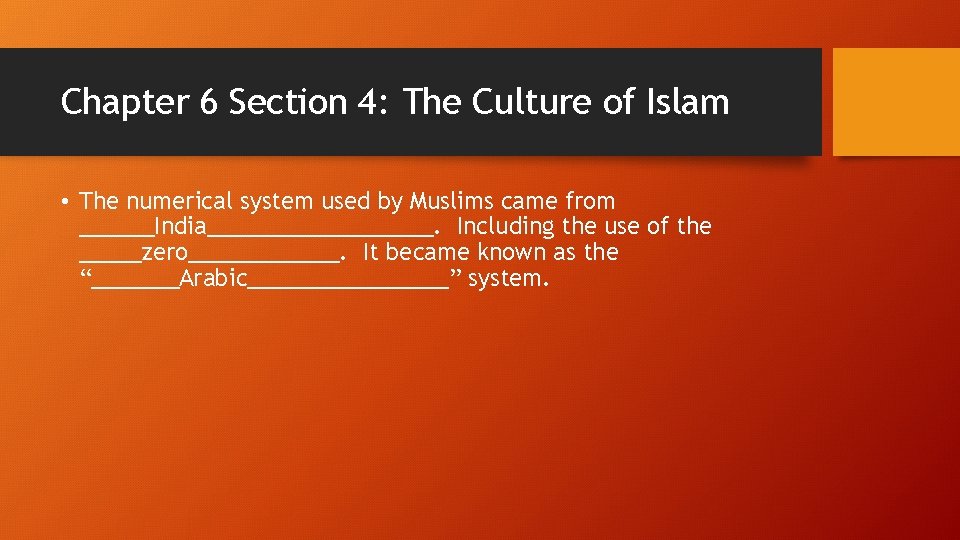
Chapter 6 Section 4: The Culture of Islam • The numerical system used by Muslims came from ______India_________. Including the use of the _____zero______. It became known as the “_______Arabic________” system.
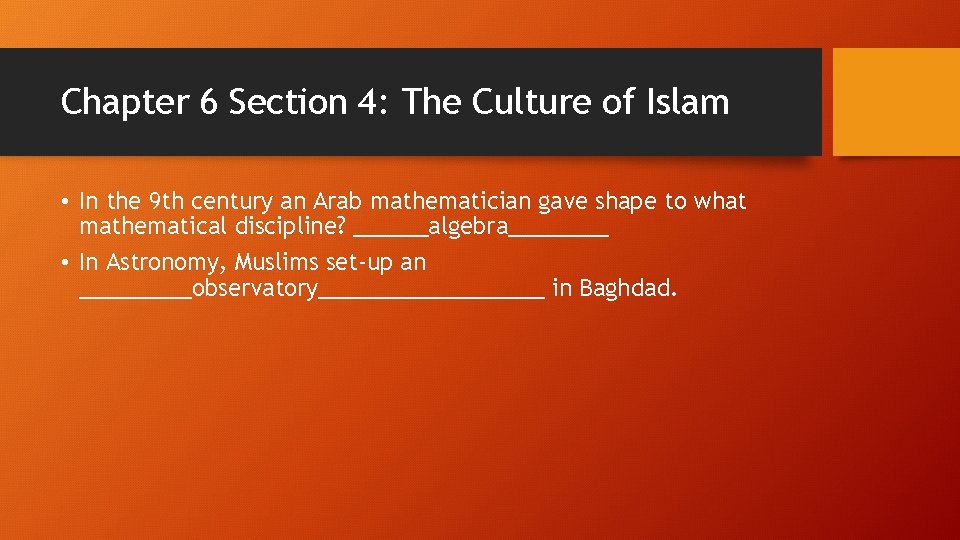
Chapter 6 Section 4: The Culture of Islam • In the 9 th century an Arab mathematician gave shape to what mathematical discipline? ______algebra____ • In Astronomy, Muslims set-up an _____observatory_________ in Baghdad.
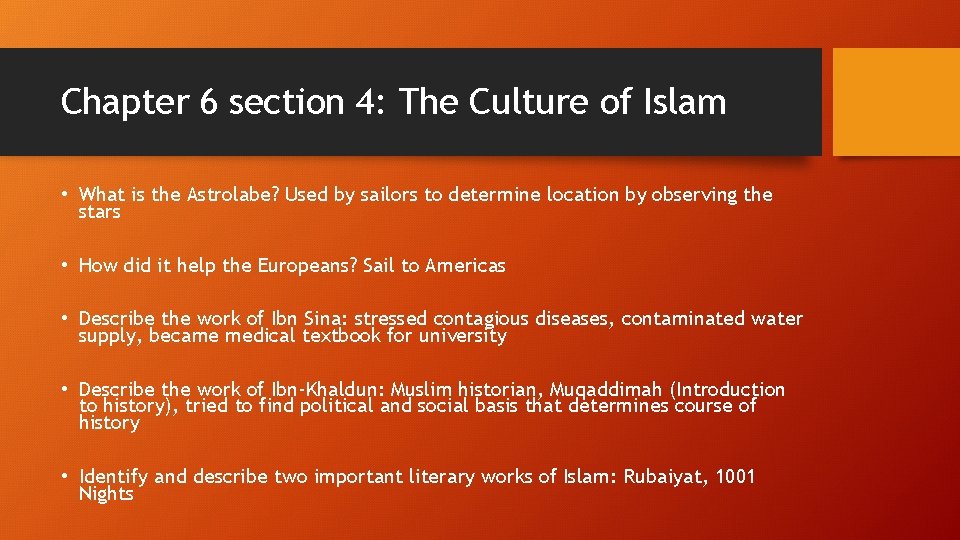
Chapter 6 section 4: The Culture of Islam • What is the Astrolabe? Used by sailors to determine location by observing the stars • How did it help the Europeans? Sail to Americas • Describe the work of Ibn Sina: stressed contagious diseases, contaminated water supply, became medical textbook for university • Describe the work of Ibn-Khaldun: Muslim historian, Muqaddimah (Introduction to history), tried to find political and social basis that determines course of history • Identify and describe two important literary works of Islam: Rubaiyat, 1001 Nights
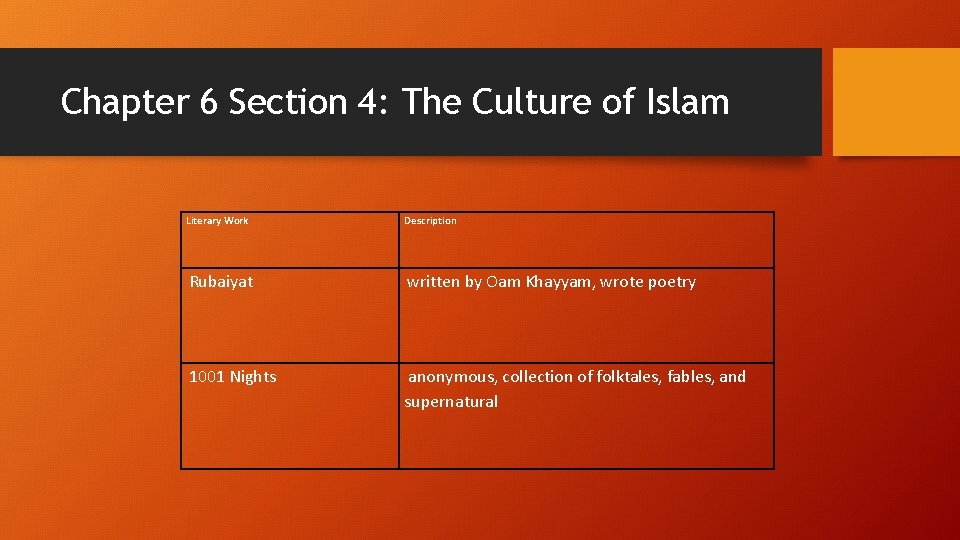
Chapter 6 Section 4: The Culture of Islam Literary Work Description Rubaiyat written by Oam Khayyam, wrote poetry 1001 Nights anonymous, collection of folktales, fables, and supernatural
Chapter 6 Section 4: The Culture of Islam • What is a Mosque? Muslim place of worship • What is a minaret? Most famous Samarra Mosque • What is a muezzin? Crier- calls the faithful to prayer 5 times a day • How many times a day are Muslims called to prayer? ___5____
Chapter 6 Section 4: The Culture of Islam • List: What was used to create Islamic art? Letters, natural plants, abstract figures • Define: Arabesques- geometric patterns repeated over and over • Explain: Why are there no pictures of Muhammad? Intimates God by taking pictures of living beings