
Chapter 6 Voters and Voter Behavior Section 1
Chapter 6: Voters and Voter Behavior Section 1
Objectives 1. Summarize the history of voting rights in the United States. 2. Identify and explain constitutional restrictions on the States’ power to set voting qualifications. Chapter 6, Section 1 Copyright © Pearson Education, Inc. Slide 2
Key Terms • • • suffrage: the right to vote franchise: a synonym for the right to vote electorate: the potential voting population disenfranchised: denied the right to vote poll tax: a fee charged before allowing someone to vote Chapter 6, Section 1 Copyright © Pearson Education, Inc. Slide 3
Introduction • How have voting rights changed over the course of American history? – Over time, voting rights have been extended to more Americans. – Voting qualifications based on property ownership, religion, race, and sex have all been eliminated through federal laws and constitutional amendments. – The age requirement for voting has been reduced. Chapter 6, Section 1 Copyright © Pearson Education, Inc. Slide 4
The Electorate • The Constitution originally gave the power to decide voter qualifications to the States. – At first most States allowed only white male property owners to vote. • Since 1789, many restrictions on voting rights have been eliminated. • At the same time, the power to decide who has the right to vote has been shifting from the States to the federal government. Chapter 6, Section 1 Copyright © Pearson Education, Inc. Slide 5
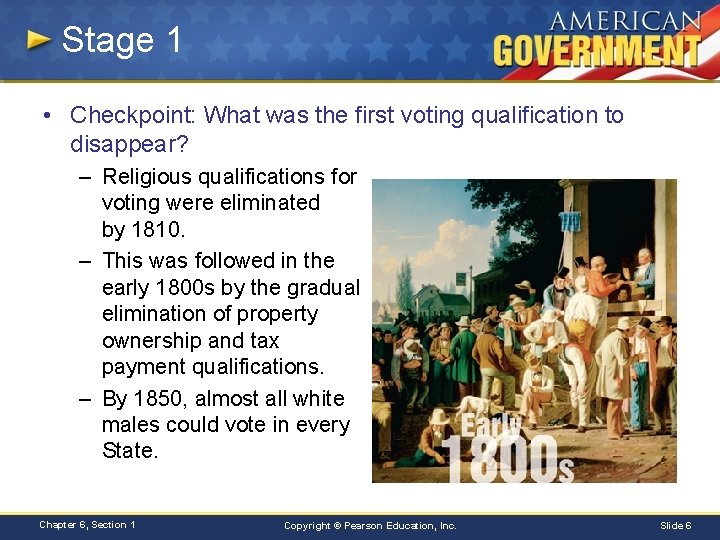
Stage 1 • Checkpoint: What was the first voting qualification to disappear? – Religious qualifications for voting were eliminated by 1810. – This was followed in the early 1800 s by the gradual elimination of property ownership and tax payment qualifications. – By 1850, almost all white males could vote in every State. Chapter 6, Section 1 Copyright © Pearson Education, Inc. Slide 6
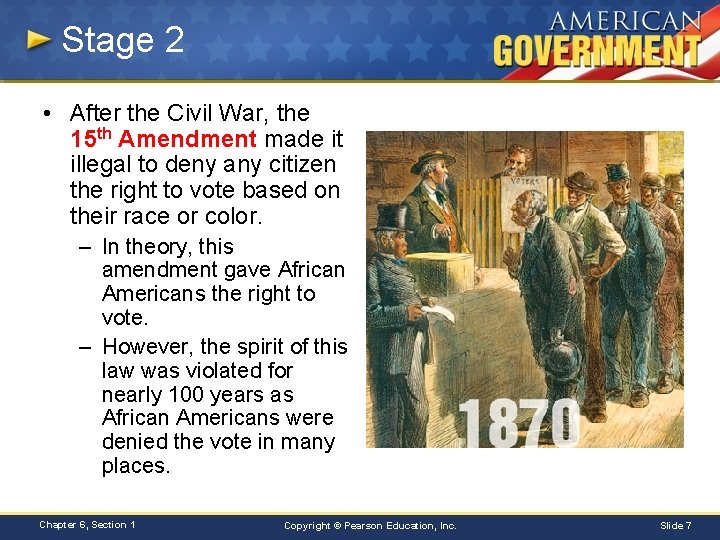
Stage 2 • After the Civil War, the 15 th Amendment made it illegal to deny any citizen the right to vote based on their race or color. – In theory, this amendment gave African Americans the right to vote. – However, the spirit of this law was violated for nearly 100 years as African Americans were denied the vote in many places. Chapter 6, Section 1 Copyright © Pearson Education, Inc. Slide 7
Stage 3 • In 1920, the ratification of the 19 th Amendment gave women the right to vote. – By 1920, more than half the States had already followed the example set by Wyoming in 1869 and given women the vote. Chapter 6, Section 1 Copyright © Pearson Education, Inc. Slide 8
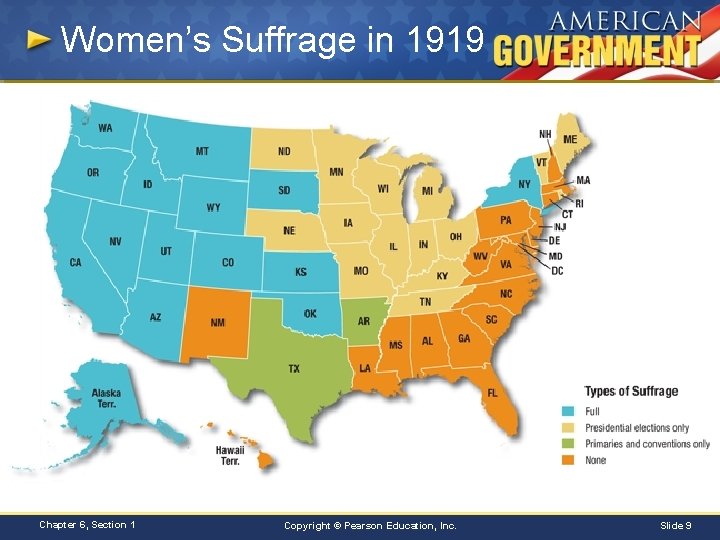
Women’s Suffrage in 1919 Chapter 6, Section 1 Copyright © Pearson Education, Inc. Slide 9
Stages 4 & 5 • During the 1960 s, the civil rights movement led to new protections for African American voting rights. – The Voting Rights Act of 1965 defended racial equality in voting. – The 24 th Amendment eliminated the poll tax in federal elections. • In 1971 the 26 th Amendment gave those 18 and older the right to vote. Chapter 6, Section 1 Copyright © Pearson Education, Inc. Slide 10
Voting Qualifications • The Constitution sets five restrictions on the ability of the States to set voter qualifications. – Anyone allowed to vote for members of their State legislature must be allowed to vote for members of Congress. – The 15 th Amendment bans the States from depriving any person of the right to vote on account of their race, color, or having once been enslaved. Chapter 6, Section 1 Copyright © Pearson Education, Inc. Slide 11
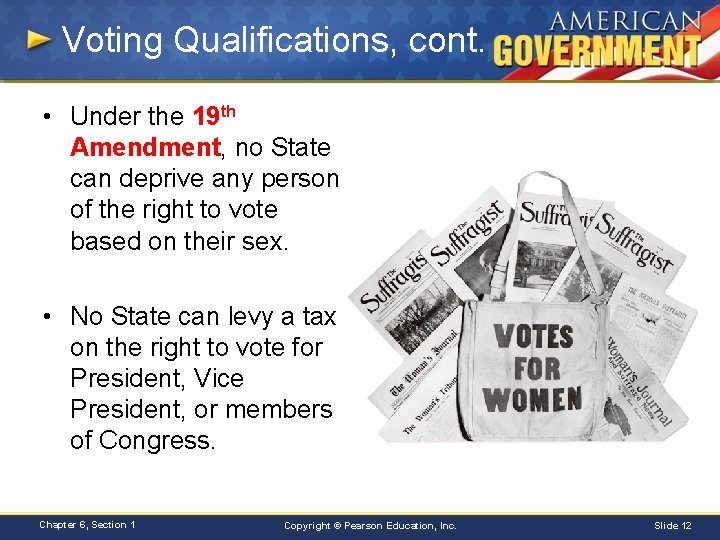
Voting Qualifications, cont. • Under the 19 th Amendment, no State can deprive any person of the right to vote based on their sex. • No State can levy a tax on the right to vote for President, Vice President, or members of Congress. Chapter 6, Section 1 Copyright © Pearson Education, Inc. Slide 12
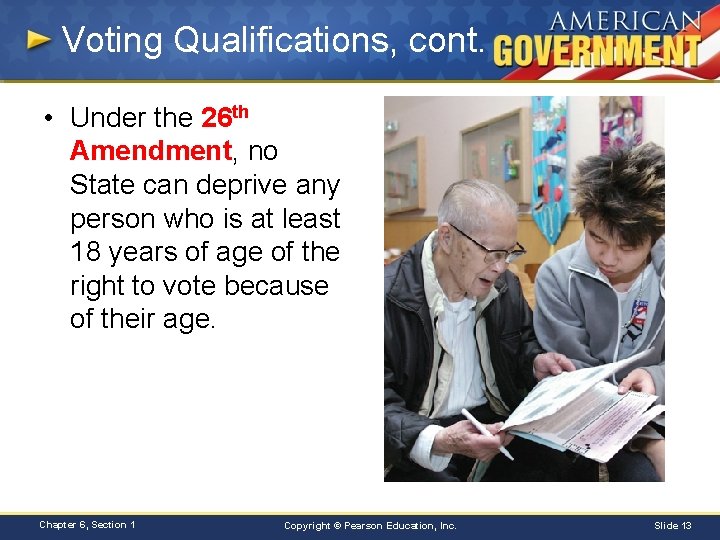
Voting Qualifications, cont. • Under the 26 th Amendment, no State can deprive any person who is at least 18 years of age of the right to vote because of their age. Chapter 6, Section 1 Copyright © Pearson Education, Inc. Slide 13
Voting Qualifications, cont. • In addition, no State can violate any other provision in the Constitution when setting its voting qualifications. – For example, a State cannot set suffrage qualifications that violate the Equal Protection Clause of the 14 th Amendment. Chapter 6, Section 1 Copyright © Pearson Education, Inc. Slide 14
Review • Now that you have learned about how voting rights have changed over the course of American history, go back and answer the Chapter Essential Question. – Why do voters act as they do? Chapter 6, Section 1 Copyright © Pearson Education, Inc. Slide 15
- Slides: 15