
Chapter 6 Vertical Integration Copyright 2006 Pearson Prentice

- Slides: 43
Chapter 6 Vertical Integration Copyright © 2006 Pearson Prentice Hall. All rights reserved. 6 -
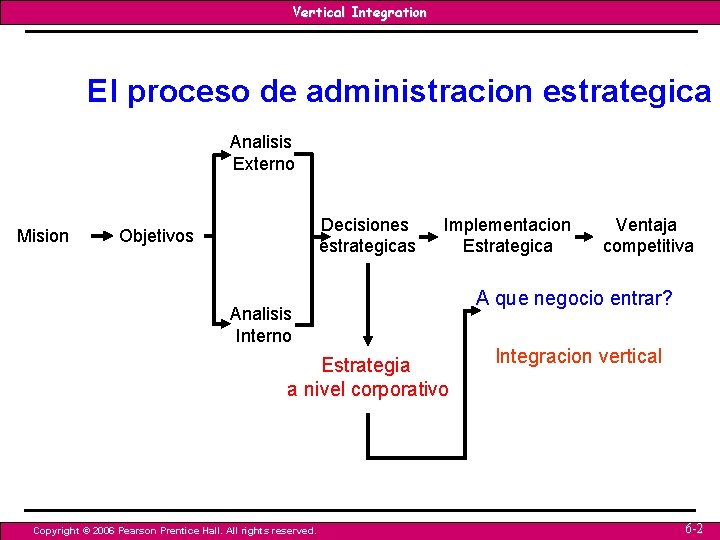
Vertical Integration El proceso de administracion estrategica Analisis Externo Mision Decisiones estrategicas Objetivos Implementacion Estrategica A que negocio entrar? Analisis Interno Estrategia a nivel corporativo Copyright © 2006 Pearson Prentice Hall. Management All rights reserved. Strategic & Competitive Ventaja competitiva Integracion vertical Advantage – Barney & Hesterly 6 -22
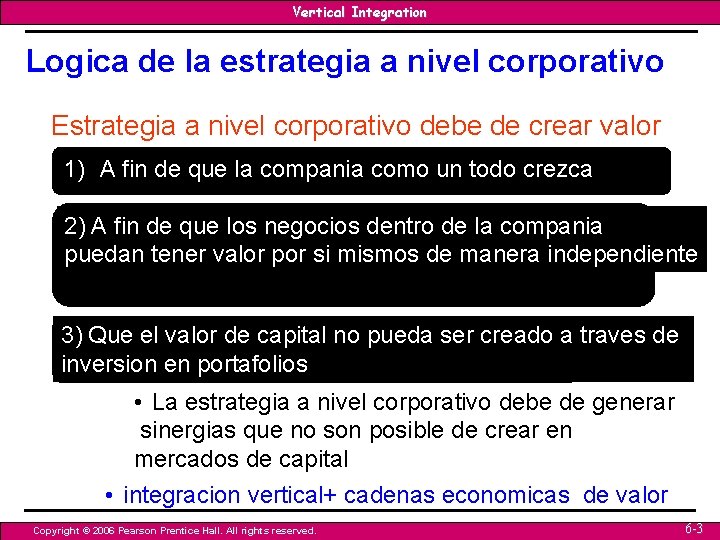
Vertical Integration Logica de la estrategia a nivel corporativo Estrategia a nivel corporativo debe de crear valor 1) A fin de que la compania como un todo crezca 2) A fin de que los negocios dentro de la compania puedan tener valor por si mismos de manera independiente 3) Que el valor de capital no pueda ser creado a traves de inversion en portafolios • La estrategia a nivel corporativo debe de generar sinergias que no son posible de crear en mercados de capital • integracion vertical+ cadenas economicas de valor Copyright © 2006 Pearson Prentice Hall. Management All rights reserved. Strategic & Competitive Advantage – Barney & Hesterly 6 -33
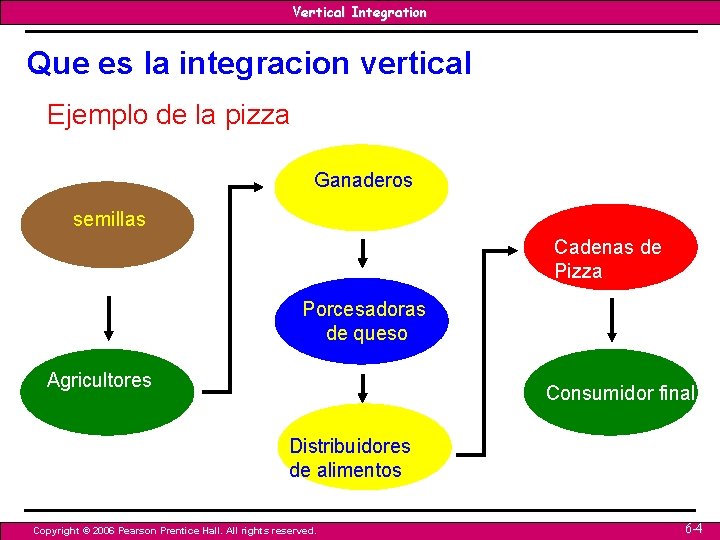
Vertical Integration Que es la integracion vertical Ejemplo de la pizza Ganaderos semillas Cadenas de Pizza Porcesadoras de queso Agricultores Consumidor final Distribuidores de alimentos Copyright © 2006 Pearson Prentice Hall. Management All rights reserved. Strategic & Competitive Advantage – Barney & Hesterly 6 -44
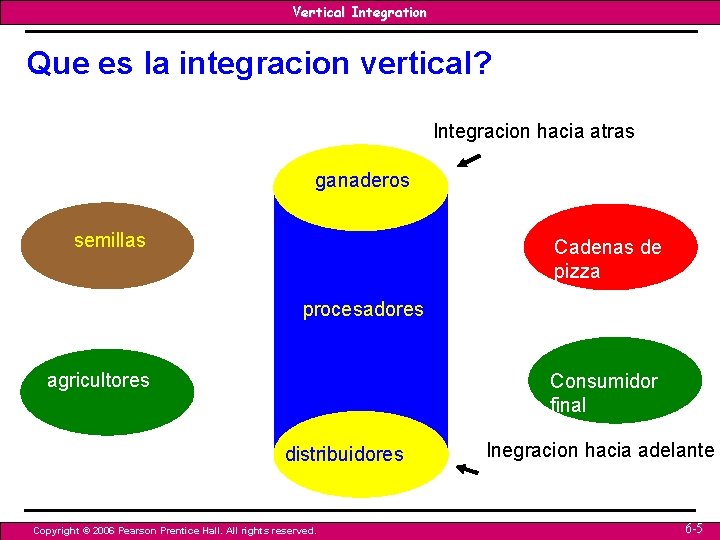
Vertical Integration Que es la integracion vertical? Integracion hacia atras ganaderos semillas Cadenas de pizza procesadores agricultores Consumidor final distribuidores Copyright © 2006 Pearson Prentice Hall. Management All rights reserved. Strategic & Competitive Inegracion hacia adelante Advantage – Barney & Hesterly 6 -55
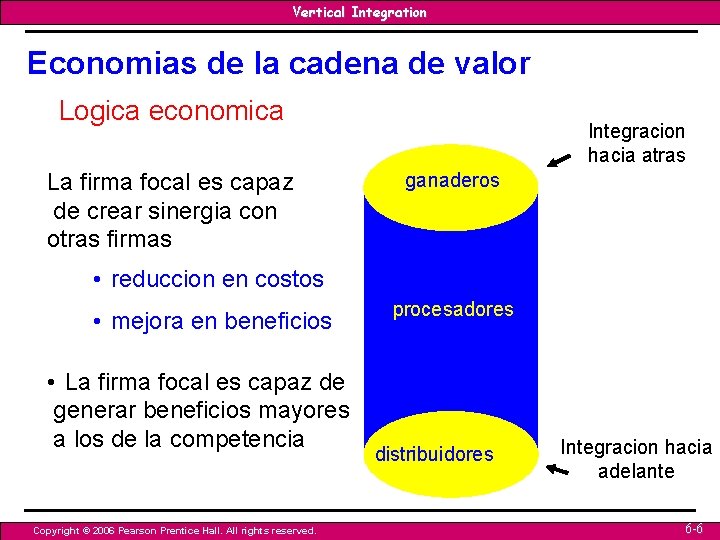
Vertical Integration Economias de la cadena de valor Logica economica La firma focal es capaz de crear sinergia con otras firmas Integracion hacia atras ganaderos • reduccion en costos • mejora en beneficios • La firma focal es capaz de generar beneficios mayores a los de la competencia Copyright © 2006 Pearson Prentice Hall. Management All rights reserved. Strategic & Competitive procesadores distribuidores Advantage – Barney & Hesterly Integracion hacia adelante 6 -66
Vertical Integration Ventaja competitiva Si la integracion vertical cumple los criterios del VRIO, entonces puede generar una ventaja competitiva Copyright © 2006 Pearson Prentice Hall. Management All rights reserved. Strategic & Competitive Advantage – Barney & Hesterly 6 -77
Vertical Integration Valor de la integracion vertical Mercado vs. intercambio economico integrado • los mercados y las formas de integracion permiten en intercambio economico • el intercambio economico debe de ser tal que permita Maximizar el valor de la firma focal • asi las firmas buscan la manera de maxmizar sus beneficios La integracion hace sentido cuando la firma focal puede generar mayor valor que aquel en el que el mercado se crea Copyright © 2006 Pearson Prentice Hall. Management All rights reserved. Strategic & Competitive Advantage – Barney & Hesterly 6 -88
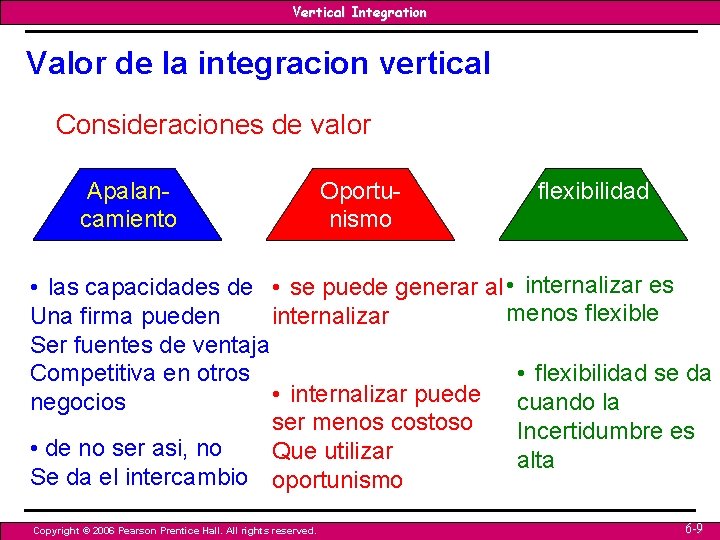
Vertical Integration Valor de la integracion vertical Consideraciones de valor Apalancamiento Oportunismo flexibilidad • las capacidades de • se puede generar al • internalizar es menos flexible Una firma pueden internalizar Ser fuentes de ventaja • flexibilidad se da Competitiva en otros • internalizar puede cuando la negocios ser menos costoso Incertidumbre es • de no ser asi, no Que utilizar alta Se da el intercambio oportunismo Copyright © 2006 Pearson Prentice Hall. Management All rights reserved. Strategic & Competitive Advantage – Barney & Hesterly 6 -99
Vertical Integration Rareza de la IV Integracion vs no integracion • la estrategia de integracion puede ser rara si integra o no lo hace pues esta NO depende la forma que la empresa tome sino quer depende en el valor generado Copyright © 2006 Pearson Prentice Hall. Management All rights reserved. Strategic & Competitive Advantage – Barney & Hesterly 6 -10 10
Vertical Integration Imitabilidad de la IV Forma vs funcion • la forma, per se, no es costosa de imitar • la funcion de valor puede ser costosa de imitar si: • la combinacion de los recursos y capacidades le da: historicidad unica Abiguedad causal Complejidad social Requerimientos de capital son limitados Copyright © 2006 Pearson Prentice Hall. Management All rights reserved. Strategic & Competitive Advantage – Barney & Hesterly 6 -11 11
Vertical Integration Imitabilidad de IV Modos de entrada • adquisicion de desarrollo interno • adquriri un proveeedor en vez de generarlos • los limites son las capacidades y recursos de las empresas • las alianzas estrategicas son un ejemplo de la IV a menos costo Copyright © 2006 Pearson Prentice Hall. Management All rights reserved. Strategic & Competitive Advantage – Barney & Hesterly 6 -12 12
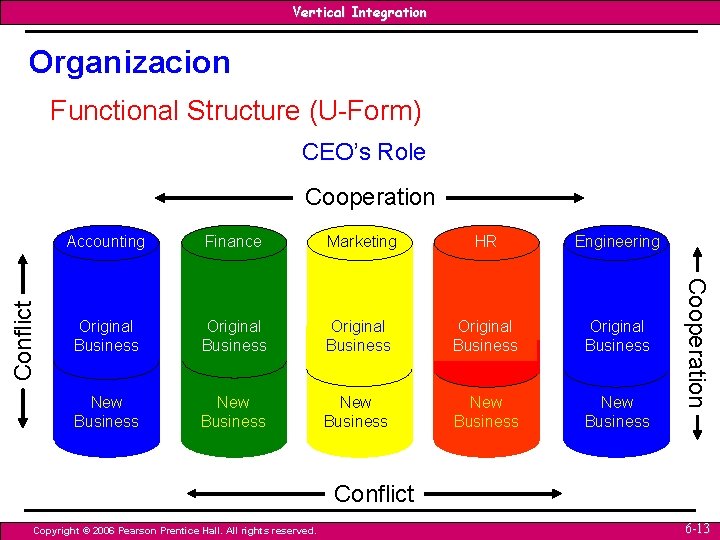
Vertical Integration Organizacion Functional Structure (U-Form) CEO’s Role Accounting Finance Marketing HR Engineering Original Business Original Business New Business New Business Cooperation Conflict Copyright © 2006 Pearson Prentice Hall. Management All rights reserved. Strategic & Competitive Advantage – Barney & Hesterly 6 -13 13
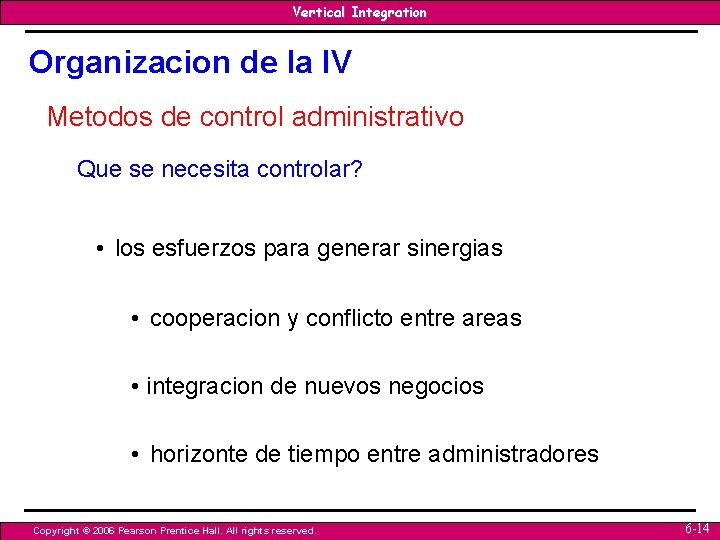
Vertical Integration Organizacion de la IV Metodos de control administrativo Que se necesita controlar? • los esfuerzos para generar sinergias • cooperacion y conflicto entre areas • integracion de nuevos negocios • horizonte de tiempo entre administradores Copyright © 2006 Pearson Prentice Hall. Management All rights reserved. Strategic & Competitive Advantage – Barney & Hesterly 6 -14 14
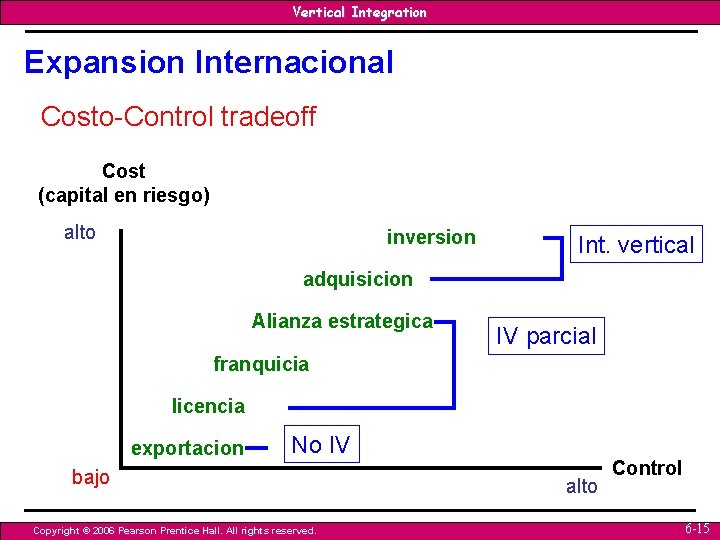
Vertical Integration Expansion Internacional Costo-Control tradeoff Cost (capital en riesgo) alto inversion Int. vertical adquisicion Alianza estrategica IV parcial franquicia licencia exportacion No IV bajo Copyright © 2006 Pearson Prentice Hall. Management All rights reserved. Strategic & Competitive alto Advantage – Barney & Hesterly Control 6 -15 15
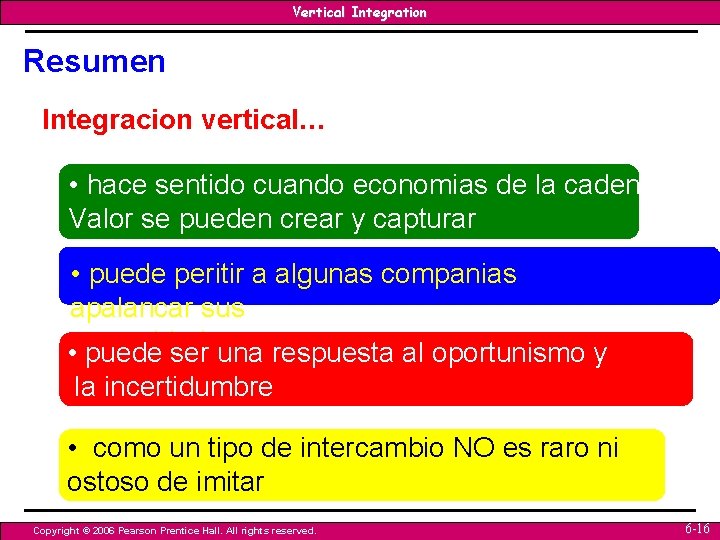
Vertical Integration Resumen Integracion vertical… • hace sentido cuando economias de la cadena de Valor se pueden crear y capturar • puede peritir a algunas companias apalancar sus • capacidades puede ser una respuesta al oportunismo y la incertidumbre • como un tipo de intercambio NO es raro ni ostoso de imitar Copyright © 2006 Pearson Prentice Hall. Management All rights reserved. Strategic & Competitive Advantage – Barney & Hesterly 6 -16 16
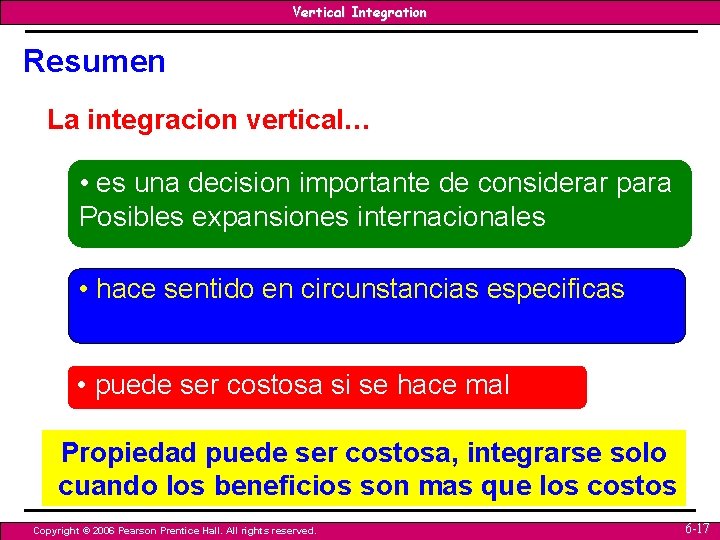
Vertical Integration Resumen La integracion vertical… • es una decision importante de considerar para Posibles expansiones internacionales • hace sentido en circunstancias especificas • puede ser costosa si se hace mal Propiedad puede ser costosa, integrarse solo cuando los beneficios son mas que los costos Copyright © 2006 Pearson Prentice Hall. Management All rights reserved. Strategic & Competitive Advantage – Barney & Hesterly 6 -17 17
Chapter 7 Vertical Integration Copyright © 2006 Pearson Prentice Hall. All rights reserved. 6 -
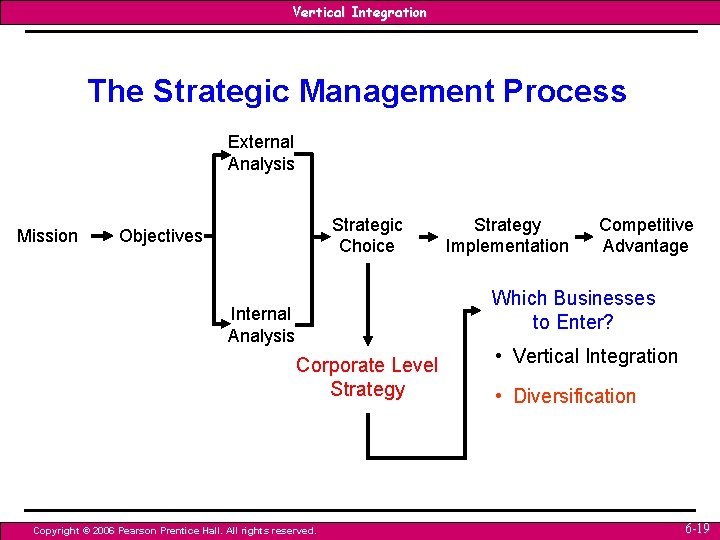
Vertical Integration The Strategic Management Process External Analysis Mission Strategic Choice Objectives Strategy Implementation Competitive Advantage Which Businesses to Enter? Internal Analysis Corporate Level Strategy Copyright © 2006 Pearson Prentice Hall. Management All rights reserved. Strategic & Competitive • Vertical Integration • Diversification Advantage – Barney & Hesterly 6 -19 19
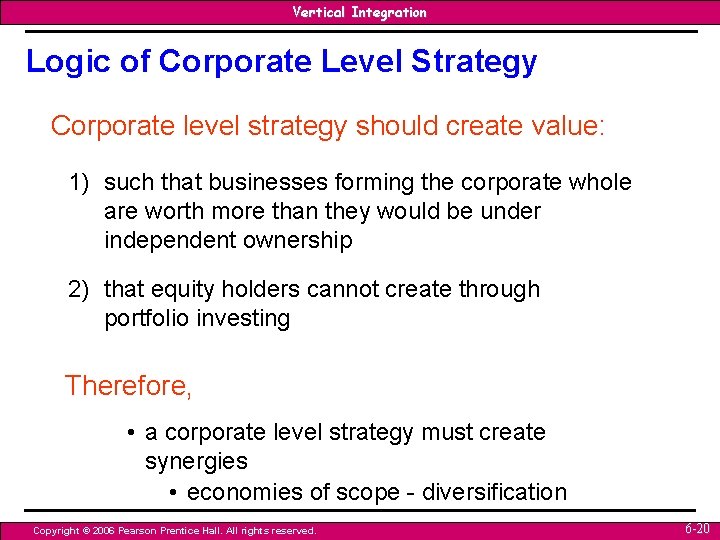
Vertical Integration Logic of Corporate Level Strategy Corporate level strategy should create value: 1) such that businesses forming the corporate whole are worth more than they would be under independent ownership 2) that equity holders cannot create through portfolio investing Therefore, • a corporate level strategy must create synergies • economies of scope - diversification Copyright © 2006 Pearson Prentice Hall. Management All rights reserved. Strategic & Competitive Advantage – Barney & Hesterly 6 -20 20
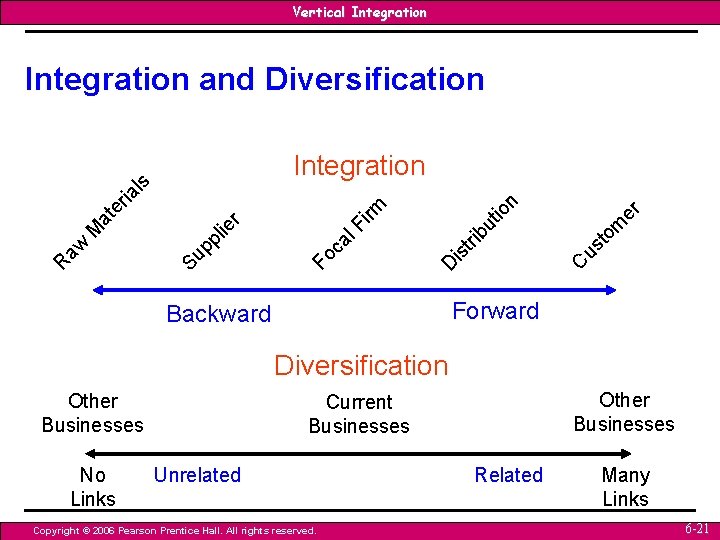
Vertical Integration and Diversification n us t C D Fo is tri ca bu om er tio irm l. F r lie pp Su R aw M at er ia ls Integration Forward Backward Diversification Other Businesses No Links Other Businesses Current Businesses Unrelated Copyright © 2006 Pearson Prentice Hall. Management All rights reserved. Strategic & Competitive Related Advantage – Barney & Hesterly Many Links 6 -21 21
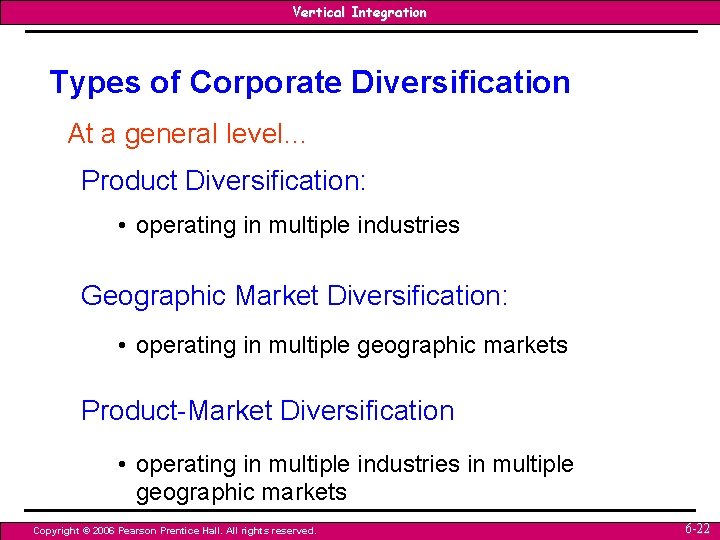
Vertical Integration Types of Corporate Diversification At a general level… Product Diversification: • operating in multiple industries Geographic Market Diversification: • operating in multiple geographic markets Product-Market Diversification • operating in multiple industries in multiple geographic markets Copyright © 2006 Pearson Prentice Hall. Management All rights reserved. Strategic & Competitive Advantage – Barney & Hesterly 6 -22 22
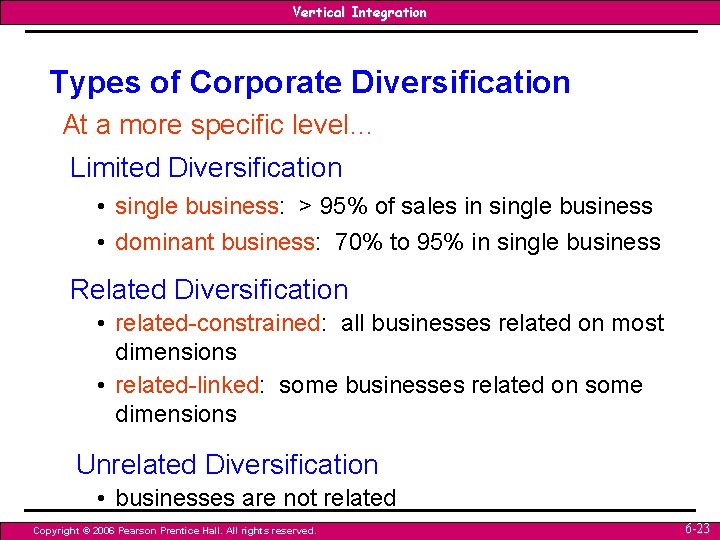
Vertical Integration Types of Corporate Diversification At a more specific level… Limited Diversification • single business: > 95% of sales in single business • dominant business: 70% to 95% in single business Related Diversification • related-constrained: all businesses related on most dimensions • related-linked: some businesses related on some dimensions Unrelated Diversification • businesses are not related Copyright © 2006 Pearson Prentice Hall. Management All rights reserved. Strategic & Competitive Advantage – Barney & Hesterly 6 -23 23
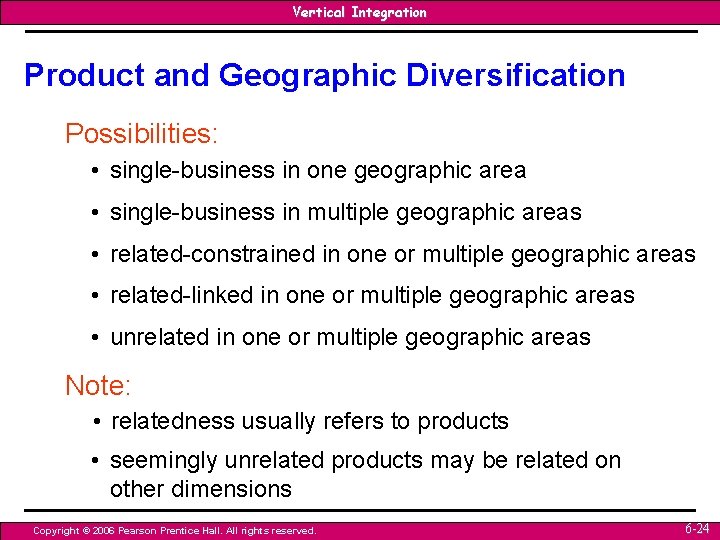
Vertical Integration Product and Geographic Diversification Possibilities: • single-business in one geographic area • single-business in multiple geographic areas • related-constrained in one or multiple geographic areas • related-linked in one or multiple geographic areas • unrelated in one or multiple geographic areas Note: • relatedness usually refers to products • seemingly unrelated products may be related on other dimensions Copyright © 2006 Pearson Prentice Hall. Management All rights reserved. Strategic & Competitive Advantage – Barney & Hesterly 6 -24 24
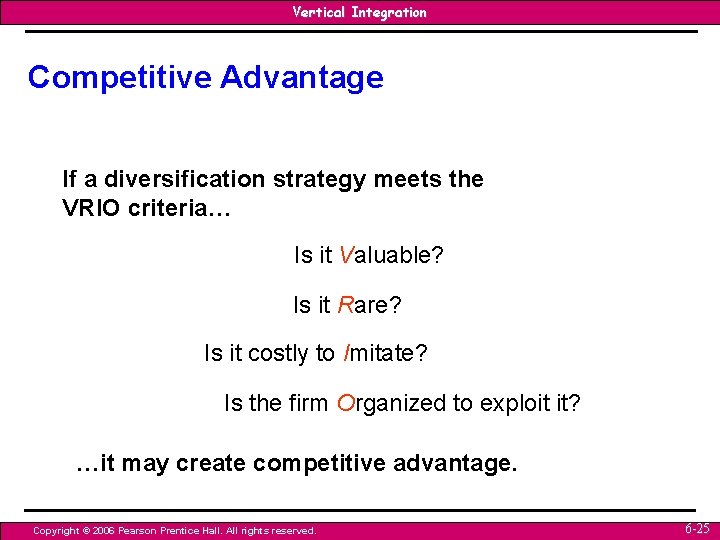
Vertical Integration Competitive Advantage If a diversification strategy meets the VRIO criteria… Is it Valuable? Is it Rare? Is it costly to Imitate? Is the firm Organized to exploit it? …it may create competitive advantage. Copyright © 2006 Pearson Prentice Hall. Management All rights reserved. Strategic & Competitive Advantage – Barney & Hesterly 6 -25 25
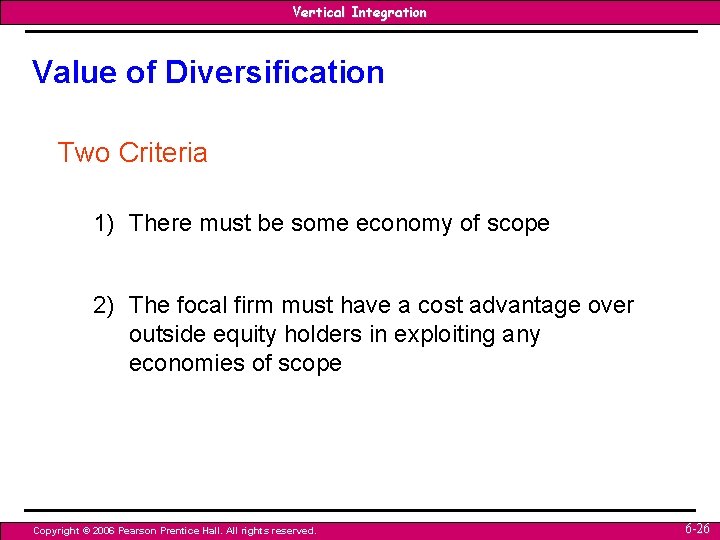
Vertical Integration Value of Diversification Two Criteria 1) There must be some economy of scope 2) The focal firm must have a cost advantage over outside equity holders in exploiting any economies of scope Copyright © 2006 Pearson Prentice Hall. Management All rights reserved. Strategic & Competitive Advantage – Barney & Hesterly 6 -26 26
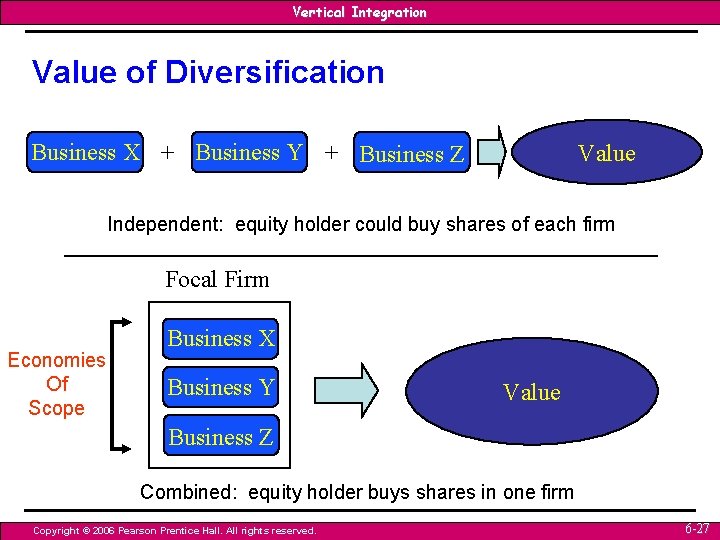
Vertical Integration Value of Diversification Business X + Business Y + Business Z Value Independent: equity holder could buy shares of each firm Focal Firm Economies Of Scope Business X Business Y Value Business Z Combined: equity holder buys shares in one firm Copyright © 2006 Pearson Prentice Hall. Management All rights reserved. Strategic & Competitive Advantage – Barney & Hesterly 6 -27 27
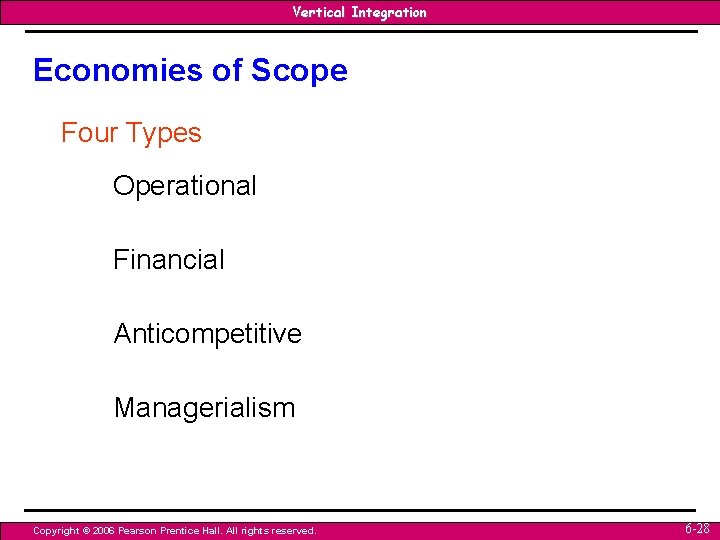
Vertical Integration Economies of Scope Four Types Operational Financial Anticompetitive Managerialism Copyright © 2006 Pearson Prentice Hall. Management All rights reserved. Strategic & Competitive Advantage – Barney & Hesterly 6 -28 28
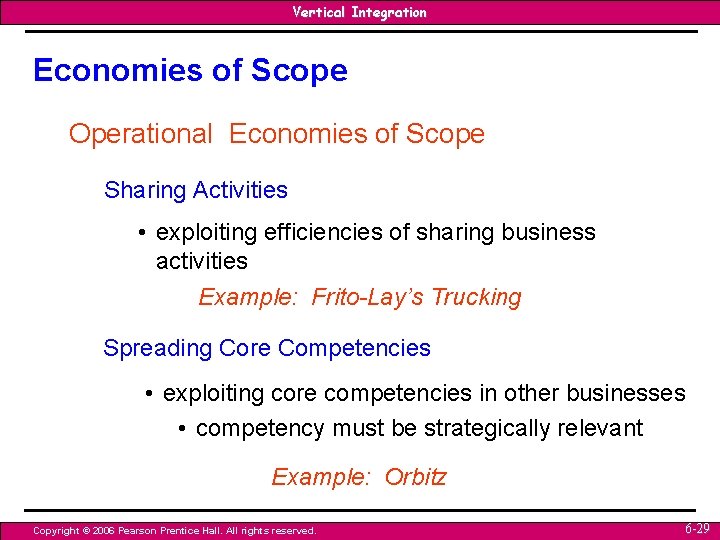
Vertical Integration Economies of Scope Operational Economies of Scope Sharing Activities • exploiting efficiencies of sharing business activities Example: Frito-Lay’s Trucking Spreading Core Competencies • exploiting core competencies in other businesses • competency must be strategically relevant Example: Orbitz Copyright © 2006 Pearson Prentice Hall. Management All rights reserved. Strategic & Competitive Advantage – Barney & Hesterly 6 -29 29
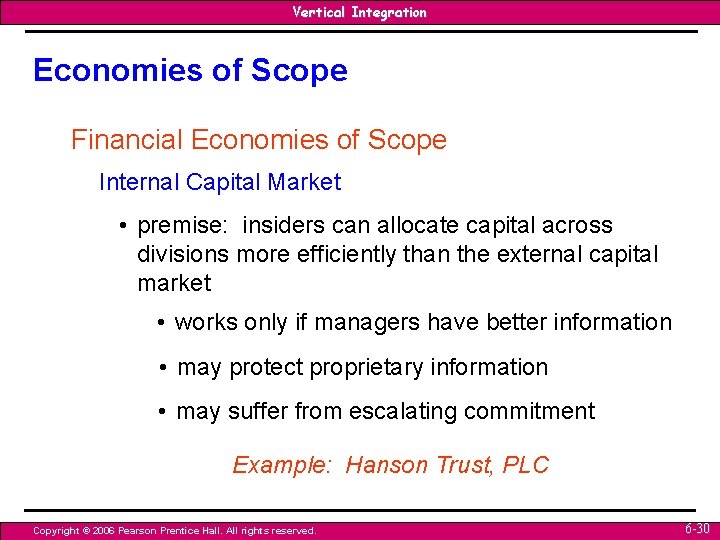
Vertical Integration Economies of Scope Financial Economies of Scope Internal Capital Market • premise: insiders can allocate capital across divisions more efficiently than the external capital market • works only if managers have better information • may protect proprietary information • may suffer from escalating commitment Example: Hanson Trust, PLC Copyright © 2006 Pearson Prentice Hall. Management All rights reserved. Strategic & Competitive Advantage – Barney & Hesterly 6 -30 30
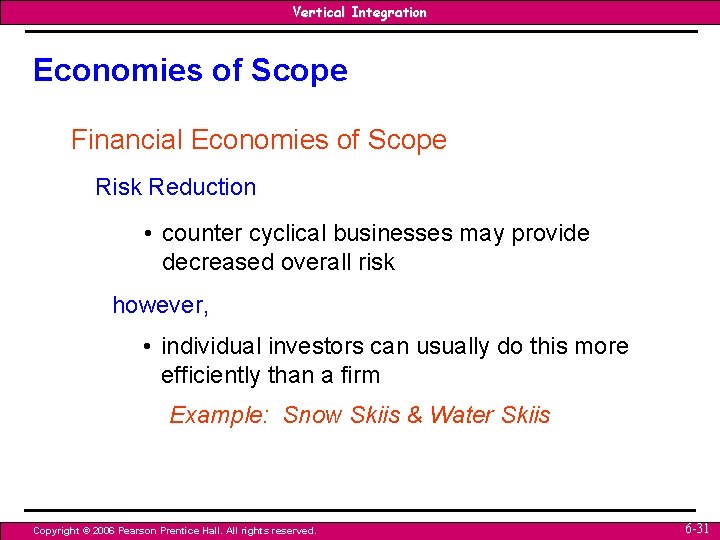
Vertical Integration Economies of Scope Financial Economies of Scope Risk Reduction • counter cyclical businesses may provide decreased overall risk however, • individual investors can usually do this more efficiently than a firm Example: Snow Skiis & Water Skiis Copyright © 2006 Pearson Prentice Hall. Management All rights reserved. Strategic & Competitive Advantage – Barney & Hesterly 6 -31 31
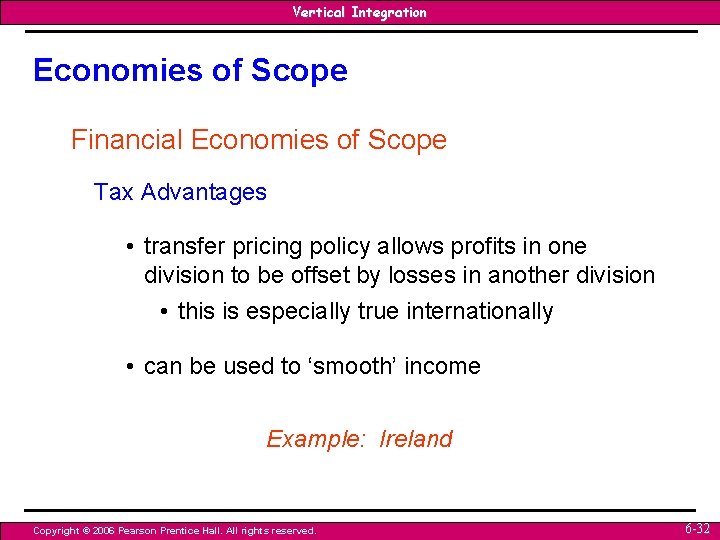
Vertical Integration Economies of Scope Financial Economies of Scope Tax Advantages • transfer pricing policy allows profits in one division to be offset by losses in another division • this is especially true internationally • can be used to ‘smooth’ income Example: Ireland Copyright © 2006 Pearson Prentice Hall. Management All rights reserved. Strategic & Competitive Advantage – Barney & Hesterly 6 -32 32
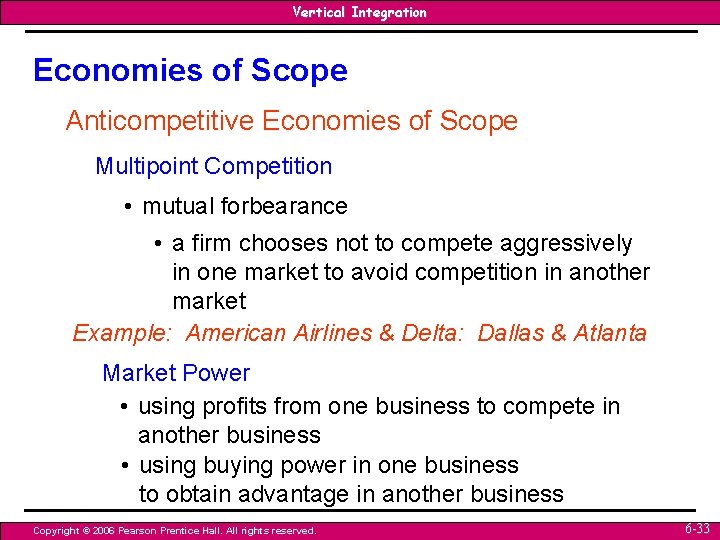
Vertical Integration Economies of Scope Anticompetitive Economies of Scope Multipoint Competition • mutual forbearance • a firm chooses not to compete aggressively in one market to avoid competition in another market Example: American Airlines & Delta: Dallas & Atlanta Market Power • using profits from one business to compete in another business • using buying power in one business to obtain advantage in another business Copyright © 2006 Pearson Prentice Hall. Management All rights reserved. Strategic & Competitive Advantage – Barney & Hesterly 6 -33 33
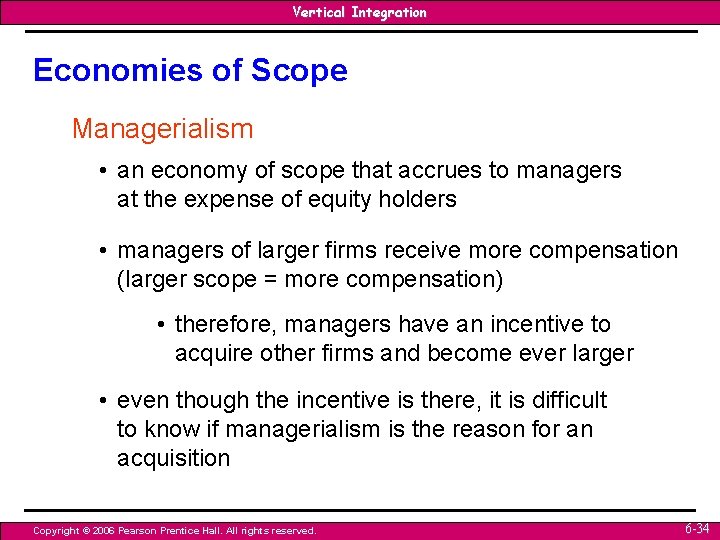
Vertical Integration Economies of Scope Managerialism • an economy of scope that accrues to managers at the expense of equity holders • managers of larger firms receive more compensation (larger scope = more compensation) • therefore, managers have an incentive to acquire other firms and become ever larger • even though the incentive is there, it is difficult to know if managerialism is the reason for an acquisition Copyright © 2006 Pearson Prentice Hall. Management All rights reserved. Strategic & Competitive Advantage – Barney & Hesterly 6 -34 34
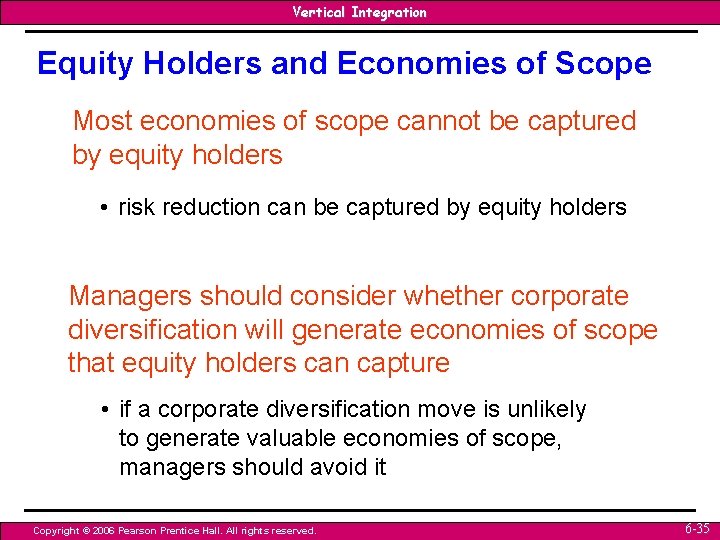
Vertical Integration Equity Holders and Economies of Scope Most economies of scope cannot be captured by equity holders • risk reduction can be captured by equity holders Managers should consider whether corporate diversification will generate economies of scope that equity holders can capture • if a corporate diversification move is unlikely to generate valuable economies of scope, managers should avoid it Copyright © 2006 Pearson Prentice Hall. Management All rights reserved. Strategic & Competitive Advantage – Barney & Hesterly 6 -35 35
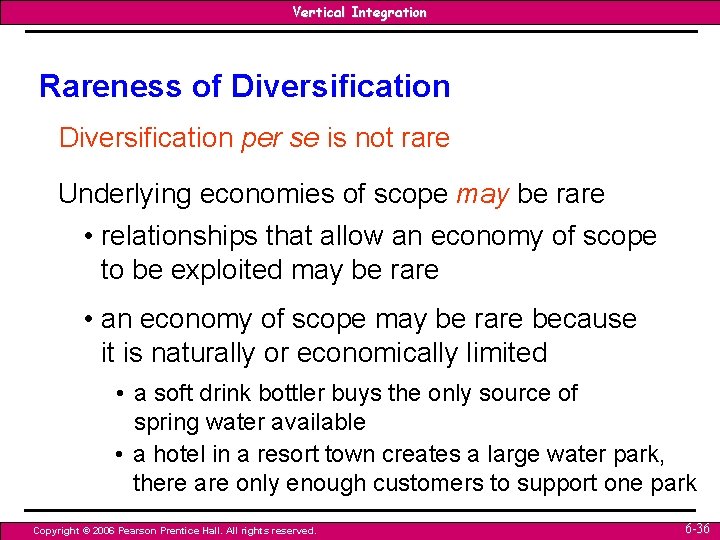
Vertical Integration Rareness of Diversification per se is not rare Underlying economies of scope may be rare • relationships that allow an economy of scope to be exploited may be rare • an economy of scope may be rare because it is naturally or economically limited • a soft drink bottler buys the only source of spring water available • a hotel in a resort town creates a large water park, there are only enough customers to support one park Copyright © 2006 Pearson Prentice Hall. Management All rights reserved. Strategic & Competitive Advantage – Barney & Hesterly 6 -36 36
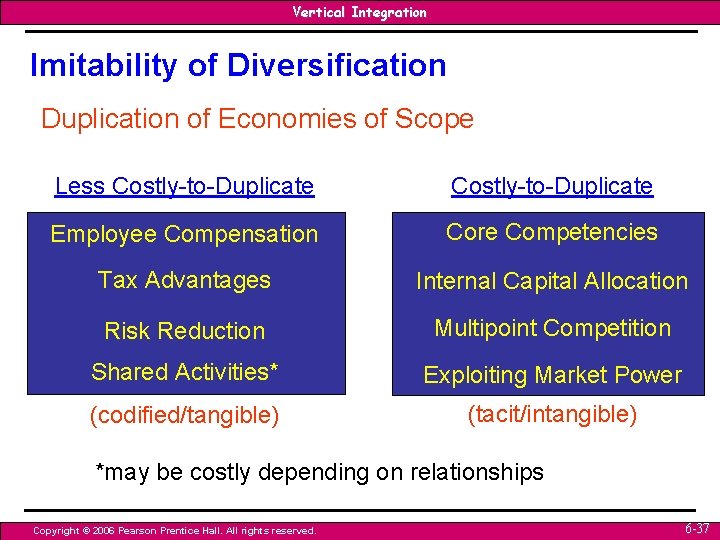
Vertical Integration Imitability of Diversification Duplication of Economies of Scope Less Costly-to-Duplicate Employee Compensation Core Competencies Tax Advantages Internal Capital Allocation Risk Reduction Multipoint Competition Shared Activities* Exploiting Market Power (codified/tangible) (tacit/intangible) *may be costly depending on relationships Copyright © 2006 Pearson Prentice Hall. Management All rights reserved. Strategic & Competitive Advantage – Barney & Hesterly 6 -37 37
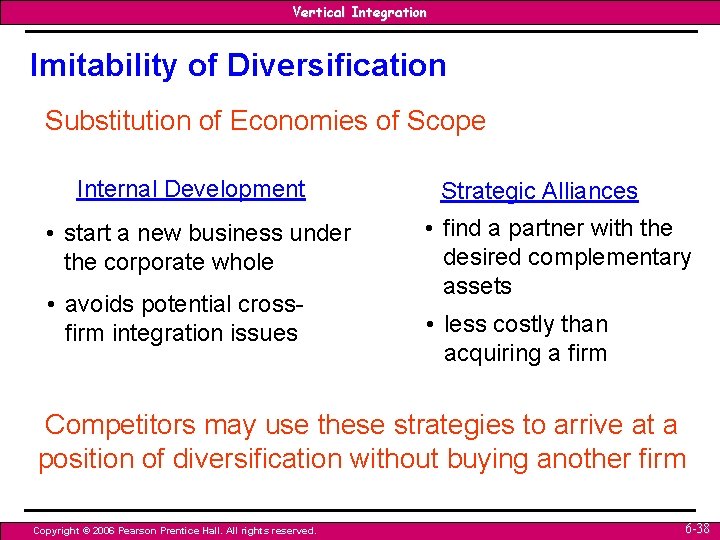
Vertical Integration Imitability of Diversification Substitution of Economies of Scope Internal Development • start a new business under the corporate whole • avoids potential crossfirm integration issues Strategic Alliances • find a partner with the desired complementary assets • less costly than acquiring a firm Competitors may use these strategies to arrive at a position of diversification without buying another firm Copyright © 2006 Pearson Prentice Hall. Management All rights reserved. Strategic & Competitive Advantage – Barney & Hesterly 6 -38 38
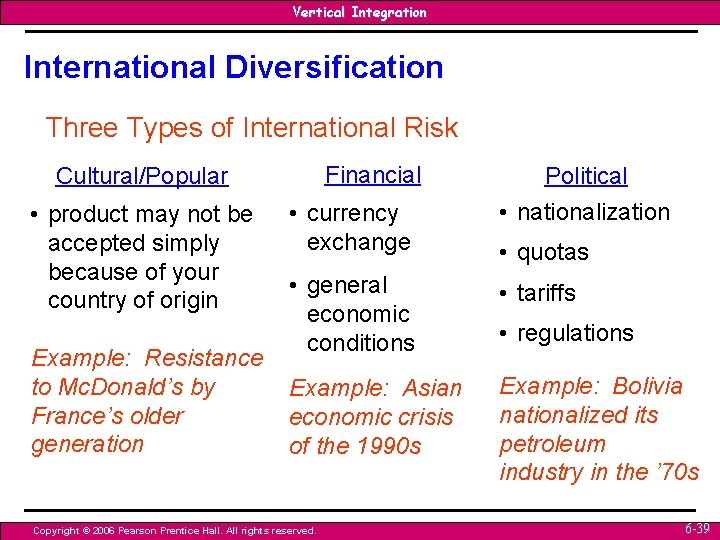
Vertical Integration International Diversification Three Types of International Risk Cultural/Popular • product may not be accepted simply because of your country of origin Example: Resistance to Mc. Donald’s by France’s older generation Financial Political • currency exchange • nationalization • general economic conditions • tariffs Example: Asian economic crisis of the 1990 s Example: Bolivia nationalized its petroleum industry in the ’ 70 s Copyright © 2006 Pearson Prentice Hall. Management All rights reserved. Strategic & Competitive • quotas • regulations Advantage – Barney & Hesterly 6 -39 39
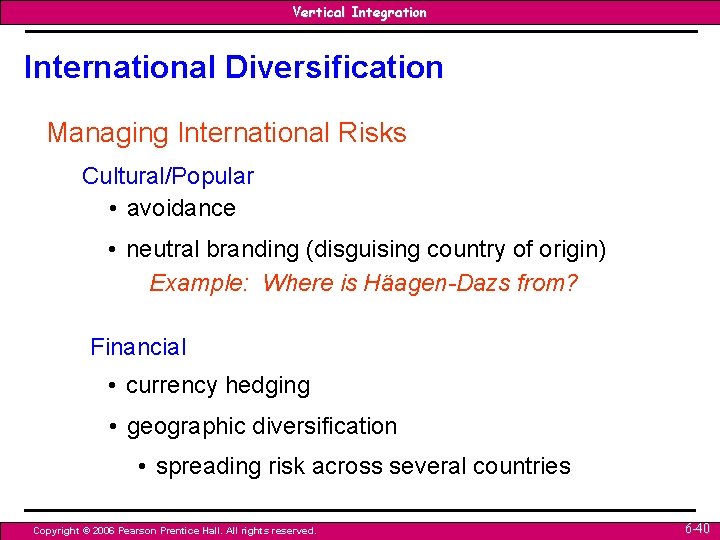
Vertical Integration International Diversification Managing International Risks Cultural/Popular • avoidance • neutral branding (disguising country of origin) Example: Where is Häagen-Dazs from? Financial • currency hedging • geographic diversification • spreading risk across several countries Copyright © 2006 Pearson Prentice Hall. Management All rights reserved. Strategic & Competitive Advantage – Barney & Hesterly 6 -40 40
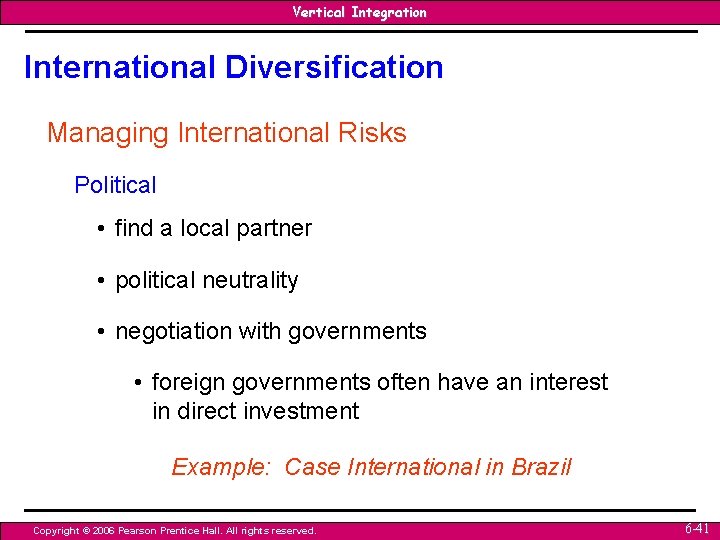
Vertical Integration International Diversification Managing International Risks Political • find a local partner • political neutrality • negotiation with governments • foreign governments often have an interest in direct investment Example: Case International in Brazil Copyright © 2006 Pearson Prentice Hall. Management All rights reserved. Strategic & Competitive Advantage – Barney & Hesterly 6 -41 41
Vertical Integration Summary Corporate Strategy: In what businesses should the firm operate? • an understanding of diversification helps managers answer that question Two Criteria: 1) economies of scope must exist 2) must create value that outside equity holders cannot create on their own Copyright © 2006 Pearson Prentice Hall. Management All rights reserved. Strategic & Competitive Advantage – Barney & Hesterly 6 -42 42
Vertical Integration Summary Economies of Scope • a case of synergy—combined activities generate greater value than independent activities • may generate competitive advantage if they meet the VRIO criteria Firms should pursue diversification only if careful analysis shows that competitive advantage is likely! Copyright © 2006 Pearson Prentice Hall. Management All rights reserved. Strategic & Competitive Advantage – Barney & Hesterly 6 -43 43