
Chapter 6 Values Ethics and Advocacy Copyright 2011







- Slides: 34
Chapter 6 Values, Ethics, and Advocacy Copyright © 2011 Wolters Kluwer Health | Lippincott Williams & Wilkins
Values • VALUE - A belief about the worth of something, about what matters. Can act as a guide to one’s behavior. • VALUE SYSTEM – Organization of values; Leads to personal code of conduct • Nurses work effectively with patients when they are sensitive to how a patient values and their own values influence nurse-patient interactions. • Values are formed during a lifetime from information from the environment, family, and culture. Copyright © 2015 Wolters Kluwer • All Rights Reserved
Common Modes of Value Transmission • Modeling – High and low value by observing others • Moralizing – Taught a complete value system • Example school or chruch Copyright © 2015 Wolters Kluwer • All Rights Reserved
Common Modes of Value Transmission • Laissez-faire – Own their own to discover value system • Rewarding and punishing – If same as parents then rewarded, punished if different • Responsible choice – Encouraged to explore weighing the consequences Copyright © 2015 Wolters Kluwer • All Rights Reserved
Values Clarification • People come to understand their own values and value system. • Helps the patient to discover through feelings and analysis of behavior what choices to make • Motivates the behavior of patients • Helps nurses to teach and counsel patients Copyright © 2015 Wolters Kluwer • All Rights Reserved
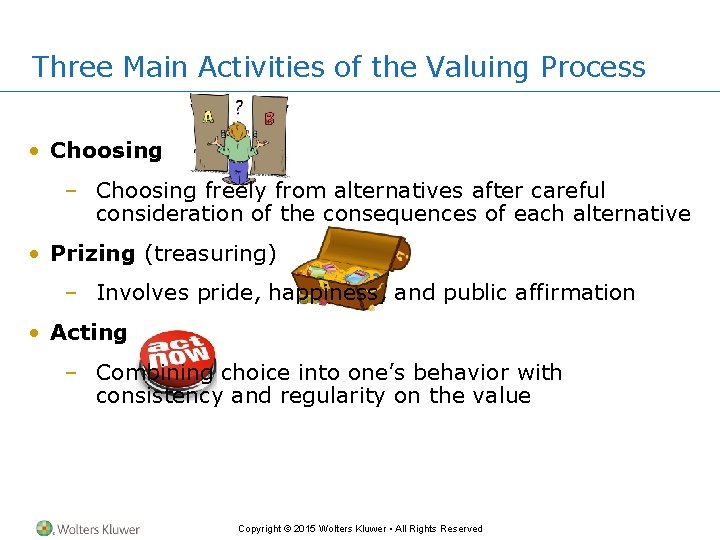
Three Main Activities of the Valuing Process • Choosing – Choosing freely from alternatives after careful consideration of the consequences of each alternative • Prizing (treasuring) – Involves pride, happiness, and public affirmation • Acting – Combining choice into one’s behavior with consistency and regularity on the value Copyright © 2015 Wolters Kluwer • All Rights Reserved
Three Main Activities of the Valuing Process Think of when you make a big purchase of value… • Choosing – First you must choose among the selection available • Prizing (treasuring) – Once you choose, you prize the item you have chosen, deciding it is best for you • Acting – Because you prize the item, you act on purchasing it. Copyright © 2015 Wolters Kluwer • All Rights Reserved
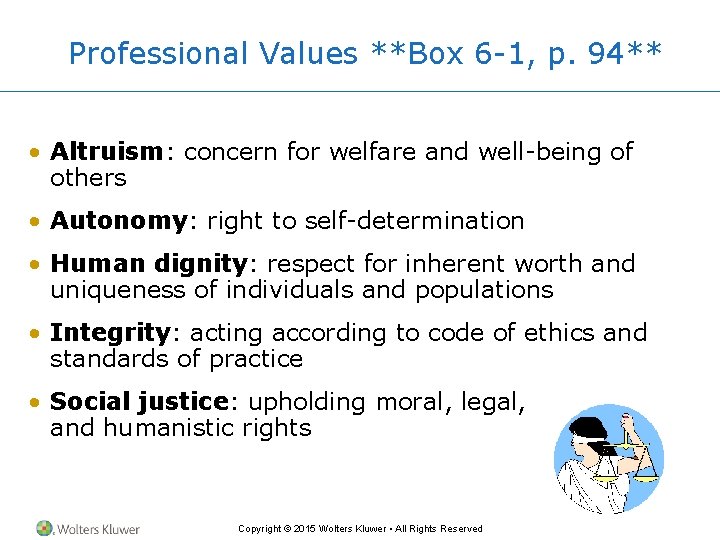
Professional Values **Box 6 -1, p. 94** • Altruism: concern for welfare and well-being of others • Autonomy: right to self-determination • Human dignity: respect for inherent worth and uniqueness of individuals and populations • Integrity: acting according to code of ethics and standards of practice • Social justice: upholding moral, legal, and humanistic rights Copyright © 2015 Wolters Kluwer • All Rights Reserved
Ethics • Inquiry into right and wrong conduct, virtue and vice, good and evil as they relate to conduct and human flourishing. • It is a study of conduct and character. • Forms a code of professional conduct. • Begins in childhood and develops gradually. • Morals – Personal or communal standards of right and wrong Copyright © 2015 Wolters Kluwer • All Rights Reserved
Types of Ethics • Bioethics – Encompasses a number of fields of “life sciences” • Nursing ethics – A subset of bioethics – Formal study of ethical issues that arise in the practice of nursing – Analysis used by nurses to make ethical judgments • Feminist ethics – Critiques existing patterns of oppression and domination in society especially affecting women and the poor Copyright © 2015 Wolters Kluwer • All Rights Reserved
Two Categories of Action-Guiding Theories • Utilitarian: The rightness or wrongness of an action depends on the consequences of the action. • Deontologic: An action is right or wrong independent of its consequences. – Example Abortion • Utilitarian best consequences for all • Deontologic wrong based on an innocent life Copyright © 2015 Wolters Kluwer • All Rights Reserved
Principle-Based Approach to Bioethics • Autonomy: Respect rights of patients to make health care decisions. • Nonmaleficence: Avoid causing harm. • Beneficence: Benefit the patient. • Justice: Give each his or her due and act fairly. • Fidelity: Keep promises. • Veracity, accountability, privacy, confidentiality ***Table 6 -1*** ***Know This*** Copyright © 2015 Wolters Kluwer • All Rights Reserved
Characteristics of the Care-Based Approach to Bioethics • Centrality of the caring relationship • Promotion of dignity and respect for patients as people • Attention to the particulars of individual patients • Cultivation of responsiveness to others • Redefinition of fundamental moral skills to include virtues Copyright © 2015 Wolters Kluwer • All Rights Reserved
Ethical Conduct • Practice based on professional standards of ethical conduct as well as professional values • Nurses should: – Cultivate the virtues of nursing – Understand ethical theories that dictate and justify professional conduct – Be familiar with codes of ethics for nurses and standards for professional nursing conduct Copyright © 2015 Wolters Kluwer • All Rights Reserved
Nursing Code of Ethics • A set of principles that reflect the primary goals, values, and obligations of the profession. • Must be embraced as part of what it means to be a nurse – More than adhering to the moral norms of the profession. Copyright © 2015 Wolters Kluwer • All Rights Reserved
Scope of Nursing Ethics Unless separately referenced, all content comes from ANA’s Code of Ethics for Nurses with Interpretive Statements, 2015 (“the Code”) OR Fowler, M. D. M. (2015). Guide to the code of ethics for nurses: Development, application, and interpretation (2 nd Ed. ). Silver Spring, MD: American Nurses Association. *All images are public domain under the Creative Commons license and were retrieved from http: //pixabay. com/en/. The question mark icon throughout indicates a discussion point or question to engage in dialogue. 16
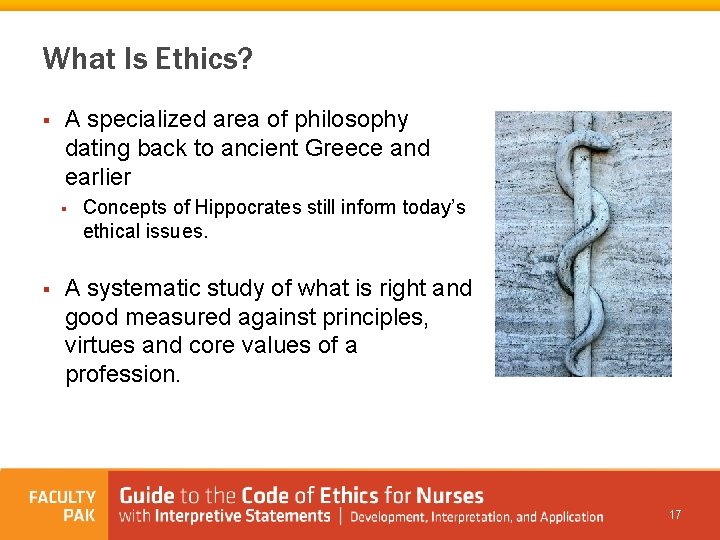
What Is Ethics? § A specialized area of philosophy dating back to ancient Greece and earlier § § Concepts of Hippocrates still inform today’s ethical issues. A systematic study of what is right and good measured against principles, virtues and core values of a profession. 17
Scope of Nursing Ethics Deals with: § Character (what sort of person one ought to be) § Conduct (how one should act) Deals with duties and obligations of nurses to: § Patients § Other health professionals § The profession § The wider public § Global humanity 18
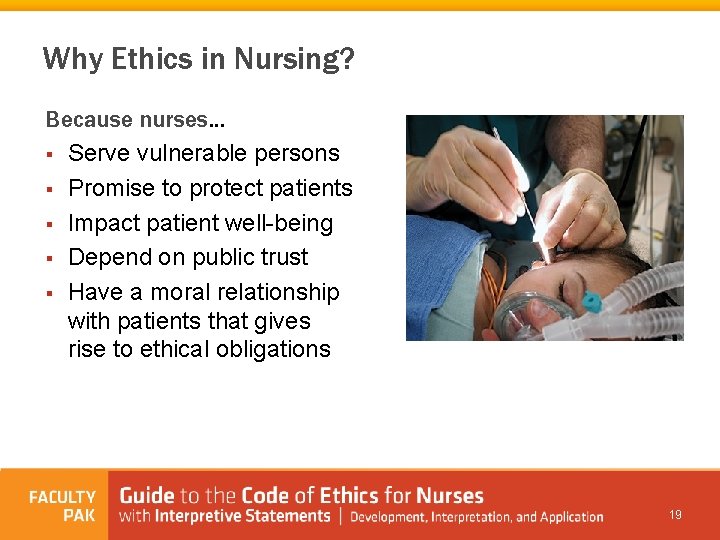
Why Ethics in Nursing? Because nurses… § Serve vulnerable persons § Promise to protect patients § Impact patient well-being § Depend on public trust § Have a moral relationship with patients that gives rise to ethical obligations 19
Personal Values and Nursing § § Morality comprises personal values, character and conduct. Those entering nursing bring moral values stemming from: § § § Religion, culture, family, education, life experience Embedded moral values are a starting point for ethical behavior and personal integrity. As nursing core values are learned and practiced, they are integrated with personal values to create a nursing moral identity. 20
Purposes of the Code of Ethics for Nurses • It is a succinct statement of the ethical obligations and duties of every nurse. • It is the profession’s nonnegotiable ethical standard. • It is an expression of nursing’s own understanding of its commitment to society. Copyright © 2015 Wolters Kluwer • All Rights Reserved
ICN Guidelines to Achieve Purposes of Code of Ethics • Study the standards under each element of the code. • Reflect on what each standard means to you. • Discuss the code with coworkers and others. • Use a specific example from experience to identify ethical dilemmas and standards of conduct in the code. • Work in groups to clarify ethical decision making, and reach consensus on standards or ethical conduct. • Collaborate with other professionals to apply standards in practice, education, management, and research. Copyright © 2015 Wolters Kluwer • All Rights Reserved
Measurement Criteria for Standard 7 (ANA Standards)/The Registered Nurse: • Uses Code of Ethics for Nurses with Interpretive Statements to guide practice • Delivers care in a manner that preserves and protects health care consumer autonomy, dignity, rights, values, and beliefs • Recognizes the centrality of the health care consumer and family as core members of the health care team • Upholds health care consumer confidentiality within legal and regulatory parameters • Assists health care consumers in self-determination and informed decision making Copyright © 2015 Wolters Kluwer • All Rights Reserved
Measurement Criteria for Standard 7 (ANA Standards) (cont. )/The Registered Nurse: • Maintains a therapeutic and professional health care consumer–nurse relationship within boundaries. • Contributes to resolving ethical issues involving health care consumers, colleagues, community groups, systems, and other stakeholders. • Takes action regarding illegal, unethical, or inappropriate behavior that can endanger or jeopardize the best interests of the health care consumer or situation. • Speaks up when appropriate to question practice when necessary for safety and quality improvement. • Advocates for equitable health care consumer care. Copyright © 2015 Wolters Kluwer • All Rights Reserved
7 Basic Tenets of Bill of Rights for RNs/Registered Nurses Must Be Able to: • Practice in a manner that fulfills obligations to society and to those who receive nursing care • Practice in environments that allow them to act in accordance with professional standards and legally authorized scopes of practice • Work in an environment that supports and facilitates ethical practice, in accordance with the Code of Ethics for Nurses • Freely and openly advocate for themselves and their patients, without fear of retribution Copyright © 2015 Wolters Kluwer • All Rights Reserved
7 Basic Tenets of Bill of Rights for RNs/Registered Nurses Must Be Able to (cont. ): • Receive fair compensation for their work, consistent with their knowledge, experience, and professional responsibilities • Practice in a work environment that is safe for themselves and their patients • Negotiate the conditions of their employment, either as individuals or collectively, in all practice settings Copyright © 2015 Wolters Kluwer • All Rights Reserved
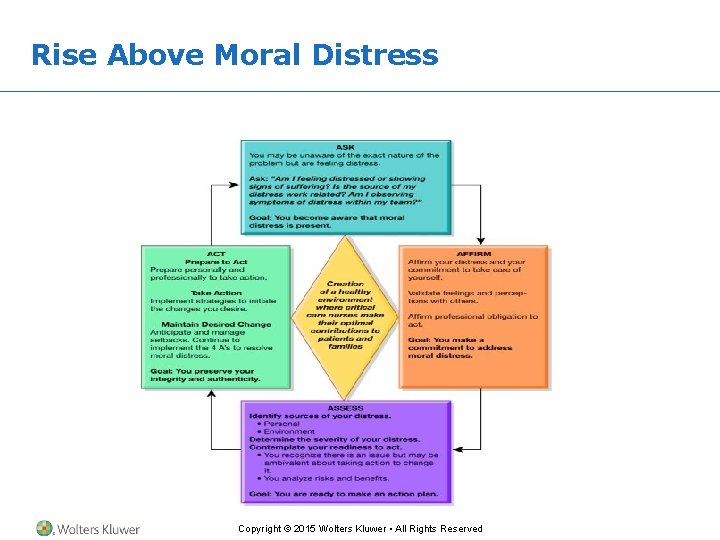
Ethical Experience and Decision Making/Ethical Problems • Ethical dilemma: Two (or more) clear moral principles apply but support mutually inconsistent courses of action. • Ethical distress: Occurs when the nurse knows the right thing to do but either personal or institutional factors make it difficult to follow the correct course of action. Copyright © 2015 Wolters Kluwer • All Rights Reserved
Rise Above Moral Distress Copyright © 2015 Wolters Kluwer • All Rights Reserved
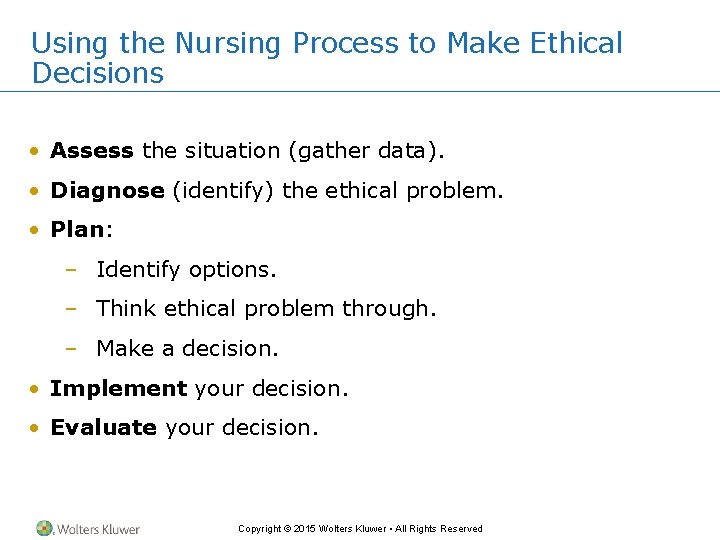
Using the Nursing Process to Make Ethical Decisions • Assess the situation (gather data). • Diagnose (identify) the ethical problem. • Plan: – Identify options. – Think ethical problem through. – Make a decision. • Implement your decision. • Evaluate your decision. Copyright © 2015 Wolters Kluwer • All Rights Reserved
Examples of Ethical Problems (read p. 104 -105) • Paternalism • Deception • Privacy • Confidentiality • Allocation of scarce nursing resources • Valid consent or refusal • Conflicts concerning new technologies Copyright © 2015 Wolters Kluwer • All Rights Reserved
Examples of Ethical Problems (cont. ) • Unprofessional, incompetent, unethical, or illegal physician practice • Unprofessional, incompetent, unethical, or illegal nurse practice • Short staffing and whistle-blowing • Beginning-of-life issues • End-of-life issues Copyright © 2015 Wolters Kluwer • All Rights Reserved
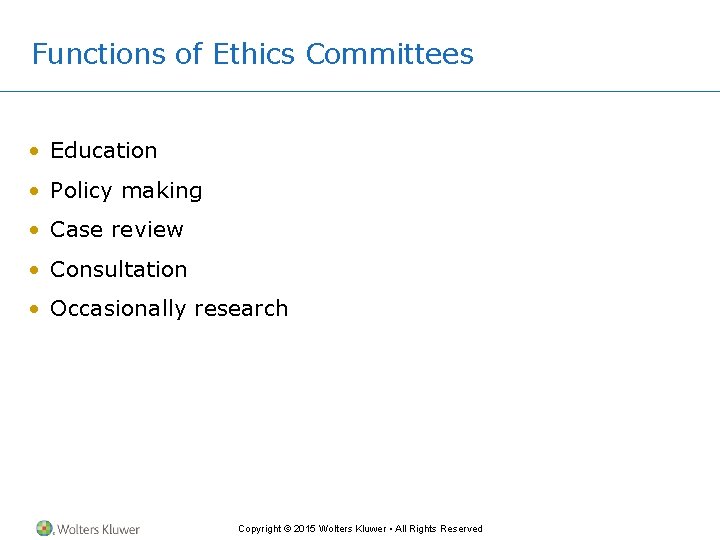
Functions of Ethics Committees • Education • Policy making • Case review • Consultation • Occasionally research Copyright © 2015 Wolters Kluwer • All Rights Reserved
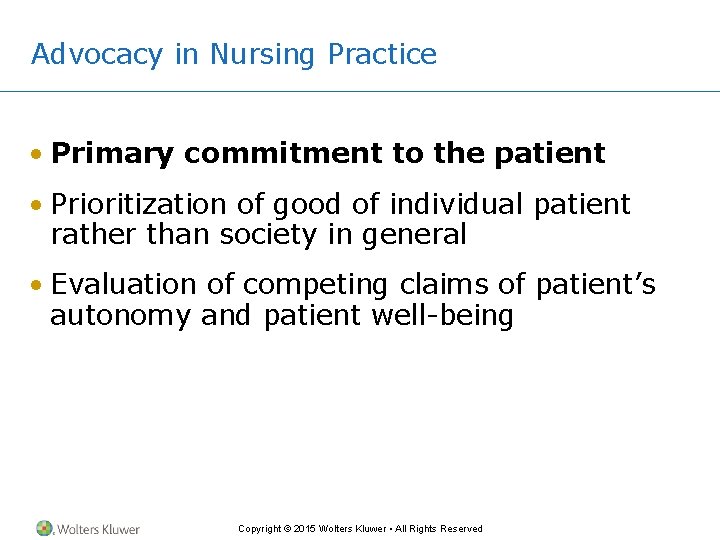
Advocacy in Nursing Practice • Primary commitment to the patient • Prioritization of good of individual patient rather than society in general • Evaluation of competing claims of patient’s autonomy and patient well-being Copyright © 2015 Wolters Kluwer • All Rights Reserved
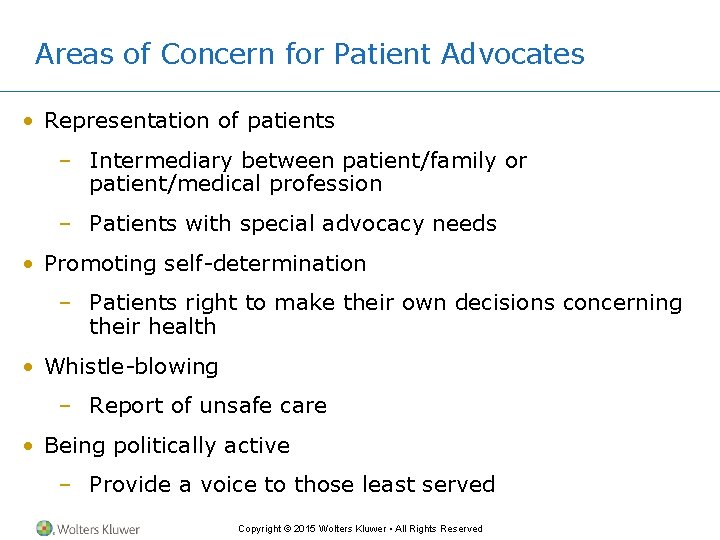
Areas of Concern for Patient Advocates • Representation of patients – Intermediary between patient/family or patient/medical profession – Patients with special advocacy needs • Promoting self-determination – Patients right to make their own decisions concerning their health • Whistle-blowing – Report of unsafe care • Being politically active – Provide a voice to those least served Copyright © 2015 Wolters Kluwer • All Rights Reserved